
EECE 320 Lecture 6, Fall 2011
American University of Beirut · Digital Systems Design · 8 pages · Prof. Ali Chehab
More EECE 320 files
Show the text of this lab
EECE 320 L6: Combinational Logic design Principles 1
Chehab, AUB, 2003
EECE 320
Digital Systems Design
Lecture 6:
Combinational Logic Design
Principles
Ali Chehab
EECE 320 L6: Combinational Logic design Principles 2
Chehab, AUB, 2003
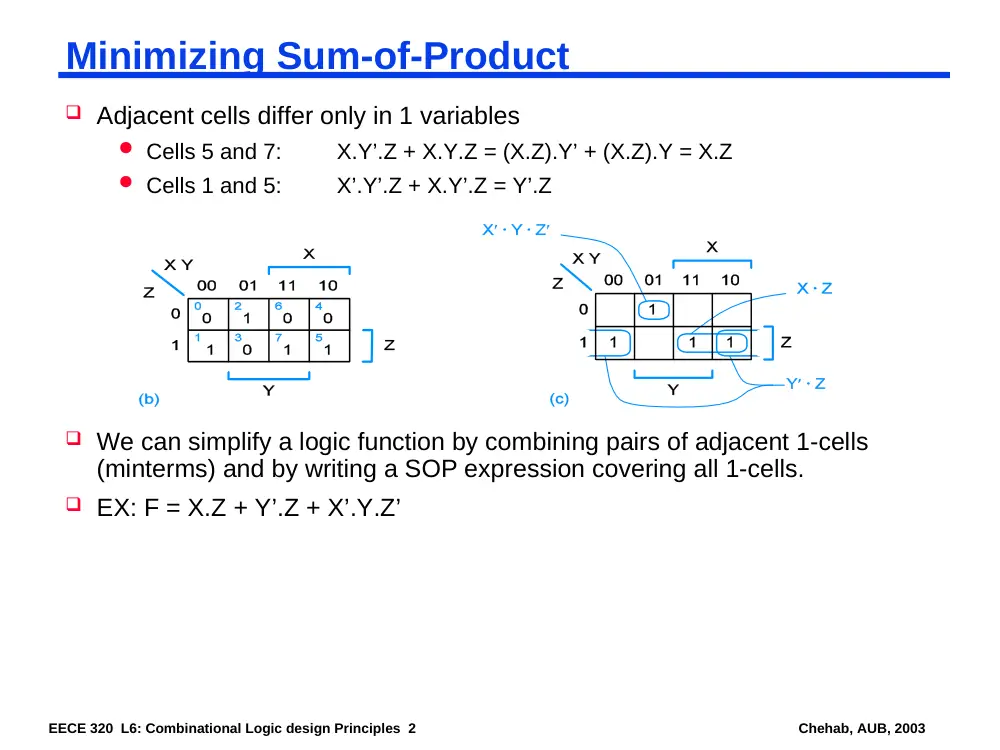
Minimizing Sum-of-Product
Adjacent cells differ only in 1 variables
Cells 5 and 7: X.Y’.Z + X.Y.Z = (X.Z).Y’ + (X.Z).Y = X.Z
Cells 1 and 5: X’.Y’.Z + X.Y’.Z = Y’.Z
We can simplify a logic function by combining pairs of adjacent 1-cells
(minterms) and by writing a SOP expression covering all 1-cells.
EX: F = X.Z + Y’.Z + X’.Y.Z’
EECE 320 L6: Combinational Logic design Principles 3
Chehab, AUB, 2003
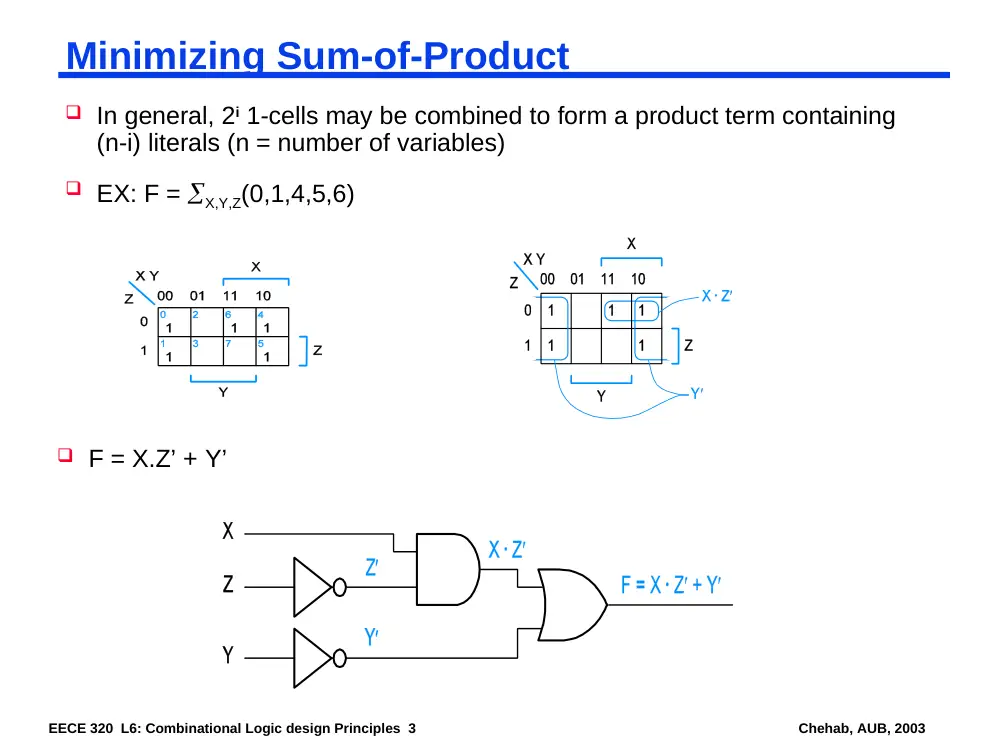
Minimizing Sum-of-Product
In general, 2i 1-cells may be combined to form a product term containing
(n-i) literals (n = number of variables)
EX: F = X,Y,Z(0,1,4,5,6)
F = X.Z’ + Y’
EECE 320 L6: Combinational Logic design Principles 4
Chehab, AUB, 2003
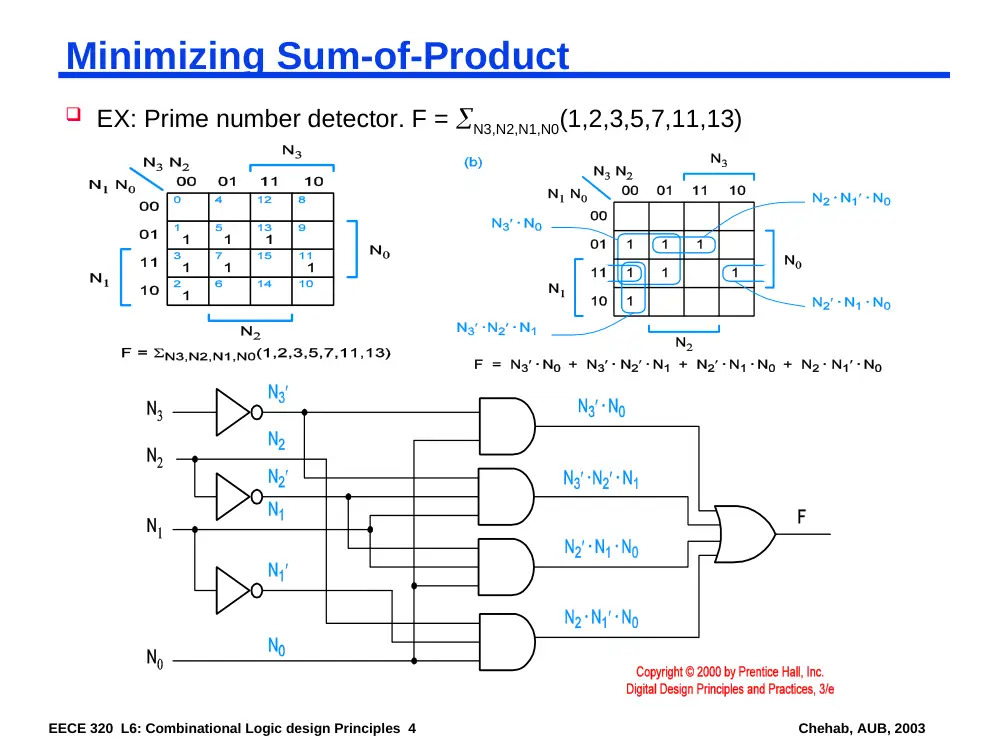
Minimizing Sum-of-Product
EX: Prime number detector. F = N3,N2,N1,N0(1,2,3,5,7,11,13)
EECE 320 L6: Combinational Logic design Principles 5
Chehab, AUB, 2003
Minimizing Sum-of-Product
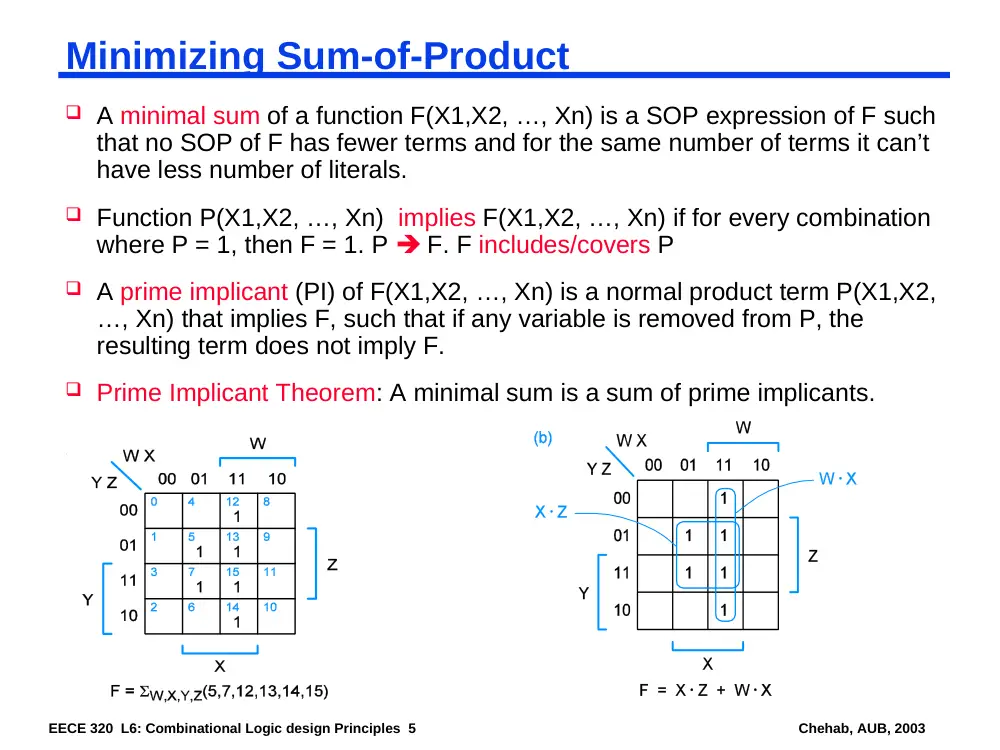
A minimal sum of a function F(X1,X2, …, Xn) is a SOP expression of F such
that no SOP of F has fewer terms and for the same number of terms it can’t
have less number of literals.
Function P(X1,X2, …, Xn) implies F(X1,X2, …, Xn) if for every combination
where P = 1, then F = 1. P F. F includes/covers P
A prime implicant (PI) of F(X1,X2, …, Xn) is a normal product term P(X1,X2,
…, Xn) that implies F, such that if any variable is removed from P, the
resulting term does not imply F.
Prime Implicant Theorem: A minimal sum is a sum of prime implicants.
EECE 320 L6: Combinational Logic design Principles 6
Chehab, AUB, 2003
Minimizing Sum-of-Product
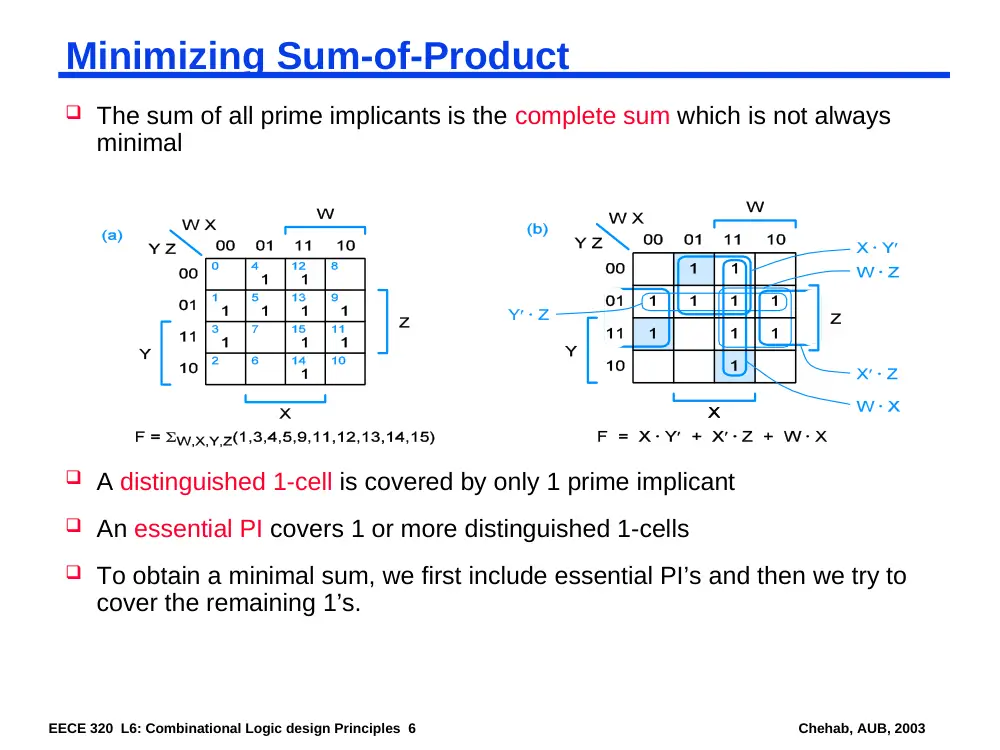
The sum of all prime implicants is the complete sum which is not always
minimal
A distinguished 1-cell is covered by only 1 prime implicant
An essential PI covers 1 or more distinguished 1-cells
To obtain a minimal sum, we first include essential PI’s and then we try to
cover the remaining 1’s.
EECE 320 L6: Combinational Logic design Principles 7
Chehab, AUB, 2003
Minimizing Sum-of-Product
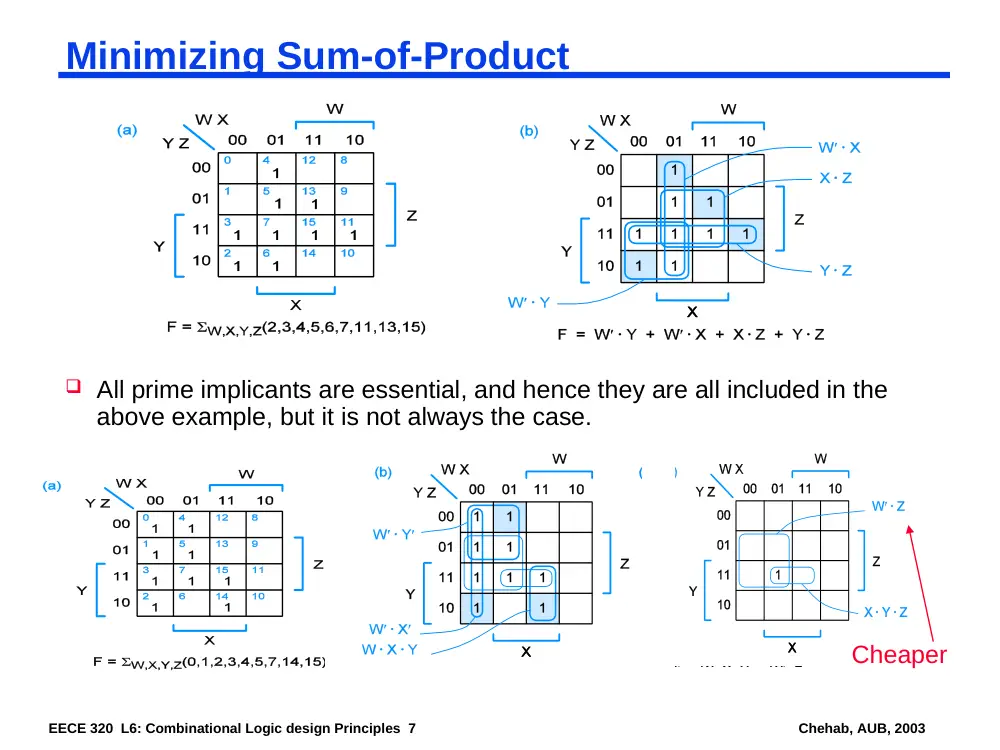
All prime implicants are essential, and hence they are all included in the
above example, but it is not always the case.
Cheaper
EECE 320 L6: Combinational Logic design Principles 8
Chehab, AUB, 2003
Next Lecture and Reminders
Next lecture
Reminders