
EECE 320 Lecture 7, Fall 2011
American University of Beirut · Digital Systems Design · 9 pages · Prof. Ali Chehab


More EECE 320 files
Show the text of this lab
EECE 320 L7: Combinational Logic design Principles 1
Chehab, AUB, 2003
EECE 320
Digital Systems Design
Lecture 7:
Combinational Logic Design
Principles
Ali Chehab
EECE 320 L7: Combinational Logic design Principles 2
Chehab, AUB, 2003
Minimizing Sum-of-Product
Given 2 PI’s P and Q in a reduced map, we say that P eclipses Q (P…Q) if
P covers at least all 1’s that are covered by Q
If P costs no more than Q, we can disregard Q.
EECE 320 L7: Combinational Logic design Principles 3
Chehab, AUB, 2003
Minimizing Sum-of-Product
Sometimes, there are no essential prime implicants, and we may have to
resort to trial and error.
EECE 320 L7: Combinational Logic design Principles 4
Chehab, AUB, 2003
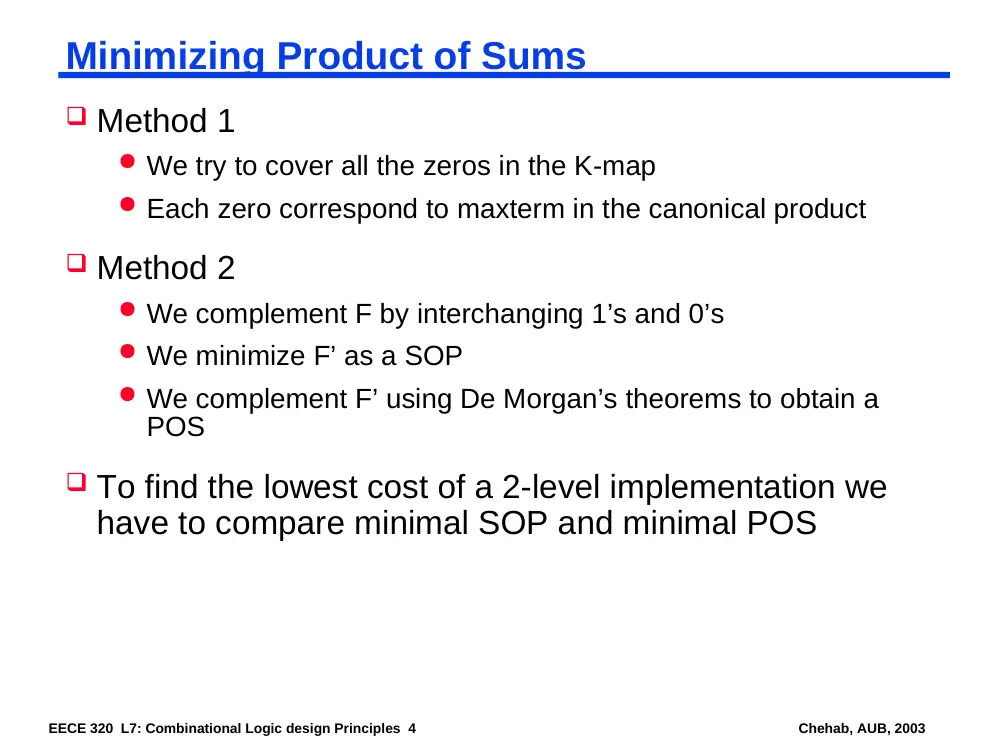
Minimizing Product of Sums
Method 1
We try to cover all the zeros in the K-map
Each zero correspond to maxterm in the canonical product
Method 2
We complement F by interchanging 1’s and 0’s
We minimize F’ as a SOP
We complement F’ using De Morgan’s theorems to obtain a
POS
To find the lowest cost of a 2-level implementation we
have to compare minimal SOP and minimal POS
EECE 320 L7: Combinational Logic design Principles 5
Chehab, AUB, 2003
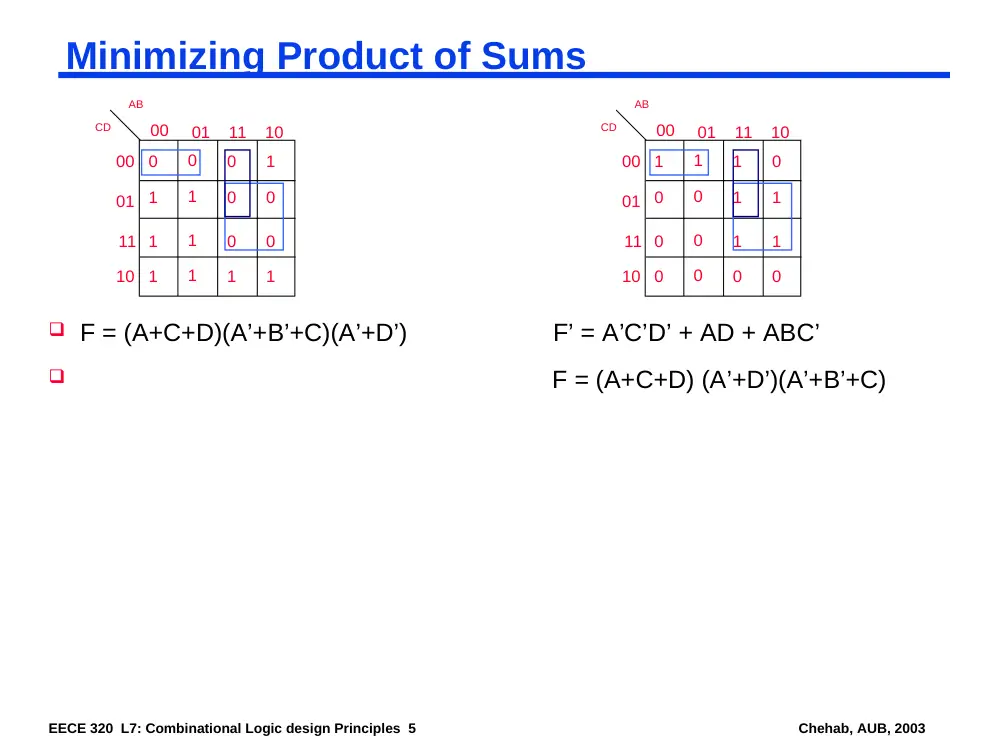
Minimizing Product of Sums
F = (A+C+D)(A’+B’+C)(A’+D’) F’ = A’C’D’ + AD + ABC’
F = (A+C+D) (A’+D’)(A’+B’+C)
CD
AB
00
01
11
10
00
01
11
10
1
0
0
1
1
1
1
1
1
0
0
1
0
0
1
0
CD
AB
00
01
11
10
00
01
11
10
0
1
1
0
0
0
0
0
0
1
1
0
1
1
0
1
EECE 320 L7: Combinational Logic design Principles 6
Chehab, AUB, 2003
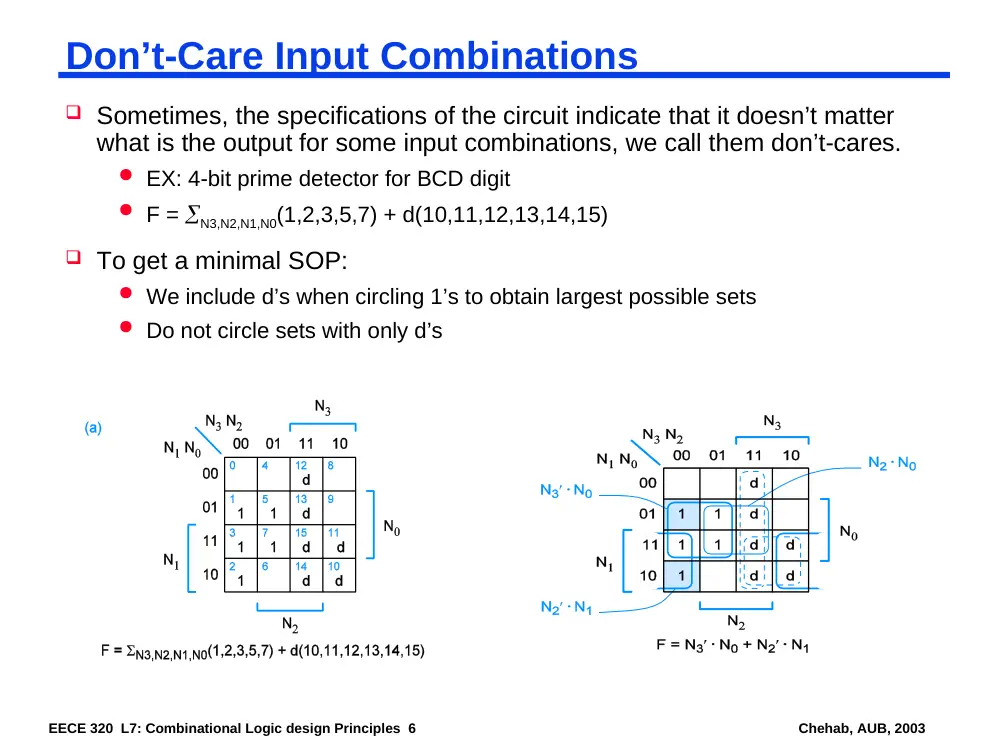
Don’t-Care Input Combinations
Sometimes, the specifications of the circuit indicate that it doesn’t matter
what is the output for some input combinations, we call them don’t-cares.
EX: 4-bit prime detector for BCD digit
F = N3,N2,N1,N0(1,2,3,5,7) + d(10,11,12,13,14,15)
To get a minimal SOP:
We include d’s when circling 1’s to obtain largest possible sets
Do not circle sets with only d’s
EECE 320 L7: Combinational Logic design Principles 7
Chehab, AUB, 2003
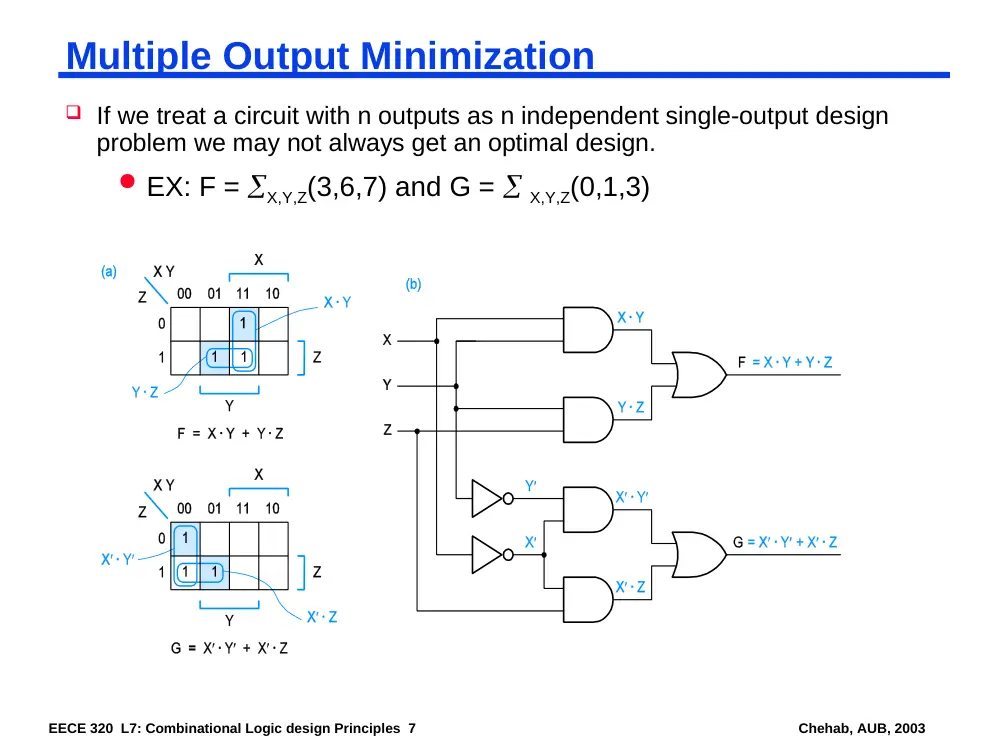
Multiple Output Minimization
If we treat a circuit with n outputs as n independent single-output design
problem we may not always get an optimal design.
EX: F = X,Y,Z(3,6,7) and G = X,Y,Z(0,1,3)
EECE 320 L7: Combinational Logic design Principles 8
Chehab, AUB, 2003
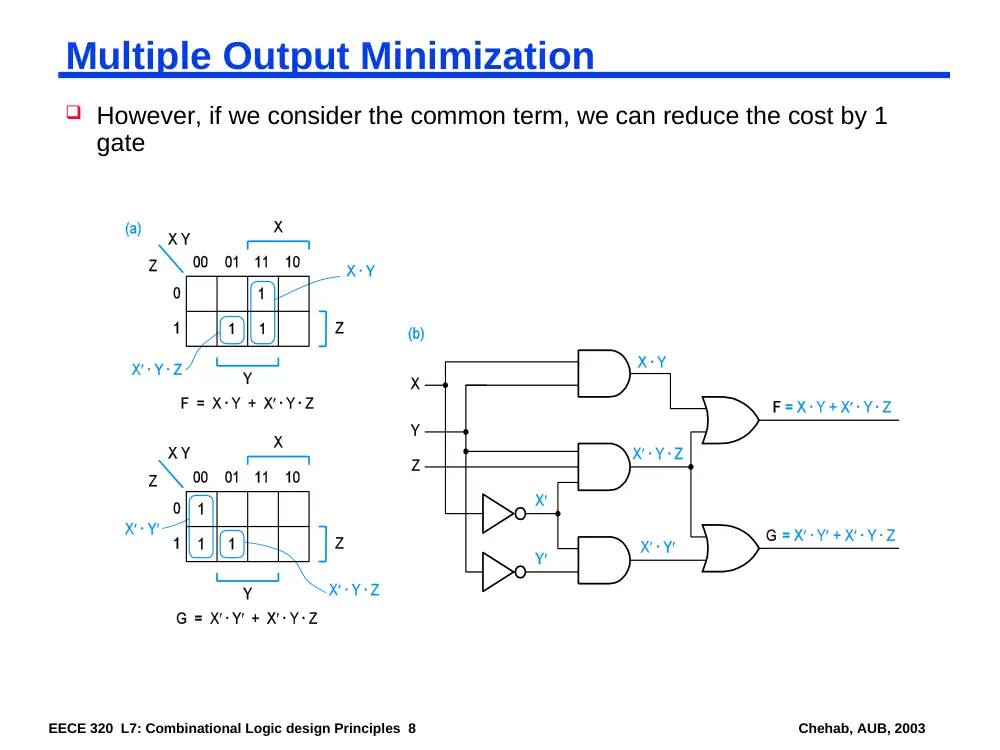
Multiple Output Minimization
However, if we consider the common term, we can reduce the cost by 1
gate
EECE 320 L7: Combinational Logic design Principles 9
Chehab, AUB, 2003
Next Lecture and Reminders
Next lecture
Reminders