
EECE 340 Exam 2, Fall 2005
American University of Beirut · Signals and Systems · 7 pages


More EECE 340 files
Show the text of this exam
EECE 440-Quiz II , Solution
1/7
AMERICAN UNIVERSITY OF BEIRUT
ELECTRICAL AND COMPUTER ENGINEERING DEPARTMENT
___________________________________________________________
EECE 440 SIGNALS AND SYSTEMS Spring 2004-2005
Prof. Kabalan QUIZ II May 6, 2005
__________________________________________________________
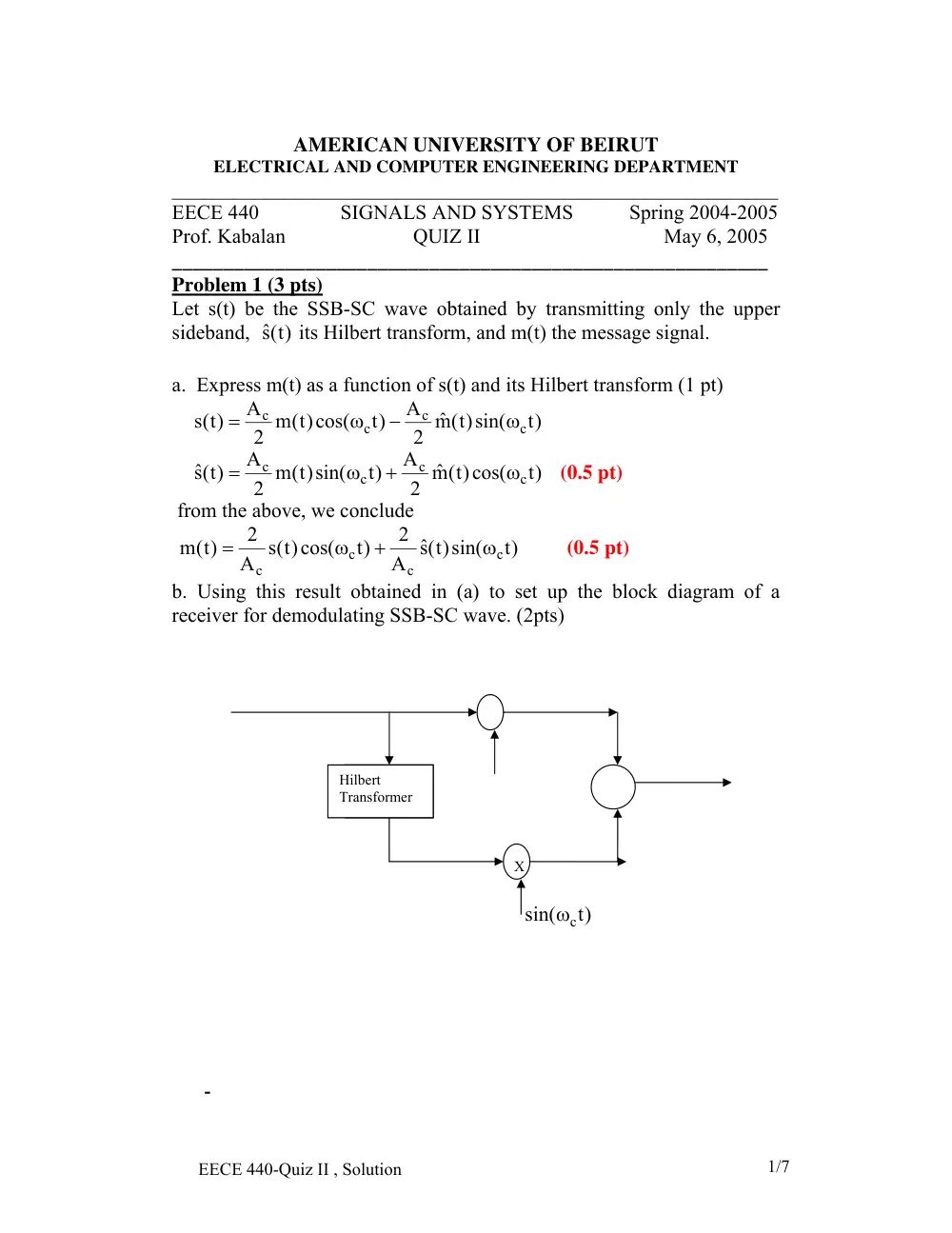
Problem 1 (3 pts)
Let s(t) be the SSB-SC wave obtained by transmitting only the upper
sideband,
)t(sˆ
its Hilbert transform, and m(t) the message signal.
a. Express m(t) as a function of s(t) and its Hilbert transform (1 pt)
)t
sin(
)t(
2 mˆ
A
)t
cos(
2 m )t(
A
)t(s
c
c
c
c
ω
−
ω
=
)t
cos(
)t(
2 mˆ
A
)t
sin(
2 m )t(
A
)t(sˆ
c
c
c
c
ω
+
ω
=
(0.5 pt)
from the above, we conclude
)t
sin(
)t(sˆ
A
2
)t
cos(
)t(s
A
2
)t(
m
c
c
c
c
ω
+
ω
=
(0.5 pt)
b. Using this result obtained in (a) to set up the block diagram of a
receiver for demodulating SSB-SC wave. (2pts)
Hilbert
Transformer
X
)t
sin(
c
ω
EECE 440-Quiz II , Solution
2/7
Problem 2 (2 pts)
Find the instantaneous frequency of the FM signal
[
])
sin(10 )t sin(30t
10 cos(10 )t cos(30t )
)t(s
2
2 −
=
Solution
t( ))
10cos(
30t )
10cos(10t
)t(s
i
2
θ
=
+
=
0.5 pt
60t
10
dt
)t(
d
)t(
i
i
+
=
θ
=
ω
rad/s 1.5 pts
Problem 3 (3 pts)
A sinusoidal carrier is frequency modulated by a 4 KHz sinusoid wave
resulting in an FM signal having a maximum frequency of 107.41 MHz
and a minimum frequency of 107.196 MHz.
a. Determine the carrier frequency. (1 pt)
107.303
2
107.41 107.196
2
f
f
f
Min
Max
c
=
+
=
+
=
MHz
b. Determine the number of impulses in the spectrum of s(t) within its
bandwidth. (2 pts)
Number of impulses on each side of the carrier= 107/4 = 26.75
Total number of impulses+ 26+26+1 = 53 impulses
Problem 4 (3 pts)
An FM modulator has a carrier frequency of 1 MHz and a frequency
sensitivity
1-
f
5 (Vsec)
k
=
. The modulator has input
)t
4cos(20
m )t(
π
=
Volts. What is the modulation index?
Solution
2
f
a
k
m
f m
=
β =
using different scale, -1 pt
EECE 440-Quiz II , Solution
3/7
Problem 5 (3 pts)
Consider the FM signal obtained from
m t( ) =
≤
≤
⎧
⎨
⎩
⎫
⎬
⎭
1 V
0
t
T = 100 s
0
elsewhere
µ
Let the bandwidth of m(t) be defined by the first crossing of M(ω) with
the ω axis. Determine the frequency sensitivity of the FM modulator if
the transmission bandwidth is set at 180Khz. The bandwidth
computation is to be based on the Carson’s rule.
Solution
⎥⎦
⎤
⎢⎣
⎡
−
ω
ω = −
ω −
1
e
j
1
M( )
j 10 4
The first crossing takes place when
− ω = π
2
10 4
, that is
The bandwidth of the signal m(t) = 10 KHz (2 pts)
80KHz
2 f
f)
2(B
BT
⇒ ∆ =
+ ∆
=
∆f = amkf
⇒
kf = 80
KHz/V because
1
am = Volt.
Problem 6 (3 pts)
Consider a single tone FM signal with amplitude 10 Volts, frequency 5
KHz, and modulation index
β = .2
Determine the ratio of the average
power of the frequency components of this FM signal contained within its
bandwidth to the total signal average power. Use Carson’s rule for
bandwidth computation.
1. Total Power = 2
A2
c Watts (1 pt)
2. The transmission bandwidth of this FM signal=
)
1(
f
2 m
+ β
= 30
KHz 1 pt
3. Power with the bandwidth=
[
2J (2 ])
2J (2)
2J (2)
2 J (2)
A
2
3
2
2
2
1
2
0
2
c
+
+
+
1 pt
4. Ratio ≈1
EECE 440-Quiz II , Solution
4/7
Problem 7 (3 pts)
Consider the signal
cos( .0 125 n)
x[n]
π
=
. Determine whether or not x[n] is
periodic. If so, determine the number of samples per fundamental
frequency.
x[n] is periodic with a period N=16
Problem 8 (4 pts)
The input-output of a discrete-time system is given by:
(
2 )]
cos x[n
[y n]
+
=
a. Is this system linear? Justify your answer
No, because cos(ax[n+2])≠ acos(x[n+2])
b. Is this system time invariant? Justify your answer.
Yes, because
n ]
[y n
n ]
x[n
0
0
−
→
−
Problem 9 (4 pts)
The input-output of a discrete-time system is given by:
y[n]=0.8 x[n+1] + 0.5 x[n]
a. Determine the system impulse response.
[n]
5.0
]1
[n
8.0
h[n]
δ
+
+
δ
=
b. Is this system causal? Justify your answer.
No, because
h[n] ≠
0 for n<0.
Problem 10 (4 pts)
The signal
u )t(
e
)t(
x
= −2t
is sampled every 0.5 seconds.
a.
Represent the sampled signal as a sequence x[n]. (2 pts)
u[n]
e
x[n]
= −n
b.
Find the z-transform X(z) of x[n]. (2 pts)
e 1z 1
1
1
X(z)
−
− −
=
with ROC
e
z > 1
(-1 for no ROC)
EECE 440-Quiz II , Solution
5/7
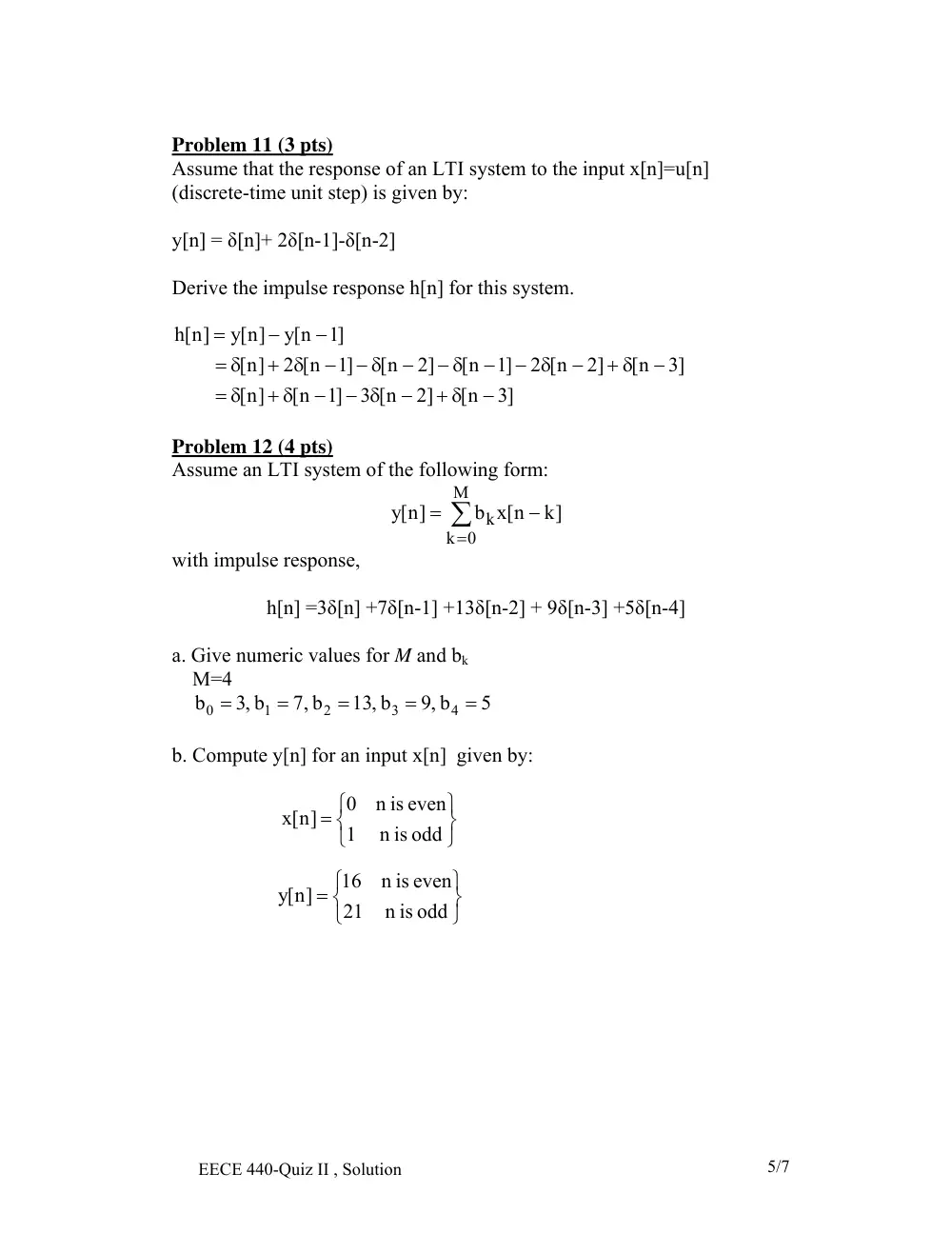
Problem 11 (3 pts)
Assume that the response of an LTI system to the input x[n]=u[n]
(discrete-time unit step) is given by:
y[n] = δ[n]+ 2δ[n-1]-δ[n-2]
Derive the impulse response h[n] for this system.
3]
[n
2]
3 [n
]1
[n
[n]
3]
[n
2]
2 [n
]1
[n
2]
[n
]1
2 [n
[n]
]1
[y n
[y n]
[n]
h
−
+ δ
−
− δ
−
+ δ
δ
=
−
+ δ
−
− δ
−
− δ
−
− δ
−
+ δ
δ
=
−
−
=
Problem 12 (4 pts)
Assume an LTI system of the following form:
∑
=
−
=
M
k 0
k
k]
b x[n
[y n]
with impulse response,
h[n] =3δ[n] +7δ[n-1] +13δ[n-2] + 9δ[n-3] +5δ[n-4]
a. Give numeric values for M and bk
M=4
5
b ,9
13 b ,
b ,7
b ,3
b
4
3
2
1
0
=
=
=
=
=
b. Compute y[n] for an input x[n] given by:
⎭
⎬
⎫
⎩
⎨
= ⎧
n is odd
1
n is even
0
x[n]
⎭
⎬
⎫
⎩
⎨
= ⎧
n is odd
21
n is even
16
[y n]
EECE 440-Quiz II , Solution
6/7
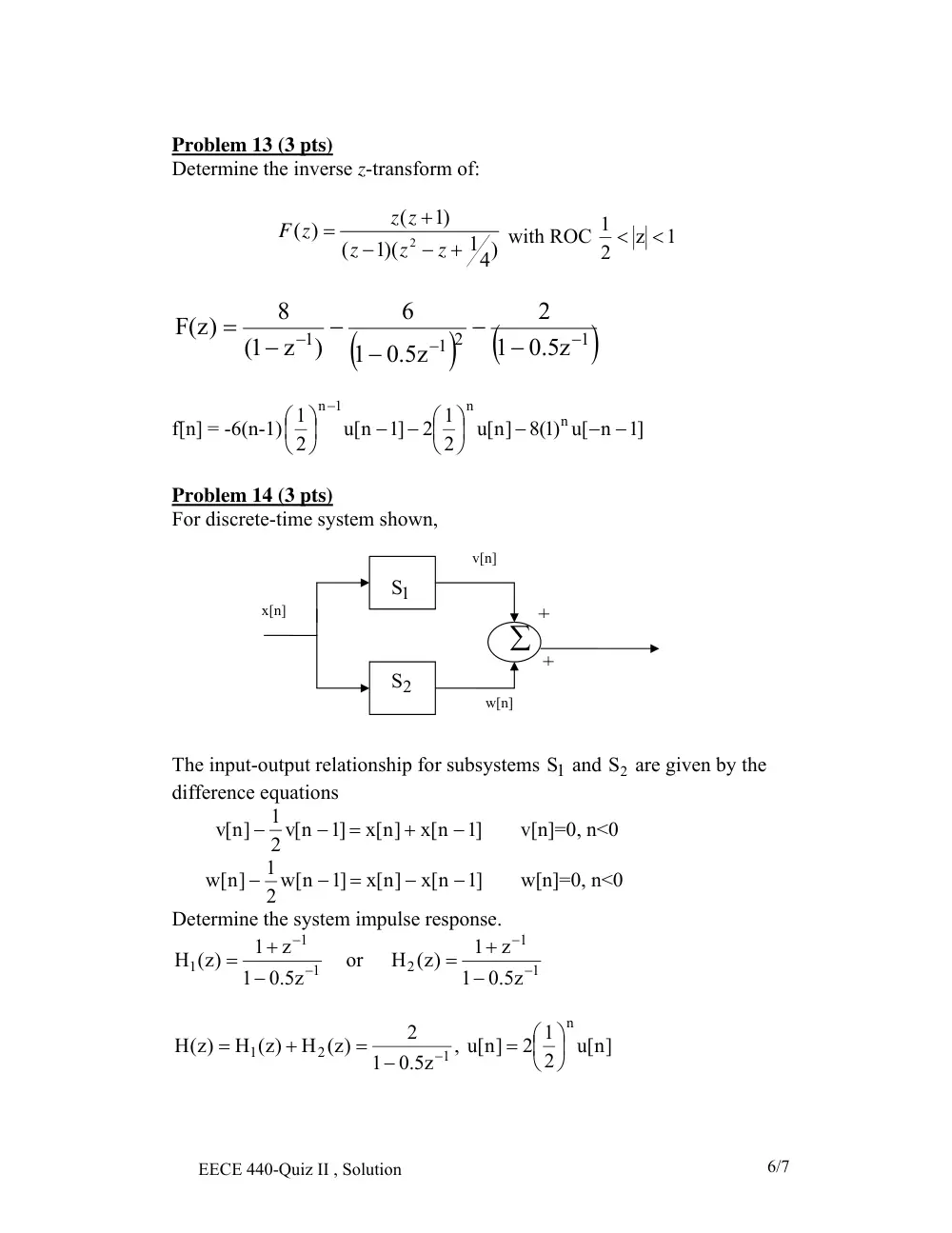
Problem 13 (3 pts)
Determine the inverse z-transform of:
14)
1)(
(
)1
(
)
(
2
+
−
−
+
=
z
z
z
z z
F z
with ROC
1
z
2
1
<
<
(
)
(
1)
1 2
1
5.0 z
1
2
5.0 z
1
6
)
z
1(
8
F(z)
−
−
−
−
−
−
−
−
=
f[n] = -6(n-1)
]1
u[ n
8 )1(
u[n]
2
2 1
]1
u[n
2
1
n
n
n 1
− −
−
⎟⎠
⎞
⎜⎝
− ⎛
−
⎟⎠
⎞
⎜⎝
⎛
−
Problem 14 (3 pts)
For discrete-time system shown,
The input-output relationship for subsystems 1
S and
2
S are given by the
difference equations
]1
x[n
x[n]
]1
2 [v n
1
[v n]
−
+
=
−
−
v[n]=0, n<0
]1
x[n
x[n]
]1
2 w[n
1
w[n]
−
−
=
−
−
w[n]=0, n<0
Determine the system impulse response.
1
1
1
5.0 z
1
z
1
z( )
H
−
−
−
+
=
or
1
1
2
5.0 z
1
z
1
H (z)
−
−
−
+
=
1
2
1
5.0 z
1
2
z( )
H
H (z)
H( )z
−
−
=
+
=
,
u[n]
2
2 1
[n]
u
n
⎟⎠
⎞
⎜⎝
= ⎛
1
S
2
S
+
+
x[n]
v[n]
w[n]
∑
EECE 440-Quiz II , Solution
7/7
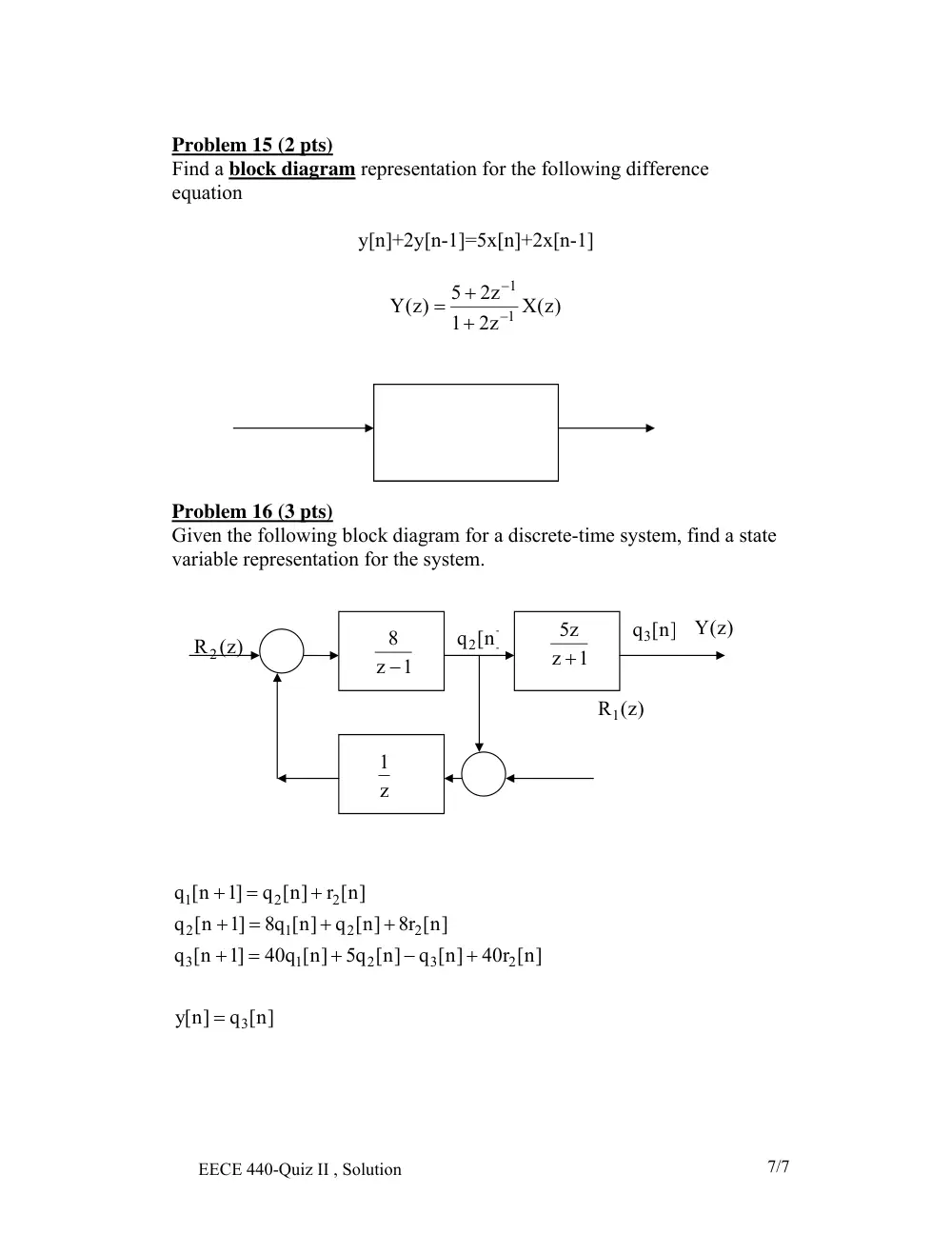
Problem 15 (2 pts)
Find a block diagram representation for the following difference
equation
y[n]+2y[n-1]=5x[n]+2x[n-1]
X(z)
2z
1
2z
5
Y(z)
1
1
−
−
+
+
=
Problem 16 (3 pts)
Given the following block diagram for a discrete-time system, find a state
variable representation for the system.
q [n]
n]
[y
40r [n]
q [n]
5q [n]
40q [n]
]1
[n
q
8r [n]
q [n]
8q [n]
]1
[n
q
r [n]
q [n]
]1
[n
q
3
2
3
2
1
3
2
2
1
2
2
2
1
=
+
−
+
=
+
+
+
=
+
+
=
+
1
z
8
−
1
z
5z
+
z
1
Y(z)
(z)
R1
R2 (z)
q2[n]
[n]
q3