
EECE 340 Final, Spring 2010
American University of Beirut · Signals and Systems · 8 pages · Prof. Karim Kabalan


More EECE 340 files
Show the text of this final exam
EECE 340 — Signals & Systems FINAL EXAM PAGE 1 OF 8
Spring 2009
AMERICAN UNIVERSITY OF BEIRUT
FACULTY OF ENGINEERING AND ARCHITECTURE
ELECTRICAL AND COMPUTER ENGINEERING DEPARTMENT
EECE 340 — Signals & Systems
FINAL EXAM-Spring 2009
Open book
TIME: 2 HOURS
Wednesday, June 10, 2009
INSTRUCTORS: K. Kabalan, J. Saade, F. Karameh
NAME : ID#:
INSTRUCTIONS
> Write your Name and ID # on this sheet, the computer card and the scratch
booklet in the provided spaces.
> Provide your answer on the computer card and solution of each problem on
the scratch booklet.
> Return the computer card, this question sheet and the scratch booklet when
you finish the test.
Only your answers on the computer card will be graded.
All questions are equally weighted in grading.
Vv
PROBLEM # 1
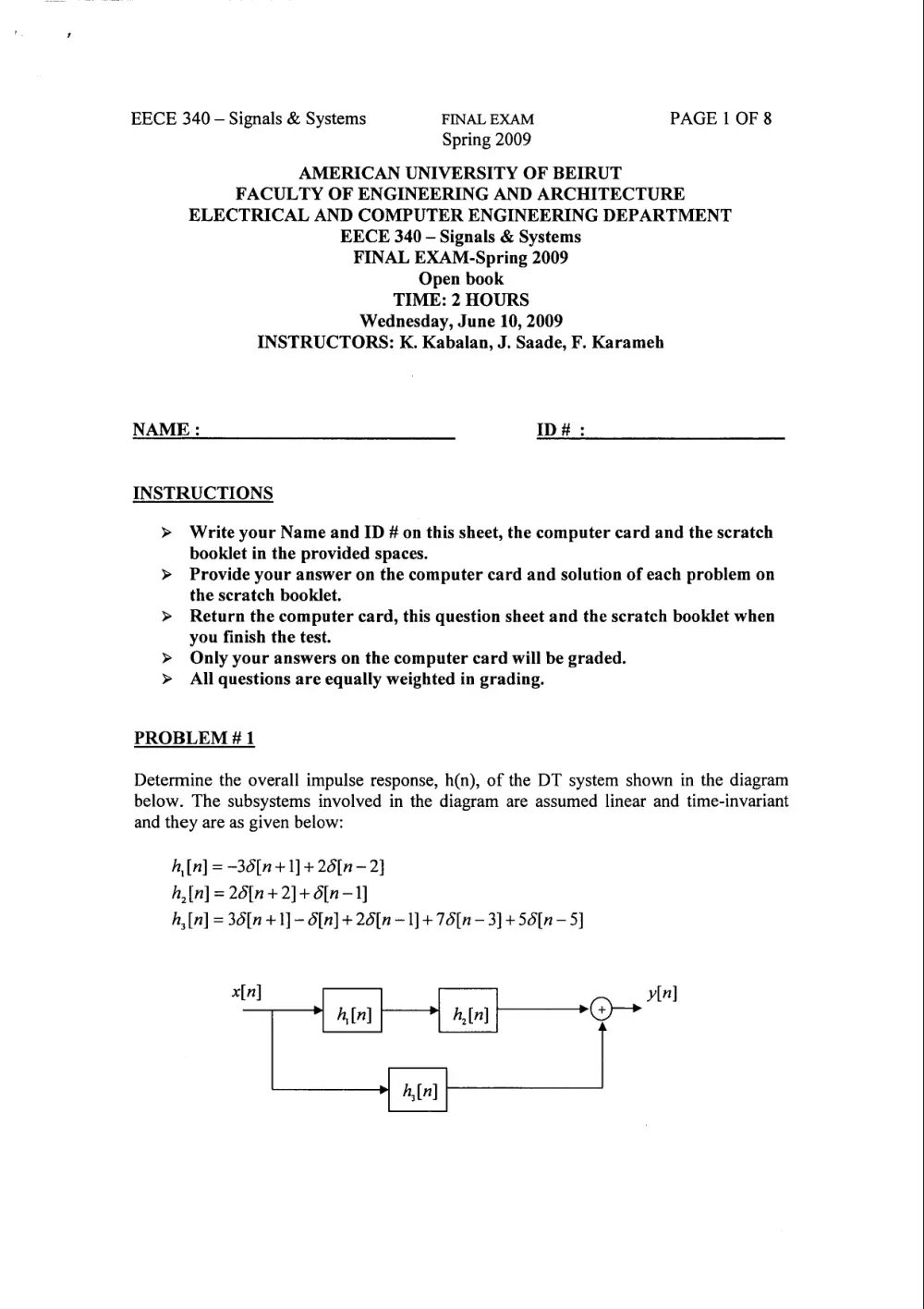
Determine the overall impulse response, h(n), of the DT system shown in the diagram
below. The subsystems involved in the diagram are assumed linear and time-invariant
and they are as given below:
h [n] = -36[n +1] + 25[n—2]
h,[n] = 26[n + 2]+6[n-1]
h,{n] = 36[n +1] - 5[n] + 25[n — 1] +76[n - 3] + 56[n - 5]
x[n]
[n]
v|
rte || lal >
>] An]
EECE 340 — Signals & Systems FINAL EXAM PAGE 2 OF 8
Spring 2009
(a) h(n)=-65(n+3)+38(n+1)+26(n-1)+98(n-3)+56(n-5)
(b) h(n)=-68(n+3)+28(n+1)+28(n-1)+85(n-3)+58(n-5)
(c) h(n)=-66(n+3)+38(n+ 1)+8(n-1)+98(n-3)+8(n-5)
(d) h(n)=-58(n+3)+36(n+ 1)+26(n-1)+66(n-3)+58(n-5)
(e) None of the above.
PROBLEM # 2
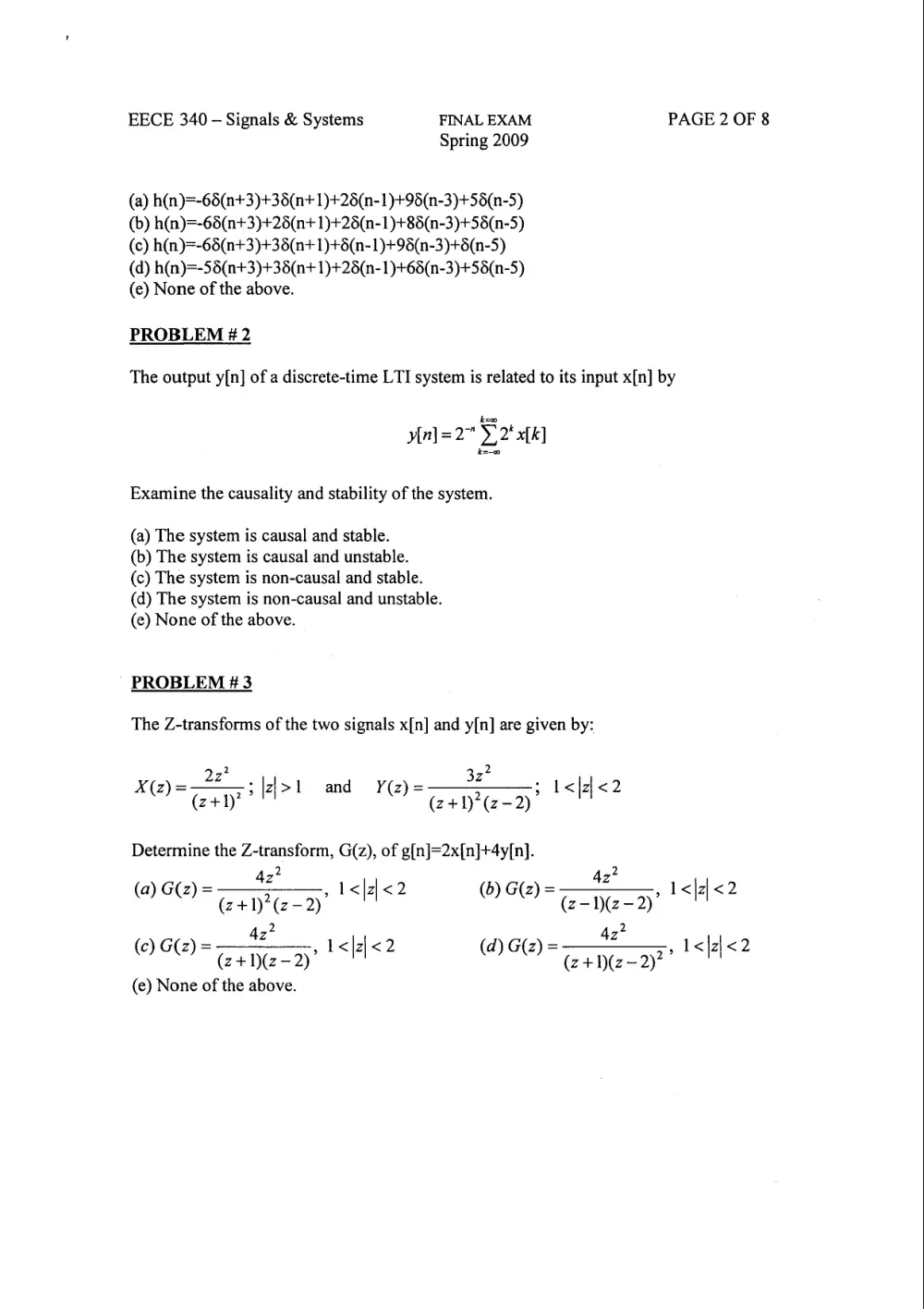
The output y[n] of a discrete-time LTI system is related to its input x[n] by
k=
yn] =2" p> 2‘ x[k]
Examine the causality and stability of the system.
(a) The system is causal and stable.
(b) The system is causal and unstable.
(c) The system is non-causal and stable.
(d) The system is non-causal and unstable.
(e) None of the above.
PROBLEM # 3
The Z-transforms of the two signals x[n] and y[n] are given by:
32?
(z+1)?(z-2)
22”
(z+lP
X(z)= s|zl>1 and ¥(z)= 5 1<|e<2
Determine the Z-transform, G(z), of g[nJ=2x[n]+4y[n].
_ 42? _ 42?
(2) 6@) = igen’ 1<|z|<2 6) G@)= Ta GaD’ 1<|z| <2
42? 42?
)G@)= To yG7n’ 1<|z|<2 (d) C= ena?’ 1<|z|<2
(e) None of the above.
EECE 340 — Signals & Systems FINAL EXAM PAGE 3 OF 8
Spring 2009
PROBLEM #4
Consider the discrete-time LTI system with transfer function given by
_ -l
H(z)-—122_ |2|>
(z-1)(z +2)
Determine the impulse response, heq(n), of the new system formed by cascading H(z)
with a second LTI system of impulse response h,[n] = 6[n]-6[n-1].
(a) heq(n)=8(n-2)-(-2)"*u(n-3)
(b) heq(n)=8(n+2)-(-2)"'u(n-3)
(c) heq(n)=6(n-2)-(-2)""u(n-3)
(d) heq(n)=8(n+2)-(-2)"u(n-3)
(e) None of the above.
PROBLEM #5
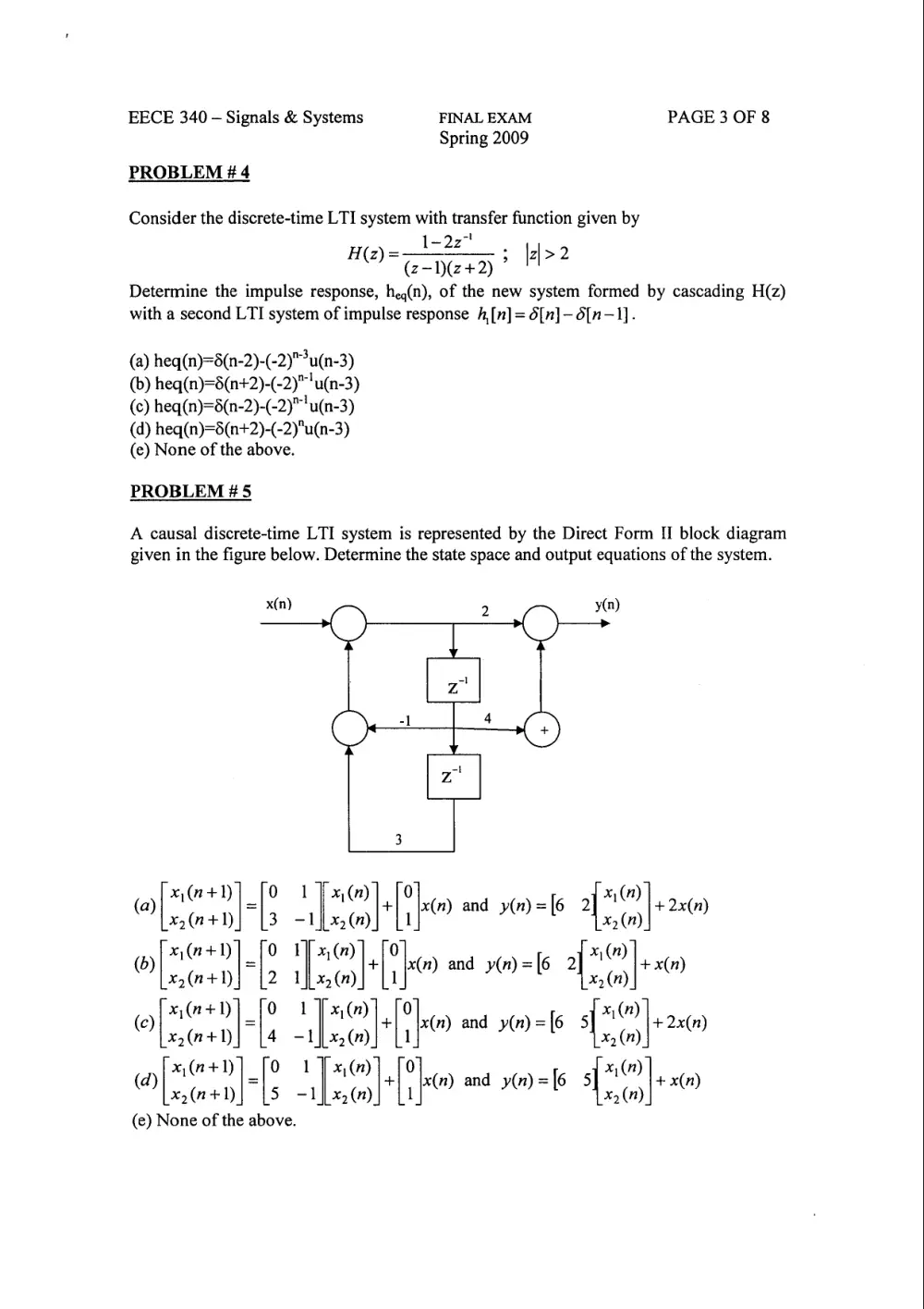
A causal discrete-time LTI system is represented by the Direct Form II block diagram
given in the figure below. Determine the state space and output equations of the system.
—O
y(n)
>
a sr 57 729 5
cof] [2 8T 8) oor ant ve af6 af] eas
[2027] -[0 T]he an vr=F6 af]
° ane ee ibe and y(n) =[6 3] 0 [200m
afer ao PAO). Lc nd vere 38 racy
(e) None of the above.
EECE 340 — Signals & Systems FINAL EXAM PAGE 4 OF 8
Spring 2009
PROBLEM # 6
A Discrete-time causal signal, h[{n], has the following discrete-time Fourier transform
(DTFT). Determine h[n]. Hint: you may use the inverse Z-transform.
l+e”
HO) = Ose"
(a) h(n) = 8(n)+3(1/2)"u(n-1)
(b) h(n) = 8(n)+3(1/2)"u(n-1)
(c) h(n) = 8(n)+3(1/2)"'u(n-1)
(d) h(n) = 8(n)+3(1/2)"u(nt 1)
(e) None of the above.
PROBLEM #7
A LTI causal and stable discrete-time system is represented by the following difference
equation:
0.25 y[n-2] + y[n-1]+y[n] =x[n-2]
Determine the magnitude frequency response, |H (a), of the system.
1 1
() Ho) ~ 2cos@+2 ) (a ~ cos@+1/4
(©) zo) ~ 2cosa +1 HO) cos@+5/4
(e) None of the above.
PROBLEM # 8
Consider the following finite-duration discrete-time signal:
1
—, n=0,1,2,3
x(n) =44
0, elsewhere
Determine the 4-point DFT of x(n).
(a) X(0)=1, X(1)=X(2)=X(3)=1/2.
(b) X(0)=1, X(1)=X(2)=X(3)=2.
(c) X(0)=1, X(1)=X(2)=X(3)=4.
(d) X€0)=1, X(1)=X(2)=X(3)=5.
(e) None of the above.
EECE 340 — Signals & Systems FINAL EXAM PAGE 5 OF 8
Spring 2009
PROBLEM # 9
Consider the following 2 finite-duration discrete-time signals:
f(n) = 36(n) + 6(n—1) + 26(n— 2) - 6(n-3)
g(n) = 36(n) + 26(n—1)+5(n-2)
Let F(k) and G(k) be the 4-point DFT’s of f(n) and g(n) respectively. Determine the
discrete-time signal y(n) such that its 4-point DFT is given by the product of F(k) and
G(k); i.e., Y(K)=F(k)G(k). Note here that y(n) in this case is the circular convolution of
f(n) and g(n). Also, note that linear convolution with an impulse provides time shift.
(a) y(n)=98(n)+96(n-1)+118(n-2)+8(n-3)
(b) y(n)=98(n)+88(n-1)+118(n-2)+25(n-3)
(c) y(n)=76(n)+88(n-1)+96(n-2)+28(n-3)
(d) y(n)=98(n)+88(n-1)+58(n-2)+8(n-3)
(e) None of the above.
PROBLEM # 10
Consider the system depicted below where T=1. Let x(t)=cos(3at/2) and H(@) be-an ideal
LPF with bandwidth equal to x rad/s. Determine the output of the system denoted by y(t).
x() v)
> x >| Hw )) os
PO) =o 5(t-nT)
(a) y(t)}=cos(at/5) (b) y(t)=cos(zt/3)
(c) y(t)}=cos(at/2) (d) y(t)}=cos(at)
(e) None of the above.
EECE 340 — Signals & Systems FINAL EXAM PAGE 6 OF 8
Spring 2009
PROBLEM # 11
Consider two LTI discrete-time systems with the following unit sample responses:
h{n]= a2" af n] and hy|n]=5|n]—-3"" wn
Let h [n] be the impulse response of the system which is equivalent to the cascaded
connection of h,[n] and h,[n]. Determine whether h [n] is causal and stable.
(a) The equivalent system is non-causal and unstable.
(b) The equivalent system is causal and stable.
(c) The equivalent system is causal and unstable.
(d) The equivalent system is non-causal and stable.
(e) None of the above.
PROBLEM # 12
Consider the continuous-time LTI causal system shown in the figure below. Obtain the
overall transfer function of the system; i.e., H(s)=Y(s)/X(s), and then determine the range
of the real constant K for which the system is stable. Hint: To obtain H(s), obtain first the
transfer function of the inner loop; i.e., P(s)/E(s).
x() et) pi) wD)
) t 4 >| i m S+4 >
_ AY
K \
(a) K<-2 (b) K>-4 (c) K >-1/4 (d) K<-1/2
(e) None of the above.
EECE 340 - Signals & Systems FINAL EXAM PAGE 7 OF 8
Spring 2009
PROBLEM # 13
A signal x(t) is sampled through a non-ideal sampler using the periodic signal s(t) of
period T as shown in the figure below. The signal x(t) is assumed band-limited (also as
shown in the figure). Let s(t)}=s(t)-1 and determine s(t) first. Then obtain the Fourier
transform spectrum of s(t) using that of s)(t) and as a result obtain the spectrum of the
sampled signal, y(t). Determine the smallest possible value of the sampling rate (1/T) for
which there is NO ALIASING in the sampled signal. USE A=T/4 in all computations.
x(t) y(t)
-5000 x 5000 7
(a) The smallest sampling rate is 7500 samples/sec.
(b) The smallest sampling rate is 5000 samples/sec.
(c) The smallest sampling rate is 2500 samples/sec.
(d) The smallest sampling rate is 10000 samples/sec.
(e) None of the above.
PROBLEM # 14
Consider a discrete-time LTI system with unit sample response, h(n), given by:
h(n) = a" u(—n - 1) with lal <1.
Determine the unit-step response, y,(n), of the system using discrete-time convolution.
(a) y,,(n) = [ghee tn: | (6) y, (n) = = lau(n)+a" u(-n—- |
(c) y, (”) = _ [a u(n) +a" u(- -n-1)| (d) y,(n) = ——[au(ny + artu(- -n-1)|
(e) None of the above.
EECE 340 — Signals & Systems FINAL EXAM PAGE 8 OF 8
Spring 2009
PROBLEM # 15
Consider the following finite-length discrete-time signal:
x(n)=u(n)-u(n-6)
Qn,
Let the Z-transform of x(n) be sampled at z= e 8 ,k=0,1,2,...,7. The sampled Z-
transform represents the discrete Fourier series coefficients of a periodic discrete-time
signal, x(n). Determine X(n)R,(n), where R,(n)=1, for n=0, 1, 2, ..., 7 and 0,
elsewhere.
(a) x(n)R,(n) = u(n) -u(n-6) (b) X(m)R, (n) = u(n) - u(n-8)
(c) ¥(n)R, (n) = u(n - 1) —u(n—-6) (d) X(n)R,(n) = u(n) —u(n—5)
(e) None of the above.
PROBLEM # 16
Consider a causal, LTI and unstable discrete-time system with transfer function given by
H(z) =, |2|>2
(z-1)(z-2)
We want to transform this system to a stable one by multiplying its impulse response,
h(n), by a”. Determine the condition on lal that provides a system with impulse response
h,(n)=a"h(n) that is stable. Use the properties of the Z-transform.
(a) |a| <1/3 (6) |a| <1/4 (c) |al<2 (d) |a| <1/2
(e) None of the above.