
EECE 340 Final, Summer 2015
American University of Beirut · Signals and Systems · 7 pages · Dr. Ibrahim Abou Faycal

More EECE 340 files
Show the text of this final exam
EECE 340 Signals and Systems J July 28, 2015
American University of Beirut, Summer 2014-2015
Final Exam
Name:
ID:
Do not open this booklet until you are told to do so
@ You have 2 hours to complete the exam.
e There are 3 problems on this exam. The problems are not in order of difficulty.
Pleasé read fully the problems before starting.
e A correct answer does not guarantee full credit. Please indicate concisely but pre-
cisely your reasoning. All answers need to be justified, unless you are specifically
told otherwise,
e You may use FOUR double-sided “cheat-sheet” of size “Ad” of hand-written notes.
® Calculators are allowed.
® Cell-phones are not allowed. Please turn them off and put them aside or give them
to the staff to hold them for you until the end of the exam.
Problem F.1: (80 points)
The different parts of this problem are INDEPENDENT. Do any 4 of the 6 questions
from (a) through (f). Do all for extra credit. The remaining questions (g) through (m)
are all mandatory.
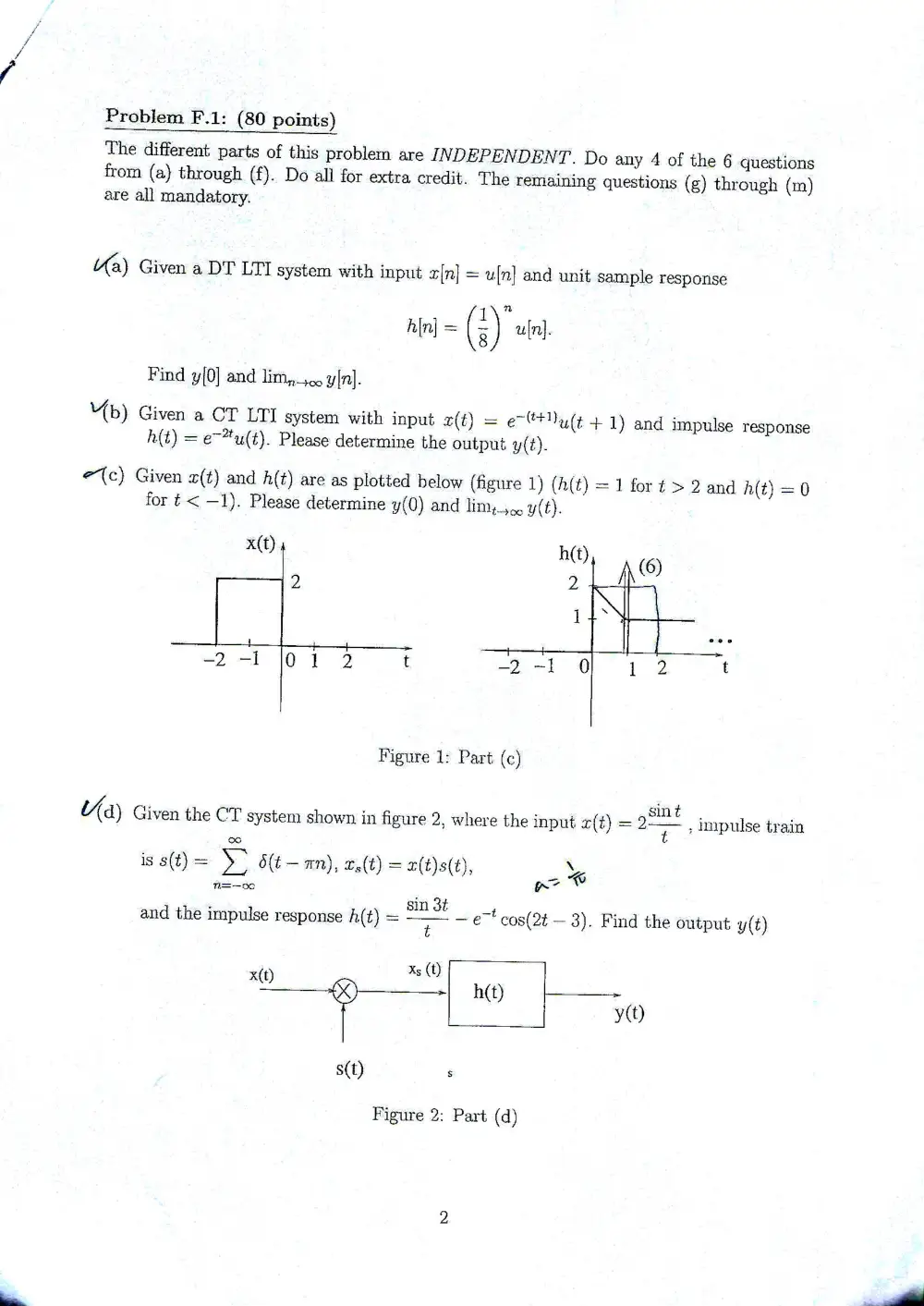
a) Given a DT LTT system with input «[n] = u{n] and unit sample response
1 n
Find y[0] and limy_,.. yln].
Vb) Given a CT LTI system with input x(t) = e~ u(t +1) and impulse response
h(t) = e~*'u(t). Please determine the output y(t).
@(c) Given x(t) and h(t) are as plotted below (figure 1) (h(t) = 1 fort > 2 and A(t) =0
for t < —1). Please determine y(0) and limy,.. y(t).
t
x(t) 4 h(t), (6)
2 24
z if
44 > —— ~
—2 -1 10 1 2 t —2 -1 0 1 2 t
Figure 1: Part (c)
int
Ka) Given the CT system shown in figure 2, where the input a(t) = — , Impulse train
is s(t) = 2 5(t — mn), x,(t) = 2(t)s(t), ae a
‘ sin 3¢ 4 ;
and the impulse response h(t) = - ae cos(2t — 3). Find the output y(t)
Xs (t)
~ -| hw
y(t)
s(t) s
Figure 2: Part (d)
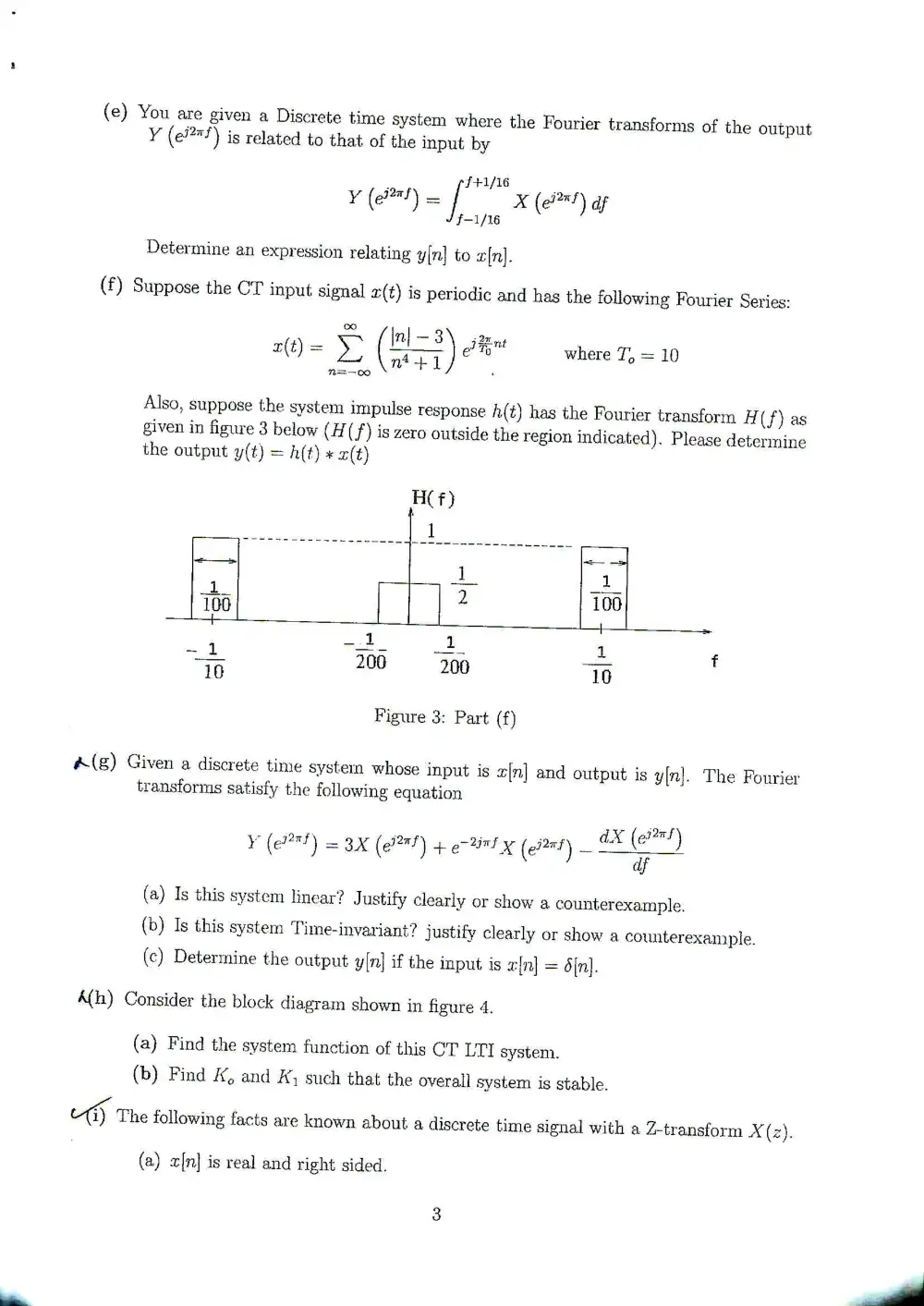
(e) You are given a Discrete time system where the Fourier transforms of the output
Y (e?) is related to that of the input by
; f+1/16 .
¥ (e*S) = | X (e*1) af
f-1/16
Determine an expression relating yln] to x[n).
(f) Suppose the CT input signal z(t) is periodic and has the following Fourier Series:
= | — 3 jen
n=—-CO
Also, suppose the system impulse res
given in figure 3 below (H(f)
the output y(t) = A(t) * x(t)
ponse /i(t) has the Fourier transform H (f) as
is zero outside the region indicated). Please determine
ACF)
en i
]
sie
100 .
~1 04
a 200 = “399 '
Figure 3: Part (f)
A(g) Given a discrete time system whose input is z[n]
and output is y(n]. The Fourier
transforms satisfy the following equation
5 ; . . AX (eff
¥ (eP™) = BX (PF) 4 eBLY (eit) ae
(a) Is this system Hnear? Justify clearly or show a counterexample.
(b) Is this system Time-invariant? justify clearly or show a counterexample.
c) Determine the output y/n] if the input is «[n] = d[n
y(n
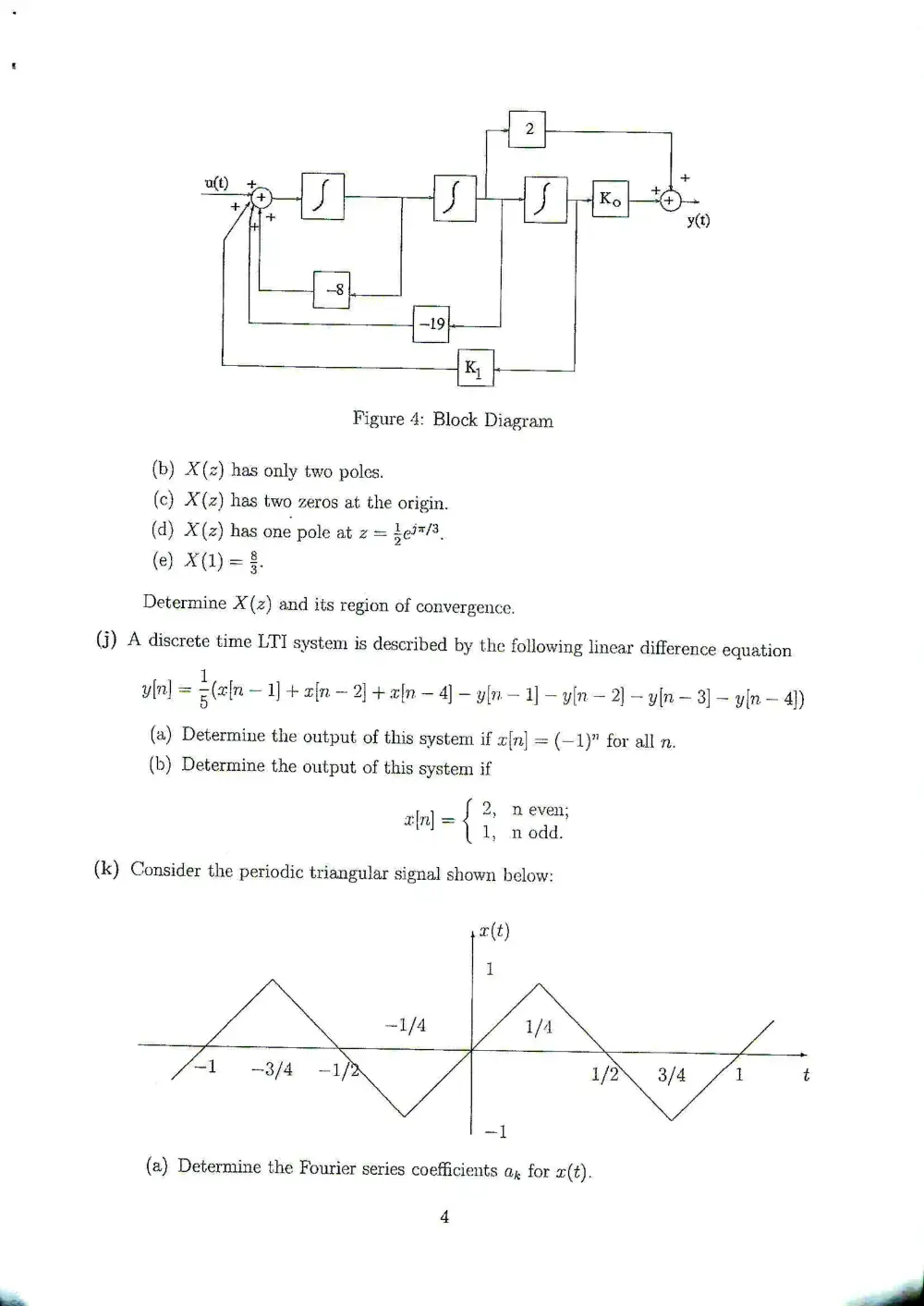
A(h) Consider the block diagram shown in figure 4.
(a) Find the system function of this CT LTT system.
(b) Find K, and K; such that the overall system is stable.
un The following facts are known about a discrete time signal with a Z-transform X(z).
(a) x[n] is real and right sided.
9 (7-H eK
[3]
K
Figure 4: Block Diagram
(b) X(z) has only two poles.
(
(c) X(z) has two zeros at. the origin.
(d) X(z) i one pole at z= $e77/3_
(e) X() =
Determine X(z) and its region of convergence.
(j) A discrete time LTI system is described by the following linear difference equation
uln] = $f ~ 1} + af 2] + elm — 4] — yln— 3] —yln—2] —yln—3] yn —4)
(a) Determine the output of this system if x{n] = (—1)" for all n.
(b) Determine the output of this system if
z(n] = 2, neven;
wu | 1, n odd.
(k) Consider the periodic triangular signal shown below:
,r(£)
1
~1/4 1/4
“1 3/4 -1/ 1 3/4 1 t
—~]
(a) Determine the Fourier series coefficients a, for x(t).
4
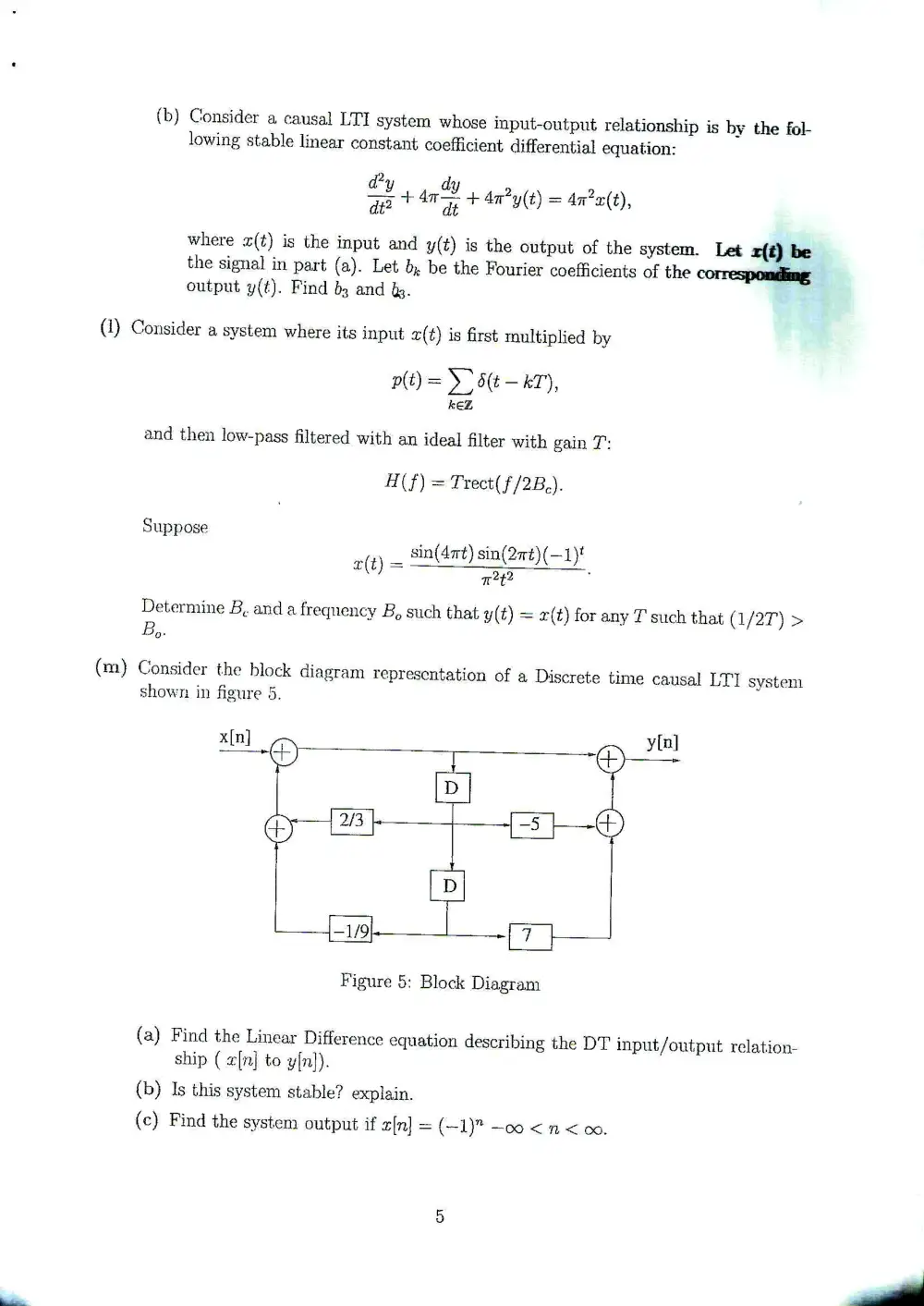
(b) Consider a causal LTT system whose input-output relationship is by the fol-
lowing stable linear constant coefficient differential equation:
e d
a + ane + 4ny(t) = 4n?ax(t),
where x(t) is the input and y(t) is the output of the system. Let x(t) be
the signal in part (a). Let b, be the Fourier coefficients of the corresponding
output y(t). Find b and ty.
(1) Consider a system where its input 2(¢) is first multiplied by
p(t) = }°5(t — kT),
keZ
and then low-pass filtered with an ideal filter with gain T:
H(f) = Trect(f/2B,).
Suppose
sin(4zt) sin(2nt)(—1)*
= nt? .
a(t)
Determine B, and a frequency B, such that y(t) = x(t) for any T such that (1/2T) >
Bo.
(m) Consider the block diagram represcntation of a Discrete time causal LTI system
shown in figure 5.
x(n] © yin]
oO 2/3 |« —| —5 a
—1/9} =| 7
Figure 5: Block Diagram
(a) Find the Linear Difference equation describing the DT input/output relation-
ship (2[n] to y[n]).
(b) Is this system stable? explain.
(c) Find the system output if z[n] = (-1)" ~00 <n < 00.
Problem F.2: (20 points)
Part I:
Consider the signal 2(t) whose Fourier transform is drawn below:
-] 0
(a) Find the value of x(0).
(b) Find the value of [ x(t) dt.
(c)
Part I
Consic
drawn
Find the value of / ja(t)|? de.
00
oc sin(27t
(d) Find the value of [ x(t) in er
8 at
: Mildly dependent on Part I
below:
ef nt de
er the signal y(t) whose Fourier transform is periodic with period equal to “5” and
(e) Find the relationship between y(t) and x(t) defined in Part I?
= 0 1 2 3
4
6
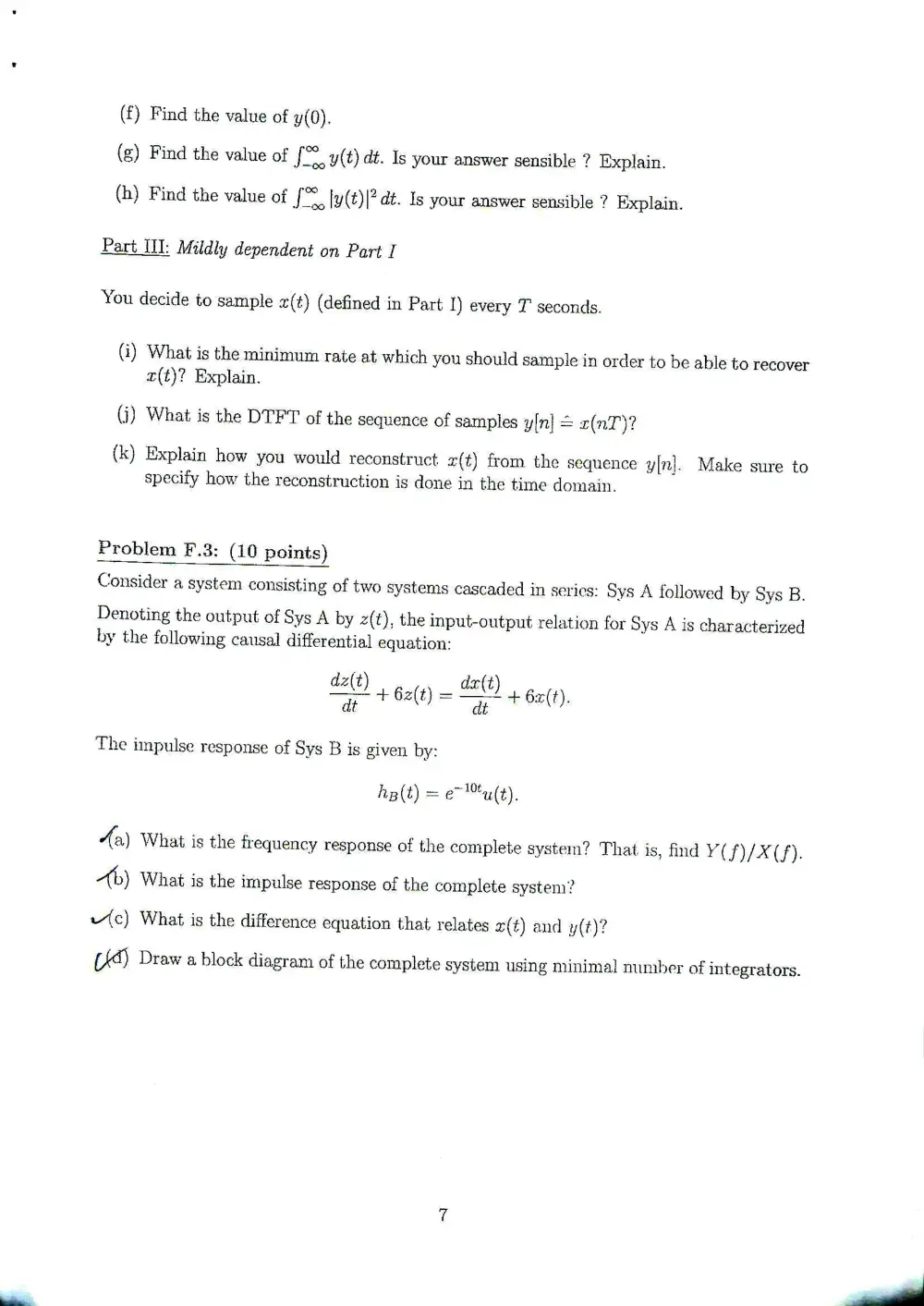
(f) Find the value of (0).
g) Find the value of fe y(t) dé. Is your answer sensible ? Explain.
(h) Find the value of f°. |y(t)|? dt. Is your answer sensible ? Explain.
Part II: Mildly dependent on Part I
You decide to sample x(t) (defined in Part 1) every T seconds.
(i) What is the minimum rate at which you should sample in order to be able to recover
x(t)? Explain.
(j) What is the DTFT of the sequence of samples y[n] = z(nT)?
(k) Explain how you would reconstruct z(t) from the sequence y|n]. Make sure to
specify how the reconstruction is done in the time domain.
Problem F.3: (10 points)
Consider a system consisting of two systems cascaded in serics: Sys A followed by Sys B.
Denoting the output of Sys A by 2(t), the input-output relation for Sys A is characterized
by the following causal differential equation:
dz(t)
at
dx(t)
dt
+ 62(t) =
+ 6x(t).
The impulse response of Sys B is given by:
h(t) =e u(t),
Aa) What is the frequency response of the complete system? That is, find Y( f)/X(f).
Ab) What is the impulse response of the complete system?
«(c) What is the difference equation that relates x(é) and y(t)?
Us) Draw a block diagram of the complete system using minimal number of integrators.