
EECE 340 Midterm, Fall 2005
American University of Beirut · Signals and Systems · 9 pages


More EECE 340 files
Show the text of this exam
AMERICAN UNIVERSITY OF BEIRUT
ELECTRICAL AND COMPUTER ENGINEERING DEPARTMENT
__________________________________________________________
EECE 440 SIGNALS AND SYSTEMS Summer 2005
Prof. Kabalan Midterm Exam-Solution July 25, 2005
__________________________________________________________
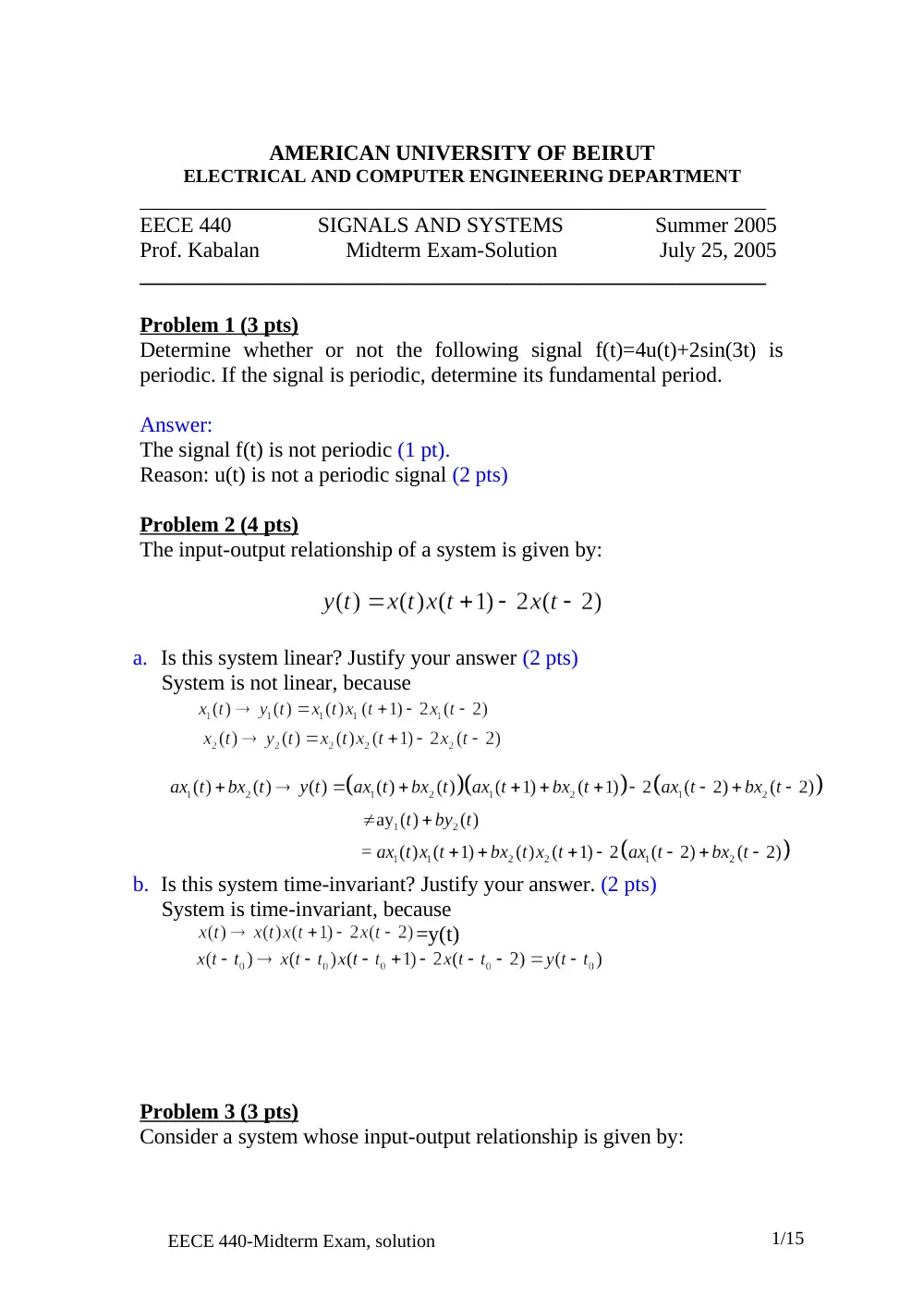
Problem 1 (3 pts)
Determine whether or not the following signal f(t)=4u(t)+2sin(3t) is
periodic. If the signal is periodic, determine its fundamental period.
Answer:
The signal f(t) is not periodic (1 pt).
Reason: u(t) is not a periodic signal (2 pts)
Problem 2 (4 pts)
The input-output relationship of a system is given by:
a. Is this system linear? Justify your answer (2 pts)
System is not linear, because
b. Is this system time-invariant? Justify your answer. (2 pts)
System is time-invariant, because
=y(t)
Problem 3 (3 pts)
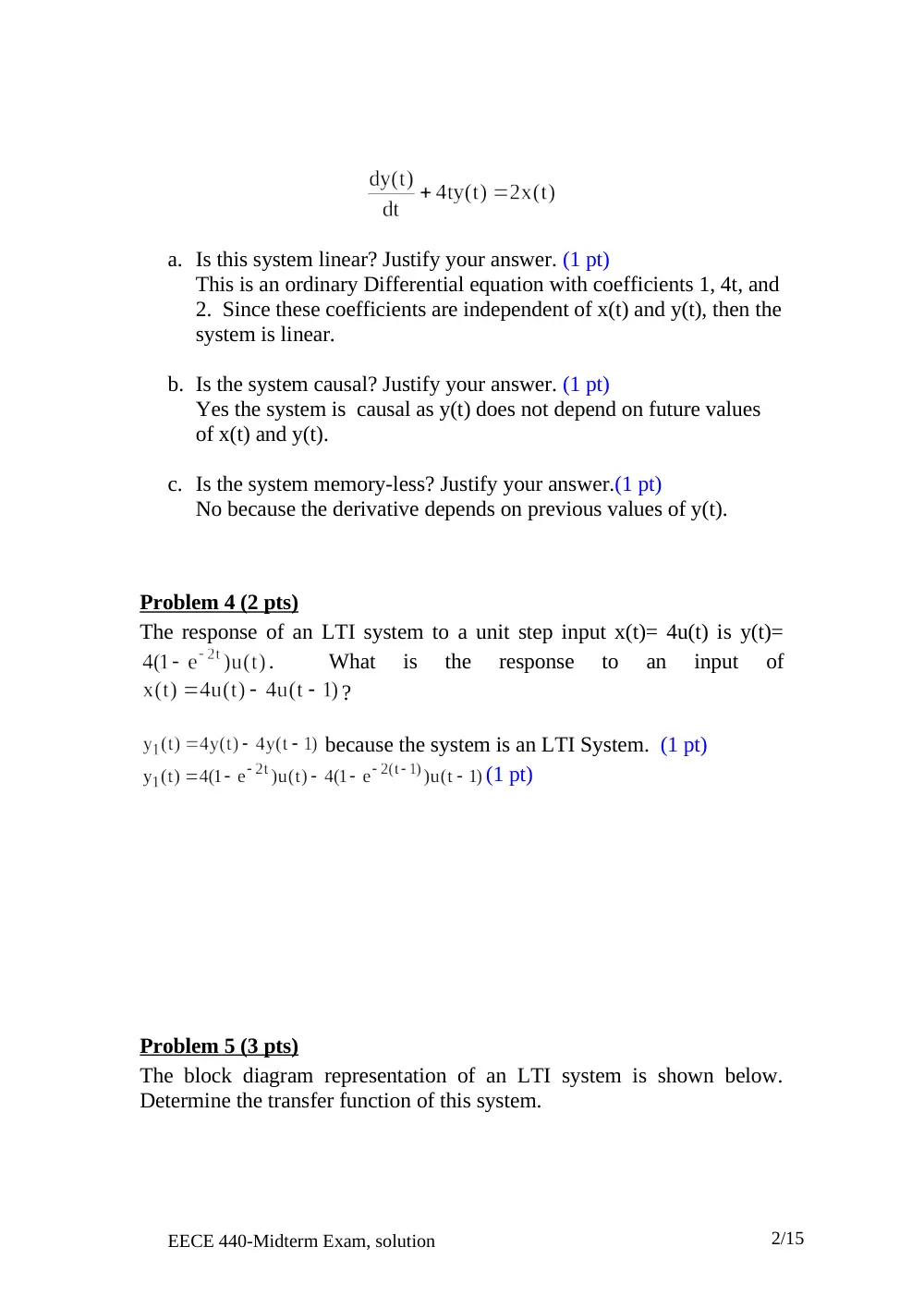
Consider a system whose input-output relationship is given by:
EECE 440-Midterm Exam, solution
1/15
a. Is this system linear? Justify your answer. (1 pt)
This is an ordinary Differential equation with coefficients 1, 4t, and
2. Since these coefficients are independent of x(t) and y(t), then the
system is linear.
b. Is the system causal? Justify your answer. (1 pt)
Yes the system is causal as y(t) does not depend on future values
of x(t) and y(t).
c. Is the system memory-less? Justify your answer.(1 pt)
No because the derivative depends on previous values of y(t).
Problem 4 (2 pts)
The response of an LTI system to a unit step input x(t)= 4u(t) is y(t)=
.
What is the response to an input of
?
because the system is an LTI System. (1 pt)
(1 pt)
Problem 5 (3 pts)
The block diagram representation of an LTI system is shown below.
Determine the transfer function of this system.
EECE 440-Midterm Exam, solution
2/15
Using Carson’s rule,
-1 pt for each wrong or missing term.
Problem 6 (3 pts)
The open loop transfer function of a unity feedback control is given by:
EECE 440-Midterm Exam, solution
+
+
+
+
+
+
+
R(s)
C(s)
3/15
Check for system stability by determining the number of poles in each
half of the complex plane.
The closed-loop transfer function is given by
1 pt
Constructing the RH table of this system, we obtain
1 pt
According to RH table, 2 sign changes which means two roots in the
rhp. Moreover, roots of A(s) are roots of the original polynomial. As
no roots of A(s) are on the jw axis, therefore the system has no poles
on the jw axis. The remaining roots (5) are in the lhp. (5,0,2) (1 pt)
Problem 7 (3 pts)
The open-loop transfer function of a unity-feedback control system is
given by:
EECE 440-Midterm Exam, solution
4/15
Determine the range of K for which this system is stable.
The closed-loop transfer function of the system is given by:
(1 pt)
The RH table
1 14
7 8+K ( 1pt)
90-K
8 +K
For stability: -8<K<90 (1 pt)
Problem 8 (4 pts)
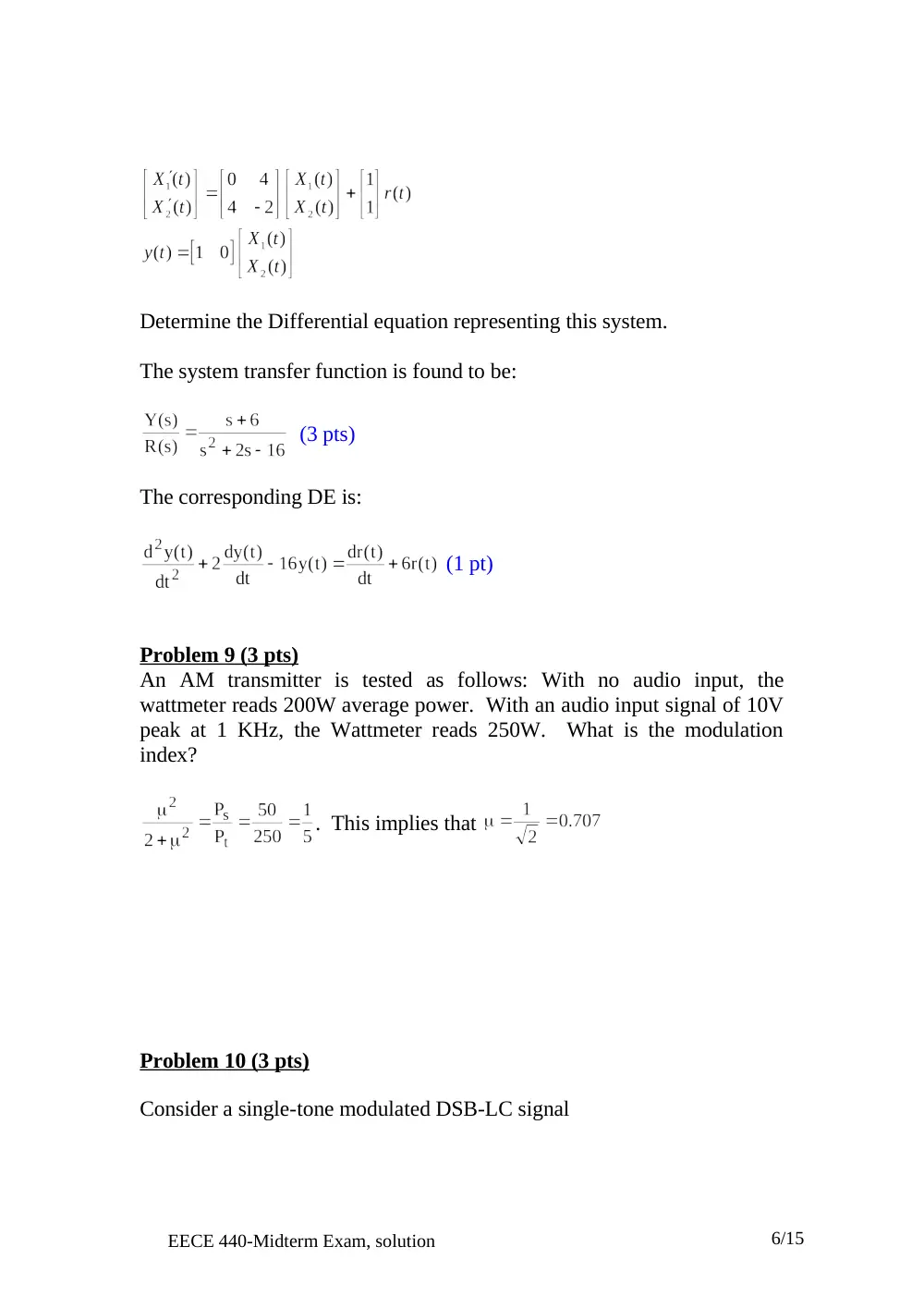
The dynamic equations of a linear time-invariant system whose output is
y(t) and input r(t) are given by:
EECE 440-Midterm Exam, solution
5/15
Determine the Differential equation representing this system.
The system transfer function is found to be:
(3 pts)
The corresponding DE is:
(1 pt)
Problem 9 (3 pts)
An AM transmitter is tested as follows: With no audio input, the
wattmeter reads 200W average power. With an audio input signal of 10V
peak at 1 KHz, the Wattmeter reads 250W. What is the modulation
index?
. This implies that
Problem 10 (3 pts)
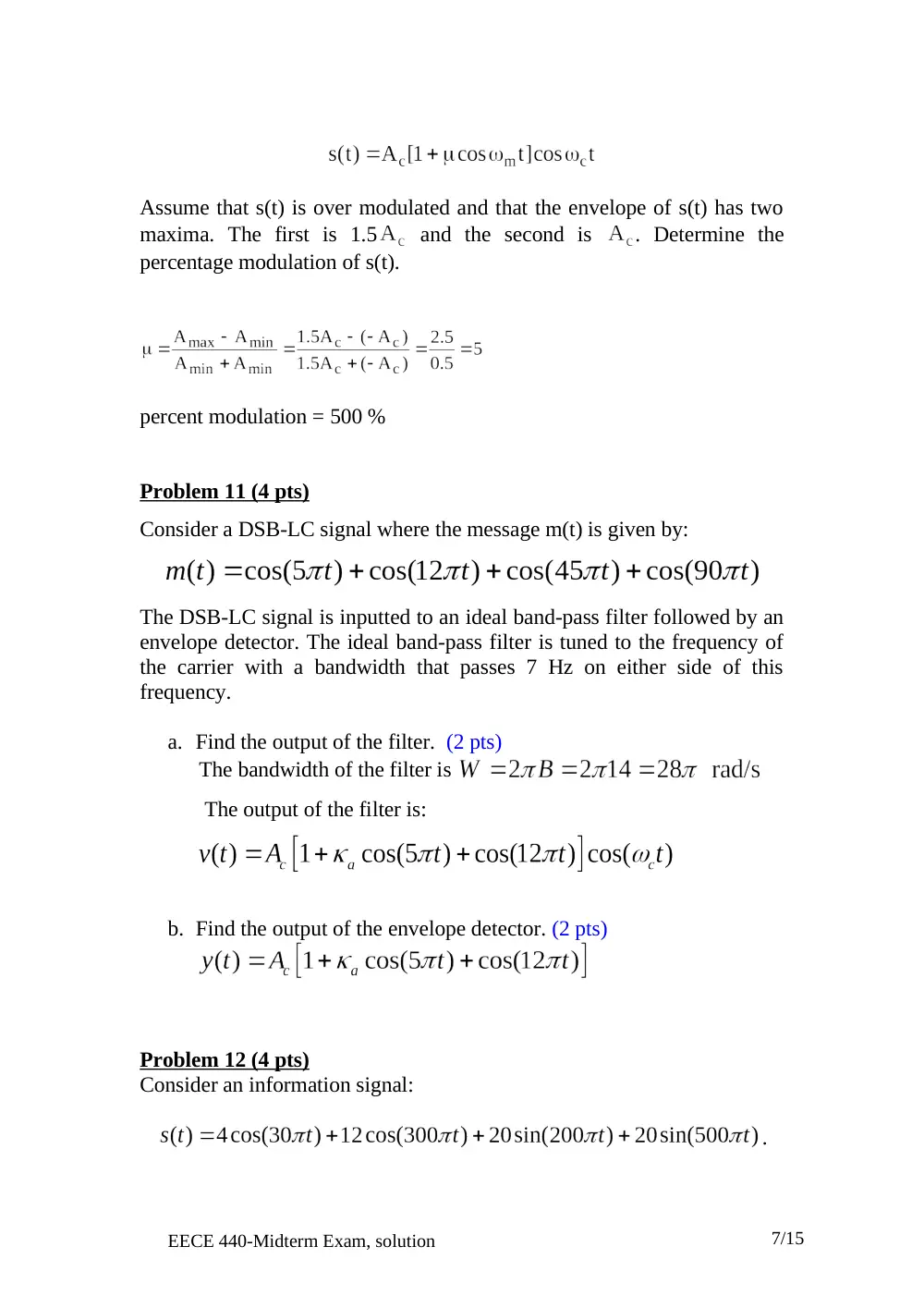
Consider a single-tone modulated DSB-LC signal
EECE 440-Midterm Exam, solution
6/15
Assume that s(t) is over modulated and that the envelope of s(t) has two
maxima. The first is 1.5
and the second is
. Determine the
percentage modulation of s(t).
percent modulation = 500 %
Problem 11 (4 pts)
Consider a DSB-LC signal where the message m(t) is given by:
The DSB-LC signal is inputted to an ideal band-pass filter followed by an
envelope detector. The ideal band-pass filter is tuned to the frequency of
the carrier with a bandwidth that passes 7 Hz on either side of this
frequency.
a. Find the output of the filter. (2 pts)
The bandwidth of the filter is
The output of the filter is:
b. Find the output of the envelope detector. (2 pts)
Problem 12 (4 pts)
Consider an information signal:
.
EECE 440-Midterm Exam, solution
7/15
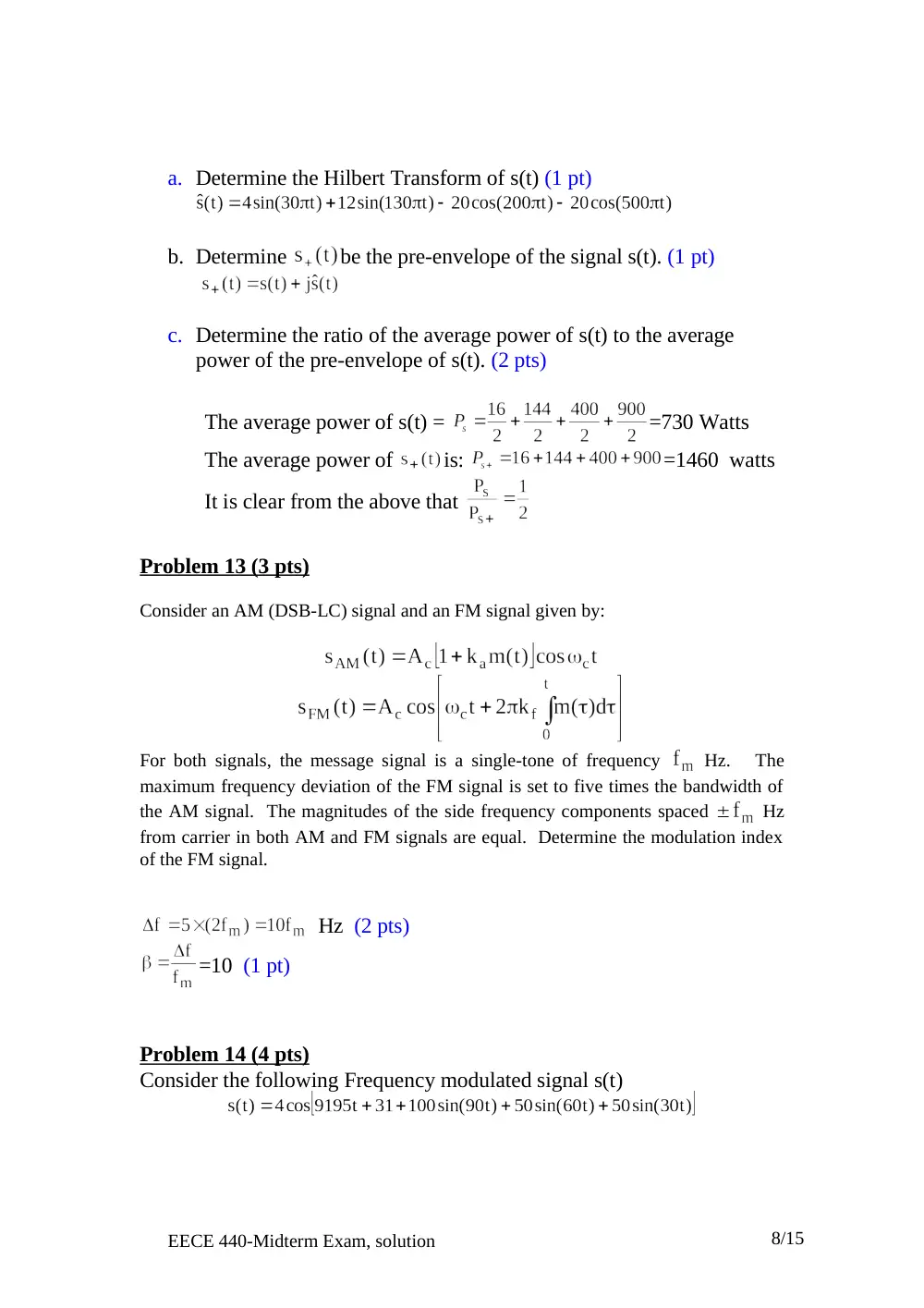
a. Determine the Hilbert Transform of s(t) (1 pt)
b. Determine
be the pre-envelope of the signal s(t). (1 pt)
c. Determine the ratio of the average power of s(t) to the average
power of the pre-envelope of s(t). (2 pts)
The average power of s(t) =
=730 Watts
The average power of
is:
=1460 watts
It is clear from the above that
Problem 13 (3 pts)
Consider an AM (DSB-LC) signal and an FM signal given by:
For both signals, the message signal is a single-tone of frequency
Hz. The
maximum frequency deviation of the FM signal is set to five times the bandwidth of
the AM signal. The magnitudes of the side frequency components spaced
Hz
from carrier in both AM and FM signals are equal. Determine the modulation index
of the FM signal.
Hz (2 pts)
=10 (1 pt)
Problem 14 (4 pts)
Consider the following Frequency modulated signal s(t)
EECE 440-Midterm Exam, solution
8/15
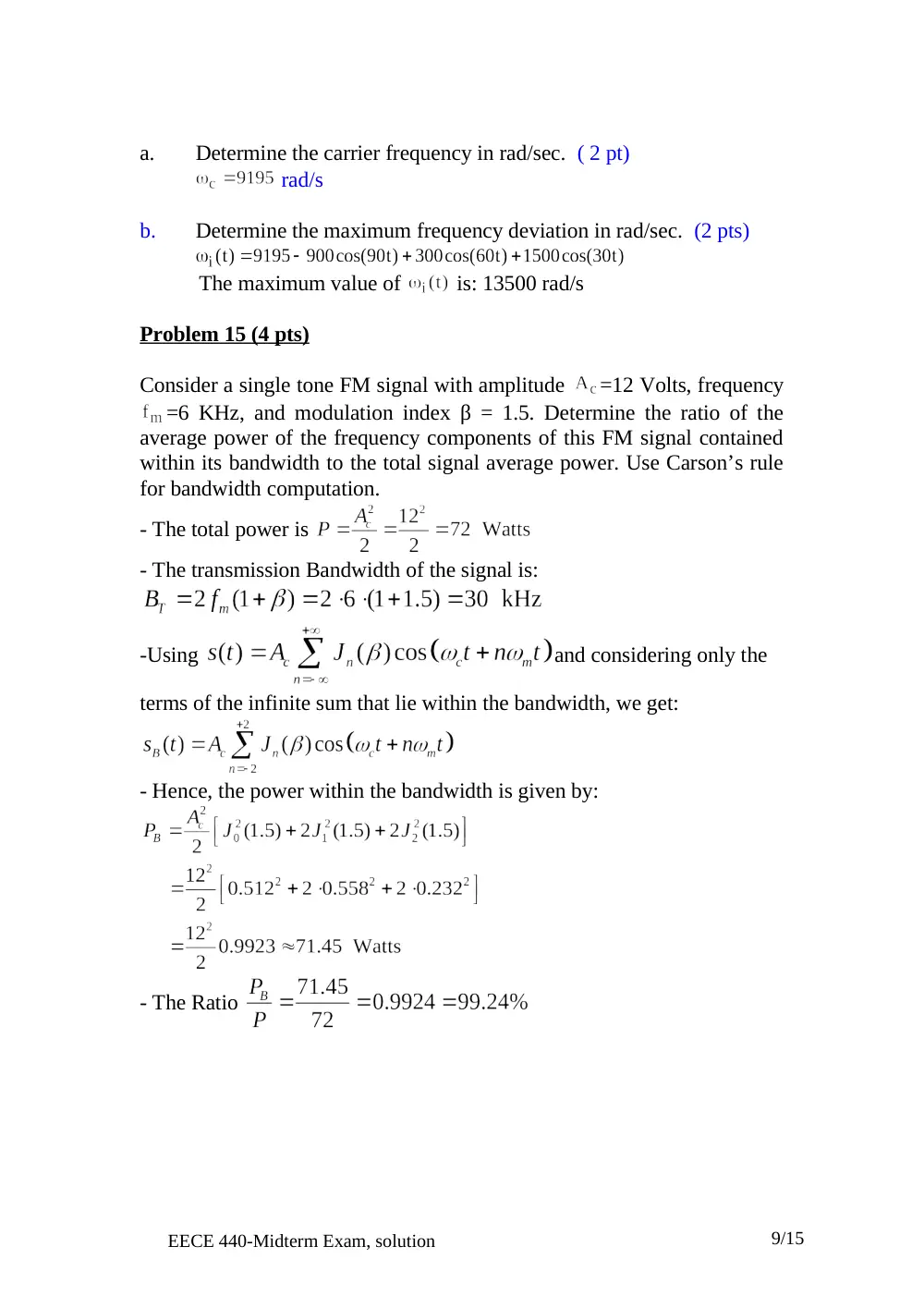
a.
Determine the carrier frequency in rad/sec. ( 2 pt)
rad/s
b.
Determine the maximum frequency deviation in rad/sec. (2 pts)
The maximum value of
is: 13500 rad/s
Problem 15 (4 pts)
Consider a single tone FM signal with amplitude
=12 Volts, frequency
=6 KHz, and modulation index β = 1.5. Determine the ratio of the
average power of the frequency components of this FM signal contained
within its bandwidth to the total signal average power. Use Carson’s rule
for bandwidth computation.
- The total power is
- The transmission Bandwidth of the signal is:
-Using
and considering only the
terms of the infinite sum that lie within the bandwidth, we get:
- Hence, the power within the bandwidth is given by:
- The Ratio
EECE 440-Midterm Exam, solution
9/15