
EECE 340 Midterm, Summer 2004
American University of Beirut · Signals and Systems · 8 pages



More EECE 340 files
Show the text of this exam
Midterm 2, Solution EECE 440
1
Midterm #2
August 9, 2004
American University of Beirut
Faculty of Engineering and Architecture
Electrical and Computer Engineering Department
Signals and Systems EECE 440
Summer 2004
Solution
Problem 1 (2 pts)
Determine whether or not each of the following continuous-time signals
is periodic. If the signal is periodic, determine its fundamental period.
a.
⎟⎠
⎞
⎜⎝
⎛
+ π
=
3
cos 4t
x )t(
. Periodic with a period T = π/2 sec.
b.
)1
t
(je
)t(
x
π −
=
. Periodic with a period T = 2 sec.
Problem 2 (3 pts):
Categorize each of the following signals as an energy signal or a power
signal. Show your work.
a. The continuous-time signal x(t), defined by:
⎭
⎬
⎫
⎩
⎨
⎧
≥
=
−
Otherwise
0
0
t
3e
)t(
x
2t
Energy signal;
9/4
dt
e
9
0
4t
=
∫
∞
−
b. The continuous-time signal y(t) , defined for - < t < by
y(t) = 3 sin(πt) + 2 cos(3πt)
Power signal as y(t) is a periodic signal
c. The signal s(t) shown below
None
Midterm 2, Solution EECE 440
2
Problem 3 (4 pts)
The input-output relationship of a continuous-time system is given by:
y(t) = x(t/2)
a. Is this system linear? Show your work.
Linear
b. Is this system time-invariant? Show your work.
Not time-invariant
c. Is this system causal? Show your work.
Not causal y(-1)=x(-0.5)
d. Is this system stable? Show your work.
Stable; x(t) bounded implies x(t/2) bounded
Problem 4 (4 pts)
The input-output relationship of a continuous-time system is given by:
∫
−
−∞
=
1
2 ( )
)
(
t
d
x
y t
τ
τ
a. Is this system linear? Show your work.
Linear (Integration)
b. Is this system time-invariant? Show your work.
Time-invariant
c. Is this system causal? Show your work.
Causal, h(t)=2u(t-1)
d. Is this system stable? Show your work.
Not stable; H(s) has a pole at s=0
Problem 5 (2 pts)
The impulse response for a linear, time-invariant system is given by:
ta at2
)t(
h
−
=
, a>0.
Let the input to the system be x(t) = u(t+2) – u(t-2).
a. Is the system stable? Show work!
Use Matlab
b. Find the output of the system.
Midterm 2, Solution EECE 440
3
Problem 6 (2 pts)
When an impulse δ(t) is applied to a certain linear system, the output is
e-4tu(t).
a. What output results from applying the input e-tu(t)?
4
s
1
H )s(
+
=
,
1
s
1
X )s(
+
=
;
)1
4)(s
s(
1
Y )s(
+
+
=
u )t(
3e
1
3e
1
)t(
y
t
4t
⎥⎦
⎤
⎢⎣
⎡
+
−
=
−
−
b. What output is the result of the input 4 cos(3t + π/4)?
[
]
u )t(
Ce
Be
Ae
)t(
y
3jt
3jt
4t
+
+
=
−
−
Problem 7 (4 pts)
A maze rover position control scheme is shown below:
a. Determine the transfer functions
1.
1
2
2
1
10K
)s
10K
1(
s
10K
R )s(
)s(
C
+
+
+
=
2.
1
2
2
10K
)s
10K
1(
s
1
D )s(
)s(
C
+
+
+
=
b. Determine the values for the constants K1 and K2 , to obtain a system
damping ratio of ζ=0.5 and a 1% steady-state error for a disturbance
unit-step, d(t)=u(t). [NOTE: Ignore the reference input]
c. What is the steady-state error resulting from the application of a unit-
ramp reference input, r(t)=tu(t), with K1=10 and K2=0.9? [NOTE:
Ignore the disturbance input]
Midterm 2, Solution EECE 440
4
Problem 8 (4 pts)
The input-output relationship of a Discrete-time system is given by:
∑
=−∞
+
=
n
k
x k
y n
]1
[
[ ]
a. Is this system linear? Show your work.
Linear
b. Is this system time-invariant? Show your work.
Time-invariant
c. Is this system causal? Show your work.
Not causal (Future values)
d. Is this system stable? Show your work.
Not stable; y[n] not bounded
Problem 9 (4 pts)
The input-output relationship of a Discrete-time system is given by:
∑
=−∞
−
=
n
k
k
n
x n
y n
3 ]
[
[ ]
[ ]
δ
a. Is this system linear? Show your work.
Linear
b. Is this system time-invariant? Show your work.
Not time-invariant
c. Is this system causal? Show your work.
Causal
d. Is this system stable? Show your work.
Stable
Problem 10 (3 pts)
Assume that the response of an LTI system to the input x[n]=u[n]
(discrete-time unit step) is given by,
y[n] = δ[n] + 2δ[n-1] - δ[n-2]
a. For this system, compute the output y2[n] to the following input:
x2[n] =3u[n] – 2u[n-4]
2 [n - 6]
5]
4 [n
4]
2 [n
2]
3 [n
]1
6 [n
3 [n]
y2[n]
δ
+
−
− δ
−
− δ
−
− δ
−
+ δ
= δ
b. Derive the impulse response h[n] for this system.
]3
[n
2]
3 [n
]1
[n
[n]
h[n]
−
+ δ
−
− δ
−
+ δ
= δ
c. Give the difference equation for this system.
]3
x[n
2]
3x[n
]1
x[n
x[n]
[y n]
−
+
−
−
−
+
=
Midterm 2, Solution EECE 440
5
Problem 11 (4 pts)
Given an IIR filter defined by the difference equation:
y[n] = √2 y[n-1] – y[n-2] + x[n]
a. Determine the transfer function H(z) for this system.
2
1
z
2z
1
1
H(z)
− + −
−
=
b. Compute the system poles.
j / 4
1
e
z
π
=
and
j / 4
2
e
z
= − π
c. Compute h[n] for this system. Is this system BIBO-stable?
[
]
Bsin( n /4) u[n]
Acos( n / 4)
h[n]
π
+
π
=
d. Determine y[n] for x[n] = δ[n] - 3δ[n-1] + 2δ[n-4]
[
]
3 2sin(n / 4) u[n]
sin( n /4)
cos( n /4)
[y n]
π
−
π
+
π
=
Problem 12 (2 pts)
Determine the discrete-time signals xa[n] and xb[n], respectively,
corresponding to the following z-transforms:
u[n]
2
1
5
3
3
1
5
8
[n]
x
n
n
a
⎪⎭
⎪⎬
⎫
⎪⎩
⎪⎨
⎧
⎟⎠
⎞
⎜⎝
⎛
−
⎟⎠
⎞
⎜⎝
⎛−
=
(
)
(
)
u[n]
8.0
17
2
9.0
17
19
x [n]
n
n
b
⎭⎬⎫
⎩⎨⎧
−
−
=
2
1
1
a
6 z
1
6 z
1
1
z
1
( )z
X
−
−
−
−
−
−
=
2
1
1
b
.0 72z
1.0 z
1
z
1
(z)
X
−
−
−
−
−
+
=
Midterm 2, Solution EECE 440
6
Problem 13 (2 pts)
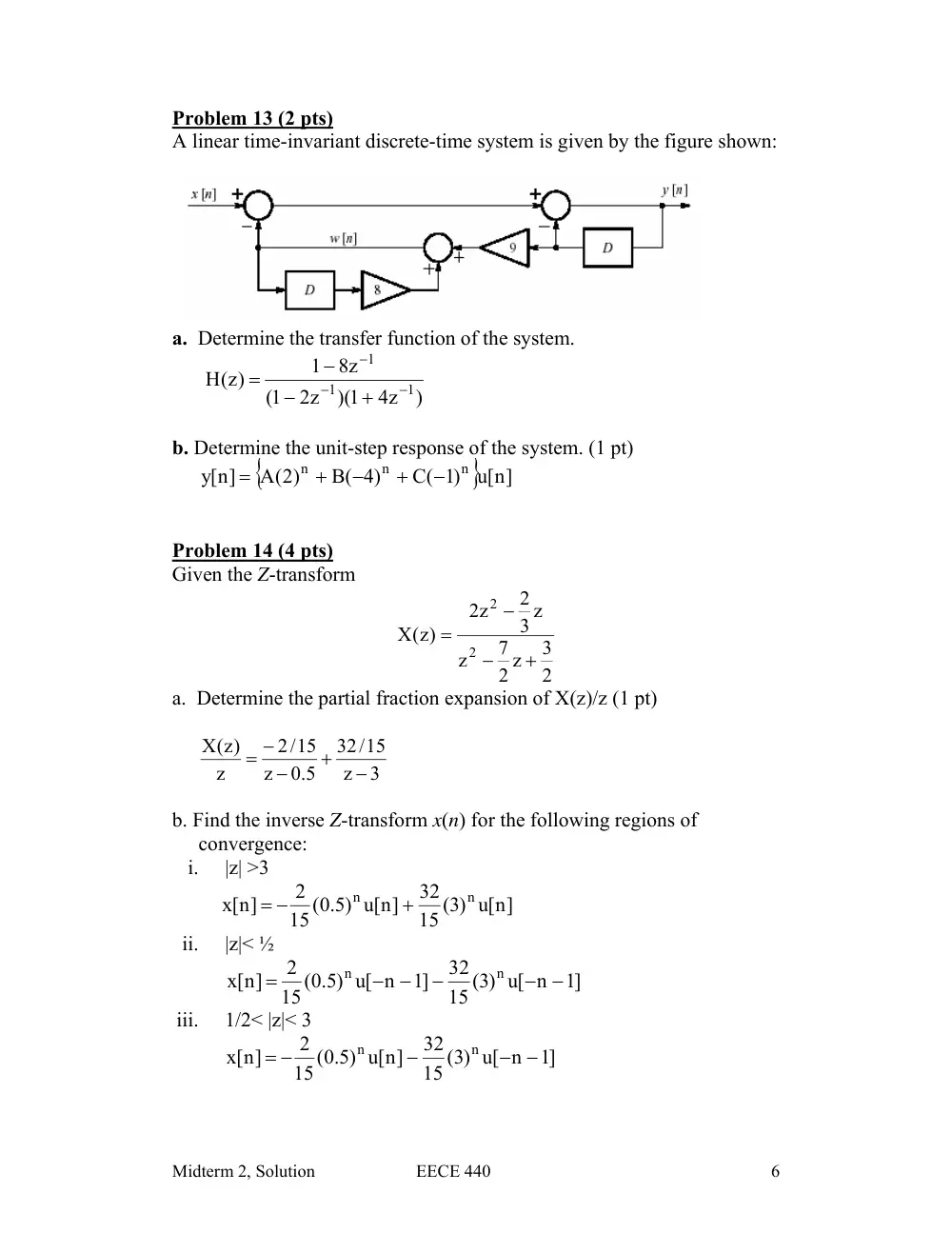
A linear time-invariant discrete-time system is given by the figure shown:
a. Determine the transfer function of the system.
)
4z
)(1
2z
1(
8z
1
H z( )
1
1
1
−
−
−
+
−
−
=
b. Determine the unit-step response of the system. (1 pt)
{
}
u[n]
)1
C(
B( 4)
A(2)
[y n]
n
n
n
−
+
−
+
=
Problem 14 (4 pts)
Given the Z-transform
2
3
2 z
7
z
3 z
2
2z
X(z)
2
2
+
−
−
=
a. Determine the partial fraction expansion of X(z)/z (1 pt)
3
z
32/15
5.0
z
2/15
z
X(z)
−
+
−
= −
b. Find the inverse Z-transform x(n) for the following regions of
convergence:
i.
|z| >3
15 (3) u[n]
32
15( 5.0 ) u[n]
2
x[n]
n
n
+
= −
ii.
|z|< ½
]1
15 (3) u[ n
32
]1
15( 5.0 ) u[ n
2
x[n]
n
n
− −
−
− −
=
iii.
1/2< |z|< 3
]1
15 (3) u[ n
32
15( 5.0 ) u[n]
2
x[n]
n
n
− −
−
= −
Midterm 2, Solution EECE 440
7
Problem 15 (2 pts)
The open-loop transfer function of a unity feedback control system is
given by:
s
2s
s
10
3s
)s(
G
2
3
+
+
+
=
a. Determine the steady-state value (final value) of the output signal
for a unit-step input.
10)
4s
2s
s(s
10
3s
)s(
C
2
3
+
+
+
+
=
1
limsC )s(
)t(c
lim
0
s
t
=
=
→
→∞
(System is stable)
b. Represent this system in a state variable form by determining the
state equation and the output equation
)t(r
10
3
0
)t(
X
)t(
X
)t(
X
0
0
10
1
0
4
0
1
2
)t(
X
)t(
X
)t(
X
3
2
1
3
2
1
⎥
⎥
⎥
⎦
⎤
⎢
⎢
⎢
⎣
⎡
+
⎥
⎥
⎥
⎦
⎤
⎢
⎢
⎢
⎣
⎡
⎥
⎥
⎥
⎦
⎤
⎢
⎢
⎢
⎣
⎡
−
−
−
=
⎥
⎥
⎥
⎦
⎤
⎢
⎢
⎢
⎣
⎡
′
′
′
c(t)=[
]
⎥
⎥
⎥
⎦
⎤
⎢
⎢
⎢
⎣
⎡
)t(
X
)t(
X
)t(
X
0
0
1
3
2
1
Problem 16 (2 pts)
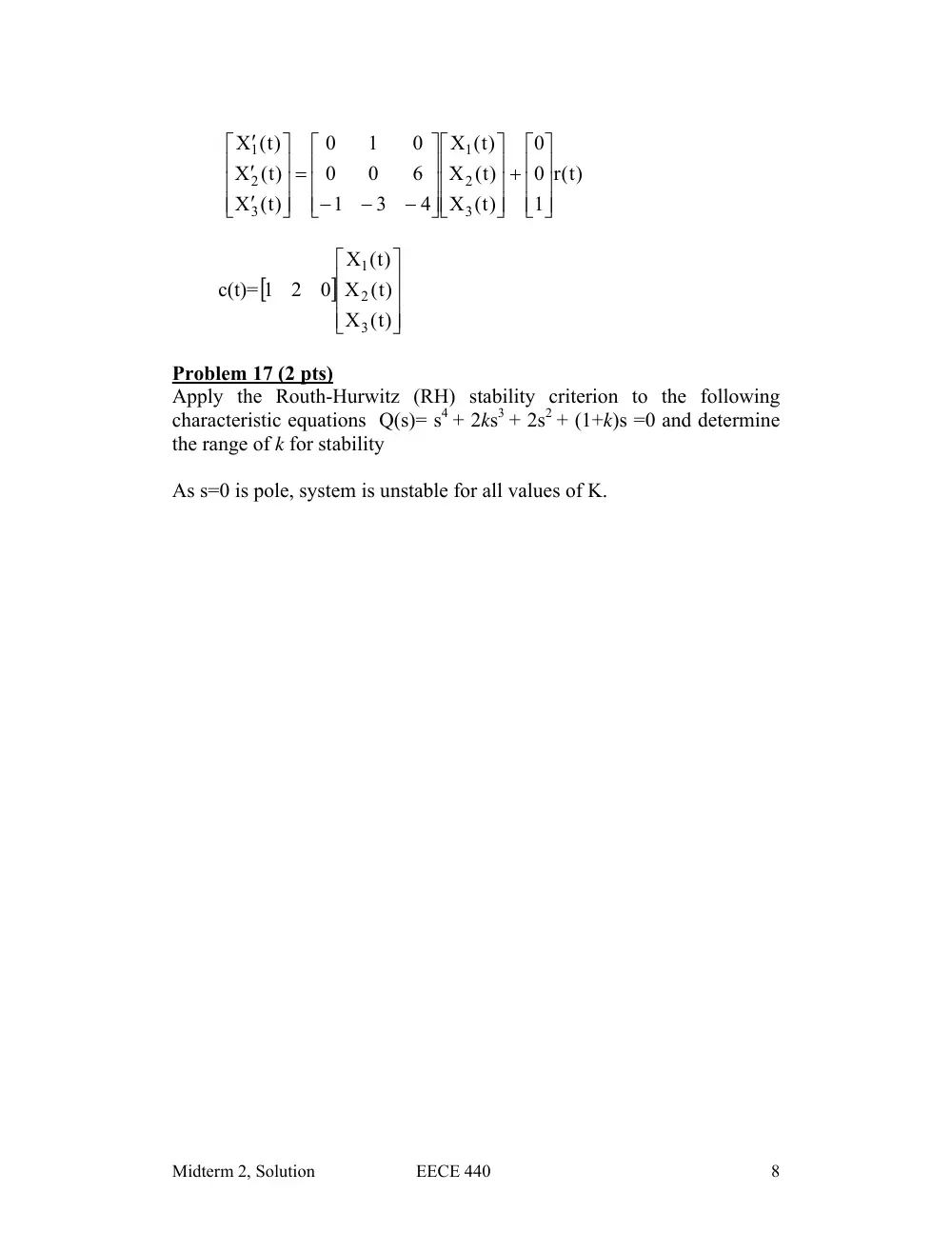
Given the block diagram below, write the state equations for this system
Midterm 2, Solution EECE 440
8
)t(r
1
0
0
)t(
X
)t(
X
)t(
X
4
3
1
6
0
0
0
1
0
)t(
X
)t(
X
)t(
X
3
2
1
3
2
1
⎥
⎥
⎥
⎦
⎤
⎢
⎢
⎢
⎣
⎡
+
⎥
⎥
⎥
⎦
⎤
⎢
⎢
⎢
⎣
⎡
⎥
⎥
⎥
⎦
⎤
⎢
⎢
⎢
⎣
⎡
−
−
−
=
⎥
⎥
⎥
⎦
⎤
⎢
⎢
⎢
⎣
⎡
′
′
′
c(t)=[
]
⎥
⎥
⎥
⎦
⎤
⎢
⎢
⎢
⎣
⎡
)t(
X
)t(
X
)t(
X
0
2
1
3
2
1
Problem 17 (2 pts)
Apply the Routh-Hurwitz (RH) stability criterion to the following
characteristic equations Q(s)= s4 + 2ks3 + 2s2 + (1+k)s =0 and determine
the range of k for stability
As s=0 is pole, system is unstable for all values of K.