
EECE 340 Midterm, Summer 2012
American University of Beirut · Signals and Systems · 6 pages · Prof. Karim Kabalan
More EECE 340 files
Show the text of this exam
EECE 340-Midterm Exam Summer 2012
1/6
AMERICAN UNIVERSITY OF BEIRUT
ELECTRICAL AND COMPUTER ENGINEERING DEPARTMENT
__________________________________________________________
EECE 340 SIGNALS AND SYSTEMS Summer 2012
Prof. Kabalan Midterm Exam July 17, 2012
__________________________________________________________
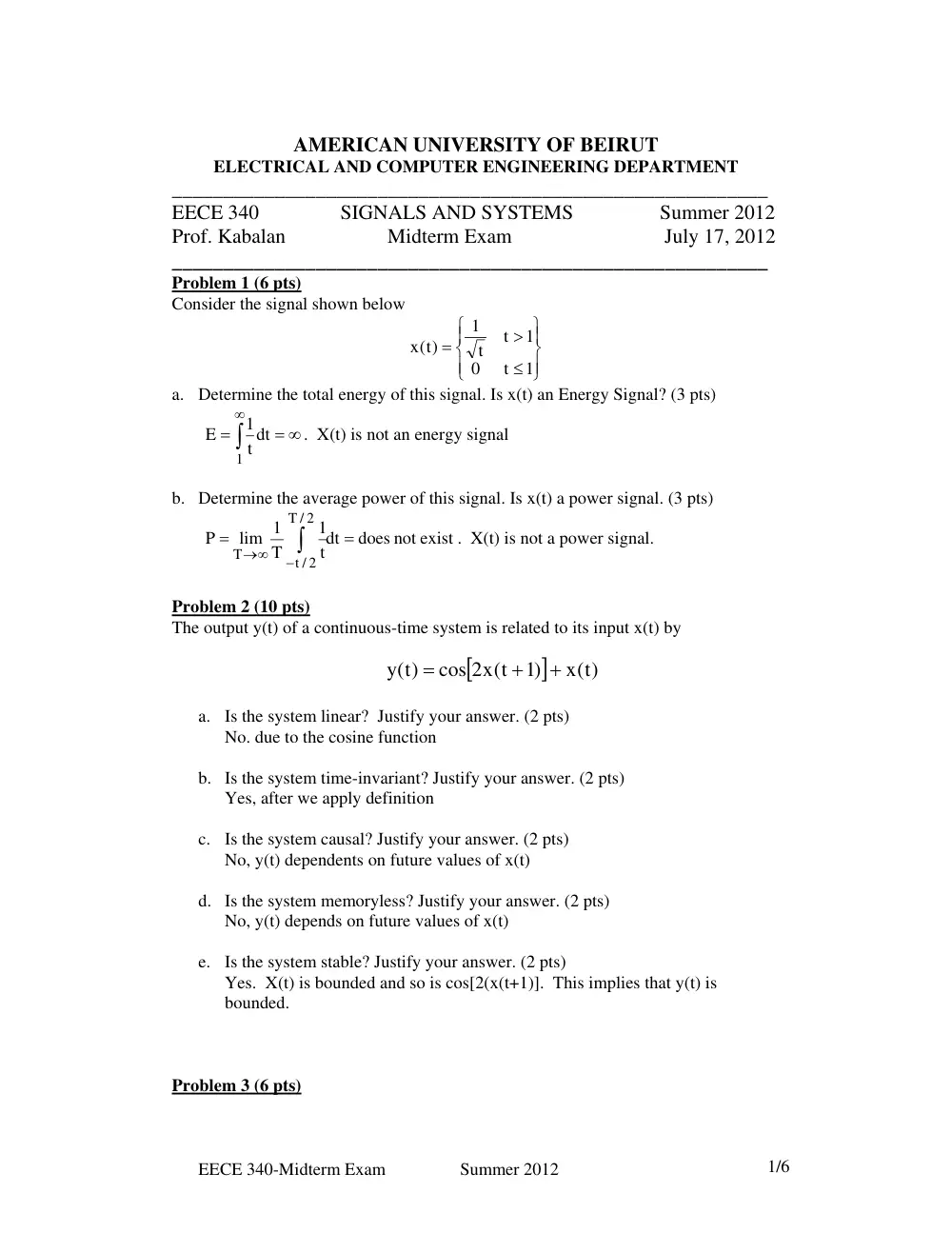
Problem 1 (6 pts)
Consider the signal shown below
⎪⎭
⎪⎬
⎫
⎪⎩
⎪⎨
⎧
≤
>
=
1
t
0
1
t
t
1
x )t(
a. Determine the total energy of this signal. Is x(t) an Energy Signal? (3 pts)
= ∞
= ∫
∞
1
t dt
1
E
. X(t) is not an energy signal
b. Determine the average power of this signal. Is x(t) a power signal. (3 pts)
does not exist
tdt
1
T
lim 1
P
/ 2
T
/t 2
T
=
=
∫
−
→∞
. X(t) is not a power signal.
Problem 2 (10 pts)
The output y(t) of a continuous-time system is related to its input x(t) by
[
]
x )t(
)1
cos 2x t(
y )t(
+
+
=
a. Is the system linear? Justify your answer. (2 pts)
No. due to the cosine function
b. Is the system time-invariant? Justify your answer. (2 pts)
Yes, after we apply definition
c. Is the system causal? Justify your answer. (2 pts)
No, y(t) dependents on future values of x(t)
d. Is the system memoryless? Justify your answer. (2 pts)
No, y(t) depends on future values of x(t)
e. Is the system stable? Justify your answer. (2 pts)
Yes. X(t) is bounded and so is cos[2(x(t+1)]. This implies that y(t) is
bounded.
Problem 3 (6 pts)
EECE 340-Midterm Exam Summer 2012
2/6
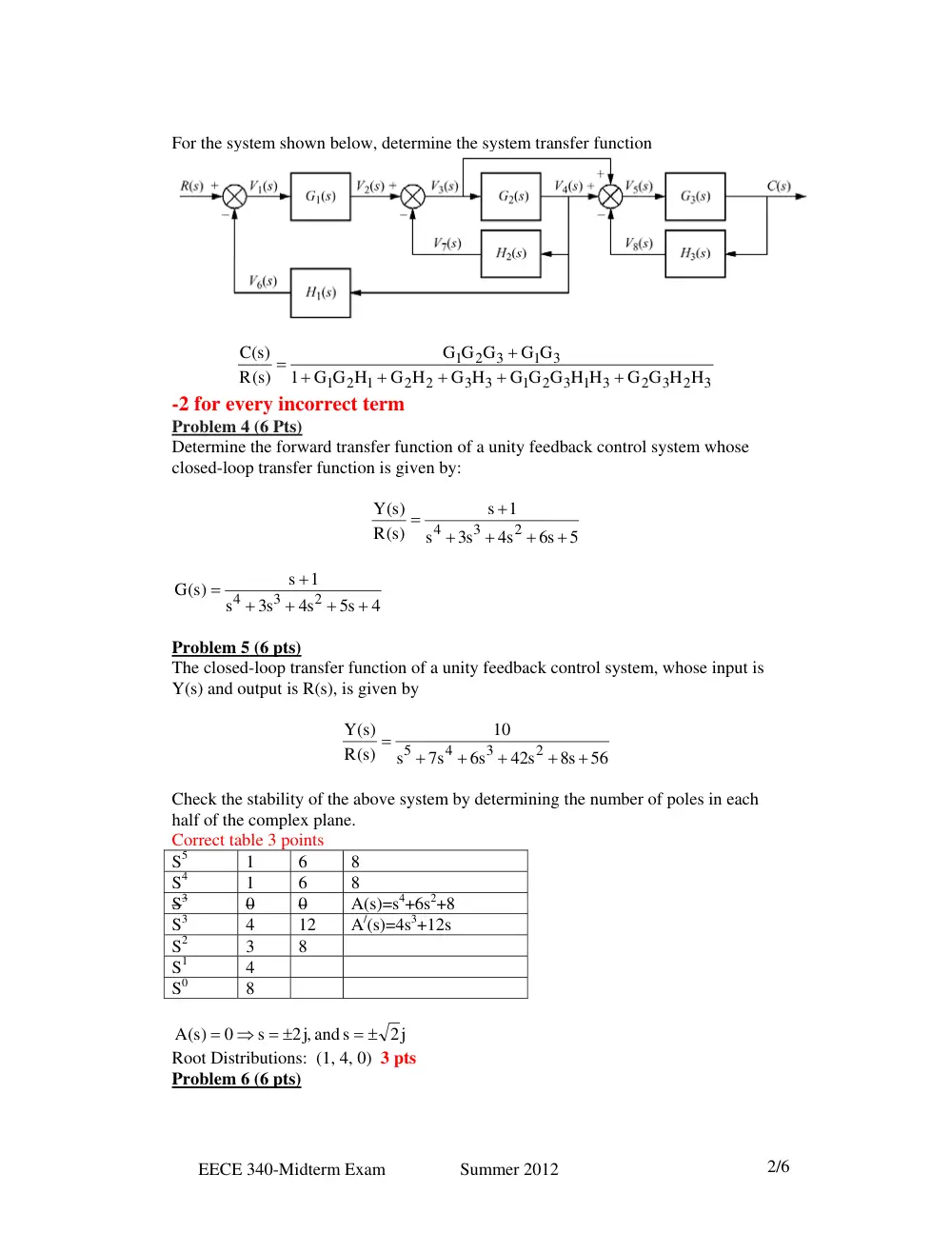
For the system shown below, determine the system transfer function
3
2
3
2
3
1
3
2
1
3
3
2
2
1
2
1
3
1
3
1 2
G G H H
G G G H H
G H
G H
G G H
1
G G
G G G
R )s(
C )s(
+
+
+
+
+
+
=
-2 for every incorrect term
Problem 4 (6 Pts)
Determine the forward transfer function of a unity feedback control system whose
closed-loop transfer function is given by:
5
6s
4s
3s
s
s 1
R )s(
)s(
Y
2
3
4
+
+
+
+
+
=
4
5s
4s
3s
s
1
s
)s(
G
2
3
4
+
+
+
+
+
=
Problem 5 (6 pts)
The closed-loop transfer function of a unity feedback control system, whose input is
Y(s) and output is R(s), is given by
56
8s
42s
6s
7s
s
10
R )s(
)s(
Y
2
3
4
5
+
+
+
+
+
=
Check the stability of the above system by determining the number of poles in each
half of the complex plane.
Correct table 3 points
S5
1
6
8
S4
1
6
8
S3
0
0
A(s)=s4+6s2+8
S3
4
12
A/(s)=4s3+12s
S2
3
8
S1
4
S0
8
2j
2 ,j and s
s
0
A )s(
= ±
= ±
⇒
=
Root Distributions: (1, 4, 0) 3 pts
Problem 6 (6 pts)
EECE 340-Midterm Exam Summer 2012
3/6
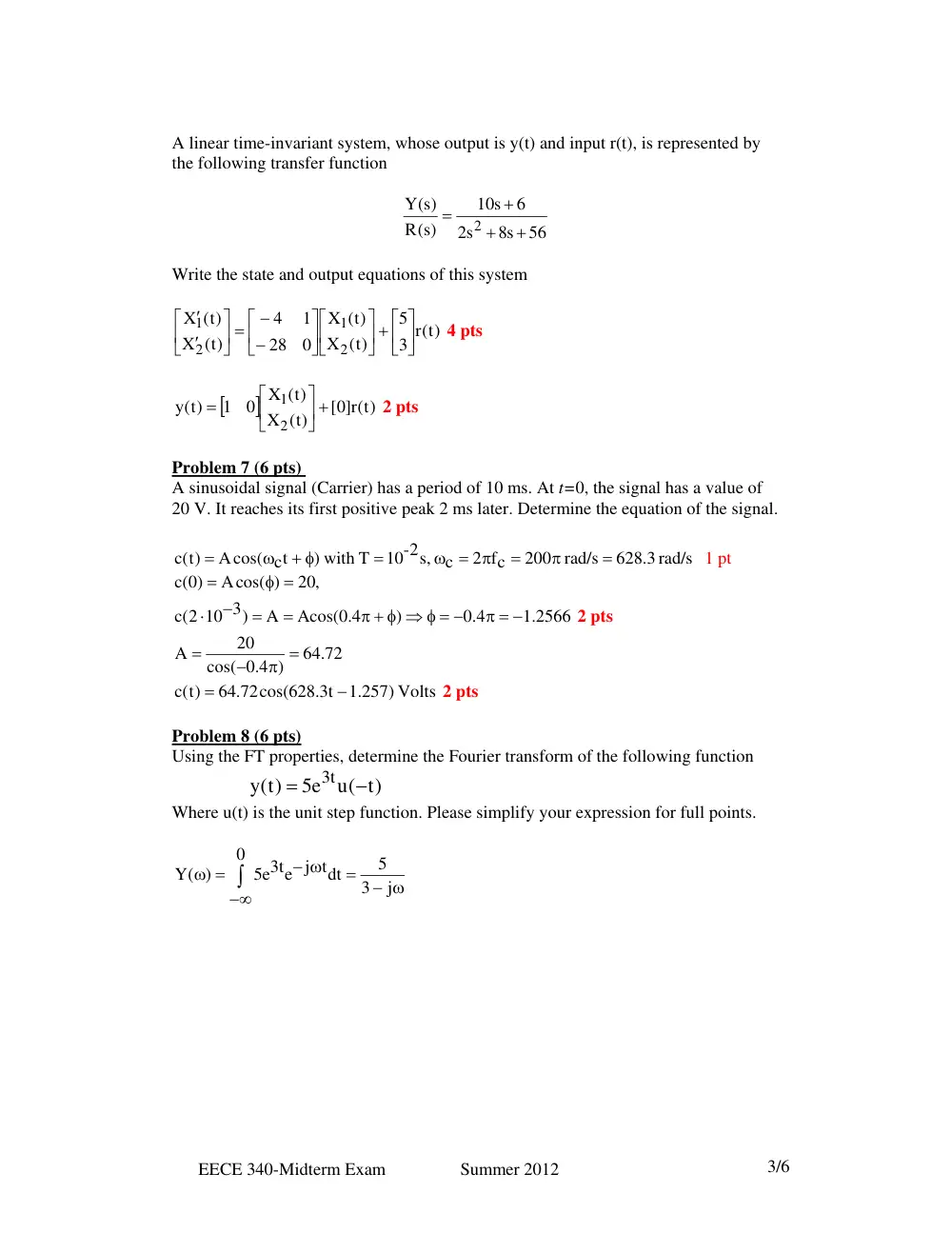
A linear time-invariant system, whose output is y(t) and input r(t), is represented by
the following transfer function
56
8s
s
2
6
10s
R )s(
)s(
Y
2
+
+
+
=
Write the state and output equations of this system
)t(r
3
5
)t(
X
)t(
X
0
28
1
4
)t(
X
)t(
X
2
1
2
1
⎥⎦
⎤
⎢⎣
+ ⎡
⎥⎦
⎤
⎢⎣
⎡
⎥⎦
⎤
⎢⎣
⎡
−
−
=
⎥⎦
⎤
⎢⎣
⎡
′
′
4 pts
[
]
)t(r]
[0
)t(
X
)t(
0 X
1
)t(
y
2
1
+
⎥⎦
⎤
⎢⎣
⎡
=
2 pts
Problem 7 (6 pts)
A sinusoidal signal (Carrier) has a period of 10 ms. At t=0, the signal has a value of
20 V. It reaches its first positive peak 2 ms later. Determine the equation of the signal.
628.3 rad/s
200 rad/s
2 fc
c
10-2 ,s
) with T
tc
Acos(
)t(c
=
π
=
ω = π
=
+ φ
ω
=
1 pt
64.72
)
4.0
cos(
20
A
.1 2566
0.4
)
Acos(0.4
A
2 10 3)
(c
20,
Acos( )
0)
(c
π =
−
=
π = −
π + φ ⇒ φ = −
=
=
−
⋅
φ =
=
2 pts
.1 257 ) Volts
64.72cos(628 t3.
)t(c
−
=
2 pts
Problem 8 (6 pts)
Using the FT properties, determine the Fourier transform of the following function
)t
5e u(
)t(
y
t3
−
=
Where u(t) is the unit step function. Please simplify your expression for full points.
− ω
=
ω
−
−∞
ω =
∫
j
3
5
j tdt
et3
5e
0
Y( )
EECE 340-Midterm Exam Summer 2012
4/6
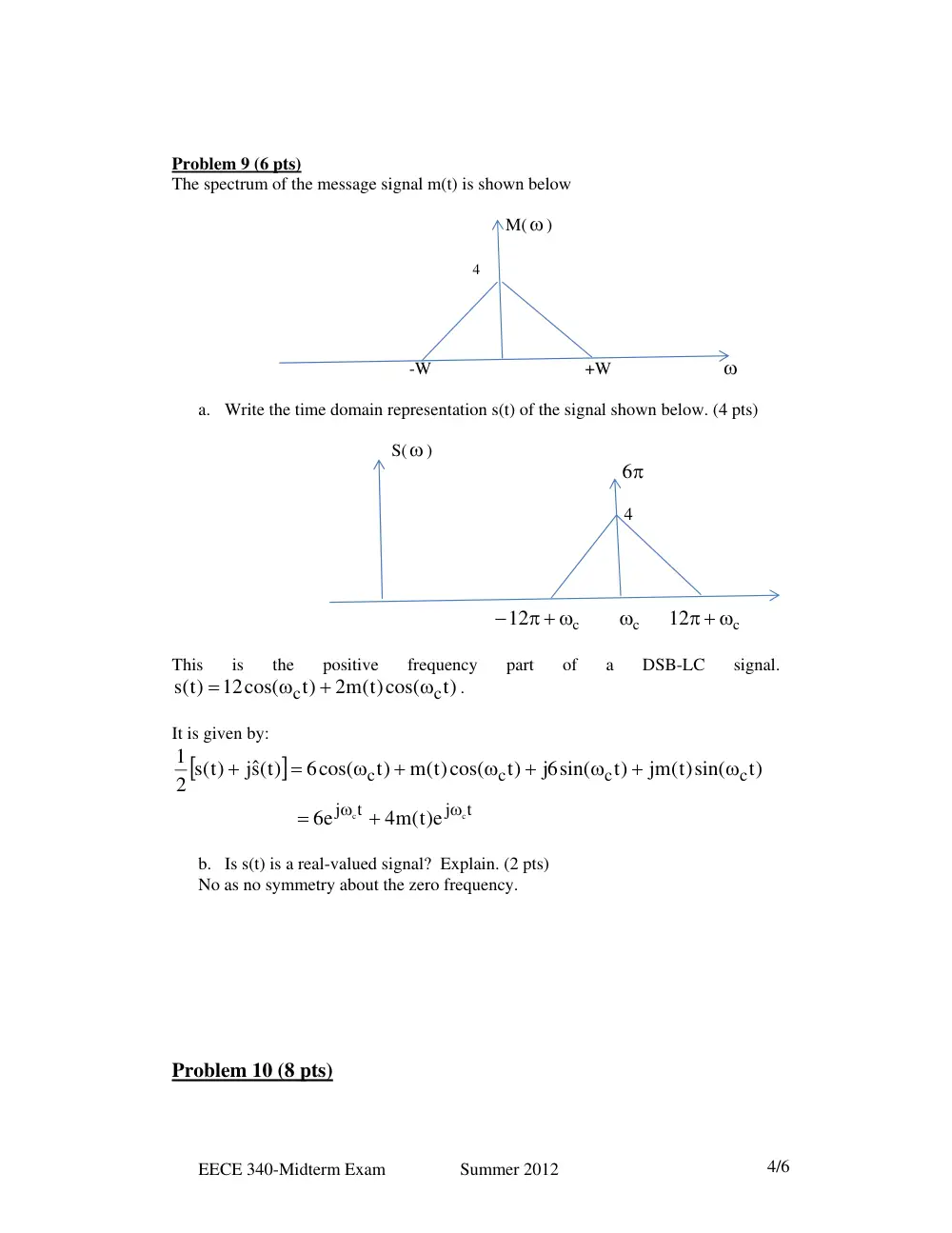
Problem 9 (6 pts)
The spectrum of the message signal m(t) is shown below
M(ω )
-W +W ω
a. Write the time domain representation s(t) of the signal shown below. (4 pts)
S(ω )
π
6
4
c
12
π + ω
−
c
ω
c
12
π + ω
This
is
the
positive
frequency
part
of
a
DSB-LC
signal.
)t
cos(
2m )t(
)t
12cos(
)t(s
c
c
ω
+
ω
=
.
It is given by:
[
]
t
j
t
j
c
c
c
c
c
c
e)t(
4m
6e
)t
jm )t( sin(
)t
6j sin(
)t
cos(
m )t(
)t
6cos(
)t(sˆj
)t(s
2
1
ω
ω
+
=
ω
+
ω
+
ω
+
ω
=
+
b. Is s(t) is a real-valued signal? Explain. (2 pts)
No as no symmetry about the zero frequency.
Problem 10 (8 pts)
4
EECE 340-Midterm Exam Summer 2012
5/6
Let m(t) be a band-limited signal of bandwidth W rad/s. Using m(t), we construct the
signal
)t
m t( )]cos(
A 1[
)t(s
ω0
+
=
where
ω0 >> W
rad/s. The signal s(t) is
imputed to the following system. Let y(t) be the output of the system as shown
below.
Band-Pass filter
s(t) Mid-frequency
0
ω y(t)
X Bandwidth =2 W rad/s
cos
)t
(2
ω0
a. Determine y(t). (4 pts)
The output of the multiplier:
[
]
[
]
[
]
)tc
cos(3
m )t(
2 1
Ac
)tc
cos(
m )t(
2 1
Ac
)tc
cos(2
)tc
cos(
m )t(
Ac 1
)tc
cos(
)t(s
ω
+
+
ω
+
=
ω
ω
+
=
ω
[
]
)tc
cos(
m )t(
2 1
Ac
y )t(
ω
+
=
b. Determine the bandwidth of y(t). (4 pts)
BW=2W rad/s.
Problem 11 (8 pts)
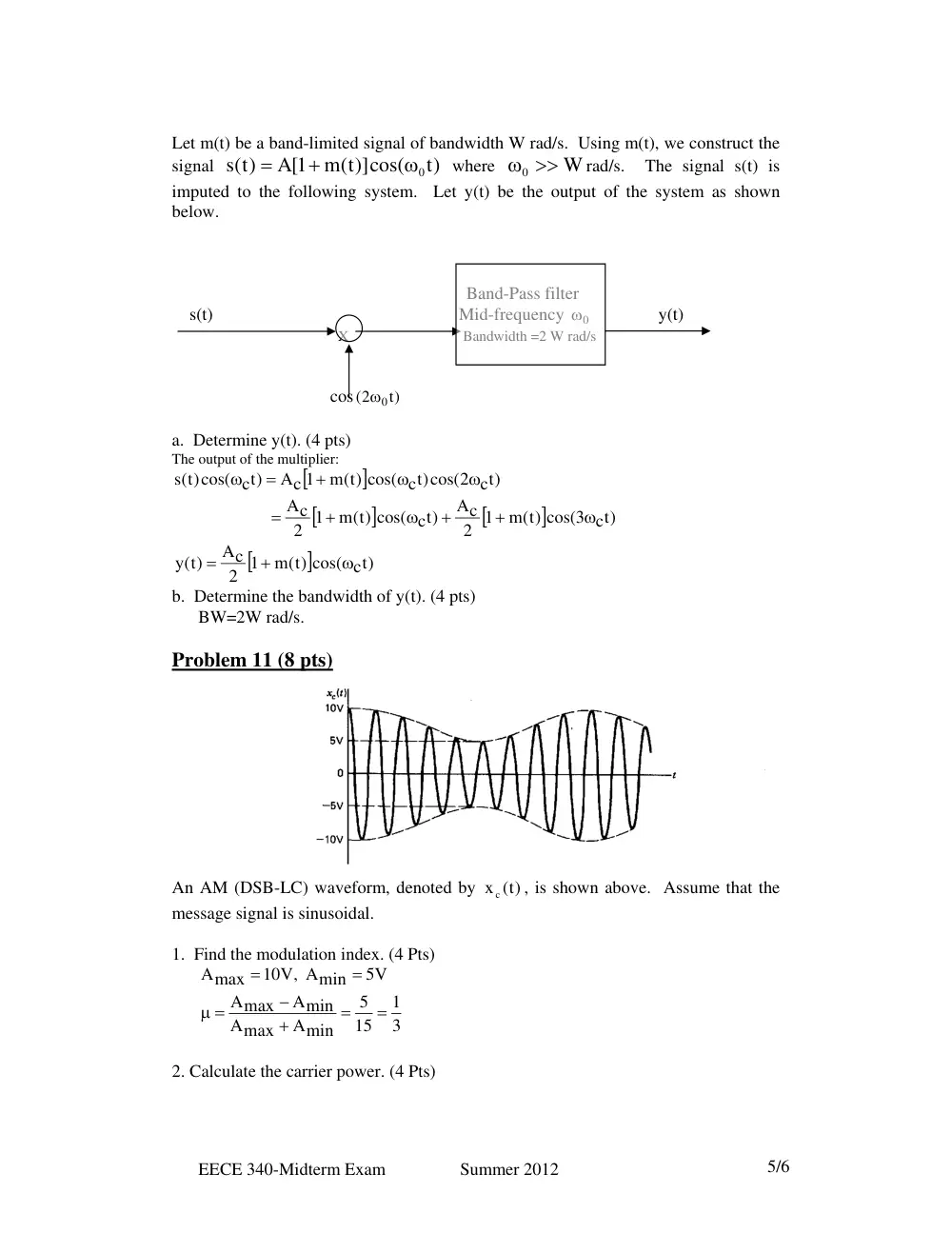
An AM (DSB-LC) waveform, denoted by
)t(
x c
, is shown above. Assume that the
message signal is sinusoidal.
1. Find the modulation index. (4 Pts)
3
1
15
5
Amin
Amax
Amin
max
A
5V
10V , Amin
max
A
=
=
+
−
=
μ
=
=
2. Calculate the carrier power. (4 Pts)
EECE 340-Midterm Exam Summer 2012
6/6
[
]
28.125 Watts
8
225
2
2
15
2
1
av
P
2 Volts
15
Ac
3
1
Ac 1
10
Ac 1
max
A
=
=
⎟⎠
⎞
⎜⎝
⎛
=
=
⇒
⎥⎦
⎤
⎢⎣
⎡ +
=
+ μ ⇒
=
Problem 12 (6 pts)
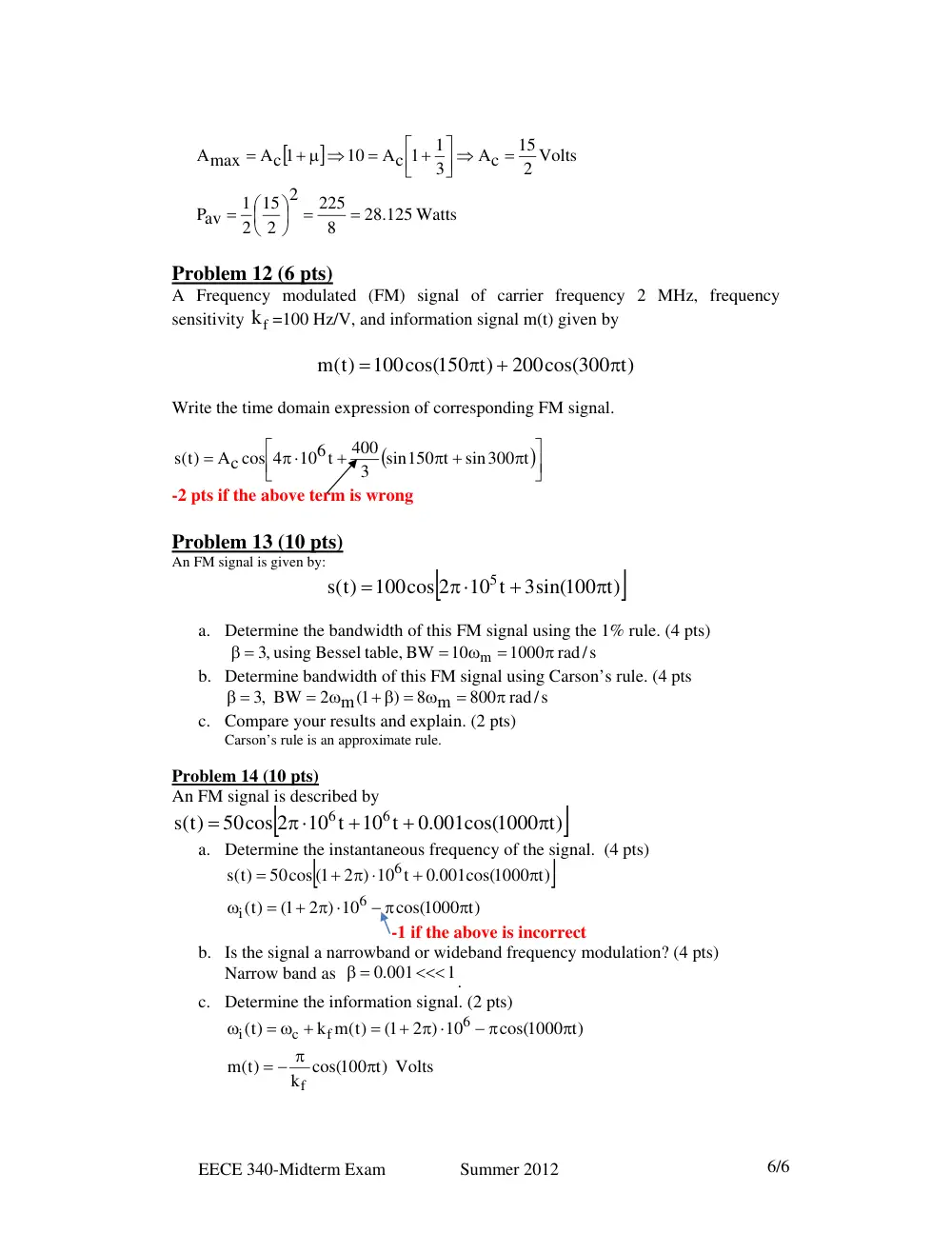
A Frequency modulated (FM) signal of carrier frequency 2 MHz, frequency
sensitivity
fk =100 Hz/V, and information signal m(t) given by
)t
200cos(300
)t
100cos(150
m )t(
π
+
π
=
Write the time domain expression of corresponding FM signal.
(
)⎥⎦
⎤
⎢⎣
⎡
π
π +
+
π⋅
=
sin300 t
sin150 t
3
400
106t
Ac cos 4
)t(s
-2 pts if the above term is wrong
Problem 13 (10 pts)
An FM signal is given by:
[
])t
3sin(100
10 t
100cos 2
)t(s
5
π
+
π⋅
=
a. Determine the bandwidth of this FM signal using the 1% rule. (4 pts)
1000 rad s/
10
,3 using Bessel table, BW
m
π
=
ω
=
β =
b. Determine bandwidth of this FM signal using Carson’s rule. (4 pts
800 rad s/
8 m
)
2 m 1(
,3 BW
π
=
+ β = ω
= ω
β =
c. Compare your results and explain. (2 pts)
Carson’s rule is an approximate rule.
Problem 14 (10 pts)
An FM signal is described by
[
])t
.0 001cos(1000
10 t
10 t
50cos 2
)t(s
6
6
π
+
+
π⋅
=
a. Determine the instantaneous frequency of the signal. (4 pts)
[
]
)t
cos(1000
2 ) 10
1(
)t(
)t
.0 001cos(1000
2 ) 10 t
50cos 1(
)t(s
6
i
6
π
− π
+ π ⋅
=
ω
π
+
+ π ⋅
=
-1 if the above is incorrect
b. Is the signal a narrowband or wideband frequency modulation? (4 pts)
Narrow band as
1
.0 001
<<<
β =
.
c. Determine the information signal. (2 pts)
Volts
)t
k cos(100
)t(
m
)t
cos(1000
2 ) 10
1(
k m )t(
)t(
f
6
f
c
i
π
− π
=
π
− π
+ π ⋅
=
= ω +
ω