
EECE 380 Problems Solution Manual, Fall 2011
American University of Beirut · Engineering Electromagnetics · 55 pages · with solution


Showing the first 10 of 55 pages. Download the PDF to see all of it.
More EECE 380 files
- Problems Solution Manual · Fall 2011Problems · with solutionView
- Problems Solution Manual · Fall 2011Problems · with solutionView
- Problems Solution Manual · Fall 2011Problems · with solutionView
- Problems Solution Manual · Fall 2011Problems · with solutionView
- Problems Solution Manual · Fall 2011Problems · with solutionView
- Problems Solution Manual · Fall 2011Problems · with solutionView
- Problems Solution Manual · Fall 2011Problems · with solutionView
- Problems · Spring 2008ProblemsView
Show the text of this problems
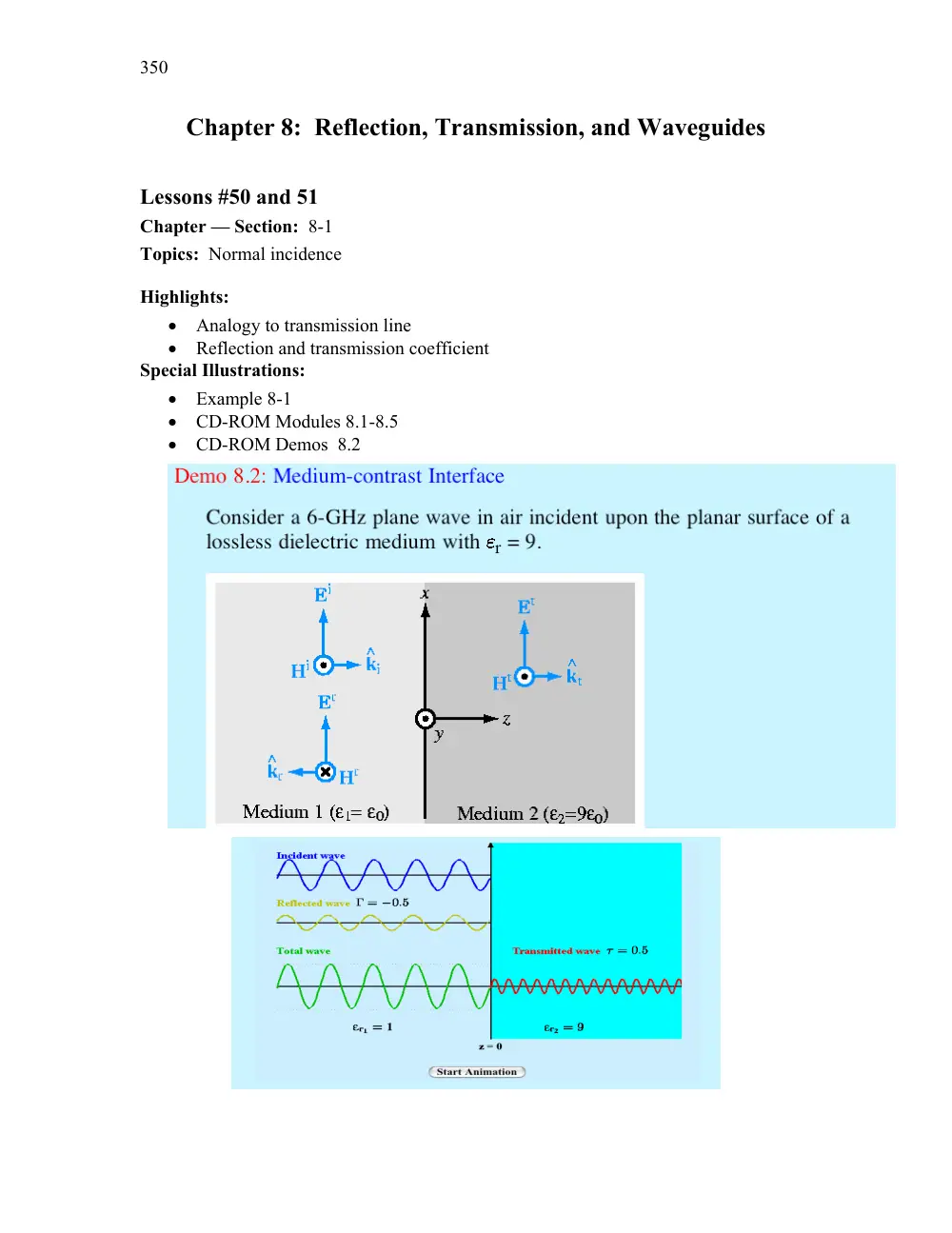
350
Chapter 8: Reflection, Transmission, and Waveguides
Lessons #50 and 51
Chapter — Section: 8-1
Topics: Normal incidence
Highlights:
• Analogy to transmission line
• Reflection and transmission coefficient
Special Illustrations:
• Example 8-1
• CD-ROM Modules 8.1-8.5
• CD-ROM Demos 8.2
351
Lesson #52
Chapter — Section: 8-2
Topics: Snell’s laws
Highlights:
• Reflection and refraction
• Index of refraction
Special Illustrations:
• Example 8-4
• Technology Brief on “Lasers” (CD-ROM)
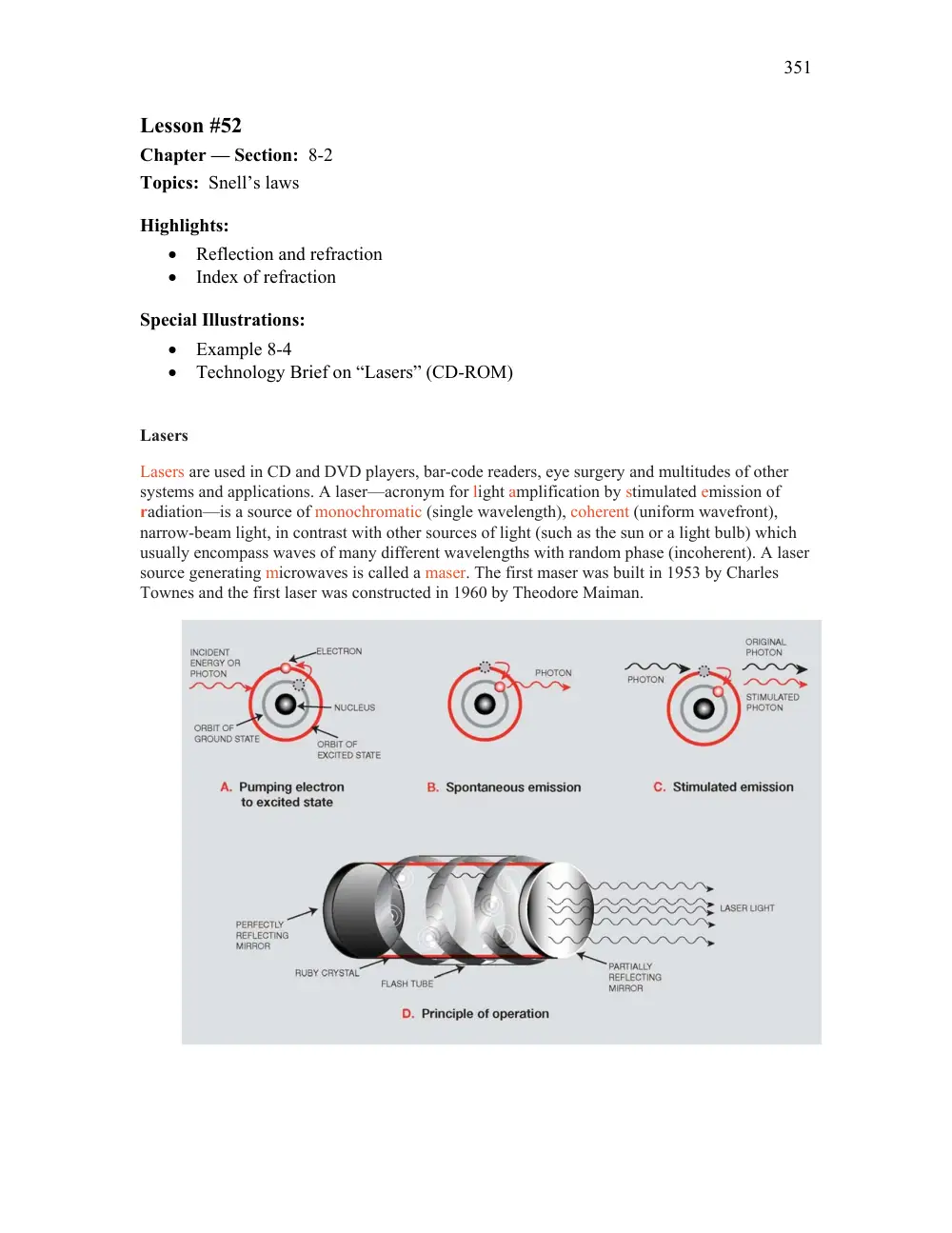
Lasers
Lasers are used in CD and DVD players, bar-code readers, eye surgery and multitudes of other
systems and applications. A laser—acronym for light amplification by stimulated emission of
radiation—is a source of monochromatic (single wavelength), coherent (uniform wavefront),
narrow-beam light, in contrast with other sources of light (such as the sun or a light bulb) which
usually encompass waves of many different wavelengths with random phase (incoherent). A laser
source generating microwaves is called a maser. The first maser was built in 1953 by Charles
Townes and the first laser was constructed in 1960 by Theodore Maiman.
352
Lesson #53
Chapter — Section: 8-3
Topics: Fiber optics
Highlights:
• Structure of an optical fiber
• Dispersion
Special Illustrations:
• Example 8-5
• Technology Brief on “Bar-Code Reader” (CD-ROM)
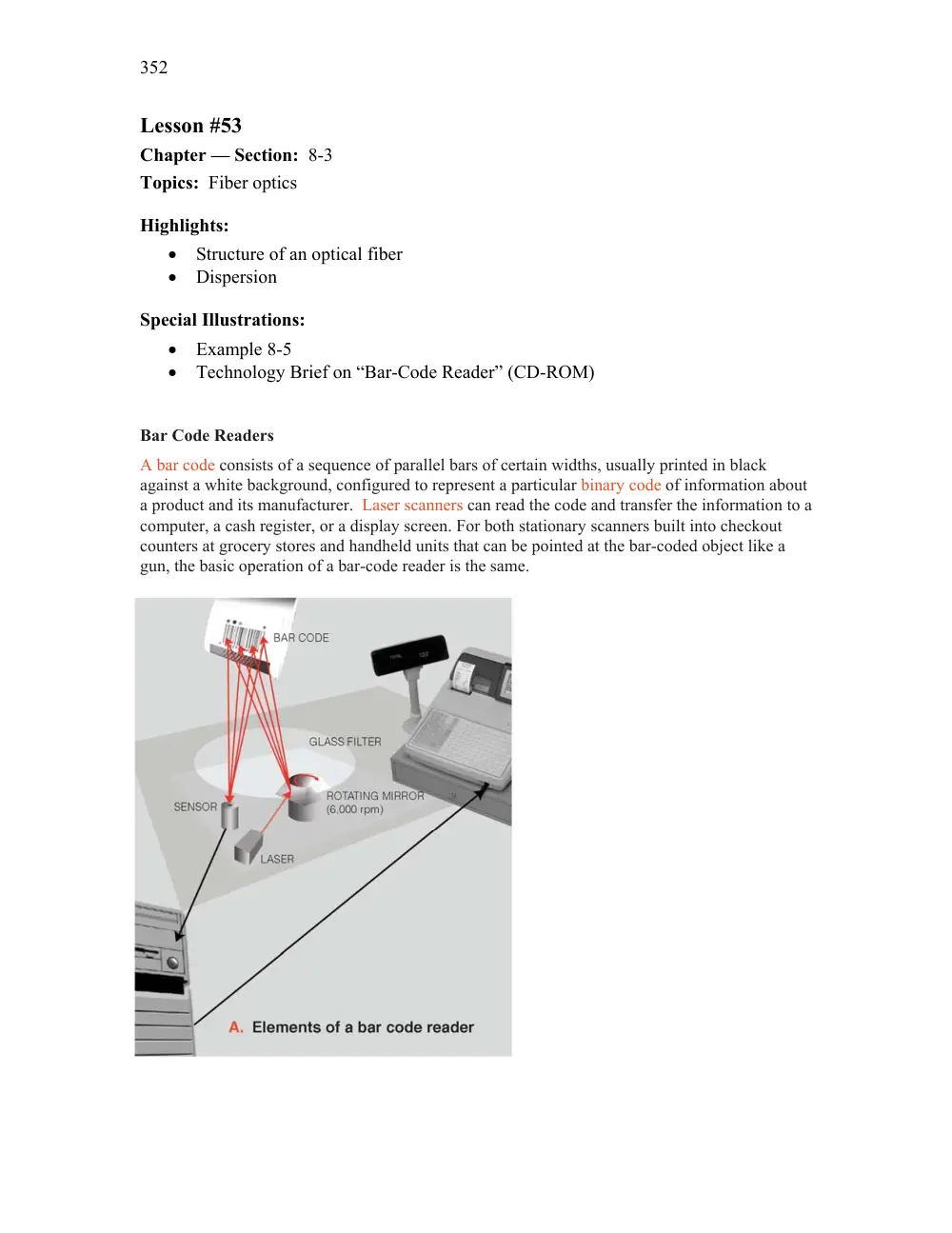
Bar Code Readers
A bar code consists of a sequence of parallel bars of certain widths, usually printed in black
against a white background, configured to represent a particular binary code of information about
a product and its manufacturer. Laser scanners can read the code and transfer the information to a
computer, a cash register, or a display screen. For both stationary scanners built into checkout
counters at grocery stores and handheld units that can be pointed at the bar-coded object like a
gun, the basic operation of a bar-code reader is the same.
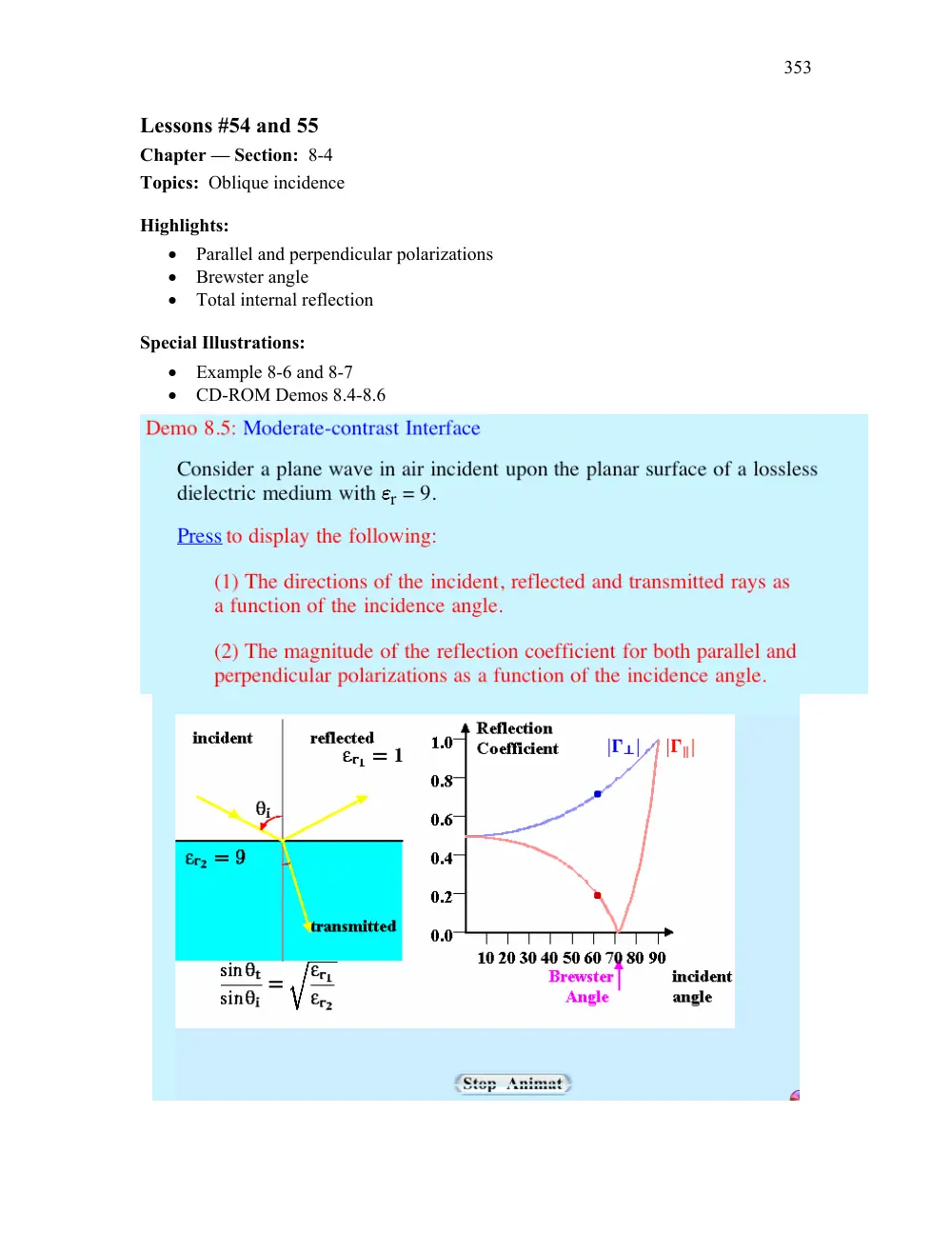
353
Lessons #54 and 55
Chapter — Section: 8-4
Topics: Oblique incidence
Highlights:
• Parallel and perpendicular polarizations
• Brewster angle
• Total internal reflection
Special Illustrations:
• Example 8-6 and 8-7
• CD-ROM Demos 8.4-8.6
354
Lesson #56
Chapter — Section: 8-5
Topics: Reflectivity and transmissivity
Highlights:
• Power relations
Special Illustrations:
• Example 8-7
355
Lessons #57–59
Chapter — Section: 8-6 to 8-10
Topics: Waveguides
Highlights:
• TE and TM modes
• Cutoff frequency
• Phase and group velocities
Special Illustrations:
• Examples 8-8, 8-9, and 8-10
Lesson #60
Chapter — Section: 8-11
Topics: Cavity Resonators
Highlights:
• Resonant frequency
• Q factor
• Applications
356
CHAPTER 8
Chapter 8
Section 8-1: Reflection and Transmission at Normal Incidence
Problem 8.1
A plane wave in air with an electric field amplitude of 20 V/m is
incident normally upon the surface of a lossless, nonmagnetic medium with εr = 25.
Determine:
(a) the reflection and transmission coefficients,
(b) the standing-wave ratio in the air medium, and
(c) the average power densities of the incident, reflected, and transmitted waves.
Solution:
(a)
η1 = η0 = 120π
(Ω),
η2 = η0
√εr
= 120π
5
= 24π
(Ω).
From Eqs. (8.8a) and (8.9),
Γ = η2 −η1
η2 +η1
= 24π−120π
24π+120π = −96
144 = −0.67,
τ = 1+Γ = 1−0.67 = 0.33.
(b)
S = 1+|Γ|
1−|Γ| = 1+0.67
1−0.67 = 5.
(c) According to Eqs. (8.19) and (8.20),
Si
av = |Ei
0|2
2η0
=
400
2×120π = 0.52 W/m2,
Sr
av = |Γ|2Si
av = (0.67)2 ×0.52 = 0.24 W/m2,
St
av = |τ|2 |Ei
0|2
2η2
= |τ|2 η1
η2
Si
av = (0.33)2 × 120π
24π ×0.52 = 0.28 W/m2.
Problem 8.2
A plane wave traveling in medium 1 with εr1 = 2.25 is normally
incident upon medium 2 with εr2 = 4. Both media are made of nonmagnetic, non-
conducting materials. If the electric field of the incident wave is given by
Ei = ˆy8cos(6π×109t −30πx)
(V/m),
(a) obtain time-domain expressions for the electric and magnetic fields in each of
the two media, and
CHAPTER 8
357
(b) determine the average power densities of the incident, reflected and transmitted
waves.
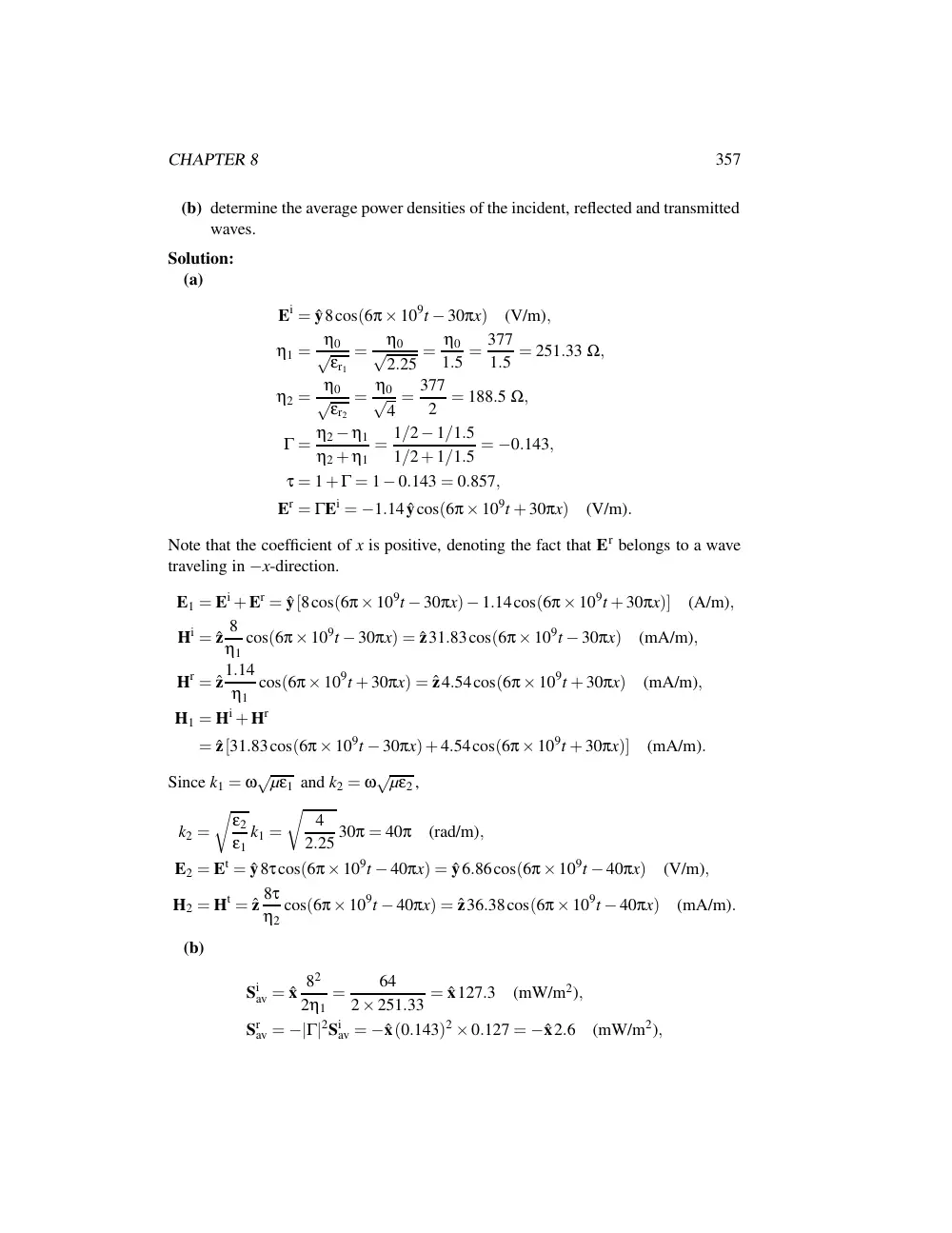
Solution:
(a)
Ei = ˆy8cos(6π×109t −30πx)
(V/m),
η1 = η0
√εr1
=
η0
√
2.25
= η0
1.5 = 377
1.5 = 251.33 Ω,
η2 = η0
√εr2
= η0
√
4
= 377
2
= 188.5 Ω,
Γ = η2 −η1
η2 +η1
= 1/2−1/1.5
1/2+1/1.5 = −0.143,
τ = 1+Γ = 1−0.143 = 0.857,
Er = ΓEi = −1.14 ˆycos(6π×109t +30πx)
(V/m).
Note that the coefficient of x is positive, denoting the fact that Er belongs to a wave
traveling in −x-direction.
E1 = Ei +Er = ˆy[8cos(6π×109t −30πx)−1.14cos(6π×109t +30πx)]
(A/m),
Hi = ˆz 8
η1
cos(6π×109t −30πx) = ˆz31.83cos(6π×109t −30πx)
(mA/m),
Hr = ˆz1.14
η1
cos(6π×109t +30πx) = ˆz4.54cos(6π×109t +30πx)
(mA/m),
H1 = Hi +Hr
= ˆz[31.83cos(6π×109t −30πx)+4.54cos(6π×109t +30πx)]
(mA/m).
Since k1 = ω√µε1 and k2 = ω√µε2 ,
k2 =
�ε2
ε1
k1 =
�
4
2.25 30π = 40π
(rad/m),
E2 = Et = ˆy8τcos(6π×109t −40πx) = ˆy6.86cos(6π×109t −40πx)
(V/m),
H2 = Ht = ˆz 8τ
η2
cos(6π×109t −40πx) = ˆz36.38cos(6π×109t −40πx)
(mA/m).
(b)
Si
av = ˆx 82
2η1
=
64
2×251.33 = ˆx127.3
(mW/m2),
Sr
av = −|Γ|2Si
av = −ˆx(0.143)2 ×0.127 = −ˆx2.6
(mW/m2),
358
CHAPTER 8
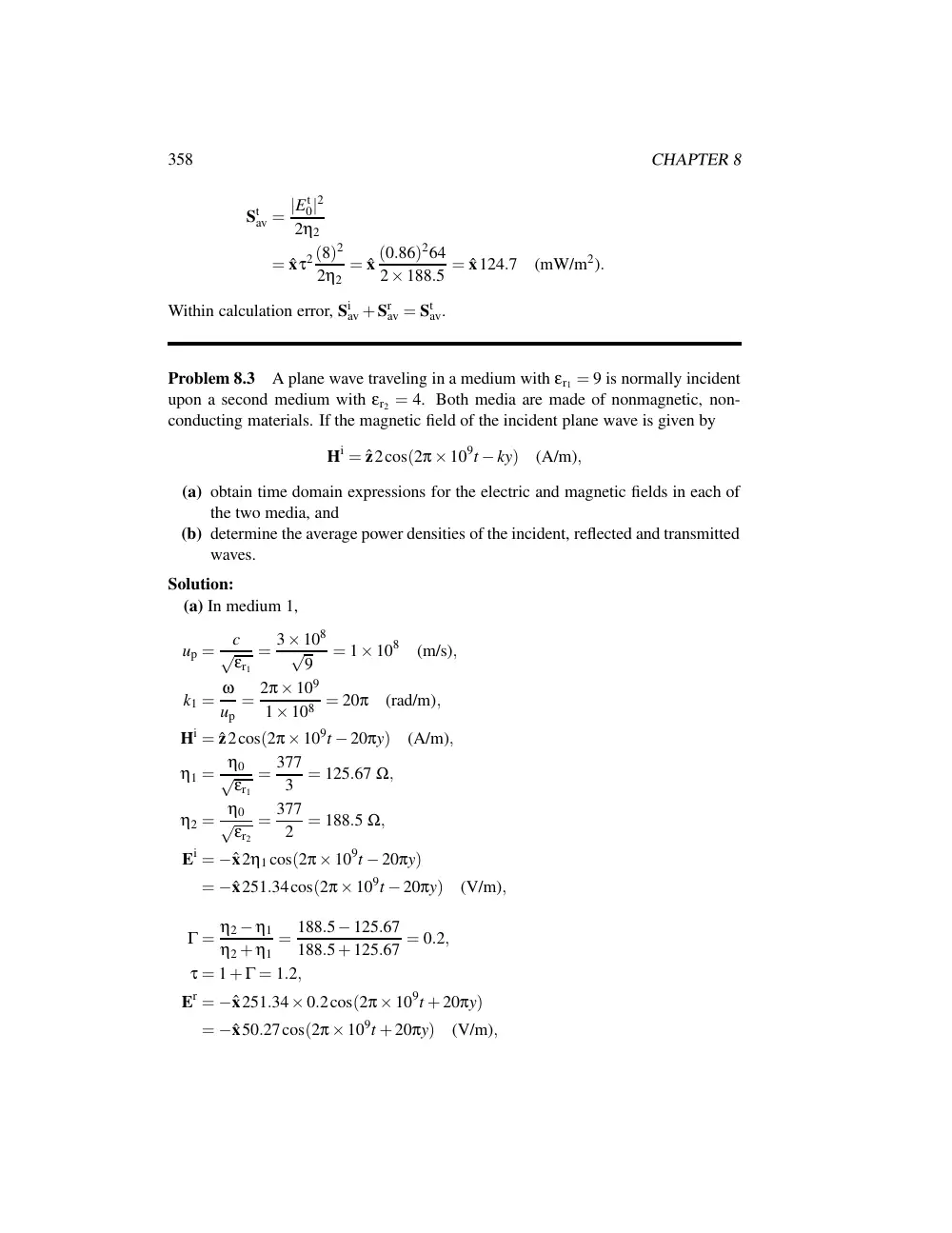
St
av = |Et
0|2
2η2
= ˆxτ2 (8)2
2η2
= ˆx (0.86)264
2×188.5 = ˆx124.7
(mW/m2).
Within calculation error, Si
av +Sr
av = St
av.
Problem 8.3
A plane wave traveling in a medium with εr1 = 9 is normally incident
upon a second medium with εr2 = 4. Both media are made of nonmagnetic, non-
conducting materials. If the magnetic field of the incident plane wave is given by
Hi = ˆz2cos(2π×109t −ky)
(A/m),
(a) obtain time domain expressions for the electric and magnetic fields in each of
the two media, and
(b) determine the average power densities of the incident, reflected and transmitted
waves.
Solution:
(a) In medium 1,
up =
c
√εr1
= 3×10⁸
√
9
= 1×10⁸
(m/s),
k1 = ω
up
= 2π×109
1×108 = 20π
(rad/m),
Hi = ˆz2cos(2π×109t −20πy)
(A/m),
η1 = η0
√εr1
= 377
3
= 125.67 Ω,
η2 = η0
√εr2
= 377
2
= 188.5 Ω,
Ei = −ˆx2η1 cos(2π×109t −20πy)
= −ˆx251.34cos(2π×109t −20πy)
(V/m),
Γ = η2 −η1
η2 +η1
= 188.5−125.67
188.5+125.67 = 0.2,
τ = 1+Γ = 1.2,
Er = −ˆx251.34×0.2cos(2π×109t +20πy)
= −ˆx50.27cos(2π×109t +20πy)
(V/m),
CHAPTER 8
359
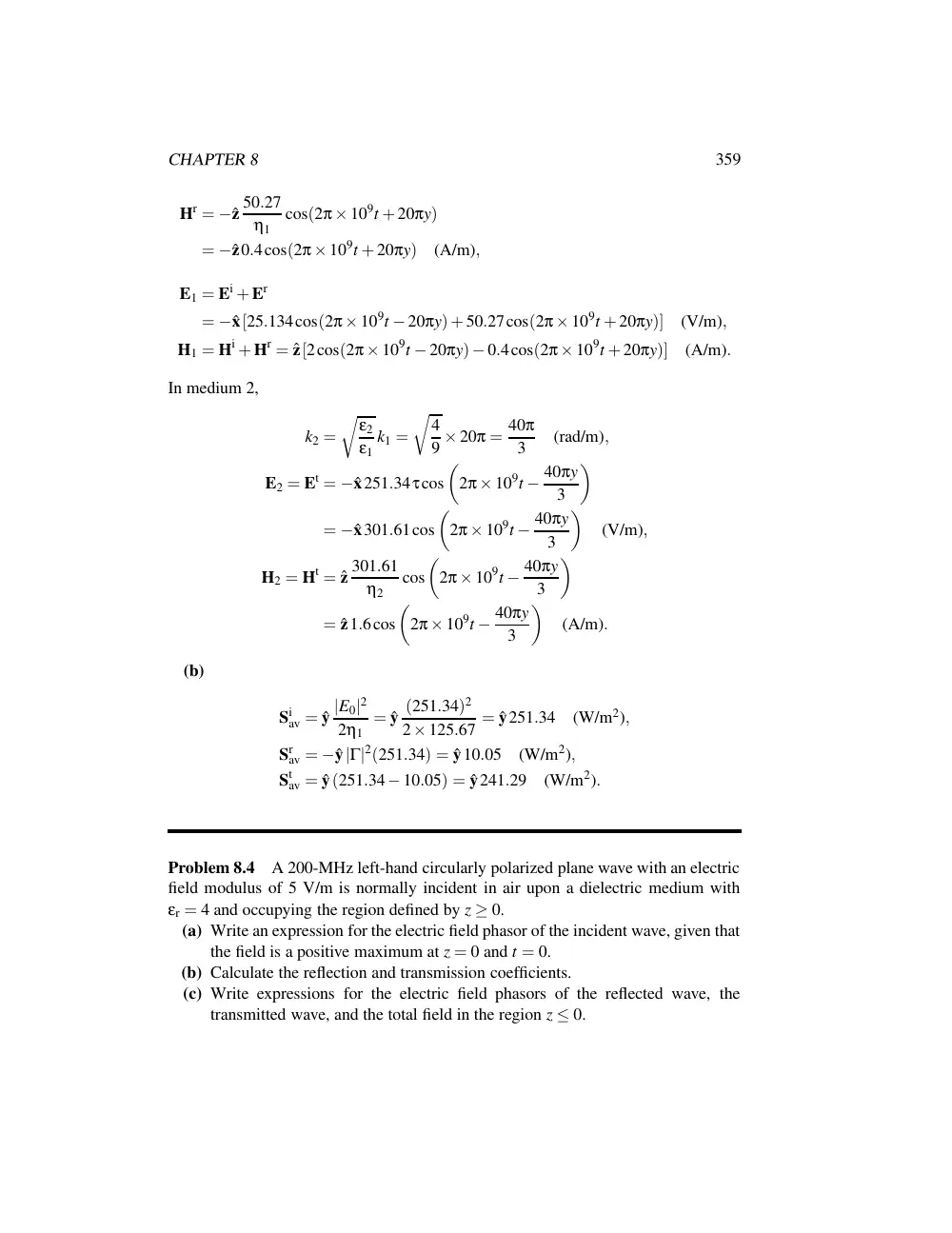
Hr = −ˆz 50.27
η1
cos(2π×109t +20πy)
= −ˆz0.4cos(2π×109t +20πy)
(A/m),
E1 = Ei +Er
= −ˆx[25.134cos(2π×109t −20πy)+50.27cos(2π×109t +20πy)]
(V/m),
H1 = Hi +Hr = ˆz[2cos(2π×109t −20πy)−0.4cos(2π×109t +20πy)]
(A/m).
In medium 2,
k2 =
�ε2
ε1
k1 =
�
4
9 ×20π = 40π
3
(rad/m),
E2 = Et = −ˆx251.34τcos
�
2π×109t − 40πy
3
�
= −ˆx301.61cos
�
2π×109t − 40πy
3
�
(V/m),
H2 = Ht = ˆz 301.61
η2
cos
�
2π×109t − 40πy
3
�
= ˆz1.6cos
�
2π×109t − 40πy
3
�
(A/m).
(b)
Si
av = ˆy |E0|2
2η1
= ˆy (251.34)2
2×125.67 = ˆy251.34
(W/m2),
Sr
av = −ˆy|Γ|2(251.34) = ˆy10.05
(W/m2),
St
av = ˆy(251.34−10.05) = ˆy241.29
(W/m2).
Problem 8.4
A 200-MHz left-hand circularly polarized plane wave with an electric
field modulus of 5 V/m is normally incident in air upon a dielectric medium with
εr = 4 and occupying the region defined by z ≥ 0.
(a) Write an expression for the electric field phasor of the incident wave, given that
the field is a positive maximum at z = 0 and t = 0.
(b) Calculate the reflection and transmission coefficients.
(c) Write expressions for the electric field phasors of the reflected wave, the
transmitted wave, and the total field in the region z ≤ 0.
360
CHAPTER 8
(d) Determine the percentages of the incident average power reflected by the
boundary and transmitted into the second medium.
Solution:
(a)
k1 = ω
c = 2π×2×108
3×108
= 4π
3 rad/m,
k2 = ω
up2
= ω
c
√εr2 = 4π
3
√
4 = 8π
3 rad/m.
LHC wave:
�Ei = a0(ˆx+ ˆyejπ/2)e− jkz = a0(ˆx+ jˆy)e− jkz,
Ei(z,t) = ˆxa0 cos(ωt −kz)− ˆya0 sin(ωt −kz),
|Ei| = [a2
0 cos2(ωt −kz)+a2
0 sin2(ωt −kz)]1/2 = a0 = 5
(V/m).
Hence,
�Ei = 5(ˆx+ jˆy)e− j4πz/3
(V/m).
(b)
η1 = η0 = 120π
(Ω),
η2 = η0
√εr
= η0
2 = 60π
(Ω).
Equations (8.8a) and (8.9) give
Γ = η2 −η1
η2 +η1
= 60π−120π
60π+120π = −60
180 = −1
3 ,
τ = 1+Γ = 2
3 .
(c)
�Er = 5Γ(ˆx+ jˆy)ejk1z = −5
3(ˆx+ jˆy)ej4πz/3
(V/m),
�Et = 5τ(ˆx+ jˆy)e− jk2z = 10
3 (ˆx+ jˆy)e− j8πz/3
(V/m),
�E1 = �Ei + �Er = 5(ˆx+ jˆy)
�
e− j4πz/3 − 1
3ej4πz/3
�
(V/m).
(d)
% of reflected power = 100×|Γ|2 = 100
9
= 11.11%,
% of transmitted power = 100×|τ|2 η1
η2
= 100×
�2
3
�2
× 120π
60π = 88.89%.
CHAPTER 8
361
Problem 8.5
Repeat Problem 8.4 after replacing the dielectric medium with a poor
conductor characterized by εr = 2.25, µr = 1, and σ = 10−4 S/m.
Solution:
(a) Medium 1:
η1 = η0 = 120π
(Ω),
k1 = ω
c = 2π×2×108
3×108
= 4π
3
(rad/m).
Medium 2:
σ2
ωε2
=
10−4 ×36π
2π×2×108 ×2.25×10−9 = 4×10⁻³.
Hence, medium 2 is a low-loss dielectric. From Table 7-1,
α2 = σ2
2
�µ2
ε2
= σ2
2
120π
√εr2
= σ2
2 × 120π
√
2.25
= 10−4
2
× 120π
1.5 = 1.26×10⁻²
(NP/m),
β2 = ω√µ2ε2 = ω√εr2
c
= 2π
(rad/m),
η2 =
�µ2
ε2
�
1+ jσ2
2ωε2
�
= 120π
√εr2
�
1+ j2×10−3�
≃ 120π
1.5 = 80π
(Ω).
LHC wave:
�Ei = a0(ˆx+ jˆy)e− jk1z,
|�Ei| = a0 = 5
(V/m),
�Ei = 5(ˆx+ jˆy)e− j4πz/3
(V/m).
(b) According to Eqs. (8.8a) and (8.9),
Γ = η2 −η1
η2 +η1
= 80π−120π
80π+120π = −0.2,
τ = 1+Γ = 1−0.2 = 0.8.
(c)
�Er = 5Γ(ˆx+ jˆy)ejk1z = −(ˆx+ jˆy)ej4πz/3
(V/m),
�Et = 5τ(ˆx+ jˆy)e−α2ze− jβzz = 4(ˆx+ jˆy)e−1.26×10⁻²ze− j2πz
(V/m),
�E1 = �Ei + �Er = 5(ˆx+ jˆy)[e− j4πz/3 −0.2e j4πz/3]
(V/m).
362
CHAPTER 8
(d)
% of reflected power = 100|Γ|2 = 100(0.2)2 = 4%,
% of transmitted power = 100|τ|2 η1
η2
= 100(0.8)2 × 120π
80π = 96%.
Problem 8.6
A 50-MHz plane wave with electric field amplitude of 50 V/m is
normally incident in air onto a semi-infinite, perfect dielectric medium with εr = 36.
Determine (a) Γ, (b) the average power densities of the incident and reflected waves,
and (c) the distance in the air medium from the boundary to the nearest minimum of
the electric field intensity, |E|.
Solution:
(a)
η1 = η0 = 120π
(Ω),
η2 =
�µ2
ε2
= 120π
√εr2
= 120π
6
= 20π
(Ω),
Γ = η2 −η1
η2 +η1
= 20π−120π
20π+120π = −0.71.
Hence, |Γ| = 0.71 and θη = 180◦.
(b)
Si
av = |Ei
0|2
2η1
=
(50)2
2×120π = 3.32
(W/m2),
Sr
av = |Γ|2Si
av = (0.71)2 ×3.32 = 1.67
(W/m2).
(c) In medium 1 (air),
λ1 = c
f = 3×10⁸
5×107 = 6 m.
From Eqs. (8.16) and (8.17),
lmax = θrλ1
4π = π×6
4π
= 1.5 m,
lmin = lmax − λ1
4 = 1.5−1.5 = 0 m (at the boundary).
Problem 8.7
What is the maximum amplitude of the total electric field in the air
medium of Problem 8.6, and at what nearest distance from the boundary does it
occur?
CHAPTER 8
363
Solution: From Problem 8.6, Γ = −0.71 and λ = 6 m.
|�E1|max = (1+|Γ|)Ei
0 = (1+0.71)×50 = 85.5 V/m,
lmax = θrλ1
4π = π×6
4π
= 1.5 m.
Problem 8.8
Repeat Problem 8.6 after replacing the dielectric medium with a
conductor with εr = 1, µr = 1, and σ = 2.78×10⁻³ S/m.
Solution:
(a) Medium 1:
η1 = η0 = 120π = 377
(Ω),
λ1 = c
f = 3×10⁸
5×107 = 6 m,
Medium 2:
σ2
ωε2
= 2.78×10−3 ×36π
2π×5×107 ×10−9 = 1.
Hence, Medium 2 is a quasi-conductor. From Eq. (7.70),
η2 =
�µ2
ε2
�
1− jε′′
2
ε′
2
�−1/2
= 120π
�
1− j σ2
ωε2
�−1/2
= 120π(1− j1)−1/2
= 120π(
√
2)−1/2ej22.5◦ = (292.88+ j121.31)
(Ω).
Γ = η2 −η1
η2 +η1
= (292.88+ j121.31)−377
(292.88+ j121.31)+377 = −0.09+ j0.12 = 0.22∠114.5◦ .
(b)
Si
av = |Ei
0|2
2η1
=
502
2×120π = 3.32
(W/m2),
|Sr
av| = |Γ|2Si
av = (0.22)2(3.32) = 0.16
(W/m2).
(c) In medium 1 (air),
λ1 = c
f = 3×10⁸
5×107 = 6 m.
For θr = 114.5◦ = 2 rad, Eqs. (8.16) and (8.17) give
lmax = θrλ1
4π + (0)λ1
2
= 2(6)
4
+0 = 3 m,
364
CHAPTER 8
lmin = lmax − λ1
4 = 3− 6
4 = 3−1.5 = 1.5 m.
Problem 8.9
The three regions shown in Fig. 8-32 (P8.9) contain perfect
dielectrics. For a wave in medium 1 incident normally upon the boundary at z = −d,
what combination of εr2 and d produce no reflection? Express your answers in terms
of εr1, εr3 and the oscillation frequency of the wave, f.
Medium 2
εr2
Medium 3
εr3
Medium 1
εr1
z = -d
z = 0
z
d
Figure P8.9: Three dielectric regions.
Solution: By analogy with the transmission-line case, there will be no reflection at
z = −d if medium 2 acts as a quarter-wave transformer, which requires that
d = λ2
4
and
η2 = √η1η3 .
The second condition may be rewritten as
η0
√εr2
=
� η0
√εr1
η0
√εr3
�1/2
,
or
εr2 = √εr1εr3 ,
λ2 = λ0
√εr2
=
c
f√εr2
=
c
f(εr1εr3)1/4 ,
and
d =
c
4f(εr1εr3)1/4 .
CHAPTER 8
365
Problem 8.10
For the configuration shown in Fig. 8-32 (P8.9), use transmission-
line equations (or the Smith chart) to calculate the input impedance at z = −d for
εr1 = 1, εr2 = 9, εr3 = 4, d = 1.2 m, and f = 50 MHz. Also determine the fraction
of the incident average power density reflected by the structure. Assume all media
are lossless and nonmagnetic.
Solution: In medium 2,
λ = λ0
√εr2
=
c
f√εr2
=
3×10⁸
5×107 ×3 = 2 m.
Hence,
β2 = 2π
λ2
= π rad/m,
β2d = 1.2π rad.
At z = −d, the input impedance of a transmission line with load impedance ZL is
given by Eq. (2.63) as
Zin(−d) = Z0
�ZL + jZ0tanβ2d
Z0 + jZLtanβ2d
�
.
In the present case, Z0 = η2 = η0/√εr2 = η0/3 and ZL = η3 = η0/√εr3 = η0/2,
where η0 = 120π (Ω). Hence,
Zin(−d) = η2
�η3 + jη2tanβ2d
η2 + jη3tanβ2d
�
= η0
3
� 1
2 + j
�1
3
�
tan1.2π
1
3 + j
�1
2
�
tan1.2π
�
= η0(0.35− j0.14).
At z = −d,
Γ = Zin −Z1
Zin +Z1
= η0(0.35− j0.14)−η0
η0(0.35− j0.14)+η0
= 0.49e− j162.14◦.
Fraction of incident power reflected by the structure is |Γ|2 = |0.49|2 = 0.24.
Problem 8.11
Repeat Problem 8.10 after interchanging εr1 and εr3.
Solution: In medium 2,
λ = λ0
√εr2
=
c
f√εr2
=
3×10⁸
5×107 ×3 = 2 m.
366
CHAPTER 8
Hence,
β2 = 2π
λ2
= π rad/m,
β2d = 1.2π rad.
At z = −d, the input impedance of a transmission line with impedance ZL is given as
Eq. (2.63),
Zin(−d) = Z0
� ZL + jZ0 tanβd
Z0 + jZLtanβ2d
�
.
In the present case, Z0 = η2 = η0/√εr2 = η0/3,
ZL = η3 = η0/√εr1 = η0, where
η0 = 120π (Ω). Hence,
Zin(−d) = η2
�η3 + jη2 tan1.2π
η2 + jη3 tan1.2π
�
= η0
3
�1+(j/3)tan1.2π
(1/3)+ jtan1.2π
�
= η0
�1+(j/3)tan1.2π
1+ j3tan1.2π
�
= (0.266− j0.337)η0 = 0.43η0∠−51.7◦ .
At z = −d,
Γ = Zin −Z1
Zin +Z1
= 0.43∠−51.7◦ − 1
2
0.43∠−51.7◦ + 1
2
= 0.49∠−101.1◦ .
Fraction of incident power reflected by structure is |Γ|2 = 0.24.
Problem 8.12
Orange light of wavelength 0.61 µm in air enters a block of glass
with εr = 1.44. What color would it appear to a sensor embedded in the glass? The
wavelength ranges of colors are violet (0.39 to 0.45 µm), blue (0.45 to 0.49 µm),
green (0.49 to 0.58 µm), yellow (0.58 to 0.60 µm), orange (0.60 to 0.62 µm), and red
(0.62 to 0.78 µm).
Solution: In the glass,
λ = λ0
√εr
= 0.61
√
1.44
= 0.508 µm.
The light would appear green.
Problem 8.13
A plane wave of unknown frequency is normally incident in air upon
the surface of a perfect conductor. Using an electric-field meter, it was determined
that the total electric field in the air medium is always zero when measured at a
CHAPTER 8
367
distance of 2 m from the conductor surface. Moreover, no such nulls were observed
at distances closer to the conductor. What is the frequency of the incident wave?
Solution: The electric field of the standing wave is zero at the conductor surface,
and the standing wave pattern repeats itself every λ/2. Hence,
λ
2 = 2 m,
or λ = 4 m,
in which case
f = c
λ = 3×10⁸
4
= 7.5×107 = 75 MHz.
Problem 8.14
Consider a thin film of soap in air under illumination by yellow light
with λ = 0.6 µm in vacuum. If the film is treated as a planar dielectric slab with
εr = 1.72, surrounded on both sides by air, what film thickness would produce strong
reflection of the yellow light at normal incidence?
Solution: The transmission line analogue of the soap-bubble wave problem is shown
in Fig. P8.14(b) where the load ZL is equal to η0, the impedance of the air medium
on the other side of the bubble. That is,
η0 = 377 Ω,
η1 =
377
√
1.72
= 287.5 Ω.
The normalized load impedance is
zL = η0
η1
= 1.31.
For the reflection by the soap bubble to be the largest, Zin needs to be the most
different from η0. This happens when zL is transformed through a length λ/4. Hence,
L = λ
4 =
λ0
4√εr
= 0.6 µm
4
√
1.72
= 0.115 µm,
where λ is the wavelength of the soap bubble material. Strong reflections will also
occur if the thickness is greater than L by integer multiples of nλ/2 = (0.23n) µm.
Hence, in general
L = (0.115+0.23n) µm,
n = 0,1,2,... .
According to Section 2-7.5, transforming a load ZL = 377 Ω through a λ/4 section
of Z0 = 287.5 Ω ends up presenting an input impedance of
Zin = Z2
0
ZL
= (287.5)2
377
= 219.25 Ω.
368
CHAPTER 8
Yellow Light
λ = 0.6 µm
Air
Soap
Air
εr1=1
εr3=1
εr2=1.72
L
(b) Transmission-line equivalent circuit
η0 = 377Ω
η2
ZL = η0 = 377 Ω
(a) Yellow light incident on soap bubble.
Figure P8.14: Diagrams for Problem 8.14.
This Zin is at the input side of the soap bubble. The reflection coefficient at that
interface is
Γ = Zin −η0
Zin +η0
= 219.25−377
219.25+377 = −0.27.
Any other thickness would produce a reflection coeffficient with a smaller magnitude.
Problem 8.15
A 5-MHz plane wave with electric field amplitude of 10 (V/m) is
normally incident in air onto the plane surface of a semi-infinite conducting material
with εr = 4, µr = 1, and σ = 100 (S/m). Determine the average power dissipated
(lost) per unit cross-sectional area in a 2-mm penetration of the conducting medium.
Solution: For convenience, let us choose Ei to be along ˆx and the incident direction
to be +ˆz. With
k1 = ω
c = 2π×5×106
3×108
= π
30
(rad/m),
CHAPTER 8
369
we have
Ei = ˆx10cos
�
π×107t − π
30 z
�
(V/m),
η1 = η0 = 377 Ω.
From Table 7-1,
ε′′
ε′ =
σ
ωεrε0
=
100×36π
π×107 ×4×10−9 = 9×10⁴,
which makes the material a good conductor, for which
α2 =
�
π fµσ =
�
π×5×106 ×4π×10−7 ×100 = 44.43
(Np/m),
β2 = 44.43
(rad/m),
ηc2 = (1+ j) α2
σ = (1+ j) 44.43
100 = 0.44(1+ j) Ω.
According to the expression for Sav2 given in the answer to Exercise 8.3,
Sav2 = ˆz|τ|2 |Ei
0|2
2
e−2α2z Re
� 1
η∗c2
�
.
The power lost is equal to the difference between Sav2 at z = 0 and Sav2 at z = 2 mm.
Thus,
P′ = power lost per unit cross-sectional area
= Sav2(0)−Sav2(z = 2 mm)
= |τ|2 |Ei
0|2
2
Re
� 1
η∗c2
�
[1−e−2α2z1]
where z1 = 2 mm.
τ = 1+Γ
= 1+ η2 −η1
η2 +η1
= 1+ 0.44(1+ j)−377
0.44(1+ j)+377 ≈ 0.0023(1+ j) = 3.3×10⁻³ej45◦.
Re
� 1
η∗c2
�
= Re
�
1
0.44(1+ j)∗
�
= Re
�
1
0.44(1− j)
�
= Re
� 1+ j
0.44×2
�
=
1
0.88 = 1.14,
P′ = (3.3×10⁻³)2 102
2 ×1.14[1−e−2×44.43×2×10−3] = 1.01×10⁻⁴
(W/m2).
370
CHAPTER 8
Problem 8.16
A 0.5-MHz antenna carried by an airplane flying over the ocean
surface generates a wave that approaches the water surface in the form of a normally
incident plane wave with an electric-field amplitude of 3,000 (V/m). Sea water is
characterized by εr = 72, µr = 1, and σ = 4 (S/m). The plane is trying to communicate
a message to a submarine submerged at a depth d below the water surface. If the
submarine’s receiver requires a minimum signal amplitude of 0.01 (µV/m), what is
the maximum depth d to which successful communication is still possible?
Solution: For sea water at 0.5 MHz,
ε′′
ε′ = σ
ωε =
4×36π
2π×0.5×106 ×72×10−9 = 2000.
Hence, sea water is a good conductor, in which case we use the following expressions
from Table 7-1:
α2 =
�
π fµσ =
�
π×0.5×106 ×4π×10−7 ×4 = 2.81
(Np/m),
β2 = 2.81
(rad/m),
ηc2 = (1+ j) α2
σ = (1+ j) 2.81
4
= 0.7(1+ j) Ω,
Γ = η2 −η1
η2 +η1
= 0.7(1+ j)−377
0.7(1+ j)+377 = (−0.9963+ j3.7×10−3),
τ = 1+Γ = 5.24×10⁻³ej44.89◦,
|Et| = |τEi
0e−α2d|.
We need to find the depth z at which |E t| = 0.01 µV/m = 10−8 V/m.
10−8 = 5.24×10−3 ×3×103e−2.81d,
e−2.81d = 6.36×10⁻¹⁰,
−2.81d = ln(6.36×10⁻¹⁰) = −21.18,
or
d = 7.54
(m).
CHAPTER 8
371
Sections 8-2 and 8-3: Snell’s Laws and Fiber Optics
Problem 8.17
A light ray is incident on a prism at an angle θ as shown in Fig.
8-33 (P8.17). The ray is refracted at the first surface and again at the second surface.
In terms of the apex angle φ of the prism and its index of refraction n, determine
the smallest value of θ for which the ray will emerge from the other side. Find this
minimum θ for n = 4 and φ = 60◦.
θ
θ3
φ
n
A
B
C
θ2
Figure P8.17: Prism of Problem 8.17.
Solution: For the beam to emerge at the second boundary, it is necessary that
θ3 < θc,
where sinθc = 1/n. From the geometry of triangle ABC,
180◦ = φ+(90◦ −θ2)+(90◦ −θ3),
or θ2 = φ−θ3. At the first boundary, sinθ = nsinθ2. Hence,
sinθmin = nsin(φ−θ3) = nsin
�
φ−sin−1
�1
n
��
,
or
θmin = sin−1
�
nsin
�
φ−sin−1
�1
n
���
.
For n = 4 and φ = 60◦,
θmin = sin−1
�
4sin(60◦ −sin−1
�1
4
��
= 20.4◦.
372
CHAPTER 8
Problem 8.18
For some types of glass, the index of refraction varies with
wavelength. A prism made of a material with
n = 1.71− 4
30 λ0,
(λ0 in µm),
where λ0 is the wavelength in vacuum, was used to disperse white light as shown in
Fig. 8-34 (P8.18). The white light is incident at an angle of 50◦, the wavelength λ0 of
red light is 0.7 µm and that of violet light is 0.4 µm. Determine the angular dispersion
in degrees.
50°
60°
Red
Green
Violet
Angular dispersion
A
B
C
θ4
θ3
θ2
Figure P8.18: Prism of Problem 8.18.
Solution: For violet,
nv = 1.71− 4
30 ×0.4 = 1.66,
sinθ2 = sinθ
nv
= sin50◦
1.66 ,
or
θ2 = 27.48◦.
From the geometry of triangle ABC,
180◦ = 60◦ +(90◦ −θ2)+(90◦ −θ3),
or
θ3 = 60◦ −θ2 = 60−27.48◦ = 32.52◦,
and
sinθ4 = nv sinθ3 = 1.66sin32.52◦ = 0.89,
or
θ4 = 63.18◦.
CHAPTER 8
373
For red,
nr = 1.71− 4
30 ×0.7 = 1.62,
θ2 = sin−1
�sin50◦
1.62
�
= 28.22◦,
θ3 = 60◦ −28.22◦ = 31.78◦,
θ4 = sin−1 [1.62sin31.78◦] = 58.56◦.
Hence, angular dispersion = 63.18◦ −58.56◦ = 4.62◦.
Problem 8.19
The two prisms in Fig. 8-35 (P8.19) are made of glass with n = 1.5.
What fraction of the power density carried by the ray incident upon the top prism
emerges from bottom prism? Neglect multiple internal reflections.
45°
45°
45°
45°
90°
90°
Si
St
6
5
4
3
2
1
Figure P8.19: Periscope problem.
Solution: Using η = η0/n, at interfaces 1 and 4,
Γa = n1 −n2
n1 +n2
= 1−1.5
1+1.5 = −0.2.
At interfaces 3 and 6,
Γb = −Γa = 0.2.
374
CHAPTER 8
At interfaces 2 and 5,
θc = sin−1
�1
n
�
= sin−1
� 1
1.5
�
= 41.81◦.
Hence, total internal reflection takes place at those interfaces. At interfaces 1, 3, 4
and 6, the ratio of power density transmitted to that incident is (1−Γ2). Hence,
St
Si = (1−Γ2)4 = (1−(0.2)2)4 = 0.85.
Problem 8.20
A light ray incident at 45◦ passes through two dielectric materials
with the indices of refraction and thicknesses given in Fig. 8-36 (P8.20). If the ray
strikes the surface of the first dielectric at a height of 2 cm, at what height will it strike
the screen?
45°
2cm
screen
n4 = 1
n1 = 1
n3 = 1.3
n2 = 1.5
3cm
4cm
5cm
45°
h4
h3
h2
h1
θ2
θ3
θ4
Figure P8.20: Light incident on a screen through a multi-layered dielectric (Problem
8.20).
Solution:
sinθ2 = n1
n2
sinθ1 = 1
1.5 sin45◦ = 0.47.
Hence,
θ2 = 28.13◦,
h2 = 3 cm×tanθ2 = 3 cm×0.53 = 1.6 cm,
sinθ3 = n2
n3
sinθ2 = 1.5
1.3 sin28.13◦ = 0.54.
Hence,
θ3 = 32.96◦,
CHAPTER 8
375
h3 = 4 cm×tan32.96◦ = 2.6 cm,
sinθ4 = n3
n4
sinθ3 = 0.707.
Hence,
θ4 = 45◦,
h4 = 5 cm×tan45◦ = 5 cm.
Total height = h1 +h2 +h3 +h4 = (2+1.6+2.6+5) = 11.2 cm.
Problem 8.21
Figure P8.21 depicts a beaker containing a block of glass on the
bottom and water over it. The glass block contains a small air bubble at an unknown
depth below the water surface. When viewed from above at an angle of 60◦, the air
bubble appears at a depth of 6.81 cm. What is the true depth of the air bubble?
60°
10 cm
θ2
da
d2
θ2
θ3
x2
x
x1
dt
Figure P8.21: Apparent position of the air bubble in Problem 8.21.
Solution: Let
da = 6.81 cm = apparent depth,
dt = true depth.
θ2 = sin−1
�n1
n2
sinθi
�
= sin−1
� 1
1.33 sin60◦
�
= 40.6◦,
376
CHAPTER 8
θ3 = sin−1
�n1
n3
sinθi
�
= sin−1
� 1
1.6 sin60◦
�
= 32.77◦,
x1 = (10 cm)×tan40.6◦ = 8.58 cm,
x = da cot30◦ = 6.81cot30◦ = 11.8 cm.
Hence,
x2 = x−x1 = 11.8−8.58 = 3.22 cm,
and
d2 = x2 cot32.77◦ = (3.22 cm)×cot32.77◦ = 5 cm.
Hence, dt = (10+5) = 15 cm.
Problem 8.22
A glass semicylinder with n = 1.5 is positioned such that its flat face
is horizontal, as shown in Fig. 8-38 (P8.22). Its horizontal surface supports a drop of
oil, as shown. When light is directed radially toward the oil, total internal reflection
occurs if θ exceeds 53◦. What is the index of refraction of the oil?
θ
nglass= 1.5
noil
oil drop
Figure P8.22: Oil drop on the flat surface of a glass semicylinder (Problem 8.22).
Solution:
sinθc = n2
n1
= noil
1.5,
noil = 1.5sin53◦ = 1.2.
Problem 8.23
A penny lies at the bottom of a water fountain at a depth of 30 cm.
Determine the diameter of a piece of paper which, if placed to float on the surface of
CHAPTER 8
377
d
x
x
30 cm
θc
θc
water surface
Figure P8.23: Light cone bounded by total internal reflection.
the water directly above the penny, would totally obscure the penny from view. Treat
the penny as a point and assume that n = 1.33 for water.
Solution:
θc = sin−1
� 1
1.33
�
= 48.75◦,
d = 2x = 2[(30 cm)tanθc] = (60 cm)×tan48.75◦ = 68.42 cm.
Problem 8.24
Suppose the optical fiber of Example 8-5 is submerged in water (with
n = 1.33) instead of air. Determine θa and fp in that case.
Solution: With n0 = 1.33, nf = 1.52 and nc = 1.49, Eq. (8.40) gives
sinθa = 1
n0
(n2
f −n2
c)1/2 =
1
1.33
�
(1.52)2 −(1.49)2�1/2 = 0.23,
or
θa = 13.1◦.
The data rate fp given by Eq. (8.45) is not a function of n0, and therefore it remains
unchanged at 4.9 (Mb/s).
378
CHAPTER 8
Problem 8.25
Equation (8.45) was derived for the case where the light incident
upon the sending end of the optical fiber extends over the entire acceptance cone
shown in Fig. 8-12(b). Suppose the incident light is constrained to a narrower range
extending between normal incidence and θ′, where θ′ < θa.
(a) Obtain an expression for the maximum data rate fp in terms of θ′.
(b) Evaluate fp for the fiber of Example 8-5 when θ′ = 5◦.
Solution:
(a) For θi = θ′,
sinθ2 = 1
nf
sinθ′,
lmax =
l
cosθ2
=
l
�
1−sin2 θ2
=
l
�
1−
�
sinθ′
nf
�2 =
lnf
�
n2
f −(sinθ′)2
,
tmax = lmax
up
= lmaxnf
c
=
ln2
f
c
�
n2
f −(sinθ′)2
,
tmin = l
up
= l nf
c ,
τ = ∆t = tmax −tmin = l nf
c
nf
�
n2
f −(sinθ′)2
−1
,
fp = 1
2τ =
c
2lnf
nf
�
n2
f −(sinθ′)2
−1
−1
(bits/s).
(b) For:
nf = 1.52,
θ′ = 5◦,
l = 1 km,
c = 3×10⁸ m/s,
fp = 59.88
(Mb/s).
CHAPTER 8
379
Sections 8-4 and 8-5: Reflection and Transmission at Oblique Incidence
Problem 8.26
A plane wave in air with
�Ei = ˆy20e− j(3x+4z)
(V/m),
is incident upon the planar surface of a dielectric material, with εr = 4, occupying the
half space z ≥ 0. Determine:
(a) the polarization of the incident wave,
(b) the angle of incidence,
(c) the time-domain expressions for the reflected electric and magnetic fields,
(d) the time-domain expressions for the transmitted electric and magnetic fields,
and
(e) the average power density carried by the wave in the dielectric medium.
Solution:
(a) �Ei = ˆy20e− j(3x+4z) V/m.
Since Ei is along ˆy, which is perpendicular to the plane of incidence, the wave is
perpendicularly polarized.
(b) From Eq. (8.48a), the argument of the exponential is
− jk1(xsinθi +zcosθi) = − j(3x+4z).
Hence,
k1 sinθi = 3,
k1 cosθi = 4,
from which we determine that
tanθi = 3
4
or
θi = 36.87◦,
and
k1 =
�
32 +42 = 5
(rad/m).
Also,
ω = upk = ck = 3×108 ×5 = 1.5×10⁹
(rad/s).
(c)
η1 = η0 = 377 Ω,
η2 = η0
√εr2
= η0
2 = 188.5 Ω,
θt = sin−1
�sinθi
√εr2
�
= sin−1
�sin36.87◦
√
4
�
= 17.46◦,
380
CHAPTER 8
Γ⊥ = η2 cosθi −η1 cosθt
η2 cosθi +η1 cosθt
= −0.41,
τ⊥ = 1+Γ⊥ = 0.59.
In accordance with Eq. (8.49a), and using the relation E r
0 = Γ⊥Ei
0,
�Er = −ˆy8.2e− j(3x−4z),
�Hr = (ˆx cosθi + ˆzsinθi) 8.2
η0
e− j(3x−4z),
where we used the fact that θi = θr and the z-direction has been reversed.
Er = Re[�Erejωt] = −ˆy8.2cos(1.5×10⁹t −3x+4z)
(V/m),
Hr = (ˆx17.4+ ˆz13.06)cos(1.5×10⁹t −3x+4z)
(mA/m).
(d) In medium 2,
k2 = k1
�ε2
ε1
= 5
√
4 = 20
(rad/m),
and
θt = sin−1
��ε1
ε2
sinθi
�
= sin−1
�1
2 sin36.87◦
�
= 17.46◦
and the exponent of Et and Ht is
− jk2(xsinθt +zcosθt) = − j10(xsin17.46◦ +zcos17.46◦) = − j(3x+9.54z).
Hence,
�Et = ˆy20×0.59e− j(3x+9.54z),
�Ht = (−ˆxcosθt + ˆzsinθt) 20×0.59
η2
e− j(3x+9.54z).
Et = Re[�Etejωt] = ˆy11.8cos(1.5×10⁹t −3x−9.54z)
(V/m),
Ht = (−ˆxcos17.46◦ + ˆzsin17.46◦) 11.8
188.5 cos(1.5×10⁹t −3x−9.54z)
= (−ˆx59.72+ ˆz18.78) cos(1.5×10⁹t −3x−9.54z)
(mA/m).
(e)
St
av = |Et
0|2
2η2
= (11.8)2
2×188.5 = 0.36
(W/m2).
CHAPTER 8
381
Problem 8.27
Repeat Problem 8.26 for a wave in air with
�Hi = ˆy2×10−2e− j(8x+6z)
(A/m),
incident upon the planar boundary of a dielectric medium (z ≥ 0) with εr = 9.
Solution:
(a) �H
i = ˆy2×10−2e− j(8x+6z).
Since Hi is along ˆy, which is perpendicular to the plane of incidence, the wave is
TM polarized, or equivalently, its electric field vector is parallel polarized (parallel to
the plane of incidence).
(b) From Eq. (8.65b), the argument of the exponential is
− jk1(xsinθi +zcosθi) = − j(8x+6z).
Hence,
k1 sinθi = 8,
k1 cosθi = 6,
from which we determine
θi = tan−1
�8
6
�
= 53.13◦,
k1 =
�
62 +82 = 10
(rad/m).
Also,
ω = upk = ck = 3×108 ×10 = 3×10⁹
(rad/s).
(c)
η1 = η0 = 377 Ω,
η2 = η0
√εr2
= η0
3 = 125.67 Ω,
θt = sin−1
�sinθi
√εr2
�
= sin−1
�sin53.13◦
√
9
�
= 15.47◦,
Γ∥ = η2 cosθt −η1 cosθi
η2 cosθt +η1 cosθi
= −0.30,
τ∥ = (1+Γ∥) cosθi
cosθt
= 0.44.
In accordance with Eqs. (8.65a) to (8.65d), E i
0 = 2×10⁻²η1 and
�Ei = (ˆxcosθi − ˆzsinθi)2×10⁻²η1 e− j(8x+6z) = (ˆx4.52− ˆz6.03)e− j(8x+6z).
382
CHAPTER 8
�Er is similar to �Ei except for reversal of z-components and multiplication of amplitude
by Γ∥. Hence, with Γ∥ = −0.30,
Er = Re[�E
rejωt] = −(ˆx1.36+ ˆz1.81)cos(3×10⁹t −8x+6z) V/m,
Hr = ˆy2×10−2Γ∥ cos(3×10⁹t −8x+6z)
= −ˆy0.6×10−2 cos(3×10⁹t −8x+6z) A/m.
(d) In medium 2,
k2 = k1
�ε2
ε1
= 10
√
9 = 30 rad/m,
θt = sin−1
��ε2
ε1
sinθi
�
= sin−1
�1
3 sin53.13◦
�
= 15.47◦,
and the exponent of Et and Ht is
− jk2(xsinθt +zcosθt) = − j30(xsin15.47◦ +zcos15.47◦) = − j(8x+28.91z).
Hence,
�Et = (ˆxcosθt − ˆzsinθt)Ei
0τ∥e− j(8x+28.91z)
= (ˆx0.96− ˆz0.27)2×10−2 ×377×0.44e− j(8x+28.91z)
= (ˆx3.18− ˆz0.90)e− j(8x+28.91z),
�Ht = ˆy Ei
0τ∥
η2
e− j(8x+28.91z)
= ˆy2.64×10−2 e− j(8x+28.91z),
Et = Re{�Etejωt}
= (ˆx3.18− ˆz0.90)cos(3×10⁹t −8x−28.91z) V/m,
Ht = ˆy2.64×10−2 cos(3×10⁹t −8x−28.91z) A/m.
(e)
St
av = |Et
0|2
2η2
= |Ht
0|2
2
η2 = (2.64×10⁻²)2
2
×125.67 = 44 mW/m2.
Problem 8.28
Natural light is randomly polarized, which means that, on average,
half the light energy is polarized along any given direction (in the plane orthogonal
CHAPTER 8
383
to the direction of propagation) and the other half of the energy is polarized along the
direction orthogonal to the first polarization direction. Hence, when treating natural
light incident upon a planar boundary, we can consider half of its energy to be in
the form of parallel-polarized waves and the other half as perpendicularly polarized
waves. Determine the fraction of the incident power reflected by the