
EECE 380 Problems Solution Manual, Fall 2011
American University of Beirut · Engineering Electromagnetics · 58 pages · with solution





Showing the first 10 of 58 pages. Download the PDF to see all of it.
More EECE 380 files
- Problems Solution Manual · Fall 2011Problems · with solutionView
- Problems Solution Manual · Fall 2011Problems · with solutionView
- Problems Solution Manual · Fall 2011Problems · with solutionView
- Problems Solution Manual · Fall 2011Problems · with solutionView
- Problems Solution Manual · Fall 2011Problems · with solutionView
- Problems Solution Manual · Fall 2011Problems · with solutionView
- Problems Solution Manual · Fall 2011Problems · with solutionView
- Problems · Spring 2008ProblemsView
Show the text of this problems
107
Chapter 3: Vector Analysis
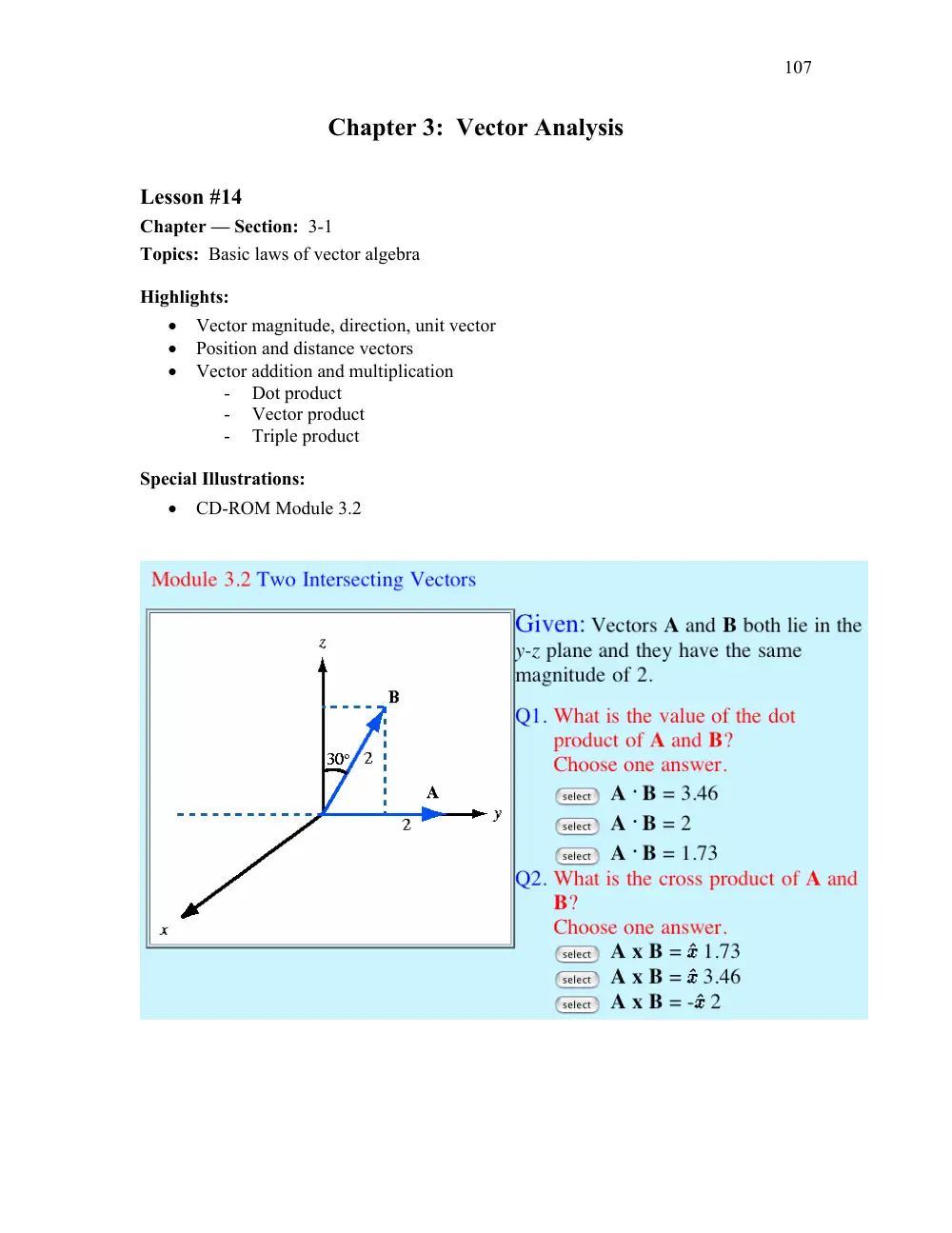
Lesson #14
Chapter — Section: 3-1
Topics: Basic laws of vector algebra
Highlights:
• Vector magnitude, direction, unit vector
• Position and distance vectors
• Vector addition and multiplication
-
Dot product
-
Vector product
-
Triple product
Special Illustrations:
• CD-ROM Module 3.2
108
Lessons #15 and 16
Chapter — Section: 3-2
Topics: Coordinate systems
Highlights:
• Commonly used coordinate systems: Cartesian, cylindrical, spherical
• Choice is based on which one best suits problem geometry
• Differential surface vectors and differential volumes
Special Illustrations:
• Examples 3-3 to 3-5
• Technology Brief on “GPS” (CD-ROM)
Global Positioning System
The Global Positioning System (GPS),
initially developed in the 1980s by the U.S.
Department of Defense as a navigation tool for
military use, has evolved into a system with
numerous civilian applications including vehicle
tracking, aircraft navigation, map displays in
automobiles, and topographic mapping. The
overall GPS is composed of 3 segments. The
space segment consists of 24 satellites (A), each
circling Earth every 12 hours at an orbital
altitude of about 12,000 miles and transmitting
continuous coded time signals. The user segment
consists of hand-held or vehicle-mounted
receivers that determine their own locations by
receiving and processing multiple satellite
signals. The third segment is a network of five
ground stations, distributed around the world,
that monitor the satellites and provide them with
updates on their precise orbital information.
GPS provides a location inaccuracy of about 30
m, both horizontally and vertically, but it
can be improved to within 1 m by
differential GPS (see illustration).
109
Lesson #17
Chapter — Section: 3-3
Topics: Coordinate transformations
Highlights:
• Basic logic for decomposing a vector in one coordinate system into the coordinate
variables of another system
• Transformation relations (Table 3-2)
Special Illustrations:
• Example 3-8
110
Lesson #18
Chapter — Section: 3-4
Topics: Gradient operator
Highlights:
• Derivation of ∇ T in Cartesian coordinates
• Directional derivative
•
∇ T in cylindrical and spherical coordinates
Special Illustrations:
• Example 3-10(b)
• CD-ROM Modules 3.5 or 3.6
• CD-ROM Demos 3.1-3.9 (any 2)
111
Lesson #19
Chapter — Section: 3-5
Topics: Divergence operator
Highlights:
• Concept of “flux”
• Derivation of ∇ .E
• Divergence theorem
Special Illustrations:
• CD-ROM Modules 3.7-3.11 (any 2)
• CD-ROM Demos 3.10-3.15 (any 1 or 2)
112
Lesson #20
Chapter — Section: 3-6
Topics: Curl operator
Highlights:
• Concept of “circulation”
• Derivation of ∇ x B
• Stokes’s theorem
Special Illustrations:
• Example 3-12
113
Lesson #21
Chapter — Section: 3-7
Topics: Laplacian operator
Highlights:
• Definition of
2
∇ V
• Definition of
2
∇ E
Special Illustrations:
• Technology Brief on “X-Ray Computed Tomography”
X-Ray Computed Tomography
Tomography is derived from the Greek words
tome, meaning section or slice, and graphia,
meaning writing. Computed tomography, also
known as CT scan or CAT scan (for computed
axial tomography), refers to a technique
capable of generating 3-D images of the x-ray
attenuation (absorption) properties of an
object. This is in contrast with the traditional
x-ray technique which produces only a 2-D
profile of the object. CT was invented in 1972
by British electrical engineer Godfrey
Hounsfield, and independently by Allan
Cormack, a South African-born American
physicist. The two inventors shared the 1979
Nobel Prize for Physiology or Medicine.
Among diagnostic imaging techniques, CT has
the decided advantage in having the sensitivity
to image body parts on a wide range of
densities, from soft tissue to blood vessels and
bones.
114
CHAPTER 3
Chapter 3
Section 3-1: Vector Algebra
Problem 3.1
Vector A starts at point
� 1
�
� 1
�
� 3
� and ends at point
� 2
�
� 1
� 0
� . Find
a unit vector in the direction of A.
Solution:
A
�
ˆx
� 2
�
1
�
�
ˆy
�
� 1
�
�
� 1
�
�
�
ˆz
� 0
�
�
� 3
�
��
ˆx
�
ˆz3
�
� A
�
�
� 1
�
9
�
3
16
�
ˆa
�
A
� A
�
�
ˆx
�
ˆz3
3
16
�
ˆx0
32
�
ˆz0
95
Problem 3.2
Given vectors A
�
ˆx2
�
ˆy3
�
ˆz, B
�
ˆx2
�
ˆy
�
ˆz3, and C
�
ˆx4
�
ˆy2
�
ˆz2,
show that C is perpendicular to both A and B.
Solution:
A
� C
�
� ˆx2
�
ˆy3
�
ˆz
�
�
� ˆx4
�
ˆy2
�
ˆz2
��
8
�
6
�
2
�
0
�
B
� C
�
� ˆx2
�
ˆy
�
ˆz3
�
�
� ˆx4
�
ˆy2
�
ˆz2
��
8
�
2
�
6
�
0
Problem 3.3
In Cartesian coordinates, the three corners of a triangle are P1
� 0
� 4
� 4
� ,
P2
� 4
�
� 4
� 4
� , and P3
� 2
� 2
�
� 4
� . Find the area of the triangle.
Solution: Let B
�
�
P1P2
�
ˆx4
�
ˆy8 and C
�
�
P1P3
�
ˆx2
�
ˆy2
�
ˆz8 represent two sides of
the triangle. Since the magnitude of the cross product is the area of the parallelogram
(see the definition of cross product in Section 3-1.4), half of this is the area of the
triangle:
A
�
1
2
� B
C
�
�
1
2
�
� ˆx4
�
ˆy8
�
� ˆx2
�
ˆy2
�
ˆz8
�
�
�
1
2
� ˆx
�
� 8
�
�
� 8
�
�
ˆy
�
�
� 4
�
�
� 8
��
�
ˆz
� 4
�
� 2
�
�
�
� 8
� 2
�
�
�
1
2
� ˆx64
�
ˆy32
�
ˆz8
�
�
1
2
�
642
�
322
�
82
�
1
2
� 5184
�
36
�
where the cross product is evaluated with Eq. (3.27).
Problem 3.4
Given A
�
ˆx2
�
ˆy3
�
ˆz1 and B
�
ˆxBx
�
ˆy2
�
ˆzBz:
(a) find Bx and Bz if A is parallel to B;
(b) find a relation between Bx and Bz if A is perpendicular to B.
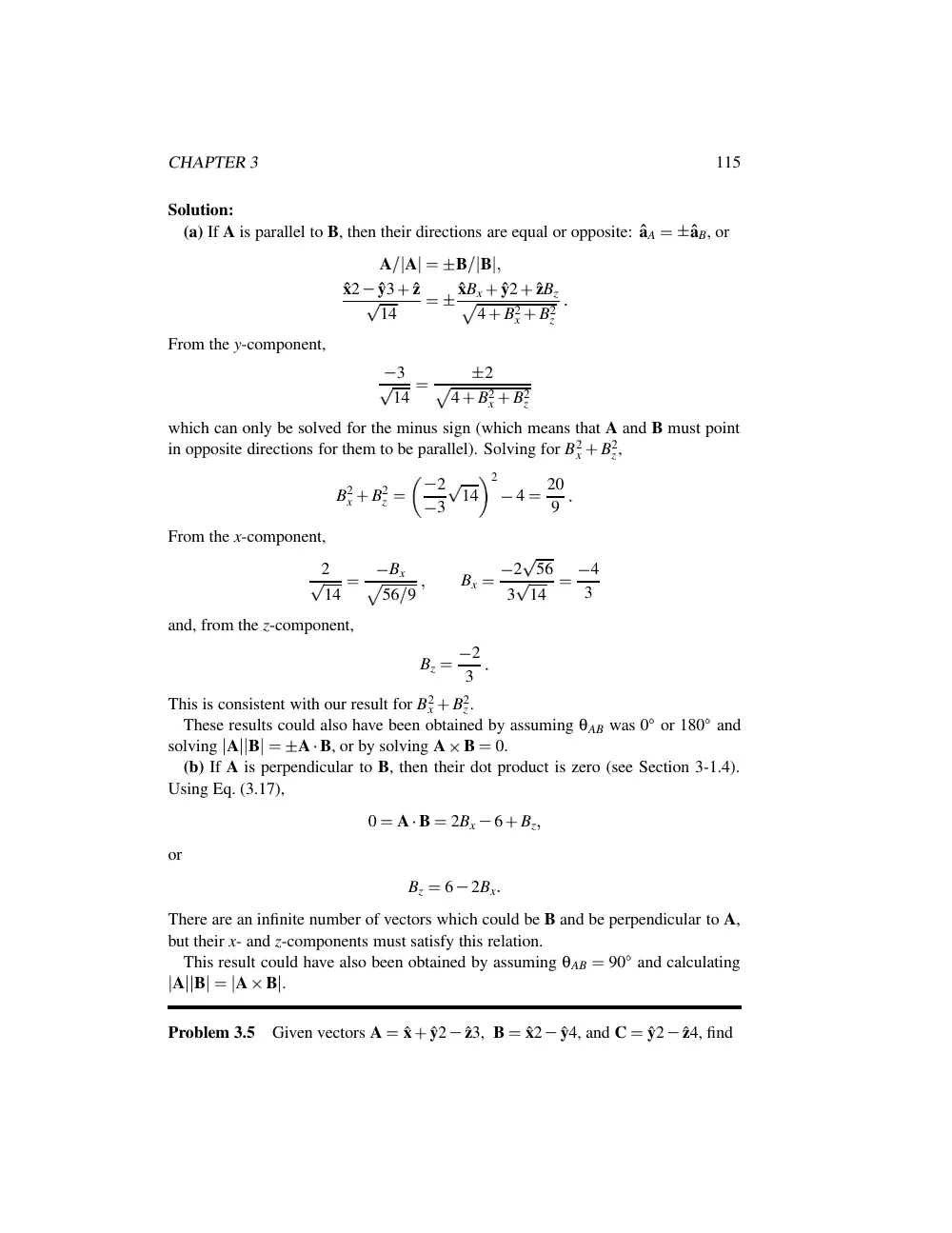
CHAPTER 3
115
Solution:
(a) If A is parallel to B, then their directions are equal or opposite: ˆaA
�
�
ˆaB, or
A
� A
�
�
� B
� B
�
�
ˆx2
�
ˆy3
�
ˆz
� 14
�
�
ˆxBx
�
ˆy2
�
ˆzBz
�
4
�
B2x
�
B2z
From the y-component,
� 3
� 14
�
� 2
�
4
�
B2x
�
B2z
which can only be solved for the minus sign (which means that A and B must point
in opposite directions for them to be parallel). Solving for B2
x
�
B2
z,
B2
x
�
B2
z
�
�
� 2
� 3
� 14
2
�
4
�
20
9
From the x-component,
2
� 14
�
� Bx
�
56
9
�
Bx
�
� 2
� 56
3
� 14
�
� 4
3
and, from the z-component,
Bz
�
� 2
3
This is consistent with our result for B2
x
�
B2
z.
These results could also have been obtained by assuming θAB was 0
� or 180
� and
solving
� A
�
� B
�
�
� A
� B, or by solving A
B
�
0.
(b) If A is perpendicular to B, then their dot product is zero (see Section 3-1.4).
Using Eq. (3.17),
0
�
A
� B
�
2Bx
�
6
�
Bz
�
or
Bz
�
6
�
2Bx
There are an infinite number of vectors which could be B and be perpendicular to A,
but their x- and z-components must satisfy this relation.
This result could have also been obtained by assuming θAB
�
90
� and calculating
� A
�
� B
�
�
� A
B
� .
Problem 3.5
Given vectors A
�
ˆx
�
ˆy2
�
ˆz3, B
�
ˆx2
�
ˆy4, and C
�
ˆy2
�
ˆz4, find
116
CHAPTER 3
(a) A and ˆa,
(b) the component of B along C,
(c) θAC,
(d) A
C,
(e) A
�
� B
C
� ,
(f) A
� B
C
� ,
(g) ˆx
B, and
(h)
� A
ˆy
�� ˆz.
Solution:
(a) From Eq. (3.4),
A
�
�
12
�
22
�
�
� 3
� 2
�
� 14
�
and, from Eq. (3.5),
ˆaA
�
ˆx
�
ˆy2
�
ˆz3
� 14
(b) The component of B along C (see Section 3-1.4) is given by
BcosθBC
�
B
� C
C
�
� 8
� 20
�
� 1
8
(c) From Eq. (3.21),
θAC
�
cos
1 A
� C
AC
�
cos
1
4
�
12
� 14
� 20
�
cos
1
16
� 280
�
17
0
�
(d) From Eq. (3.27),
A
C
�
ˆx
� 2
�
� 4
�
�
�
� 3
� 2
�
�
ˆy
�
�
� 3
� 0
�
1
�
� 4
�
�
�
ˆz
� 1
� 2
�
�
2
� 0
�
��
�
ˆx2
�
ˆy4
�
ˆz2
(e) From Eq. (3.27) and Eq. (3.17),
A
�
� B
C
�
�
A
�
� ˆx16
�
ˆy8
�
ˆz4
��
1
� 16
�
�
2
� 8
�
�
�
� 3
� 4
�
20
Eq. (3.30) could also have been used in the solution. Also, Eq. (3.29) could be used
in conjunction with the result of part (d).
(f) By repeated application of Eq. (3.27),
A
� B
C
�
�
A
� ˆx16
�
ˆy8
�
ˆz4
��
ˆx32
�
ˆy52
�
ˆz24
Eq. (3.33) could also have been used.
CHAPTER 3
117
(g) From Eq. (3.27),
ˆx
B
�
� ˆz4
(h) From Eq. (3.27) and Eq. (3.17),
� A
ˆy
�
� ˆz
�
� ˆx3
�
ˆz
�
� ˆz
�
1
Eq. (3.29) and Eq. (3.25) could also have been used in the solution.
Problem 3.6
Given vectors A
�
ˆx2
�
ˆy
�
ˆz3 and B
�
ˆx3
�
ˆz2, find a vector C whose
magnitude is 9 and whose direction is perpendicular to both A and B.
Solution:
The cross product of two vectors produces a new vector which is
perpendicular to both of the original vectors.
Two vectors exist which have a
magnitude of 9 and are orthogonal to both A and B: one which is 9 units long in
the direction of the unit vector parallel to A
B, and one in the opposite direction.
C
�
� 9 A
B
� A
B
�
�
� 9
� ˆx2
�
ˆy
�
ˆz3
��
� ˆx3
�
ˆz2
�
�
� ˆx2
�
ˆy
�
ˆz3
��
� ˆx3
�
ˆz2
�
�
�
� 9 ˆx2
�
ˆy13
�
ˆz3
� 22
�
132
�
32
�
�
� ˆx1
34
�
ˆy8
67
�
ˆz2
0
�
Problem 3.7
Given A
�
ˆx
� x
�
2y
�
�
ˆy
� y
�
3z
�
�
ˆz
� 3x
�
y
� , determine a unit vector
parallel to A at point P
� 1
�
� 1
� 2
� .
Solution: The unit vector parallel to A
�
ˆx
� x
�
2y
�
�
ˆy
� y
�
3z
�
�
ˆz
� 3x
�
y
� at the
point P
� 1
�
� 1
� 2
� is
A
� 1
�
� 1
� 2
�
� A
� 1
�
� 1
� 2
�
�
�
� ˆx
�
ˆy5
�
ˆz4
�
�
� 1
� 2
�
�
� 5
� 2
�
42
�
� ˆx
�
ˆy5
�
ˆz4
� 42
�
� ˆx0
15
�
ˆy0
77
�
ˆz0
62
Problem 3.8
By expansion in Cartesian coordinates, prove:
(a) the relation for the scalar triple product given by (3.29), and
(b) the relation for the vector triple product given by (3.33).
Solution:
(a) Proof of the scalar triple product given by Eq. (3.29): From Eq. (3.27),
A
B
�
ˆx
� AyBz
�
AzBy
�
�
ˆy
� AzBx
�
AxBz
�
�
ˆz
� AxBy
�
AyBx
�
�
118
CHAPTER 3
B
C
�
ˆx
� ByCz
�
BzCy
�
�
ˆy
� BzCx
�
BxCz
�
�
ˆz
� BxCy
�
ByCx
�
�
C
A
�
ˆx
� CyAz
� CzAy
�
�
ˆy
� CzAx
� CxAz
�
�
ˆz
� CxAy
� CyAx
�
Employing Eq. (3.17), it is easily shown that
A
�
� B
C
�
�
Ax
� ByCz
�
BzCy
�
�
Ay
� BzCx
�
BxCz
�
�
Az
� BxCy
�
ByCx
�
�
B
�
� C
A
�
�
Bx
� CyAz
� CzAy
�
�
By
� CzAx
� CxAz
�
�
Bz
� CxAy
� CyAx
�
�
C
�
� A
B
�
�
Cx
� AyBz
�
AzBy
�
�
Cy
� AzBx
�
AxBz
�
�
Cz
� AxBy
�
AyBx
�
�
which are all the same.
(b) Proof of the vector triple product given by Eq. (3.33): The evaluation of the left
hand side employs the expression above for B
C with Eq. (3.27):
A
� B
C
�
�
A
� ˆx
� ByCz
�
BzCy
�
�
ˆy
� BzCx
�
BxCz
�
�
ˆz
� BxCy
�
ByCx
�
�
�
ˆx
� Ay
� BxCy
�
ByCx
�
�
Az
� BzCx
�
BxCz
�
�
�
ˆy
� Az
� ByCz
�
BzCy
�
�
Ax
� BxCy
�
ByCx
��
�
ˆz
� Ax
� BzCx
�
BxCz
�
�
Ay
� ByCz
�
BzCy
�
�
�
while the right hand side, evaluated with the aid of Eq. (3.17), is
B
� A
� C
�
�
C
� A
� B
�
�
B
� AxCx
�
AyCy
�
AzCz
�
�
C
� AxBx
�
AyBy
�
AzBz
�
�
ˆx
� Bx
� AyCy
�
AzCz
�
� Cx
� AyBy
�
AzBz
�
�
�
ˆy
� By
� AxCx
�
AzCz
�
� Cy
� AxBx
�
AzBz
�
�
�
ˆz
� Bz
� AxCx
�
AyCy
�
� Cz
� AxBx
�
AyBy
�
�
By rearranging the expressions for the components, the left hand side is equal to the
right hand side.
Problem 3.9
Find an expression for the unit vector directed toward the origin from
an arbitrary point on the line described by x
�
1 and z
�
2.
Solution: An arbitrary point on the given line is
� 1
� y
� 2
� . The vector from this point
to
� 0
� 0
� 0
� is:
A
�
ˆx
� 0
�
1
�
�
ˆy
� 0
�
y
�
�
ˆz
� 0
�
2
��
� ˆx
�
ˆyy
�
2ˆz
�
� A
�
�
�
1
�
y2
�
4
�
�
5
�
y2
�
ˆa
�
A
� A
�
�
� ˆx
�
ˆyy
�
ˆz2
�
5
�
y2
CHAPTER 3
119
Problem 3.10
Find an expression for the unit vector directed toward the point P
located on the z-axis at a height h above the x–y plane from an arbitrary point
Q
� x
� y
�
� 3
� in the plane z
�
� 3.
Solution: Point P is at
� 0
� 0
� h
� . Vector A from Q
� x
� y
�
� 3
� to P
� 0
� 0
� h
� is:
A
�
ˆx
� 0
�
x
�
�
ˆy
� 0
�
y
�
�
ˆz
� h
�
3
��
�
ˆxx
�
ˆyy
�
ˆz
� h
�
3
�
�
� A
�
�
� x2
�
y2
�
� h
�
3
� 2
� 1
� 2
�
ˆa
�
A
� A
�
�
� ˆxx
�
ˆyy
�
ˆz
� h
�
3
�
� x2
�
y2
�
� h
�
3
� 2
� 1
� 2
Problem 3.11
Find a unit vector parallel to either direction of the line described by
2x
�
z
�
4
Solution: First, we find any two points on the given line. Since the line equation
is not a function of y, the given line is in a plane parallel to the x–z plane. For
convenience, we choose the x–z plane with y
�
0.
For x
�
0, z
�
4. Hence, point P is at
� 0
� 0
� 4
� .
For z
�
0, x
�
2. Hence, point Q is at
� 2
� 0
� 0
� .
Vector A from P to Q is:
A
�
ˆx
� 2
�
0
�
�
ˆy
� 0
�
0
�
�
ˆz
� 0
�
4
��
ˆx2
�
ˆz4
�
ˆa
�
A
� A
�
�
ˆx2
�
ˆz4
� 20
Problem 3.12
Two lines in the x–y plane are described by the expressions:
Line 1
x
�
2y
�
� 6
�
Line 2
3x
�
4y
�
8
Use vector algebra to find the smaller angle between the lines at their intersection
point.
Solution: Intersection point is found by solving the two equations simultaneously:
� 2x
�
4y
�
12
�
3x
�
4y
�
8
120
CHAPTER 3
10
20
30
25
15
35
-30 -25 -20 -15 -10
-35
-10
-15
-20
-25
-30
10
15
20
25
30
(0, 2)
(0, -3)
(20, -13)
B
A
θAB
Figure P3.12: Lines 1 and 2.
The sum gives x
�
20, which, when used in the first equation, gives y
�
� 13.
Hence, intersection point is
� 20
�
� 13
� .
Another point on line 1 is x
�
0, y
�
� 3. Vector A from
� 0
�
� 3
� to
� 20
�
� 13
� is
A
�
ˆx
� 20
�
�
ˆy
�
� 13
�
3
��
ˆx20
�
ˆy10
�
� A
�
�
�
202
�
102
�
� 500
A point on line 2 is x
�
0, y
�
2. Vector B from
� 0
� 2
� to
� 20
�
� 13
� is
B
�
ˆx
� 20
�
�
ˆy
�
� 13
�
2
��
ˆx20
�
ˆy15
�
� B
�
�
�
202
�
152
�
� 625
Angle between A and B is
θAB
�
cos
1
�
A
� B
� A
�
� B
�
�
cos
1
�
400
�
150
� 500
�
� 625
�
10
3
�
Problem 3.13
A given line is described by
x
�
2y
�
4
Vector A starts at the origin and ends at point P on the line such that A is orthogonal
to the line. Find an expression for A.
CHAPTER 3
121
Solution: We first plot the given line. Next we find vector B which connects point
P1
� 0
� 2
� to P2
� 4
� 0
� , both of which are on the line:
B
�
ˆx
� 4
�
0
�
�
ˆy
� 0
�
2
��
ˆx4
�
ˆy2
Vector A starts at the origin and ends on the line at P. If the x-coordinate of P is x,
x
y
A
B
P (0,2)
1
P (4,0)
2
(0,0)
Figure P3.13: Given line and vector A.
then its y-coordinate has to be
� 4
�
x
�
2 in order to be on the line. Hence P is at
� x
�
� 4
�
x
�
2
� . Vector A is
A
�
ˆxx
�
ˆy
� 4
�
x
2
But A is perpendicular to the line. Hence,
A
� B
�
0
�
�
ˆxx
�
ˆy
� 4
�
x
2
�
�
� ˆx4
�
ˆy2
��
0
�
4x
�
� 4
�
x
��
0
�
or
x
�
4
5
�
0
8
Hence,
A
�
ˆx0
8
�
ˆy
� 4
�
0
8
2
�
ˆx0
8
�
ˆy1
6
Problem 3.14
Show that, given two vectors A and B,
122
CHAPTER 3
(a) the vector C defined as the vector component of B in the direction of A is given
by
C
�
ˆa
� B
� ˆa
��
A
� B
� A
�
� A
� 2
�
where ˆa is the unit vector of A, and
(b) the vector D defined as the vector component of B perpendicular to A is given
by
D
�
B
�
A
� B
� A
�
� A
� 2
Solution:
(a) By definition, B
� ˆa is the component of B along ˆa. The vector component of
� B
� ˆa
� along A is
C
�
ˆa
� B
� ˆa
��
A
� A
�
�
B
� A
� A
�
�
A
� B
� A
�
� A
� 2
(b) The figure shows vectors A, B, and C, where C is the projection of B along A.
It is clear from the triangle that
B
�
C
�
D
�
or
D
�
B
�
C
�
B
�
A
� B
� A
�
� A
� 2
A
C
D
B
Figure P3.14: Relationships between vectors A, B, C, and D.
CHAPTER 3
123
Problem 3.15
A certain plane is described by
2x
�
3y
�
4z
�
16
Find the unit vector normal to the surface in the direction away from the origin.
Solution: Procedure:
1. Use the equation for the given plane to find three points, P1, P2 and P3 on the
plane.
2. Find vector A from P1 to P2 and vector B from P1 to P3.
3. Cross product of A and B gives a vector C orthogonal to A and B, and hence
to the plane.
4. Check direction of ˆc.
Steps:
1. Choose the following three points:
P1 at
� 0
� 0
� 4
�
�
P2 at
� 8
� 0
� 0
�
�
P3 at
� 0
� 16
3
� 0
�
2. Vector A from P1 to P2
A
�
ˆx
� 8
�
0
�
�
ˆy
� 0
�
0
�
�
ˆz
� 0
�
4
��
ˆx8
�
ˆz4
Vector B from P1 to P3
B
�
ˆx
� 0
�
0
�
�
ˆy
� 16
3
�
0
�
ˆz
� 0
�
4
��
ˆy 16
3
�
ˆz4
3.
C
�
A
B
�
ˆx
� AyBz
�
AzBy
�
�
ˆy
� AzBx
�
AxBz
�
�
ˆz
� AxBy
�
AyBx
�
�
ˆx
�
0
�
�
� 4
�
�
�
� 4
�
� 16
3
�
ˆy
�
�
� 4
�
� 0
�
8
�
�
� 4
�
�
�
ˆz
�
8
� 16
3
�
0
� 0
�
ˆx 64
3
�
ˆy32
�
ˆz 128
3
124
CHAPTER 3
Verify that C is orthogonal to A and B
A
� C
�
�
8
� 64
3
�
� 32
� 0
�
�
� 128
3
�
�
� 4
�
�
512
3
�
512
3
�
0
B
� C
�
�
0
� 64
3
�
�
32
� 16
3
�
� 128
3
�
�
� 4
�
�
512
3
�
512
3
�
0
4. C
�
ˆx 64
3
�
ˆy32
�
ˆz 128
3
ˆc
�
C
� C
�
�
ˆx 64
3
�
ˆy32
�
ˆz 128
3
�
� 64
3
�
2
�
322
�
� 128
3
�
2
�
ˆx0
37
�
ˆy0
56
�
ˆz0
74
ˆc points away from the origin as desired.
Problem 3.16
Given B
�
ˆx
� z
� 3y
�
�
ˆy
� 2x
� 3z
�
�
ˆz
� x
�
y
� , find a unit vector parallel
to B at point P
� 1
� 0
�
� 1
� .
Solution: At P
� 1
� 0
�
� 1
� ,
B
�
ˆx
�
� 1
�
�
ˆy
� 2
�
3
�
�
ˆz
� 1
��
� ˆx
�
ˆy5
�
ˆz
�
ˆb
�
B
� B
�
�
� ˆx
�
ˆy5
�
ˆz
� 1
�
25
�
1
�
� ˆx
�
ˆy5
�
ˆz
� 27
Problem 3.17
When sketching or demonstrating the spatial variation of a vector
field, we often use arrows, as in Fig. 3-25 (P3.17), wherein the length of the arrow
is made to be proportional to the strength of the field and the direction of the arrow
is the same as that of the field’s. The sketch shown in Fig. P3.17, which represents
the vector field E
�
ˆrr, consists of arrows pointing radially away from the origin and
their lengths increase linearly in proportion to their distance away from the origin.
Using this arrow representation, sketch each of the following vector fields:
(a) E1
�
� ˆxy,
(b) E2
�
ˆyx,
(c) E3
�
ˆxx
�
ˆyy,
(d) E4
�
ˆxx
�
ˆy2y,
(e) E5
�
ˆφφφr,
(f) E6
�
ˆrsinφ.
CHAPTER 3
125
x
y
E
E
E
E
Figure P3.17: Arrow representation for vector field E
�
ˆrr (Problem 3.17).
Solution:
(a)
x
y
x^
P2.13a: E1
= -
y
E
E
E
E
126
CHAPTER 3
(b)
x
y
E
E
E
E
P3.17b: E2
�
ˆyx
(c)
x
y
E
E
E
E
E
x^
P2.13c: E3
= x + y^ y
CHAPTER 3
127
(d)
x
y
x^
P2.13d:E4
= x + y^ 2y
E
E
E
E
(e)
x
y
φ^
P2.13e: E5
= r
E
E
E
E
128
CHAPTER 3
(f)
x
y
r^
P2.13f: E6
= sinφ
E
E
E
E
Problem 3.18
Use arrows to sketch each of the following vector fields:
(a) E1
�
ˆxx
�
ˆyy,
(b) E2
�
�
ˆφφφ,
(c) E3
�
ˆy 1
x,
(d) E4
�
ˆrcosφ.
Solution:
CHAPTER 3
129
(a)
x
y
x^
P2.14a: E1
= x - y^ y
E
E
E
E
(b)
x
y
φ^
P2.14b:E2
= -
E
E
E
E
130
CHAPTER 3
(c)
x
y
Indicates |E| is infinite
P2.14c: E3
= y^ (1/x)
E
E
(d)
x
y
r^
P2.14d:E4
= cosφ
E
E
E
E
E
E
E
E
E
CHAPTER 3
131
Sections 3-2 and 3-3: Coordinate Systems
Problem 3.19
Convert the coordinates of the following points from Cartesian to
cylindrical and spherical coordinates:
(a) P1
� 1
� 2
� 0
� ,
(b) P2
� 0
� 0
� 2
� ,
(c) P3
� 1
� 1
� 3
� ,
(d) P4
�
� 2
� 2
�
� 2
� .
Solution: Use the “coordinate variables” column in Table 3-2.
(a) In the cylindrical coordinate system,
P1
�
�
�
12
�
22
� tan
1
� 2
1
�
� 0
��
�
� 5
� 1
107 rad
� 0
��
� 2
24
� 63
4
�
� 0
�
In the spherical coordinate system,
P1
�
�
�
12
�
22
�
02
� tan
1
�
�
12
�
22
0
�
� tan
1
� 2
1
�
�
�
�
� 5
� π
2 rad
� 1
107 rad
�
�
� 2
24
� 90
0
�
� 63
4
�
�
Note that in both the cylindrical and spherical coordinates, φ is in Quadrant I.
(b) In the cylindrical coordinate system,
P2
�
�
�
02
�
02
� tan
1
� 0
0
�
� 2
�
�
� 0
� 0 rad
� 2
��
� 0
� 0
�
� 2
�
In the spherical coordinate system,
P2
�
�
�
02
�
02
�
22
� tan
1
�
�
02
�
02
2
�
� tan
1
� 0
0
�
�
�
� 2
� 0 rad
� 0 rad
��
� 2
� 0
�
� 0
�
�
Note that in both the cylindrical and spherical coordinates, φ is arbitrary and may
take any value.
(c) In the cylindrical coordinate system,
P3
�
�
�
12
�
12
� tan
1
� 1
1
�
� 3
��
�
� 2
� π
4 rad
� 3
�
�
� 1
41
� 45
0
�
� 3
�
In the spherical coordinate system,
P3
�
�
�
12
�
12
�
32
� tan
1
�
�
12
�
12
3
�
� tan
1
� 1
1
�
�
�
�
� 11
� 0
44 rad
� π
4 rad
�
�
� 3
32
� 25
2
�
� 45
0
�
�
Note that in both the cylindrical and spherical coordinates, φ is in Quadrant I.
132
CHAPTER 3
(d) In the cylindrical coordinate system,
P4
�
�
�
�
� 2
� 2
�
22
� tan
1
� 2
�
2
�
�
� 2
�
�
� 2
� 2
� 3π
4 rad
�
� 2
��
� 2
83
� 135
0
�
�
� 2
�
In the spherical coordinate system,
P4
�
�
�
�
� 2
� 2
�
22
�
�
� 2
� 2
� tan
1
�
�
�
� 2
� 2
�
22
�
2
�
� tan
1
� 2
�
2
�
�
�
� 2
� 3
� 2
187 rad
� 3π
4 rad
�
�
� 3
46
� 125
3
�
� 135
0
�
�
Note that in both the cylindrical and spherical coordinates, φ is in Quadrant II.
Problem 3.20
Convert the coordinates of the following points from cylindrical to
Cartesian coordinates:
(a) P1
� 2
� π
4
�
� 2
� ,
(b) P2
� 3
� 0
�
� 2
� ,
(c) P3
� 4
� π
� 3
� .
Solution:
(a)
P1
� x
� y
� z
�
�
P1
� rcosφ
� rsinφ
� z
��
P1
2cos π
4
� 2sin π
4
�
� 2
�
P1
� 1
41
� 1
41
�
� 2
�
(b) P2
� x
� y
� z
��
P2
� 3cos0
� 3sin0
�
� 2
��
P2
� 3
� 0
�
� 2
� .
(c) P3
� x
� y
� z
��
P3
� 4cosπ
� 4sinπ
� 3
��
P3
�
� 4
� 0
� 3
� .
Problem 3.21
Convert the coordinates of the following points from spherical to
cylindrical coordinates:
(a) P1
� 5
� 0
� 0
� ,
(b) P2
� 5
� 0
� π
� ,
(c) P3
� 3
� π
2
� 0
� .
Solution:
(a)
P1
� r
� φ
� z
��
P1
� Rsinθ
� φ
� Rcosθ
��
P1
� 5sin0
� 0
� 5cos0
�
�
P1
� 0
� 0
� 5
�
(b) P2
� r
� φ
� z
��
P2
� 5sin0
� π
� 5cos0
��
P2
� 0
� π
� 5
� .
CHAPTER 3
133
(c) P3
� r
� φ
� z
��
P3
� 3sin π
2
� 0
� 3cos π
2
��
P3
� 3
� 0
� 0
� .
Problem 3.22
Use the appropriate expression for the differential surface area ds to
determine the area of each of the following surfaces:
(a) r
�
3; 0
�
φ
�
π
3;
� 2
�
z
�
2,
(b) 2
�
r
�
5; π
2
�
φ
�
π; z
�
0,
(c) 2
�
r
�
5; φ
�
π
4;
� 2
�
z
�
2,
(d) R
�
2; 0
�
θ
�
π
3; 0
�
φ
�
π,
(e) 0
�
R
�
5; θ
�
π
3; 0
�
φ
�
2π.
Also sketch the outlines of each of the surfaces.
Solution:
3
2
∆Φ = π/3
2
5
y
x
2
5
(a)
(b)
(d)
(e)
(c)
Figure P3.22: Surfaces described by Problem 3.22.
(a) Using Eq. (3.43a),
A
�
�
2
z
�
2
�
π
� 3
φ
� 0
� r
�
� r
� 3 dφdz
�
� 3φz
�
� π
� 3
φ
� 0
�
�
�
2
z
�
2
�
4π
134
CHAPTER 3
(b) Using Eq. (3.43c),
A
�
�
5
r
� 2
�
π
φ
� π
� 2
� r
�
� z
� 0 dφdr
�
� 1
2r2φ
�
�
�
5
r
� 2
�
�
�
π
φ
� π
� 2
�
21π
4
(c) Using Eq. (3.43b),
A
�
�
2
z
�
2
�
5
r
� 2
� 1
�
� φ
� π
� 4 dr dz
�
� rz
�
� 2
z
�
2
�
�
�
5
r
� 2
�
12
(d) Using Eq. (3.50b),
A
�
�
π
� 3
θ
� 0
�
π
φ
� 0
� R2 sinθ
�
�
�
R
� 2 dφdθ
�
�
� 4φcosθ
�
� π
� 3
θ
� 0
�
�
�
π
φ
� 0
�
2π
(e) Using Eq. (3.50c),
A
�
�
5
R
� 0
�
2π
φ
� 0
� Rsinθ
�
� θ
� π
� 3 dφdR
�
�
1
2R2φsin π
3
�
�
�
2π
φ
� 0
�
�
�
�
5
R
� 0
�
25
� 3π
2
Problem 3.23
Find the volumes described by
(a) 2
�
r
�
5; π
2
�
φ
�
π; 0
�
z
�
2,
(b) 0
�
R
�
5; 0
�
θ
�
π
3; 0
�
φ
�
2π.
Also sketch the outline of each volume.
Solution:
(a)
(b)
z
y
x
z
y
x
2
5
5
2
Figure P3.23: Volumes described by Problem 3.23 .
(a) From Eq. (3.44),
V
�
�
2
z
� 0
�
π
φ
� π
� 2
�
5
r
� 2r dr dφdz
�
�
� 1
2r2φz
�
�
�
5
r
� 2
�
�
�
π
φ
� π
� 2
�
�
�
�
2
z
� 0
�
21π
2
CHAPTER 3
135
(b) From Eq. (3.50e),
V
�
�
2π
φ
� 0
�
π
� 3
θ
� 0
�
5
R
� 0R2 sinθdRdθdφ
�
�
�
�
�
cosθR3
3 φ
�
�
�
�
5
R
� 0
�
�
�
�
�
�
π
� 3
θ
� 0
�
�
�
�
�
�
�
2π
φ
� 0
�
125π
3
Problem 3.24
A section of a sphere is described by 0
�
R
�
2, 0
�
θ
�
90
�
� and
30
�
�
φ
�
90
� . Find:
(a) the surface area of the spherical section,
(b) the enclosed volume.
Also sketch the outline of the section.
Solution:
y
z
x
φ=30o
Figure P3.24: Outline of section.
136
CHAPTER 3
S
�
�
π
� 2
φ
� π
� 6
�
π
� 2
θ
� 0 R2 sinθdθdφ
� R
� 2
�
4
π
2
�
π
6
�
�
cosθ
� π
� 2
0
�
�
4
π
3
�
4π
3
(m2)
�
V
�
�
2
R
� 0
�
π
� 2
φ
� π
� 6
�
π
� 2
θ
� 0 R2 sinθdRdθdφ
�
R3
3
�
�
�
�
2
0
π
2
�
π
6
�
�
cosθ
� π
� 2
0
�
�
8
3
π
3
�
8π
9
(m3)
Problem 3.25
A vector field is given in cylindrical coordinates by
E
�
ˆrrcosφ
�
ˆφφφrsinφ
�
ˆzz2
Point P
� 2
� π
� 3
� is located on the surface of the cylinder described by r
�
2. At point P,
find:
(a) the vector component of E perpendicular to the cylinder,
(b) the vector component of E tangential to the cylinder.
Solution:
(a) En
�
ˆr
� ˆr
� E
��
ˆr
� ˆr
�
� ˆrrcosφ
�
ˆφφφrsinφ
�
ˆzz2
��
�
ˆrrcosφ.
At P
� 2
� π
� 3
� , En
�
ˆr2cosπ
�
� ˆr2.
(b) Et
�
E
�
En
�
ˆφφφrsinφ
�
ˆzz2.
At P
� 2
� π
� 3
� , Et
�
ˆφφφ2sinπ
�
ˆz32
�
ˆz9.
Problem 3.26
At a given point in space, vectors A and B are given in spherical
coordinates by
A
�
ˆR4
�
ˆθθθ2
�
ˆφφφ
�
B
�
�
ˆR2
�
ˆφφφ3
Find:
(a) the scalar component, or projection, of B in the direction of A,
(b) the vector component of B in the direction of A,
(c) the vector component of B perpendicular to A.
Solution:
CHAPTER 3
137
(a) Scalar component of B in direction of A:
C
�
B
� ˆa
�
B
� A
� A
�
�
�
�
ˆR2
�
ˆφφφ3
�
�
� ˆR4
�
ˆθθθ2
�
ˆφφφ
�
� 16
�
4
�
1
�
� 8
�
3
� 21
�
�
11
� 21
�
� 2
4
(b) Vector component of B in direction of A:
C
�
ˆaC
�
A C
� A
�
�
� ˆR4
�
ˆθθθ2
�
ˆφφφ
�
�
� 2
4
�
� 21
�
�
� ˆR2
09
�
ˆθθθ1
05
�
ˆφφφ0
52
�
(c) Vector component of B perpendicular to A:
D
�
B
�
C
�
�
�
ˆR2
�
ˆφφφ3
�
�
� ˆR2
09
�
ˆθθθ1
05
�
ˆφφφ0
52
�
�
ˆR0
09
�
ˆθθθ1
05
�
ˆφφφ2
48
Problem 3.27
Given vectors
A
�
ˆr
� cosφ
�
3z
�
�
ˆφφφ
� 2r
�
4sinφ
�
�
ˆz
� r
�
2z
�
�
B
�
� ˆrsinφ
�
ˆzcosφ
�
find
(a) θAB at
� 2
� π
2
� 0
� ,
(b) a unit vector perpendicular to both A and B at
� 2
� π
3
� 1
� .
Solution: It doesn’t matter whether the vectors are evaluated before vector products
are calculated, or if the vector products are directly calculated and the general results
are evaluated at the specific point in question.
(a) At
� 2
� π
2
� 0
� , A
�
�
ˆφφφ8
�
ˆz2 and B
�
� ˆr. From Eq. (3.21),
θAB
�
cos
1
� A
� B
AB
�
cos
1
�
0
AB
�
90
�
(b) At
� 2
� π
3
� 1
� , A
�
ˆr7
2
�
ˆφφφ4
� 1
�
1
2
� 3
� and B
�
� ˆr1
2
� 3
�
ˆz1
2. Since A
B is
perpendicular to both A and B, a unit vector perpendicular to both A and B is given
by
�
A
B
� A
B
�
�
�
ˆr
�
� 4
� 1
�
1
2
� 3
�
�
� 1
2
�
�
ˆφφφ
� 7
2
�
� 1
2
�
�
ˆz
� 4
� 1
�
1
2
� 3
�
�
� 1
2
� 3
�
�
� 2
� 1
�
1
2
� 3
�
�
2
�
� 7
4
�
2
�
� 3
�
2
� 3
�
2
��
� ˆr0
487
�
ˆφφφ0
228
�
ˆz0
843
�
138
CHAPTER 3
Problem 3.28
Find the distance between the following pairs of points:
(a) P1
� 1
� 2
� 3
� and P2
�
� 2
�
� 3
�
� 2
� in Cartesian coordinates,
(b) P3
� 1
� π
4
� 3
� and P4
� 3
� π
4
� 4
� in cylindrical coordinates,
(c) P5
� 4
� π
2
� 0
� and P6
� 3
� π
� 0
� in spherical coordinates.
Solution:
(a)
d
�
�
�
� 2
�
1
� 2
�
�
� 3
�
2
� 2
�
�
� 2
�
3
� 2
� 1
� 2
�
� 9
�
25
�
25 � 1
� 2
�
� 59
�
7
68
(b)
d
�
� r2
2
�
r2
1
�
2r1r2 cos
� φ2
�
φ1
�
�
� z2
�
z1
� 2
� 1
� 2
�
� 9
�
1
�
2
3
1
cos
π
4
�
π
4
�
� 4
�
3
� 2
� 1
� 2
�
� 10
�
6
�
1
� 1
� 2
�
51
� 2
�
2
24
(c)
d
�
� R2
2
�
R2
1
�
2R1R2
� cosθ2 cosθ1
�
sinθ1 sinθ2 cos
� φ2
�
φ1
��
1
� 2
�
�
9
�
16
�
2
3
4
� cosπcos π
2
�
sin π
2 sinπcos
� 0
�
0
�
�� 1
� 2
�
� 9
�
16
�
0
1
� 2
�
� 25
�
5
Problem 3.29
Determine the distance between the following pairs of points:
(a) P1
� 1
� 1
� 2
� and P2
� 0
� 2
� 3
� ,
(b) P3
� 2
� π
3
� 1
� and P4
� 4
� π
2
� 3
� ,
(c) P5
� 3
� π
� π
2
� and P6
� 4
� π
2
� π
� .
Solution:
(a) From Eq. (3.66),
d
�
�
� 0
�
1
� 2
�
� 2
�
1
� 2
�
� 3
�
2
� 2
�
� 3
(b) From Eq. (3.67),
d
�
�
22
�
42
�
2
� 2
�
� 4
� cos
π
2
�
π
3
�
� 3
�
1
� 2
�
�
24
�
8
� 3
�
3
18
CHAPTER 3
139
(c) From Eq. (3.68),
d
�
�
32
�
42
�
2
� 3
�
� 4
� cos π
2 cosπ
�
sinπsin π
2 cos
π
�
π
2
�
5
Problem 3.30
Transform the following vectors into cylindrical coordinates and
then evaluate them at the indicated points:
(a) A
�
ˆx
� x
�
y
�
at P1
� 1
� 2
� 3
� ,
(b) B
�
ˆx
� y
�
x
�
�
ˆy
� x
�
y
�
at P2
� 1
� 0
� 2
� ,
(c) C
�
ˆxy2
� x2
�
y2
�
�
ˆyx2
� x2
�
y2
�
�
ˆz4 at P3
� 1
�
� 1
� 2
� ,
(d) D
�
ˆRsinθ
�
ˆθθθcosθ
�
ˆφφφcos2 φ at P4
� 2
� π
2
� π
4
� ,
(e) E
�
ˆRcosφ
�
ˆθθθsinφ
�
ˆφφφsin2 θ at P5
� 3
� π
2
� π
� .
Solution: From Table 3-2:
(a)
A
�
� ˆrcosφ
�
ˆφφφsinφ
�
� rcosφ
�
rsinφ
�
�
ˆrrcosφ
� cosφ
�
sinφ
�
�
ˆφφφrsinφ
� cosφ
�
sinφ
�
�
P1
�
�
�
12
�
22
� tan
1
� 2
1
�
� 3
��
�
� 5
� 63
4
�
� 3
�
�
A
� P1
��
� ˆr0
447
�
ˆφφφ0
894
�
� 5
�
447
�
894
�
�
ˆr1
34
�
ˆφφφ2
68
(b)
B
�
� ˆrcosφ
�
ˆφφφsinφ
�
� rsinφ
�
rcosφ
�
�
� ˆφφφcosφ
�
ˆrsinφ
�
� rcosφ
�
rsinφ
�
�
ˆrr
� 2sinφcosφ
�
1
�
�
ˆφφφr
� cos2 φ
�
sin2 φ
��
ˆrr
� sin2φ
�
1
�
�
ˆφφφrcos2φ
�
P2
�
�
�
12
�
02
� tan
1
� 0
1
�
� 2
��
� 1
� 0
�
� 2
�
�
B
� P2
��
� ˆr
�
ˆφφφ
(c)
C
�
� ˆrcosφ
�
ˆφφφsinφ
� r2 sin2 φ
r2
�
� ˆφφφcosφ
�
ˆrsinφ
� r2 cos2 φ
r2
�
ˆz4
�
ˆrsinφcosφ
� sinφ
�
cosφ
�
�
ˆφφφ
� sin3 φ
�
cos3 φ
�
�
ˆz4
�
P3
�
�
�
12
�
�
� 1
� 2
� tan
1
�
� 1
1
�
� 2
��
�
� 2
�
� 45
�
� 2
�
�
C
� P3
��
ˆr0
707
�
ˆz4
(d)
D
�
� ˆrsinθ
�
ˆzcosθ
� sinθ
�
� ˆrcosθ
�
ˆzsinθ
� cosθ
�
ˆφφφcos2 φ
�
ˆr
�
ˆφφφcos2 φ
�
140
CHAPTER 3
P4
�
� 2sin
� π
2
�
� π
4
� 2cos
� π
2
���
� 2
� 45
�
� 0
�
�
D
� P4
��
ˆr
�
ˆφφφ1
2
(e)
E
�
� ˆrsinθ
�
ˆzcosθ
� cosφ
�
� ˆrcosθ
�
ˆzsinθ
� sinφ
�
ˆφφφsin2 θ
�
P5
�
3
� π
2
� π
�
E
� P5
��
ˆrsin π
2
�
ˆzcos π
2
cosπ
�
ˆrcos π
2
�
ˆzsin π
2
sinπ
�
ˆφφφsin2 π
2
�
� ˆr
�
ˆφφφ
Problem 3.31
Transform the following vectors into spherical coordinates and then
evaluate them at the indicated points:
(a) A
�
ˆxy2
�
ˆyxz
�
ˆz4 at P1
� 1
�
� 1
� 2
� ,
(b) B
�
ˆy
� x2
�
y2
�
z2
�
�
ˆz
� x2
�
y2
�
at P2
�
� 1
� 0
� 2
� ,
(c) C
�
ˆrcosφ
�
ˆφφφsinφ
�
ˆzcosφsinφ at P3
� 2
� π
4
� 2
� , and
(d) D
�
ˆxy2
� x2
�
y2
�
�
ˆyx2
� x2
�
y2
�
�
ˆz4 at P4
� 1
�
� 1
� 2
� .
Solution: From Table 3-2:
(a)
A
�
� ˆRsinθcosφ
�
ˆθθθcosθcosφ
�
ˆφφφsinφ
�
� Rsinθsinφ
� 2
�
� ˆRsinθsinφ
�
ˆθθθcosθsinφ
�
ˆφφφcosφ
�
� Rsinθcosφ
�
� Rcosθ
�
�
� ˆRcosθ
�
ˆθθθsinθ
� 4
�
ˆR
� R2 sin2 θsinφcosφ
� sinθsinφ
�
cosθ
�
�
4cosθ
�
�
ˆθθθ
� R2 sinθcosθsinφcosφ
� sinθsinφ
�
cosθ
�
�
4sinθ
�
�
ˆφφφR2 sinθ
� cosθcos2 φ
�
sinθsin3 φ
�
�
P1
�
�
�
12
�
�
� 1
� 2
�
22
� tan
1
�
�
12
�
�
� 1
� 2
2
� tan
1
�
� 1
1
�
�
�
� 6
� 35
3
�
�
� 45
�
�
�
A
� P1
��
ˆR2
856
�
ˆθθθ2
888
�
ˆφφφ2
123
(b)
B
�
� ˆRsinθsinφ
�
ˆθθθcosθsinφ
�
ˆφφφcosφ
� R2
�
� ˆRcosθ
�
ˆθθθsinθ
� R2 sin2 θ
�
ˆRR2 sinθ
� sinφ
�
sinθcosθ
�
�
ˆθθθR2
� cosθsinφ
�
sin3 θ
�
�
ˆφφφR2 cosφ
�
P2
�
�
�
�
� 1
� 2
�
02
�
22
� tan
1
�
�
�
� 1
� 2
�
02
2
� tan
1
� 0
�
� 1
��
�
�
� 5
� 26
6
�
� 180
�
�
�
CHAPTER 3
141
B
� P2
��
�
ˆR0
896
�
ˆθθθ0
449
�
ˆφφφ5
(c)
C
�
� ˆRsinθ
�
ˆθθθcosθ
� cosφ
�
ˆφφφsinφ
�
� ˆRcosθ
�
ˆθθθsinθ
� cosφsinφ
�
ˆRcosφ
� sinθ
�
cosθsinφ
�
�
ˆθθθcosφ
� cosθ
�
sinθsinφ
�
�
ˆφφφsinφ
�
P3
�
�
22
�
22
� tan
1
� 2
2
�
� π
4
�
� 2
� 2
� 45
�
� 45
�
�
�
C
� P3
��
ˆR0
854
�
ˆθθθ0
146
�
ˆφφφ0
707
(d)
D
�
� ˆRsinθcosφ
�
ˆθθθcosθcosφ
�
ˆφφφsinφ
�
R2 sin2 θsin2 φ
R2 sin2 θsin2 φ
�
R2sin2 θcos2 φ
�
� ˆRsinθsinφ
�
ˆθθθcosθsinφ
�
ˆφφφcosφ
�
R2 sin2 θcos2 φ
R2 sin2 θsin2 φ
�
R2sin2 θcos2 φ
�
� ˆRcosθ
�
ˆθθθsinθ
� 4
�
ˆR
� sinθcosφsin2 φ
�
sinθsinφcos2 φ
�
4cosθ
�
�
ˆθθθ
� cosθcosφsin2 φ
�
cosθsinφcos2 φ
�
4sinθ
�
�
ˆφφφ
� cos3 φ
�
sin3 φ
�
�
P4
� 1
�
� 1
� 2
��
P4
�
� 1
�
1
�
4
� tan
1
�
� 1
�
1
2
�
� tan
1
�
� 1
1
�
�
�
P4
�
� 6
� 35
26
�
�
� 45
�
�
�
D
� P4
��
ˆR
� sin35
26
� cos45
� sin2 45
�
�
sin35
26
� sin
�
� 45
�
� cos2 45
�
�
4cos35
26
�
�
�
ˆθθθ
� cos35
26
� cos45
� sin2 45
�
�
cos35
26
� sin
�
� 45
�
� cos2 45
�
�
4sin35
26
�
�
�
ˆφφφ
� cos3 45
�
�
sin3 45
�
�
�
ˆR