
EECE 380 Problems, Spring 2008
American University of Beirut · Engineering Electromagnetics · 2 pages
More EECE 380 files
- Problems Solution Manual · Fall 2011Problems · with solutionView
- Problems Solution Manual · Fall 2011Problems · with solutionView
- Problems Solution Manual · Fall 2011Problems · with solutionView
- Problems Solution Manual · Fall 2011Problems · with solutionView
- Problems Solution Manual · Fall 2011Problems · with solutionView
- Problems Solution Manual · Fall 2011Problems · with solutionView
- Problems Solution Manual · Fall 2011Problems · with solutionView
- Problems Solution Manual · Fall 2011Problems · with solutionView
Show the text of this problems
Electrostatics (cont.)
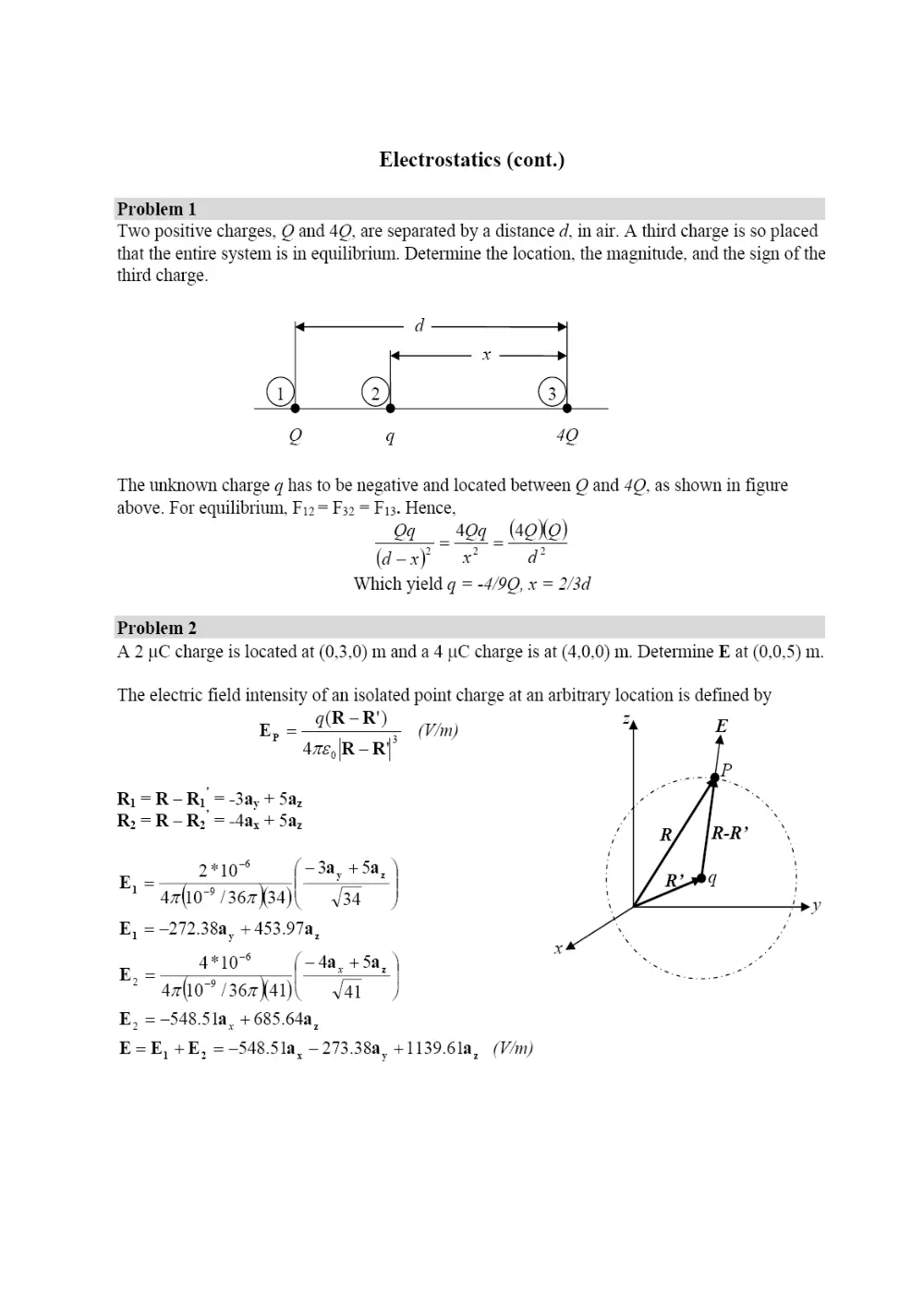
Problem 1
Two positive charges, O and 4Q, are separated by a distance d. in air. A third charge is so placed
that the entire system is in equilibrium. Determine the location, the magnitude, and the sign of the
third charge.
d
io
QO q 40
The unknown charge q has to be negative and located between O and 4Q, as shown in figure
above. For equilibrium. F 12 = F32 = Fi3. Hence,
Qq _ 40q _ (40XQ)
( d _ xy x? d 2
Which yield g = -4/90, x = 2/3d
Problem 2
A2 uC charge is located at (0.3.0) m and a 4 uC charge is at (4.0.0) m. Determine E at (0.0.5) m.
The electric field intensity of an isolated point charge at an arbitrary location is defined by
R-R' Z
E, ~_((R-R) (Vin) “ E
4e,|R-R}
R, = R-R, = -3ay + Sa,
R;=R-R, =-4a, + Sa,
E
1
2*10° —3a, +5a,
~ 4x10” /367\34) 34
E, = -272.38a, + 453.97a,
4*10°% “a 2s
E, = _ :
4n(l0* /367\41)\-V41
E, =-548.5la, +685.64a,
E=E, +E, =~548.5la, —273.38a, +1139.6la, (Vim)
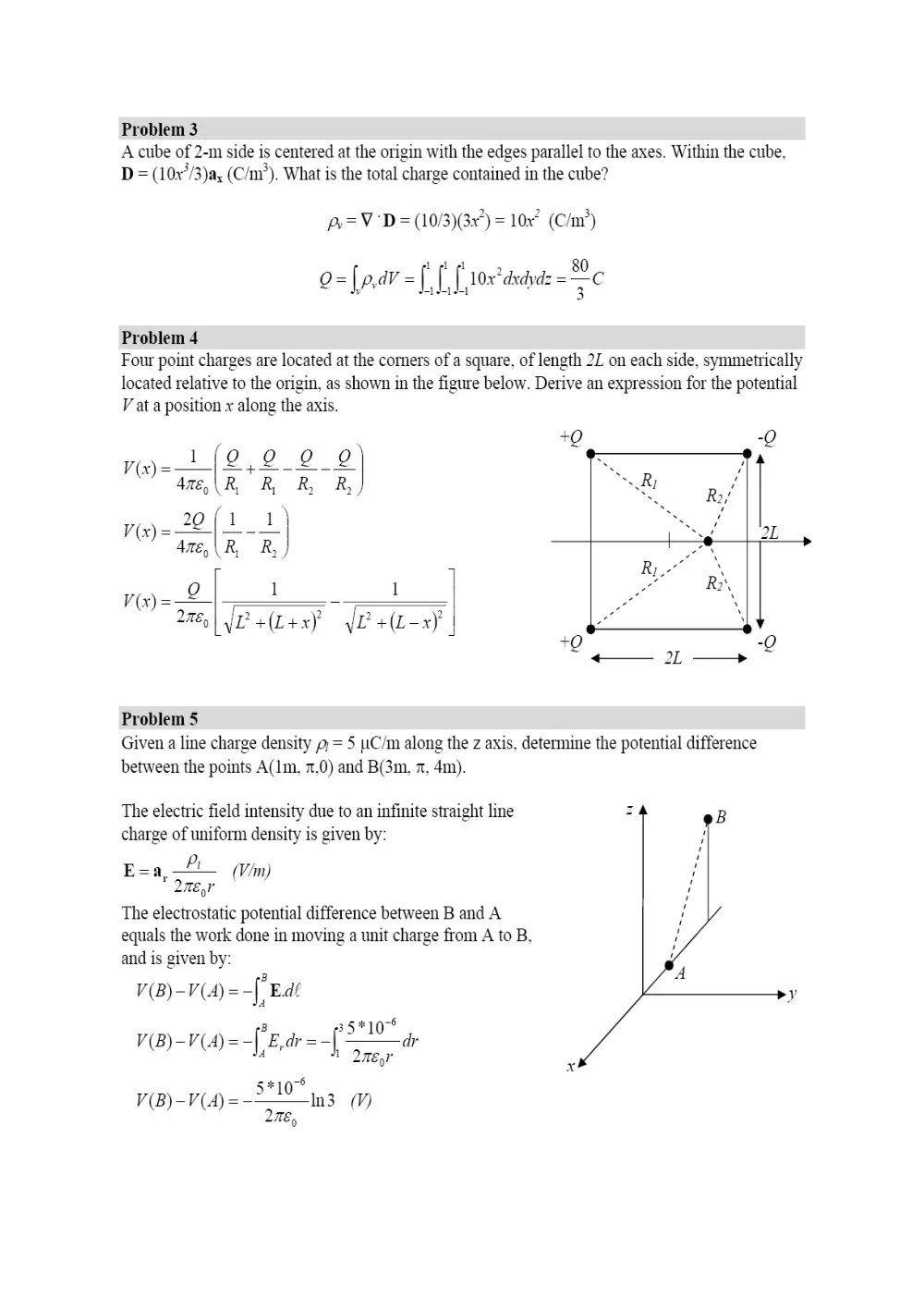
Problem 3
A cube of 2-m side is centered at the origin with the edges parallel to the axes. Within the cube,
D = (10x°/3)a, (C/m*). What is the total charge contained in the cube?
p= VD =(10/3)(3x") = 10x” (C/m’)
0=[pdv =f [ 10x" dedyde = =
Problem 4
Four point charges are located at the corners of a square, of length 2Z on each side, symmetrically
located relative to the origin, as shown in the figure below. Derive an expression for the potential
V at a position x along the axis.
' +O -O
o«—__"——-e
Vx) = 2.2.0.0) SR F
4me,\R, R, R, R, SAY Ro!
20(1 1 Mf
V(x) =—=| —-— — 2L
©) Ane, \ R, z| ma >
r Rye
QO 1 1 wo RN
1(9)-52 | o .
2me,| Je +(L+xy Ve +(L-x) SF
L ‘ ’
2 <— 2L — 2
Problem 5
Given a line charge density p = 5 uC/m along the z axis, determine the potential difference
between the points A(1m, 7.0) and B(3m, 7, 4m).
The electric field intensity due to an infinite straight line
charge of uniform density is given by:
E=a,—"— (vm)
27€ 51
The electrostatic potential difference between B and A
equals the work done in moving a unit charge from A to B,
and is given by:
V(B)-V(A)=-[, Eat
B 35* 10%
V(B)-V(A)=-| E,dr=- dr
(B)-V(A)=-[ E,ai Ver
5*10°
V(B)-V(A)=- In3 (V)
27€,