
EECE 380 Problems Solution Manual, Fall 2011
American University of Beirut · Engineering Electromagnetics · 24 pages · with solution

Showing the first 10 of 24 pages. Download the PDF to see all of it.
More EECE 380 files
- Problems Solution Manual · Fall 2011Problems · with solutionView
- Problems Solution Manual · Fall 2011Problems · with solutionView
- Problems Solution Manual · Fall 2011Problems · with solutionView
- Problems Solution Manual · Fall 2011Problems · with solutionView
- Problems Solution Manual · Fall 2011Problems · with solutionView
- Problems Solution Manual · Fall 2011Problems · with solutionView
- Problems Solution Manual · Fall 2011Problems · with solutionView
- Problems · Spring 2008ProblemsView
Show the text of this problems
Chapter 1: Introduction: Waves and Phasors
Lesson #1
Chapter — Section: Chapter 1
Topics: EM history and how it relates to other fields
Highlights:
• EM in Classical era: 1000 BC to 1900
• Examples of Modern Era Technology timelines
• Concept of “fields” (gravitational, electric, magnetic)
• Static vs. dynamic fields
• The EM Spectrum
Special Illustrations:
• Timelines from CD-ROM
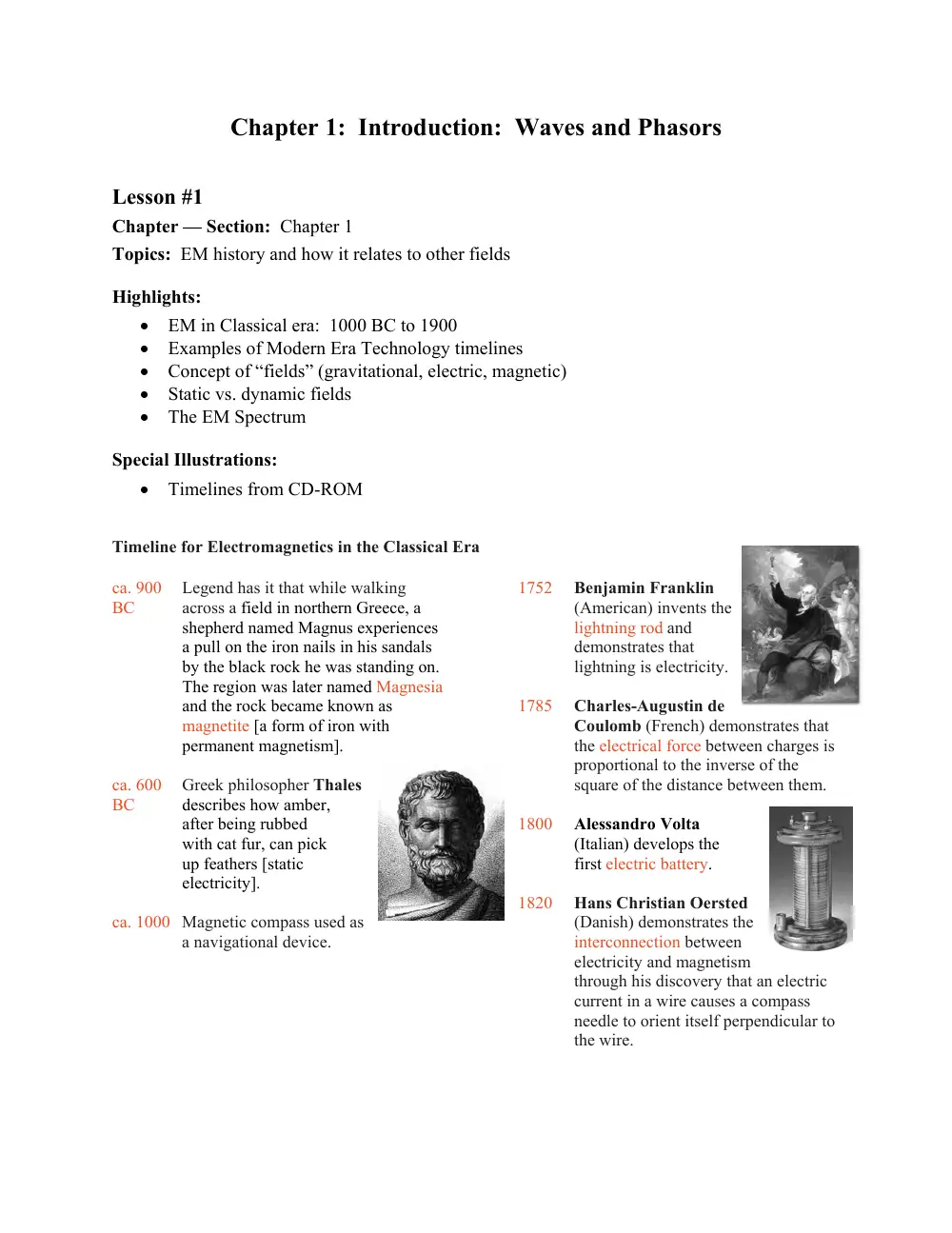
Timeline for Electromagnetics in the Classical Era
ca. 900 Legend has it that while walking
BC
across a field in northern Greece, a
shepherd named Magnus experiences
a pull on the iron nails in his sandals
by the black rock he was standing on.
The region was later named Magnesia
and the rock became known as
magnetite [a form of iron with
permanent magnetism].
ca. 600 Greek philosopher Thales
BC
describes how amber,
after being rubbed
with cat fur, can pick
up feathers [static
electricity].
ca. 1000 Magnetic compass used as
a navigational device.
1752 Benjamin Franklin
(American) invents the
lightning rod and
demonstrates that
lightning is electricity.
1785
Charles-Augustin de
Coulomb (French) demonstrates that
the electrical force between charges is
proportional to the inverse of the
square of the distance between them.
1800
Alessandro Volta
(Italian) develops the
first electric battery.
1820
Hans Christian Oersted
(Danish) demonstrates the
interconnection between
electricity and magnetism
through his discovery that an electric
current in a wire causes a compass
needle to orient itself perpendicular to
the wire.
2
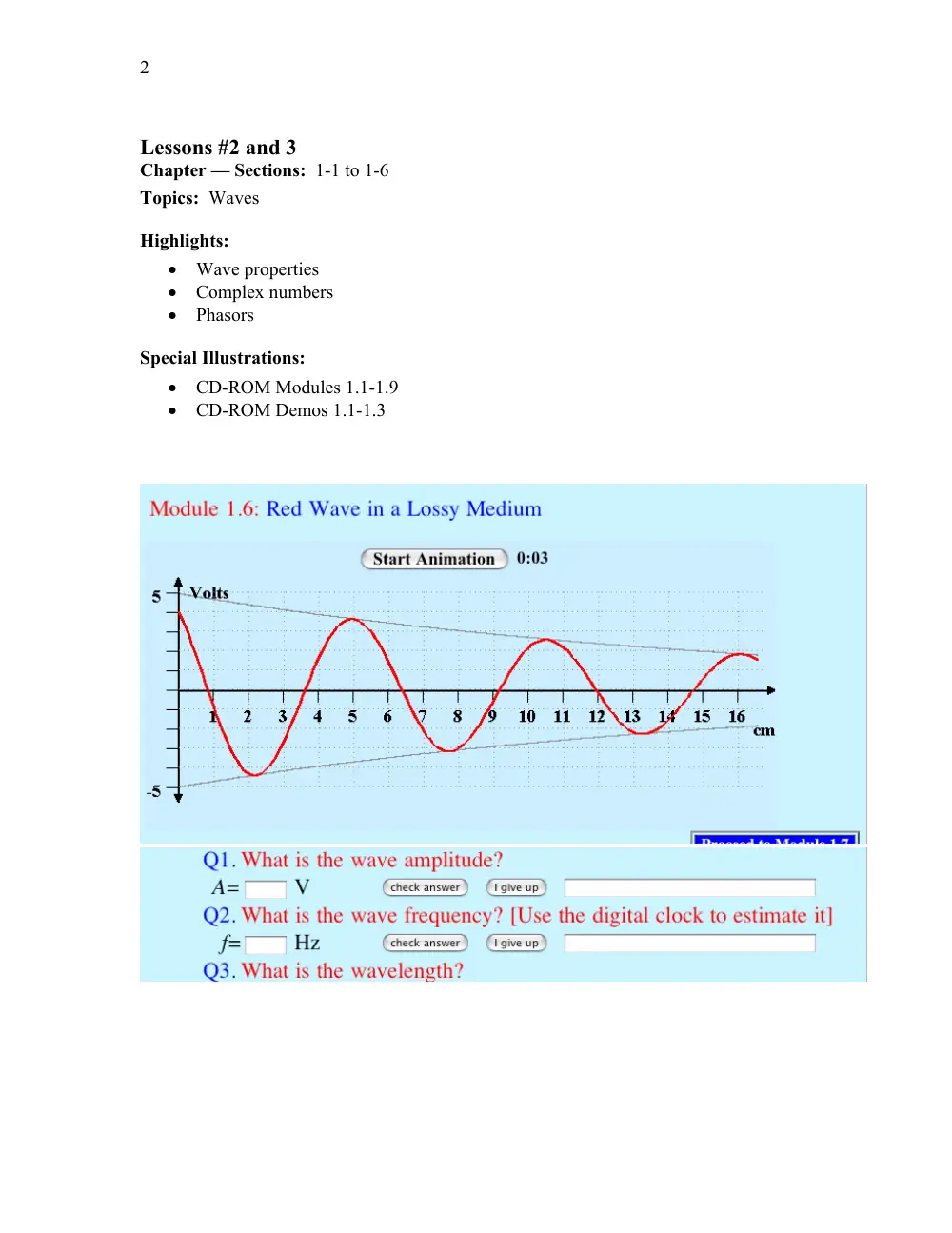
Lessons #2 and 3
Chapter — Sections: 1-1 to 1-6
Topics: Waves
Highlights:
• Wave properties
• Complex numbers
• Phasors
Special Illustrations:
• CD-ROM Modules 1.1-1.9
• CD-ROM Demos 1.1-1.3
CHAPTER 1
3
Chapter 1
Section 1-3: Traveling Waves
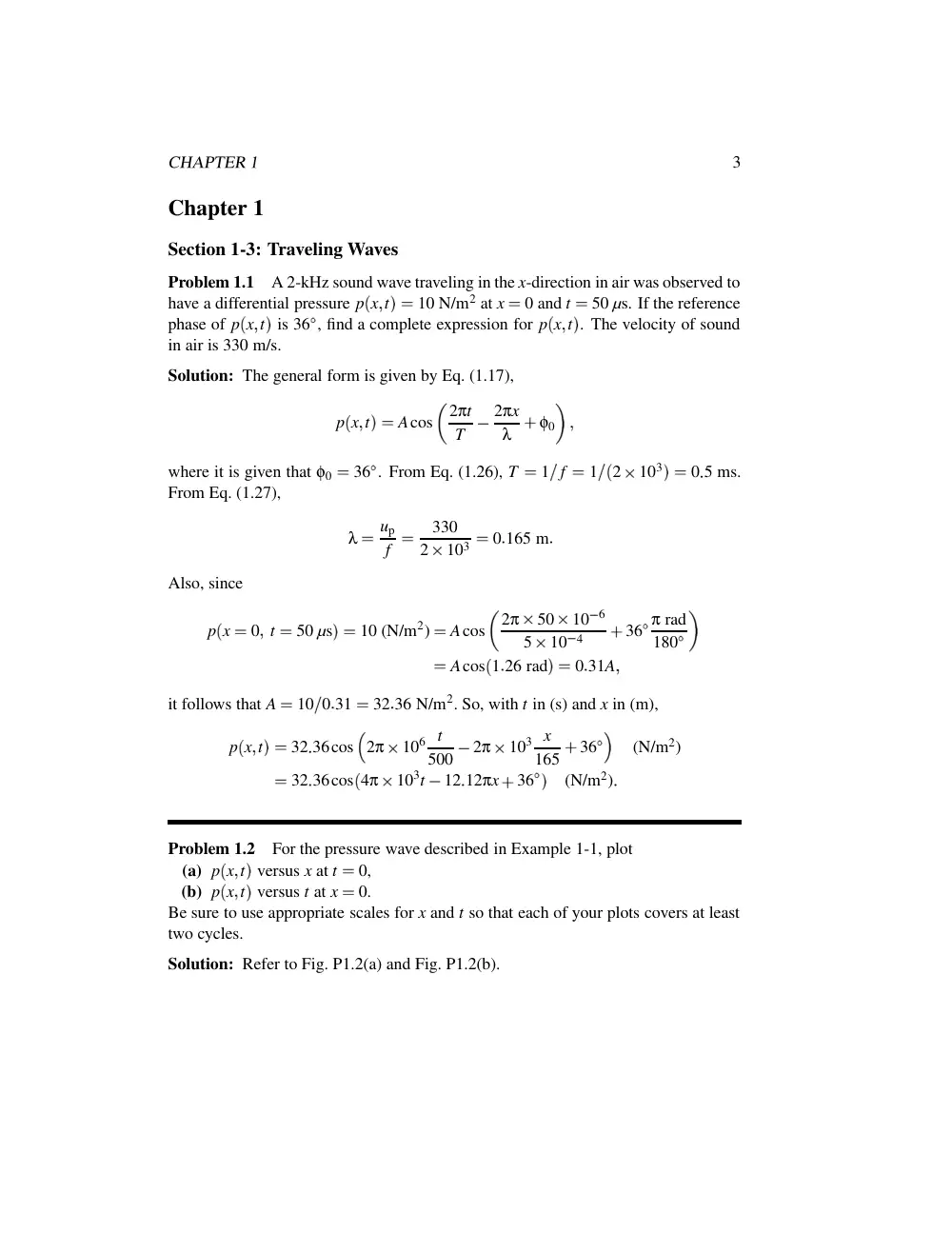
Problem 1.1
A 2-kHz sound wave traveling in the x-direction in air was observed to
have a differential pressure p
� x
� t
��
10 N/m2 at x
�
0 and t
�
50 µs. If the reference
phase of p
� x
� t
� is 36
� , find a complete expression for p
� x
� t
� . The velocity of sound
in air is 330 m/s.
Solution: The general form is given by Eq. (1.17),
p
� x
� t
��
Acos
� 2πt
T
�
2πx
λ
�
φ0
�
where it is given that φ0
�
36
� . From Eq. (1.26), T
�
1
f
�
1
� 2
103
��
0
5 ms.
From Eq. (1.27),
λ
�
up
f
�
330
2
103
�
0
165 m
Also, since
p
� x
�
0
� t
�
50 µs
��
10 (N/m2)
�
Acos
� 2π
50
10
6
5
10
4
�
36
� π rad
180
�
�
Acos
� 1
26 rad
��
0
31A
�
it follows that A
�
10
0
31
�
32
36 N/m2. So, with t in (s) and x in (m),
p
� x
� t
��
32
36cos
2π
106 t
500
�
2π
103 x
165
�
36
�
(N/m2)
�
32
36cos
� 4π
103t
�
12
12πx
�
36
�
�
(N/m2)
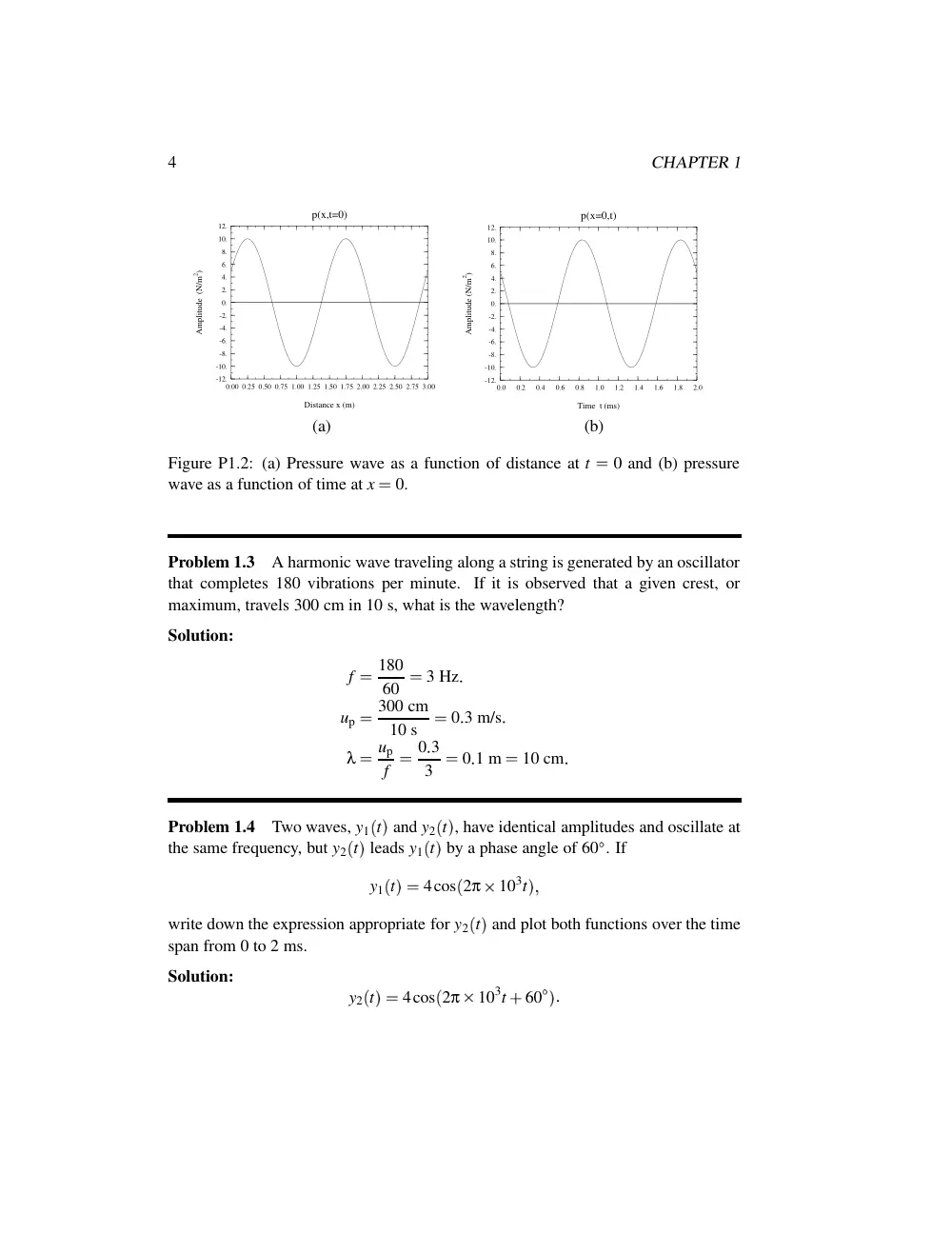
Problem 1.2
For the pressure wave described in Example 1-1, plot
(a) p
� x
� t
� versus x at t
�
0,
(b) p
� x
� t
� versus t at x
�
0.
Be sure to use appropriate scales for x and t so that each of your plots covers at least
two cycles.
Solution: Refer to Fig. P1.2(a) and Fig. P1.2(b).
4
CHAPTER 1
0.00 0.25 0.50 0.75 1.00 1.25 1.50 1.75 2.00 2.25 2.50 2.75 3.00
-12.
-10.
-8.
-6.
-4.
-2.
0.
2.
4.
6.
8.
10.
12.
Amplitude (N/m2)
Distance x (m)
p(x,t=0)
0.0
0.2
0.4
0.6
0.8
1.0
1.2
1.4
1.6
1.8
2.0
-12.
-10.
-8.
-6.
-4.
-2.
0.
2.
4.
6.
8.
10.
12.
Amplitude (N/m2)
Time t (ms)
p(x=0,t)
(a)
(b)
Figure P1.2: (a) Pressure wave as a function of distance at t
�
0 and (b) pressure
wave as a function of time at x
�
0.
Problem 1.3
A harmonic wave traveling along a string is generated by an oscillator
that completes 180 vibrations per minute. If it is observed that a given crest, or
maximum, travels 300 cm in 10 s, what is the wavelength?
Solution:
f
�
180
60
�
3 Hz
up
�
300 cm
10 s
�
0
3 m/s
λ
�
up
f
�
0
3
3
�
0
1 m
�
10 cm
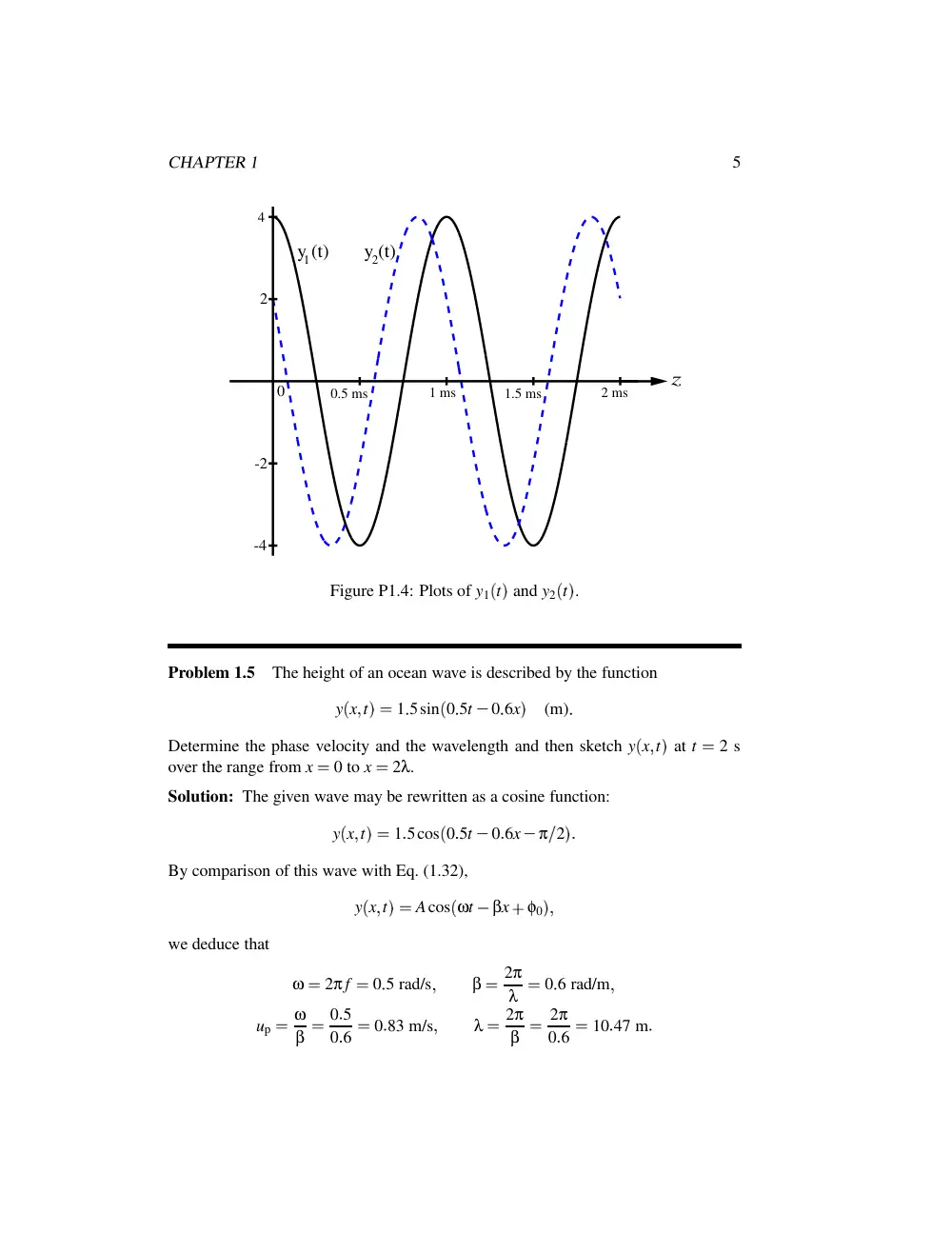
Problem 1.4
Two waves, y1
� t
� and y2
� t
� , have identical amplitudes and oscillate at
the same frequency, but y2
� t
� leads y1
� t
� by a phase angle of 60
� . If
y1
� t
��
4cos
� 2π
103t
�
�
write down the expression appropriate for y2
� t
� and plot both functions over the time
span from 0 to 2 ms.
Solution:
y2
� t
��
4cos
� 2π
103t
�
60
�
�
CHAPTER 1
5
0
4
2
-2
-4
0.5 ms
1 ms
1.5 ms
2 ms
y (t)
1
y (t)
2
z
Figure P1.4: Plots of y1
� t
� and y2
� t
� .
Problem 1.5
The height of an ocean wave is described by the function
y
� x
� t
��
1
5sin
� 0
5t
�
0
6x
�
(m)
Determine the phase velocity and the wavelength and then sketch y
� x
� t
� at t
�
2 s
over the range from x
�
0 to x
�
2λ.
Solution: The given wave may be rewritten as a cosine function:
y
� x
� t
��
1
5cos
� 0
5t
�
0
6x
�
π
2
�
By comparison of this wave with Eq. (1.32),
y
� x
� t
��
Acos
� ωt
�
βx
�
φ0
�
�
we deduce that
ω
�
2π f
�
0
5 rad/s
�
β
�
2π
λ
�
0
6 rad/m
�
up
�
ω
β
�
0
5
0
6
�
0
83 m/s
�
λ
�
2π
β
�
2π
0
6
�
10
47 m
6
CHAPTER 1
2λ
x
1.5
1
0.5
0
-0.5
-1
-1.5
y (π/2, t)
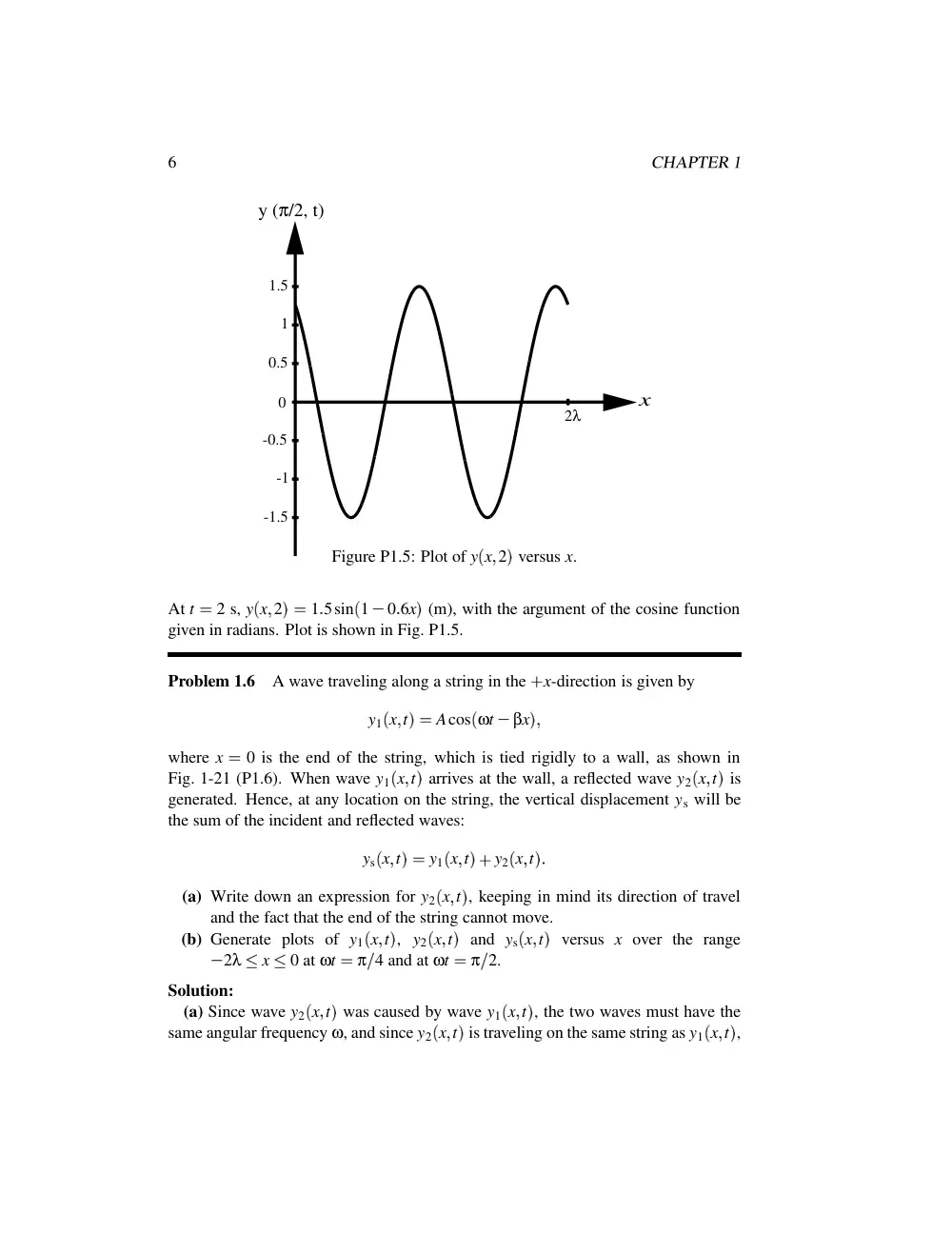
Figure P1.5: Plot of y
� x
� 2
� versus x.
At t
�
2 s, y
� x
� 2
�
�
1
5sin
� 1
�
0
6x
� (m), with the argument of the cosine function
given in radians. Plot is shown in Fig. P1.5.
Problem 1.6
A wave traveling along a string in the
� x-direction is given by
y1
� x
� t
��
Acos
� ωt
�
βx
�
�
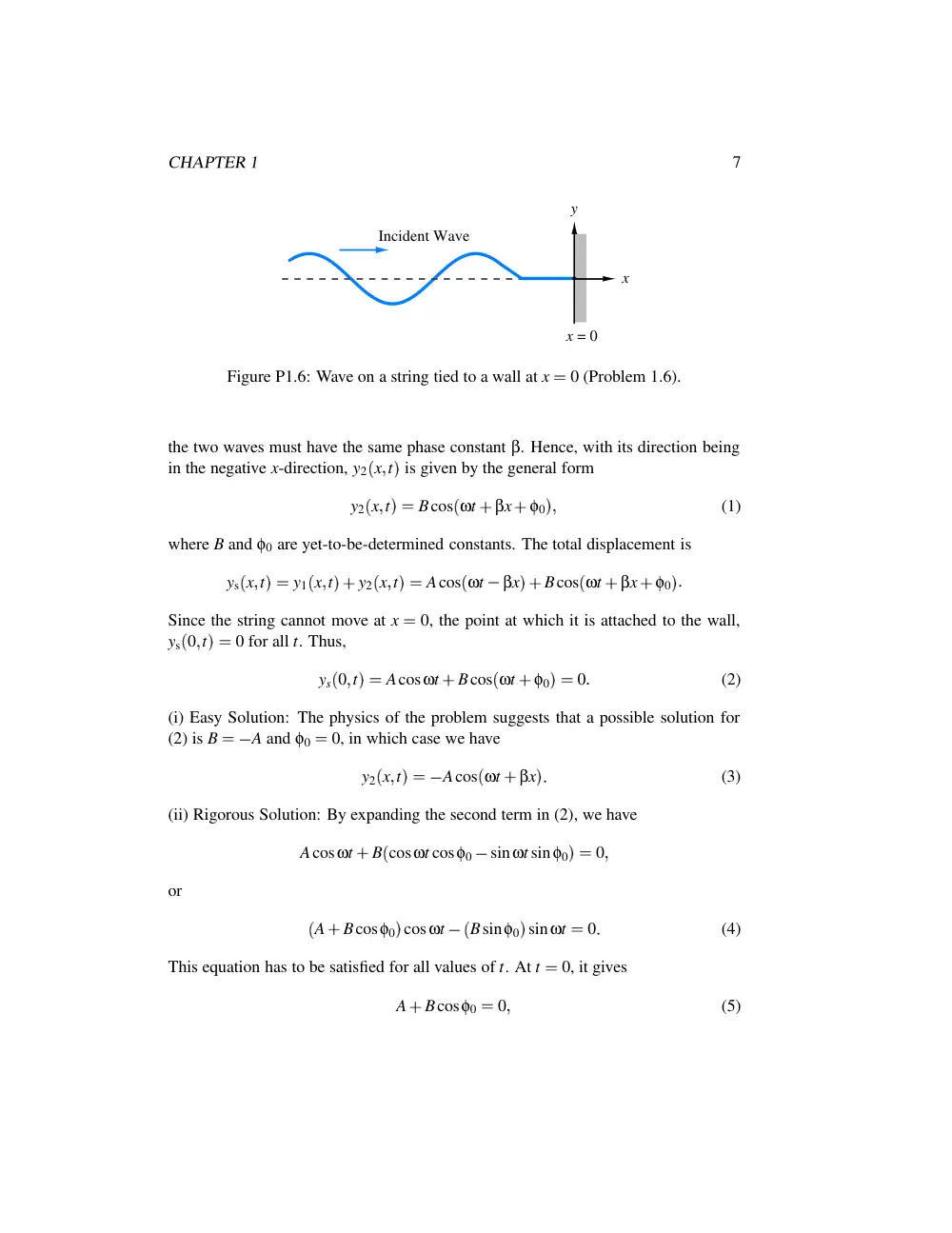
where x
�
0 is the end of the string, which is tied rigidly to a wall, as shown in
Fig. 1-21 (P1.6). When wave y1
� x
� t
� arrives at the wall, a reflected wave y2
� x
� t
� is
generated. Hence, at any location on the string, the vertical displacement ys will be
the sum of the incident and reflected waves:
ys
� x
� t
��
y1
� x
� t
�
�
y2
� x
� t
�
(a) Write down an expression for y2
� x
� t
� , keeping in mind its direction of travel
and the fact that the end of the string cannot move.
(b) Generate plots of y1
� x
� t
� , y2
� x
� t
�
and ys
� x
� t
�
versus x over the range
� 2λ
�
x
�
0 at ωt
�
π
4 and at ωt
�
π
2.
Solution:
(a) Since wave y2
� x
� t
� was caused by wave y1
� x
� t
� , the two waves must have the
same angular frequency ω, and since y2
� x
� t
� is traveling on the same string as y1
� x
� t
� ,
CHAPTER 1
7
x
x = 0
Incident Wave
y
Figure P1.6: Wave on a string tied to a wall at x
�
0 (Problem 1.6).
the two waves must have the same phase constant β. Hence, with its direction being
in the negative x-direction, y2
� x
� t
� is given by the general form
y2
� x
� t
��
Bcos
� ωt
�
βx
�
φ0
�
�
(1)
where B and φ0 are yet-to-be-determined constants. The total displacement is
ys
� x
� t
��
y1
� x
� t
�
�
y2
� x
� t
��
Acos
� ωt
�
βx
�
�
Bcos
� ωt
�
βx
�
φ0
�
Since the string cannot move at x
�
0, the point at which it is attached to the wall,
ys
� 0
� t
��
0 for all t. Thus,
ys
� 0
� t
��
Acosωt
�
Bcos
� ωt
�
φ0
��
0
(2)
(i) Easy Solution: The physics of the problem suggests that a possible solution for
(2) is B
�
� A and φ0
�
0, in which case we have
y2
� x
� t
��
� Acos
� ωt
�
βx
�
(3)
(ii) Rigorous Solution: By expanding the second term in (2), we have
Acosωt
�
B
� cosωt cosφ0
�
sinωt sinφ0
��
0
�
or
� A
�
Bcosφ0
� cosωt
�
� Bsinφ0
� sinωt
�
0
(4)
This equation has to be satisfied for all values of t. At t
�
0, it gives
A
�
Bcosφ0
�
0
�
(5)
8
CHAPTER 1
and at ωt
�
π
2, (4) gives
Bsinφ0
�
0
(6)
Equations (5) and (6) can be satisfied simultaneously only if
A
�
B
�
0
(7)
or
A
�
� B
and
φ0
�
0
(8)
Clearly (7) is not an acceptable solution because it means that y1
� x
� t
�
�
0, which is
contrary to the statement of the problem. The solution given by (8) leads to (3).
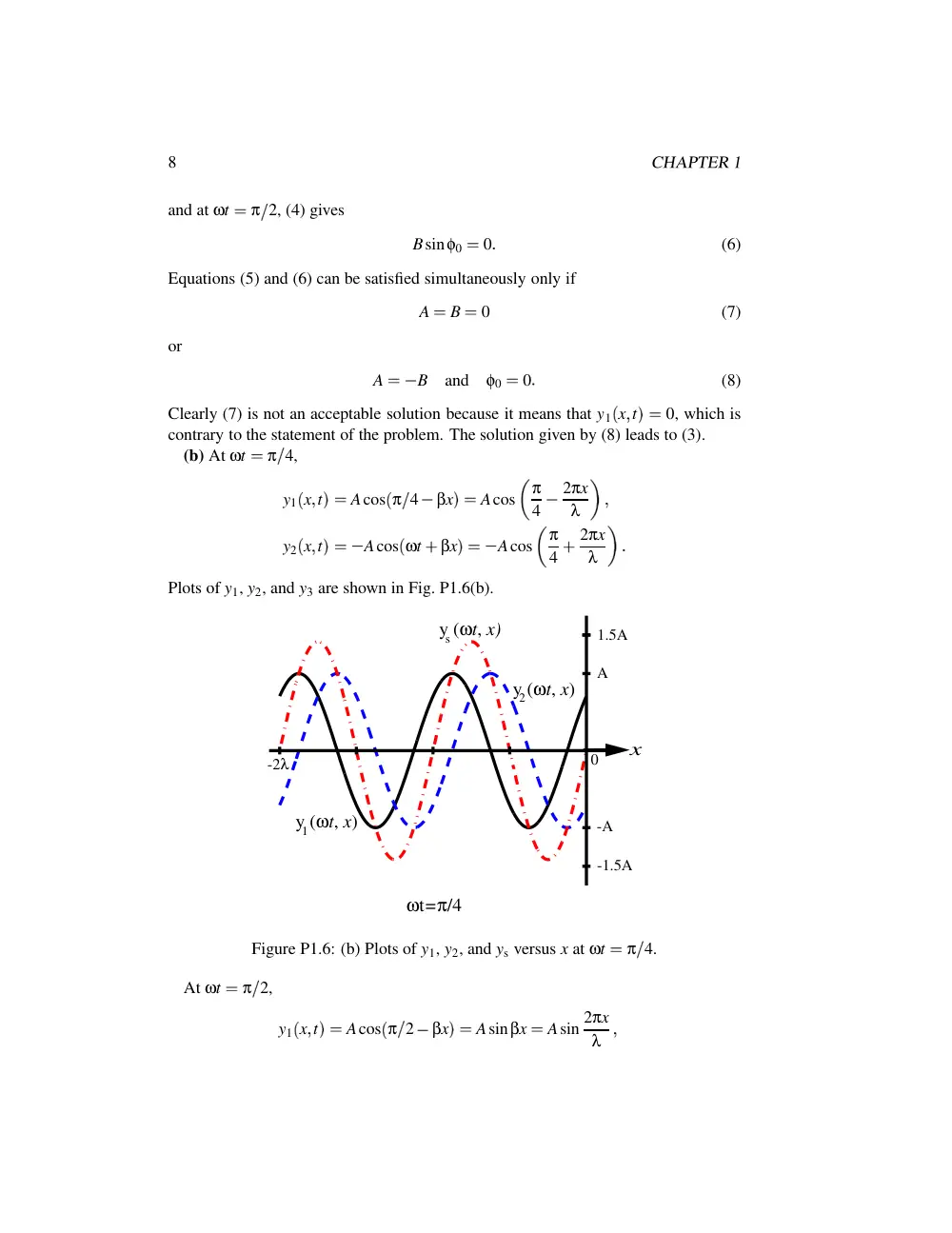
(b) At ωt
�
π
4,
y1
� x
� t
��
Acos
� π
4
�
βx
��
Acos
� π
4
�
2πx
λ
�
y2
� x
� t
��
� Acos
� ωt
�
βx
��
� Acos
� π
4
�
2πx
λ
Plots of y1, y2, and y3 are shown in Fig. P1.6(b).
y (ωt, x)
2
y (ωt, x)
s
0
A
-A
-2λ
x
1.5A
-1.5A
ωt=π/4
y (ωt, x)
1
Figure P1.6: (b) Plots of y1, y2, and ys versus x at ωt
�
π
4.
At ωt
�
π
2,
y1
� x
� t
��
Acos
� π
2
�
βx
��
Asinβx
�
Asin 2πx
λ
�
CHAPTER 1
9
y2
� x
� t
��
� Acos
� π
2
�
βx
��
Asinβx
�
Asin 2πx
λ
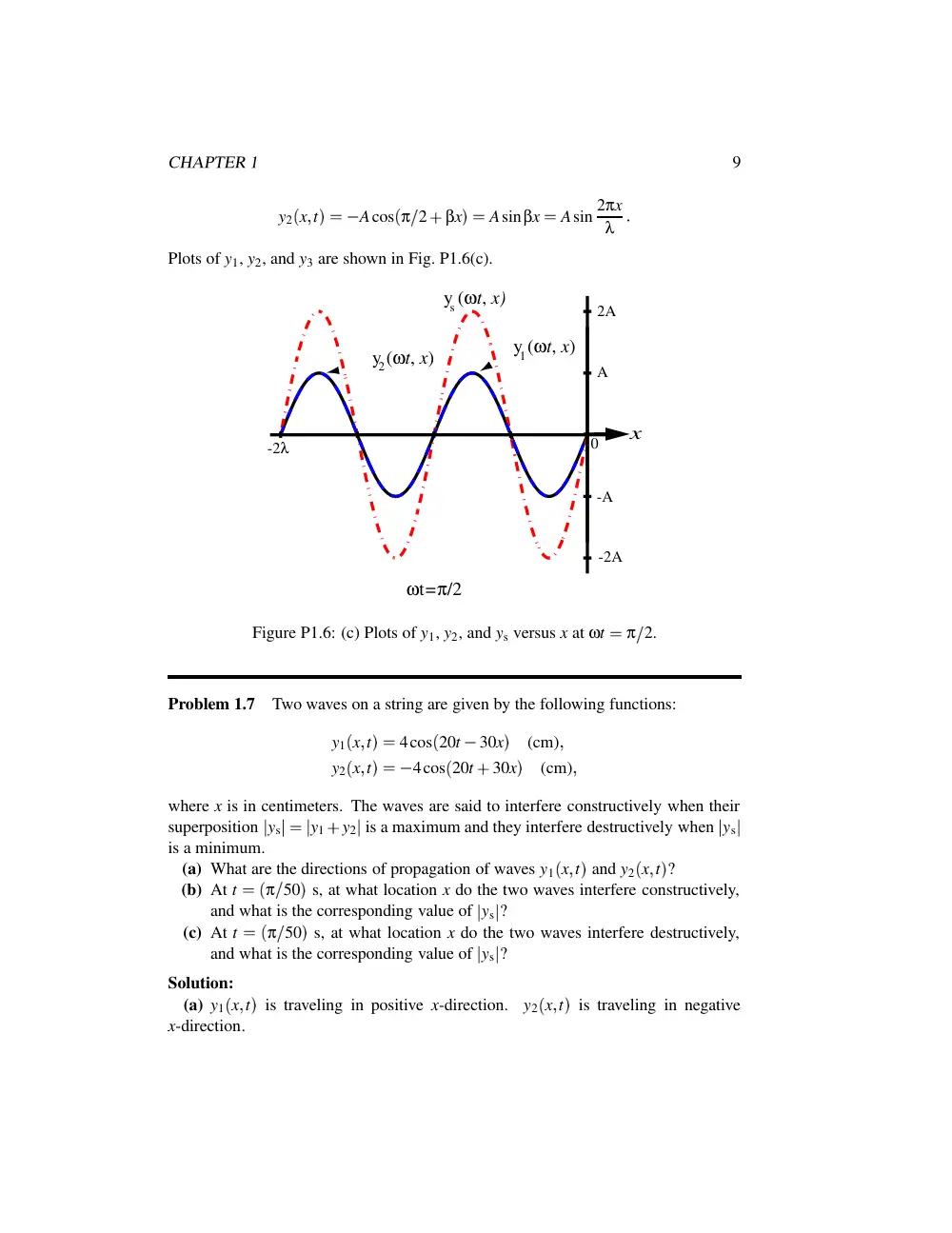
Plots of y1, y2, and y3 are shown in Fig. P1.6(c).
y (ωt, x)
2
y (ωt, x)
s
0
A
-A
-2λ
x
2A
-2A
ωt=π/2
y (ωt, x)
1
Figure P1.6: (c) Plots of y1, y2, and ys versus x at ωt
�
π
2.
Problem 1.7
Two waves on a string are given by the following functions:
y1
� x
� t
��
4cos
� 20t
�
30x
�
(cm)
�
y2
� x
� t
��
� 4cos
� 20t
�
30x
�
(cm)
�
where x is in centimeters. The waves are said to interfere constructively when their
superposition
� ys
�
�� y1
�
y2
� is a maximum and they interfere destructively when
� ys
�
is a minimum.
(a) What are the directions of propagation of waves y1
� x
� t
� and y2
� x
� t
� ?
(b) At t
�
� π
50
� s, at what location x do the two waves interfere constructively,
and what is the corresponding value of
� ys
� ?
(c) At t
�
� π
50
� s, at what location x do the two waves interfere destructively,
and what is the corresponding value of
� ys
� ?
Solution:
(a) y1
� x
� t
� is traveling in positive x-direction.
y2
� x
� t
� is traveling in negative
x-direction.
10
CHAPTER 1
(b) At t
�
� π
50
� s, ys
�
y1
�
y2
�
4
� cos
� 0
4π
�
30x
�
�
cos
� 0
4π
�
3x
�� . Using the
formulas from Appendix C,
2sinxsiny
�
cos
� x
�
y
�
�
� cosx
�
y
�
�
we have
ys
�
8sin
� 0
4π
� sin30x
�
7
61sin30x
Hence,
� ys
� max
�
7
61
and it occurs when sin30x
�
1, or 30x
�
π
2
�
2nπ, or x
�
�
π
60
�
2nπ
30
cm, where
n
�
0
� 1
� 2
�
(c)
� ys
� min
�
0 and it occurs when 30x
�
nπ, or x
�
nπ
30 cm.
Problem 1.8
Give expressions for y
� x
� t
� for a sinusoidal wave traveling along a
string in the negative x-direction, given that ymax
�
40 cm, λ
�
30 cm, f
�
10 Hz,
and
(a) y
� x
� 0
��
0 at x
�
0,
(b) y
� x
� 0
��
0 at x
�
7
5 cm.
Solution: For a wave traveling in the negative x-direction, we use Eq. (1.17) with
ω
�
2π f
�
20π (rad/s), β
�
2π
λ
�
2π
0
3
�
20π
3 (rad/s), A
�
40 cm, and x
assigned a positive sign:
y
� x
� t
��
40cos
�
20πt
�
20π
3 x
�
φ0
(cm)
�
with x in meters.
(a) y
� 0
� 0
��
0
�
40cosφ0. Hence, φ0
�� π
2, and
y
� x
� t
��
40cos
�
20πt
�
20π
3 x
�
π
2
�
�
� 40sin
� 20πt
�
20π
3 x
� (cm),
if φ0
�
π
2
�
40sin
� 20πt
�
20π
3 x
� (cm),
if φ0
�
� π
2
(b) At x
�
7
5 cm = 7
5
10
2 m, y
�
0
�
40cos
� π
2
�
φ0
� . Hence, φ0
�
0 or π,
and
y
� x
� t
��
�
40cos
� 20πt
�
20π
3 x
� (cm),
if φ0
�
0
�
� 40cos
� 20πt
�
20π
3 x
� (cm),
if φ0
�
π
CHAPTER 1
11
Problem 1.9
An oscillator that generates a sinusoidal wave on a string completes
20 vibrations in 50 s. The wave peak is observed to travel a distance of 2.8 m along
the string in 50 s. What is the wavelength?
Solution:
T
�
50
20
�
2
5 s
�
up
�
2
8
5
�
0
56 m/s
�
λ
�
upT
�
0
56
2
5
�
1
4 m
Problem 1.10
The vertical displacement of a string is given by the harmonic
function:
y
� x
� t
��
6cos
� 16πt
�
20πx
�
(m)
�
where x is the horizontal distance along the string in meters. Suppose a tiny particle
were to be attached to the string at x
�
5 cm, obtain an expression for the vertical
velocity of the particle as a function of time.
Solution:
y
� x
� t
��
6cos
� 16πt
�
20πx
�
(m)
u
� 0
05
� t
��
dy
� x
� t
�
dt
�
�
�
�
x
� 0
� 05
�
96πsin
� 16πt
�
20πx
�
� x
� 0
� 05
�
96πsin
� 16πt
�
π
�
�
� 96πsin
� 16πt
�
(m/s)
Problem 1.11
Given two waves characterized by
y1
� t
��
3cosωt
�
y2
� t
��
3sin
� ωt
�
36
�
�
�
does y2
� t
� lead or lag y1
� t
� , and by what phase angle?
Solution: We need to express y2
� t
� in terms of a cosine function:
y2
� t
��
3sin
� ωt
�
36
�
�
�
3cos
π
2
�
ωt
�
36
�
�
3cos
� 54
�
�
ωt
��
3cos
� ωt
�
54
�
�
12
CHAPTER 1
Hence, y2
� t
� lags y1
� t
� by 54
� .
Problem 1.12
The voltage of an electromagnetic wave traveling on a transmission
line is given by v
� z
� t
�
�
5e
αz sin
� 4π
109t
�
20πz
� (V), where z is the distance in
meters from the generator.
(a) Find the frequency, wavelength, and phase velocity of the wave.
(b) At z
�
2 m, the amplitude of the wave was measured to be 1 V. Find α.
Solution:
(a) This equation is similar to that of Eq. (1.28) with ω
�
4π
109 rad/s and
β
�
20π rad/m.
From Eq. (1.29a),
f
�
ω
2π
�
2
109 Hz
�
2 GHz; from
Eq. (1.29b), λ
�
2π
β
�
0
1 m. From Eq. (1.30),
up
�
ω
β
�
2
108 m/s
(b) Using just the amplitude of the wave,
1
�
5e
α2
�
α
�
� 1
2 m ln
� 1
5
�
0
81 Np/m.
Problem 1.13
A certain electromagnetic wave traveling in sea water was observed
to have an amplitude of 98.02 (V/m) at a depth of 10 m and an amplitude of 81.87
(V/m) at a depth of 100 m. What is the attenuation constant of sea water?
Solution: The amplitude has the form Aeαz. At z
�
10 m,
Ae
10α
�
98
02
and at z
�
100 m,
Ae
100α
�
81
87
The ratio gives
e
10α
e
100α
�
98
02
81
87
�
1
20
or
e
10α
�
1
2e
100α
Taking the natural log of both sides gives
ln
� e
10α
��
ln
� 1
2e
100α
�
�
� 10α
�
ln
� 1
2
�
�
100α
�
90α
�
ln
� 1
2
��
0
18
Hence,
α
�
0
18
90
�
2
10
3
(Np/m)
CHAPTER 1
13
Section 1-5: Complex Numbers
Problem 1.14
Evaluate each of the following complex numbers and express the
result in rectangular form:
(a) z1
�
4ejπ
� 3,
(b) z2
�� 3 ej3π
� 4,
(c) z3
�
6e
jπ
� 2,
(d) z4
�
j3,
(e) z5
�
j
4,
(f) z6
�
� 1
�
j
� 3,
(g) z7
�
� 1
�
j
� 1
� 2.
Solution: (Note: In the following solutions, numbers are expressed to only two
decimal places, but the final answers are found using a calculator with 10 decimal
places.)
(a) z1
�
4ejπ
� 3
�
4
� cosπ
3
�
jsinπ
3
��
2
0
�
j3
46.
(b)
z2
�
� 3ej3π
� 4
�
� 3
�
cos
� 3π
4
�
jsin
� 3π
4
�
�
� 1
22
�
j1
22
�
1
22
�
� 1
�
j
�
(c) z3
�
6e
jπ
� 2
�
6
� cos
�
� π
2
�
�
jsin
�
� π
2
��
�
�
j6.
(d) z4
�
j3
�
j
� j2
�
�
j, or
z4
�
j3
�
� ejπ
� 2
� 3
�
ej3π
� 2
�
cos
� 3π
2
�
�
jsin
� 3π
2
��
�
j
(e) z5
�
j
4
�
� ejπ
� 2
�
4
�
e
j2π
�
1.
(f)
z6
�
� 1
�
j
� 3
�
�
� 2e
jπ
� 4
� 3
�
�
� 2
� 3e
j3π
� 4
�
�
� 2
� 3
� cos
� 3π
4
�
�
jsin
� 3π
4
��
�
� 2
�
j2
�
� 2
� 1
�
j
�
(g)
z7
�
� 1
�
j
� 1
� 2
�
�
� 2e
jπ
� 4
� 1
� 2
�� 21
� 4e
jπ
� 8
�
� 1
19
� 0
92
�
j0
38
�
�
�
� 1
10
�
j0
45
�
Problem 1.15
Complex numbers z1 and z2 are given by
z1
�
3
�
j2
�
z2
�
� 4
�
j3
14
CHAPTER 1
(a) Express z1 and z2 in polar form.
(b) Find
� z1
� by applying Eq. (1.41) and again by applying Eq. (1.43).
(c) Determine the product z1z2 in polar form.
(d) Determine the ratio z1
z2 in polar form.
(e) Determine z3
1 in polar form.
Solution:
(a) Using Eq. (1.41),
z1
�
3
�
j2
�
3
6e
j33
� 7
�
�
z2
�
� 4
�
j3
�
5e j143
� 1
�
(b) By Eq. (1.41) and Eq. (1.43), respectively,
� z1
�
�
� 3
�
j2
�
��
32
�
�
� 2
� 2
�
� 13
�
3
60
�
� z1
�
��
� 3
�
j2
�
� 3
�
j2
��
� 13
�
3
60
(c) By applying Eq. (1.47b) to the results of part (a),
z1z2
�
3
6e
j33
� 7
�
5ej143
� 1
�
�
18ej109
� 4
�
(d) By applying Eq. (1.48b) to the results of part (a),
z1
z2
�
3
6e
j33
� 7
�
5ej143
� 1
�
�
0
72e
j176
� 8
�
(e) By applying Eq. (1.49) to the results of part (a),
z3
1
�
� 3
6e
j33
� 7
�
�
3
�
� 3
6
� 3e
j3
� 33
� 7
�
�
46
66e
j101
� 1
�
Problem 1.16
If z
�
� 2
�
j4, determine the following quantities in polar form:
(a) 1
z,
(b) z3,
(c)
� z
� 2,
(d)
��� z
,
(e)
��� z
.
Solution: (Note: In the following solutions, numbers are expressed to only two
decimal places, but the final answers are found using a calculator with 10 decimal
places.)
CHAPTER 1
15
(a)
1
z
�
1
� 2
�
j4
�
�
� 2
�
j4
�
1
�
� 4
47ej116
� 6
�
�
1
�
� 4
47
�
1e
j116
� 6
�
�
0
22e
j116
� 6
�
(b) z3
�
�
� 2
�
j4
� 3
�
� 4
47ej116
� 6
�
� 3
�
� 4
47
� 3ej350
� 0
�
�
89
44e
j10
� .
(c)
� z
� 2
�
z
� z
�
�
� 2
�
j4
�
�
� 2
�
j4
��
4
�
16
�
20.
(d)
��� z
�
���
� 2
�
j4
�
4.
(e)
��� z
�
��
�
� 2
�
j4
�
� 4
�
4e jπ.
Problem 1.17
Find complex numbers t
�
z1
�
z2 and s
�
z1
�
z2, both in polar form,
for each of the following pairs:
(a) z1
�
2
�
j3, z2
�
1
�
j3,
(b) z1
�
3, z2
�
�
j3,
(c) z1
�
3
�
30
� , z2
�
3
�
30
� ,
(d) z1
�
3
�
30
� , z2
�
3
�
150
� .
Solution:
(a)
t
�
z1
�
z2
�
� 2
�
j3
�
�
� 1
�
j3
��
3
�
s
�
z1
�
z2
�
� 2
�
j3
�
�
� 1
�
j3
��
1
�
j6
�
6
08e j80
� 5
�
(b)
t
�
z1
�
z2
�
3
�
j3
�
4
24e
j45
�
�
s
�
z1
�
z2
�
3
�
j3
�
4
24e j45
�
(c)
t
�
z1
�
z2
�
3
� 30
�
�
3
�
30
�
�
3ej30
�
�
3e
j30
�
�
� 2
6
�
j1
5
�
�
� 2
6
�
j1
5
�
�
5
2
�
s
�
z1
�
z2
�
3ej30
�
�
3e
j30
�
�
� 2
6
�
j1
5
�
�
� 2
6
�
j1
5
�
�
j3
�
3e j90
�
(d)
t
�
z1
�
z2
�
3
� 30
�
�
3
�
150
�
�
� 2
6
�
j1
5
�
�
�
� 2
6
�
j1
5
��
0
�
s
�
z1
�
z2
�
� 2
6
�
j1
5
�
�
�
� 2
6
�
j1
5
�
�
5
2
�
j3
�
6e j30
�
Problem 1.18
Complex numbers z1 and z2 are given by
z1
�
5
�
60
�
�
z2
�
2
� 45
�
16
CHAPTER 1
(a) Determine the product z1z2 in polar form.
(b) Determine the product z1z
2 in polar form.
(c) Determine the ratio z1
z2 in polar form.
(d) Determine the ratio z
1
z
2 in polar form.
(e) Determine
� z1 in polar form.
Solution:
(a) z1z2
�
5e
j60
�
2ej45
�
�
10e
j15
� .
(b) z1z
2
�
5e
j60
�
2e
j45
�
�
10e
j105
� .
(c)
z1
z2
�
5e
j60
�
2ej45
�
�
2
5
j105
� .
(d)
z
1
z
2
�
� z1
z2
�
2
5j105
� .
(e)
� z1
�
�
5e
j60
�
�
�
� 5e
j30
� .
Problem 1.19
If z
�
3
�
j5, find the value of ln
� z
� .
Solution:
� z
�
�
�
�
32
�
52
�
5
83
�
θ
�
tan
1
�
� 5
3
�
� 59
�
�
z
�
� z
� ejθ
�
5
83e
j59
�
�
ln
� z
��
ln
� 5
83e
j59
�
�
�
ln
� 5
83
�
�
ln
� e
j59
�
�
�
1
76
�
j59
�
�
1
76
�
j59
� π
180
�
�
1
76
�
j1
03
Problem 1.20
If z
�
3
�
j4, find the value of ez.
Solution:
ez
�
e3
j4
�
e3
� e
j4
�
e3
� cos4
�
jsin4
�
�
e3
�
20
09
�
and
4 rad
�
4
π
180
�
�
229
18
�
Hence, ez
�
20
08
� cos229
18
�
�
jsin229
18
�
��
� 13
13
�
j15
20.
CHAPTER 1
17
Section 1-6: Phasors
Problem 1.21
A voltage source given by vs
� t
�
�
25cos
� 2π
103t
�
30
�
� (V) is
connected to a series RC load as shown in Fig. 1-19. If R
�
1 MΩ and C
�
200 pF,
obtain an expression for vc
� t
� , the voltage across the capacitor.
Solution: In the phasor domain, the circuit is a voltage divider, and
�
Vc
�
�
Vs
1
jωC
R
�
1
jωC
�
�
Vs
� 1
�
jωRC
�
Now
�
Vs
�
25e
j30
� V with ω
�
2π
103 rad/s, so
�
Vc
�
25e
j30
� V
1
�
j
�
� 2π
103 rad/s
��
� 106 Ω
��
� 200
10
12 F
�
�
�
25e
j30
� V
1
�
j2π
5
�
15
57e
j81
� 5
� V.
Converting back to an instantaneous value,
vc
� t
��
��
�
Vcejωt
�
�� 15
57e j
� ωt
81
� 5
�� V
�
15
57cos
� 2π
103t
�
81
5
�
� V
�
where t is expressed in seconds.
Problem 1.22
Find the phasors of the following time functions:
(a) v
� t
��
3cos
� ωt
�
π
3
�
(V),
(b) v
� t
��
12sin
� ωt
�
π
4
�
(V),
(c) i
� x
� t
��
2e
3x sin
� ωt
�
π
6
�
(A),
(d) i
� t
��
� 2cos
� ωt
�
3π
4
�
(A),
(e) i
� t
��
4sin
� ωt
�
π
3
�
�
3cos
� ωt
�
π
6
�
(A).
Solution:
(a)
�
V
�
3e
jπ
� 3 V.
(b) v
� t
�
�
12sin
� ωt
�
π
4
�
�
12cos
� π
2
�
� ωt
�
π
4
�
�
�
12cos
� ωt
�
π
4
� V,
�
V
�
12e
jπ
� 4 V.
(c)
i
� t
��
2e
3x sin
� ωt
�
π
6
� A
�
2e
3x cos
� π
2
�
� ωt
�
π
6
�
� A
�
2e
3x cos
� ωt
�
π
3
� A
�
�
I
�
2e
3xe
jπ
� 3 A
18
CHAPTER 1
(d)
i
� t
��
� 2cos
� ωt
�
3π
4
�
�
�
I
�
� 2ej3π
� 4
�
2e
jπej3π
� 4
�
2e
jπ
� 4 A
(e)
i
� t
��
4sin
� ωt
�
π
3
�
�
3cos
� ωt
�
π
6
�
�
4cos
� π
2
�
� ωt
�
π
3
��
�
3cos
� ωt
�
π
6
�
�
4cos
�
� ωt
�
π
6
�
�
3cos
� ωt
�
π
6
�
�
4cos
� ωt
�
π
6
�
�
3cos
� ωt
�
π
6
��
7cos
� ωt
�
π
6
�
�
�
I
�
7e
jπ
� 6 A
Problem 1.23
Find the instantaneous time sinusoidal functions corresponding to
the following phasors:
(a)
�
V
�
� 5ejπ
� 3 (V),
(b)
�
V
�
j6e
jπ
� 4 (V),
(c)
�
I
�
� 6
�
j8
�
(A),
(d) ˜I
�
� 3
�
j2 (A),
(e) ˜I
�
j (A),
(f) ˜I
�
2ejπ
� 6 (A).
Solution:
(a)
�
V
�
� 5ejπ
� 3 V
�
5ej
� π
� 3
π
� V
�
5e
j2π
� 3 V
�
v
� t
��
5cos
� ωt
�
2π
3
� V
(b)
�
V
�
j6e
jπ
� 4 V
�
6ej
�
π
� 4
� π
� 2
� V
�
6ejπ
� 4 V
�
v
� t
��
6cos
� ωt
�
π
4
� V
(c)
�
I
�
� 6
�
j8
� A
�
10e j53
� 1
� A
�
i
� t
��
10cos
� ωt
�
53
1
�
� A.
(d)
�
I
�
� 3
�
j2
�
3
61e j146
� 31
�
�
i
� t
��
��
� 3
61e j146
� 31
� ejωt
�
3
61 cos
� ωt
�
146
31
�
� A
CHAPTER 1
19
(e)
�
I
�
j
�
ejπ
� 2
�
i
� t
��
��
� ejπ
� 2ejωt
�
cos
� ωt
�
π
2
��
�
sinωt A
(f)
�
I
�
2ejπ
� 6
�
i
� t
��
��
� 2ejπ
� 6ejωt
�
2cos
� ωt
�
π
6
� A
Problem 1.24
A series RLC circuit is connected to a generator with a voltage
vs
� t
��
V0 cos
� ωt
�
π
3
� (V).
(a) Write down the voltage loop equation in terms of the current i
� t
� , R, L, C, and
vs
� t
� .
(b) Obtain the corresponding phasor-domain equation.
(c) Solve the equation to obtain an expression for the phasor current
�
I.
Vs(t)
R
L
C
i
Figure P1.24: RLC circuit.
Solution:
(a) vs
� t
��
Ri
�
Ldi
dt
�
1
C
�
idt
(b) In phasor domain:
�
Vs
�
R˜I
�
jωL˜I
�
˜I
jωC
(c)
˜I
�
�
Vs
R
�
j
� ωL
�
1
ωC
�
�
V0ejπ
� 3
R
�
j
� ωL
�
1
ωC
�
�
ωCV0ejπ
� 3
ωRC
�
j
� ω2LC
�
1
�
Problem 1.25
A wave traveling along a string is given by
y
� x
� t
��
2sin
� 4πt
�
10πx
�
(cm)
20
CHAPTER 1
where x is the distance along the string in meters and y is the vertical displacement.
Determine: (a) the direction of wave travel, (b) the reference phase φ0, (c) the
frequency, (d) the wavelength, and (e) the phase velocity.
Solution:
(a) We start by converting the given expression into a cosine function of the form
given by (1.17):
y
� x
� t
��
2cos
4πt
�
10πx
�
π
2
(cm)
Since the coefficients of t and x both have the same sign, the wave is traveling in the
negative x-direction.
(b) From the cosine expression, φ0
�
� π
2.
(c) ω
�
2π f
�
4π,
f
�
4π
2π
�
2 Hz
(d) 2π
λ
�
10π,
λ
�
2π
10π
�
0
2 m.
(e) up
�
fλ
�
2
0
2
�
0
4 (m/s).
Problem 1.26
A laser beam traveling through fog was observed to have an intensity
of 1 (µW/m2) at a distance of 2 m from the laser gun and an intensity of 0.2
(µW/m2) at a distance of 3 m.
Given that the intensity of an electromagnetic
wave is proportional to the square of its electric-field amplitude, find the attenuation
constant α of fog.
Solution: If the electric field is of the form
E
� x
� t
��
E0e
αx cos
� ωt
�
βx
�
�
then the intensity must have a form
I
� x
� t
��
� E0e
αx cos
� ωt
�
βx
�� 2
�
E2
0e
2αx cos2
� ωt
�
βx
�
or
I
� x
� t
��
I0e
2αx cos2
� ωt
�
βx
�
where we define I0
�
E2
0. We observe that the magnitude of the intensity varies as
I0e
2αx. Hence,
at x
�
2 m
�
I0e
4α
�
1
10
6
(W/m2)
�
at x
�
3 m
�
I0e
6α
�
0
2
10
6
(W/m2)
CHAPTER 1
21
I0e
4α
I0e
6α
�
10
6
0
2
10
6
�
5
e
4α
� e6α
�
e2α
�
5
α
�
0
8
(NP/m)
Problem 1.27
Complex numbers z1 and z2 are given by
z1
�
� 3
�
j2
z2
�
1
�
j2
Determine (a) z1z2, (b) z1
z
2, (c) z2
1, and (d) z1z
1, all all in polar form.
Solution:
(a) We first convert z1 and z2 to polar form:
z1
�
�
� 3
�
j2
��
�
�
32
�
22 e
jtan
� 1 2
� 3
�
�
� 13 e
j33
� 7
�
�
� 13 ej
� 180
�
33
� 7
�
�
�
� 13 ej146
� 3
�
z2
�
1
�
j2
�
� 1
�
4 e
jtan
� 1 2
�
� 5 e
j63
� 4
�
z1z2
�
� 13 ej146
� 3
�
� 5 e
j63
� 4
�
�
� 65 ej82
� 9
�
(b)
z1
z
2
�
� 13 ej146
� 3
�
� 5 ej63
� 4
�
�
�
13
5 ej82
� 9
�
(c)
z2
1
�
�
� 13
� 2
� ej146
� 3
�
� 2
�
13ej292
� 6
�
�
13e
j360
� ej292
� 6
�
�
13e
j67
� 4
�
22
CHAPTER 1
(d)
z1z
1
�
� 13 ej146
� 3
�
� 13 e
j146
� 3
�
�
13
Problem 1.28
If z
�
3e jπ
� 6, find the value of ez.
Solution:
z
�
3ejπ
� 6
�
3cosπ
6
�
j3sinπ
6
�
2
6
�
j1
5
ez
�
e2
� 6
�
j1
� 5
�
e2
� 6
ej1
� 5
�
e2
� 6
� cos1
5
�
jsin1
5
�
�
13
46
� 0
07
�
j0
98
�
�
0
95
�
j13
43
Problem 1.29
The voltage source of the circuit shown in the figure is given by
vs
� t
��
25cos
� 4
104t
�
45
�
�
(V)
Obtain an expression for iL
� t
� , the current flowing through the inductor.
vs(t)
L
i
R1
R2
iL
A
iR2
+
-
R1 = 20 Ω, R2 = 30 Ω, L = 0.4 mH
Solution: Based on the given voltage expression, the phasor source voltage is
�
Vs
�
25e
j45
�
(V)
(9)
The voltage equation for the left-hand side loop is
R1i
�
R2iR2
�
vs
(10)
CHAPTER 1
23
For the right-hand loop,
R2iR2
�
LdiL
dt
�
(11)
and at node A,
i
�
iR2
�
iL
(12)
Next, we convert Eqs. (2)–(4) into phasor form:
R1
�
I
�
R2
�
IR2
�
�
Vs
(13)
R2
�
IR2
�
jωL
�
IL
(14)
�
I
�
�
IR2
�
�
IL
(15)
Upon combining (6) and (7) to solve for
�
IR2 in terms of
�
I, we have:
�
IR2
�
jωL
R2
�
jωLI
(16)
Substituting (8) in (5) and then solving for
�
I leads to:
R1
�
I
�
jR2ωL
R2
�
jωL
�
I
�
�
Vs
�
I
�
R1
�
jR2ωL
R2
�
jωL
�
�
Vs
�
I
� R1R2
�
jR1ωL
�
jR2ωL
R2
�
jωL
�
�
Vs
�
I
�
�
R2
�
jωL
R1R2
�
jωL
� R1
�
R2
�
�
Vs
(17)
Combining (6) and (7) to solve for
�
IL in terms of
�
I gives
�
IL
�
R2
R2
�
jωL
�
I
(18)
Combining (9) and (10) leads to
�
IL
�
�
R2
R2
�
jωL
�
R2
�
jωL
R1R2
�
jωL
� R1
�
R2
�
�
Vs
�
R2
R1R2
�
�
jωL
� R1
�
R2
�
�
Vs
24
CHAPTER 1
Using (1) for
�
Vs and replacing R1, R2, L and ω with their numerical values, we have
�
IL
�
30
20
30
�
j4
104
0
4
10
3
� 20
�
30
� 25e
j45
�
�
30
25
600
�
j800 e
j45
�
�
7
5
6
�
j8 e
j45
�
�
7
5e
j45
�
10ej53
� 1
�
�
0
75e
j98
� 1
�
(A)
Finally,
iL
� t
��
��
�
�
ILejωt
�
�
0
75cos
� 4
104t
�
98
1
�
�
(A)