
EECE 380 Problems, Spring 2008
American University of Beirut · Engineering Electromagnetics · 4 pages
More EECE 380 files
- Problems Solution Manual · Fall 2011Problems · with solutionView
- Problems Solution Manual · Fall 2011Problems · with solutionView
- Problems Solution Manual · Fall 2011Problems · with solutionView
- Problems Solution Manual · Fall 2011Problems · with solutionView
- Problems Solution Manual · Fall 2011Problems · with solutionView
- Problems Solution Manual · Fall 2011Problems · with solutionView
- Problems Solution Manual · Fall 2011Problems · with solutionView
- Problems Solution Manual · Fall 2011Problems · with solutionView
Show the text of this problems
SOLUTION
SOLUTION
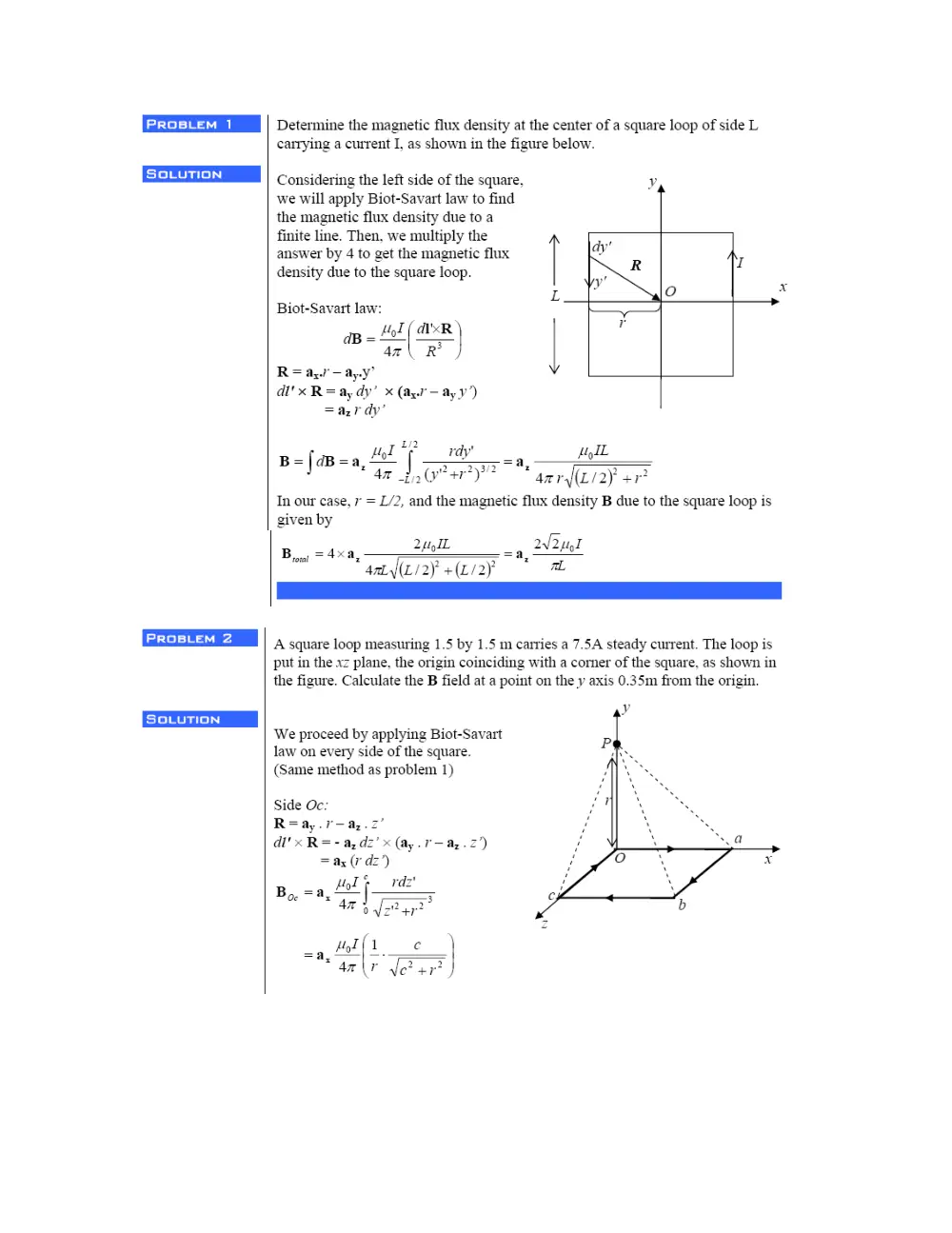
Determine the magnetic flux density at the center of a square loop of side L
carrying a current I, as shown in the figure below.
Considering the left side of the square, y
we will apply Biot-Savart law to find
the magnetic flux density due to a
finite line. Then, we multiply the
answer by 4 to get the magnetic flux
density due to the square loop.
Biot-Savart law:
4z\ R°
R=ayr—ayy’
di'x R= ay dy’ X (ay — ayy’)
=az,rdy’
=a MIL
“anny (L/2y +7?
In our case, 7 = L/2, and the magnetic flux density B due to the square loop is
given by
Mol * f rdy'
B=|dB=a 7 ahalt
} © an 2. (v2 +r? P?
2 2
=4xa, 2oIL =a, 22 pI
AaLy(L/2) +(L/2) aL
B
total
A square loop measuring 1.5 by 1.5 m carries a 7.5A steady current. The loop is
put in the xz plane, the origin coinciding with a comer of the square, as shown in
the figure. Calculate the B field at a point on the y axis 0.35m from the origin.
We proceed by applying Biot-Savart
law on every side of the square.
(Same method as problem 1)
Side Oc:
Re=ay.r—a,.2’
di'* R=-a,dz’ x (ay.r—a,.2’)
= ax (7 dz’)
Mol +
B,=a rdz
x 3
4m 4 {2242
107 x7.5 1.5
B,. =a, —— = aa, x 2.087
0.35 V1.5? +0.35?
rdz 1
v¥24er? “? IPar
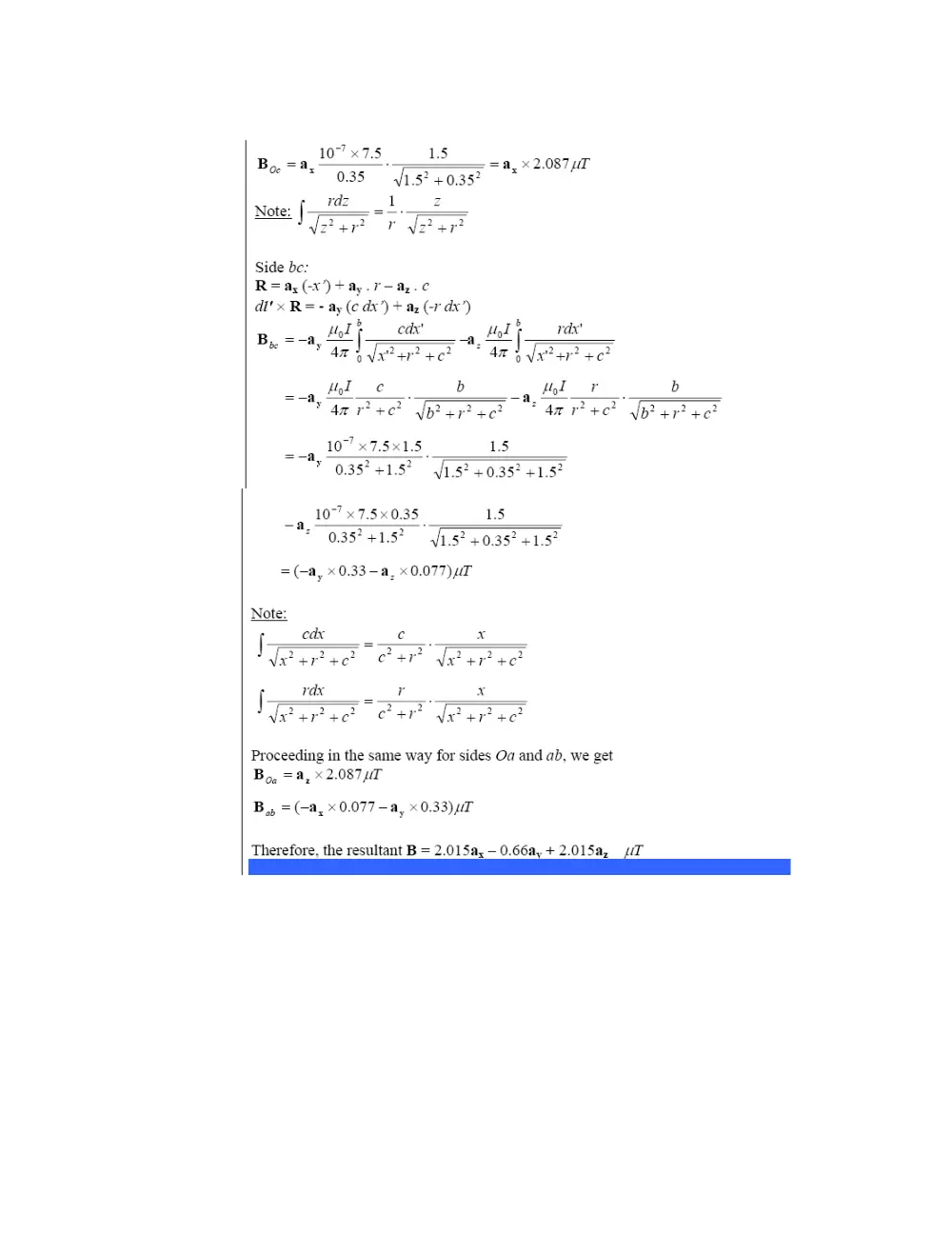
Side be:
R=ax(-x)+ay.7—az.c
di' x Bee as CGI eC r dx’)
_fot i Ae ae
* an yx? arr ae?
Ml ¢ b “lor b
=a, 2 2° > > 77a, 2 2° > >
“Ar r+e VPsrPec? An rote be +ree?
Note:
107 x7.5x1.5 1.5
0.35°41.5° 1.5? +4035? +15?
107 «7.5 0.35 1.5
0.354157 V1.5? 40.357 41.8
=(-a, «0.33 —a, x 0.077) uT
y
—a_
Note:
| cdx _ ce x
2 2 > 2.2
A verse?
rax _ sr x
2 2 2 272 2 2 2
xo+rt+e c+T xo+rt+e
Proceeding in the same way for sides Oa and ab, we get
B,, =a, x 2.087 nT
= (-a, «0.077 —a, « 0.33) uT
Therefore, the resultant B = 2.015a, —0.66a,+2.015a, uT
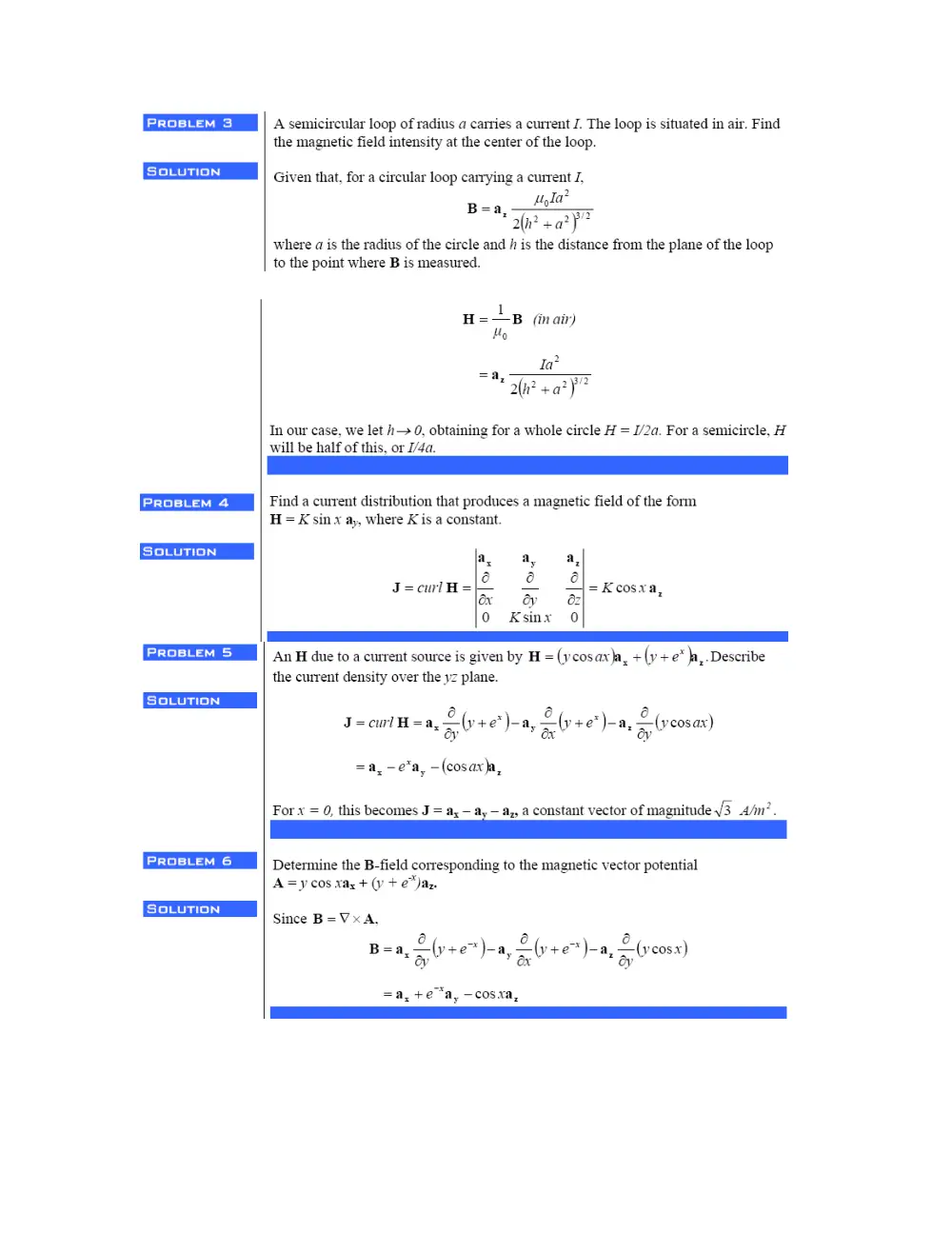
PROBLEM 3 A semicircular loop of radius a carries a current J. The loop is situated in air. Find
the magnetic field intensity at the center of the loop.
SOLUTION Given that, for a circular loop carrying a current J,
M,Ja?
*2(h? +a?)
where a is the radius of the circle and h is the distance from the plane of the loop
to the point where B is measured.
B=a
1
H=—B (inair)
Ho
2
Ja“
In our case, we let h— 0, obtaining for a whole circle H = J/2a. For a semicircle, H
will be half of this. or J/4a.
Find a current distribution that produces a magnetic field of the form
H = K sin x ay, where K is a constant.
SOLUTION
a, ay a,
J=cuwlH =|— o —=Kcosxa,
ox GO
0 Ksinx 0
An H due to a current source is given by H =(vcosax)a, + (v +e" hh, Describe
the current density over the yz plane.
SOLUTION
J=cuwlH= a, =v +e j- ay <b +e )-a, S(ve0sas)
=a, —e7a, —(cosax)a,
For x = 0, this becomes J = a, — a, — a,, a constant vector of magnitude 3 A/mm’.
PROBLEM 6 Determine the B-field corresponding to the magnetic vector potential
A=ycosxay+ (vy + ea,
SOLUTION .
Since B=VxA,
B=a, Hv + e*)-a, Llvee")-a, (ycosx)
a
oy
-x .
=a, +e a, —cosxa,
PROBLEM 1
SOLUTION
PROBLEM 2
SOLUTION
PROBLEM 3
SOLUTION
PROBLEM 4
SOLUTION
A 0.5-m-long straight conductor carries 10 A of current in the positive z direction and
is located 50 mm away from the z axis. The field in the region is given by
B=-0.1sin(¢/2)a, (7). Find the force on the conductor.
F =1f dlxB =Ifadl(a, xB)=JL,B,(a, xa, )=IL,B,a,
F =10x0.5[-0.1sin(¢/2)p, =-0.5sin(¢/2)a, NV
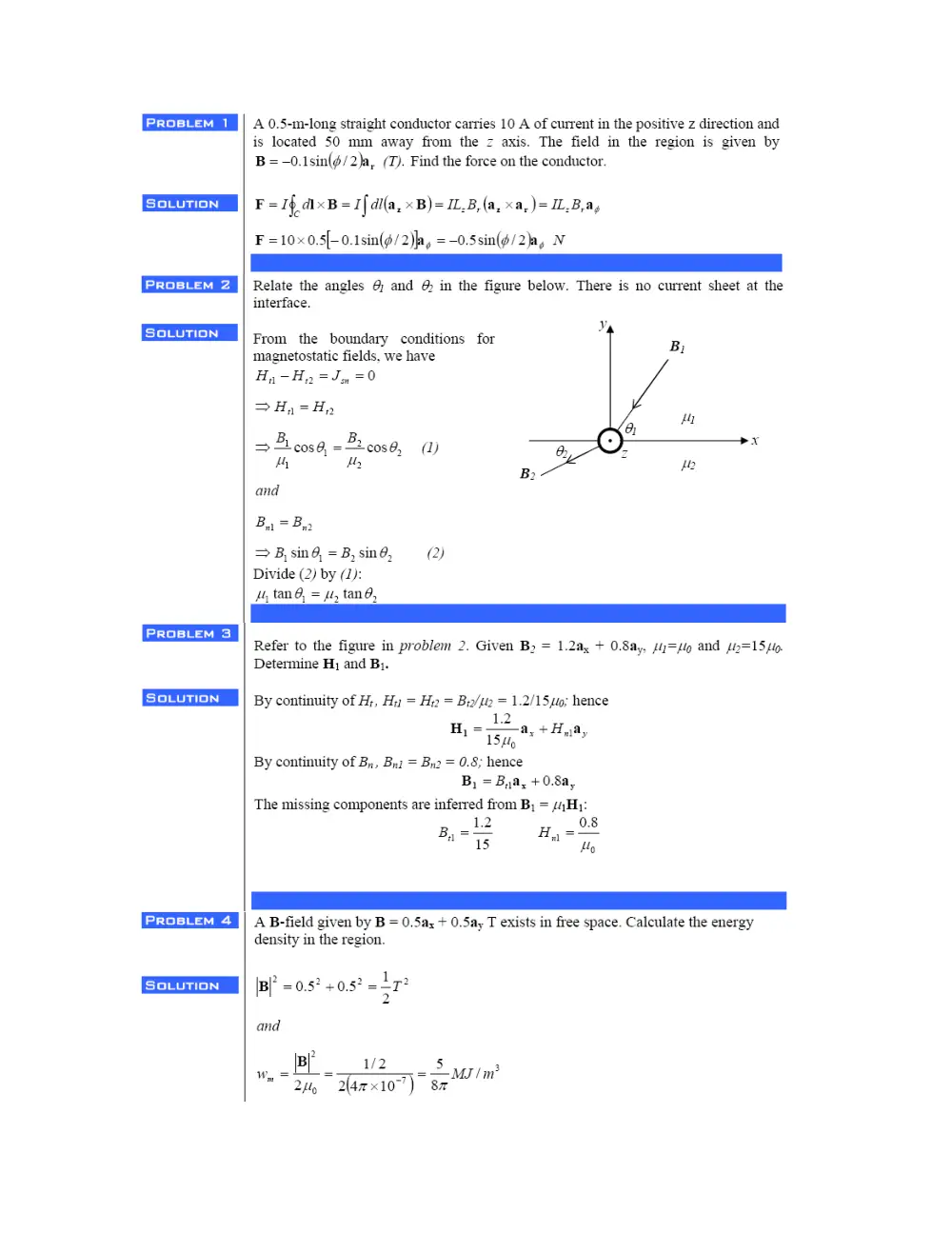
Relate the angles @ and @ in the figure below. There is no current sheet at the
interface.
From the boundary conditions for
magnetostatic fields. we have
Ay -Hy =F, =0
> Ay = Ay
= Freose, =r cosé, (1) x
Ay My
and
By = By
> B, sin @, = B, sin é, (2)
Divide (2) by (1):
Li, tan@, = yw, tand,
Refer to the figure in problem 2. Given B) = 1.2a, + O.8ay, 47={p and sy=15 4p.
Determine Hj, and Bi.
By continuity of H;, Hy = Hy = By2/tp = 1.2/15,zu0; hence
1.2
154
By continuity of B,, Baz = Bn2 = 0.8; hence
B, = Bya, + 0.8a,
The missing components are inferred from B; = 44H;:
1.2 0.8
B,=—— H,=-—
15 "Us
l= a, +H,,a,
A B-field given by B = 0.5ax + 0.Say T exists in free space. Calculate the energy
density in the region.
Bf =0.5? 0.8? =477
2
and
. BE 1/2 5
‘m = == MI!’
2uy 2(4z x10") 87
v