
MATH 201 Chapter 11 Summary, Fall 2011
American University of Beirut · Calculus and Analytical Geometry III · 7 pages

More MATH 201 files
- Chapter 11 Summary with Examples · Fall 2011ChapterView
- Chapter 14 Summary · Fall 2011ChapterView
- Chapter 15 Summary · Fall 2011ChapterView
- Chapter 16 Summary · Fall 2011ChapterView
- Problems Solution Chapter 16 · Fall 2008Chapter · with solutionView
- Problems Solution Chapter 16 · Fall 2008Chapter · with solutionView
- Problems Solution Chapter 2 · Fall 2008Chapter · with solutionView
- Problems Solution Chapter 2 · Fall 2008Chapter · with solutionView
Show the text of this chapter
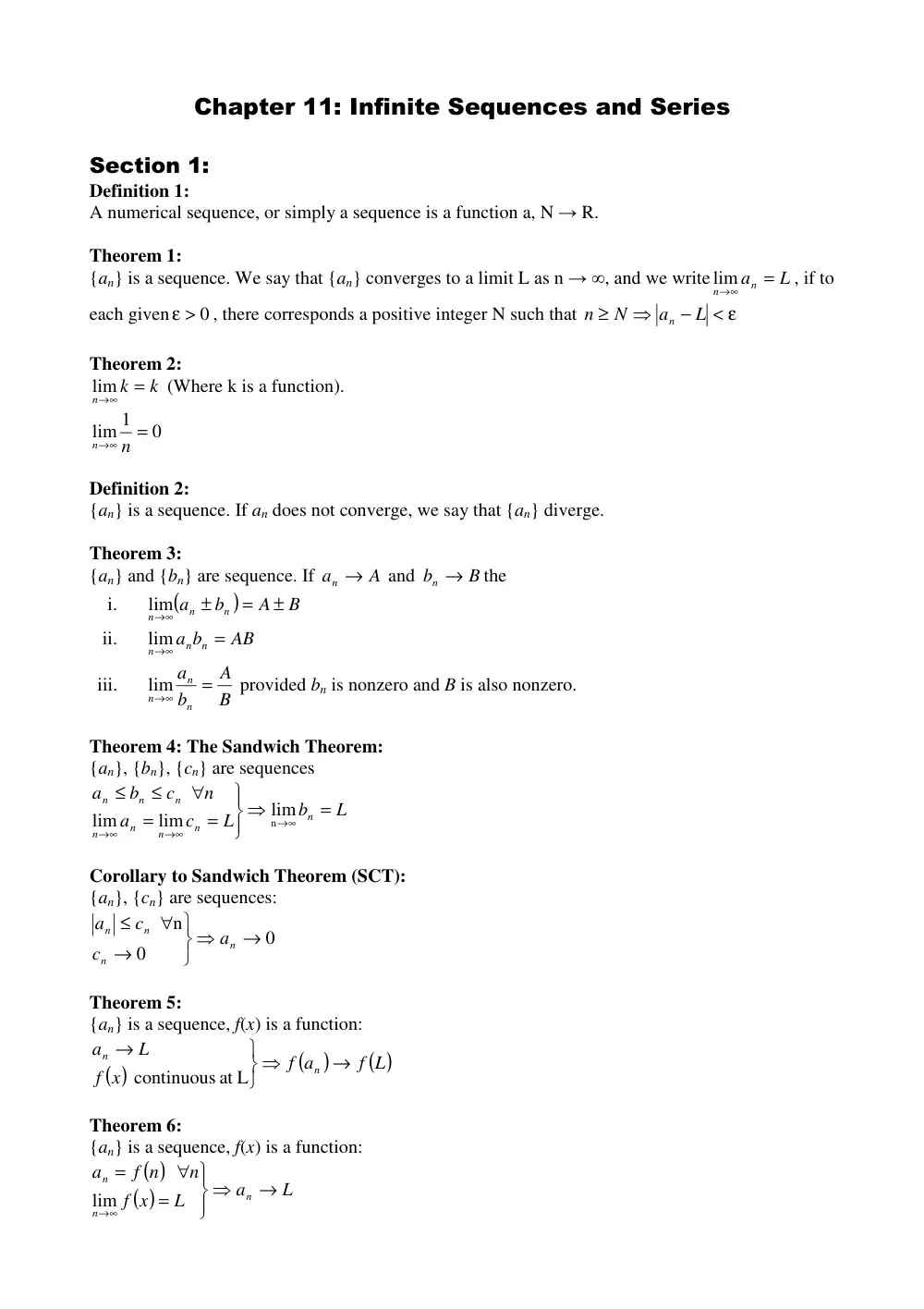
Chapter 11: Infinite Sequences and Series
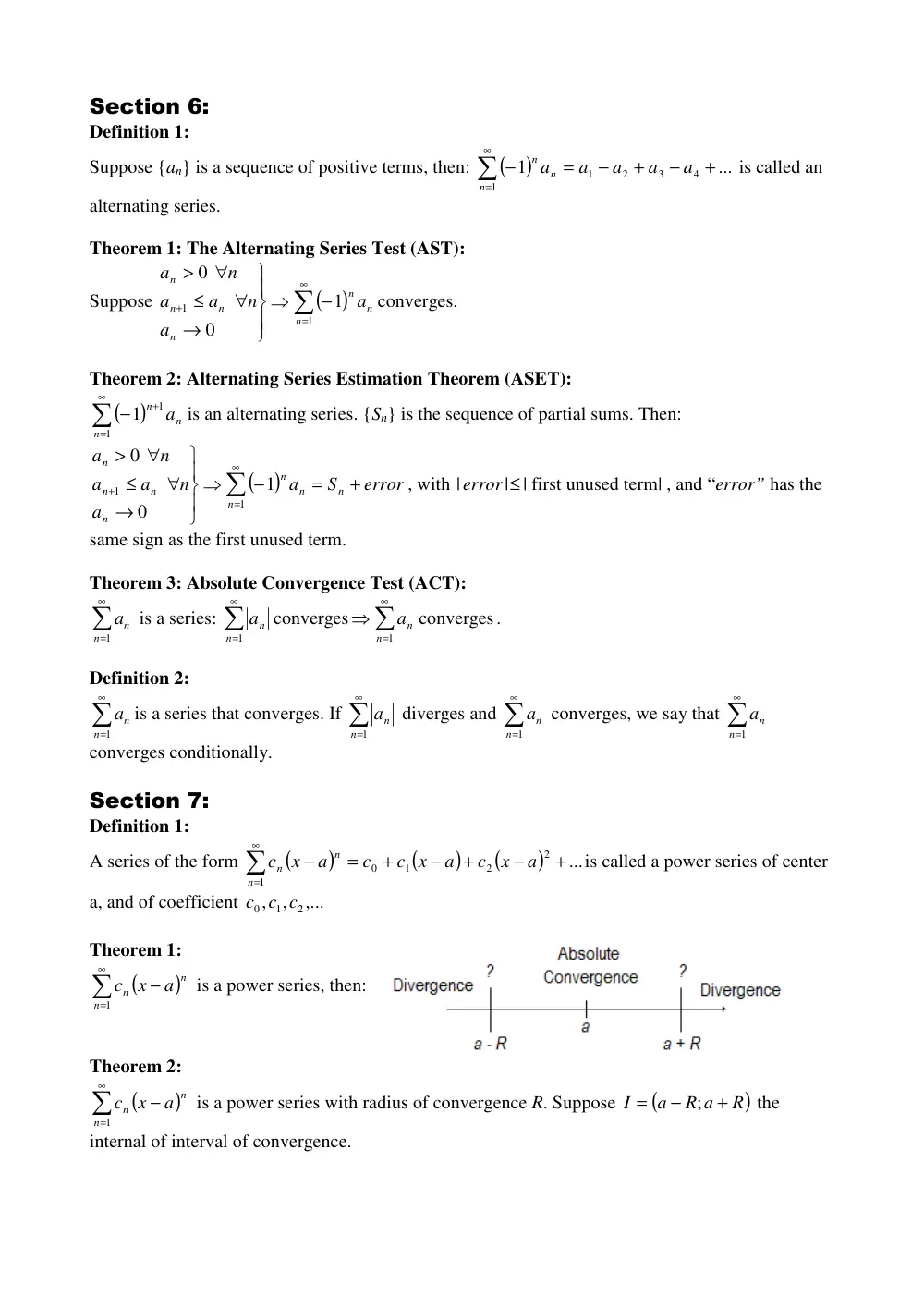
Section 1:
Definition 1:
A numerical sequence, or simply a sequence is a function a, N → R.
Theorem 1:
{an} is a sequence. We say that {an} converges to a limit L as n → ∞, and we write
L
an
n
=
→∞
lim
, if to
each given
ε > 0
, there corresponds a positive integer N such that
< ε
−
⇒
≥
L
a
N
n
n
Theorem 2:
k
k
n
=
→∞
lim
(Where k is a function).
0
lim 1
=
∞
n→ n
Definition 2:
{an} is a sequence. If an does not converge, we say that {an} diverge.
Theorem 3:
{an} and {bn} are sequence. If
B
b
A
a
n
n
→
→
and
the
i.
(
)
B
A
b
a
n
n
n
±
=
±
→∞
lim
ii.
AB
a b
n
n
n
=
→∞
lim
iii.
B
A
b
a
n
n
n
=
→∞
lim
provided bn is nonzero and B is also nonzero.
Theorem 4: The Sandwich Theorem:
{an}, {bn}, {cn} are sequences
L
b
L
c
a
n
c
b
a
n
n
n
n
n
n
n
n
=
⇒
=
=
∀
≤
≤
→∞
→∞
→∞
nlim
lim
lim
Corollary to Sandwich Theorem (SCT):
{an}, {cn} are sequences:
0
0
n
→
⇒
→
∀
≤
n
n
n
n
a
c
c
a
Theorem 5:
{an} is a sequence, f(x) is a function:
( )
(
)
( )
f L
f a
x
f
L
a
n
n
→
⇒
→
continuous at L
Theorem 6:
{an} is a sequence, f(x) is a function:
( )
( )
L
a
L
x
f
n
f n
a
n
n
n
→
⇒
=
∀
=
→∞
lim
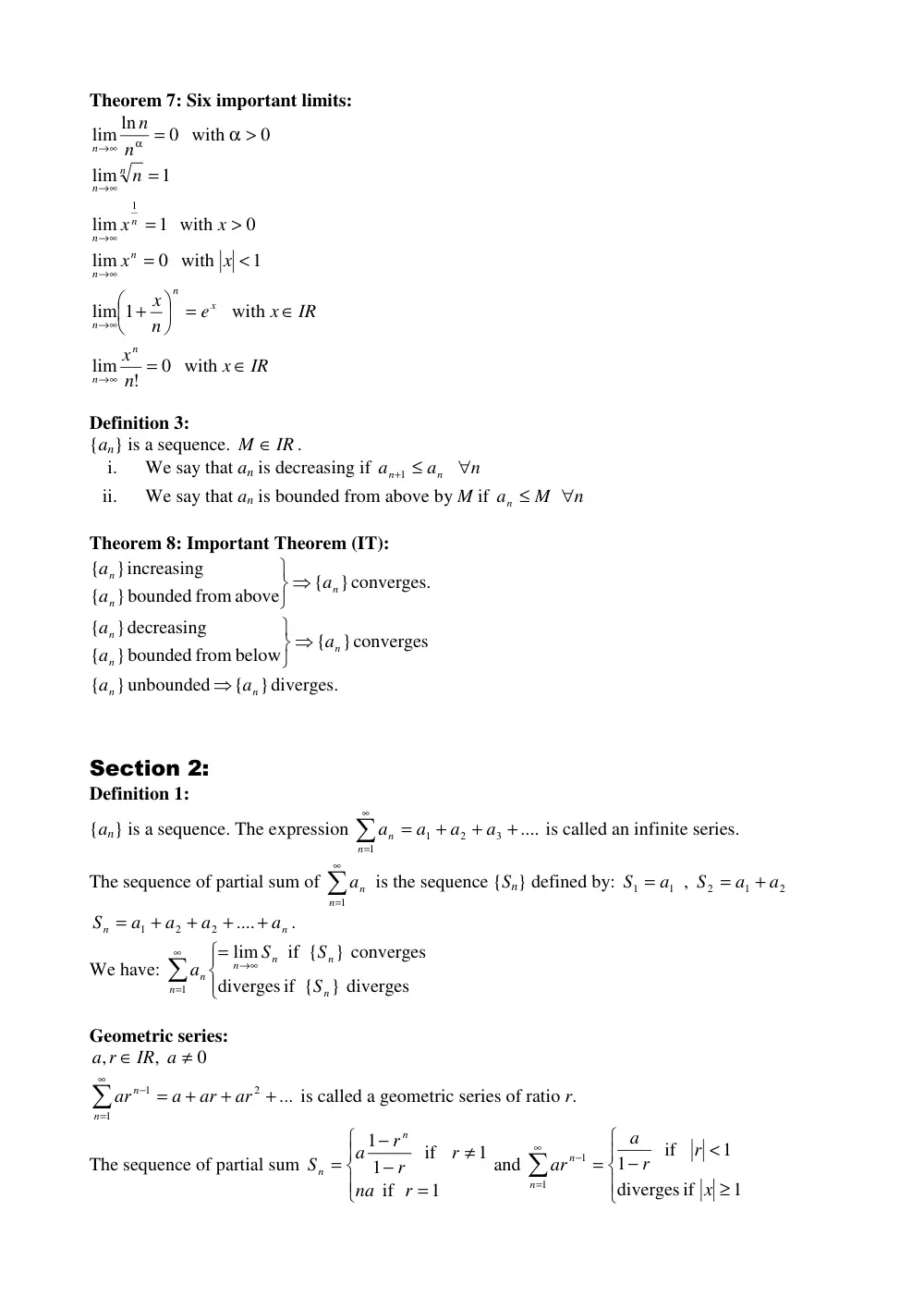
Theorem 7: Six important limits:
0
0 with
lim ln
α >
=
α
→∞
n
n
n
1
lim
=
∞
→
n
n
n
0
1 with
lim
1
>
=
→∞
x
x n
n
1
0 with
lim
<
=
→∞
x
x n
n
IR
x
e
n
x
x
n
n
∈
=
+
→∞
with
lim 1
IR
x
n
x n
n
∈
=
→∞
0 with
!
lim
Definition 3:
{an} is a sequence.
M ∈ IR
.
i.
We say that an is decreasing if
n
a
a
n
n
∀
+ ≤
1
ii.
We say that an is bounded from above by M if
n
M
an
∀
≤
Theorem 8: Important Theorem (IT):
}converges.
{
}bounded from above
{
}increasing
{
n
n
n
a
a
a
⇒
}converges
{
}bounded from below
{
}decreasing
{
n
n
n
a
a
a
⇒
}diverges.
{
}unbounded
{
n
n
a
a
⇒
Section 2:
Definition 1:
{an} is a sequence. The expression
....
3
2
1
1
+
+
+
=
∑
∞
=
a
a
a
a
n
n
is called an infinite series.
The sequence of partial sum of ∑
∞
n=1
n
a is the sequence {Sn} defined by:
2
1
2
1
1
,
a
a
S
a
S
+
=
=
n
n
a
a
a
a
S
+
+
+
+
=
....
2
2
1
.
We have:
=
→∞
∞
=∑
} diverges
if {
diverges
} converges
if {
lim
1
n
n
n
n
n
n
S
S
S
a
Geometric series:
0
,
,
≠
∈
IR a
a r
∑
∞
=
−
+
+
+
=
1
2
1
...
n
n
ar
ar
a
ar
is called a geometric series of ratio r.
The sequence of partial sum
=
≠
−
−
=
1
if
1
if
1
1
r
na
r
r
r
a
S
n
n
and
≥
<
−
=
∑
∞
=
−
1
if
diverges
1
if
1
1
1
x
r
r
a
ar
n
n
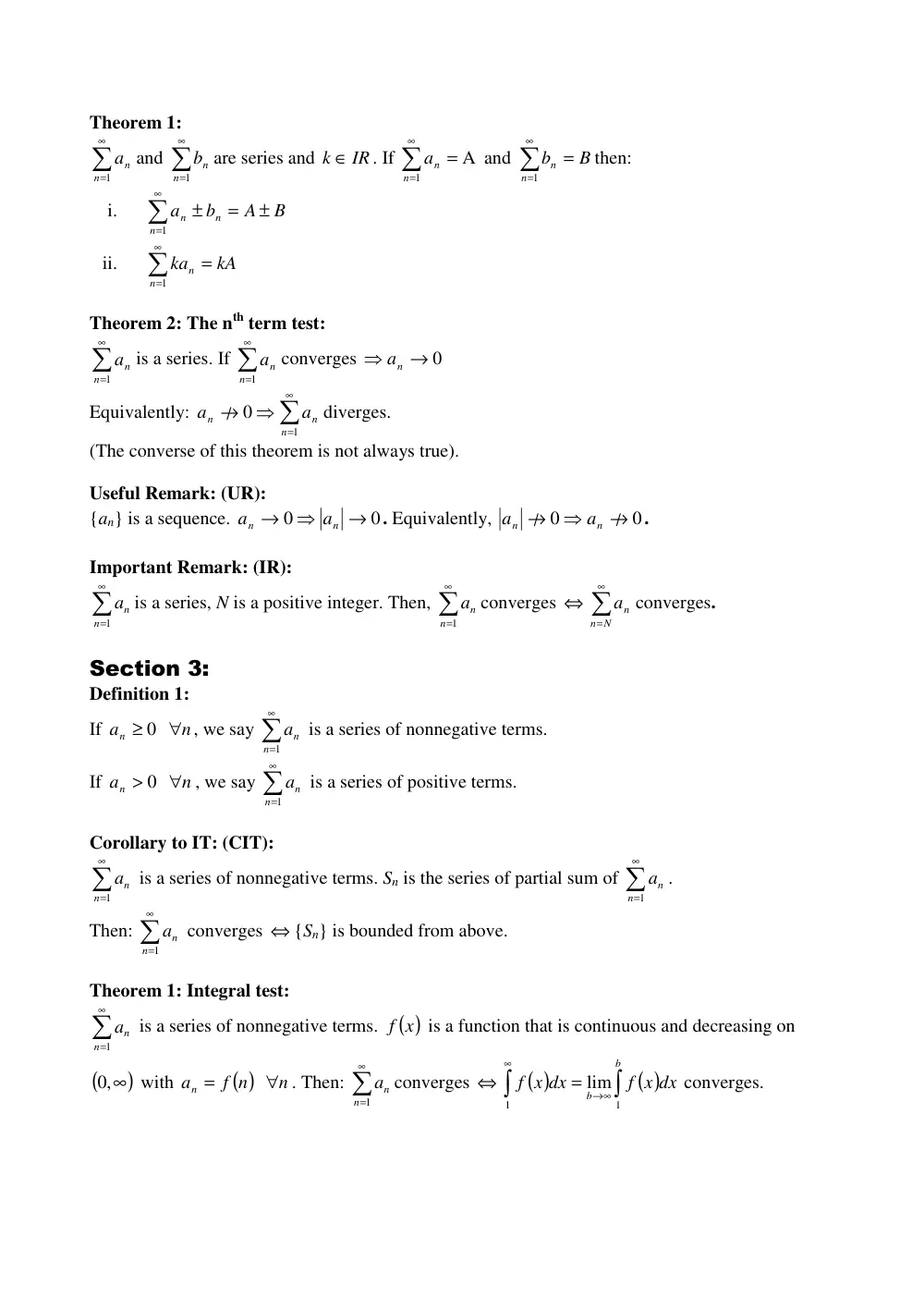
Theorem 1:
∑
∑
∞
=
∞
=
1
1
and
n
n
n
n
b
a
are series and
k ∈ IR
. If
B
b
a
n
n
n
n
=
=
∑
∑
∞
=
∞
=
1
1
A and
then:
i.
B
A
b
a
n
n
n
±
=
±
∑
∞
=1
ii.
kA
ka
n
n =
∑
∞
=1
Theorem 2: The nth term test:
∑
∞
n=1
n
a is a series. If ∑
∞
n=1
n
a converges
→ 0
⇒
an
Equivalently:
∑
∞
=
⇒
→/
1
0
n
n
n
a
a
diverges.
(The converse of this theorem is not always true).
Useful Remark: (UR):
{an} is a sequence.
0
0
→
⇒
→
n
n
a
a
. Equivalently,
0
0
→/
⇒
→/
n
n
a
a
.
Important Remark: (IR):
∑
∞
n=1
n
a is a series, N is a positive integer. Then, ∑
∞
n=1
n
a converges ⇔ ∑
∞
n=N
n
a converges.
Section 3:
Definition 1:
If
n
an
≥ ∀
0
, we say ∑
∞
n=1
n
a is a series of nonnegative terms.
If
n
an
> ∀
0
, we say ∑
∞
n=1
n
a is a series of positive terms.
Corollary to IT: (CIT):
∑
∞
n=1
n
a is a series of nonnegative terms. Sn is the series of partial sum of ∑
∞
n=1
n
a .
Then: ∑
∞
n=1
n
a converges ⇔ {Sn} is bounded from above.
Theorem 1: Integral test:
∑
∞
n=1
n
a is a series of nonnegative terms. ( )
f x
is a function that is continuous and decreasing on
(
,0 ∞)
with
( )
n
f n
an
∀
=
. Then: ∑
∞
n=1
n
a converges ⇔
( )
∫ ( )
∫
∞
→
∞
=
b
b
f x dx
x dx
f
1
1
lim
converges.
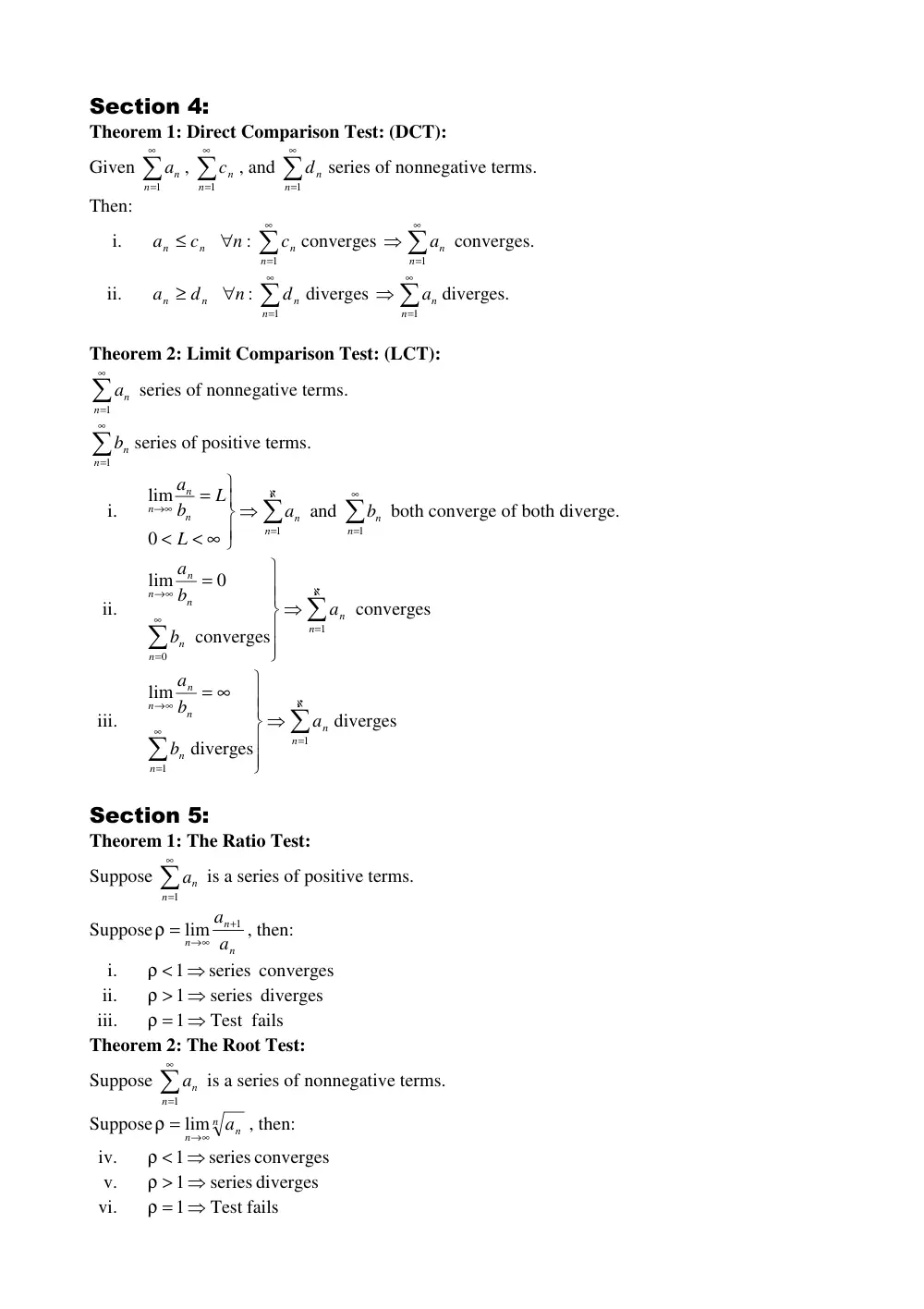
Section 4:
Theorem 1: Direct Comparison Test: (DCT):
Given ∑
∞
n=1
n
a , ∑
∞
n=1
nc , and ∑
∞
n=1
n
d series of nonnegative terms.
Then:
i.
n
c
a
n
n
∀
≤
: ∑
∞
n=1
nc converges ⇒ ∑
∞
n=1
n
a converges.
ii.
n
d
a
n
n
∀
≥
: ∑
∞
n=1
n
d diverges ⇒ ∑
∞
n=1
n
a diverges.
Theorem 2: Limit Comparison Test: (LCT):
∑
∞
n=1
n
a series of nonnegative terms.
∑
∞
n=1
nb series of positive terms.
i.
∑
∑
∞
=
ℵ
=
→∞
⇒
< ∞
<
=
1
1
and
0
lim
n
n
n
n
n
n
n
b
a
L
L
b
a
both converge of both diverge.
ii.
converges
converges
0
lim
1
0
∑
∑
ℵ
=
∞
=
→∞
⇒
=
n
n
n
n
n
n
n
a
b
b
a
iii.
diverges
diverges
lim
1
1
∑
∑
ℵ
=
∞
=
→∞
⇒
∞
=
n
n
n
n
n
n
n
a
b
b
a
Section 5:
Theorem 1: The Ratio Test:
Suppose ∑
∞
n=1
n
a is a series of positive terms.
Suppose
n
n
n
a
a
1
lim
+
ρ = →∞
, then:
i.
ρ < 1⇒ series converges
ii.
ρ > 1⇒ series diverges
iii.
ρ = 1⇒ Test fails
Theorem 2: The Root Test:
Suppose ∑
∞
n=1
n
a is a series of nonnegative terms.
Suppose
n
n
n
a
ρ = →∞
lim
, then:
iv.
ρ < 1⇒ series converges
v.
ρ > 1⇒ series diverges
vi.
ρ = 1⇒ Test fails
Section 6:
Definition 1:
Suppose {an} is a sequence of positive terms, then:
(
)
...
1
4
3
2
1
1
+
−
+
−
=
−
∑
∞
=
a
a
a
a
a
n
n n
is called an
alternating series.
Theorem 1: The Alternating Series Test (AST):
Suppose
(
)
∑
∞
=
+
−
⇒
→
∀
≤
∀
>
1
1
1
0
0
n
n
n
n
n
n
n
a
a
n
a
a
n
a
converges.
Theorem 2: Alternating Series Estimation Theorem (ASET):
(
)
∑
∞
=
+
−
1
1
1
n
n
n a is an alternating series. {Sn} is the sequence of partial sums. Then:
(
)
∑
∞
=
+
+
=
−
⇒
→
∀
≤
∀
>
1
1
1
0
0
n
n
n
n
n
n
n
n
error
S
a
a
n
a
a
n
a
, with
|error|≤
| first unused term| , and “error” has the
same sign as the first unused term.
Theorem 3: Absolute Convergence Test (ACT):
∑
∞
n=1
n
a is a series:
∑
∑
∞
=
∞
=
⇒
1
1
converges
converges
n
n
n
n
a
a
.
Definition 2:
∑
∞
n=1
n
a is a series that converges. If ∑
∞
n=1
n
a diverges and ∑
∞
n=1
n
a converges, we say that ∑
∞
n=1
n
a
converges conditionally.
Section 7:
Definition 1:
A series of the form
(
)
(
)
(
)
∑
∞
=
+
−
+
−
+
=
−
1
2
2
1
0
...
n
n
n
a
x
c
a
c x
c
a
x
c
is called a power series of center
a, and of coefficient
,...
,
,
2
1
0
c c c
Theorem 1:
(
)
∑
∞
=
−
1
n
n
n
a
x
c
is a power series, then:
Theorem 2:
(
)
∑
∞
=
−
1
n
n
n
a
x
c
is a power series with radius of convergence R. Suppose
(
R)
R a
a
I
+
−
=
;
the
internal of interval of convergence.
Suppose ( )
(
)
∑
∞
=
∈
−
=
1
with
n
n
n
I
x
a
x
c
f x
, then this function is infinitely differentiable on I, and
( )
(
)
I
x
a
x
nc
x
f
n
n
n
∈
−
= ∑
∞
=
−
with
'
1
1
( )
(
) (
)
∑
∞
=
−
∈
−
−
=
1
2 with
1
''
n
n
n
I
x
a
x
c
n n
x
f
Theorem 3:
(
)
∑
∞
=
−
1
n
n
n
a
x
c
is a power series with radius of convergence R and suppose
(
R)
R a
a
I
+
−
=
;
the
internal of interval of convergence, then:
( )
∫
f x dx
exists for all x in I, and
( )
(
)
∑
∫
∞
=
+
−
+
+
=
0
1
1
n
n
n
a
x
n
c
c
f x dx
for
x ∈ I
Theorem 4:
∑
∞
=0
n
anxn
and ∑
∞
=0
n
bnxn
are 2 power series with radii of convergence
1
R and
2
R respectively.
Suppose R is the minimum of
1
R and
2
R , then:
∑
∑
∑
∞
=
∞
=
∞
=
=
0
0
0
n
n
n
n
n
n
n
n n
c x
b x
a x
for
x < R
where
∑
=
−
=
n
k
k
n k
n
b
a
c
0
.
Section 8:
Definition 1:
I is a open interval of center a.
f(x) is a function which is infinitely differentiable on I.
n a positive integer.
Then: The Taylor polynomial of order n generated by f at
x = a
is:
( )
( )
( )(
)
( )(
)
( )( )
(
)
n
a
n
n
a
x
n
f
a
x
x
f
a
a x
f
f a
P x
−
+
+
−
+
−
+
=
!
........
!2
''
'
2
The Taylor series generated by ( )
f x
at
x = a
is
( )( )(
)
( )
( )(
)
( )(
)
∑
∞
=
+
−
+
−
+
=
−
0
2
........
!2
''
'
!
n
n
n
a
x
x
f
a
a x
f
f a
a
x
n
a
f
Section 9:
Taylor's Theorem:
I is an open interval of center a.
f(x) is a function which is infinitely differentiable on I.
Suppose
( )
Pn x
is a Taylor polynomial of order n generated by f at
x = a
.
Then: ( )
( )
( )
x
R
P x
x
f
n
n
+
=
with
( )
(
)( )
(
) (
)
1
1
!
1
+
+
−
+
=
n
n
n
a
x
n
c
f
x
R
for some c strictly between 0 and x.
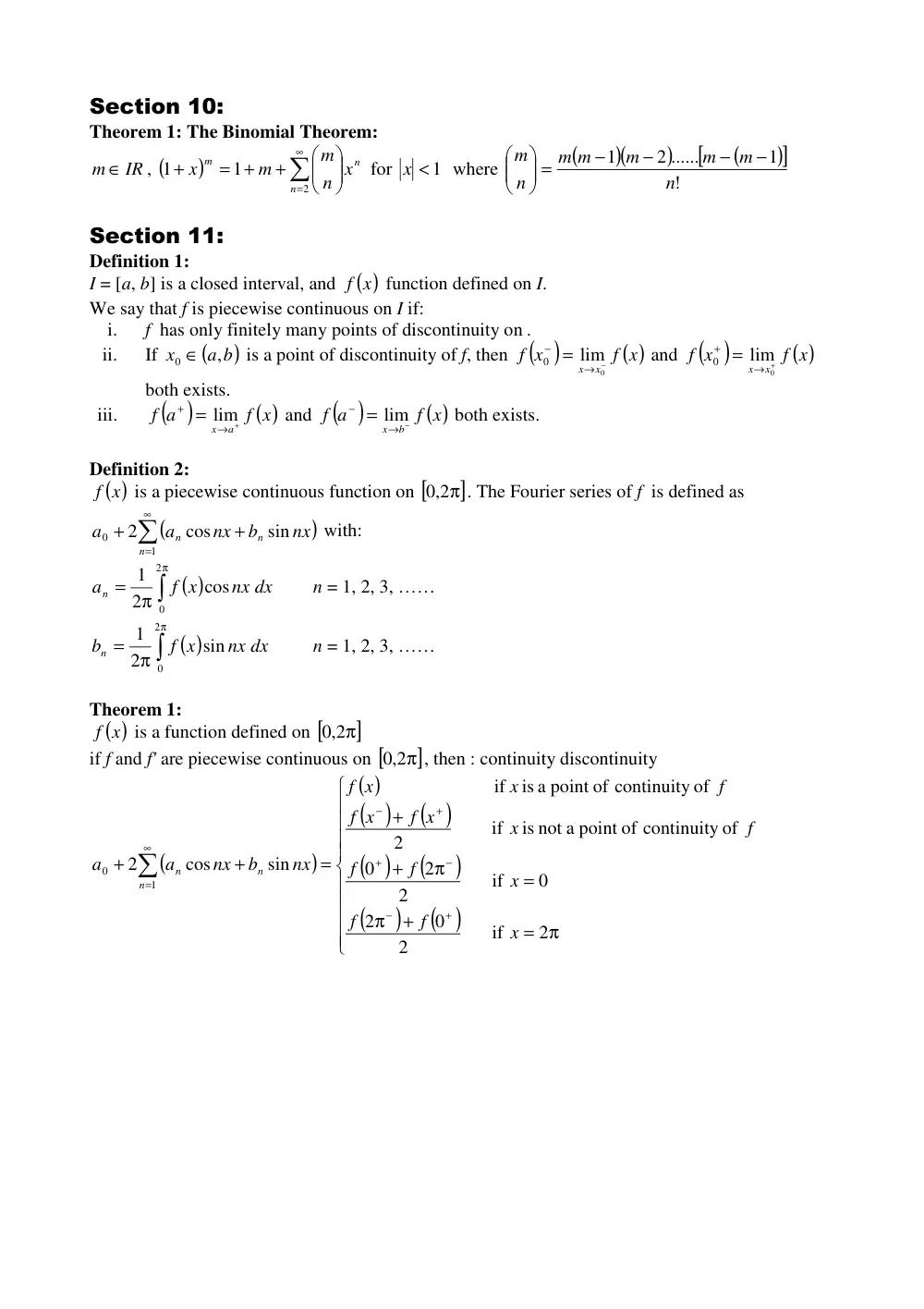
Section 10:
Theorem 1: The Binomial Theorem:
m ∈ IR
, (
)
∑
∞
=
+
= +
+
2
1
1
n
n
m
x
n
m
m
x
for
x < 1
where
(
)(
)
(
)
[
]
!
1
2 ......
1
n
m
m
m
m m
n
m
−
−
−
−
=
Section 11:
Definition 1:
I = [a, b] is a closed interval, and ( )
f x
function defined on I.
We say that f is piecewise continuous on I if:
i.
f has only finitely many points of discontinuity on .
ii.
If
(
a b)
x
,
0 ∈
is a point of discontinuity of f, then (
)
( )
f x
x
f
x
x
−
→
− =
0
lim
0
and (
)
( )
f x
x
f
x
x
+
→
+ =
0
lim
0
both exists.
iii.
(
)
( )
f x
a
f
a
x
+
→
+ = lim
and (
)
( )
f x
a
f
b
x
−
→
− = lim
both exists.
Definition 2:
( )
f x
is a piecewise continuous function on [
2,0 π]
. The Fourier series of f is defined as
(
)
∑
∞
=
+
+
1
0
sin
cos
2
n
n
n
nx
b
nx
a
a
with:
( )
nx dx
f x
an
∫
π
π
=
2
0
cos
2
1
n = 1, 2, 3, ……
( )
nx dx
f x
bn
∫
π
π
=
2
0
sin
2
1
n = 1, 2, 3, ……
Theorem 1:
( )
f x
is a function defined on [
2,0 π]
if f and f' are piecewise continuous on [
2,0 π]
, then : continuity discontinuity
(
)
( )
(
)
(
)
(
)
(
)
(
)
(
)
= π
+
π
=
π
+
+
=
+
+
+
−
−
+
+
−
∞
=∑
2
if
2
0
2
0
if
2
2
0
if is not a point of continuity of
2
if is a point of continuity of
sin
cos
2
1
0
x
f
f
x
f
f
f
x
f x
x
f
f
x
x
f
nx
b
nx
a
a
n
n
n