
MATH 201 Chapter 14 Summary, Fall 2011
American University of Beirut · Calculus and Analytical Geometry III · 5 pages

More MATH 201 files
- Chapter 11 Summary · Fall 2011ChapterView
- Chapter 11 Summary with Examples · Fall 2011ChapterView
- Chapter 15 Summary · Fall 2011ChapterView
- Chapter 16 Summary · Fall 2011ChapterView
- Problems Solution Chapter 16 · Fall 2008Chapter · with solutionView
- Problems Solution Chapter 16 · Fall 2008Chapter · with solutionView
- Problems Solution Chapter 2 · Fall 2008Chapter · with solutionView
- Problems Solution Chapter 2 · Fall 2008Chapter · with solutionView
Show the text of this chapter
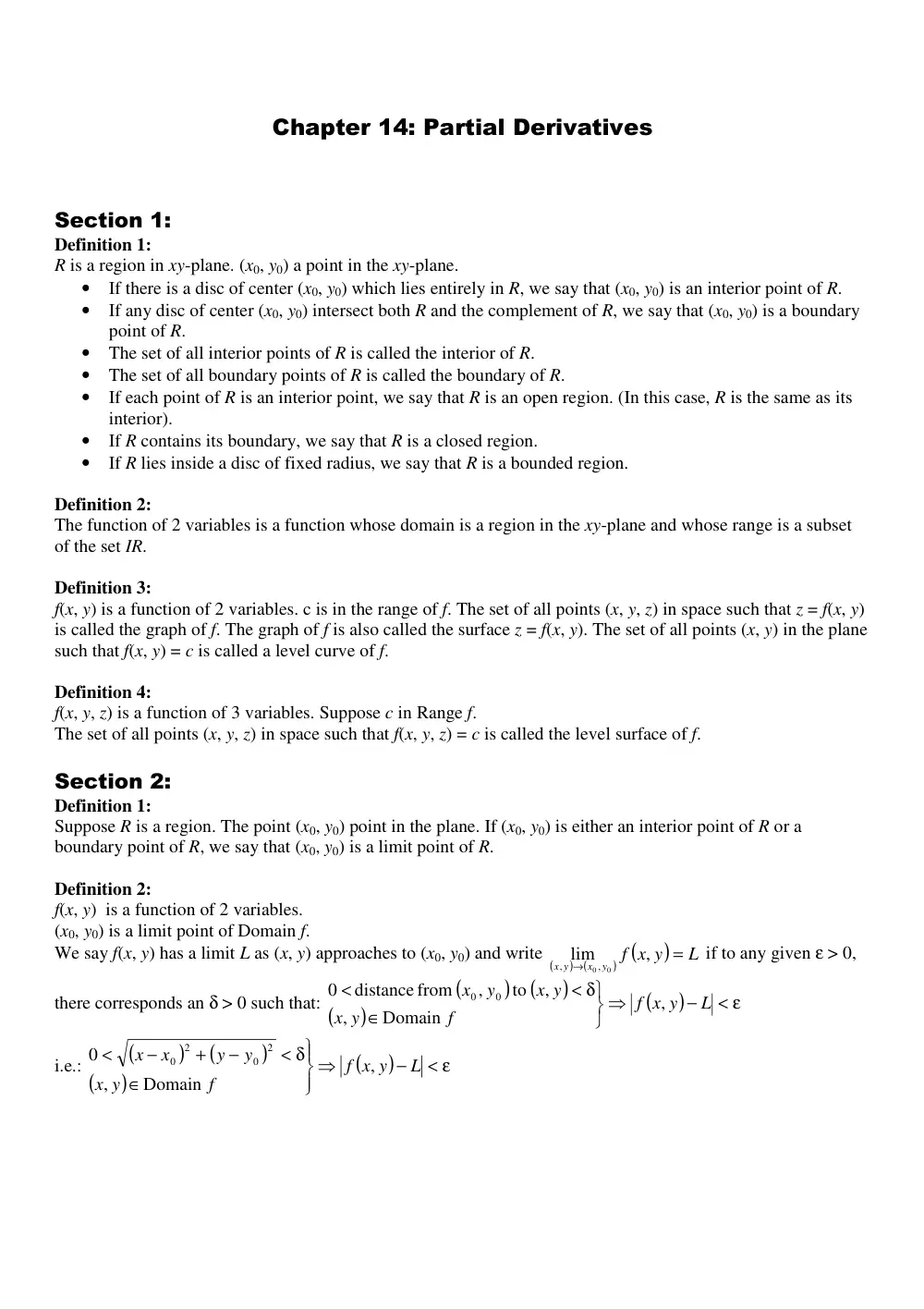
Chapter 14: Partial Derivatives
Section 1:
Definition 1:
R is a region in xy-plane. (x0, y0) a point in the xy-plane.
• If there is a disc of center (x0, y0) which lies entirely in R, we say that (x0, y0) is an interior point of R.
• If any disc of center (x0, y0) intersect both R and the complement of R, we say that (x0, y0) is a boundary
point of R.
• The set of all interior points of R is called the interior of R.
• The set of all boundary points of R is called the boundary of R.
• If each point of R is an interior point, we say that R is an open region. (In this case, R is the same as its
interior).
• If R contains its boundary, we say that R is a closed region.
• If R lies inside a disc of fixed radius, we say that R is a bounded region.
Definition 2:
The function of 2 variables is a function whose domain is a region in the xy-plane and whose range is a subset
of the set IR.
Definition 3:
f(x, y) is a function of 2 variables. c is in the range of f. The set of all points (x, y, z) in space such that z = f(x, y)
is called the graph of f. The graph of f is also called the surface z = f(x, y). The set of all points (x, y) in the plane
such that f(x, y) = c is called a level curve of f.
Definition 4:
f(x, y, z) is a function of 3 variables. Suppose c in Range f.
The set of all points (x, y, z) in space such that f(x, y, z) = c is called the level surface of f.
Section 2:
Definition 1:
Suppose R is a region. The point (x0, y0) point in the plane. If (x0, y0) is either an interior point of R or a
boundary point of R, we say that (x0, y0) is a limit point of R.
Definition 2:
f(x, y) is a function of 2 variables.
(x0, y0) is a limit point of Domain f.
We say f(x, y) has a limit L as (x, y) approaches to (x0, y0) and write
(
)
(
) (
)
L
x y
f
y
x
x y
=
→
,
lim
0 , 0
,
if to any given ε > 0,
there corresponds an δ > 0 such that:
(
)
(
)
(
)
(
)
< ε
−
⇒
∈
< δ
<
L
f x y
f
y
x
x y
y
x
,
Domain
,
to ,
,
distance from
0
0
0
i.e.:
(
)
(
)
(
)
(
)
< ε
−
⇒
∈
< δ
−
+
−
<
L
f x y
f
y
x
y
y
x
x
,
Domain
,
0
2
0
0 2
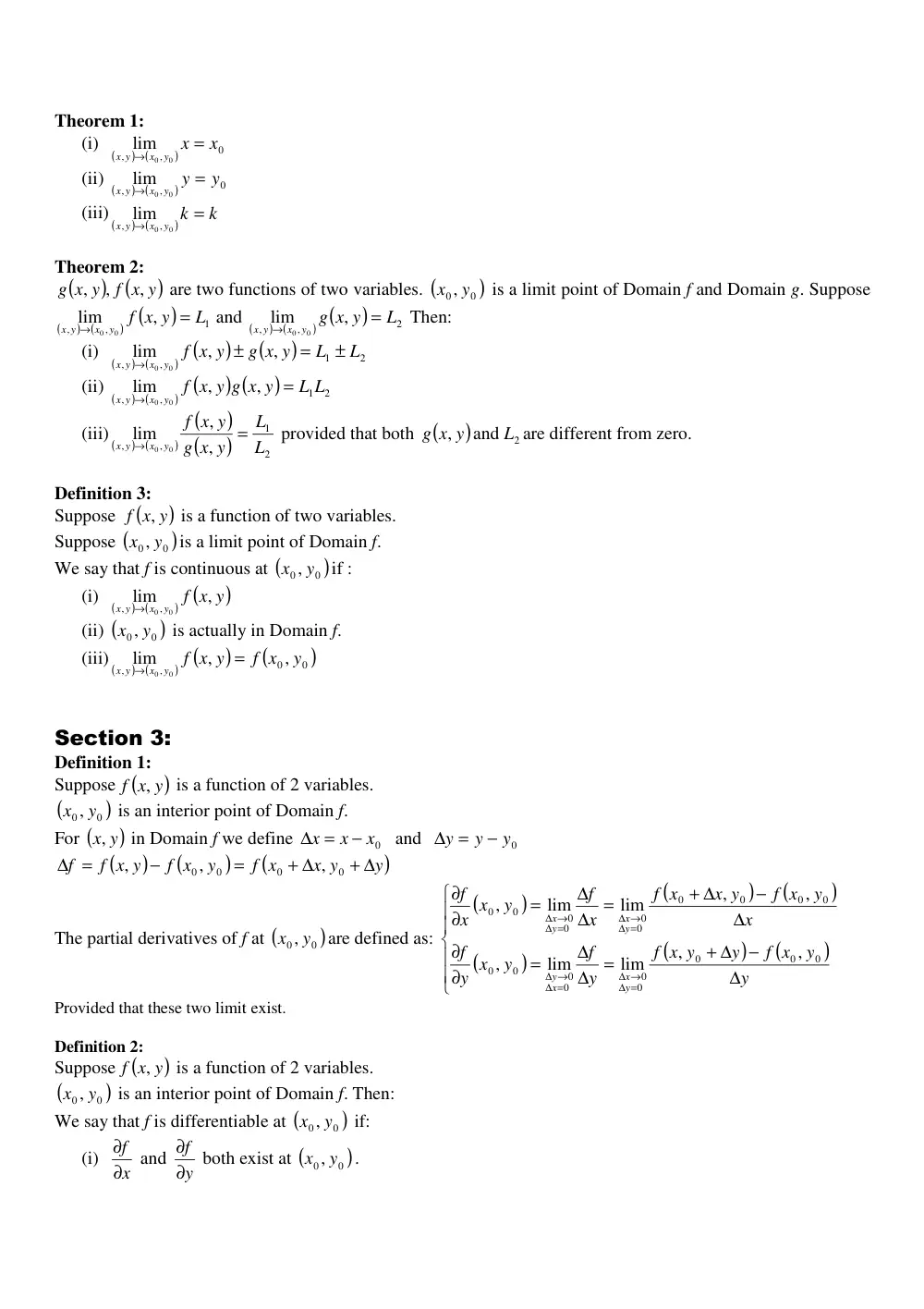
Theorem 1:
(i)
(
)
(
)
0
,
,
lim0 0
x
x
y
x
x y
=
→
(ii)
(
)
(
)
0
,
,
lim0 0
y
y
y
x
x y
=
→
(iii)
(
)
(
)
k
k
y
x
x y
=
→
, lim0 , 0
Theorem 2:
(
)
(
f x y)
g x y
,
,
,
are two functions of two variables. (
x0, y0 )
is a limit point of Domain f and Domain g. Suppose
(
)
(
) (
)
1
,
,
,
lim
0 0
L
x y
f
y
x
x y
=
→
and
(
)
(
) (
)
2
,
,
,
lim
0 0
L
g x y
y
x
x y
=
→
Then:
(i)
(
)
(
) (
)
(
)
2
1
,
,
,
,
lim
0 0
L
L
g x y
x y
f
y
x
x y
±
=
±
→
(ii)
(
)
(
) (
) (
)
2
1
,
,
,
,
lim
0 0
L L
x y g x y
f
y
x
x y
=
→
(iii)
(
)
(
)
(
)
(
)
2
1
,
,
,
,
lim
0 0
L
L
g x y
x y
f
y
x
x y
=
→
provided that both (
)
and 2
,
L
g x y
are different from zero.
Definition 3:
Suppose (
f x y)
,
is a function of two variables.
Suppose (
x0, y0 )
is a limit point of Domain f.
We say that f is continuous at (
x0, y0 )
if :
(i)
(
)
(
) (
x y)
f
y
x
x y
,
lim
0 , 0
,
→
(ii) (
x0, y0 )
is actually in Domain f.
(iii)
(
)
(
) (
)
(
0 )
0
,
,
,
,
lim
0 0
y
f x
x y
f
y
x
x y
=
→
Section 3:
Definition 1:
Suppose (
f x y)
,
is a function of 2 variables.
(
x0, y0 )
is an interior point of Domain f.
For (
x, y)
in Domain f we define
0
0
and
y
y
y
x
x
x
−
∆ =
−
∆ =
(
)
(
)
(
y)
x y
f x
y
f x
f x y
f
+ ∆
+ ∆
=
−
=
∆
0
0
0
0
,
,
,
The partial derivatives of f at (
x0, y0 )
are defined as:
(
)
(
)
(
)
(
)
(
)
(
)
∆
−
+ ∆
=
∆
∆
=
∂
∂
∆
−
+ ∆
=
∆
∆
=
∂
∂
∆ =
∆ →
∆ =
→
∆
∆ =
∆ →
∆ =
→
∆
y
y
f x
y
f x y
y
f
y
y x
f
x
y
f x
x y
f x
x
f
y
x x
f
y
x
x
y
y
x
y
x
0
0
0
0
0
0
0
0
0
0
0
0
0
0
0
0
0
0
0
,
,
lim
lim
,
,
,
lim
lim
,
Provided that these two limit exist.
Definition 2:
Suppose (
f x y)
,
is a function of 2 variables.
(
x0, y0 )
is an interior point of Domain f. Then:
We say that f is differentiable at (
x0, y0 )
if:
(i)
y
f
x
f
∂
∂
∂
∂
and
both exist at (
x0, y0 )
.
(ii)
(
)
(
)
y
x
y
x x y
f
x
y
x x
f
f
∆ + ε ∆ + ε ∆
∂
∆ + ∂
∂
= ∂
∆
2
1
0
0
0, 0
where
(
)
(
0,0 )
,
0 as
0 and
2
0
→
∆
∆
ε →
ε →
y
x
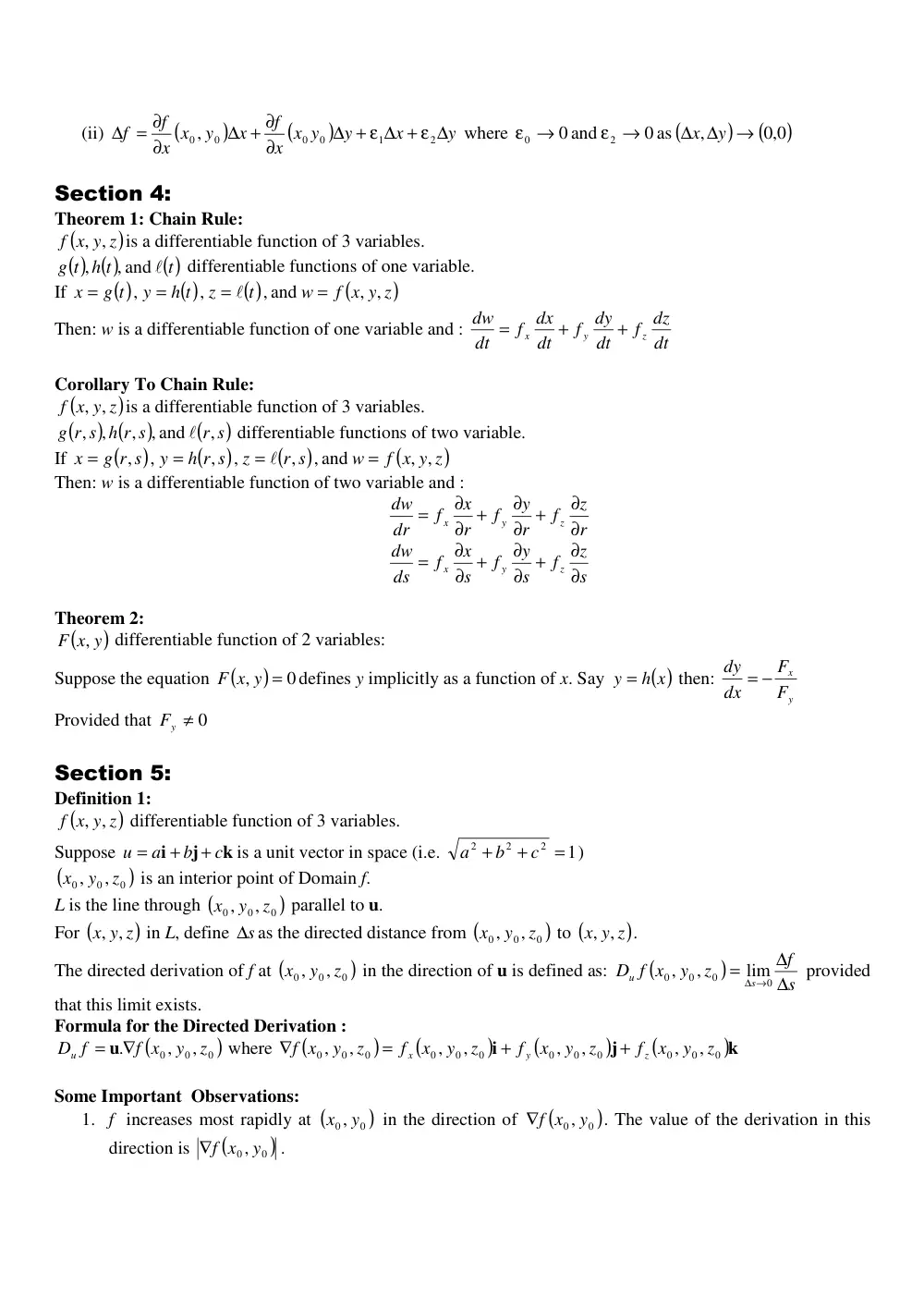
Section 4:
Theorem 1: Chain Rule:
(
)z
f x y
, ,
is a differentiable function of 3 variables.
( ) ( )
( )t
g t h t
, and l
,
differentiable functions of one variable.
If
( )
( )
( )
(
)z
f x y
w
t
z
h t
y
g t
x
, ,
, and
,
,
=
=
=
=
l
Then: w is a differentiable function of one variable and :
dt
f dz
dt
f dy
dt
f dx
dt
dw
z
y
x
+
+
=
Corollary To Chain Rule:
(
f x y z)
, ,
is a differentiable function of 3 variables.
(
) (
)
(
)s
r
g r s h r s
,
, and
,
,
,
l
differentiable functions of two variable.
If
(
)
(
)
(
)
(
)z
f x y
w
r s
z
h r s
y
g r s
x
, ,
, and
,
,
,
,
,
=
=
=
=
l
Then: w is a differentiable function of two variable and :
r
z
f
r
y
f
r
x
f
dr
dw
z
y
x
∂
∂
∂ +
∂
∂ +
∂
=
s
z
f
s
y
f
s
x
f
ds
dw
z
y
x
∂
∂
∂ +
∂
∂ +
∂
=
Theorem 2:
(
F x y)
,
differentiable function of 2 variables:
Suppose the equation (
)
0
,
F x y =
defines y implicitly as a function of x. Say
( )
y = h x
then:
y
x
F
F
dx
dy
= −
Provided that
Fy ≠ 0
Section 5:
Definition 1:
(
f x y z)
, ,
differentiable function of 3 variables.
Suppose
k
j
i
c
b
a
u
+
+
=
is a unit vector in space (i.e.
1
2
2
2
=
+
+
c
b
a
)
(
0 )
0
0
,
,
z
y
x
is an interior point of Domain f.
L is the line through (
0 )
0
0
,
,
z
y
x
parallel to u.
For (
)z
x y
, ,
in L, define s
∆ as the directed distance from (
0 )
0
0
,
,
z
y
x
to (
)z
x y
, ,
.
The directed derivation of f at (
0 )
0
0
,
,
z
y
x
in the direction of u is defined as:
(
)
s
f
z
y
f x
D
s
u
∆
∆
=
∆ →
0
0
0
0
lim
,
,
provided
that this limit exists.
Formula for the Directed Derivation :
(
0 )
0
0
,
,
.
z
y
f x
Du f
= u ∇
where
(
)
(
)
(
)
(
)k
j
i
0
0
0
0
0
0
0
0
0
0
0
0
,
,
,
,
,
,
,
,
z
y
x
f
z
y
x
f
z
y
x
f
z
y
x
f
z
y
x
+
+
=
∇
Some Important Observations:
1. f increases most rapidly at (
x0, y0 )
in the direction of
(
∇f x0, y0 )
. The value of the derivation in this
direction is
(
∇f x0, y0 )
.
2. f decreases most rapidly at (
x0, y0 )
in the direction of
(
− ∇f x0, y0 )
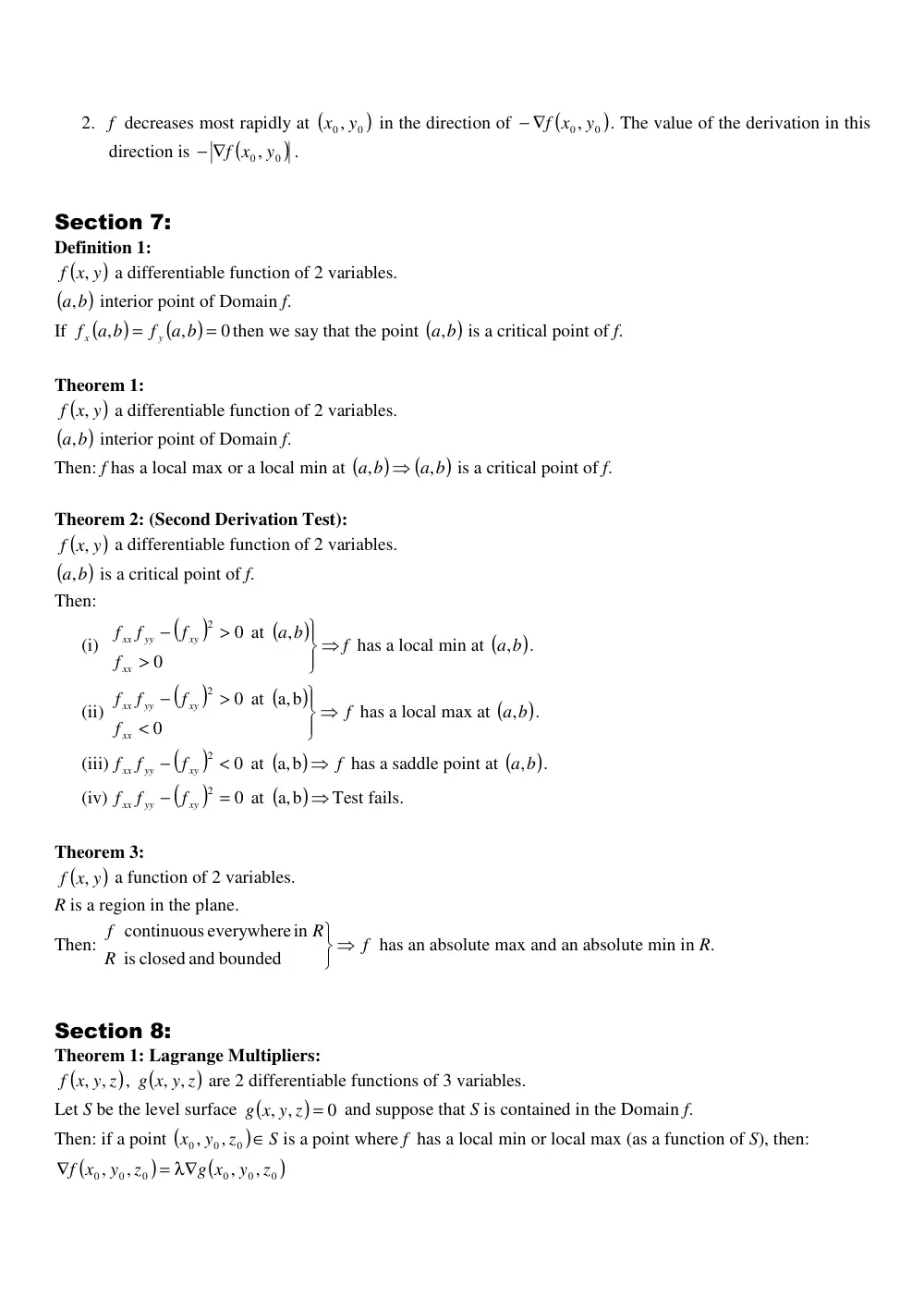
. The value of the derivation in this
direction is
(
− ∇f x0, y0 )
.
Section 7:
Definition 1:
(
f x y)
,
a differentiable function of 2 variables.
(
a,b)
interior point of Domain f.
If
(
)
(
)
0
,
,
=
=
a b
f
a b
f
y
x
then we say that the point (
a,b)
is a critical point of f.
Theorem 1:
(
f x y)
,
a differentiable function of 2 variables.
(
a,b)
interior point of Domain f.
Then: f has a local max or a local min at (
)
(
a b)
a b
,
,
⇒
is a critical point of f.
Theorem 2: (Second Derivation Test):
(
f x y)
,
a differentiable function of 2 variables.
(
a,b)
is a critical point of f.
Then:
(i)
(
)
(
) ⇒
>
>
−
0
0 at ,
2
xx
xy
xx yy
f
a b
f
f
f
f has a local min at (
a,b)
.
(ii)
(
)
(
) ⇒
<
>
−
0
0 at a,b
2
xx
xy
xx yy
f
f
f
f
f has a local max at (
a,b)
.
(iii)
(
)
(
) ⇒
<
−
0 at a,b
2
xy
xx yy
f
f
f
f has a saddle point at (
a,b)
.
(iv)
(
)
(
) ⇒
=
−
0 at a,b
2
xy
xx yy
f
f
f
Test fails.
Theorem 3:
(
f x y)
,
a function of 2 variables.
R is a region in the plane.
Then:
f
R
R
f
⇒
is closed and bounded
continuous everywhere in
has an absolute max and an absolute min in R.
Section 8:
Theorem 1: Lagrange Multipliers:
(
f x y z)
, ,
, (
g x y z)
, ,
are 2 differentiable functions of 3 variables.
Let S be the level surface (
)
0
, ,
g x y z =
and suppose that S is contained in the Domain f.
Then: if a point (
)
S
z
y
x
∈
0
0
0
,
,
is a point where f has a local min or local max (as a function of S), then:
(
)
(
0 )
0
0
0
0
0
,
,
,
,
z
y
g x
z
y
f x
= λ∇
∇