
MATH 201 Problems Solution Chapter 2, Fall 2008
American University of Beirut · Calculus and Analytical Geometry III · 54 pages · with solution

Showing the first 10 of 54 pages. Download the PDF to see all of it.
More MATH 201 files
- Chapter 11 Summary · Fall 2011ChapterView
- Chapter 11 Summary with Examples · Fall 2011ChapterView
- Chapter 14 Summary · Fall 2011ChapterView
- Chapter 15 Summary · Fall 2011ChapterView
- Chapter 16 Summary · Fall 2011ChapterView
- Problems Solution Chapter 16 · Fall 2008Chapter · with solutionView
- Problems Solution Chapter 16 · Fall 2008Chapter · with solutionView
- Problems Solution Chapter 2 · Fall 2008Chapter · with solutionView
Show the text of this chapter
CHAPTER 2 LIMITS AND CONTINUITY
2.1 RATES OF CHANGE AND LIMITS
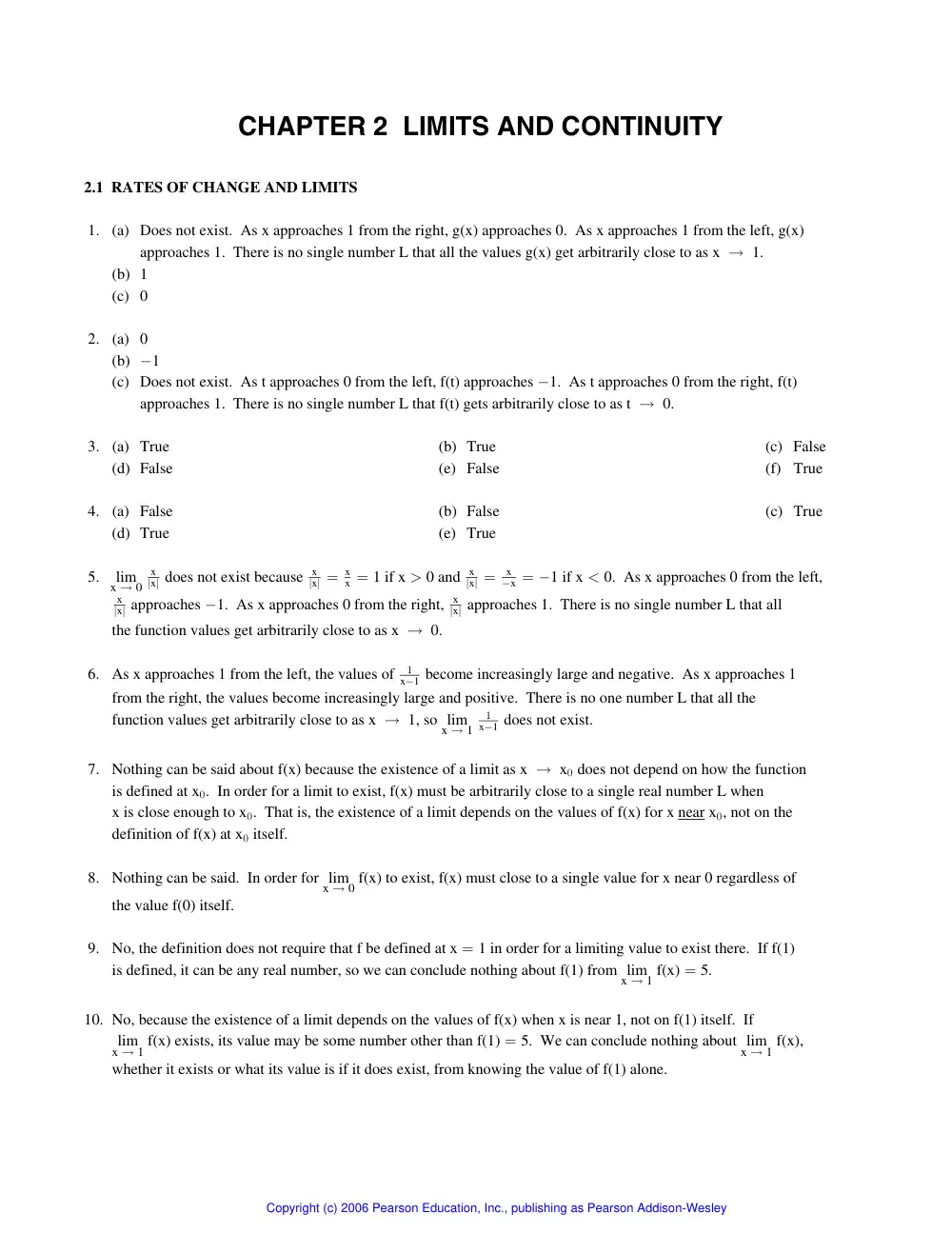
1. (a) Does not exist. As x approaches 1 from the right, g(x) approaches 0. As x approaches 1 from the left, g(x)
approaches 1. There is no single number L that all the values g(x) get arbitrarily close to as x
Ä 1.
(b) 1
(c) 0
2. (a) 0
(b)
�1
(c) Does not exist. As t approaches 0 from the left, f(t) approaches 1. As t approaches 0 from the right, f(t)
�
approaches 1. There is no single number L that f(t) gets arbitrarily close to as t
0.
Ä
3. (a) True
(b) True
(c) False
(d) False
(e) False
(f) True
4. (a) False
(b) False
(c) True
(d) True
(e) True
5. lim
does not exist because
1 if x
0 and
1 if x
0. As x approaches 0 from the left,
x
Ä 0
x
x
x
x
x
x
x
x
x
x
k k
k k
k k
œ
œ
�
œ
œ �
�
�
approaches 1. As x approaches 0 from the right,
approaches 1. There is no single number L that all
x
x
x
x
k k
k k
�
the function values get arbitrarily close to as x
0.
Ä
6. As x approaches 1 from the left, the values of
become increasingly large and negative. As x approaches 1
"
�
x 1
from the right, the values become increasingly large and positive. There is no one number L that all the
function values get arbitrarily close to as x
1, so lim
does not exist.
Ä
x
Ä 1
"
�
x 1
7. Nothing can be said about f(x) because the existence of a limit as x
Ä x does not depend on how the function
!
is defined at x . In order for a limit to exist, f(x) must be arbitrarily close to a single real number L when
!
x is close enough to x . That is, the existence of a limit depends on the values of f(x) for x
x , not on the
!
!
near
definition of f(x) at x itself.
!
8. Nothing can be said. In order for lim f(x) to exist, f(x) must close to a single value for x near 0 regardless of
x
Ä 0
the value f(0) itself.
9. No, the definition does not require that f be defined at x
œ 1 in order for a limiting value to exist there. If f(1)
is defined, it can be any real number, so we can conclude nothing about f(1) from lim f(x)
5.
x
Ä 1
œ
10. No, because the existence of a limit depends on the values of f(x) when x is near 1, not on f(1) itself. If
lim f(x) exists, its value may be some number other than f(1)
5. We can conclude nothing about lim f(x),
x
1
x
1
Ä
Ä
œ
whether it exists or what its value is if it does exist, from knowing the value of f(1) alone.
Copyright (c) 2006 Pearson Education, Inc., publishing as Pearson Addison-Wesley
68
Chapter 2 Limits and Continuity
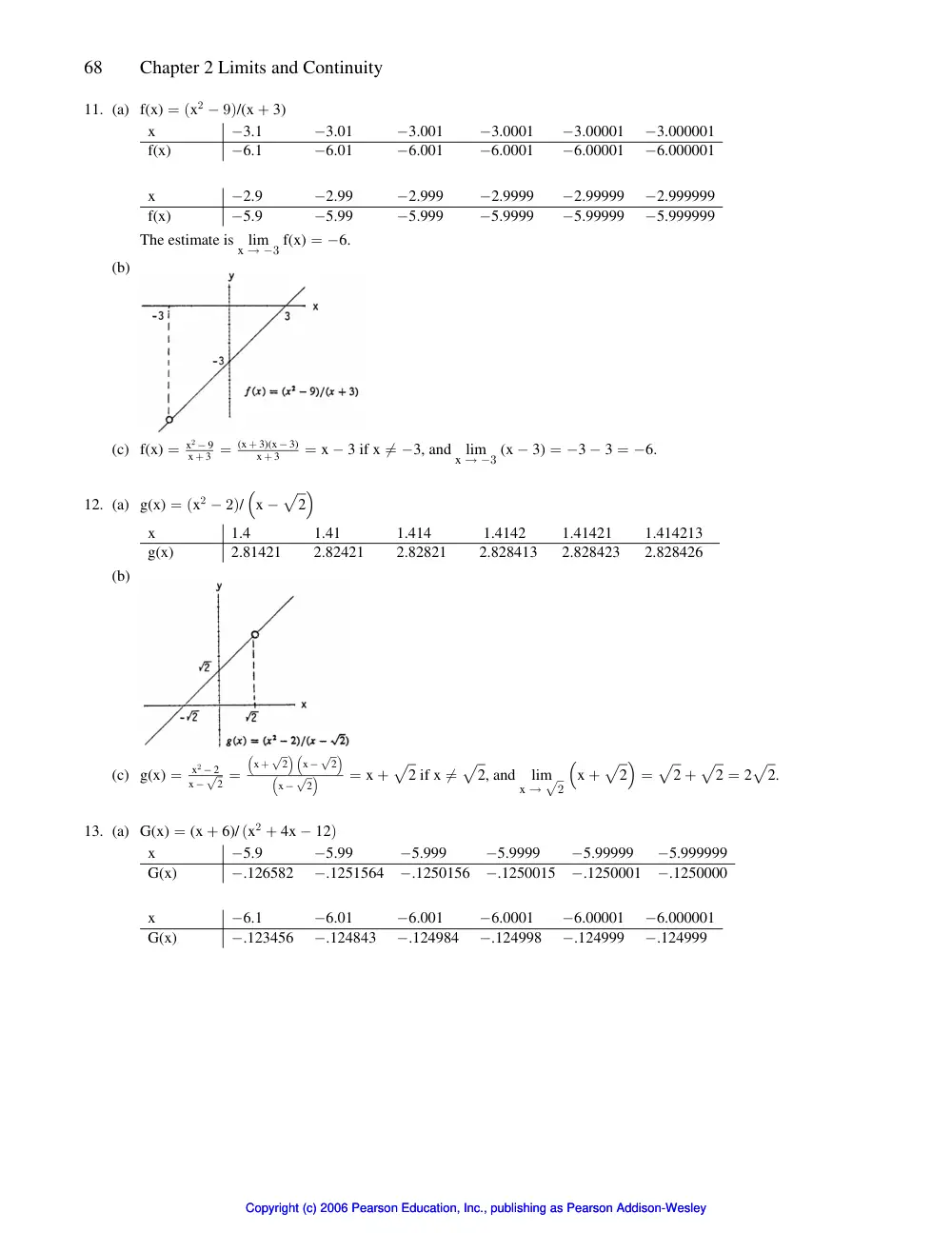
11. (a) f(x)
x
/(x
3)
œ
� *
�
a
b
#
x
3.1
3.01
3.001
3.0001
3.00001
3.000001
f(x)
6.1
6.01
6.001
6.0001
6.00001
6.000001
�
�
�
�
�
�
�
�
�
�
�
�
x
2.9
2.99
2.999
2.9999
2.99999
2.999999
f(x)
5.9
5.99
5.999
5.9999
5.99999
5.999999
�
�
�
�
�
�
�
�
�
�
�
�
The estimate is lim f(x)
6.
x Ä �$
œ �
(b)
(c) f(x)
x
3 if x
3, and lim (x
3)
3
3
6.
œ
œ
œ
�
Á �
�
œ � �
œ �
x
9
x
3
x
3
(x
3)(x
3)
# �
�
�
�
�
x Ä �$
12. (a) g(x)
x
/ x
2
œ
� #
�
a
b Š
È ‹
#
x
1.4
1.41
1.414
1.4142
1.41421
1.414213
g(x)
2.81421
2.82421
2.82821
2.828413
2.828423
2.828426
(b)
(c) g(x)
x
2 if x
2, and lim x
2
2
2
2
2.
œ
œ
œ
�
Á
�
œ
�
œ
x
2
x
2
x
2
x
2
x
2
# �
�
�
�
�
È
Š
‹ Š
‹
È
È
Š
È ‹
È
È
È
È
È
È
Š
‹
x Ä
#
È
13. (a) G(x)
(x
6)/ x
4x
12
œ
�
�
�
a
b
#
x
5.9
5.99
5.999
5.9999
5.99999
5.999999
G(x)
.126582
.1251564
.1250156
.1250015
.1250001
.1250000
�
�
�
�
�
�
�
�
�
�
�
�
x
6.1
6.01
6.001
6.0001
6.00001
6.000001
G(x)
.123456
.124843
.124984
.124998
.124999
.124999
�
�
�
�
�
�
�
�
�
�
�
�
Copyright (c) 2006 Pearson Education, Inc., publishing as Pearson Addison-Wesley
Copyright (c) 2006 Pearson Education, Inc., publishing as Pearson Addison-Wesley
Section 2.1 Rates of Change and Limits
69
(b)
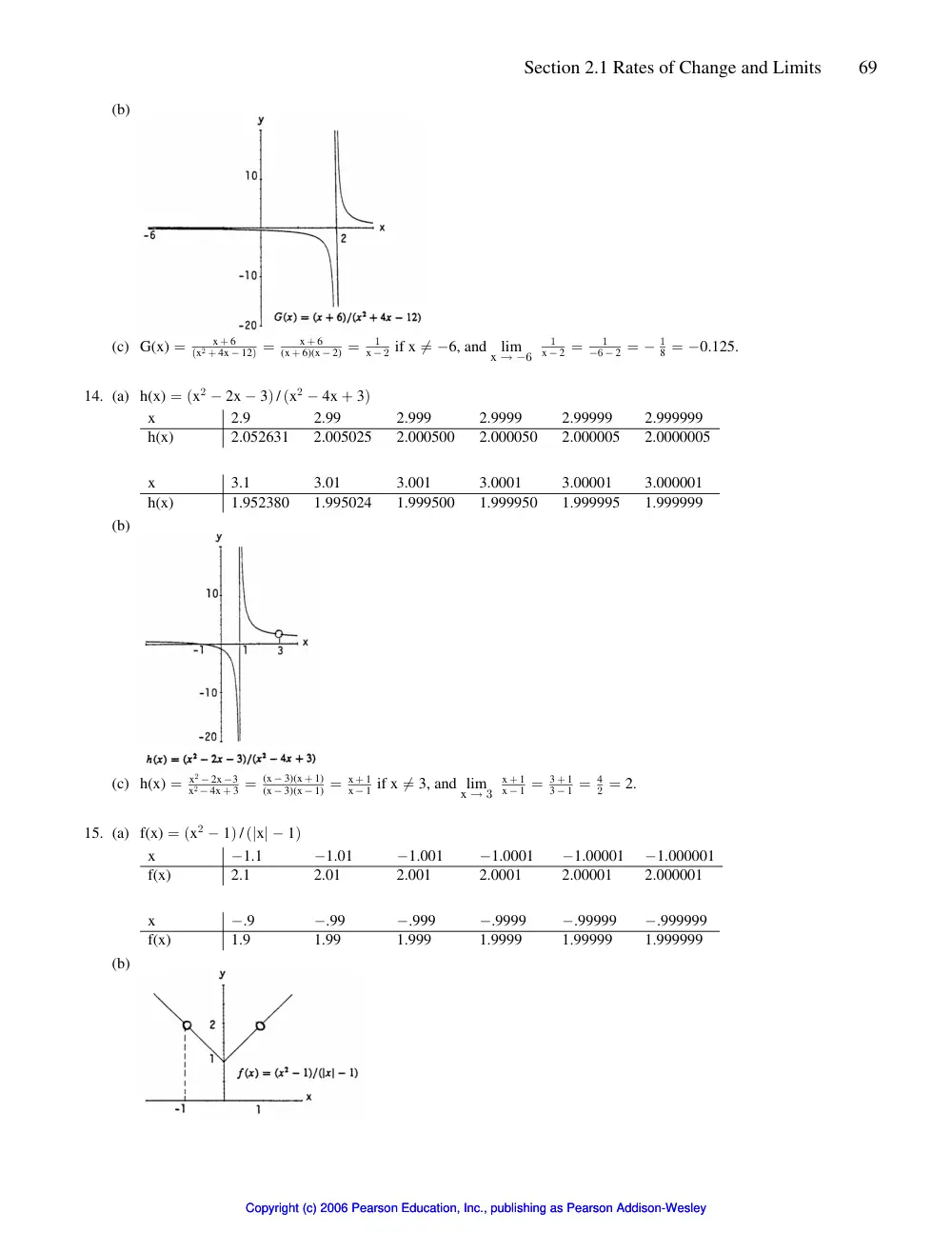
(c) G(x)
if x
6, and lim
0.125.
œ
œ
œ
Á �
œ
œ �
œ �
x
6
x
6
x
4x
12
(x
6)(x
2)
x
x
2
2
8
�
�
"
"
"
"
�
�
�
�
� #
�
�' �
a
b
#
x Ä �'
14. (a) h(x)
x
2x
3 / x
4x
3
œ
�
�
�
�
a
b a
b
#
#
x
2.9
2.99
2.999
2.9999
2.99999
2.999999
h(x)
2.052631
2.005025
2.000500
2.000050
2.000005
2.0000005
x
3.1
3.01
3.001
3.0001
3.00001
3.000001
h(x)
1.952380
1.995024
1.999500
1.999950
1.999995
1.999999
(b)
(c) h(x)
if x
3, and lim
2.
œ
œ
œ
Á
œ
œ
œ
x
2x
3
x
1
x
1
3
1
4
x
4x
3
(x
3)(x
1)
x
1
x
1
3
1
(x
3)(x
1)
#
# �
�
�
�
�
�
�
�
�
�
�
�
#
�
�
x Ä $
15. (a) f(x)
x
1 /
x
1
œ
�
�
a
b a
b
k k
#
x
1.1
1.01
1.001
1.0001
1.00001
1.000001
f(x)
2.1
2.01
2.001
2.0001
2.00001
2.000001
�
�
�
�
�
�
x
.9
.99
.999
.9999
.99999
.999999
f(x)
1.9
1.99
1.999
1.9999
1.99999
1.999999
�
�
�
�
�
�
(b)
Copyright (c) 2006 Pearson Education, Inc., publishing as Pearson Addison-Wesley
Copyright (c) 2006 Pearson Education, Inc., publishing as Pearson Addison-Wesley
70
Chapter 2 Limits and Continuity
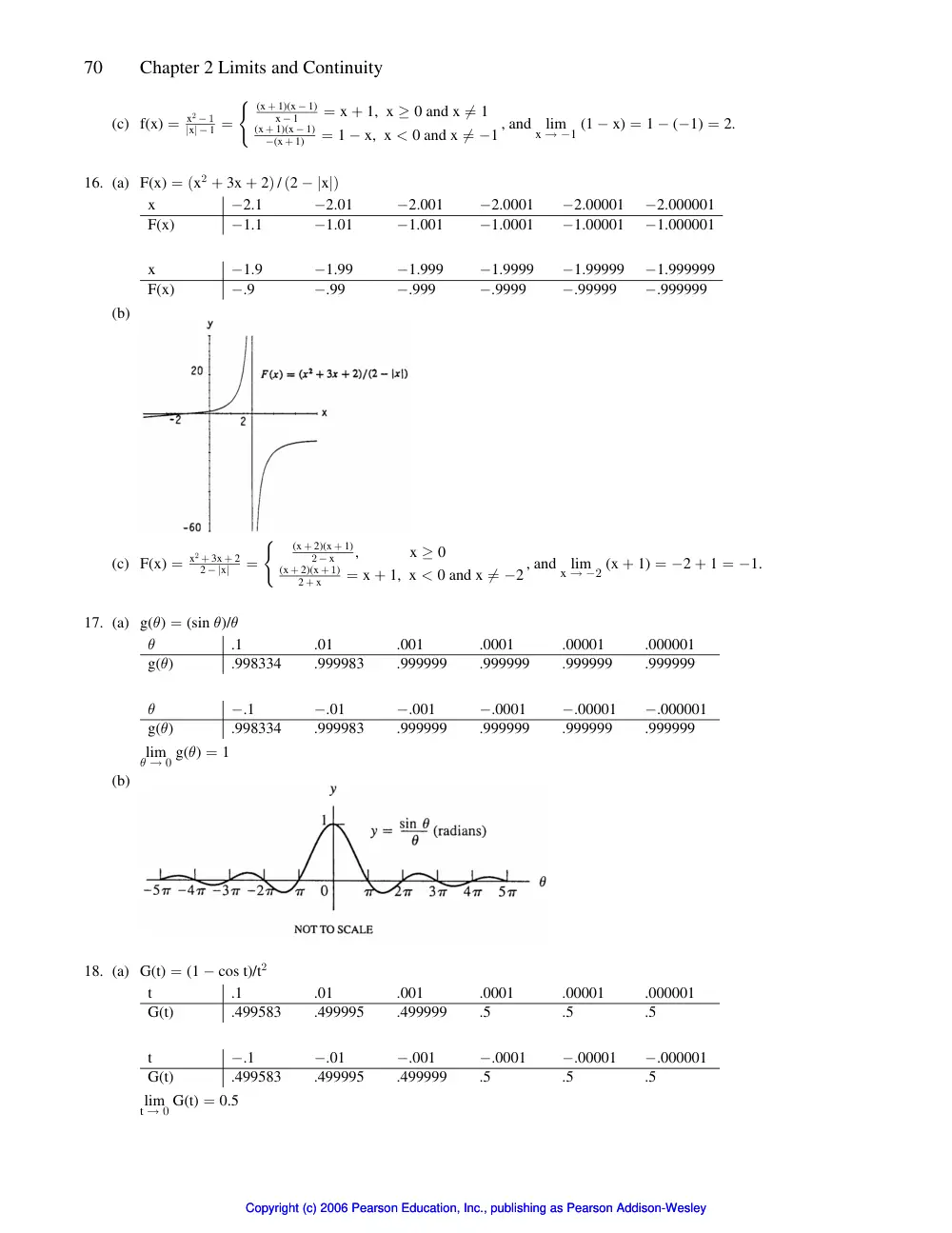
(c) f(x)
, and lim (1
x)
1
( 1)
2.
x
1, x
0 and x
1
1
x, x
0 and x
1
œ
œ
�
œ
� �
œ
œ
�
Á
œ
�
�
Á �
x
x
1
(x
1)(x
1)
x
1
(x
1)(x
1)
(x
1)
# � "
�
�
�
�
�
�
�
�
k k
�
x
1
Ä �
16. (a) F(x)
x
3x
2 / 2
x
œ
�
�
�
a
b a
k kb
#
x
2.1
2.01
2.001
2.0001
2.00001
2.000001
F(x)
1.1
1.01
1.001
1.0001
1.00001
1.000001
�
�
�
�
�
�
�
�
�
�
�
�
x
1.9
1.99
1.999
1.9999
1.99999
1.999999
F(x)
.9
.99
.999
.9999
.99999
.999999
�
�
�
�
�
�
�
�
�
�
�
�
(b)
(c) F(x)
, and lim (x
1)
2
1
, x
0
x
1, x
0 and x
2
œ
œ
�
œ � �
œ
œ
�
�
Á �
x
3x
2
2
x
(x
2)(x
1)
x
(x
2)(x
)
2
x
# �
�
�
�
�
# �
�
� "
�
k k
�
x Ä �#
�1.
17. (a) g( )
(sin )/
)
) )
œ
.1
.01
.001
.0001
.00001
.000001
g( )
.998334
.999983
.999999
.999999
.999999
.999999
)
)
.1
.01
.001
.0001
.00001
.000001
g( )
.998334
.999983
.999999
.999999
.999999
.999999
)
)
�
�
�
�
�
�
lim g( )
1
) Ä !
) œ
(b)
18. (a) G(t)
(1
cos t)/t
œ
�
#
t
.1
.01
.001
.0001
.00001
.000001
G(t)
.499583
.499995
.499999
.5
.5
.5
t
.1
.01
.001
.0001
.00001
.000001
G(t)
.499583
.499995
.499999
.5
.5
.5
�
�
�
�
�
�
lim G(t)
0.5
t Ä !
œ
Copyright (c) 2006 Pearson Education, Inc., publishing as Pearson Addison-Wesley
Copyright (c) 2006 Pearson Education, Inc., publishing as Pearson Addison-Wesley
Section 2.1 Rates of Change and Limits
71
(b)
Graph is NOT TO SCALE
19. (a) f(x)
œ x
"ÎÐ"� Ñ
x
x
.9
.99
.999
.9999
.99999
.999999
f(x)
.348678
.366032
.367695
.367861
.367877
.367879
x
1.1
1.01
1.001
1.0001
1.00001
1.000001
f(x)
.385543
.369711
.368063
.367897
.367881
.367878
lim f(x)
0.36788
x
Ä 1
¸
(b)
Graph is NOT TO SCALE. Also the intersection of the axes is not the origin: the axes intersect at the point
(1 2.71820).
ß
20. (a) f(x)
3
1 /x
œ
�
a
b
x
x
.1
.01
.001
.0001
.00001
.000001
f(x)
1.161231
1.104669
1.099215
1.098672
1.098618
1.098612
x
.1
.01
.001
.0001
.00001
.000001
f(x)
1.040415
1.092599
1.098009
1.098551
1.098606
1.098611
�
�
�
�
�
�
lim f(x)
1.0986
x Ä !
¸
(b)
21. lim 2x
2(2)
4
22. lim 2x
2(0)
0
x
x
Ä #
Ä !
œ
œ
œ
œ
23. lim (3x
1)
3
1
0
24. lim
x
x
1
Ä
Ä
"
$
�
œ
�
œ
œ
œ �
ˆ ‰
"
�
�"
"
�
�
#
3
3x 1
3(1)
1
1
Copyright (c) 2006 Pearson Education, Inc., publishing as Pearson Addison-Wesley
Copyright (c) 2006 Pearson Education, Inc., publishing as Pearson Addison-Wesley
72
Chapter 2 Limits and Continuity
25. lim 3x(2x
1)
3( 1)(2( 1)
1)
9
26. lim
1
x
x
1
Ä �
Ä �
"
�
œ
�
�
�
œ
œ
œ
œ �
3x
3
2x 1
2( 1) 1
3
3( 1)
#
#
�
�
�
�
�
27. lim x sin x
sin
28. lim
x
x
Ä
Ä
1
#
œ
œ
œ
œ
œ
1
1
1
1
1
1
1
1
#
#
#
�
�
�
�
�"
"
1
cos x
cos
1
1
1
1
29. (a)
19
(b)
1
?
?
?
?
f
28
9
f
2
0
x
3
1
x
1
( 1)
f(3)
f(2)
f(1)
f(
)
œ
œ
œ
œ
œ
œ
�
�
�"
� #
� �
#
�
�
30. (a)
0
(b)
2
?
?
?
?
g
g(1)
g( 1)
g
g(0) g( 2)
x
1
( 1)
2
x
0 ( 2)
1 1
0
4
œ
œ
œ
œ
œ
œ �
�
�
�
�
� �
� �
#
�
�
31. (a)
(b)
?
?
?
1
?
1
h
1
1
4
h
t
t
h
h
h
h
0
3
3
3
œ
œ
œ �
œ
œ
œ
ˆ
‰
ˆ ‰
È
È
ˆ ‰
ˆ ‰
3
4
4
3
4
4
6
6
3
1
1
1
1
1
1
1
1
1
1
�
�
� �
�
�
�
�
#
#
#
32. (a)
(b)
0
?
1
?
1
1
?
1
1
1
?
1
1
1
g
g( )
g(0)
(2
1)
(2
1)
g
g( )
g(
)
(2
1)
(2
)
t
0
0
t
(
)
2
œ
œ
œ �
œ
œ
œ
�
�
�
�
�
�
�
�
� "
�
�
� �
#
33.
1
?
?)
R
3
R(2)
R(0)
2
0
8 1
1
œ
œ
œ
œ
�
�
#
#
� �
� "
È
È
34.
2
2
0
?
?)
P
P(2)
P(1)
(8
16
10) (
)
2
1
1
œ
œ
œ
�
œ
�
�
�
� " � % � &
�
35. (a)
Q
Slope of PQ
œ ?
?
p
t
Q (10 225)
42.5 m/sec
"
�
�
ß
œ
650
225
20
10
Q (14 375)
45.83 m/sec
#
�
�
ß
œ
650
375
20
14
Q (16.5 475)
50.00 m/sec
$
�
�
ß
œ
650
475
20
16.5
Q (18 550)
50.00 m/sec
%
�
�
ß
œ
650
550
20
18
(b) At t
20, the Cobra was traveling approximately 50 m/sec or 180 km/h.
œ
36. (a)
Q
Slope of PQ
œ ?
?
p
t
Q (5 20)
12 m/sec
"
�
�
ß
œ
80
20
10
5
Q (7 39)
13.7 m/sec
#
�
�
ß
œ
80
39
10
7
Q (8.5 58)
14.7 m/sec
$
�
�
ß
œ
80
58
10
8.5
Q (9.5 72)
16 m/sec
%
�
�
ß
œ
80
72
10
9.5
(b) Approximately 16 m/sec
37. (a)
(b)
56 thousand dollars per year
?
?
p
t
1994
1992
174
62
112
œ
œ
œ
�
�
#
(c) The average rate of change from 1991 to 1992 is
35 thousand dollars per year.
?
?
p
t
1992
1991
62
27
œ
œ
�
�
The average rate of change from 1992 to 1993 is
49 thousand dollars per year.
?
?
p
t
1993
1992
111
62
œ
œ
�
�
So, the rate at which profits were changing in 1992 is approximatley
35
49
42 thousand dollars per year.
"
#a
b
�
œ
Copyright (c) 2006 Pearson Education, Inc., publishing as Pearson Addison-Wesley
Copyright (c) 2006 Pearson Education, Inc., publishing as Pearson Addison-Wesley
Section 2.1 Rates of Change and Limits
73
38. (a) F(x)
(x
2)/(x
2)
œ
�
�
x
1.2
1.1
1.01
1.001
1.0001
1
F(x)
4.0
3.4
3.04
3.004
3.0004
3
�
�
�
�
�
�
5.0;
4.4;
?
?
?
?
F
F
x
1.2
1
x
1.1
1
4.0
( 3)
3.4
( 3)
œ
œ �
œ
œ �
�
� �
�
� �
�
�
4.04;
4.
;
?
?
?
?
F
F
x
1.01
1
x
1.001
1
3.04
( 3)
3.004
( 3)
œ
œ �
œ
œ � !!%
�
� �
�
� �
�
�
4.
;
?
?
F
x
1.0001
1
3.
( 3)
œ
œ � !!!%
� !!!% � �
�
(b) The rate of change of F(x) at x
œ 1 is 4.
�
39. (a)
0.414213
0.449489
?
?
?
?
g
g(2)
g(1)
2
g
g(1.5)
g(1)
x
2
1
1
x
1.5
1
0.5
1.5
œ
œ
¸
œ
œ
¸
�
� "
�
�
# �
�
� "
È
È
?
?
g
g(1
h)
g(1)
x
(1
h)
1
h
1
h
œ
œ
�
�
�
�
� �"
È
(b) g(x)
x
œ È
1
h
1.1
1.01
1.001
1.0001
1.00001
1.000001
1
h
1.04880
1.004987
1.0004998
1.0000499
1.000005
1.0000005
1
h
1 /h
0.4880
0.4987
0.4998
0.499
0.5
�
�
�
�
È
Š
‹
È
0.5
(c) The rate of change of g(x) at x
1 is 0.5.
œ
(d) The calculator gives lim
.
h Ä !
œ
È1
h
h
� �"
"
#
40. (a) i)
f(3)
f(2)
3
2
1
1
6
�
�
�
"
œ
œ
œ �
"
"
�"
#
3
6
ii)
, T
2
f(T)
f(2)
T
T
T
T(T
2)
T(2
T)
T
2
T
2
T
�
� #
� #
� #
#
�
�#
�
#
�
�
�
�
"
œ
œ
œ
œ
œ �
Á
"
"
#
#
#
T
T
T
2
T
(b)
T
2.1
2.01
2.001
2.0001
2.00001
2.000001
f(T)
0.476190
0.497512
0.499750
0.4999750
0.499997
0.499999
f(T)
f(2) / T
2
0.2381
0.2488
0.2
a
b a
b
�
�
�
�
�
500
0.2500
0.2500
0.2500
�
�
�
(c) The table indicates the rate of change is 0.25 at t
2.
�
œ
(d) lim
T Ä # ˆ
‰
"
"
�#T
4
œ �
41-46. Example CAS commands:
:
Maple
f := x -> (x^4
16)/(x
2);
�
�
x0 := 2;
plot( f(x), x
x0-1..x0+1, color
black,
œ
œ
title
œ "Section 2.1, #41(a)" );
limit( f(x), x
œ x0 );
In Exercise 43, note that the standard cube root, x^(1/3), is not defined for x<0 in many CASs. This can be
overcome in Maple by entering the function as f := x -> (surd(x+1, 3)
� 1)/x.
: (assigned function and values for x0 and h may vary)
Mathematica
Clear[f, x]
f[x_]:=(x
x
5x
3)/(x
1)
3
2
2
�
�
�
�
x0= 1; h = 0.1;
�
Plot[f[x],{x, x0
h, x0
h}]
�
�
Limit[f[x], x
x0]
Ä
Copyright (c) 2006 Pearson Education, Inc., publishing as Pearson Addison-Wesley
Copyright (c) 2006 Pearson Education, Inc., publishing as Pearson Addison-Wesley
74
Chapter 2 Limits and Continuity
2.2 CALCULATING LIMITS USING THE LIMIT LAWS
1.
lim (2x
5)
2( 7)
5
14
5
9
2.
lim (10
3x)
10
3(12)
10
36
26
x
x
1
Ä �(
Ä #
�
œ
�
�
œ �
�
œ �
�
œ
�
œ
�
œ �
3. lim
x
5x
2
(2)
5(2)
2
4
10
2
4
x Ä # a
b
�
�
�
œ �
�
�
œ � �
�
œ
#
#
4.
lim x
2x
4x
8
( 2)
2( 2)
4( 2)
8
8
8
8
8
16
x Ä �# a
b
$
#
$
#
�
�
�
œ �
�
�
�
�
�
œ � �
�
�
œ �
5. lim 8(t
5)(t
7)
8(6
5)(6
7)
8
6. lim 3s(2s
1)
3
2
1
2
1
t
s
Ä '
Ä
�
�
œ
�
�
œ �
�
œ
�
œ
�
œ
#
$
ˆ ‰ �
‘
ˆ
‰
ˆ ‰
2
2
4
2
3
3
3
3
7. lim
8. lim
2
x
x
Ä #
Ä &
x
3
2
3
5
4
4
4
x
6
2
6
8
x
7
5
7
�
�
�
�
�
�
�#
œ
œ
œ
œ
œ �
9.
lim
y Ä �&
y
( 5)
5
y
5
( 5)
10
25
5
#
#
�
� �
#
�
œ
œ
œ
10. lim
y Ä #
y
2
y
5y
6
(2)
5( )
6
4
10
6
0
5
2
2
4
4
�
�
�
�
# �
�
�
#
�
"
#
#
œ
œ
œ
œ
11. lim 3(2x
1)
3(2( 1)
1)
3( 3)
27
x Ä �"
�
œ
�
�
œ
�
œ
#
#
#
12. lim (x
3)
( 4
3)
( 1)
1
x Ä �%
�
œ � �
œ �
œ
"*)%
"*)%
"*)%
13. lim (5
y)
[5
( 3)]
(8)
(8)
2
16
y Ä �$
�
œ
� �
œ
œ
œ
œ
%Î$
%Î$
%Î$
"Î$
%
%
ˆ
‰
14. lim (2z
8)
(2(0)
8)
( 8)
2
z Ä !
�
œ
�
œ �
œ �
"Î$
"Î$
"Î$
15. lim
h Ä !
3
3
3
3
3h
1
1
3(0)
1
1
1
1
2
È
È
È
�
�
�
�
�
œ
œ
œ
16. lim
h Ä !
5
5
5
5
5h
4
2
5(0)
4
2
4
4
È
È
È
�
�
�
�
� #
œ
œ
œ
17. lim
lim
lim
lim
lim
h
0
h
0
h
0
h
0
h
0
Ä
Ä
Ä
Ä
Ä
È
È
È
È
È
a
b
Š
‹
Š
‹
È
È
3h
1
3h
1
3h
1
1
3h
1
h
h
3h
1
1
3h 1
h
3h
1
h
3h
1
3h
3
�
� "
�
� "
�
�
� " �
�
�
� �"
�
� "
�
� "
œ
†
œ
œ
œ
œ
œ
3
È" � "
$
#
18. lim
lim
lim
lim
lim
h
0
h
0
h
0
h
0
h
0
Ä
Ä
Ä
Ä
Ä
È
È
È
È
È
a
b
Š
‹
Š
‹
È
È
5h
4
2
5h
4
2
5h
4
2
5h
4
4
h
h
5h
4
2
5h
4
2
h
5h
4
2
h
5h
4
2
5h
5
�
�
�
�
�
�
�
�
�
�
�
�
�
�
�
�
œ
†
œ
œ
œ
œ
œ
5
5
4
2
4
È �
19. lim
lim
lim
x
x
x
Ä &
Ä &
Ä &
x
5
x
5
1
x
25
(x
5)(x
5)
x
5
5
5
10
�
�
"
"
�
�
�
�
�
#
œ
œ
œ
œ
20. lim
lim
lim
x
x
x
Ä �$
Ä �$
Ä �$
x
3
x
3
1
x
4x
3
(x
3)(x
1)
x
1
3
1
2
�
�
"
"
�
�
�
�
�
� �
#
œ
œ
œ
œ �
21. lim
lim
lim (x
2)
7
x
x
x
Ä �&
Ä �&
Ä �&
x
3x
0
x
5
x
5
(x
5)(x
2)
# �
� "
�
�
�
�
œ
œ
�
œ �& � # œ �
Copyright (c) 2006 Pearson Education, Inc., publishing as Pearson Addison-Wesley
Copyright (c) 2006 Pearson Education, Inc., publishing as Pearson Addison-Wesley
Section 2.2 Calculating Limits Using the Limit Laws
75
22. lim
lim
lim (x
5)
2
5
3
x
x
x
Ä #
Ä #
Ä #
x
7x
0
x
x
2
(x
5)(x
2)
# �
� "
� #
�
�
�
œ
œ
�
œ
�
œ �
23. lim
lim
lim
t
t
t
Ä "
Ä "
Ä "
t
t
2
t
2
1
2
3
t
1
(t
1)(t
1)
t
1
1
1
(t
2)(t
1)
#
#� �
�
�
�
�
�
�
�
#
�
�
œ
œ
œ
œ
24. lim
lim
lim
t
t
t
Ä �"
Ä �"
Ä �"
t
3t
2
t
2
1
2
1
t
t
2
(t
2)(t
1)
t
2
1
2
3
(t
2)(t
1)
#
#�
�
�
� �
� �
�
�
�
� �
�
�
œ
œ
œ
œ �
25. lim
lim
lim
x
x
x
Ä �#
Ä �#
Ä �#
�
�
�
�
�
�
�
�
2x
4
2
2
1
x
2x
x (x
2)
x
4
2
2(x
2)
$
#
#
#
œ
œ
œ
œ �
26. lim
lim
lim
y
0
y
y
Ä
Ä !
Ä !
5y
8y
y (5y
8)
5y
8
3y
16y
y
3y
16
3y
16
16
8
$
#
#
%
#
#
#
#
�
�
�
�
�
�
�
#
"
œ
œ
œ
œ �
a
b
27. lim
lim
lim
u
1
u
1
u
1
Ä
Ä
Ä
u
4
u
1
u
u
1 (u
1)
u
u
1
1
1
1
3
u
(u
1)(u
1)
u
(u
1)
(1
1)(1
1)
%
$
#
#
#
#
� "
�
�
�
�
�
�
�
�
� "
�
�
� "
�
�
�
œ
œ
œ
œ
a
b
a
b
a
b
28. lim
lim
lim
v
v
v
Ä #
Ä #
Ä #
v
8
v
2v
4
4
4
4
12
3
v
16
(v
2) v
2v
4
(v
2)(v
2) v
4
(v
2) v
4
(4)(8)
32
8
$
#
%
#
#
#
�
�
�
�
�
�
�
�
�
�
�
�
�
�
œ
œ
œ
œ
œ
a
b
a
b
a
b
29. lim
lim
lim
x
x
x
Ä *
Ä *
Ä *
È
È
ˆ
‰ ˆ
‰
È
È
È
È
x
3
x
3
x
9
6
x
3
x
3
x
3
9
3
�
�
�
�
�
�
"
"
"
�
œ
œ
œ
œ
30. lim
lim
lim
lim x 2
x
4(2
2)
16
x
x
x
x
Ä %
Ä %
Ä %
Ä %
4x
x
2
x
2
x
2
x
x(4
x)
x 2
x
2
x
�
�
�
�
�
�
�
#
È
È
È
ˆ
‰ ˆ
‰
È
È
œ
œ
œ
�
œ
�
œ
ˆ
‰
È
31. lim
lim
lim
lim
x
3
x
1
x
1
x
1
x
1
Ä
Ä
Ä
Ä
x
1
x
3
2
x
3
x
3
(x
1)
x
3
2
(x
1)
x
3
(x
3)
4
�
�
�
�
� #
�
� #
�
�
�
�
�
� #
�
�
È
È
È
ˆ
‰
ˆ
‰
È
È
ˆ
‰ ˆ
‰
œ
œ
œ
�
� #
Š
‹
È
4
2
4
œ
�
œ
È
32. lim
lim
lim
x
x
x
1
Ä �
Ä �
Ä �
"
"
œ
œ
È
Š
‹ Š
‹
È
È
Š
‹
Š
‹
È
È
a
b
x
8
3
x
1
x
8
x
8
(x
1)
x
8
(x
1)
x
8
x
8
#
#
#
#
#
#
�
�
�
�
� $
�
� $
�
�
� $
�
�
� $
�
� *
lim
lim
œ
œ
œ
œ �
x
1
x
1
Ä �
Ä �
(x
1)(x
1)
(x
1)
x
x
1
2
x
3
3
3
�
�
�
� ) � $
�
�
"
� ) � $
�
Š
‹
È
È
#
#
33. lim
lim
lim
x
2
x
2
x
2
Ä
Ä
Ä
È
Š
‹ Š
‹
È
È
Š
‹
Š
‹
È
È
a
b
x
12
4
x
2
x
12
4
x
12
4
(x
2)
x
12
4
(x
2)
x
12
4
x
12
16
#
#
#
#
#
#
�
�
�
�
�
�
�
�
�
�
�
�
�
�
�
œ
œ
lim
lim
œ
œ
œ
œ
x
2
x
2
Ä
Ä
(x
2)(x
2)
(x
2)
x
12
4
x
2
4
x
12
4
16
4
2
�
�
�
�
�
�
"
�
�
�
Š
‹
È
È
È
#
#
34. lim
lim
lim
x
2
x
2
x
2
Ä �
Ä �
Ä �
x
2
x
5
3
x
2
x
5
3
x
2
x
5
3
x
5
3
x
5
3
x
5
9
�
�
�
�
�
�
�
�
�
�
�
�
�
�
�
È
a
b
a
b
Š
‹
Š
‹
È
È
Š
‹ Š
‹
È
È
a
b
#
#
#
#
#
#
œ
œ
lim
lim
œ
œ
œ
œ �
x
2
x
2
Ä �
Ä �
a
b Š
‹
È
È
È
x
2
x
5
3
(x
2)(x
2)
x
2
4
2
x
5
3
9
3
3
�
�
�
�
�
�
�
�
�
�
#
#
35. lim
lim
lim
x
3
x
3
x
3
Ä �
Ä �
Ä �
2
x
5
x
3
2
x
5
2
x
5
(x
3) 2
x
5
(x
3) 2
x
5
4
x
5
�
�
�
�
�
�
�
�
�
�
�
�
�
�
�
È
Š
‹ Š
‹
È
È
Š
‹
Š
‹
È
È
a
b
#
#
#
#
#
#
œ
œ
lim
lim
lim
œ
œ
œ
œ
œ
x
3
x
3
x
3
Ä �
Ä �
Ä �
9
x
3
x
6
3
(x
3) 2
x
5
(x
3) 2
x
5
(3
x)(3
x)
2
x
5
2
4
2
�
�
�
�
�
�
�
�
�
�
�
�
�
#
#
#
#
Š
‹
Š
‹
È
È
È
È
Copyright (c) 2006 Pearson Education, Inc., publishing as Pearson Addison-Wesley
Copyright (c) 2006 Pearson Education, Inc., publishing as Pearson Addison-Wesley
76
Chapter 2 Limits and Continuity
36. lim
lim
lim
x
4
x
4
x
4
Ä
Ä
Ä
4
x
5
x
9
4
x
5
x
9
4
x
5
x
9
5
x
9
5
x
9
25
x
9
�
�
�
�
�
�
�
�
�
�
�
�
�
�
�
È
a
b
a
b
Š
‹
Š
‹
È
È
Š
‹ Š
‹
È
È
a
b
#
#
#
#
#
#
œ
œ
lim
lim
lim
œ
œ
œ
œ
œ
x
4
x
4
x
4
Ä
Ä
Ä
a
b
a
b
Š
‹
Š
‹
È
È
È
È
4
x
5
x
9
4
x
5
x
9
16
x
(4
x)(4
x)
4
x
8
4
5
x
9
5
25
5
�
�
�
�
�
�
�
�
�
�
�
�
�
#
#
#
#
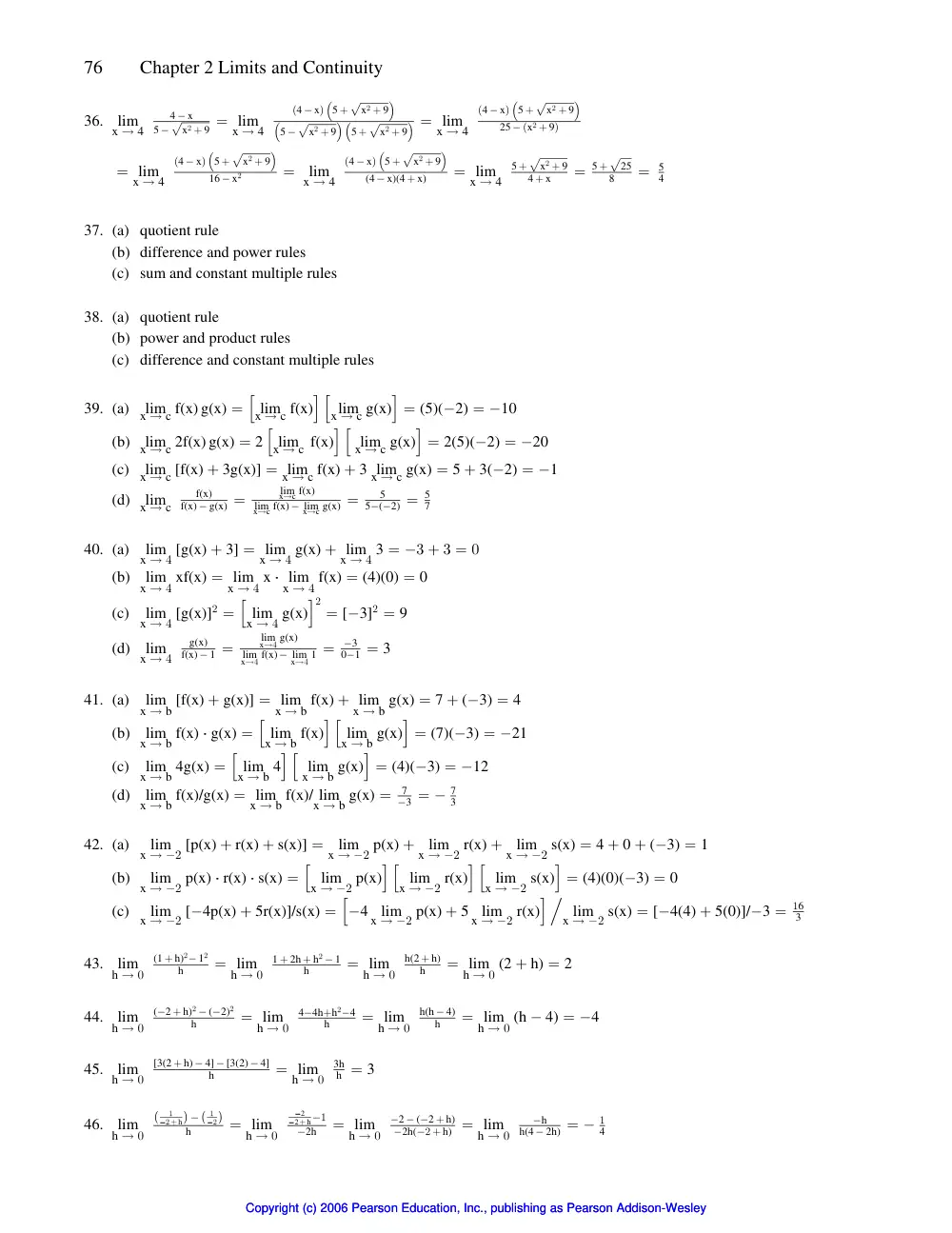
37. (a) quotient rule
(b) difference and power rules
(c) sum and constant multiple rules
38. (a) quotient rule
(b) power and product rules
(c) difference and constant multiple rules
39. (a) lim f(x) g(x)
lim f(x)
lim g(x)
(5)( 2)
10
x
c
x
c
x
c
Ä
Ä
Ä
œ
œ
�
œ �
’
“ ’
“
(b) lim 2f(x) g(x)
2 lim f(x)
lim g(x)
2(5)( 2)
20
x
c
x
c
x
c
Ä
Ä
Ä
œ
œ
�
œ �
’
“ ’
“
(c) lim [f(x)
3g(x)]
lim f(x)
3 lim g(x)
5
3( 2)
1
x
c
x
c
x
c
Ä
Ä
Ä
�
œ
�
œ
�
�
œ �
(d) lim
x
Ä c
f(x)
f(x)
g(x)
lim f(x)
lim g(x)
5 ( 2)
7
lim f(x)
5
5
�
�
� �
œ
œ
œ
x
c
x
c
x
c
Ä
Ä
Ä
40. (a) lim [g(x)
3]
lim g(x)
lim 3
x
x
x
Ä %
Ä %
Ä %
�
œ
�
œ �$ � $ œ !
(b) lim xf(x)
lim x
lim f(x)
(4)(0)
0
x
x
x
Ä %
Ä %
Ä %
œ
œ
œ
†
(c) lim [g(x)]
lim g(x)
[ 3]
9
x
x
Ä %
Ä %
#
#
#
œ
œ �
œ
’
“
(d) lim
3
x Ä %
g(x)
f(x)
1
lim f(x)
lim 1
0 1
lim g(x)
3
�
�
�
�
œ
œ
œ
x
x
x
Ä%
Ä%
Ä%
41. (a) lim [f(x)
g(x)]
lim f(x)
lim g(x)
7
( 3)
4
x
b
x
b
x
b
Ä
Ä
Ä
�
œ
�
œ
� �
œ
(b) lim f(x) g(x)
lim f(x)
lim g(x)
(7)( 3)
21
x
b
x
b
x
b
Ä
Ä
Ä
†
œ
œ
�
œ �
’
“ ’
“
(c) lim 4g(x)
lim 4
lim g(x)
(4)( 3)
12
x
b
x
b
x
b
Ä
Ä
Ä
œ
œ
�
œ �
’
“ ’
“
(d) lim f(x)/g(x)
lim f(x)/ lim g(x)
x
b
x
b
x
b
Ä
Ä
Ä
œ
œ
œ �
7
7
3
3
�
42. (a)
lim [p(x)
r(x)
s(x)]
lim p(x)
lim r(x)
lim s(x)
4
0
( 3)
1
x
x
x
x
Ä �#
Ä �#
Ä �#
Ä �#
�
�
œ
�
�
œ
�
� �
œ
(b)
lim p(x) r(x) s(x)
lim p(x)
lim r(x)
lim s(x)
(4)(0)( 3)
0
x
x
x
x
Ä �#
Ä �#
Ä �#
Ä �#
†
†
œ
œ
�
œ
’
“ ’
“ ’
“
(c)
lim [ 4p(x)
5r(x)]/s(x)
4 lim p(x)
5 lim r(x)
lim s(x)
[ 4(4)
5(0)]/ 3
x
x
x
x
Ä �#
Ä �#
Ä �#
Ä �#
�
�
œ �
�
œ �
�
� œ
’
“ ‚
"6
3
43. lim
lim
lim
lim (2
h)
2
h
h
h
h
Ä !
Ä !
Ä !
Ä !
(1
h)
1
h(2
h)
h
h
h
1
2h
h
1
�
�
�
�
�
�
#
#
#
œ
œ
œ
�
œ
44. lim
lim
lim
lim (h
4)
4
h
h
h
h
Ä !
Ä !
Ä !
Ä !
( 2
h)
( 2)
h(h
4)
h
h
h
4 4h h
4
� �
� �
�
�
�
�
#
#
#
œ
œ
œ
�
œ �
45. lim
lim
3
h
h
Ä !
Ä !
[3(2
h)
4]
[3(2)
4]
h
h
3h
�
�
�
�
œ
œ
46. lim
lim
lim
lim
h
h
h
h
Ä !
Ä !
Ä !
Ä !
ˆ
‰
ˆ
‰
"
"
�
�# �
�#
� �
h
2
2 h
�
�"
�
�
�# �
�
� � � �
�
"
h
2h
2h(
h)
h(4
2h)
4
2
( 2
h)
h
œ
œ
œ
œ �
Copyright (c) 2006 Pearson Education, Inc., publishing as Pearson Addison-Wesley
Copyright (c) 2006 Pearson Education, Inc., publishing as Pearson Addison-Wesley
Section 2.2 Calculating Limits Using the Limit Laws
77
47. lim
lim
lim
h
h
h
Ä !
Ä !
Ä !
È
È
Š
‹ Š
‹
È
È
È
È
Š
‹
Š
‹
È
È
È
È
7
h
7
h
7
h
7
7
h
7
h
7
h
7
h
7
h
7
(7
h)
7
�
�
�
�
�
�
�
�
�
�
�
�
œ
œ
lim
lim
œ
œ
œ
h
h
Ä !
Ä !
h
h
7 h
7
7 h
7
7
Š
‹
È
È
È
È
È
� �
"
"
� �
#
48. lim
lim
lim
h
h
h
Ä !
Ä !
Ä !
È
È
Š
‹ Š
‹
È
È
Š
‹
Š
‹
È
È
3(0
h)
1
3(0)
1
h
3h
1
3h
1
h
3h
1
h
3h
1
1
(3h
1)
�
�
�
�
�
� "
�
� "
� � "
�
�
�
� "
œ
œ
lim
lim
œ
œ
œ
h
h
Ä !
Ä !
3h
3
3
h
3h
1
3h
1
1
Š
‹
È
È
�
� "
�
�
#
49. lim
5
2x
5
2(0)
5 and lim
5
x
5
(0)
5; by the sandwich theorem,
x
x
Ä !
Ä !
È
È
È
È
È
È
�
œ
�
œ
�
œ
�
œ
#
#
#
#
lim f(x)
5
x Ä !
œ È
50. lim 2
x
2
0
2 and lim 2 cos x
2(1)
2; by the sandwich theorem, lim g(x)
2
x
x
x
Ä !
Ä !
Ä !
a
b
�
œ
�
œ
œ
œ
œ
#
51. (a) lim 1
1
1 and lim 1
1; by the sandwich theorem, lim
1
x
x
x
Ä !
Ä !
Ä !
Š
‹
�
œ
�
œ
œ
œ
x
0
x sin x
6
6
2 2 cos x
#
�
(b) For x
0, y
(x sin x)/(2
2 cos x)
Á
œ
�
lies between the other two graphs in the
figure, and the graphs converge as x
0.
Ä
52. (a) lim
lim
lim
0
and lim
; by the sandwich theorem,
x
x
x
x
Ä !
Ä !
Ä !
Ä !
Š
‹
"
"
"
"
"
#
#
#
#
#
#
#
�
œ
�
œ
�
œ
œ
x
1
x
24
4
#
#
lim
.
x Ä !
1 cos x
x
�
"
#
#
œ
(b) For all x
0, the graph of f(x)
(1
cos x)/x
Á
œ
�
#
lies between the line y
œ " and the parabola
#
y
x /24, and the graphs converge as x
0.
œ
�
Ä
"
#
#
53. lim f(x) exists at those points c where lim x
lim x . Thus, c
c
c
1
c
0
x
c
x
c
x
c
Ä
Ä
Ä
%
#
%
#
#
#
œ
œ
Ê
�
œ
a
b
c
0, 1, or 1. Moreover, lim f(x)
lim x
0 and lim f(x)
lim f(x)
1.
Ê
œ
�
œ
œ
œ
œ
x
x
x
1
x
1
Ä !
Ä !
Ä �
Ä
#
54. Nothing can be concluded about the values of f, g, and h at x
œ 2. Yes, f(2) could be 0. Since the
conditions of the sandwich theorem are satisfied, lim f(x)
5
0.
x Ä #
œ � Á
55. 1
lim
lim f(x)
5
2(1)
lim f(x)
2
5
7.
œ
œ
œ
Ê
�
œ
Ê
œ
�
œ
x
x
x
Ä %
Ä %
Ä %
f(x) 5
x 2
lim x
lim 2
lim f(x)
lim 5
lim f(x)
5
�
�
�
% � #
�
�
x
x
x
x
x
Ä%
Ä%
Ä%
Ä%
Ä%
Copyright (c) 2006 Pearson Education, Inc., publishing as Pearson Addison-Wesley
Copyright (c) 2006 Pearson Education, Inc., publishing as Pearson Addison-Wesley
78
Chapter 2 Limits and Continuity
56. (a) 1
lim
lim f(x)
4.
œ
œ
œ
Ê
œ
x
x
Ä �#
Ä �#
f(x)
x
lim x
lim f(x)
lim f(x)
#
#
x
x
x
�#
�#
�#
%
(b) 1
lim
lim
lim
lim
lim
2.
œ
œ
œ
Ê
œ �
x
x
x
x
x
Ä �#
Ä �#
Ä �#
Ä �#
Ä �#
f(x)
f(x)
f(x)
f(x)
x
x
x
x
x
#
’
“ ’
“
’
“ ˆ
‰
"
"
�#
57. (a) 0
3 0
lim
lim (x
2)
lim
(x
2)
lim [f(x)
5]
lim f(x)
5
œ
œ
�
œ
�
œ
�
œ
�
†
’
“ ’
“
’
“
Š
‹
x
x
x
x
x
Ä #
Ä #
Ä #
Ä #
Ä #
f(x)
5
f(x)
5
x
x
�
�
� #
� #
lim f(x)
5.
Ê
œ
x Ä #
(b) 0
4 0
lim
lim (x
2)
lim f(x)
5 as in part (a).
œ
œ
�
Ê
œ
†
’
“ ’
“
x
x
x
Ä #
Ä #
Ä #
f(x)
5
x
�
� #
58. (a) 0
1 0
lim
lim x
lim
lim x
lim
x
lim f(x). That is, lim f(x
œ
œ
œ
œ
œ
†
†
’
“ ’
“
’
“ ’
“
’
“
x
x
x
x
x
x
x
Ä !
Ä !
Ä !
Ä !
Ä !
Ä !
Ä !
f(x)
f(x)
f(x)
x
x
x
#
#
#
#
#
#
)
0.
œ
(b) 0
1 0
lim
lim x
lim
x
lim
. That is, lim
0.
œ
œ
œ
œ
œ
†
†
’
“ ’
“
’
“
x
x
x
x
x
Ä !
Ä !
Ä !
Ä !
Ä !
f(x)
f(x)
f(x)
f(x)
x
x
x
x
#
#
59. (a) lim x sin
0
x Ä !
"
x œ
(b)
1
sin
1 for x
0:
� Ÿ
Ÿ
Á
"
x
x
0
x
x sin
x
lim x sin
0 by the sandwich theorem;
�
Ê � Ÿ
Ÿ
Ê
œ
"
"
x
x
x Ä !
x
0
x
x sin
x
lim x sin
0 by the sandwich theorem.
�
Ê �
Ê
œ
"
"
x
x
x Ä !
60. (a) lim x cos
0
x Ä !
#
ˆ "
x$ ‰
œ
(b)
1
cos
1 for x
0
x
x cos
x
lim x cos
0 by the sandwich
� Ÿ
Ÿ
Á
Ê �
Ÿ
Ÿ
Ê
œ
ˆ
‰
ˆ
‰
ˆ
‰
"
"
"
#
#
#
#
x
x
x
$
$
$
x Ä !
theorem since lim x
0.
x Ä !
# œ
2.3 PRECISE DEFINITION OF A LIMIT
1.
Step 1:
x
5
x
5
5
x
5
k
� k
�
Ê � �
�
�
Ê � �
�
�
�
$
$
$
$
$
Step 2:
5
7
2, or
5
1
4.
$
$
$
$
�
œ
Ê
œ
� �
œ
Ê
œ
The value of which assures x
5
1
x
7 is the smaller value,
2.
$
$
$
k
� k
�
Ê
�
�
œ
Copyright (c) 2006 Pearson Education, Inc., publishing as Pearson Addison-Wesley
Copyright (c) 2006 Pearson Education, Inc., publishing as Pearson Addison-Wesley
Section 2.3 Precise Definition of a Limit
79
2.
Step 1:
x
2
x
2
x
2
k
� k
�
Ê � �
�
�
Ê � � # �
�
�
$
$
$
$
$
Step 2:
2
1
1, or
2
7
5.
� �
œ
Ê
œ
�
œ
Ê
œ
$
$
$
$
The value of which assures x
2
1
x
7 is the smaller value,
1.
$
$
$
k
� k
�
Ê
�
�
œ
3.
Step 1:
x
( 3)
x
3
x
3
k
k
� �
�
Ê � �
� $ �
Ê � �
�
�
�
$
$
$
$
$
Step 2:
3
, or
.
� �
œ �
Ê
œ
� $ œ �
Ê
œ
$
$
$
$
7
5
#
#
#
#
"
"
The value of which assures x
( 3)
x
is the smaller value,
.
$
$
$
k
k
� �
�
Ê �
�
� �
œ
7
#
#
#
"
"
4.
Step 1:
x
x
x
¸
¸
ˆ
� � ‰
�
Ê � �
�
�
Ê � �
�
�
�
3
3
3
3
#
#
#
#
$
$
$
$
$
Step 2:
, or
1.
� �
œ �
Ê
œ #
�
œ �
Ê
œ
$
$
$
$
3
7
3
#
#
#
#
"
The value of which assures x
x
is the smaller value,
.
$
$
$
¸
¸
ˆ
� � ‰
�
Ê �
�
� �
œ "
3
7
#
#
#
"
5.
Step 1:
x
x
x
¸
¸
�
�
Ê � �
�
�
Ê � �
�
�
�
"
"
"
"
#
#
#
#
$
$
$
$
$
Step 2:
, or
.
� �
œ
Ê
œ
�
œ
Ê
œ
$
$
$
$
"
"
"
"
#
#
4
4
9
18
7
14
The value of which assures x
x
is the smaller value,
.
$
$
$
¸
¸
�
�
Ê
�
�
œ
"
"
#
4
4
9
7
18
6.
Step 1:
x
3
x
3
3
x
3
k
� k
�
Ê � �
�
�
Ê � �
�
�
�
$
$
$
$
$
Step 2:
2.7591
0.2409, or
3.2391
0.2391.
� � $ œ
Ê
œ
� $ œ
Ê
œ
$
$
$
$
The value of which assures x
3
2.7591
x
3.2391 is the smaller value,
0.2391.
$
$
$
k
� k
�
Ê
�
�
œ
7. Step 1:
x
5
x
5
5
x
5
k
� k
�
Ê � �
�
�
Ê � �
�
�
�
$
$
$
$
$
Step 2:
From the graph,
5
4.9
0.1, or
5
5.1
0.1; thus
0.1 in either case.
� �
œ
Ê
œ
�
œ
Ê
œ
œ
$
$
$
$
$
8. Step 1:
x
( 3)
x
3
3
x
3
k
k
� �
�
Ê � �
�
�
Ê � �
�
�
�
$
$
$
$
$
Step 2:
From the graph,
3
3.1
0.1, or
3
2.9
0.1; thus
0.1.
� �
œ �
Ê
œ
�
œ �
Ê
œ
œ
$
$
$
$
$
9. Step 1:
x
1
x
1
1
x
1
k
� k
�
Ê � �
�
�
Ê � �
�
�
�
$
$
$
$
$
Step 2:
From the graph,
1
, or
1
; thus
.
� �
œ
Ê
œ
�
œ
Ê
œ
œ
$
$
$
$
$
9
7
25
9
7
16
16
16
16
16
10. Step 1:
x
3
x
3
3
x
3
k
� k
�
Ê � �
�
�
Ê � �
�
�
�
$
$
$
$
$
Step 2:
From the graph,
3
2.61
0.39, or
3
3.41
0.41; thus
0.39.
� �
œ
Ê
œ
�
œ
Ê
œ
œ
$
$
$
$
$
11. Step 1:
x
2
x
2
2
x
2
k
� k
�
Ê � �
�
�
Ê � �
�
�
�
$
$
$
$
$
Step 2:
From the graph,
2
3
2
3
0.2679, or
2
5
5
2
0.2361;
� �
œ
Ê
œ
�
¸
�
œ
Ê
œ
�
¸
$
$
$
$
È
È
È
È
thus
5
2.
$ œ
�
È
Copyright (c) 2006 Pearson Education, Inc., publishing as Pearson Addison-Wesley
Copyright (c) 2006 Pearson Education, Inc., publishing as Pearson Addison-Wesley
80
Chapter 2 Limits and Continuity
12. Step 1:
x
( 1)
x
1
1
x
1
k
k
� �
�
Ê � �
�
�
Ê � �
�
�
�
$
$
$
$
$
Step 2:
From the graph,
1
0.1180, or
1
0.1340;
� �
œ �
Ê
œ
¸
�
œ �
Ê
œ
¸
$
$
$
$
È
È
È
È
5
5
2
3
2
3
#
#
#
#
�
�
thus
.
$ œ
È5
� 2
#
13. Step 1:
x
( 1)
x
1
1
x
1
k
k
� �
�
Ê � �
�
�
Ê � �
�
�
�
$
$
$
$
$
Step 2:
From the graph,
1
0.77, or
1
0.36; thus
0.36.
� �
œ �
Ê
œ
¸
�
œ �
Ê
œ
œ
œ
$
$
$
$
16
7
16
9
9
9
9
25
25
25
14. Step 1:
x
x
x
¸
¸
�
�
Ê � �
�
�
Ê � �
�
�
�
"
"
"
"
#
#
#
#
$
$
$
$
$
Step 2:
From the graph,
0.00248, or
0.00251;
� �
œ
Ê
œ
�
¸
�
œ
Ê
œ
�
¸
$
$
$
$
"
"
"
"
#
#
#
#
1
1
1
1
2.01
2
.01
1.99
1.99
thus
0.00248.
$ œ
15. Step 1:
(x
1)
5
0.01
x
4
0.01
0.01
x
4
0.01
3.99
x
4.01
k
k
k
k
�
�
�
Ê
�
�
Ê �
�
�
�
Ê
�
�
Step 2:
x
4
x
4
4
x
4
0.01.
k
� k
�
Ê � �
�
�
Ê � �
�
�
�
Ê
œ
$
$
$
$
$
$
16. Step 1:
(2x
2)
( 6)
0.02
2x
4
0.02
0.02
2x
4
0.02
4.02
2x
3.98
k
k
k
k
�
� �
�
Ê
�
�
Ê �
�
�
�
Ê �
�
� �
2.01
x
1.99
Ê �
�
� �
Step 2:
x
( 2)
x
2
2
x
2
0.01.
k
k
� �
�
Ê � �
�
�
Ê � �
�
�
�
Ê
œ
$
$
$
$
$
$
17. Step 1:
x
1
0.1
0.1
x
1
0.1
0.9
x
1
1.1
0.81
x
1
1.21
¹
¹
È
È
È
�
� " �
Ê �
�
�
� " �
Ê
�
�
�
Ê
�
�
�
0.19
x
0.21
Ê �
�
�
Step 2:
x
0
x
. Then,
or
; thus,
0.19.
k
� k
�
Ê � �
�
� œ �!Þ"* Ê
œ !Þ"*
œ !Þ#"
œ
$
$
$
$
$
$
$
18. Step 1:
x
0.1
0.1
x
0.1
0.4
x
0.6
0.16
x
0.36
¸
¸
È
È
È
�
�
Ê �
�
�
�
Ê
�
�
Ê
�
�
"
"
#
#
Step 2:
x
x
.
¸
¸
�
�
Ê � �
�
�
Ê � �
� B �
�
"
"
"
"
4
4
4
4
$
$
$
$
$
Then,
0.16
0.09 or
0.36
0.11; thus
0.09.
� �
œ
Ê
œ
�
œ
Ê
œ
œ
$
$
$
$
$
"
"
4
4
19. Step 1:
19
x
19
x
1
2
19
x
4
19
x
16
¹
¹
È
È
È
�
� $ � " Ê �" �
�
� $ �
Ê
�
�
� % Ê
�
�
�
x
19
16
15
x
3 or 3
x
15
Ê �% �
�
� �
Ê
�
�
�
�
Step 2:
x
10
x
10
10
x
10.
k
k
�
�
Ê � �
�
�
Ê � �
�
�
�
$
$
$
$
$
Then
10
3
7, or
10
15
5; thus
5.
� �
œ
Ê
œ
�
œ
Ê
œ
œ
$
$
$
$
$
20. Step 1:
x
7
4
1
x
7
1
3
x
7
5
9
x
7
25
16
x
32
¹
¹
È
È
È
�
�
�
Ê �" �
�
� % �
Ê
�
�
�
Ê
�
�
�
Ê
�
�
Step 2:
x
23
x
23
23
x
23.
k
k
�
�
Ê � �
�
�
Ê � �
�
�
�
$
$
$
$
$
Then
23
16
7, or
23
32
9; thus
7.
� �
œ
Ê
œ
�
œ
Ê
œ
œ
$
$
$
$
$
21. Step 1:
0.05
0.05
0.05
0.2
0.3
x
or
x
5.
¸
¸
"
"
"
"
"
#
x
4
x
4
x
3
3
10
10
10
�
�
Ê �
�
�
�
Ê
�
�
Ê
�
�
�
�
Step 2:
x
4
x
4
4
x
4.
k
� k
�
Ê � �
�
�
Ê � �
�
�
�
$
$
$
$
$
Then
or
, or
4
5 or
1; thus
.
� � % œ
œ
�
œ
œ
œ
$
$
$
$
$
10
2
2
3
3
3
22. Step 1:
x
3
.1
0.1
x
3
0.1
2.9
x
3.1
2.9
x
3.1
k
k
È
È
#
#
#
�
� !
Ê �
�
�
�
Ê
�
�
Ê
�
�
Step 2:
x
3
x
3
3
x
3.
¹
È ¹
È
È
È
�
�
Ê � �
�
�
Ê � �
�
�
�
$
$
$
$
$
Then
3
2.9
3
2.9
0.0291, or
3
3.1
3.1
3
0.0286;
� �
œ
Ê
œ
�
¸
�
œ
Ê
œ
�
¸
$
$
$
$
È
È
È
È
È
È
È
È
thus
0.0286.
$ œ
Copyright (c) 2006 Pearson Education, Inc., publishing as Pearson Addison-Wesley
Copyright (c) 2006 Pearson Education, Inc., publishing as Pearson Addison-Wesley
Section 2.3 Precise Definition of a Limit
81
23. Step 1:
x
4
0.5
0.5
x
4
0.5
3.5
x
4.5
3.5
x
4.5
4.5
x
3.5,
k
k
k k
È
È
È
È
#
#
#
�
�
Ê �
�
�
�
Ê
�
�
Ê
�
�
Ê �
�
� �
for x near 2.
�
Step 2:
x
( 2)
x
2
x
2.
k
k
� �
�
Ê � �
�
�
Ê � � # �
�
�
$
$
$
$
$
Then
4.5
4.5
0.1213, or
3.5
3.5
0.1292;
� � # œ �
Ê
œ
� # ¸
� # œ �
Ê
œ # �
¸
$
$
$
$
È
È
È
È
thus
4.5
2
0.12.
$ œ
�
¸
È
24. Step 1:
( 1)
0.1
0.1
1
0.1
x
or
x
.
¸
¸
"
"
"
x
x
10
x
10
11
9
9
11
11
9
10
10
10
10
� �
�
Ê �
�
�
�
Ê �
�
� �
Ê �
�
� �
�
�
� �
Step 2:
x
( 1)
x
1
x
.
k
k
� �
�
Ê � �
�
�
Ê � � " �
�
� "
$
$
$
$
$
Then
, or
; thus
.
� � " œ �
Ê
œ
� " œ �
Ê
œ
œ
$
$
$
$
$
10
10
9
9
11
11
11
"
"
"
25. Step 1:
x
5
11
x
16
1
x
16
1
15
x
17
15
x
17.
k
k
k
k
a
b
È
È
#
#
#
#
�
�
� " Ê
�
�
Ê �" �
�
�
Ê
�
�
Ê
�
�
Step 2:
x
4
x
4
x
.
k
� k
�
Ê � �
�
�
Ê � � % �
�
� %
$
$
$
$
$
Then
15
15
0.1270, or
17
17
0.1231;
� � % œ
Ê
œ % �
¸
� % œ
Ê
œ
� % ¸
$
$
$
$
È
È
È
È
thus
17
4
0.12.
$ œ
�
¸
È
26. Step 1:
5
1
4
6
30
x
20 or 20
x
30.
¸
¸
120
120
120
x
x
x
x
4
120
6
�
� " Ê �" �
� & �
Ê
�
�
Ê
�
�
Ê
�
�
�
�
"
"
Step 2:
x
24
x
24
24
x
24.
k
k
�
�
Ê � �
�
�
Ê � �
�
�
�
$
$
$
$
$
Then
24
20
4, or
24
30
6; thus
4.
� �
œ
Ê
œ
�
œ
Ê
œ
Ê
œ
$
$
$
$
$
27. Step 1:
mx
2m
0.03
0.03
mx
2m
0.03
0.03
2m
mx
0.03
2m
k
k
�
�
Ê �
�
�
�
Ê �
�
�
�
�
Ê
2
x
2
.
�
�
�
�
0.03
0.03
m
m
Step 2:
x
2
x
2
x
.
k
� k
�
Ê � �
�
�
Ê � � # �
�
� #
$
$
$
$
$
Then
, or
. In either case,
.
� � # œ # �
Ê
œ
� # œ # �
Ê
œ
œ
$
$
$
$
$
0.03
0.03
0.03
0.03
0.03
m
m
m
m
m
28. Step 1:
mx
3m
c
c
mx
3m
c
c
3m
mx
c
3m
3
x
3
k
k
�
�
Ê � �
�
�
Ê � �
�
�
�
Ê
�
�
�
�
c
c
m
m
Step 2:
x
3
x
3
.
k
� k
�
Ê � �
�
�
Ê � � $ � B �
� $
$
$
$
$
$
Then
, or
. In either case,
.
� � $ œ $ �
Ê
œ
� $ œ $ �
Ê
œ
œ
$
$
$
$
$
c
c
c
c
c
m
m
m
m
m
29. Step 1:
(mx
b)
b
c
mx
c
c
mx
c
x
.
¸
¸
ˆ
‰
�
�
�
� - Ê � �
�
�
Ê � �
�
�
�
Ê
�
�
�
�
m
m
m
m
c
c
m
m
#
#
#
#
#
#
"
"
Step 2:
x
x
x
.
¸
¸
�
�
Ê � �
�
�
Ê � �
�
�
�
"
"
"
"
#
#
#
#
$
$
$
$
$
Then
, or
. In either case,
.
� �
œ
�
Ê
œ
�
œ
�
Ê
œ
œ
$
$
$
$
$
"
"
"
"
#
#
#
#
c
c
c
c
c
m
m
m
m
m
30. Step 1:
(mx
b)
(m
b)
0.05
0.05
mx
m
0.05
0.05
m
mx
0.05
m
k
k
�
�
�
�
Ê �
�
�
�
Ê �
�
�
�
�
1
x
.
Ê
�
�
� " �
0.05
0.05
m
m
Step 2:
x
1
x
1
x
.
k
� k
�
Ê � �
�
�
Ê � � " �
�
� "
$
$
$
$
$
Then
, or
. In either case,
.
� � " œ " �
Ê
œ
� " œ " �
Ê
œ
œ
$
$
$
$
$
0.05
0.05
0.05
0.05
0.05
m
m
m
m
m
31. lim (3
2x)
3
2(3)
3
x
Ä 3
�
œ
�
œ �
Step 1:
3
2x
( 3)
0.02
0.02
6
2x
0.02
6.02
2x
5.98
3.01
x
2.99 or
k
k
a
b
�
� �
�
Ê �
�
�
�
Ê �
� �
� �
Ê
�
�
2.99
x
3.01.
�
�
Step 2:
0
x
3
x
3
x
.
�
�
�
Ê � �
�
�
Ê � � $ �
�
� $
k
k
$
$
$
$
$
Then
2.99
0.01, or
3.01
0.01; thus
0.01.
� � $ œ
Ê
œ
� $ œ
Ê
œ
œ
$
$
$
$
$
32. lim ( 3x
)
( 3)( 1)
2
1
x
Ä �1
�
� # œ �
�
�
œ
Step 1:
( 3x
2)
1
0.03
0.03
3x
3
0.03
0.01
x
1
0.01
1.01
x
0.99.
k
k
�
�
�
�
Ê �
� �
�
�
Ê
�
�
� �
Ê �
�
� �
Copyright (c) 2006 Pearson Education, Inc., publishing as Pearson Addison-Wesley
Copy