
MATH 201 Chapter 11 Summary with Examples, Fall 2011
American University of Beirut · Calculus and Analytical Geometry III · 77 pages

Showing the first 10 of 77 pages. Download the PDF to see all of it.
More MATH 201 files
- Chapter 11 Summary · Fall 2011ChapterView
- Chapter 14 Summary · Fall 2011ChapterView
- Chapter 15 Summary · Fall 2011ChapterView
- Chapter 16 Summary · Fall 2011ChapterView
- Problems Solution Chapter 16 · Fall 2008Chapter · with solutionView
- Problems Solution Chapter 16 · Fall 2008Chapter · with solutionView
- Problems Solution Chapter 2 · Fall 2008Chapter · with solutionView
- Problems Solution Chapter 2 · Fall 2008Chapter · with solutionView
Show the text of this chapter
CHAPTER 11: Infinite Sequences and Series
§11.1 Sequences
Section Contents:
(1) Definition and notation of sequences.
(2) Convergence and divergence of sequences.
(3) Calculating limits of sequences.
(4) L’Hˆopital’s rule.
(5) Familiar limits.
(6) Recursively defined sequences.
(7) Monotone and bounded sequences.
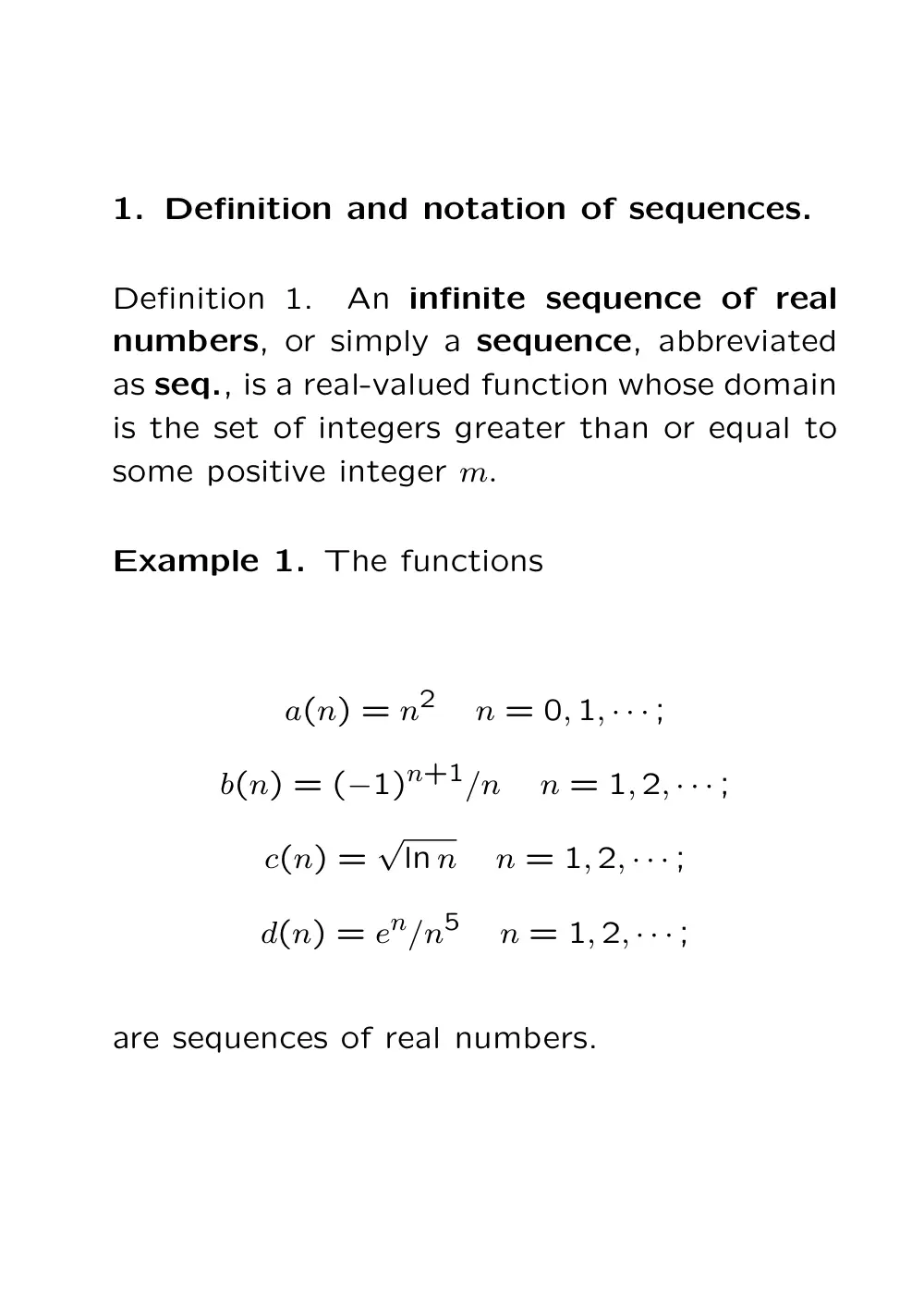
1. Definition and notation of sequences.
Definition 1.
An infinite sequence of real
numbers, or simply a sequence, abbreviated
as seq., is a real-valued function whose domain
is the set of integers greater than or equal to
some positive integer m.
Example 1. The functions
a(n) = n2
n = 0, 1, · · · ;
b(n) = (−1)n+1/n
n = 1, 2, · · · ;
c(n) =
√
ln n
n = 1, 2, · · · ;
d(n) = en/n5
n = 1, 2, · · · ;
are sequences of real numbers.
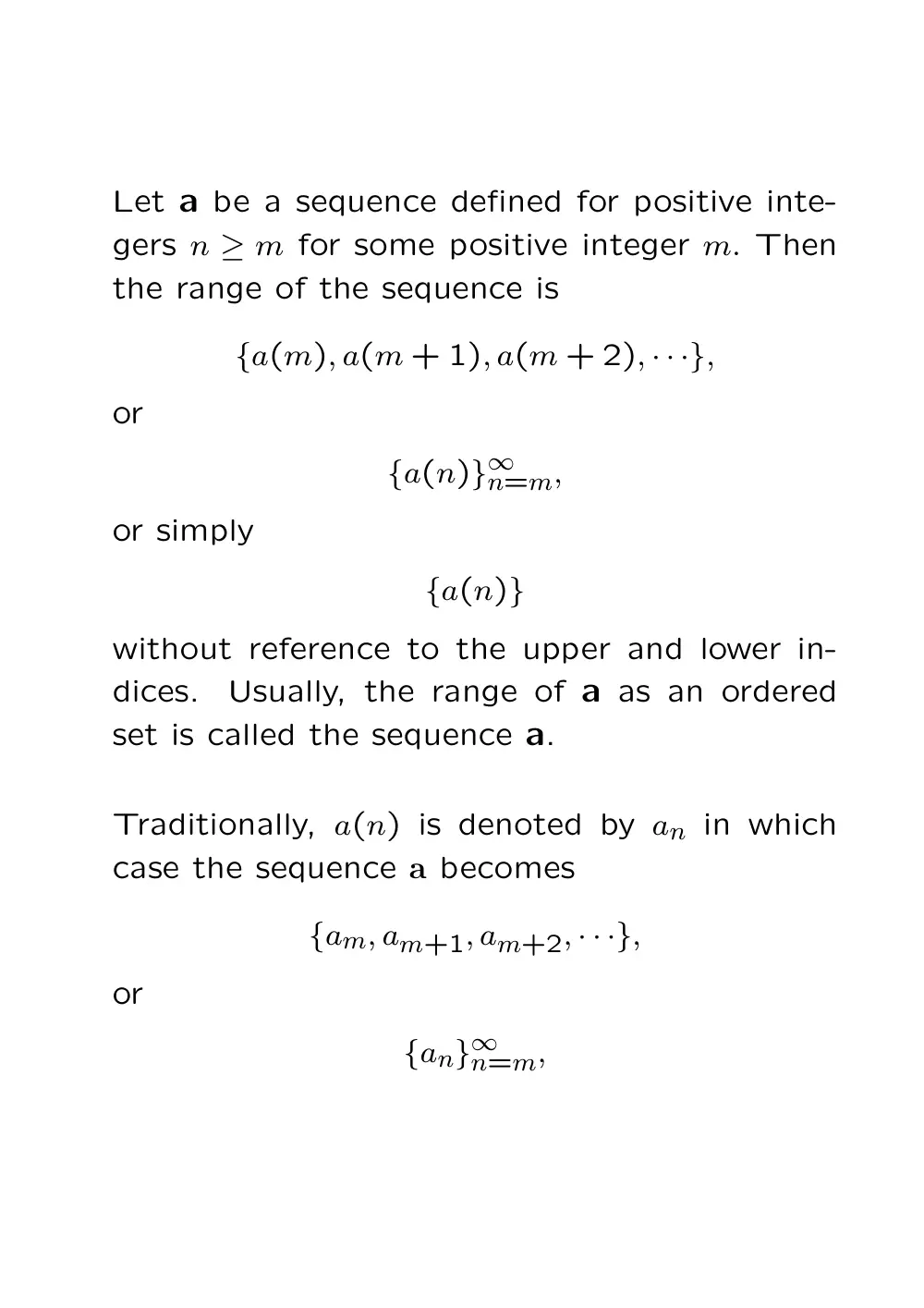
Let a be a sequence defined for positive inte-
gers n ≥ m for some positive integer m. Then
the range of the sequence is
{a(m), a(m + 1), a(m + 2), · · ·},
or
{a(n)}∞
n=m,
or simply
{a(n)}
without reference to the upper and lower in-
dices.
Usually, the range of a as an ordered
set is called the sequence a.
Traditionally, a(n) is denoted by an in which
case the sequence a becomes
{am, am+1, am+2, · · ·},
or
{an}∞
n=m,
or simply
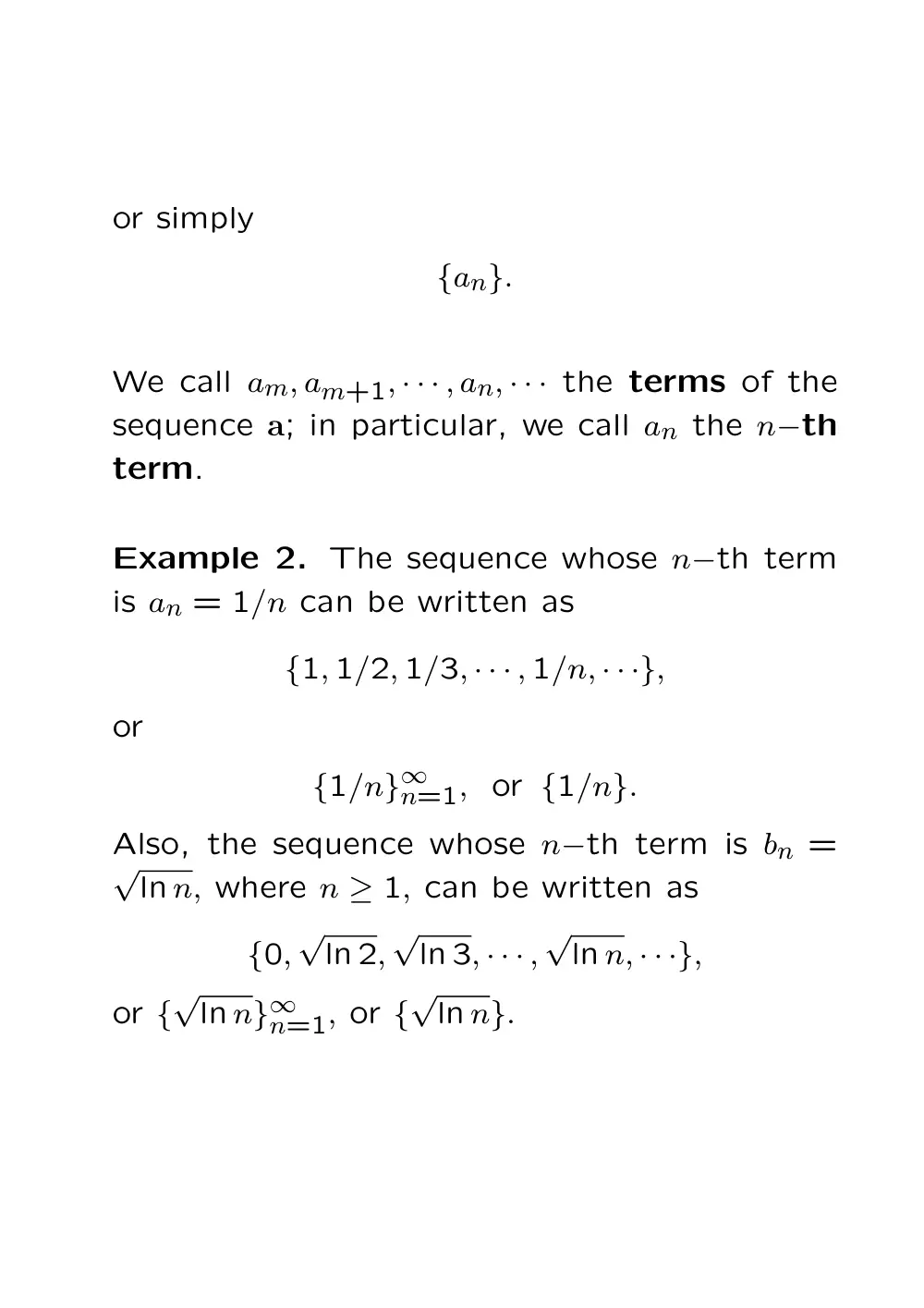
{an}.
We call am, am+1, · · · , an, · · · the terms of the
sequence a; in particular, we call an the n−th
term.
Example 2. The sequence whose n−th term
is an = 1/n can be written as
{1, 1/2, 1/3, · · · , 1/n, · · ·},
or
{1/n}∞
n=1, or {1/n}.
Also, the sequence whose n−th term is bn =
√
ln n, where n ≥ 1, can be written as
{0,
√
ln 2,
√
ln 3, · · · ,
√
ln n, · · ·},
or {
√
ln n}∞
n=1, or {
√
ln n}.
Graphical Representation of sequences.
A sequence a = {an}∞
n=m is represented graph-
ically in two ways as follows.
(i) By its graph as the function a(n) = an,
where n = m, m + 1, · · · .
(ii) By the graphs of the terms an on the real
axis.
Example 3. The graphs of the sequence {√n}
are
2.
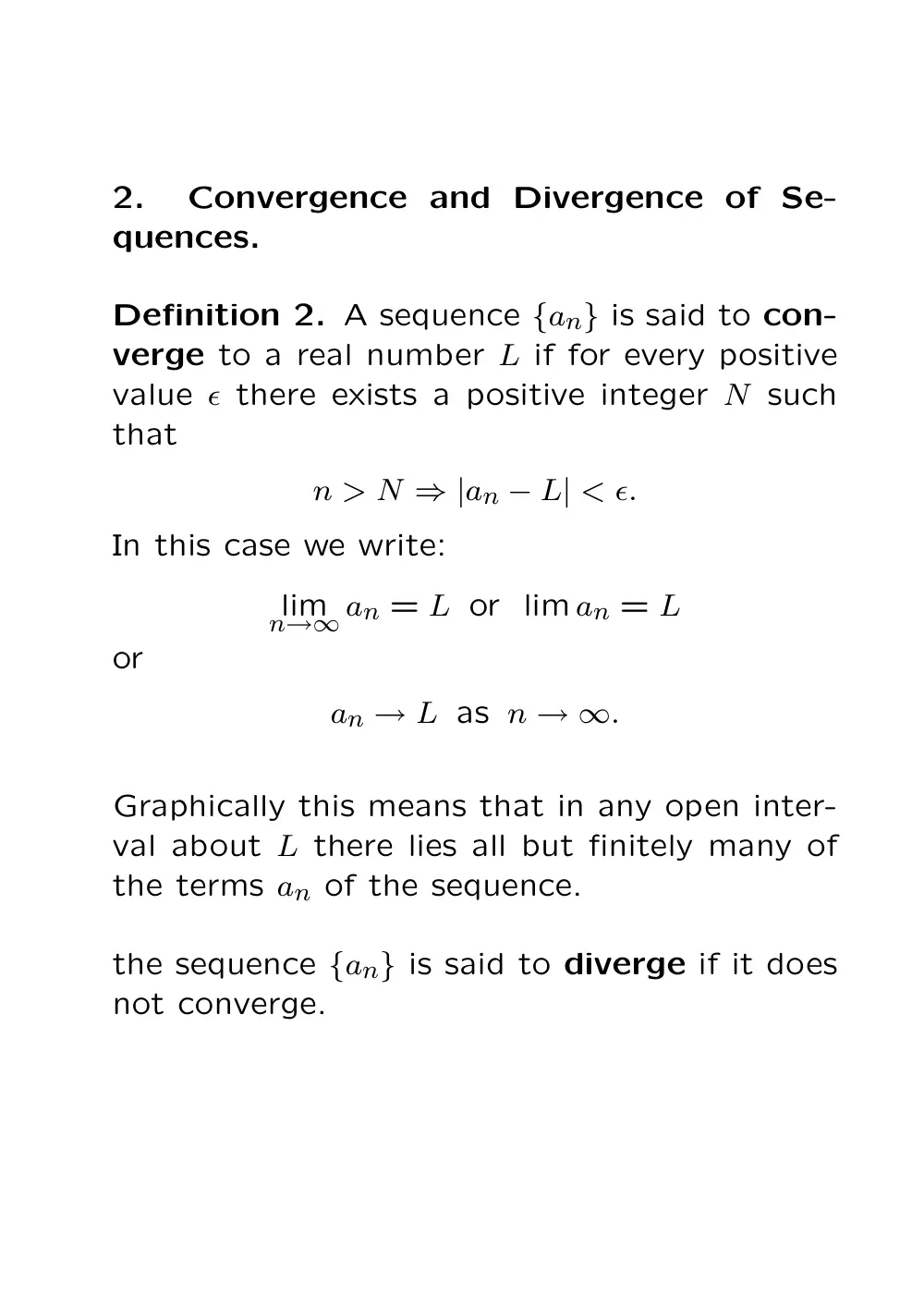
Convergence and Divergence of Se-
quences.
Definition 2. A sequence {an} is said to con-
verge to a real number L if for every positive
value ϵ there exists a positive integer N such
that
n > N ⇒ |an − L| < ϵ.
In this case we write:
lim
n→∞ an = L or lim an = L
or
an → L as n → ∞.
Graphically this means that in any open inter-
val about L there lies all but finitely many of
the terms an of the sequence.
the sequence {an} is said to diverge if it does
not converge.
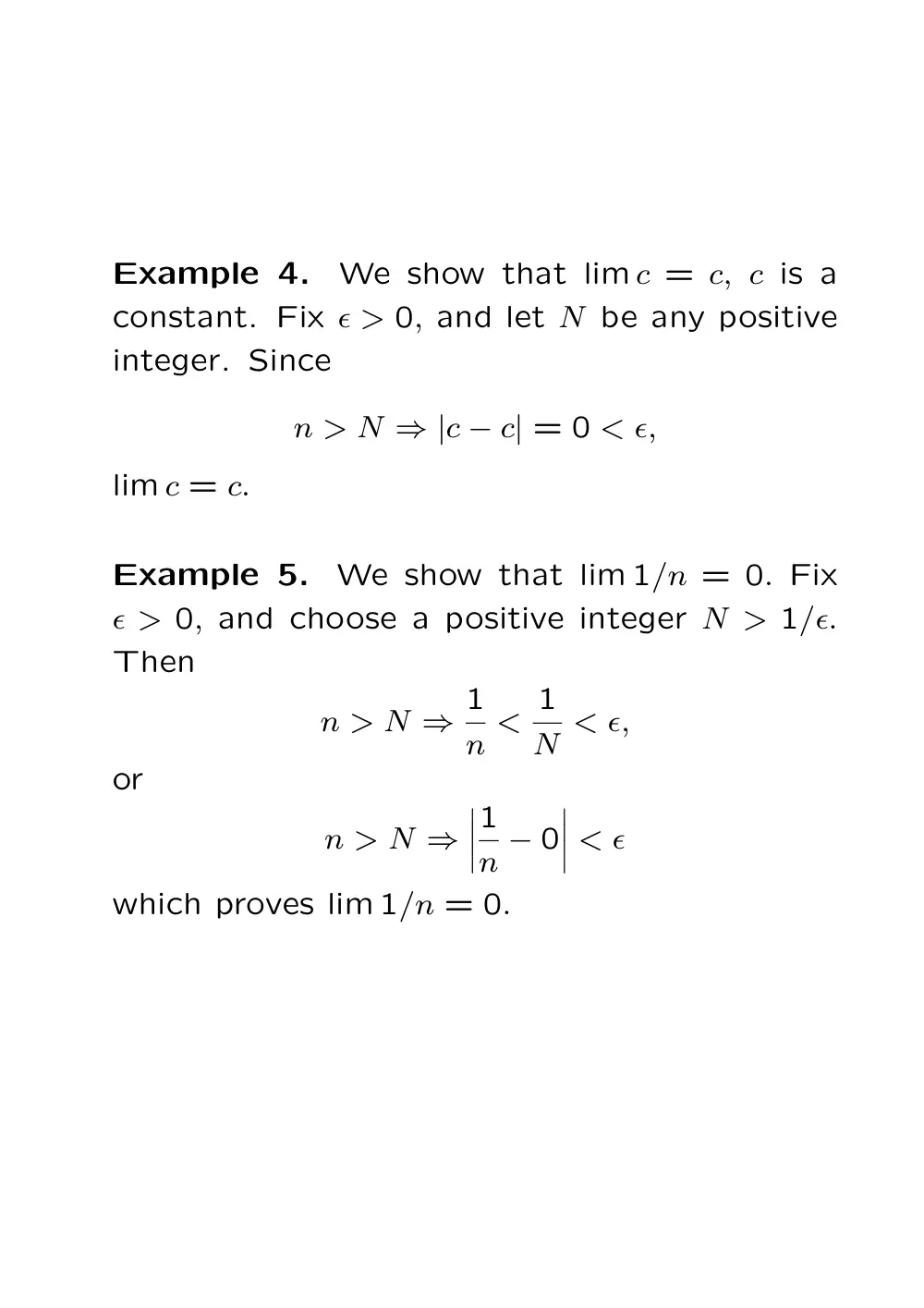
Example 4.
We show that lim c = c, c is a
constant. Fix ϵ > 0, and let N be any positive
integer. Since
n > N ⇒ |c − c| = 0 < ϵ,
lim c = c.
Example 5.
We show that lim 1/n = 0. Fix
ϵ > 0, and choose a positive integer N > 1/ϵ.
Then
n > N ⇒ 1
n < 1
N < ϵ,
or
n > N ⇒
����
1
n − 0
���� < ϵ
which proves lim 1/n = 0.
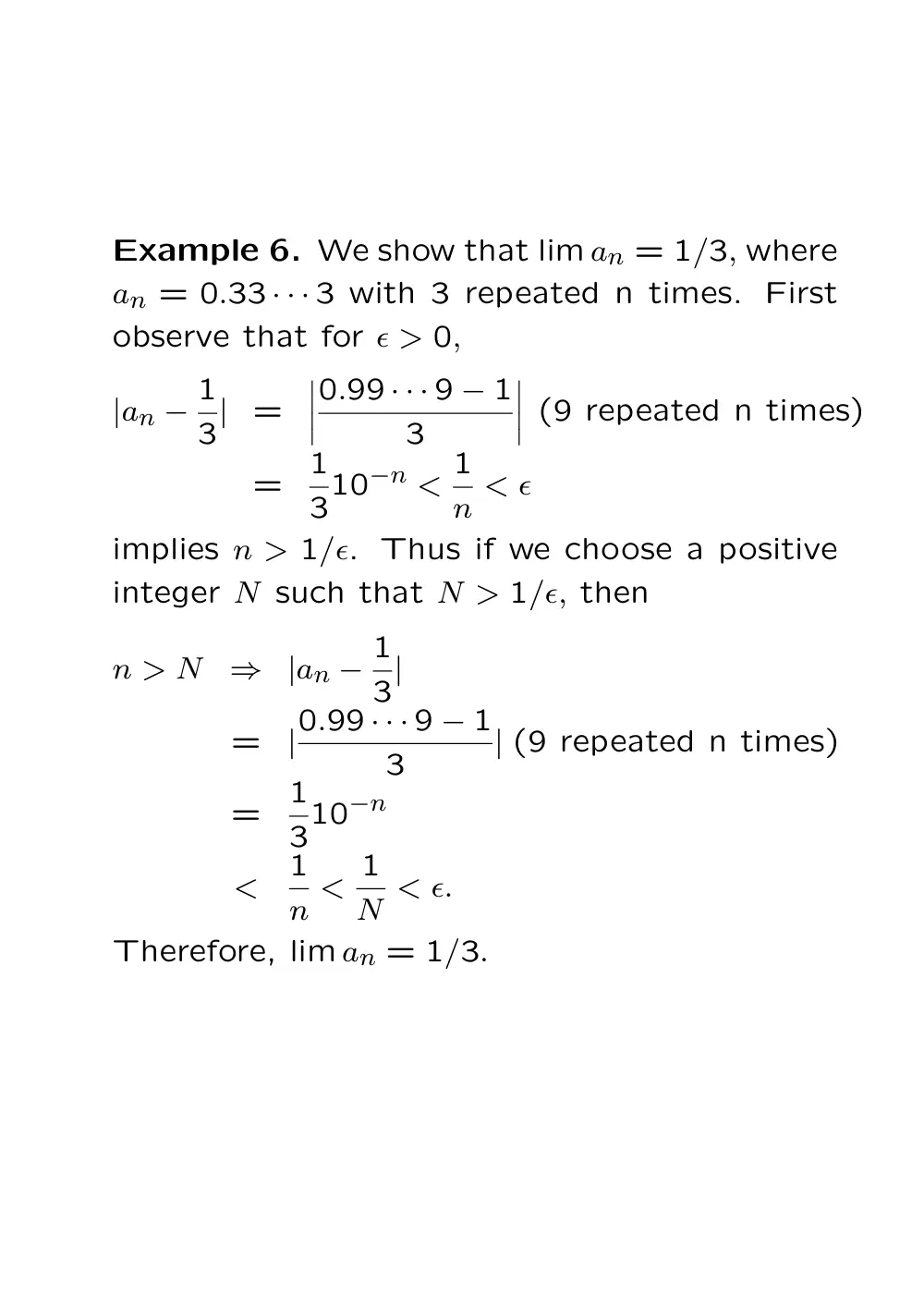
Example 6. We show that lim an = 1/3, where
an = 0.33 · · · 3 with 3 repeated n times. First
observe that for ϵ > 0,
|an − 1
3|
=
����
0.99 · · · 9 − 1
3
���� (9 repeated n times)
=
1
310−n < 1
n < ϵ
implies n > 1/ϵ. Thus if we choose a positive
integer N such that N > 1/ϵ, then
n > N
⇒
|an − 1
3|
=
|0.99 · · · 9 − 1
3
| (9 repeated n times)
=
1
310−n
<
1
n < 1
N < ϵ.
Therefore, lim an = 1/3.
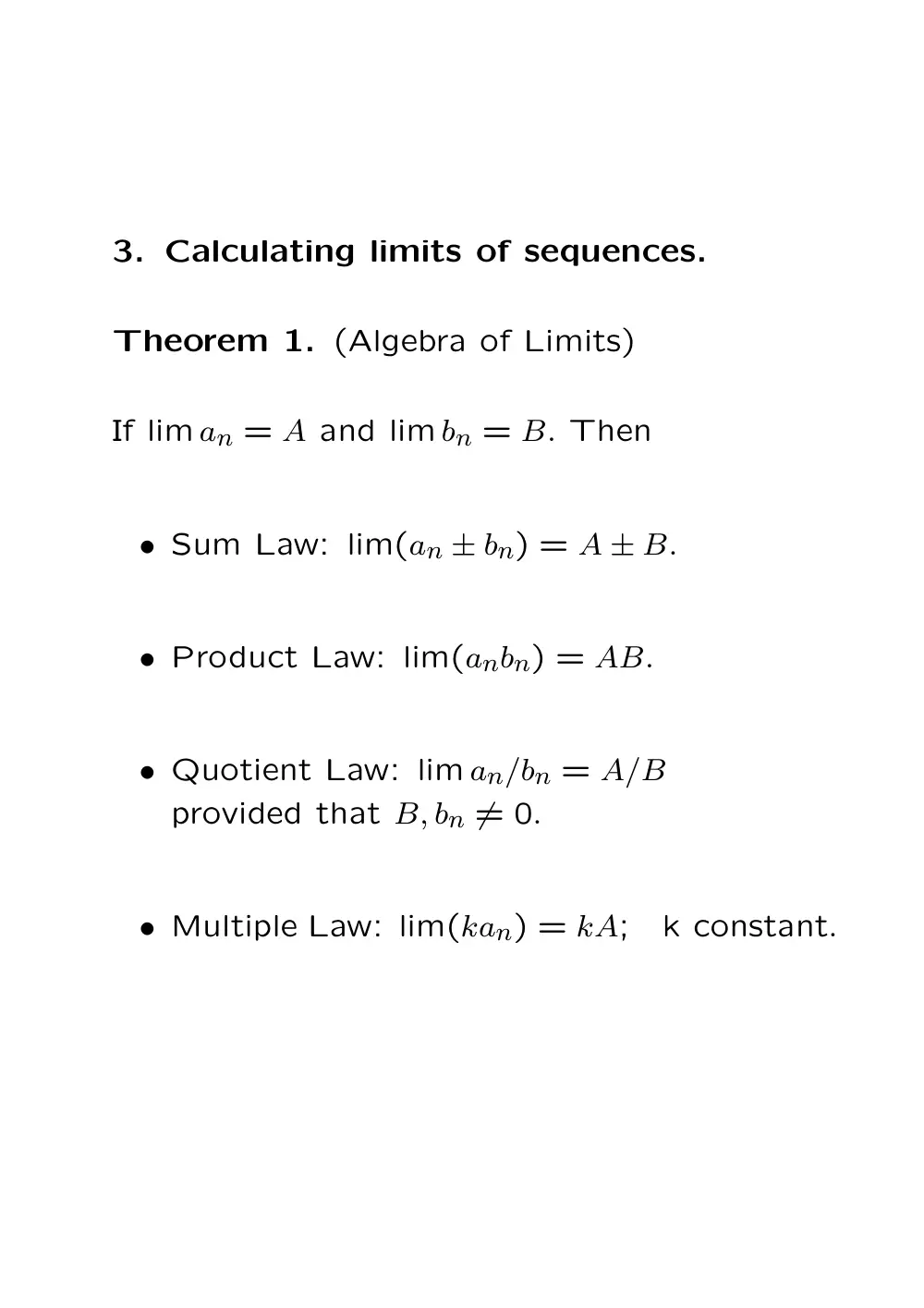
3. Calculating limits of sequences.
Theorem 1. (Algebra of Limits)
If lim an = A and lim bn = B. Then
• Sum Law: lim(an ± bn) = A ± B.
• Product Law: lim(anbn) = AB.
• Quotient Law: lim an/bn = A/B
provided that B, bn ̸= 0.
• Multiple Law: lim(kan) = kA;
k constant.
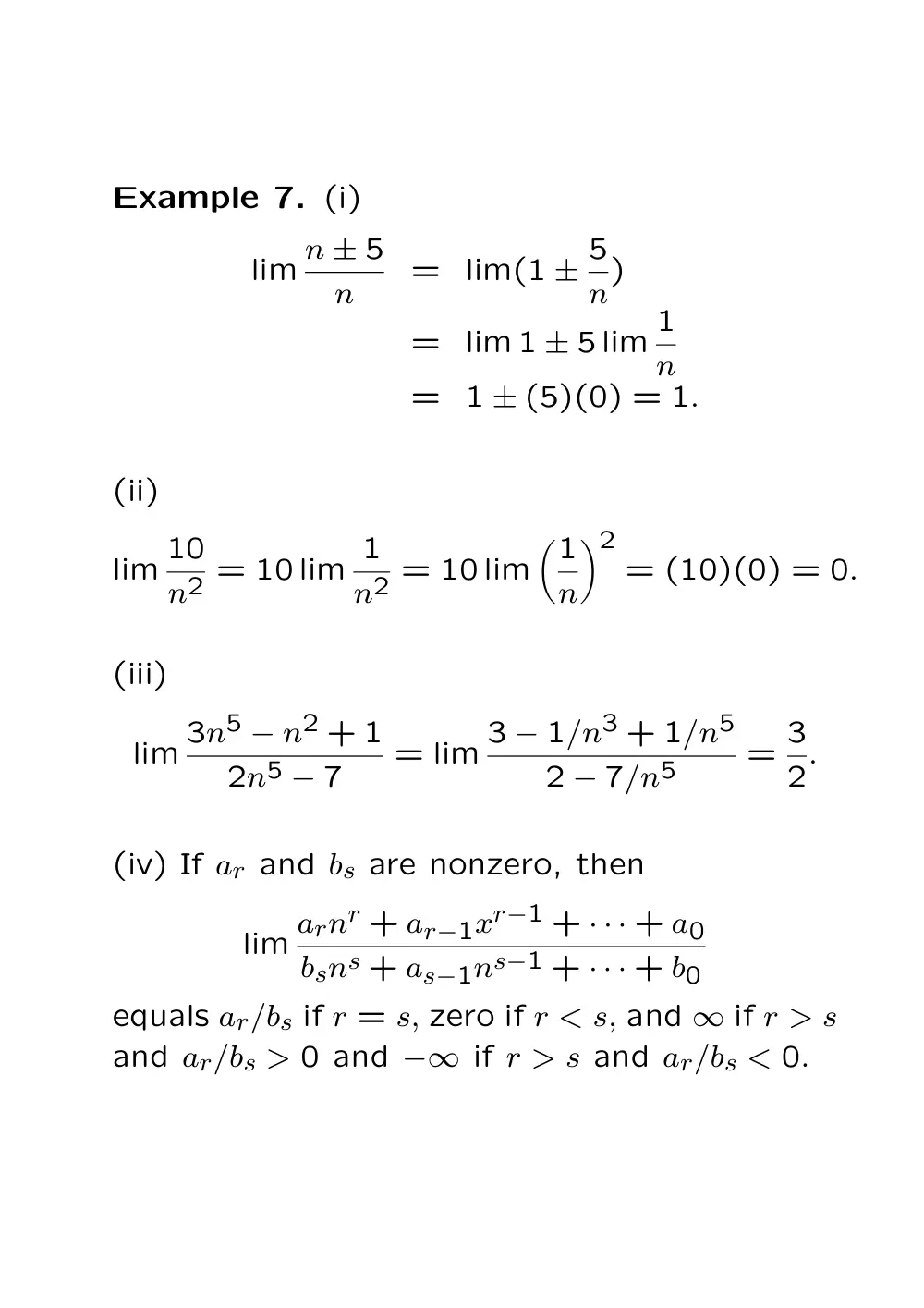
Example 7. (i)
lim n ± 5
n
=
lim(1 ± 5
n)
=
lim 1 ± 5 lim 1
n
=
1 ± (5)(0) = 1.
(ii)
lim 10
n2 = 10 lim 1
n2 = 10 lim
�1
n
�2
= (10)(0) = 0.
(iii)
lim 3n5 − n2 + 1
2n5 − 7
= lim 3 − 1/n3 + 1/n5
2 − 7/n5
= 3
2.
(iv) If ar and bs are nonzero, then
lim arnr + ar−1xr−1 + · · · + a0
bsns + as−1ns−1 + · · · + b0
equals ar/bs if r = s, zero if r < s, and ∞ if r > s
and ar/bs > 0 and −∞ if r > s and ar/bs < 0.
Theorem 2. (Sandwich Theorem)
Suppose that
(i) an ≤ bn ≤ cn for n > m, where m is a fixed
positive integer, and if
(ii) lim an = lim cn = L for some real number
L.
Then lim bn = L.
Example 8. (i)
lim cos n
n
= 0
since
����
cos n
n
���� ≤ 1
n.
(ii)
lim (−1)n
n
= 0
since
�����
(−1)n
n
����� ≤ 1
n.
(iii)
lim
�
4 + 1
n2 = 2
since
2 =
√
4
<
�
4 + 1
n2 <
�
4 + 2
n + 1
n2
=
�
(2 + 1
n)2 = 2 + 1
n
and lim 2 = lim(2 + 1/n) = 2.
Theorem 3. (Continuous Function Theorem)
Suppose that
(i) lim an = L and
(ii) f is a continuous function at L.
Then lim f(an) = f(lim an) = f(L).
Example 9. (i) lim cos(π/n) = cos(lim π/n) =
cos 0 = 1.
(ii)
lim
�
4 + 1
n2
=
�
lim(4 + 1
n2)
=
�
4 + lim 1
n2 = 2.
(iii) lim 31/n = 3lim 1/n = 30 = 1.
(iv) lim ln(n/(n + 1)) = ln[lim(n/(n + 1))] =
ln 1 = 0.
Theorem 4. ( L’Hˆopital’s rule)
Let a be a real number or ±∞. Suppose
(i) limx→a f(x) = limx→a g(x) = 0, ∞, −∞, re-
spectively, or
lim
x→a f(x) = ±∞ and
lim
x→a g(x) = ∓∞.
(ii) f and g are differentiable around a.
Then
lim
x→a
f(x)
g(x) = lim
x→a
f′(x)
g′(x)
provided that the right limit exists or is infinite.
Corollary 1. Under the assumptions of Theo-
rem 4, if
an = f(n)
g(n),
(n > m)
for some positive integer m, then
lim an = lim f(n)
g(n) = lim f′(n)
g′(n).
Example 9. (i)
lim ln n
n
=
lim
x→∞
ln x
x
=
lim
x→∞
(ln x)′
(x)′
=
lim
x→∞
1/x
1
= 0.
Hence,
lim
n→∞
ln n
n
= 0.
(1)
(ii)
lim n1/n
=
lim e(ln n)/n
=
elim(ln n)/n = e0 = 1.
Hence,
lim
n→∞ n1/n = 1.
(2)
(iii) For a fixed real number x we have:
lim
n→∞
�
1 + x
n
�n
=
lim
n→∞ en ln(1+x/n)
=
lim
n→∞ e
ln(1+x/n)
1/n
=
lim
t→∞ e
ln(1+x/t)
1/t
=
e
limt→∞
[1/(1+x/t)][−x/t2]
−1/t2
=
elimt→∞ x/(1+x/t) = ex.
Hence,
lim
n→∞
�
1 + x
n
�n
= ex.
(3)
If x = 1, then (3) gives:
lim
n→∞
�
1 + 1
n
�n
= e
(−∞ < x < ∞).
The following limits can also be shown for a
fixed real value x.
lim
n→∞ xn = 0
(|x| < 1).
(4)
lim
n→∞ x1/n = 1
(x > 0).
(5)
lim
n→∞
xn
n! = 0
(−∞ < x < ∞).
(6)
5.
Familiar limits.
The following limits are
useful for problem solving:
lim
n→∞
ln n
n
= 0.
lim
n→∞ n1/n = 1.
lim
n→∞
�
1 + x
n
�n
= ex.
lim
n→∞ xn = 0
(|x| < 1).
lim
n→∞ x1/n = 1
(x > 0).
lim
n→∞
xn
n! = 0
(−∞ < x < ∞).
6. Recursively defined sequences.
Definition 3. A sequence {an}∞
m is said to be
defined recursively if its definition consists of
(a) values of one or more terms, and
(b) a recursive formula that yields the re-
maining terms.
Example 10.
(i) The recursive definition of
the sequence in Example 4(ii) is given by the
following:
(a) a1 =
√
2;
(b) an+1 = √an for all n ≥ 1.
(ii) The sequence {an}∞
1 defined recursively by
setting
(a) a1 = 1 and
(b) an+1 = an + (−2)n for all n ≥ 1
has initial terms: 1, −1, 3, −5, 11, · · · . Note that
the sequence does not converge; for if lim an →
L, then, by using the recurrence formula (b),
L = L + lim(−2)n
which gives the false conclusion lim(−2)n = 0.
(iii) The Fibonacci sequence is defined recur-
sively by setting
(a) a1 = a2 = 1 and
(b) an+1 = an + an−1 for all n ≥ 2.
This sequence has the initial terms
1, 1, 2, 3, 5, 8, 13, · · ·
Can you find an explicit formula for an?
7. Monotone and bounded sequences.
Definition 4. A sequence {an}∞
n=m is said to
be a
(a) nondecreasing sequence if
am ≤ am+1 ≤ · · · ≤ an ≤ · · ·
or
an ≤ an+1
(n ≥ m).
(b) nonincreasing sequence if
am ≥ am+1 ≥ · · · ≥ an ≥ · · ·
or
an ≥ an+1
(n ≥ m).
(c) monotone sequence if it is either a non-
decreasing or a nonincreasing sequence.
If in (a) and (b) the inequalities were strict,
then we may say the sequence {an}∞
n=m is strictly
increasing, strictly decreasing. In this case
we may also say that the sequence is strictly
monotone.
Example 11. (i) The sequence
0.1, 0.11, · · · , 0.11 · · · 1(1 n times), · · ·
is nondecreasing (strictly increasing)
(ii) the sequence {(ln n)/n}∞
n=3 is nonincreas-
ing (strictly decreasing) since
d
dx
ln x
x
= 1 − ln x
x2
< 0
(x ≥ 3).
(iii) the sequence {⌊−n/2⌋}∞
n=1 is nonincreas-
ing since it is the sequence
−1, −1, −2, −2, −3, −3, · · · .
Definition 5. A sequence {an}∞
n=m is said to
be
(a) bounded from above if there exists a real-
value K such that
an ≤ K
(n ≥ m).
(b) bounded from below if there exists a real-
value k such that
an ≥ k
(n ≥ m).
(c) bounded if it is bounded from above and
below; i.e.
there exists a real-value M such
that
|an| ≤ M
(n ≥ m).
Moreover, the sequence {an}∞
m is said to have
an upper bound K if (a) holds, a lower bound
K if (b) holds, and a bound M if (c) holds.
Example 12.
(i) The sequence {−n2}∞
n=1 is
bounded above by zero but1 is not bounded
below.
(ii) The sequence {⌊n/3⌋}∞
n=1 is bounded be-
low by zero but is not bounded above.
(iii) The sequence {(−1)n(1−1/n)}∞
n=1 is bounded
by 1 since
|(−1)n(1 − 1/n)| = 1 − 1/n ≤ 1.
Theorem 5. (Monotone Sequence Theorem)
Every bounded monotone sequence is conver-
gent. In particular, a sequence {an} that is
(a) nondecreasing and bounded above is con-
vergent, and
(b) nonincreasing and bounded below is con-
vergent.
Example 13. (i) The sequence {tan−1 n}∞
n=1
is bounded above and nondecreasing. Hence it
is convergent; in fact, lim tan−1 n = π/2.
(ii) The sequence
{21/(2n)}∞
n=1 :
√
2,
�√
2,
��√
2, · · ·
is bounded below and nonincreasing.
Hence
it is convergent.
The conclusion can also be
obtained by observing that the sequence is a
subsequence of {21/n} which converges to 1.
CHAPTER 11: Infinite Series
§11.2 Infinite Series
Section Contents:
(1) Series and partial sums.
(2) Geometric series.
(3) n−th term test for divergence.
(4) Algebra of convergent series.
(5) General remarks.
1. Series and partial sums.
While it is possible to add two, three, hundred,
or even million real numbers, how can we at-
tach a meaning to a sum of infinitely many
numbers?
The theory of infinite series is an attempt to
answer this question.
To form an infinite series, we begin with a se-
quence
{a(n)} : a1, a2, · · · , an, · · ·
and establish the finite sums
S1
=
a1 =
1
�
k=1
ak
S2
=
a1 + a2 =
2
�
k=1
ak
...
Sn
=
a1 + a2 + · · · + an =
n
�
k=1
ak
...
This leads us to consider the “infinite sum”
∞
�
k=1
ak = a1 + a2 + · · · + an + · · ·
which we shall call infinite series.
Definition 1. An infinite series of real num-
bers, or simply an infinite series, is an expres-
sion of the form
∞
�
k=1
ak = a1 + a2 + · · · + an + · · · .
The number ak is called the k−th term of the
series. The n−th partial sum of the series is
the finite sum
n
�
k=1
ak = a1 + a2 + · · · + an.
We say the series �∞
k=1 ak converges if the
sequence {Sn} of partial sums converges. If
lim
n→∞ Sn = S,
then we say that the series �∞
k=1 ak converges
to S, or is convergent to S, and we write
S =
∞
�
k=1
ak.
On the other hand, if the sequence {Sn} di-
verges, then we say the series �∞
k=1 ak diverges,
or is divergent.
Example 1. The series
0.3 + 0.03 + · · · + 0.00 · · · 03 (k-1 zeros) + · · ·
has the following sequence of partial sums
0.3, 0.33, · · · , 0.33 · · · 33 (k threes ), · · ·
which converges to 1/3. Hence,
∞
�
k=1
3
10k = 1
3.
Example 2. The series
∞
�
k=1
1
k(k + 1) =
1
1.2+ 1
2.3+ 1
3.4+· · ·+
1
k(k + 1)+· · · ,
called a telescoping series, has partial sums
Sn =
n
�
k=1
1
k(k + 1) =
1
1.2+ 1
2.3+ 1
3.4+· · ·+
1
n(n + 1).
Observe that
1
k(k + 1) = 1
k −
1
k + 1
(k = 1, 2, · · ·)
yields
Sn
=
�1
1 − 1
2
�
+
�1
2 − 1
3
�
+
�1
3 − 1
4
�
+ · · · +
�1
n −
1
n + 1
�
.
=
1 −
1
n + 1.
Since
lim Sn = lim
�
1 −
1
n + 1
�
= 1,
the series converges to 1, or,
∞
�
k=1
1
k(k + 1) = 1.
2. Geometric series.
These are series of form
∞
�
k=1
ark−1 = a + ar + ar2 + · · · + ark−1 + · · · ,
where r is called the common ratio of the
series.
The n−the partial sum of this series is
Sn =
n
�
k=1
ark−1 = a + ar + ar2 + · · · + arn−1.
To find a compact form for Sn, consider
rSn =
n
�
k=1
= ar + ar2 + · · · + arn.
Then
(1 − r)Sn = Sn − rSn = a(1 − rn),
or
Sn = a1 − rn
1 − r
(r ̸= 1).
It follows that
lim Sn =
�
a/(1 − r)
for |r| < 1
fails to exist
for |r| ≥ 1
We conclude that the geometric series �∞
k=1 ark−1
converges for |r| < 1
and
diverges for |r| ≥ 1 and a ̸= 0.
In the case of convergence, we write
∞
�
k=1
ark−1 =
a
1 − r
for |r| < 1.
Example 3. (i)
∞
�
k=0
1
2k =
1
1 − 1/2 = 2.
(ii)
∞
�
k=1
1
10k =
1/10
1 − 1/10 = 1
9.
(iii)
∞
�
k=1
2
3k−1 =
2
1 − 1/3 = 3.
(iv) The series
∞
�
k=0
�5
4
�k
is divergent since it is a geometric series whose
common ratio is 5/4 > 1.
3. n−term test for divergence.
Theorem 1. If the series �∞
k=0 ak converges,
then lim an = 0.
Proof.
If Sn is the n−th partial sum and
�∞
k=0 ak = S, then
an = Sn − Sn−1,
and
lim an = lim Sn − lim Sn−1 = S − S = 0.
Corollary 1. If
(i) lim an fails to exist, or
(ii) lim an ̸= 0,
then the series �∞
k=0 ak diverges.
Example 4. (i) The series
∞
�
k=0
k
k + 1
diverges since lim k/(k + 1) = 1 ̸= 0.
(ii) The series
∞
�
k=1
ek
k
diverges since lim ek/k = ∞ ̸= 0.
(iii) The series
∞
�
k=1
k√
k
diverges since lim k√
k = 1 ̸= 0.
(iv) The series
∞
�
k=1
k!
10k
diverges since lim k!
10k = ∞ ̸= 0.
(v) The series
∞
�
k=1
(2k)!
2k(k!)
diverges since lim (2k)!
2k(k!) = ∞ ̸= 0.
(vi) The series �∞
k=1 k ln(1+1/k) diverges since
lim k ln(1 + 1/k) = 1 ̸= 0.
Remark 1. The convergence condition lim an =
0 for the series �∞
k=1 ak is necessary but not
sufficient. We show that the harmonic series
∞
�
k=1
1
k = 1 + 1
2 + 1
3 + · · · + 1
n + · · · ,
called the harmonic series, is divergent even
though lim 1/n = 0. To see this, we have:
S21 = S2
=
1 + 1
2 = 3
2
S22 = S4
=
S2 + 1
3 + 1
4 > S2 + 1
4 + 1
4 = 4
2
S23 = S8
=
S4 + 1
5 + 1
6 + 1
7 + 1
8
>
S4 + 1
8 + 1
8 + 1
8 + 1
8 > 5
2
...
S2n
≥
n + 2
2
for every positive integer n.
This implies that the sequence {S2n} is diver-
gent, and so is the sequence {Sn}.
4. Algebra of convergent series.
Theorem 2. Suppose �∞
k=1 ak = A and �∞
k=1 bk =
B. Then
(a) Sum Rule: �∞
k=1(ak + bk) = A + B.
(b) Difference Rule: �∞
k=1(ak − bk) = A − B.
(c) Constant Multiple Rule: �∞
k=1 cak = cA.
Example 5. (i)
∞
�
k=0
� 5
2k − 1
3k
�
=
5
(1 − 1/2) −
1
(1 − 1/3) = 17
2 .
(ii)
∞
�
k=1
�
1
k(k + 1) + 1
2k
�
= 1 +
1/2
1 − 1/2 = 2.
Theorem 3. (a) If series �∞
k=1 ak diverges and
c ̸= 0 is a constant, then �∞
k=1 cak diverges.
(b) If series �∞
k=1 ak converges and series �∞
k=1 bk
diverges, then the series �∞
k=1(ak±bk) diverges.
Remark 2. If both series �∞
k=1 ak and �∞
k=1 bk
diverge, then series �∞
k=1(ak ± bk) may con-
verge or diverge.
Example 6. The series �∞
k=0(−1)k = 1 − 1 +
1 − 1 + 1 − 1 + · · · diverges since its sequence
of partial sums 1, 0, 1, 0, 1, 0, · · · diverges. The
series �∞
k=0(1/√π)k converges since it is a geo-
metric series of common ratio 1/√π < 1. Hence
the series
∞
�
k=0
(−1)k ±
�
1
√π
�k
diverges.
5. General remarks.
(a) Re-indexing of series:
A series can be
re-indexed without any alteration as follows:
∞
�
k=m
ak =
∞
�
k=m+r
ak−r =
∞
�
k=m−r
ak+r
for any integer r.
(b) Addition and deletion of terms: Adding
or deleting a finite number of terms in a series
does not change the nature of its convergence.
That is why one need not specify the lower in-
dex of a series when comes to to decide on
its convergence. nonetheless, in case of con-
vergence adding or deleting a finite number of
terms in a series may change the sum of the
series.
Example 7.We can write
∞
�
k=0
cos kπ
5k
=
∞
�
k=3
cos(k − 3)π
5k−3
=
∞
�
k=−1
cos(k + 1)π
5k+1
.
CHAPTER 11: Infinite Series
§11.3 The integral Test
Section Contents:
(1) Series with non-negative terms.
(2) The integral test.
1. Series with non-negative terms.
Definition 1. A series
∞
�
k=1
ak = a1 + a2 + · · · + ak + · · · ,
where each ak ≥ 0 is called a series with non-
negative terms.
A series with non-negative terms �∞
k=1 ak has a
non-decreasing sequence of partial sums {Sn}:
S1 ≤ S2 ≤ · · · ≤ Sn ≤ · · · .
Thus the series converges if and only if the
sequence {Sn} is bounded above, i.e.
Sn ≤ M
(n ≥ 1)
for some value M.
1. The integral test. Suppose
(a) f is continuous real function on an interval
[N, ∞), where N > 0.
(b) f(x) ≥ 0 for all x ≥ N.
(c) f is non-increasing on [N, ∞).
(d) an = f(n) for all n ≥ N.
Then
∞
�
k=1
ak converges ⇔
� ∞
N f(x) dx converges.
Sketch of proof. Textbook: Figure 8.13.
2. Harmonic and p−series
The series
∞
�
k=1
1
kp = 1
1p + 1
2p + · · · + 1
kp + · · · ,
where p is a fixed real, is called a p−series. If
p = 1, the series becomes
∞
�
k=1
1
k = 1
1 + 1
2 + · · · + 1
k + · · ·
which is known as the harmonic series.
Theorem 1. (The p−series test)
∞
�
k=1
1
kp
�
converges
for p > 1
diverges
for p ≤ 1
Example 1. The p−series
∞
�
k=1
1
k2 and
∞
�
k=1
1
k3/2
converge since 2, 3/2 > 1, and the series
∞
�
k=1
1
k,
∞
�
k=1
1
√
k
and
∞
�
k=1
1
ke/π
diverge since 1, 1/2, e/π ≤ 1.
Proof of Theorem 1. We consider two cases:
1. p ≤ 0. In this case,
lim
k→∞
1
kp = lim
k→∞ k−p =
�
1
if p = 0
∞
for p < 0
and the p−series diverges.
2. p > 0. In this case the function
f(x) = 1
xp
(x ≥ 1),
satisfies the conditions (a), · · · , (d) of the inte-
gral test.
Consider the improper integral
� ∞
1
1
xp dx.
We consider three cases:
(a) p = 1. In this case the integral becomes
� ∞
1
1
x dx = lim
t→∞
� t
1
1
x dx = lim
t→∞ ln t = ∞,
and the harmonic series diverges.
(b) 0 < p < 1. In this case the integral becomes
� ∞
1
1
xpdx = lim
t→∞
� t
1
1
xpdx
= lim
t→∞
�
x1−p
1 − p
�t
1
=
1
1 − p lim
t→∞
�
t1−p − 1
�
= ∞,
and the p−series (harmonic series) diverges.
(c) p > 1. In this case and in view of (b) we
have:
� ∞
1
1
xp dx
=
1
p − 1 lim
t→∞
�
1 −
1
tp−1
�
=
1
p − 1,
and the p−series converges.
CHAPTER 11: Infinite Series
§11.4 Comparison Tests
Theorem 1.
(The Direct comparison test)
Suppose
0 ≤ ak ≤ bk
(k ≥ 1).
(a) � bk converges ⇒ � ak converges.
(b) � ak diverges ⇒ � bk diverges.
Sketch of Proof. Let
Sn = a1+a2+· · ·+an and Tn = b1+b2+· · ·+bn.
(a) �∞
1 bk converges ⇒ Sn ≤ Tn ≤ M for some M.
This proves (a).
(b) �∞
1 ak diverges ⇒ Tn ≥ Sn → ∞ as n → ∞.
This proves (b).
Example 1.
(i) The series �∞
1 1/(2k3 + 1)
converges since
1
2k3 + 1 ≤ 1
k3
(k ≥ 1)
and since the p−series �∞
1 1/k3 converges.
(ii) The series �∞
1 1/(3k − 2) diverges since
1
3k − 2 > 1
3k
(k ≥ 1)
and since the harmonic series diverges.
(iii) The series
∞
�
1
k3
k5 + 5k4 + 7
converges since
k3
k5 + 5k4 + 7 < k3
k5 = 1
k2
and since the p−series �∞
1 1/k2 converges.
(iv) The series �∞
1 1/ ln(k + 1) diverges since
1
ln(k + 1) > 1
k
(k ≥ 3)
and since the harmonic series diverges.
Theorem 2. (The limit comparison test)
Suppose the series
�
ak and
�
bk where ak ≥ 0 and bk > 0.
Then
(a) lim ak/bk = L > 0 ⇒ both series converge
or both series diverge.
(b) lim ak/bk = 0
and � bk
converges ⇒ � ak
converges.
(c) lim ak/bk = ∞ and � ak converges ⇒ � bk
converges.
(d) lim ak/bk = ∞
and � bk
diverges ⇒ � ak
diverges.
Example 2. (i) The series
∞
�
1
3n3 − 2n2 + n
n4 + 1
diverges since
lim (3n3 − 2n2 + n)/(n4 + 1)
1/n
= 3 > 0
and the harmonic series diverges.
(ii) The series �∞
1 sin(π/k) diverges since
lim sin(π/k)/(1/k) = π lim sin(π/k)/(π/k) = π > 0
and the harmonic series diverges.
(iii) The series
∞
�
1
5
√
k + 100
2k3√
k + 9
√
k
converges since
(5
√
k + 100)/(2k3√
k + 9
√
k)
1/k3
= 5
2 > 0
and the p−series �∞
1 1/k3 converges.
(iv) The series
∞
�
1
ln(1 + 1/k)
k
converges since
lim (ln(1 + 1/k))/k
1/k2
= lim ln(1 + 1/k)
1/k
= lim
x→0
ln(1 + x)
x
= lim
x→0
[ln(1 + x)]′
(x)′
= 1
and the p−series �∞
1 1/k2 converges.
CHAPTER 11: Infinite Series
§11.5 The Ratio and Root Tests Tests
Section Contents:
(1) Ratio Test.
(ii) Root Test.
1. Ratio test
Theorem 1. (The ratio test)
Suppose the series �∞
1 ak satisfies ak > 0 for
all k ≥ 1, and suppose
lim ak+1
ak
= L (possibly ∞.)
Then
(a) L < 1 ⇒ �∞
1 ak converges.
(b) L > 1 ⇒ �∞
1 ak diverges.
(c) L = 1 ⇒ �∞
1 ak is undecided.
Example 1. (i) The series �∞
1 1/k! converges
since
lim 1/(k + 1)!
1/k!
= lim
1
k + 1 = 0 < 1.
(ii) The series �∞
1 k3/10k converges since
lim (k + 1)3/10k+1
k3/10k
= 1
10
�
lim k + 1
k
�3
= 1
10 < 1.
(iii) The series �∞
1 (2k)!/(k!)2 diverges since
(2k + 2)!/[(k + 1)!]2
(2k)!/[(k)!]2
= lim 4k + 2
k + 1 = 4 > 1.
(iv) The series �∞
1 kk/k! diverges since
lim (k + 1)k+1/(k + 1)!
kk/k!
= lim
�k + 1
k
�k
= e > 1.
1. Root test
Theorem 2. (The root test)
Suppose the series �∞
1 ak satisfies ak ≥ 0 for
all k ≥ 1, and suppose
lim k√ak = L (possibly ∞.)
Then
(a) L < 1 ⇒ �∞
1 ak converges.
(b) L > 1 ⇒ �∞
1 ak diverges.
(c) L = 1 ⇒ �∞
1 ak is undecided.
Example 2. (i) The series �∞
2 1/(ln k)k con-
verges since
lim
k�
1/(ln k)k = lim 1
ln k = 0 < 1.
(ii) The series �∞
1 2k/k3 diverges since
lim
k�
2k/k3 = 2 lim
�
1
k√
k
�3
= 2 > 1.
(iii) The root test fails with the series �∞
1 (1 −
1/k)k since
lim
k�
(1 − 1/k)k = lim(1 − 1/k) = 1.
However, the series diverges by the k−th term
test since
lim(1 − 1/k)k = 1/e ̸= 0.