
MECH 430 Midterm, Summer 2009
American University of Beirut · Instrumentation and Measurements · 3 pages
More MECH 430 files
Show the text of this exam
AMERICAN UNIVERSITY OF BEIRUT
MECH 430 Instrumentation & Measurements
Exam1 – April 22nd , 2009
Time Allowed: 2 hours
Two parts:
Part 1: Closed Book
Part 2: Cheat sheet allowed as well as a calculator.
Test Rules
•
Test period = 120 minutes.
•
Explain everything in order for me to give you part marks
•
If you are stuck on a part SKIP it and then come back later.
•
Sharing calculators is not allowed.
IMPORTANT: Write your name on this question booklet and hand it in with your script
book.
Name: ………………………………………………
Student Number: ………………………………….
MECH 430 Instrumentation & Measurements – Midterm (Spring 2009)
Part 1 (40 marks) (comprehensive) NO CHEAT SHEET here.
1) Discuss how a systematic uncertainty can be estimated for a measured value. How is random
uncertainty estimated? What is the difference in the terms error and uncertainty?
2) Describe how a computer mouse (ball-type) operates? What is the physical principal upon
which these sensors are based?
3) Describe with the aid of sketch what is the Hall-effect. What sensors did you see in your notes
that use this effect?
4) What are the different type of sensors you learned that can be used as range sensors? Choose
two of them and describe them in detail. Also discuss the physical principal upon which these
two sensors are based.
5) Present four examples of pressure sensors. Explain 2 of them in detail and explain the physical
principle upon which they are based?
6) Explain what is a load cell and what it is used for.
7) What is the difference between a thermocouple and a thermistor? Explain each of them and
draw them.
8) What is a Pitot tube used for? Present its relevant equation.
9) What is an LDR? Explain.
10) With the aid of graphs describe what are sensitivity, drift, gain, FSO, FS, precision, accuracy,
threshold, and resolution? What is meant by an 8bit resolution?
11) What is meant by impedance? Input and output impedance? impedance matching? Should a
force sensor have high or low input impedance? Explain.
12) Explain one of the DC problems of an op-amp and how do we remedy it.
Part II – Solving (60%) You may use a cheat sheet here.
Problem 1 (20 marks)
For a thin-walled pressure vessel of Diameter D, and wall thickness, t, subjected to an internal
pressure, p, the tangential stress is given by σ = pD / 2t
t
. During one test, 10 meausurements of
pressure yielded a mean of 8610 lb/ft2 with a standard deviation of 273.1/ Cylinder dimensions are
to be based on a set of 10 measurements which yielded:
D = 6.2in, SD = 0.18 and t = 0.22in., S = 0.04
Determine the best estimate of stress. Pressure measurements and dimensions have a systematic
uncertainty of 1% of the reading.
Problem 2 (20 marks)
The area of a flat, rectangular parcel of land is computed from the measurement of the length of two
adjacent sides, X and Y. Measurements are made using a scaled chain accurate to within 0.5% over
its indicated length. The two sides are measured several times with the following results:
X = 556m Y = 222m
Sx = 5.3m Sy = 2.1m
ν = 8 ν = 7
Estimate the area of the land and state the confidence interval of that measurement at 95%.
MECH 430 Instrumentation & Measurements – Midterm (Spring 2009)
Problem 3 (20 marks)
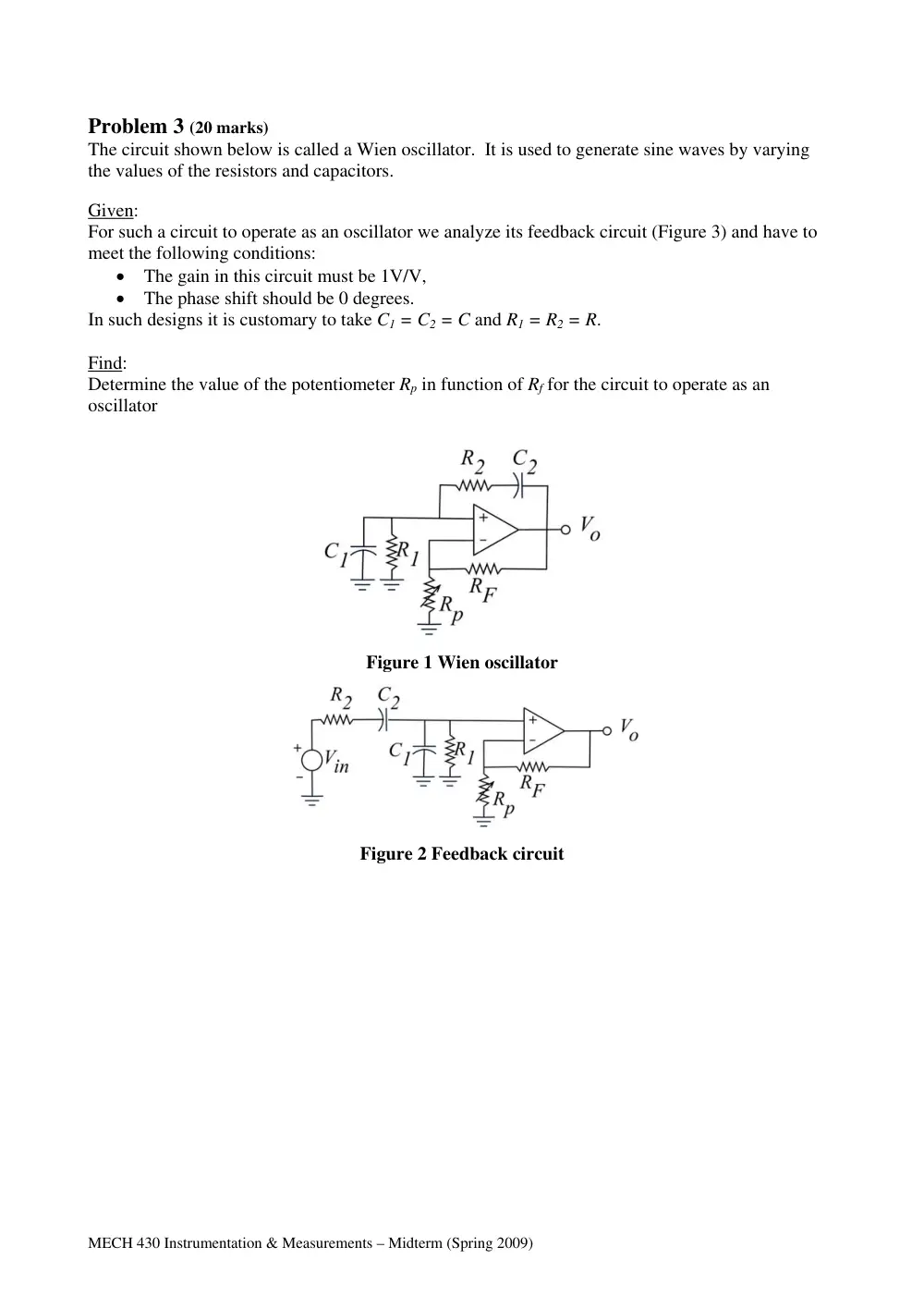
The circuit shown below is called a Wien oscillator. It is used to generate sine waves by varying
the values of the resistors and capacitors.
Given:
For such a circuit to operate as an oscillator we analyze its feedback circuit (Figure 3) and have to
meet the following conditions:
• The gain in this circuit must be 1V/V,
• The phase shift should be 0 degrees.
In such designs it is customary to take C1 = C2 = C and R1 = R2 = R.
Find:
Determine the value of the potentiometer Rp in function of Rf for the circuit to operate as an
oscillator
Figure 1 Wien oscillator
Figure 2 Feedback circuit
MECH 430 Instrumentation & Measurements – Midterm (Spring 2009)