
MECH 430 Final, Spring 2015
American University of Beirut · Instrumentation and Measurements · 17 pages
Showing the first 10 of 17 pages. Download the PDF to see all of it.
More MECH 430 files
Show the text of this final exam
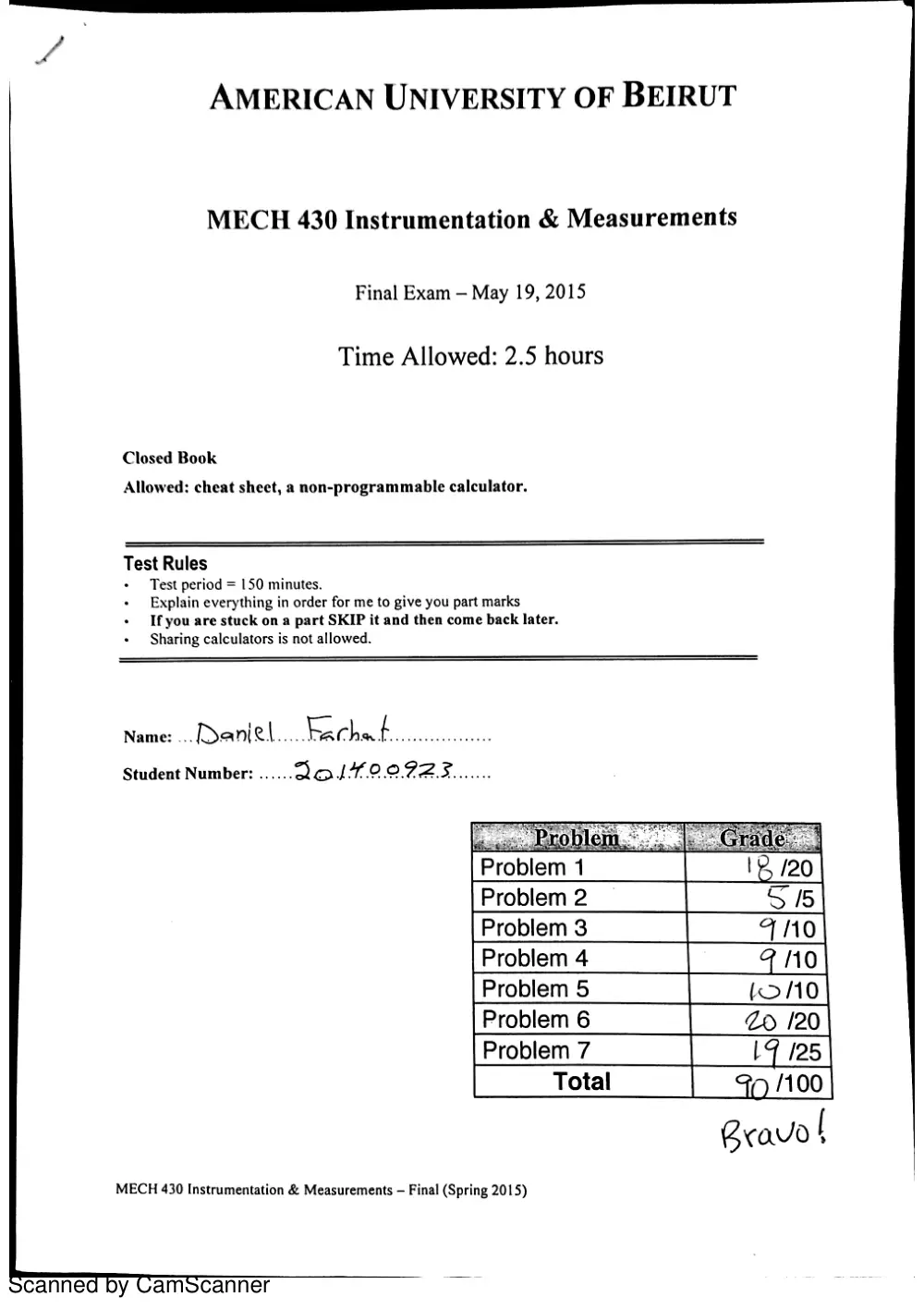
AMERICAN UNIVERSITY OF BEIRUT
MECH 430 Instrumentation & Measurements
Final Exam — May 19, 2015
Time Allowed: 2.5 hours
Closed Book
Allowed: cheat sheet, a non-programmable calculator.
Test Rules
Test period = 150 minutes.
Explain everything in order for me to give you part marks
If you are stuck on a part SKIP it and then come back later.
Sharing calculators is not allowed.
Name: Daniel... Kachahonccccccce
Student Number: ...... DoILO9C7%Z.S.......
eae Lee
Problem 1
Problem 2
Problem 3
Problem 4
Problem 5
Problem 6
Problem 7
Total
MECH 430 Instrumentation & Measurements — Final (Spring 2015)
Problour time rou Wind ote
HEMET eI ED peal
VY Nowe tae apyatig atin Kor tho op aap atten than WHT atin
an P y Nera thes ae ign |,
\)\ i’ Wer veg! a,
SY WAY hee ot tine ae CPO AHAR Taper Tange!
\\\ . mi rn ree vanel oul owt vay ll lee
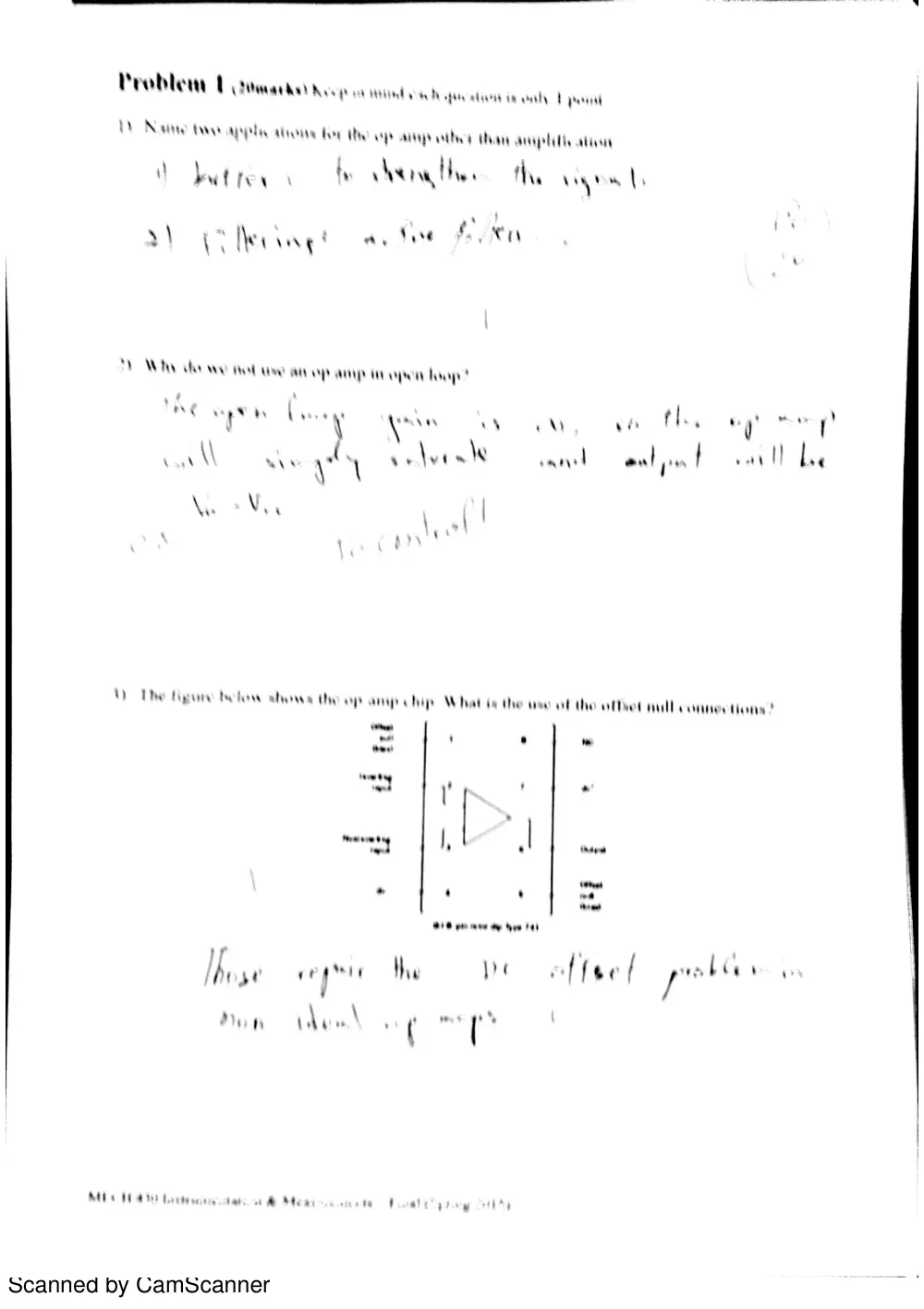
VD Tie Figsuiiw Dacha athcrvan he OPP CH What Ge the dae ot the offer null cannes tote?
sn
mer ‘ J Ls
ee
ewe
io \' ’ *.
meraty | |, td
Steet
o ‘ ' CI
ho
O10 pee ree te ew Fat
hose eegiste Wha \ye olfee! pines ‘
Micthaty Wee ctat ow & Mea ‘ ia ' ‘
Scanned by CamScanner
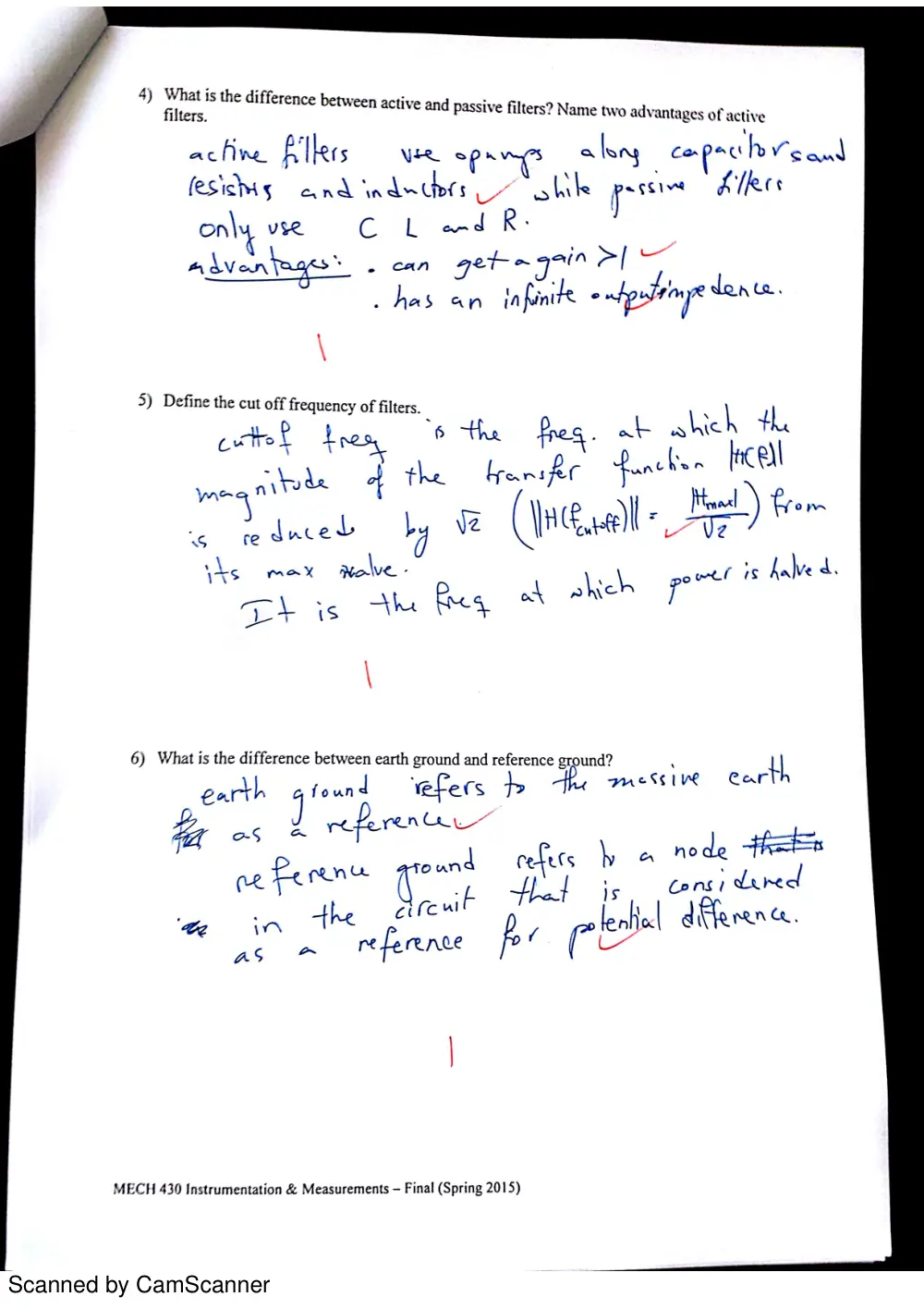
4) What is the difference between
active and passive filters? Name two advantages of active
filters.
‘ Fr . ‘hv \
achive Pilkers VR ape “t a lon a | ¢ Seu
fesichs and ww ds ths Uv hike ‘a ike
only vse C L awd R-
a ven tages’ - can geben goin Pl il
. has an infinite = ahpslringe anes.
\
\
5) Define the cut off frequency of filters.
ewttes - 6 the freq.
avrvde the
—_
"S re “
As max nol
oh ie OM "te =
\
\
3
6) What is the difference between earth ground and reference ne J ; - mae {|
MECH 430 Instrumentation & Measurements — Final (Spring 2015)
Scanned by CamScanner
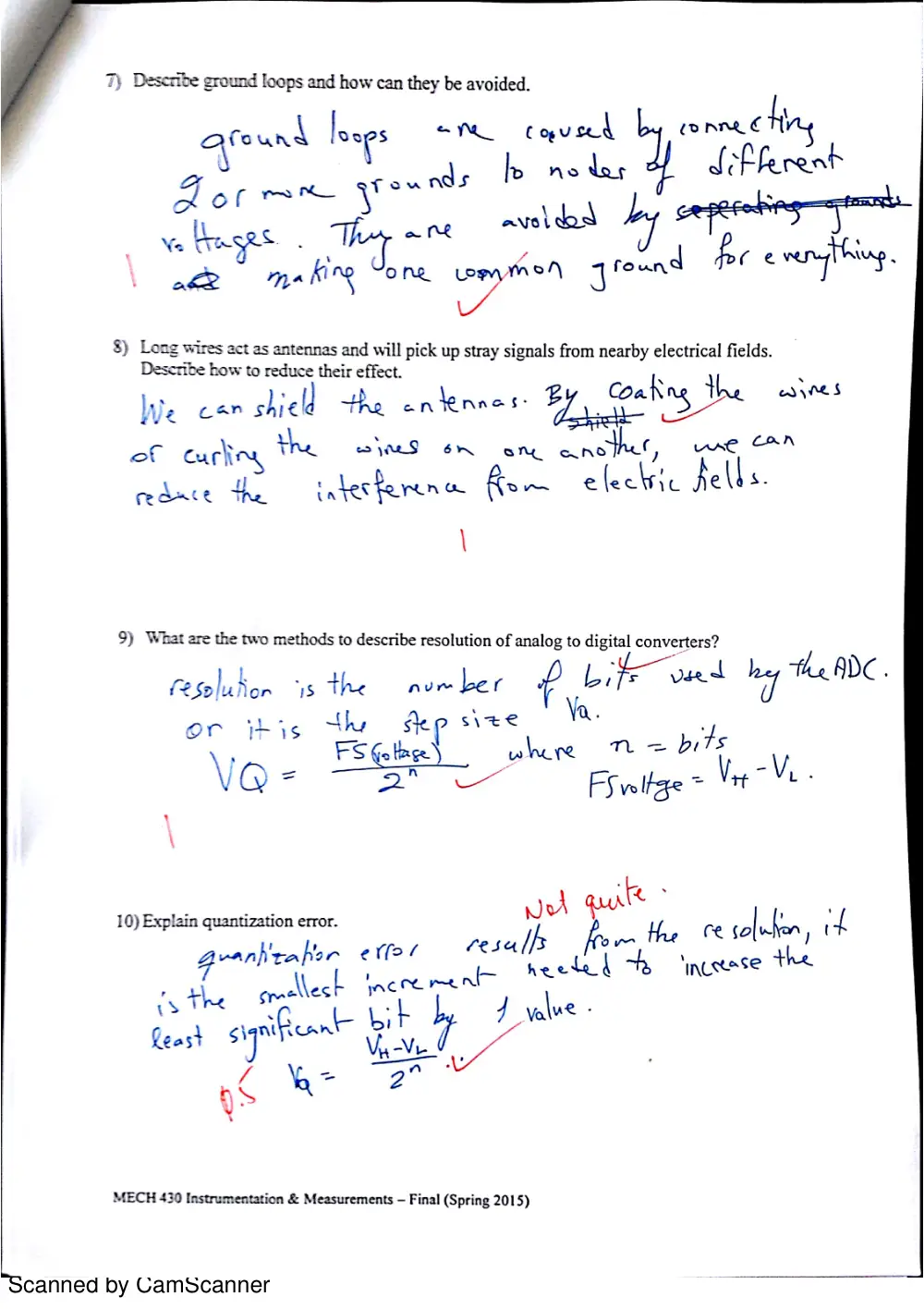
7} Describe ground loops and how can they be avoided.
teu loogs a he Cop sed ronne cH
, a pounds lp no los prcalarn
7 - ane ee oe
28
$) Long wires act as antennas and will pick up stray signals from ol electrical fields.
Describe how to reduce their effect.
an yrs
} fx c shiel the enttnncs-: 2 Coak wy
ay
§ ‘i CON
of carling | the shed oy SA QANo 7.
4 ter be pen & Row wiecke Fk
re Be Tha
\
9) What are the two methods to describe resolution of analog to digital converters?
fe 50] \ 1S the nue ber Le toed hag the ADC.
Ullor \
or itis 7 sep site os
— bts
. Fee) lure TET
VQ = ly a FS volte ~ Vit VL .
greellest | ye ee
>t cn bit 4 4 value -
Reast sigh Vy-Ve
= A
yo Ro?
MECH 430 Instrumentation & Measurements — Final (Spring 2015)
“Scanned by CamScanner
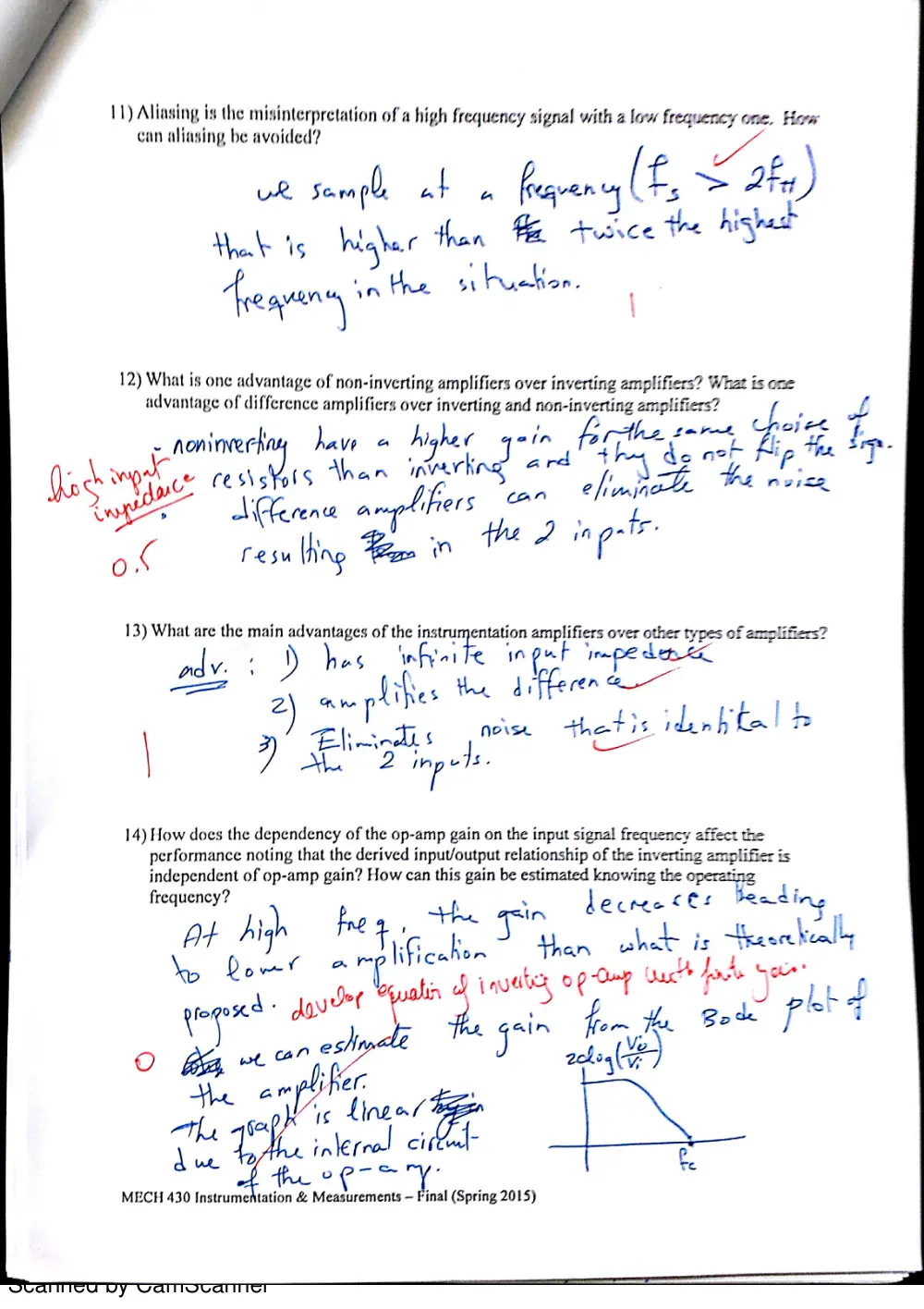
11) Aliasing is the misinterpretation of a high frequency signal with alow frequency one. Hav
can aliasing be avoided? a
[£ : F )
5
U5: +h, hished
Myo. ‘5 Wqhe than Fe, runce He WY
Freaaen ") ‘a Pre $1 i ushion.
12) What is one advantage of non-inverting amplifiers over inverting amplifiers? What is one
advantage of difference amplifiers over inverting and non-inverting amplifiers? if .
' ro [eo haar as at
_rovineehny Dear = hes rin Petes Toh in he
Yr 4 ‘
© es\sfolS Ahan os \ te noioQ
> Aerene anaplihers can . chai
m4 resulting oe fhe J ingl
13) What are the main advantages atthe instrumentation amplifiers over other types of amplifiers?
lye ) bes eheike in(ah mpedenex
14) How does the dependency of the op-amp gain on the input signal frequency affect the
performance noting that the derived inpuvoutput relationship of the inverting amplifier is
independent of op-amp gain? How can this gain be estimated knowing the operating
frequency? decree Cs Beading
At high fre ty, ct ise 7 than whet . Hevackicly
oe deer arp
f { *
L oe et ae
dd iquater 09 Onp uct” ps
Al (Ta) » 4 v b
re dovet * the gain fo Ke end f
of oo
eee She aN
MECH 430 Instrumentation & Ps i F ha (Spring 2015)
O
Rh
f
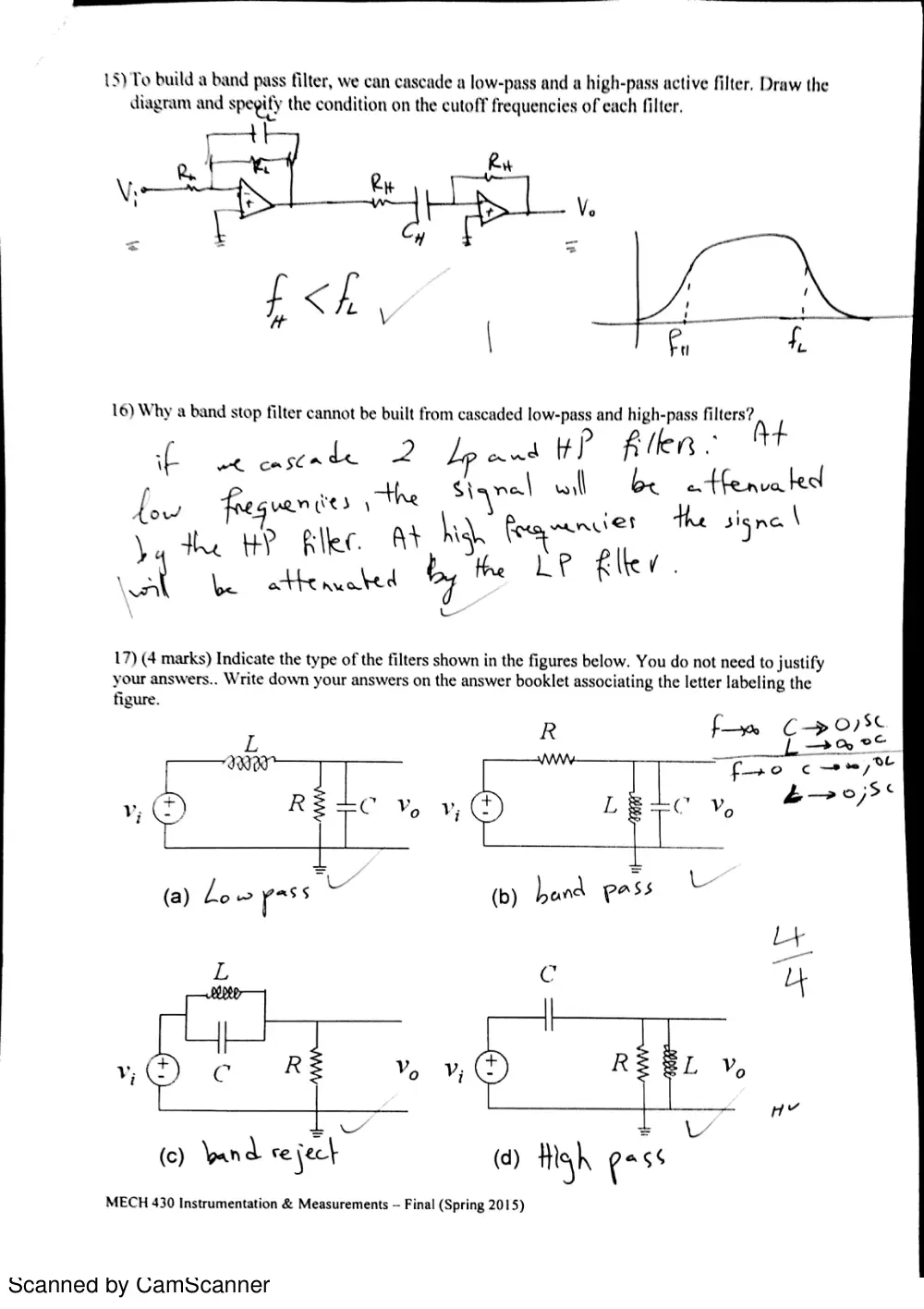
1S) To build a band pass filter, we can cascade a low-pass and a high-pass active filter, Draw the
diagram and spegity the condition on the cutoff frequencies of cach filter.
4.
16) Why a band stop filter cannot be built from cascaded low-pass and high-pass filters?
(ce cnsende 2 Lpond tt? fillen- _
tow foeguan t's the Siqnel wil be a tlenva
nue the 3! we, \
the HP filles. At hy. Frgmsnes! :
- OY tel bby fhe LY fle
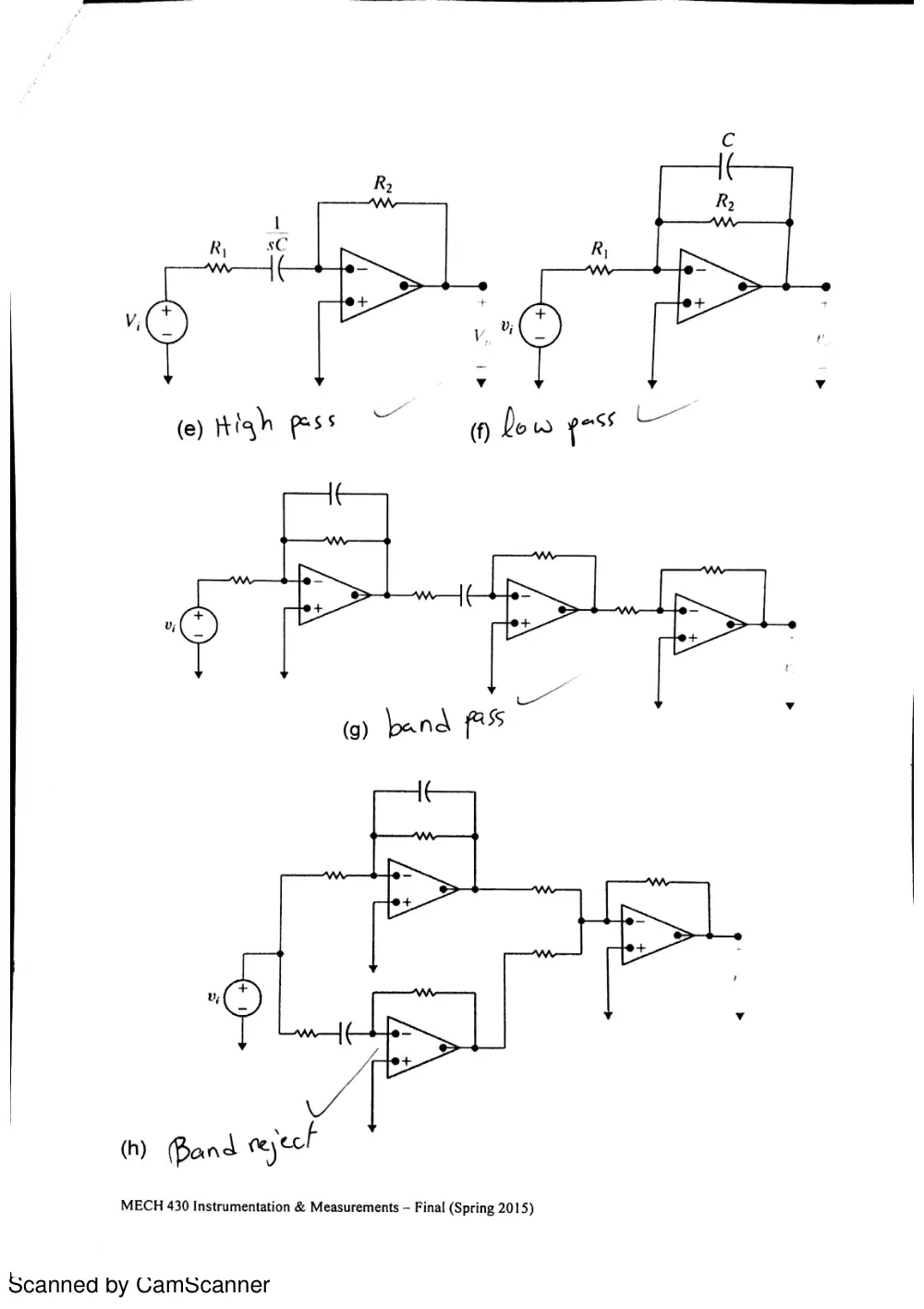
17) (4 marks) Indicate the type of the filters shown in the figures below. You do not need to justify
your answers.. Write down your answers on the answer booklet associating the letter labeling the
figure. $
0 Cp OSC
“ i [ace
WW “f° c ete Ol
> L Loy, £— oj>6
T —
y L
nyv
ey)
»
tt_-—Wwvs—_
tN
<
°
(d) Hy h poss
MECH 430 Instrumentation & Measurements — Final (Spring 2015)
Scanned by CamScanner
MECH 430 Instrumentation & Measurements — Final (Spring 2015)
Scanned by CamScanner
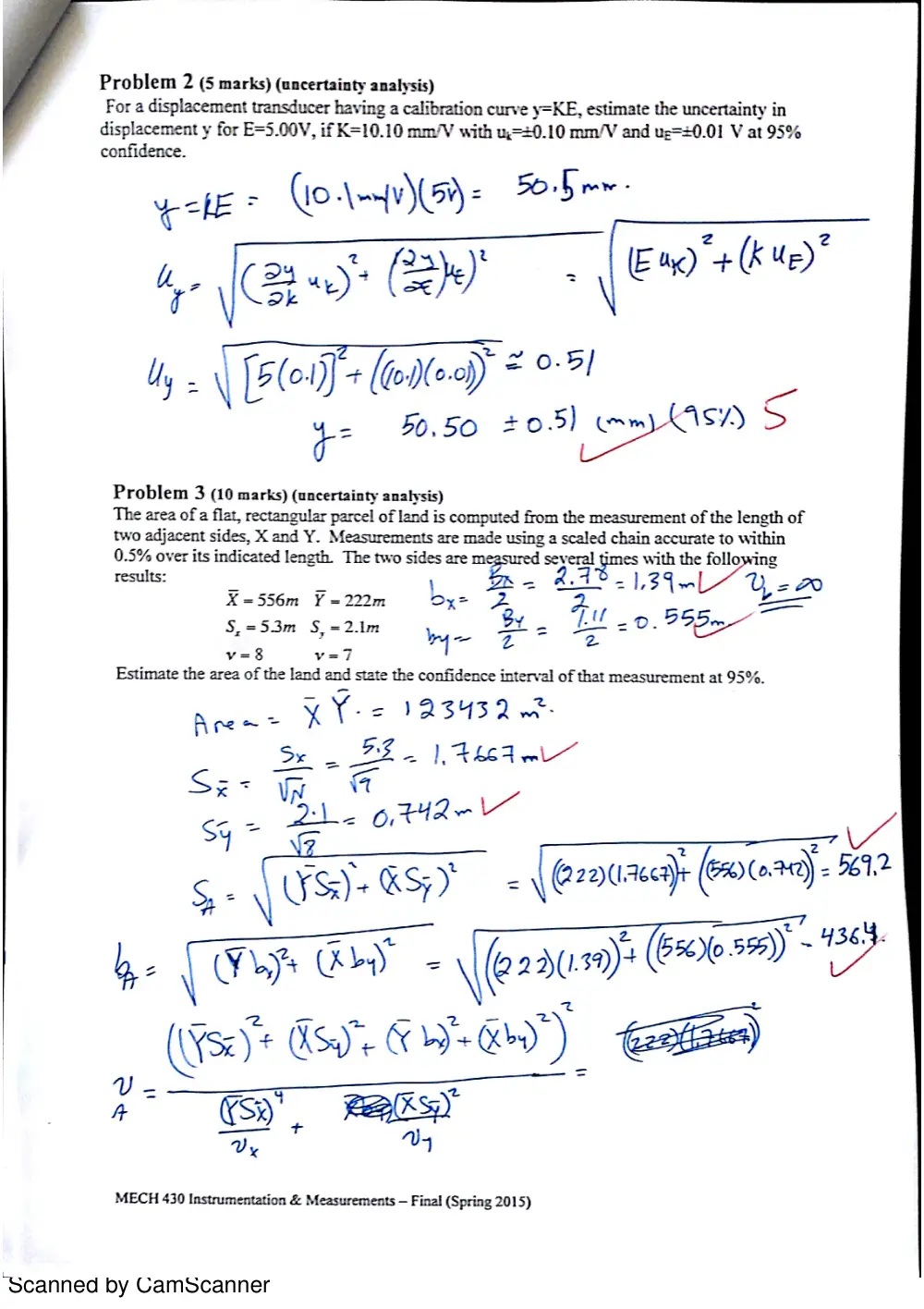
Problem 2 (5 marks) (uncertainty analysis)
For a displacement transducer having a calibration curve y=KE, estimate the uncertainty in
displacement y for E=5.00V, if K=10.10 mm/V with u.=+0.10 mm/V and uz=20.01 V at 95%
confidence.
pete” (OLN: Fe
iy (By BY
ts a ANN ae
Uy . \| [lol + + ((oo-0)) = 7!
+95) wmpAsy 5
+ 50.50 20. a
Problem 3 (10 marks) (uncertainty analysis)
The area of a flat, rectangular parcel of land is computed from the measurement of the length of
two adjacent sides, X and Y. Measurements are made using a scaled chain accurate to within
0.5% over its indicated length. The two sides are megsured 3 wale es with the following
= 1L34— War,
results: \ En
X=556m Y=222m dy> 2 a
5,=53m S,-2im By Lt =D. B55
a ry
v=8 v=7
Estimate the area of the land and state the confidence interval of that measurement at 95%.
~ XY-= 123432 wr:
c= >
S. . “S.. eto
<s
: : Vz z —— ts
CYS: KS) = NGG (C020) = 569.2
“\\
b- Te cy -\(@x30) 6 («6 3B) ~ a 363.
(\\se)* AS) e & GY) CEE
Gy, ES
Vy V5
V =
4
MECH 430 Instrumentation & Measurements — Final (Spring 2015)
“Scanned by CamScanner
« _— x 4
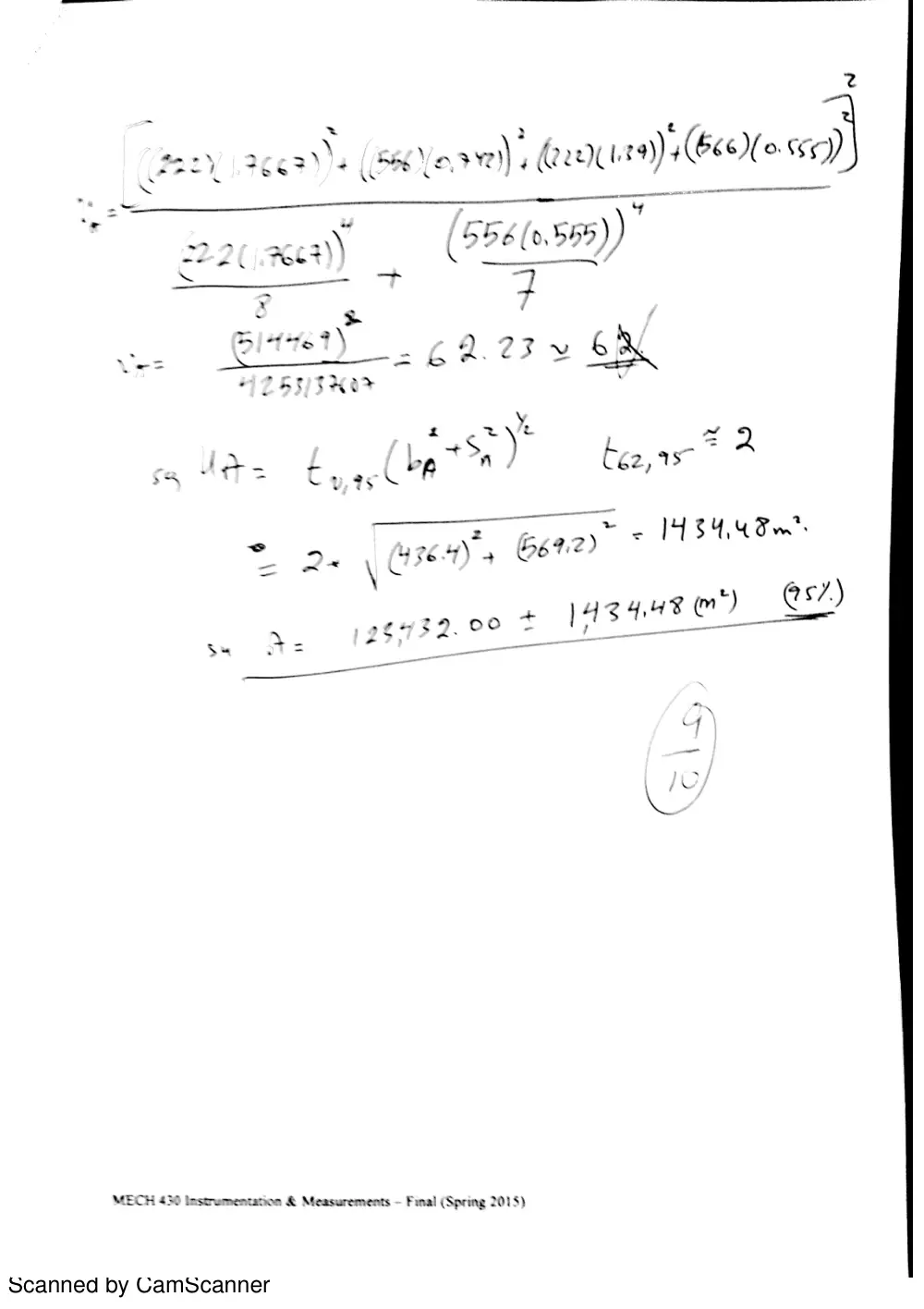
. os ean 556 (0,555) )
5 efor 7 )\ oa) 22 -
= Ss HO —
“7h Tho
Vy
z ~tye
, 4s")
: re L vp "
o c= Cpe
——
osu), &
a a Ln eg 47) 2 67:
MECH 430 Instrumentation & Measurements — Final (Spring 2015)
scanned by CamScanner
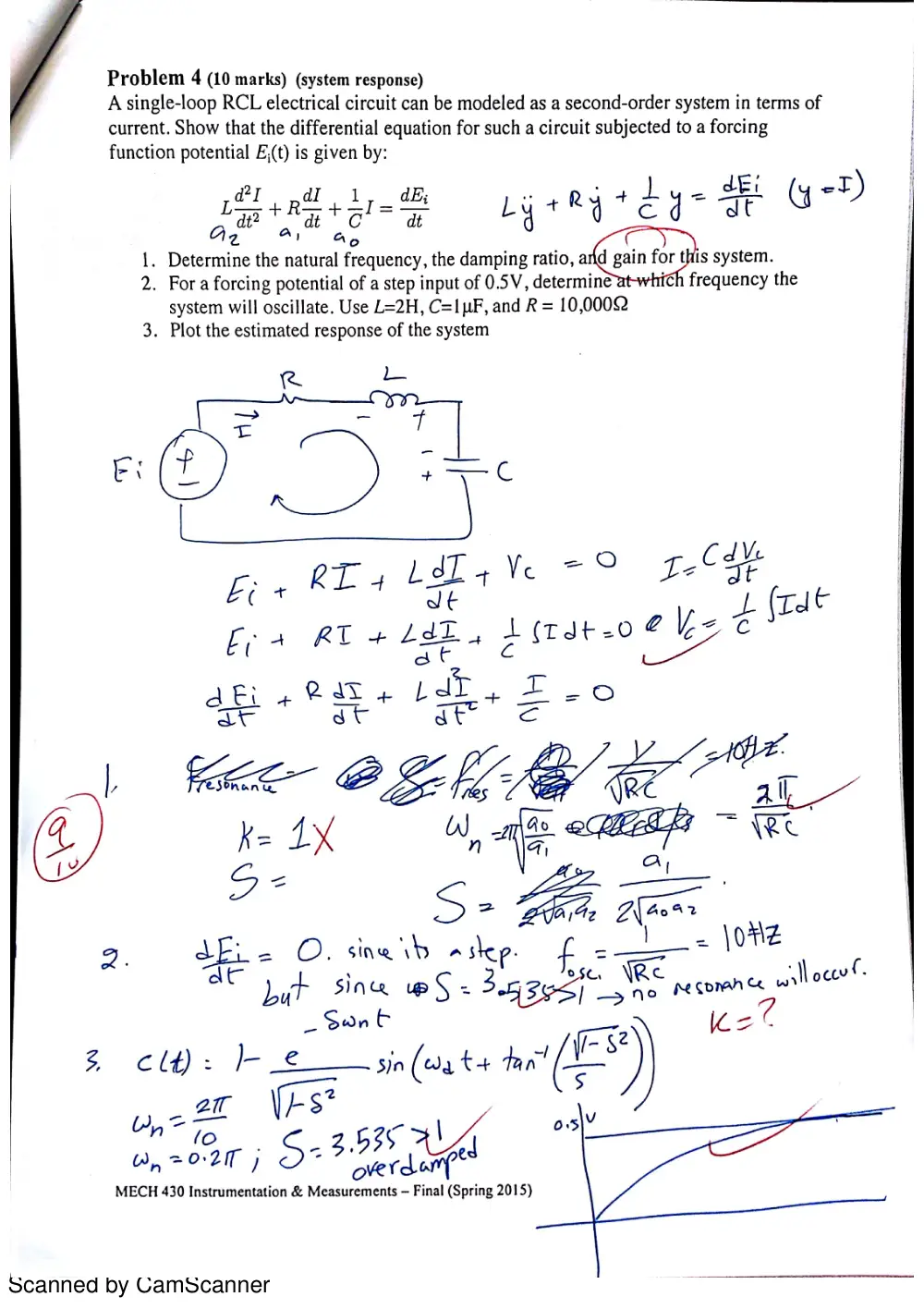
Problem 4 (10 marks) (system response)
A single-loop RCL electrical circuit can be modeled as a second-order system in terms of
current. Show that the differential equation for such a circuit subjected to a forcing
function potential E;(t) is given by:
@I dl 1, dB R +h = Bee (yD
Lip thatol =a Lut ‘ cia
4) 2 a, Ao
1. Determine the natural frequency, the damping ratio, a to. gain for this system.
2. For a forcing potential of a step input of 0.5V, determine-at-whi
Ch frequency the
system will oscillate. Use L=2H, C=IpF, and R = 10,0002
3. Plot the estimated response of the system
dt L (tae
pa = ot@ket
Ey 4 Pi. b Ee 3 gp eae Dh
abi 4 @ate LAT, TL
at dv at a
LY Ge At
D> HA aa \ore
2. AE = O. sine ih aslep. "
ac LiF Since up S = abe fans i wall ocer"
_~ Sant mid
% 6cl4): fein we)
=
S
=. OMT j S. 35 AA
MECH 430 Instrumentation & Measurements — Final (Spring 2015)
Scanned by CamScanner