
MECH 430 Notes 3, Spring 2014
American University of Beirut · Instrumentation and Measurements · 11 pages

Showing the first 10 of 11 pages. Download the PDF to see all of it.
More MECH 430 files
Show the text of this notes
Instrumentation & Measurements
MECH 430
MECH 430
Slide 1
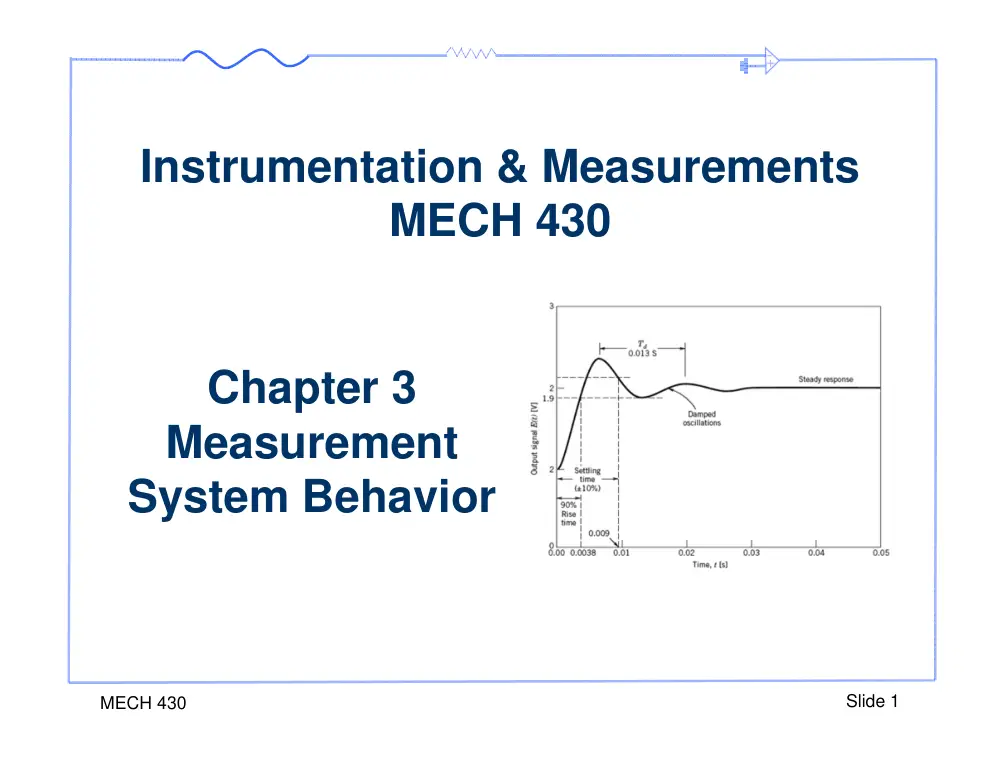
Chapter 3
Measurement
System Behavior
3.1 Introduction
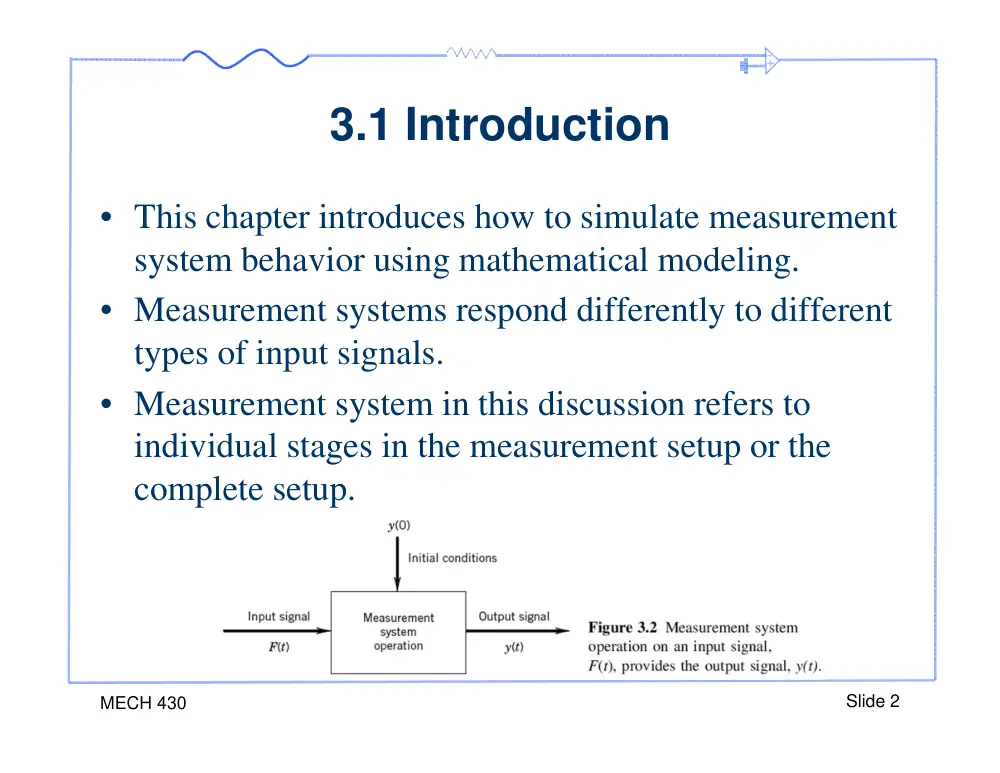
• This chapter introduces how to simulate measurement
system behavior using mathematical modeling.
• Measurement systems respond differently to different
types of input signals.
• Measurement system in this discussion refers to
individual stages in the measurement setup or the
complete setup.
MECH 430
Slide 2
3.3 Sensor Models
• Systems can be modeled using differential equations.
• The behavior of sensors can described as
– Zero-order model
– First-order model
– Second-order model
• Higher order sensors are usually approximated by one
of the models shown above
MECH 430
Slide 3
Zero Order Sensors
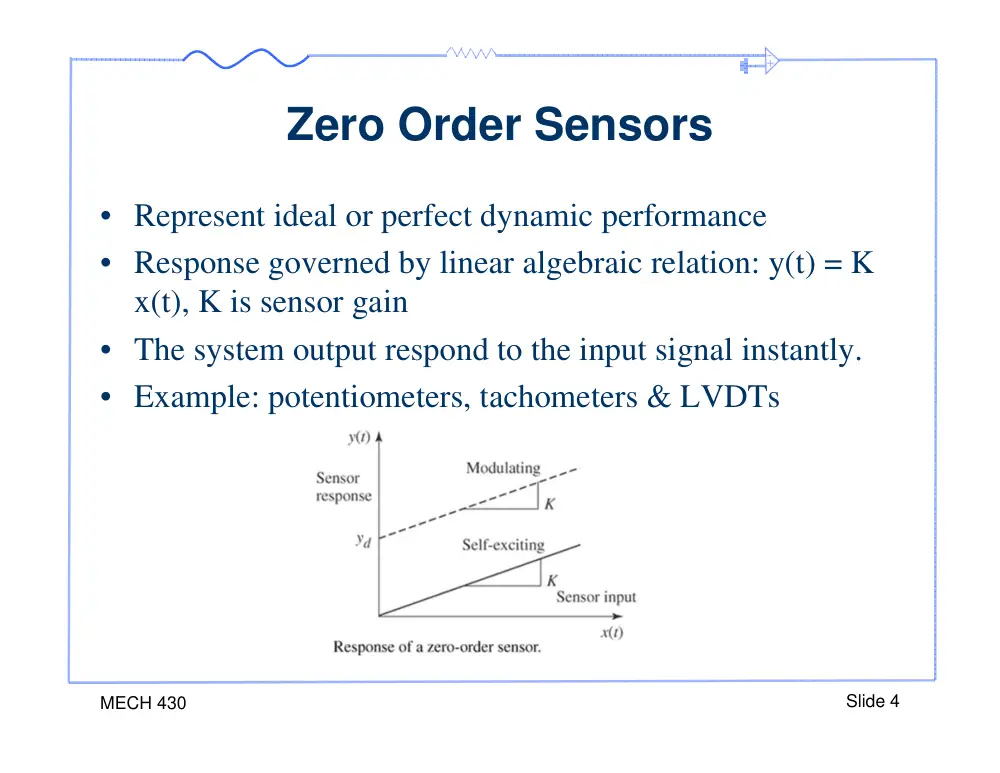
• Represent ideal or perfect dynamic performance
• Response governed by linear algebraic relation: y(t) = K
x(t), K is sensor gain
• The system output respond to the input signal instantly.
• Example: potentiometers, tachometers & LVDTs
MECH 430
Slide 4
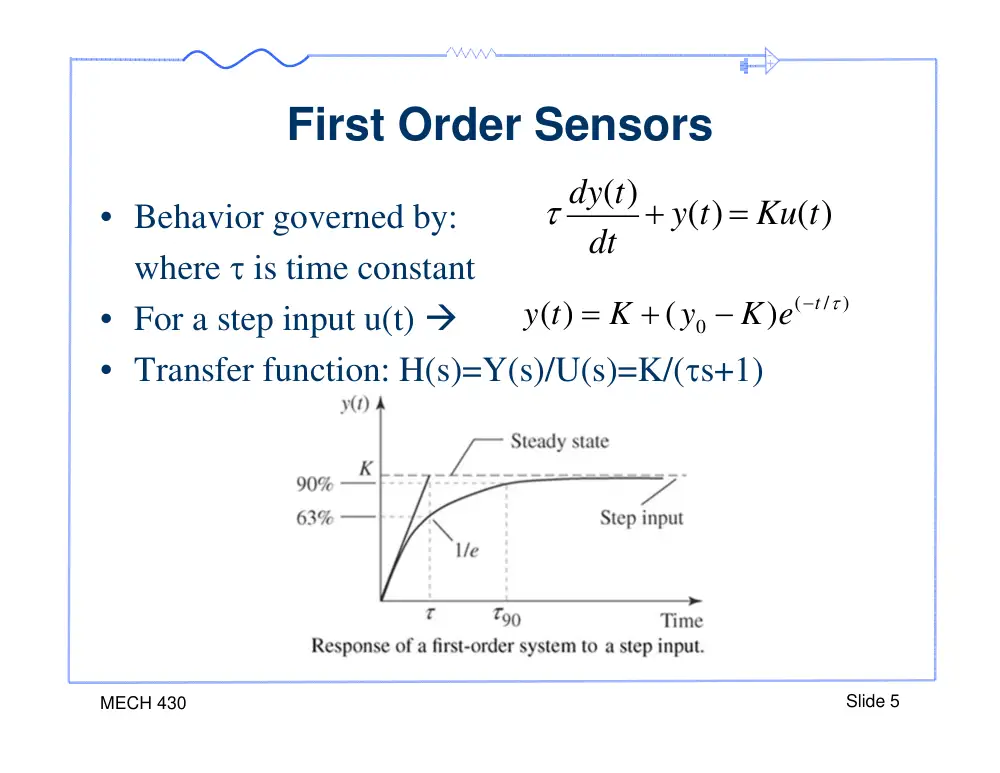
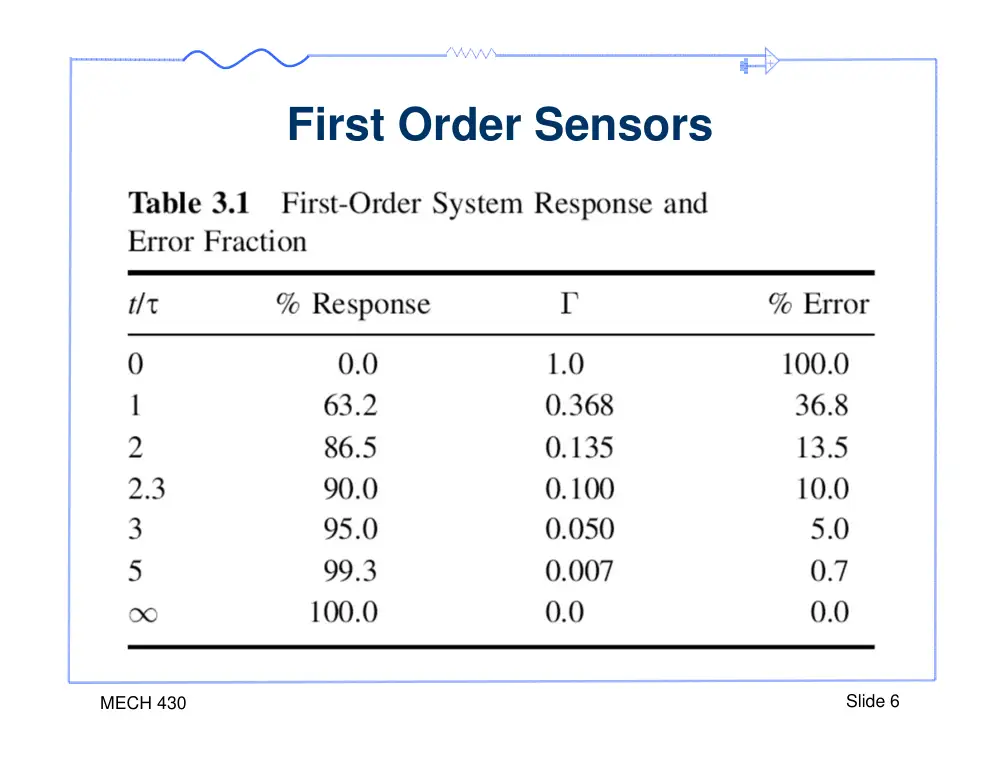
First Order Sensors
• Behavior governed by:
where is time constant
• For a step input u(t)
• Transfer function: H(s)=Y(s)/U(s)=K/(s+1)
MECH 430
Slide 5
dy(t)
dt
y(t) Ku(t)
/ )
(
0
)
(
( )
K e t
y
K
y t
First Order Sensors
MECH 430
Slide 6
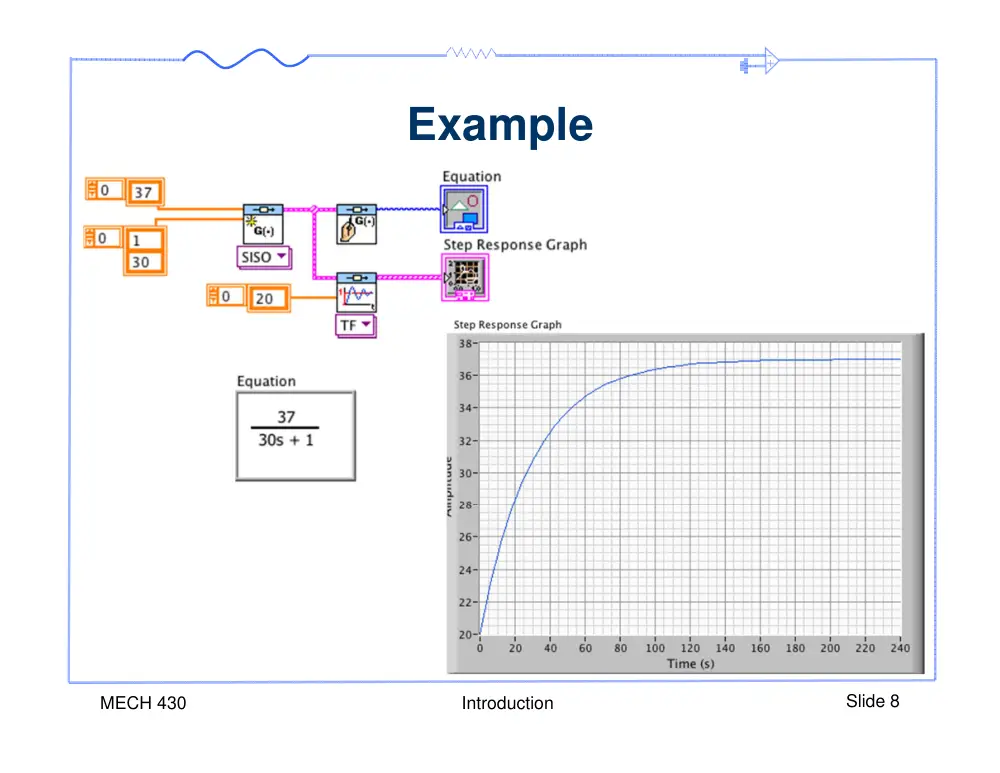
Example of first order sensor
system
• Example 3.3: A thermometer with a time constant of
30 seconds is originally at room temperature, that is
20 degrees Celsius. It is suddenly exposed to a 37
degrees Celsius.
• Modeling with a first order differential equation:
• 30dT(t)/dt + T(t) = 37
• The solution of which is:
• T(t) = 37 + (20 – 37) e-t/30
• T(t) = 37 – 17 e-t/30 degrees Celsius
MECH 430
Slide 7
Example
MECH 430
Introduction
Slide 8
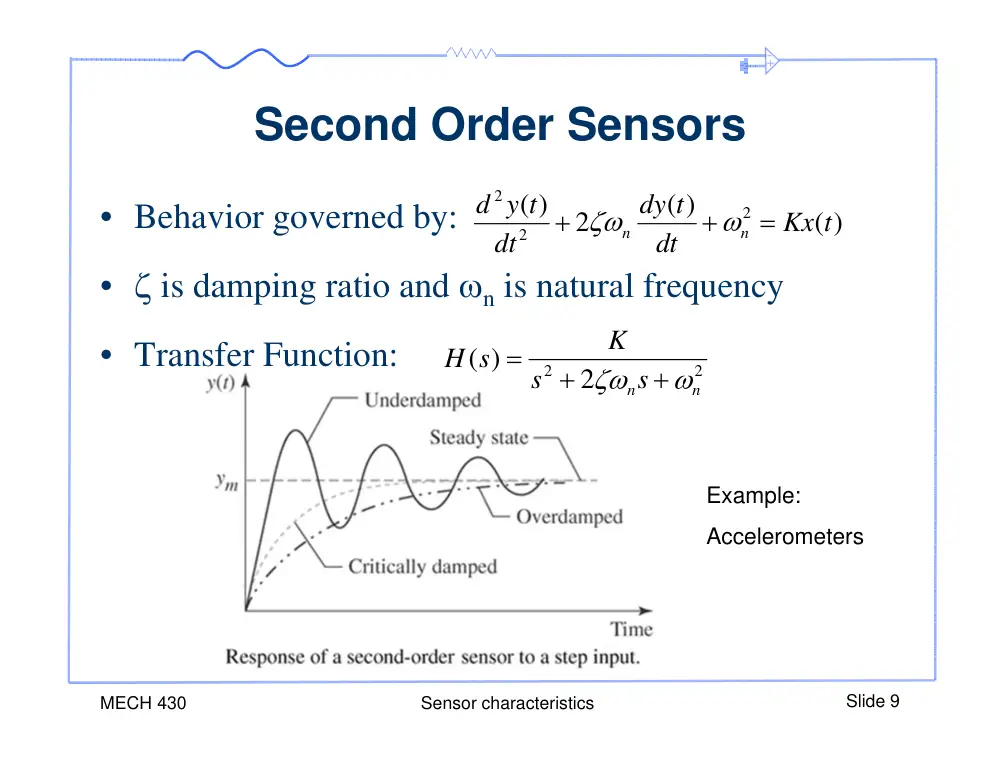
Second Order Sensors
• Behavior governed by:
• is damping ratio and n is natural frequency
• Transfer Function:
MECH 430
Sensor characteristics
Slide 9
( )
( )
2
( )
2
2
2
Kx t
dt
dy t
dt
y t
d
n
n
Example:
Accelerometers
2
2
2
)
(
n
ns
s
K
H s
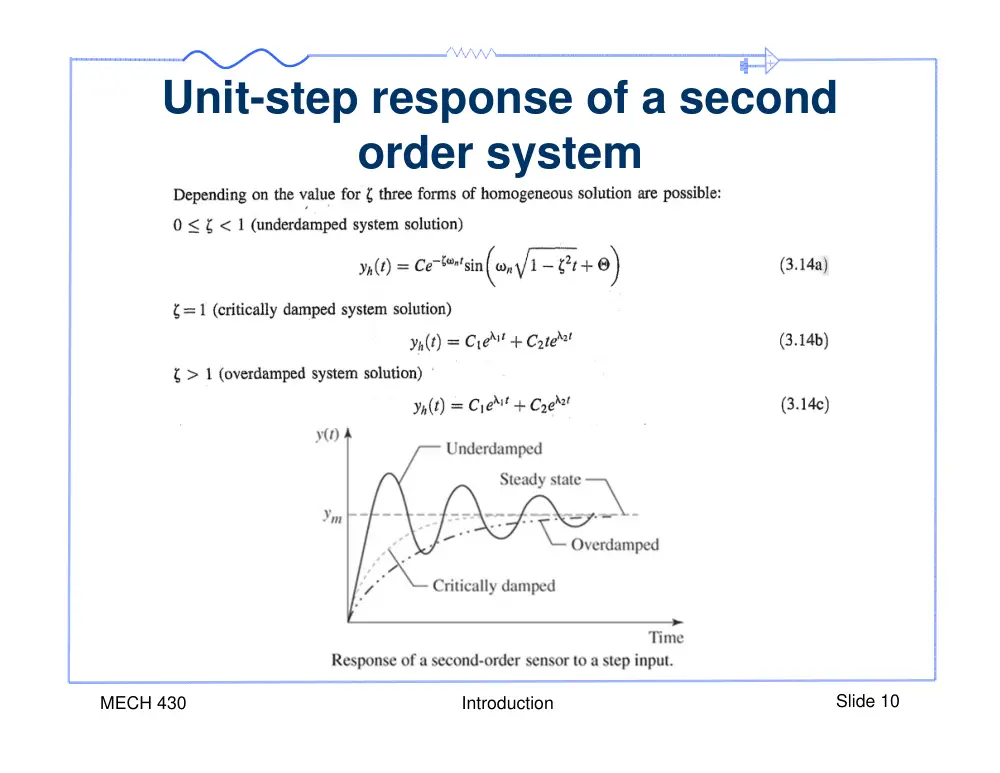
Unit-step response of a second
order system
MECH 430
Introduction
Slide 10
Unit-step response of a second
order system
MECH 430
Introduction
Slide 11