
PHYS 200 Final, Fall 1995
American University of Beirut · Understanding the Universe · 8 pages

More PHYS 200 files
Show the text of this final exam
AMG ene .
Lip ans hy
Or oni ee
AUB PHYSICS 200 Jan. 31, 1996
Physics Department Final Exam Time: 1 hour
Name:
ID. No.:
General Information:
(1) No make up of this exam without legal reason .
(2) Answer all questions given in this exam. In case of multiple choice question, you are
allowed to circle only one answer.
(3) If you cannot answer the question directly, leave it to the end.
(4) This exam contains 20 main questions, each has 10 grades, so that the total grade
is 200.
Total Grade :
(9) The figure below shows a schematic
diagram of the sun. Answer the
following, questions
(a) Indentify the photosphere
(circle one of these)
a b c d
(b) Indentify the sun's convective
zone (circle one of these)
b d The Sun (fol 49 scal
(10) In the figures below, the initial and final states of the hydrogen atom are shown
schematically. Initial State Final State
(a) Which final state corresponds
to ionization (circle onc)
a b c
(b) Which final state corresponds
fo an emission of light ?
(circle one)
a b c
(11) In the figure below, the energy level
diagram of the hydrogen atom is shown
schematically. Which transitions lead
to visible light ? (circle one)
A B Cc
\
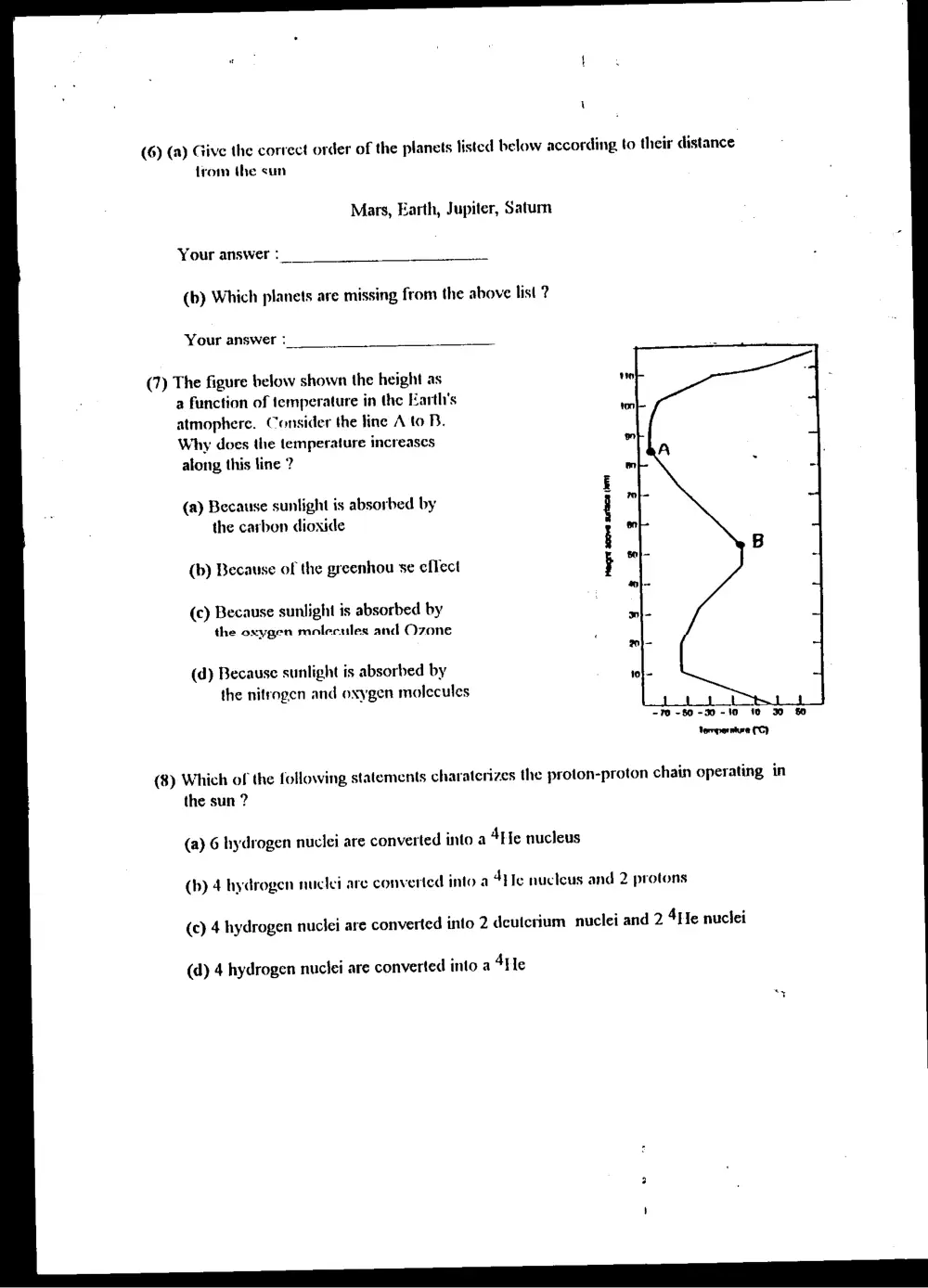
(6) (a) Give the correct order of the planets listed below according to their distance
from the sun
Mars, Earth, Jupiter, Saturn
Your answer :__
(b) Which planets are missing from the above list ?
Your answer :
(7) The figure below shown the height as
a function of temperature in the Earth's
atmophere. Consider the line A to B.
Why does the temperature increases
along this line ?
(a) Because sunlight is absorbed by
the carbon dioxide
Megnt acove surface (amt
(b) Because of the greenhou se effect
(c) Because sunlight is absorbed by
the oxygen molecules and Ozone
(d) Because sunlight is absorbed by
the nitrogen and oxygen molecules
-70-80-30-10 10 30 8
lerrpernture CC)
(8) Which of the following statements charaterizes the proton-proton chain operating in
the sun ?
(a) 6 hydrogen nuclei are converted into a 4He nucleus
(b) 4 hydrogen nuclei are converted into a 4H Ie nucleus and 2 protons
(c) 4 hydrogen nuclei are converted into 2 deutcrium nuclei and 2 4He nuclei
(d) 4 hydrogen nuclei are converted into a 4He
t
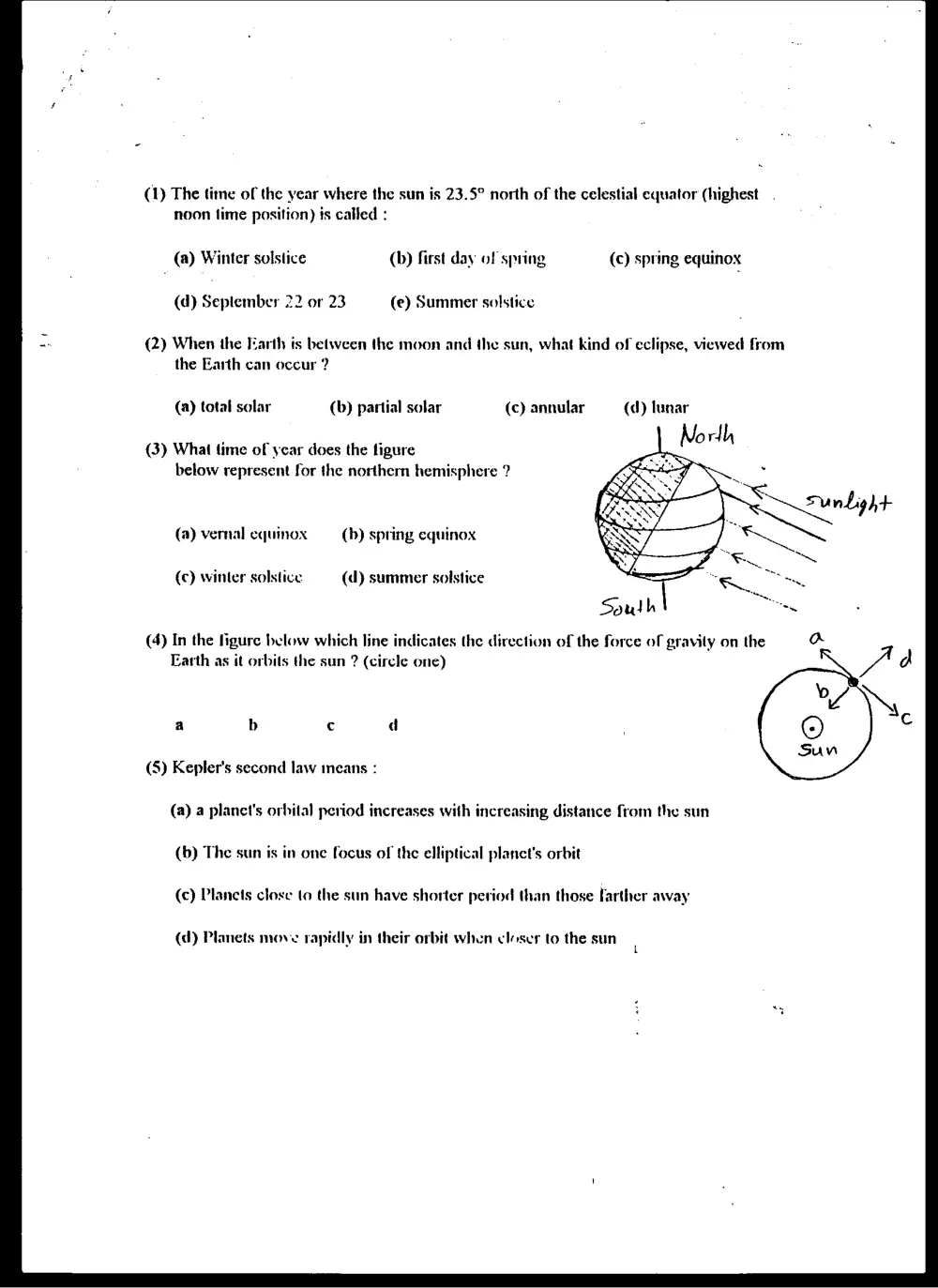
(1) The time of the year where the sun is 23.5° north of the celestial equator (highest
noon time position) is called :
(a) Winter solstice (b) first day of spring (c) spring equinox
(d) September 22 or 23 (e) Summer solstice
(2) When the Earth ts between the moon and the sun, what kind of eclipse, viewed from
the Earth can occur ?
(a) total solar (b) partial solar (c) annular (d) lunar
(3) What lime of year does the figure
below represent for the northern hemisphere ?
(a) vernal equinox (b) spring equinox
(c) winter solstice (d) summer solstice
(4) In the figure below which line indicates the direction of the force of gravily on the a
Earth as it orbits the sun ? (circle one) JA a
a b c d , © c
(5) Kepler's second law means :
(a) a planet's orbital period increases with increasing distance from the sun
(b) The sun is in one focus of the elliptical planet's orbit
(c) Planets close to the sun have shorter period than those farther away
(d) Planets move rapidly in their orbit when closer to the sun
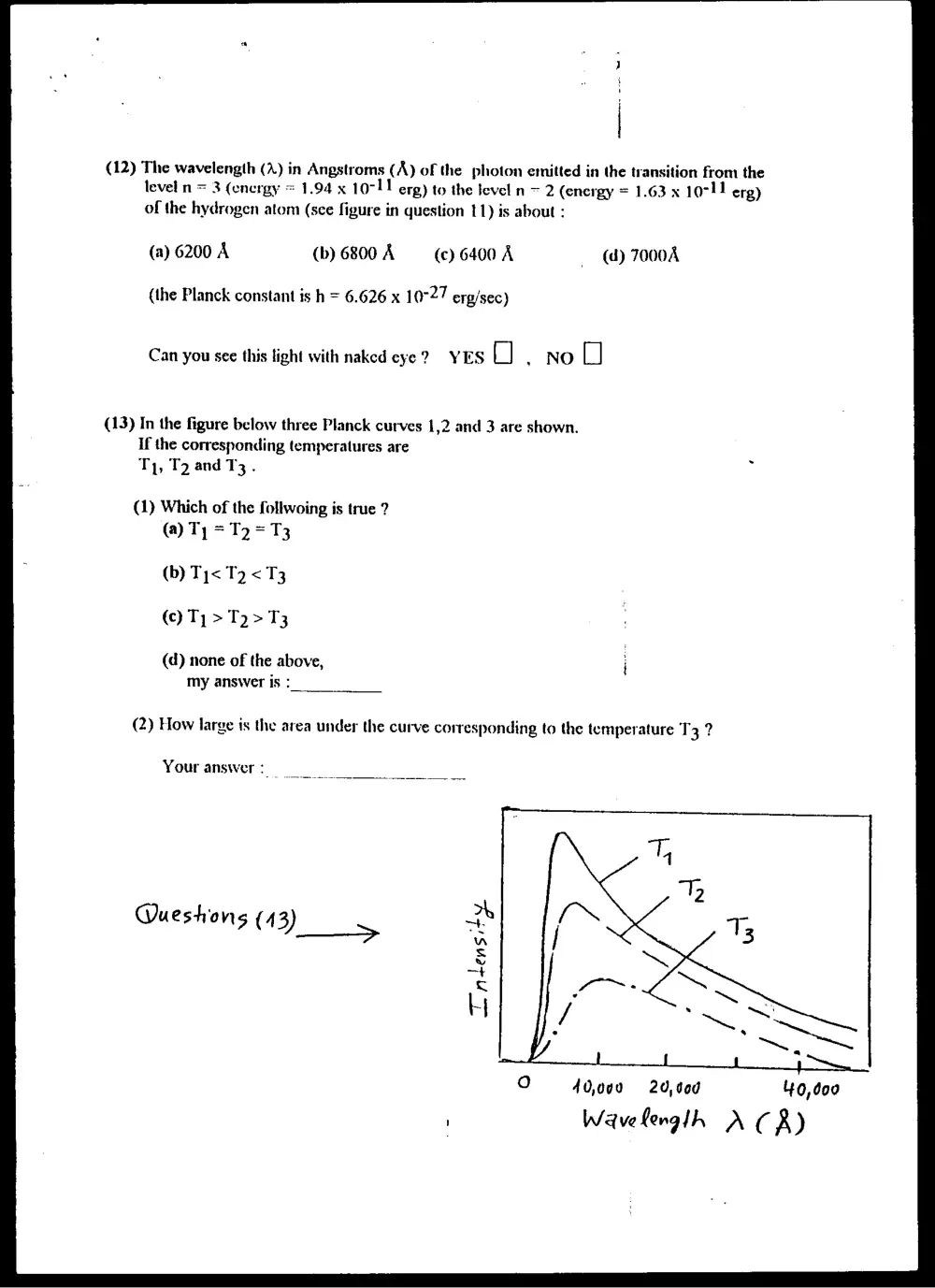
(12) The wavelength (4) in Angstroms (A) of the photon emitted in the transition from the
level n = 3 (energy = 1.94 x 10⁻¹¹ erg) to the level n = 2 (energy = 1.63 x 10711 erg)
of the hydrogen atom (sce figure in question 11) is about :
(a) 6200 A (b) 6800 A (c) 6400 A _ (d) 7000A
(the Planck constant is h = 6.626 x 10°27 erg/sec)
Can you see this light with naked eye? YES LI
(13) In the figure below three Planck curves 1,2 and 3 are shown.
If the corresponding temperatures are
Ty, Tz and T3.
(1) Which of the follwoing is true ?
(a) T] = T2=T3
(b) T}< T2 < T3
(c) Ty > T2>T3
(d) none of the above,
my answer is :
(2) How large is the area under the curve corresponding to the temperature T3 ?
Your answer >
Questions (43)
40000 20,000 40,000
Wavelenglh A CA)
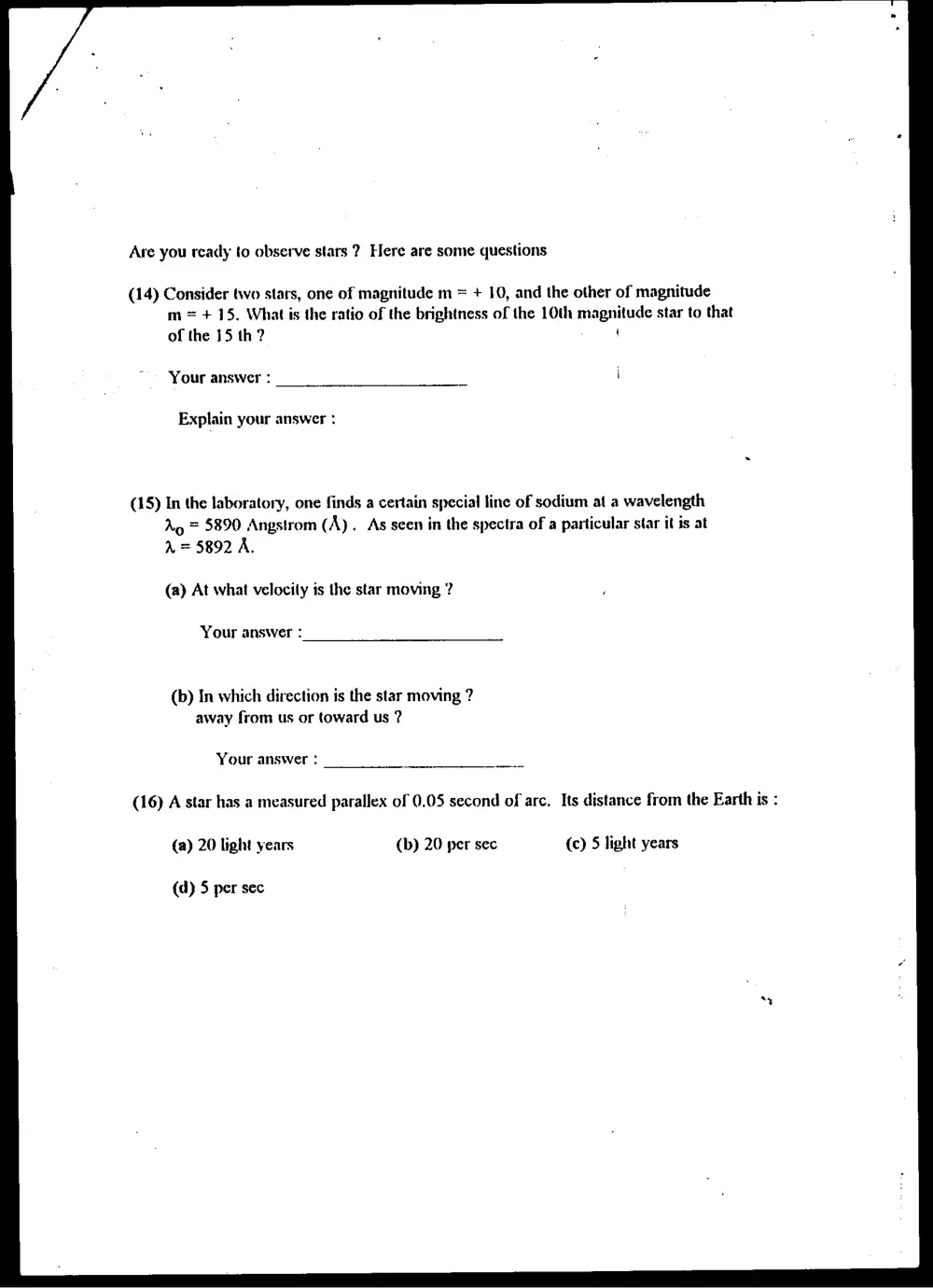
Are you ready to observe stars 2? Here are some questions
(14) Consider two stars, one of magnitude m = + 10, and the other of magnitude
m = + 15. What is the ratio of the brightness of the 10th magnitude star to that
of the 15 th? '
Your answer : i
Explain your answer :
(15) In the laboratory, one finds a certain special line of sodium at a wavelength
Xo = 5890 Angstrom (A). As seen in the spectra of a particular star it is at
0 = 5892 A.
(a) At what velocily is the star moving ?
Your answer :
(b) In which direction is the star moving ?
away from us or toward us ?
Your answer :
(16) A star has a measured parallex of 0.05 second of arc. Its distance from the Earth is :
(a) 20 light years (b) 20 per sec (c) 5 light years
(a) 5 per sec
“y
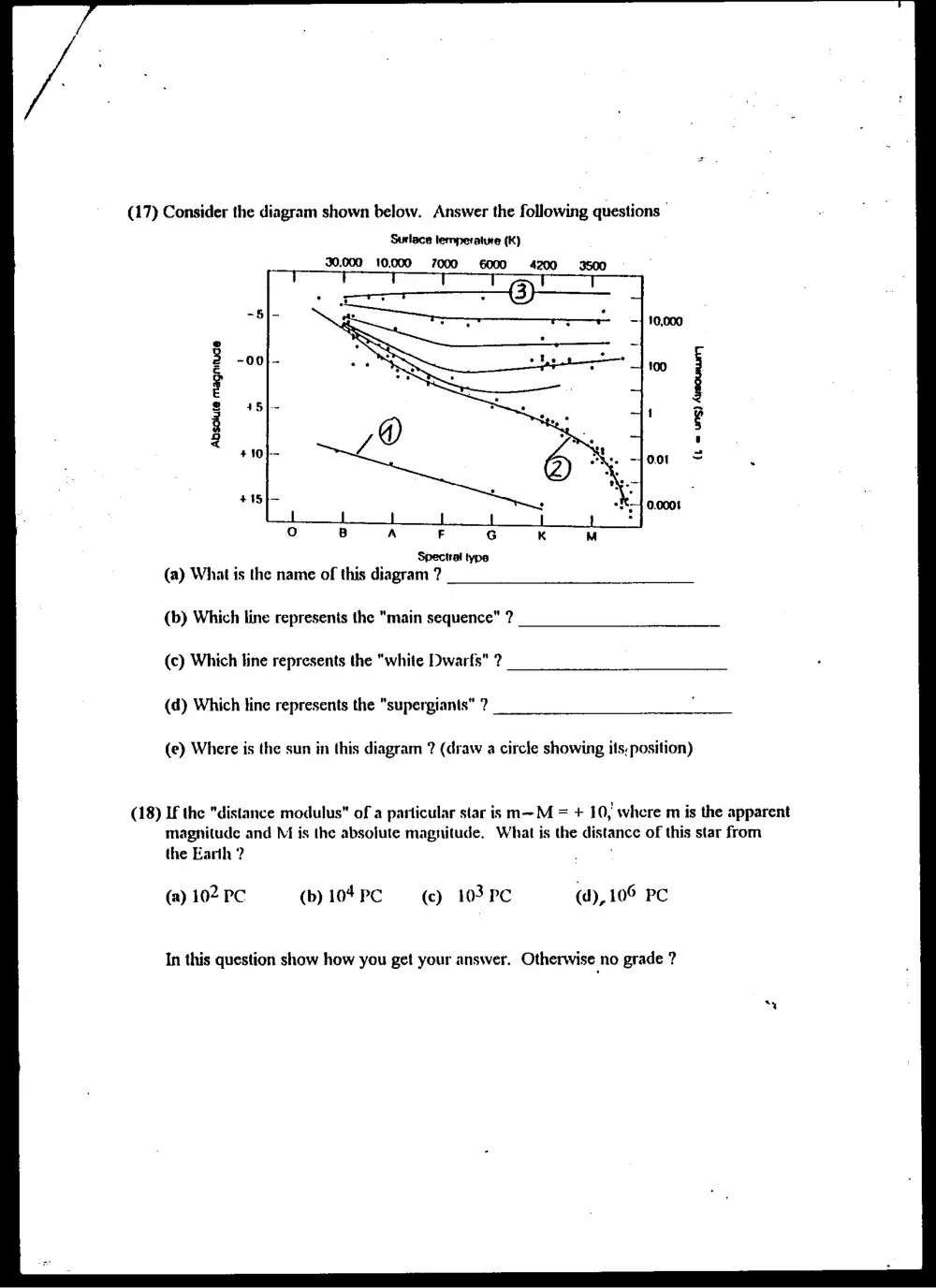
(17) Consider the diagram shown below. Answer the following questions
Surlace temperature (K)
30.000 10.000 7000 6000 4200 3600
1
°o '
J a
+
on
Absolute magnitude
al aT
to) 8
Spectral type
(a) What is the name of this diagram ?
(b} Which line represents the "main sequence" ?
(c) Which line represents the “white Dwarfs" ?
(d) Which line represents the "supergiants” ?
(e) Where is the sun in this diagram ? (draw a circle showing its,position)
(18) If the "distance modulus” of a particular star is m—M = + 10,’ where m is the apparent
magnitude and M is the absolute magnitude. What is the distance of this star from
the Earth ? .
(a) 102 PC (by 104 PC (ce) 103 PC (d), 106 PC
In this question show how you get your answer. Otherwise no grade ?
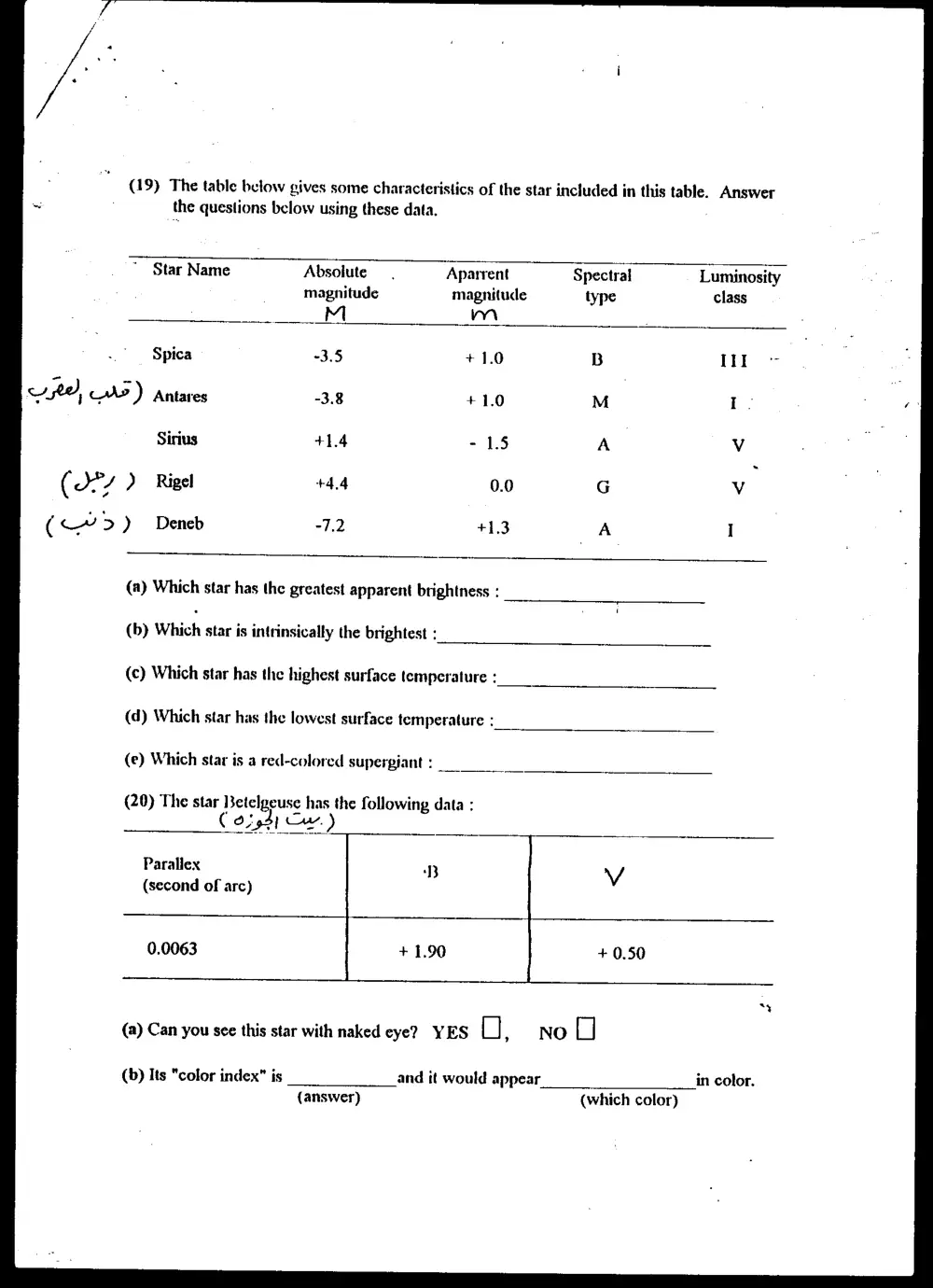
(19) The table below gives some characteristics of the star included in this table. Answer
~ ; the questions below using these data.
Star Name Absolute Aparrent Spectral Luminosity
magnitude magnitude type class
M aA)
Spica -3.5 + 1.0 B Ill
22), 2) Antares -3.8 +1.0 M a Oy
Sirius +14 - 15 A v
( J”/ ) Rigel +4.4 0.0 G Vv
(>) Deneb “7.2 +13 A I
(a) Which star has the greatest apparent brightness :
(b) Which star is intrinsically the brightest :
(c) Which star has the highest surface temperature :
(d) Which star has the lowest surface temperature :
(e) Which star is a red-colored supergiant :
(20) The star Betelgeuse has the following data :
Coi931 Cu)
(cosond of arc) » v
0.0063 + 1.90 + 0.50
“y
(a) Can you see this star with naked eye? YES O » NO O
(b) Its "color index” is and it would appear in color.
(answer) (which color)