
PHYS 200 Final, Spring 1998
American University of Beirut · Understanding the Universe · 8 pages


More PHYS 200 files
Show the text of this final exam
Mont Ns nary
LIBRARY i
OF RG ay |
ee
Physics Dept. Physics 200 June 26, 1998
Final Exam Time: 1 % hour.
Name:
LD. No.:
No make up of this exam without legal reason
In multiple choice questions crossing more than one answer cancels the question.
All questions are obligatory
Physical data
speed of light C = 3 x 10° m/s
1 Angstrom = 10° * cm
Page Grade
Total:
True or False
Indicate by crossing which question is True or False (each question has one point)
True False
The sidereal day is based on the rotation
of the Earth with respect to distant stars
When a particular event happens, Beirut
clocks indicate 2 hours later than Greenwhich clocks.
Black bodies are objects that cannot emit any radiation
because the have black color.
Radiation at wavelength of 3 meters are visible to human
eye.
Sceismic transverse waves (s-waves) cannot travel through
a liquid.
The greenhouse effect is primary responsible for the
circulation patterns in the Earth’s atmosphere.
The Disk of the Milkey Way contains only old stars.
Cepheids variables have longer pulsation periods than
RR Lyrae variables.
RR Lyrae variable stars are found in open clusters.
All things except of light are attracted by gravity
The central temperature of the Earth is close to 6000K.
The central temperature of the Sun is less than 10’ K
According to the Kepler’s first law, a planet moves faster
when it is closest to the sun.
Population I stars are found in the galactic disk.
A star cluster of an age of 10 billion years still contains
many O-type.
It is not possible to ionize hydrogen by using visible light.
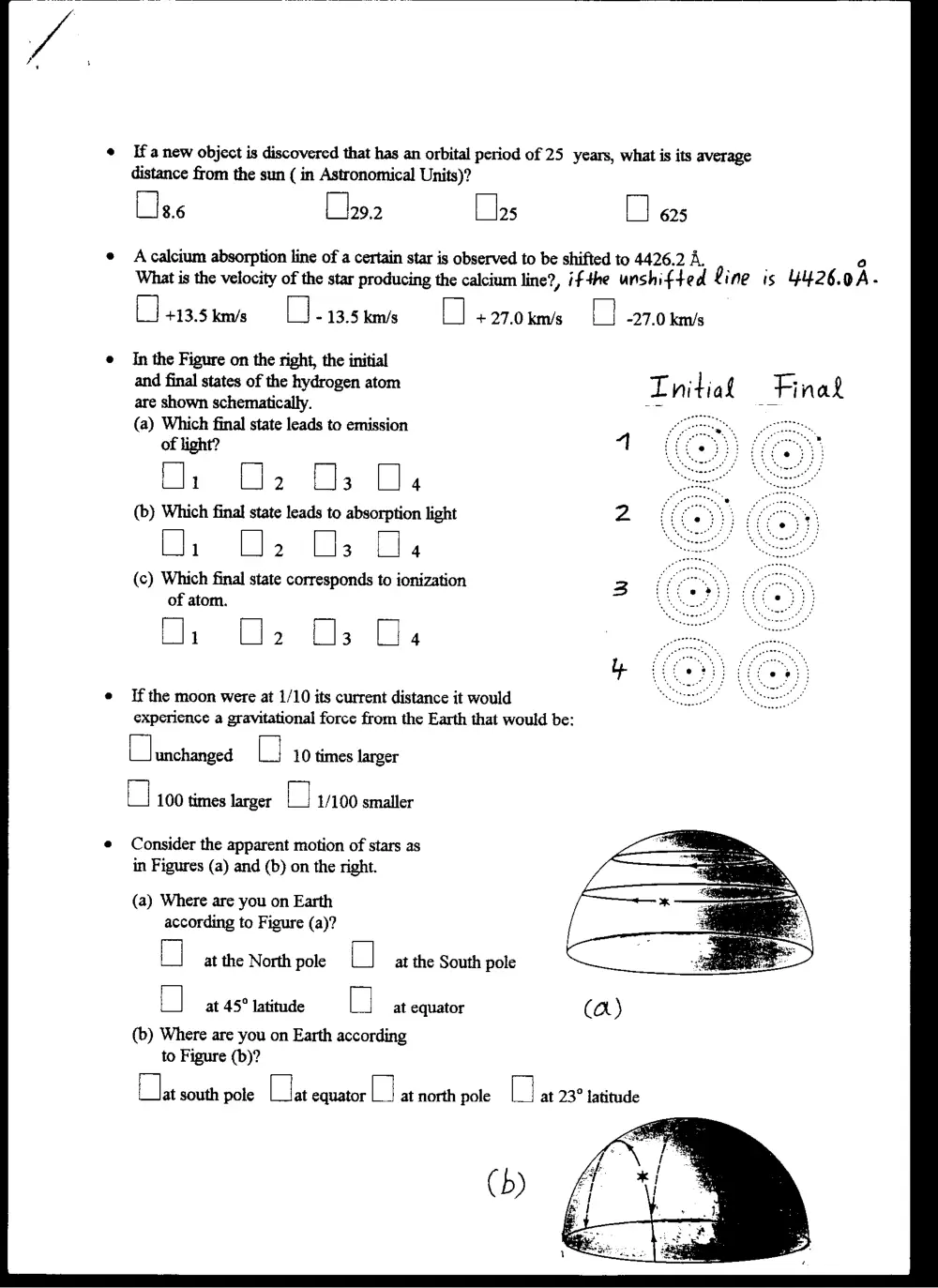
¢ Ifa new object is discovered that has an orbital period of 25 years, what is its average
distance from the sun ( in Astronomical Units)?
8.6 29.2 25 625
e Acalcium absorption line of a certain star is observed to be shifted to 4426.2 A.
What is the velocity of the star producing the calcium line?, if the unshifted fine is 4426. oA.
+13.5 km/s ~ 13.5 km/s + 27.0 km/s -27.0 km/s
e In the Figure on the right, the initial
and final states of the hydrogen atom Tnitiag Final
are shown schematically. = -—
(a) Which final state leads to emission
of light? 4
1 2 3 4
(b) Which final state leads to absorption light 2
1 2 3 4
(c) Which final state corresponds to ionization 3
of atom.
1 2 3 4
e If the moon were at 1/10 its current distance it would
experience a gravitational force from the Earth that would be:
unchanged 10 times larger
100 times larger 1/100 smaller
e Consider the apparent motion of stars as
in Figures (a) and (b) on the right.
(a) Where are you on Earth
according to Figure (a)?
at the North pole at the South pole
at 45° latitude at equator (ay
(b) Where are you on Earth according
to Figure (b)?
at south pole at equator at north pole LI at 23° latitude
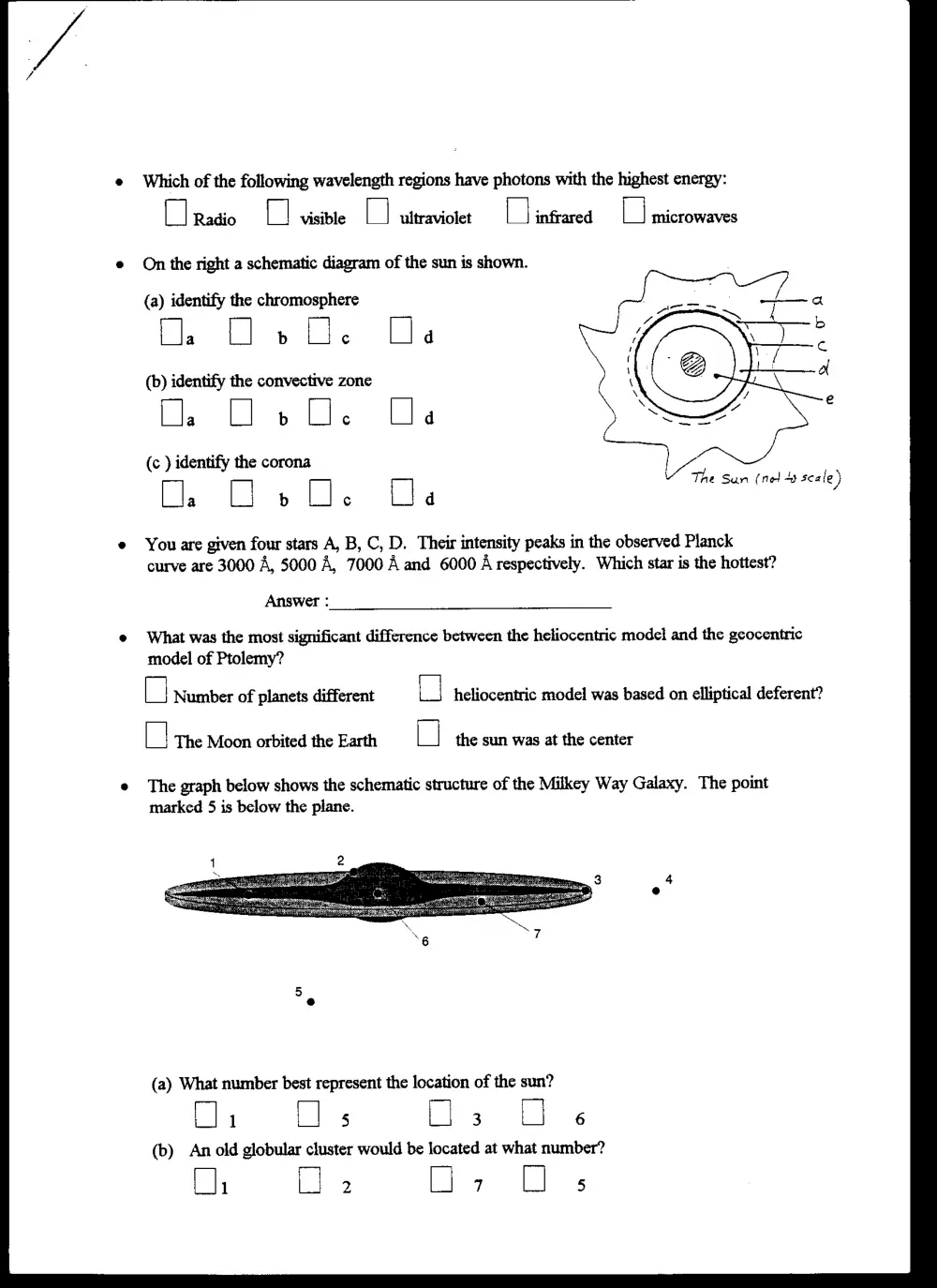
¢ Which of the following wavelength regions have photons with the highest energy:
Radio visible ultraviolet infrared microwaves
© On the right a schematic diagram of the sun is shown.
(a) identify the chromosphere
a b ¢ d
(b) identify the convective zone
a b c d
(c ) identify the corona
The Sun (nol -Y scale)
a b lic d
e You are given four stars A, B, C, D. Their intensity peaks in the observed Planck
curve are 3000 A, 5000 A, 7000 A and 6000 A respectively. Which star is the hottest?
Answer :
© What was the most significant difference between the heliocentric model and the geocentric
model of Ptolemy?
Number of planets different heliocentric model was based on elliptical deferent?
The Moon orbited the Earth the sun was at the center
e The graph below shows the schematic structure of the Milkey Way Galaxy. The point
marked 5 is below the plane.
(a) What number best represent the location of the sun?
1 5 3 6
(b) An old globular cluster would be located at what number?
1 2 7 5
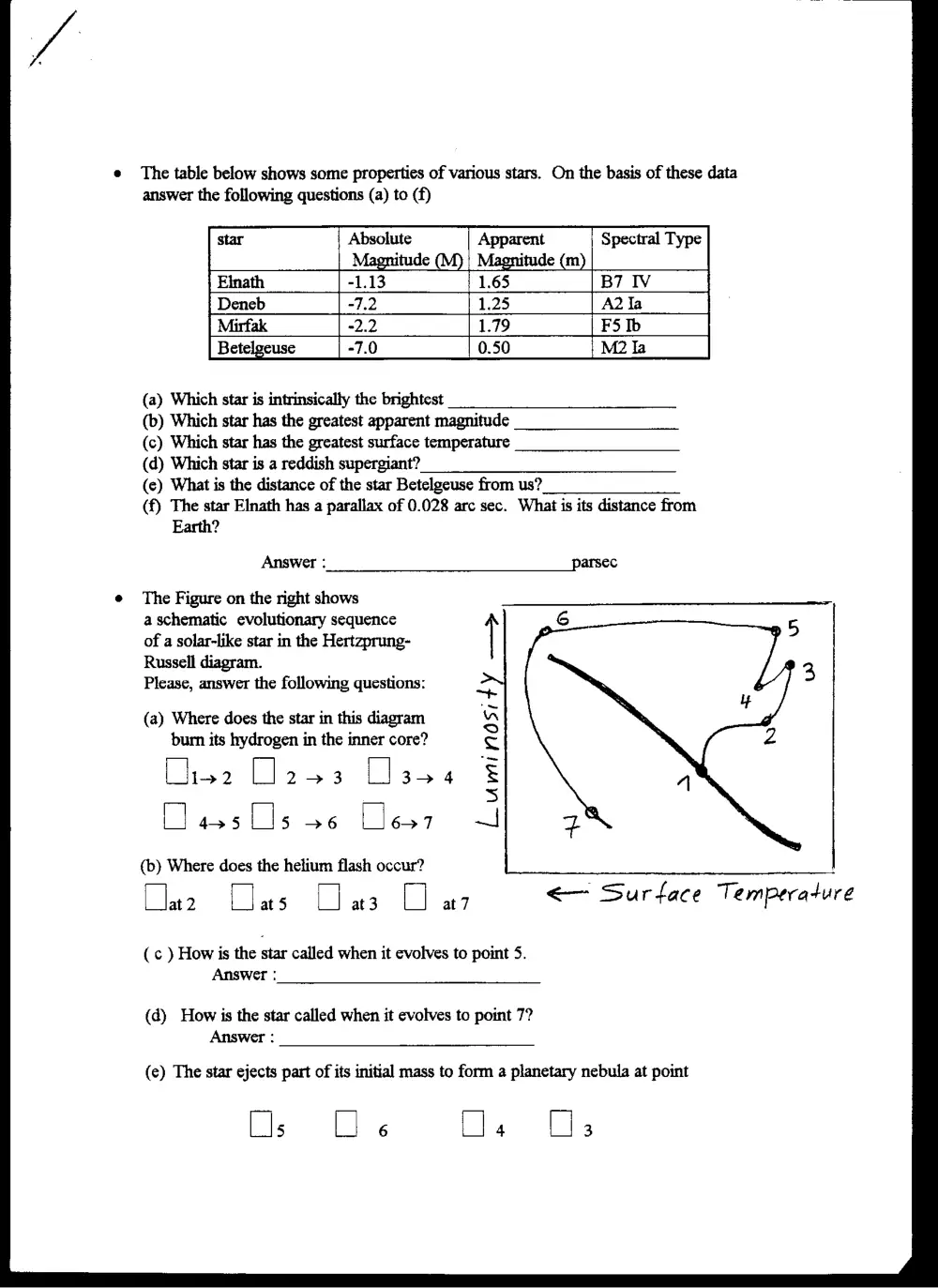
e The table below shows some properties of various stars. On the basis of these data
answer the following questions (a) to (f)
(a) Which star is intrinsically the brightest
(b) Which star has the greatest apparent magnitude
(c) Which star has the greatest surface temperature
(d) Which star is a reddish supergiant?
(¢) What is the distance of the star Betelgeuse from us?
(f) The star Elnath has a parallax of 0.028 arc sec. What is its distance from
Earth?
Answer : parsec
e The Figure on the right shows
aschematic evolutionary sequence
of a solar-like star in the Hertzprung-
Russell diagram.
Please, answer the following questions:
6
(a) Where does the star in this diagram
burn its hydrogen in the inner core?
1+ 2 27> 3 34> 4
Luminosity —>
455 5 +6 leo
(b) Where does the helium flash occur?
at2 as) lata LJ] at? <— Surface Temperature
(c ) How is the star called when it evolves to point 5.
Answer :
(d) How is the star called when it evolves to point 7?
Answer :
(e) The star ejects part of its initial mass to form a planetary nebula at point
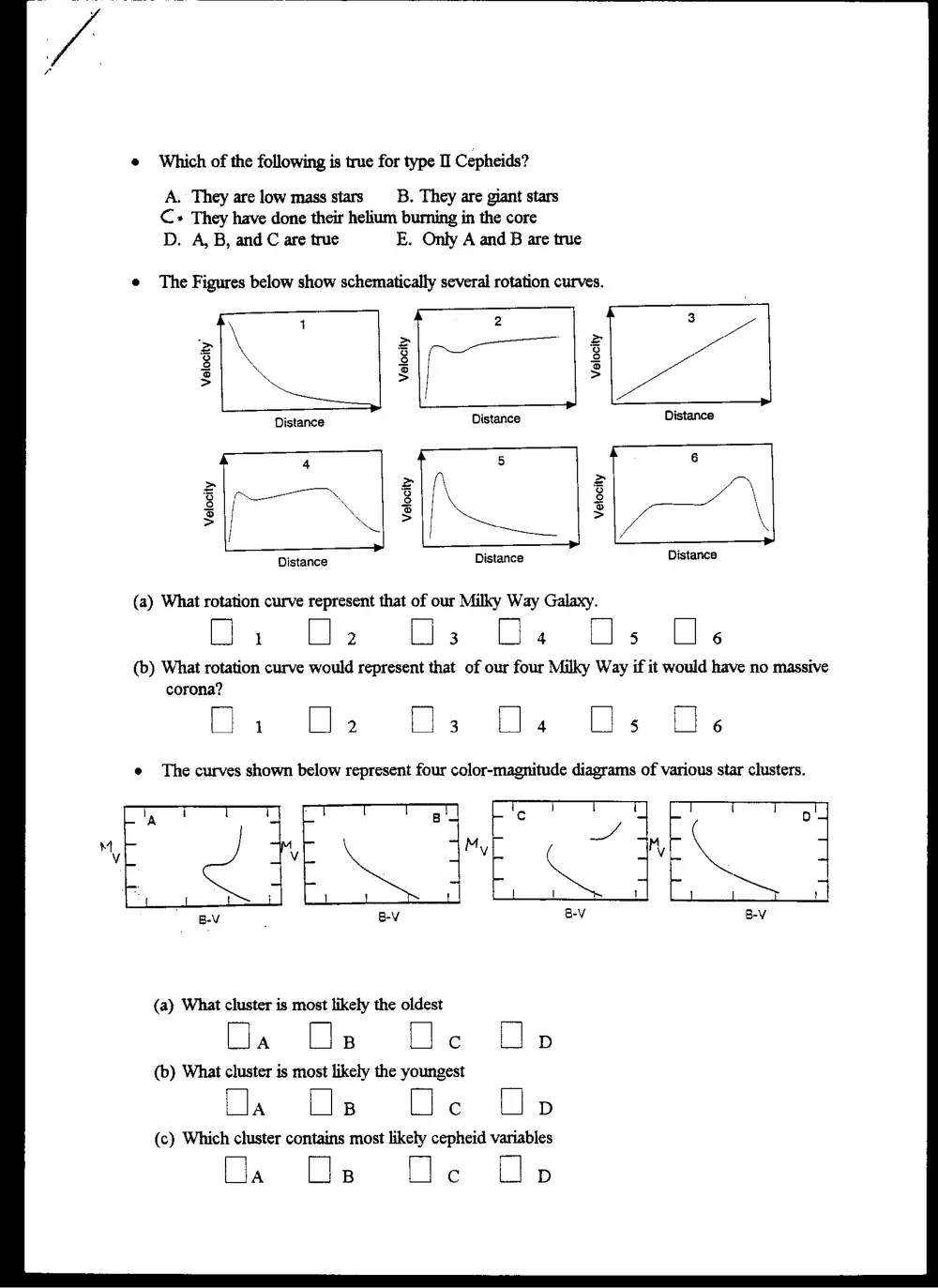
e Which of the following is true for type Il Cepheids?
A. They are low mass stars B. They are giant stars
C+ They have done their helium burning in the core
D. A, B, and C are true E. Only A and B are true
e The Figures below show schematically several rotation curves.
ry 1 4
Distance
Vetocily
Distance Distance
(a) What rotation curve represent that of our Milky Way Galaxy.
1 2 3 4
(b) What rotation curve would represent that of our four Milky W:
corona?
1 L} 2 3 4
e The curves shown below represent four color-magnitude diagrams of various star clusters.
. T T T TT 51
SENT
: L ~ i !
BV . BV ev BV
(a) What cluster is most likely the oldest
A B Cc
(b) What cluster is most likely the youngest
A B Cc D
(c) Which cluster contains most likely cepheid variables
A B c D
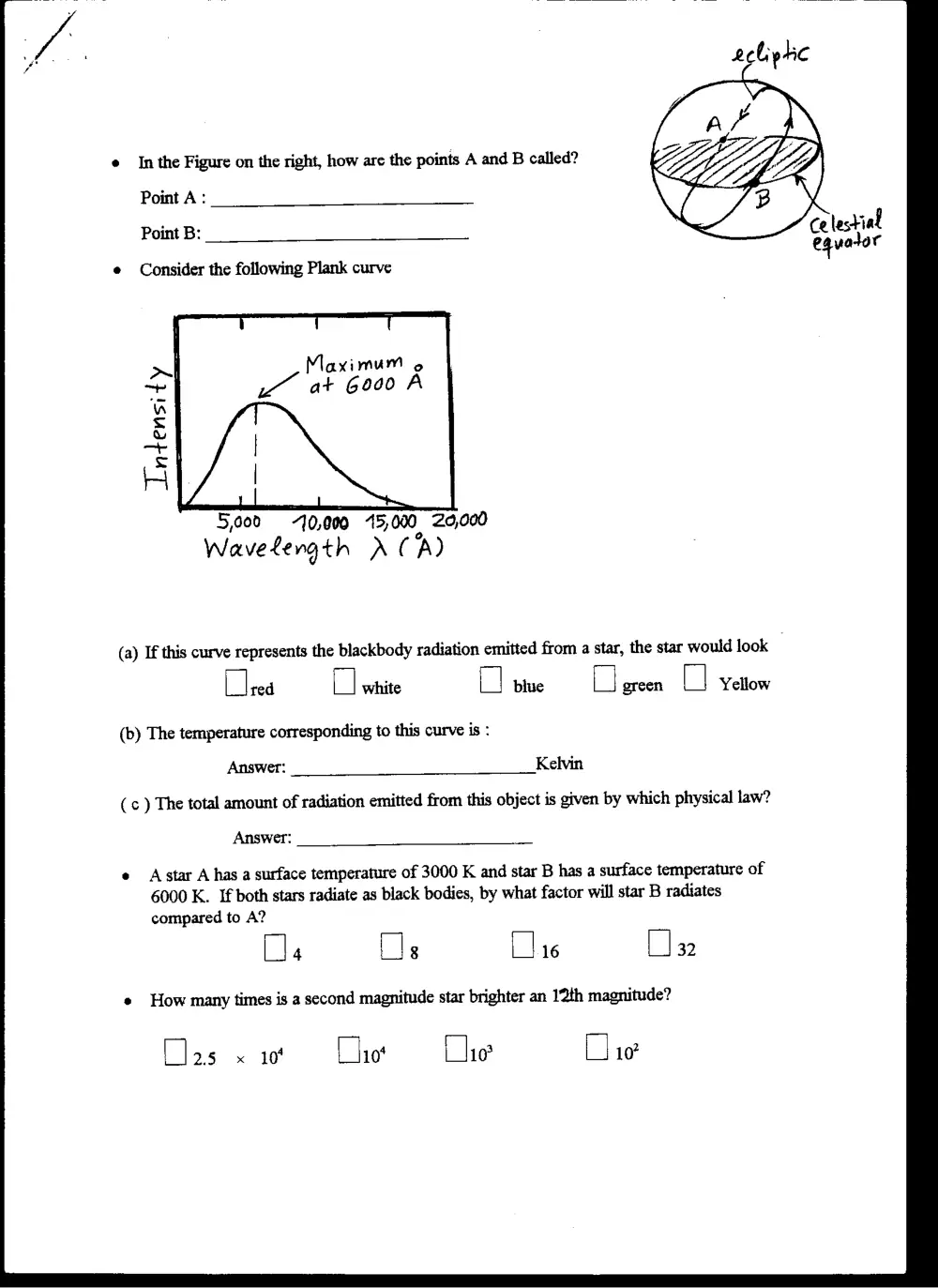
¢ Inthe Figure on the right, how are the points A and B called?
Point A:
Point B:
¢ Consider the following Plank curve
5,000 70,000 15,000 20,000
Wavelength A (A)
(a) If this curve represents the blackbody radiation emitted from a star, the star would look
red white blue green Yellow
(b) The temperature corresponding to this curve is :
Answer: Kelvin
(c) The total amount of radiation emitted from this object is given by which physical law?
Answer:
e Astar A has a surface temperature of 3000 K and star B has a surface temperature of
6000 K. If both stars radiate as black bodies, by what factor will star B radiates
compared to A?
4 8 16 32
© How many times is a second magnitude star brighter an 12th magnitude?
2.5 x 10° 10° 10° L_} 10?
e The 21-cm radiation of hydrogen arises from which of the following:
Transition between two orbitals of the hydrogen atom
From recapturing an electron by the ionized hydrogen atom
Spin flip of the electron spin in the hydrogen atom
From the ionization of the hydrogen atom
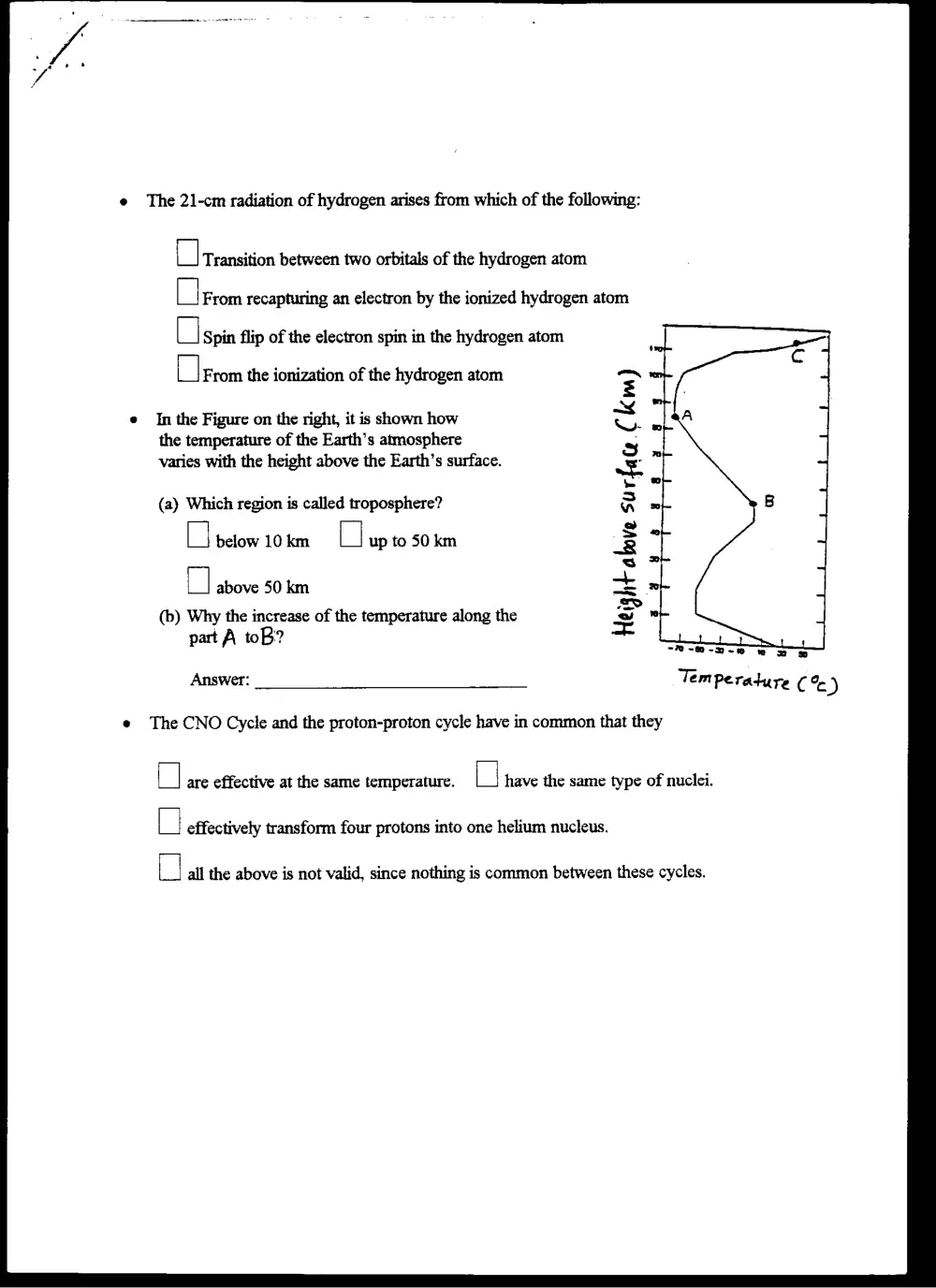
e In the Figure on the right, it is shown how
the temperature of the Earth’s atmosphere
varies with the height above the Earth’s surface.
(a) Which region is called troposphere?
below 10 km up to 50 km
above 50 km
Height above surface Ckm)
(b) Why the increase of the temperature along the
part A toB? a
cwiecs
Answer: Temperature (% 5)
e The CNO Cycle and the proton-proton cycle have in common that they
are effective at the same temperature. have the same type of nuclei.
effectively transform four protons into one helium nucleus.
all the above is not valid, since nothing is common between these cycles.