
PHYS 200 Final, Spring 1997
American University of Beirut · Understanding the Universe · 10 pages


More PHYS 200 files
Show the text of this final exam
June 16, 1997
Time: 1 4% hours
/ @ The time of the year where the sun is 23.5° north of the celesnal equator (highest
a nbox time f‘osition) is called :
ng a
Co Winter solstice (C1 first day of spring (CJ spring equinox
CJ. September 22 or 23. «= (1 Summer solstice
~ @ When the Earth is between the moon and the sun, what kind of eclipse, viewed from
the Earth can occur ?
at
{C] total solar CO partial solar
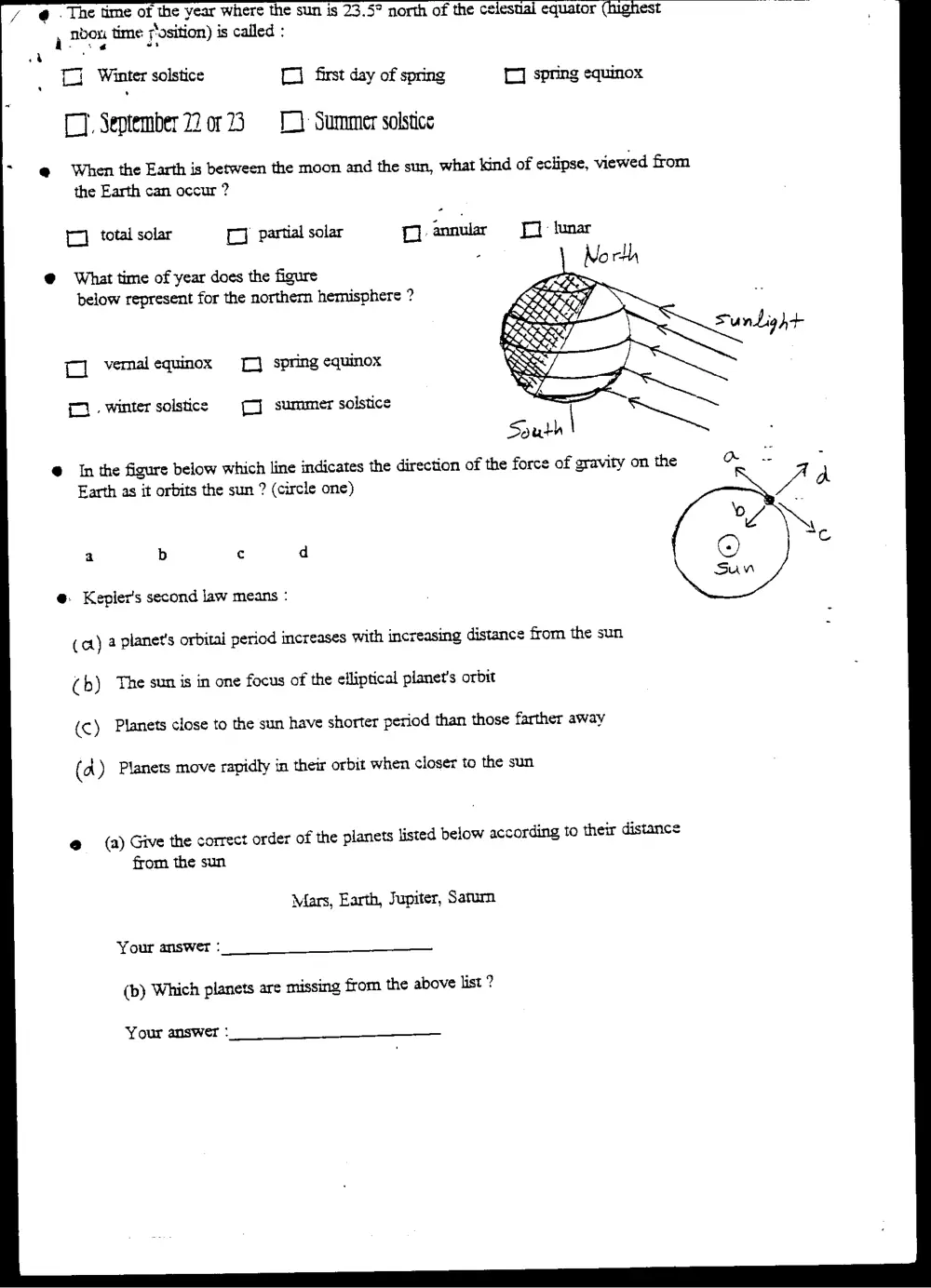
@ What time of year does the figure
below represent for the northern hemisphere ?
CO spring equinox
im vernal equinox
(0. winter solstice = (J summer solstice
@ In the figure below which line indicates the direction of the force of gravity on the
Earth as it orbits the sun ? (circle one)
a b c d
@. Kepler's second law means :
(a) a planet's orbital period increases with increasing distance from the sun
(b) The sun is in one focus of the elliptical planet's orbit
(Cc) Planets close to the sun have shorter period than those farther away
(a) Planets move rapidly in their orbit when closer to the sun
(a) Give the correct order of the planets listed below according to their distance
from the sun
Mars, Earth, Jupiter, Saturn
Your answer :
(b) Which planets are missing from the above list ?
Your answer «
aA
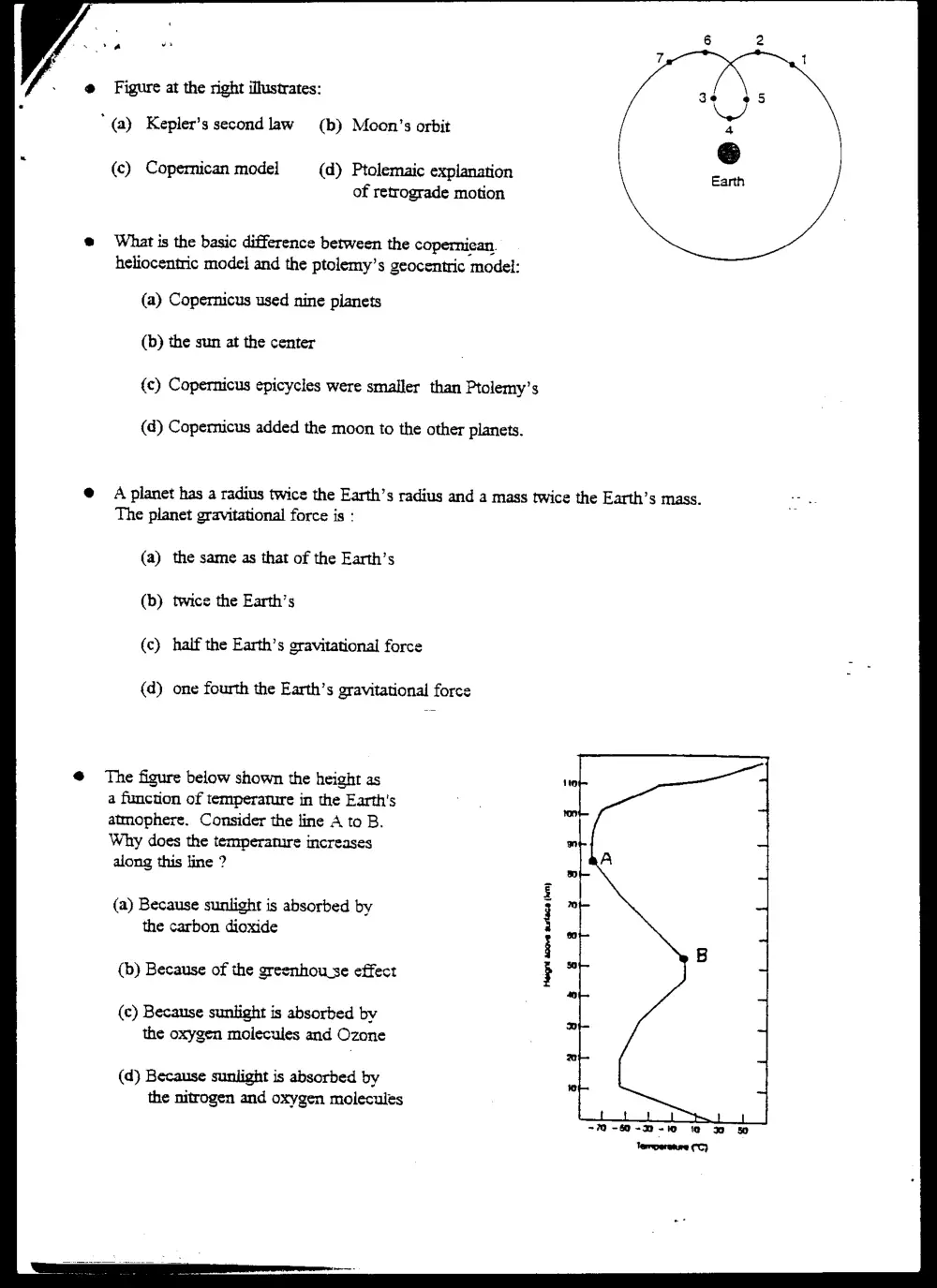
® Figure at the right illustrates:
‘(a) Kepler’s second law (b) Mcon’s orbit
(c) Copernican model (d) Ptolemaic explanation
of retrograde motion
® What is the basic difference between the copernican,
heliocentric model and the ptolemy’s geocentric model:
(a) Copernicus used nine planets
(b) the sun at the center
(¢) Copernicus epicycles were smaller than Ptolemy’s
(a) Copernicus added the moon to the other planets.
@ A planet has a radius twice the Earth’s radius and a mass twice the Earth’s mass.
The planet gravitational force is :
(a) the same as that of the Earth’s
(b) twice the Earth’s
(c) half the Earth’s gravitational force
(d) one fourth the Earth’s gravitational force
@ The figure below shown the height as
a function of temperature in the Earth’s
atmophere. Consider the line A to B.
Why does the temperamre increases
along this line ?
(a) Because sunlight is absorbed by
the carbon dioxide
(b) Because of the greenhou_se effect
(c) Because suntight is absorbed by
the oxygen molecules and Ozone
(d) Because sunlight is absorbed by
the nitrogen and oxygen molecules
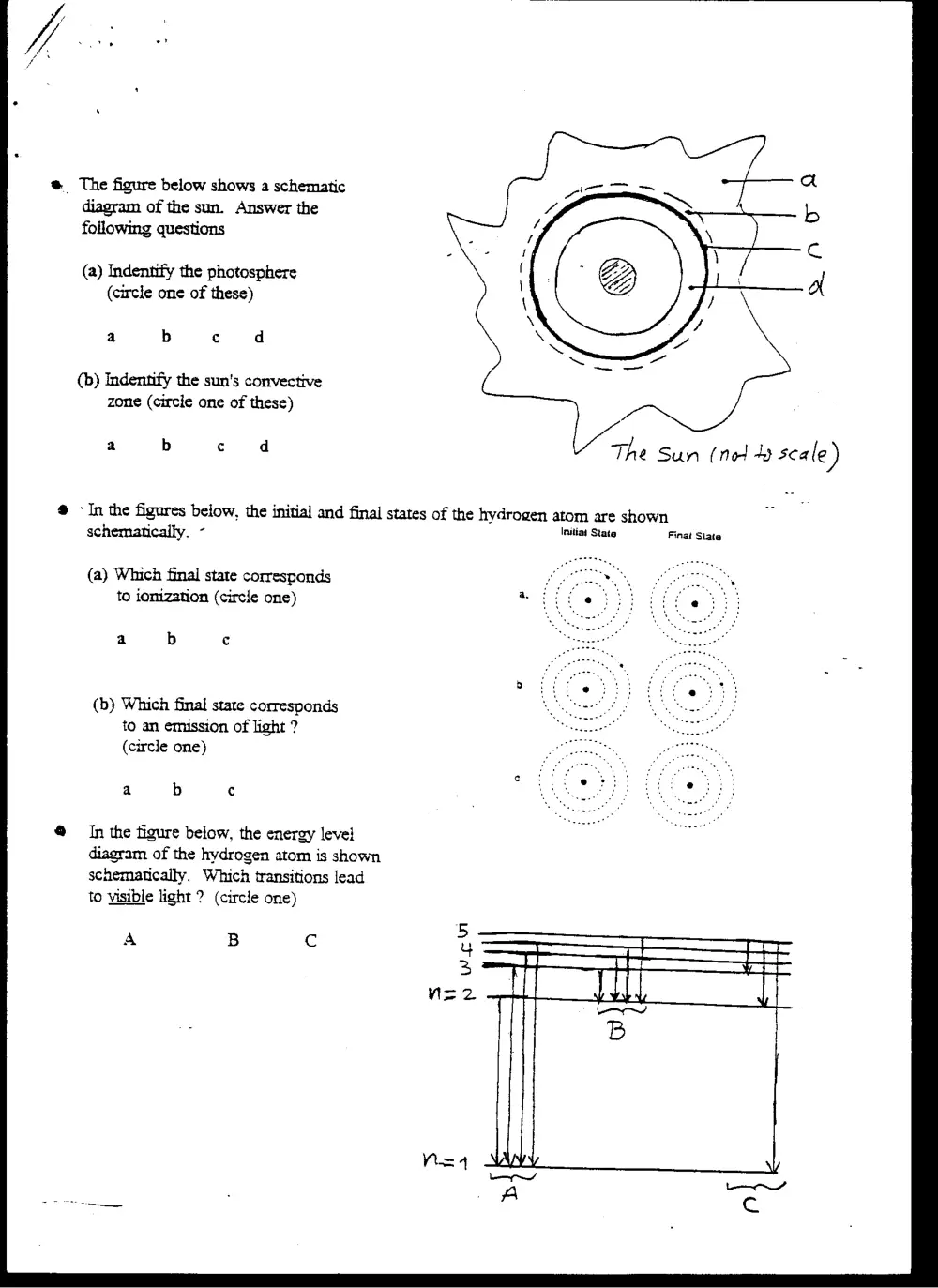
@ The figure below shows a schematic
diagram of the sun. Answer the
following questions
(a) Indentify the photosphere
(circle one of these)
a b c d
(b) Indentify the sun's convective
zone (circle one of these)
a b c d The Sun (not 4) scale)
® - In the figures below, the initial and final states of the hydrogen atom are shown
schematicaily. - Initial State Finat Slate
(a) Which final state corresponds
to ionization (circle one)
a b c
(b) Which final state corresponds
to an emission of light ?
(circle one)
a b c
@ In the figure below, the energy level
diagram of the hydrogen atom is shown
schematically. Which transitions lead
to visible light ? (circle one)
A B Cc
fo . The wavelength (A) in Angstroms & of the photon emitted in the transition from the
level n = 3 (energy = 1.94 x 10⁻¹¹ <8) to the level n = 2 (energy = 1.63 x 10°11 erg)
of the hydrogen atom is about:
(a) 6200 A (b) 6800 A (c) 6400 A (d) 7000A
(the Planck constant is h = 6.626 x 10⁻²⁷ erg/sec)
no
Can you see this light with naked eye? YES iz 7
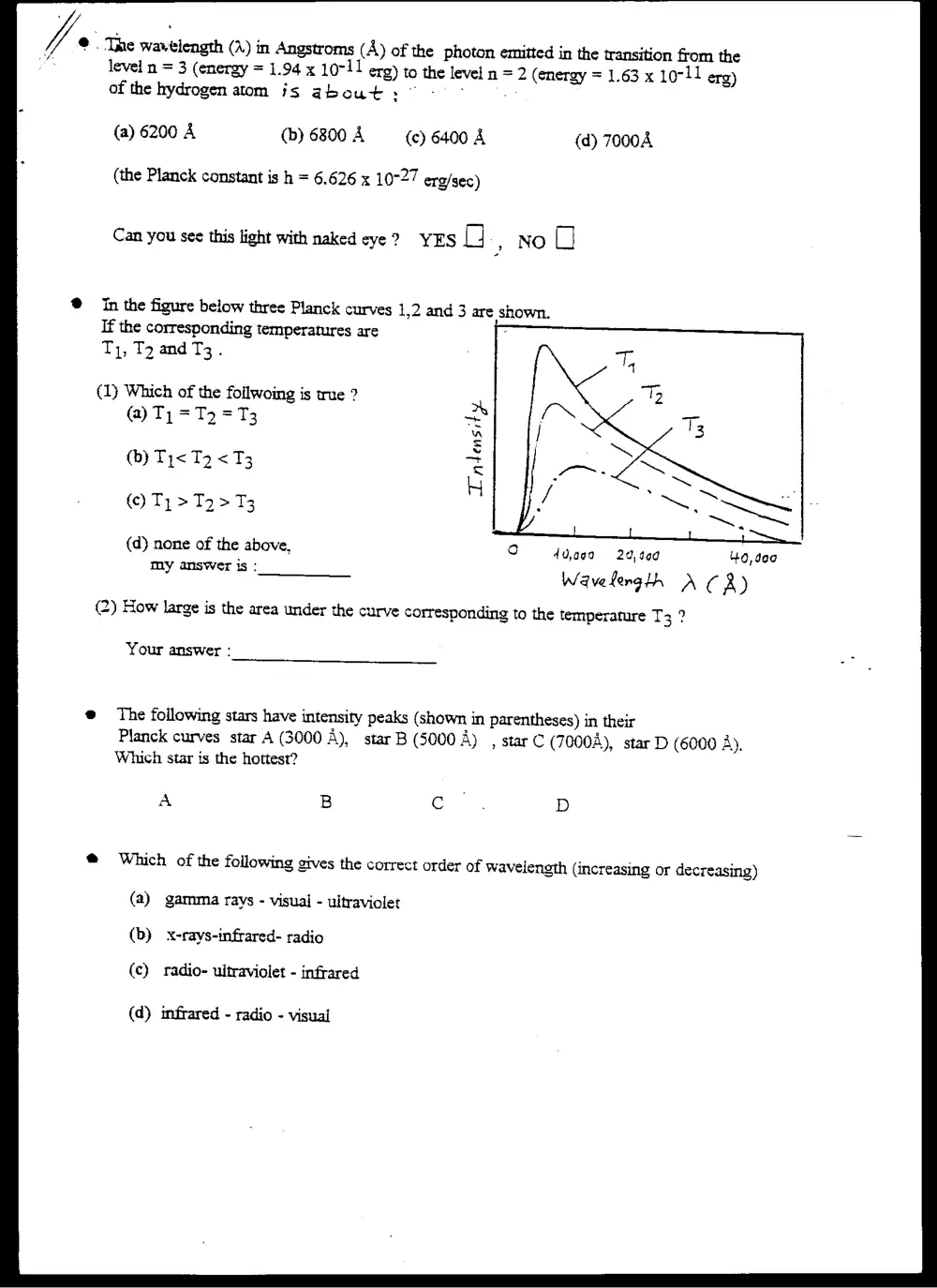
®@ in the figure below three Planck curves 1,2 and 3 are shown.
If the corresponding temperatures are
Ty, Tg and T3.
(1) Which of the follwoing is true ?
(a) T] =T2 =T3
(b) T]< T2 <T3
() Ty >T2>T3
(d) none of the above,
my answer is :
i) d0aea 20,400 40,00
Wavelength ACR)
(2) How large is the area under the curve corresponding to the temperature T3 ?
Your answer :
@ The following stars have intensity peaks (shown i in parentheses) i in their
Planck curves star A (3000 A), star B (5000 A) , starC (7000A), star D (6000 A),
Which star is the hottest?
A B Cc, D
@ Which of the following gives the correct order of wavelength (increasing or decreasing)
(a) gamma rays - visual - ultraviolet
(b) x-rays-infrared- radio
(c) radio- ultraviolet - infrared
(d) imfrared - radio - visual
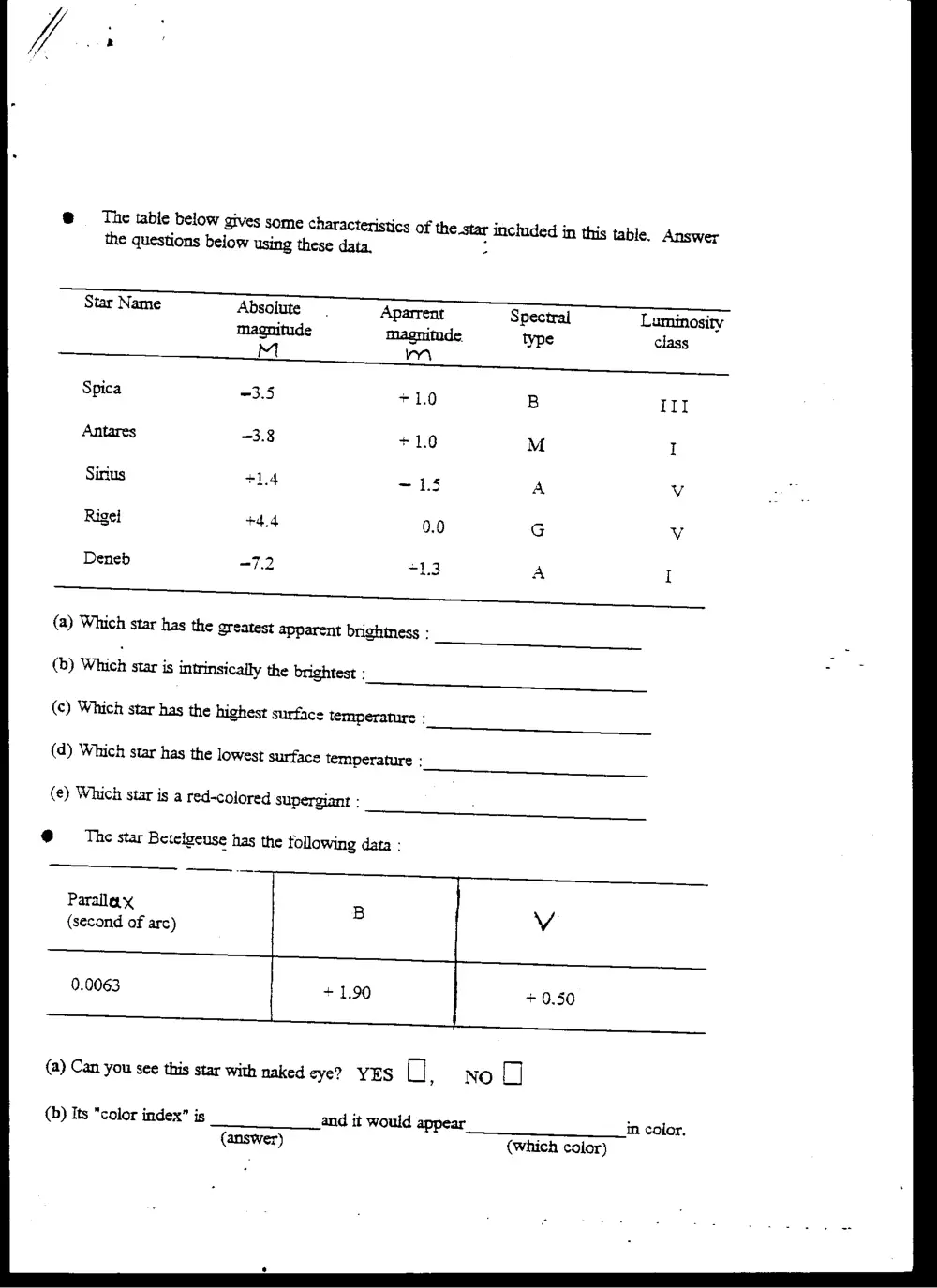
@ The table below gives some characteristics of the star inciuded in this table. Answer
the questions below using these data. :
Star Name Absolute Aparrent Spectral Luminosity
magnitude magnitude. type class
M laa’
Spica —3.5 +1.0 B III
Antares -3.8 +10 M I
Sirius +14 ~ 15 A Vv
Rigel +44 0.0 G Vv
Deneb -7.2 +13 A I
(a) Which star has the greatest apparent brightness :
(b) Which Star is intrinsically the brightest :
(c) Which star has the highest surface temperature :
(d) Which star has the lowest surface temperature :
(e) Which star is a red-colored supergiant :
@ = The star Beteigeuse has the following data :
Parallax B V
(second of arc)
0.0063 + 1.90 + 0.50
(a) Can you see this star with naked eye? YES U , NO O]
(D) Its "color index” is and it would appear in color.
(answer) (which color)
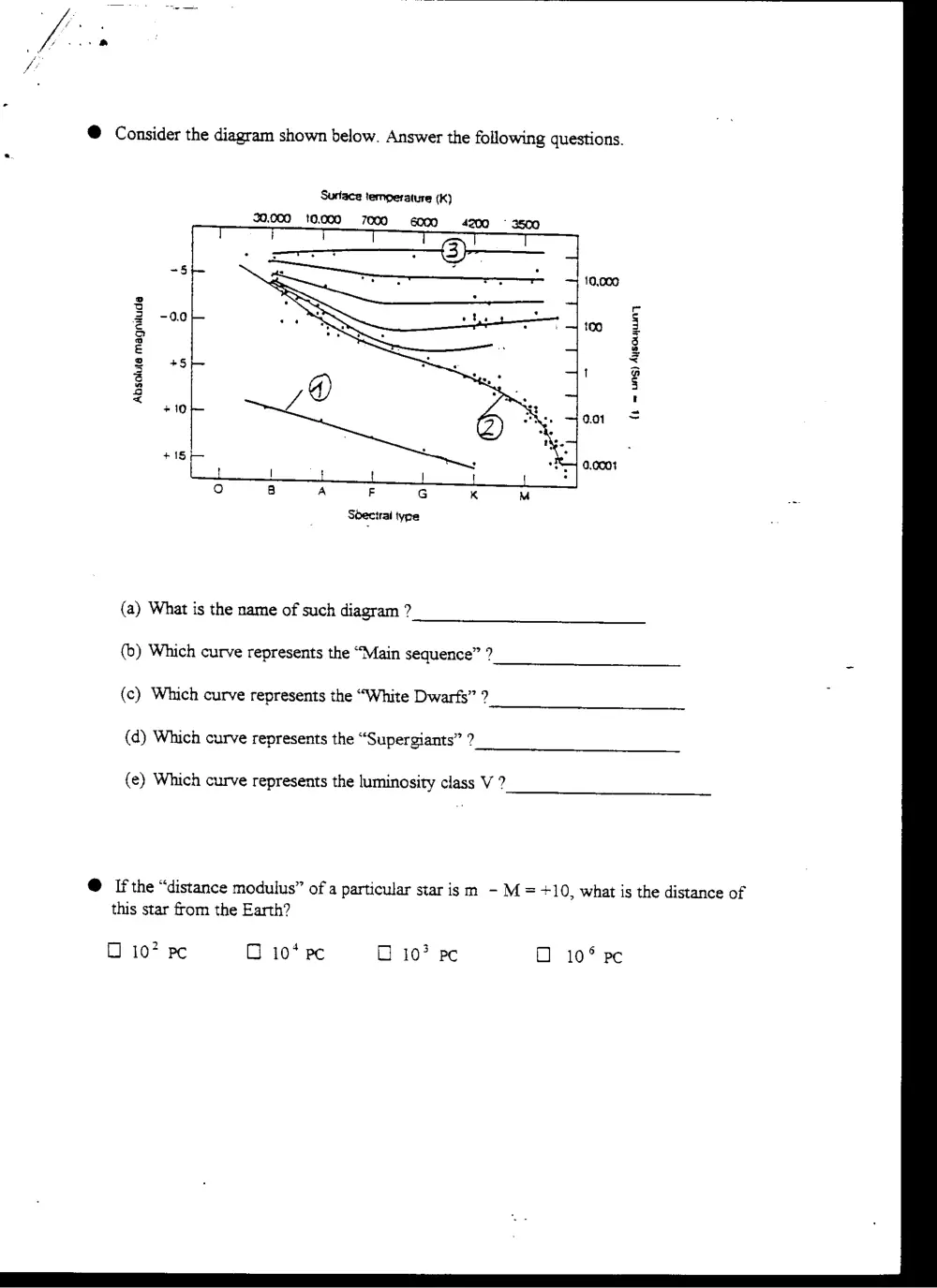
@ Consider the diagram shown below. Answer the following questions.
Surface temperature (K)
30.000 10.000 7000 6c00 )§= 4200 * 3800
en ee ee a ee ee
-0.0
Absolute magnitude
+
a
(t= ung) Aysoujuuiny
+
36
+15
Sdectrai type
(a) What is the name of such diagram ?
(0) Which curve represents the “Main sequence” ?
(c) Which curve represents the “White Dwarfs” ?
(d) Which curve represents the “Supergiants” ?
(e) Which curve represents the luminosity class V ?
@ Ifthe “distance modulus” of a particular star is m - M = +10, what is the distance of
this star from the Earth?
0 10? pc O 10* pc O10? pc 10° pc
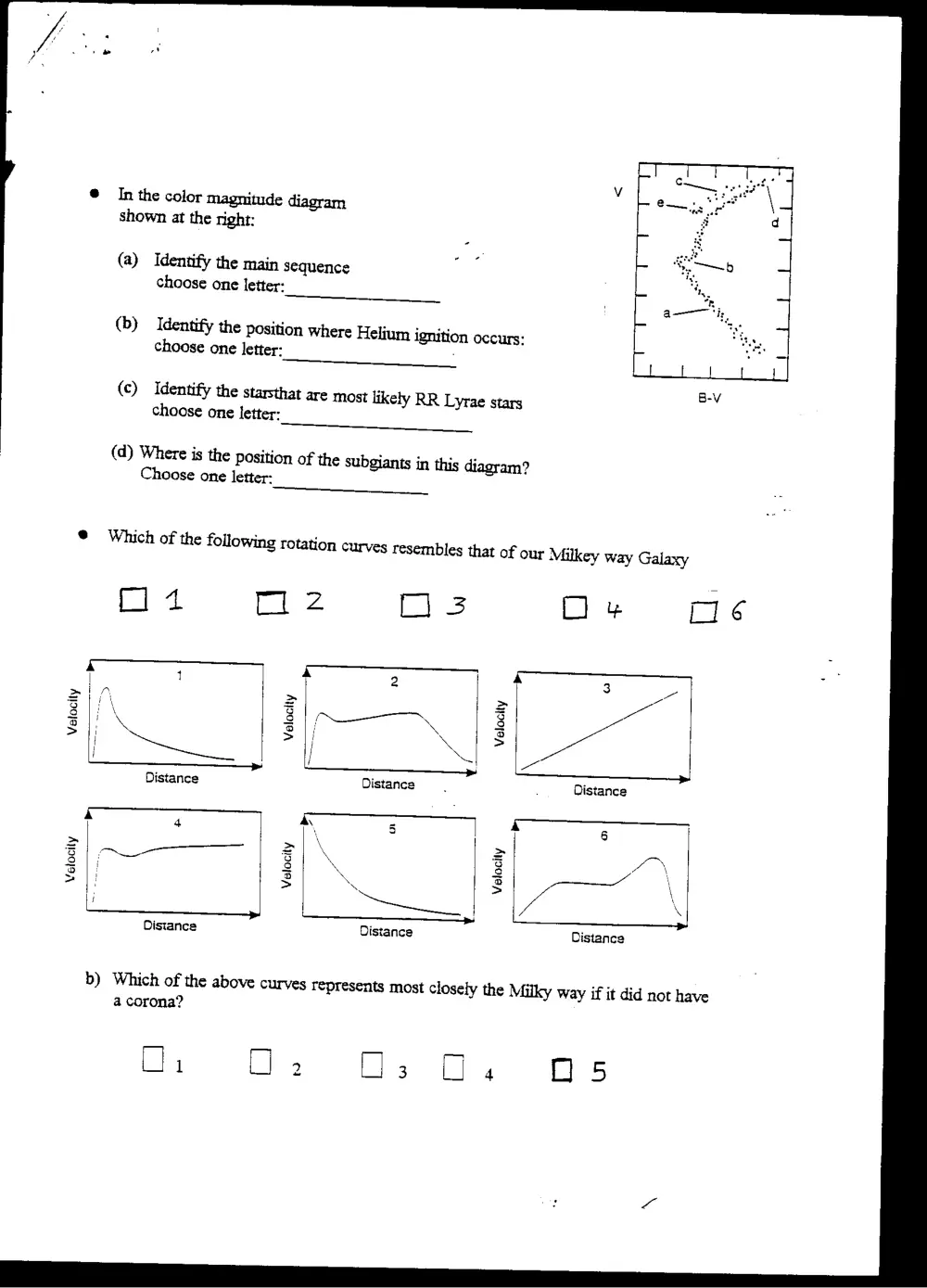
shown at the right:
choose one letter:
choose one letter:
@ In the color magnitude diagram
(a) Identify the main sequence
choose one letter:
(b) Identify the Position where Helium ignition occurs:
(c) Identify the starsthat are most likely RR Lyrae stars
Choose one letter:
(d) Where is the position of the
subgiants in this diagram?
a
@ Which of the following rotation curves resembles that of our
fl 4 Cl 2
Cj 3
Milkey way Galaxy
fl &
4 1 4 2 4 3
ain > 2 a
Syl \ rs] 8
3 Si! 3
EaE 3 | {OS 3
> {i > |} XN >
} | a“
> > -
Distance Distance Distance
‘ 4 xX 5 £ 6
> = =
Bi ~N 3 3 “™
3 |} 3 3 i
car S)o\ 3 \
| eee \
U —> _— —
Cistance
b) Which of the above curves represents most close:
a corona?
ty
Distance
[Cs O4
Distance
ly the Milky way if it did not have
D5
ma
‘@ + The graph shows the visible features of the Milky way Galaxy. The point 5 is
“> below the plane.
Our Home
a) What number best represents the approximate location of the sun?
|3
b) An old star in the halo of the Galaxy would be located at what number?
Js Ll 3
@ During the red giant phase of evolution, low-mass stars are:
(a) burning hydrogen in their cores
(b) burning helium in their cores
(c) burning helium in their cores and hydrogen in a shell
(d) only contracting
Stars may end their evolution by forming:
(a) onty black holes
(b) only neutron stars
(c) only white dwarfs
(d) White dwarfs, neutron stars or black holes depending on the mass
@ The 21-cm line of hydrogen is important for astronomy because
(a) stars emit strongty at this wavelength
(b) many cool dark clouds can be detected by it,
{c) it enables astronomer to detect “bt ack hales
(d) the interstellar material absorbs at this wavelength.
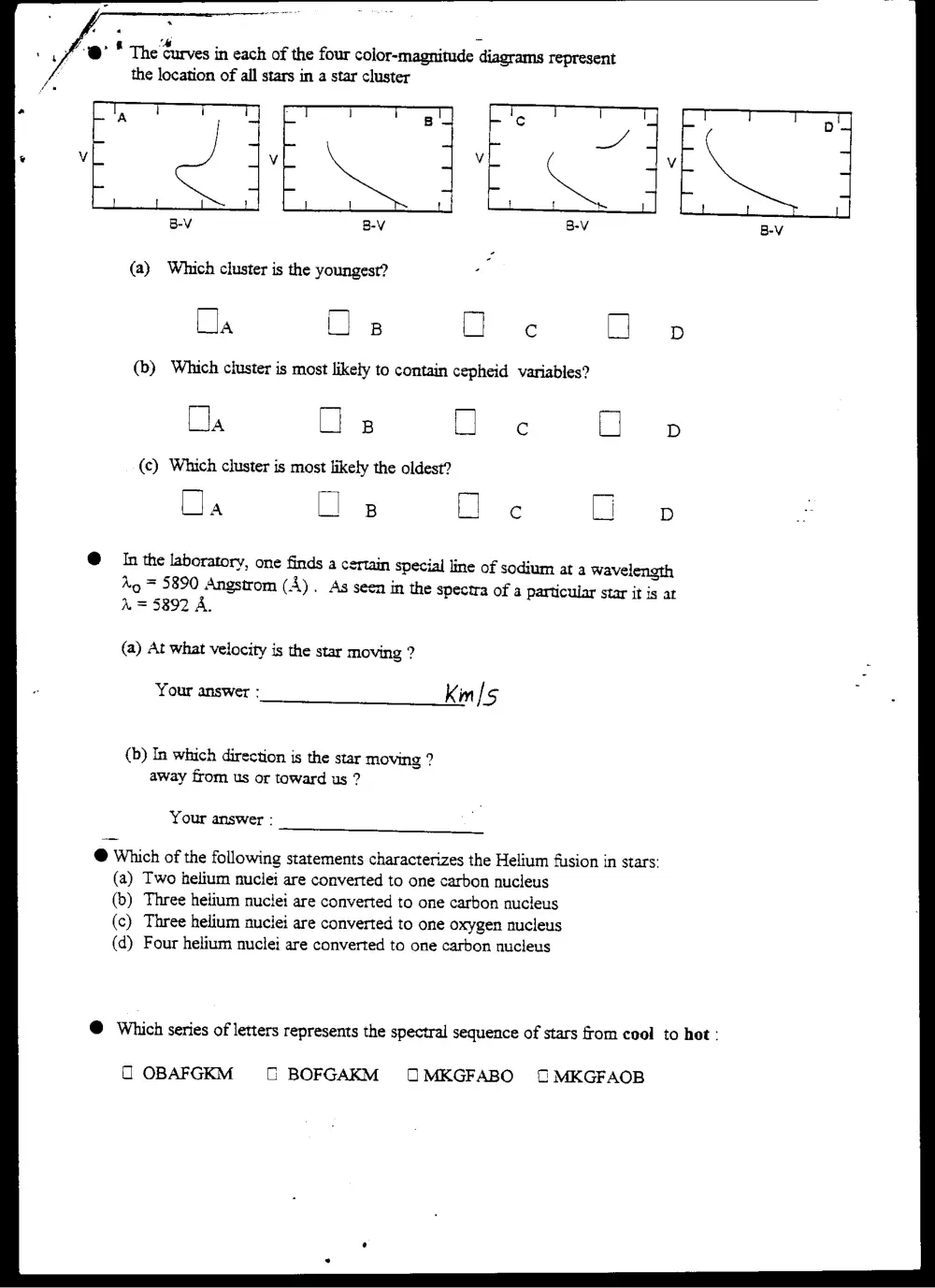
fe’ * The Curves in each of the four color-magnitude diagrams represent
; the location of all stars in a star cluster
—
B-V
(a) Which cluster is the youngest?
_—
LJ
A B Cc
(b) Which cluster is most likely to contain cepheid variables?
co
A B Cc
(c) Which cluster is most likely the oldest?
A L' B il c¢ i 6p
In the laboratory, one finds a certain special line of sodium at a wavelength
Ag =5 om (A). As seen in the spectra of a particular star it is at
A= 5892 A.
(a) At what velocity is the star moving ?
Your answer : Kin|s
(b) In which direction is the star moving ?
away from us or toward us ?
Your answer :
@ Which of the following statements characterizes the Helium fusion in stars:
(a) Two helium nuclei are converted to one carbon nucleus
(b) Three helium nuciei are converted to one carbon nucleus
(c) Three helium nuciei are converted to one oxygen nucleus
(d) Four helium nuclei are converted to one carbon nucleus
@ Which series of letters represents the spectral sequence of stars from cool to hot:
G OBAFGKM (C BOFGAKM OMKGFABO ©MKGFAOB