
PHYS 200 Final, Spring 1999
American University of Beirut · Understanding the Universe · 9 pages

More PHYS 200 files
Show the text of this final exam
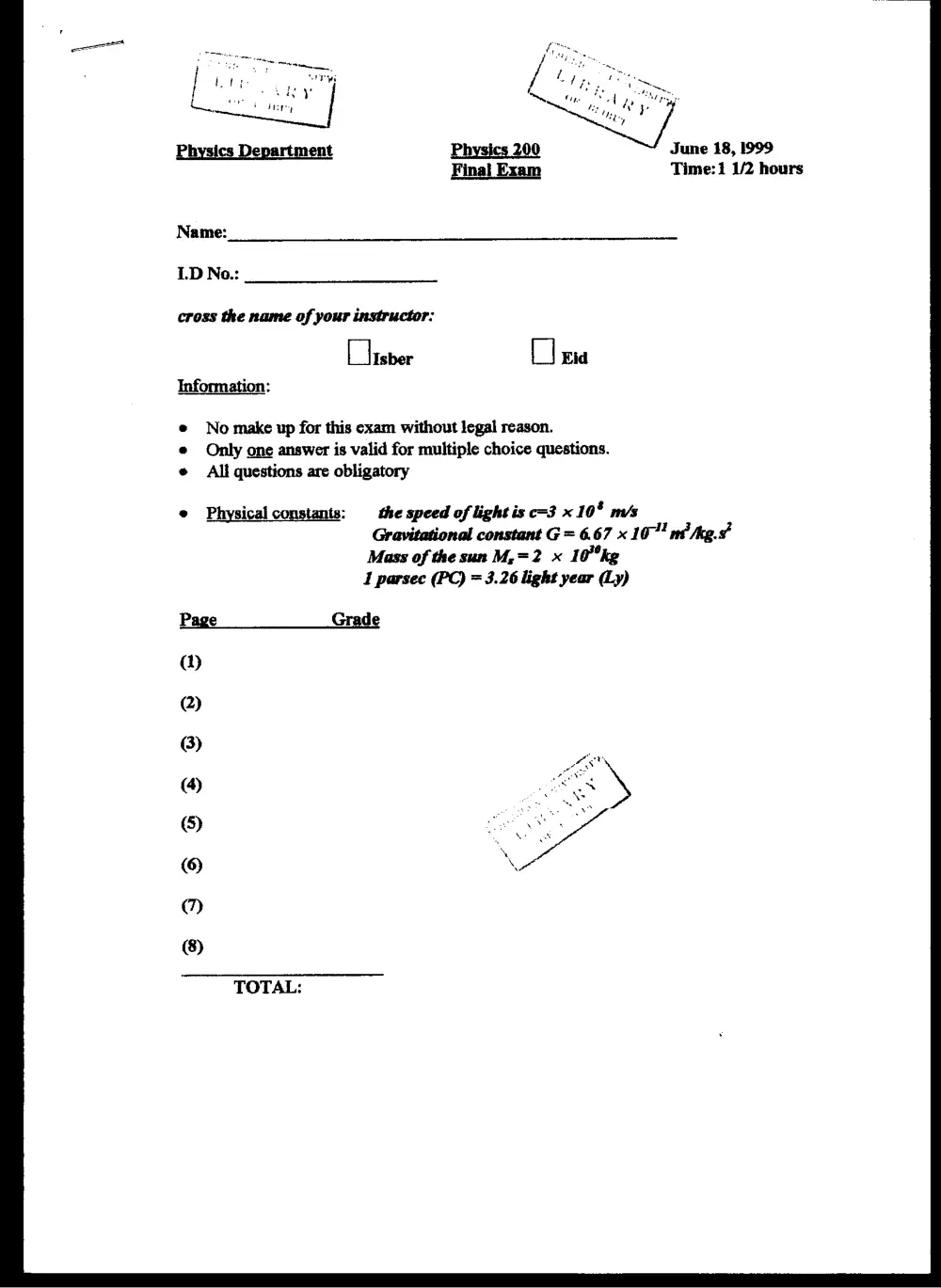
hysics De! ent Ph 200 June 18, 1999
Final Exam Time:1 1/2 hours
Name:
LD No.:
cross the name of your instructor:
[ lisber [| Eid
Information:
e No make up for this exam without legal reason.
e Only one answer is valid for multiple choice questions.
All questions are obligatory
e Physical constants: tse speed of light is c=3 x10* m/s
Gravitational constant G = 6.67 x 10" mb ‘kg.
Mass of the sun M,=2 x 10°*kg
I parsec (PC) = 3.26 light year (Ly)
8)
TOTAL:
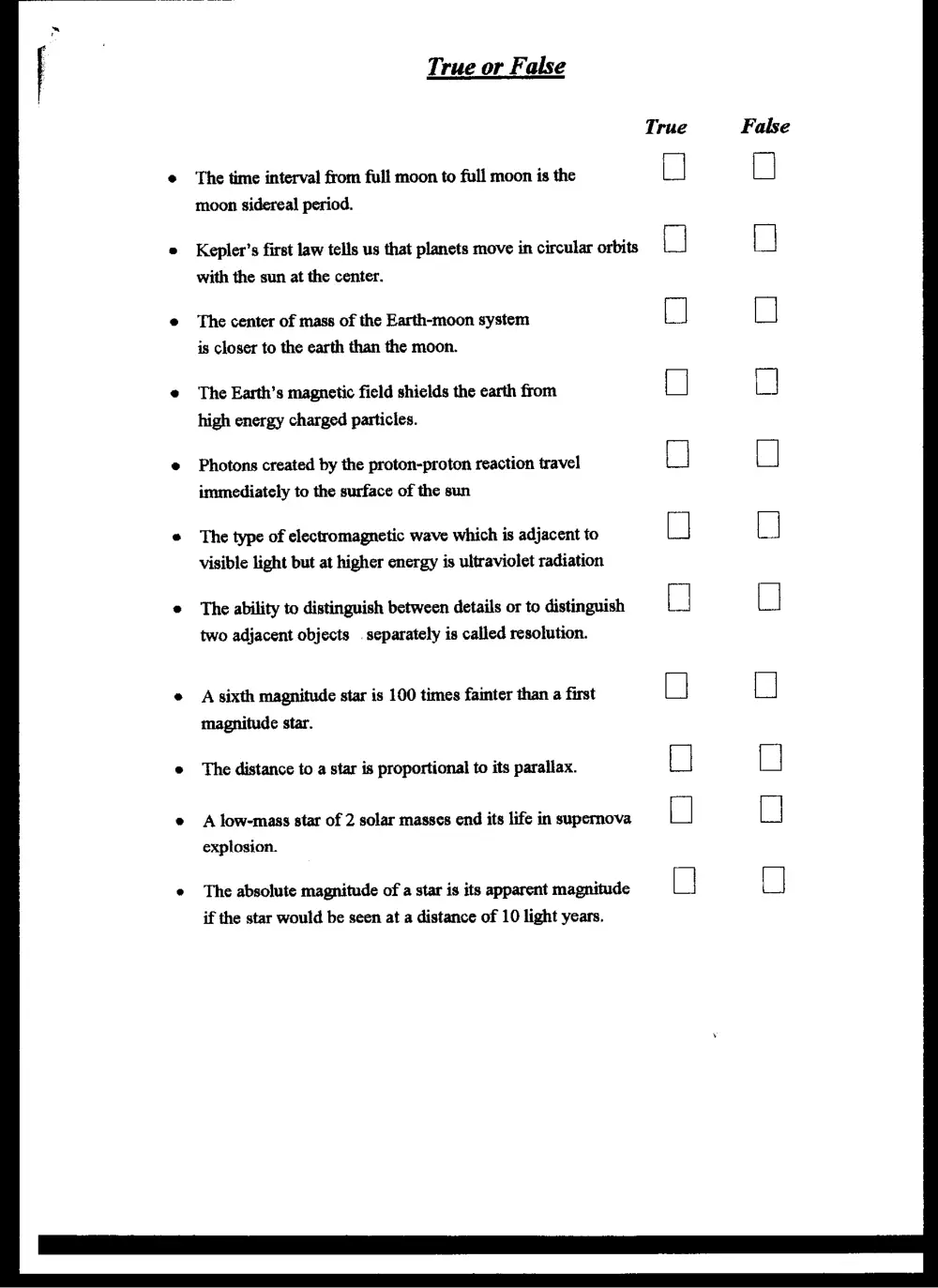
True or False
© The time interval from full moon to full moon is the
moon sidereal period.
© Kepler's first law tells us that planets move in circular orbits
with the sun at the center.
e The center of mass of the Earth-moon system
is closer to the earth than the moon.
e The Earth’s magnetic field shields the earth from
high energy charged particles.
© Photons created by the proton-proton reaction travel
immediately to the surface of the sun
e The type of electromagnetic wave which is adjacent to
visible light but at higher energy is ultraviolet radiation
© The ability to distinguish between details or to distinguish
two adjacent objects . separately is called resolution.
e Asixth magnitude star is 100 times fainter than a first
magnitude star.
© The distance to a star is proportional to its parallax.
e A low-mass star of 2 solar masses end its life in supernova
explosion.
© The absolute magnitude of a star is its apparent magnitude
if the star would be seen at a distance of 10 light years.
True
False
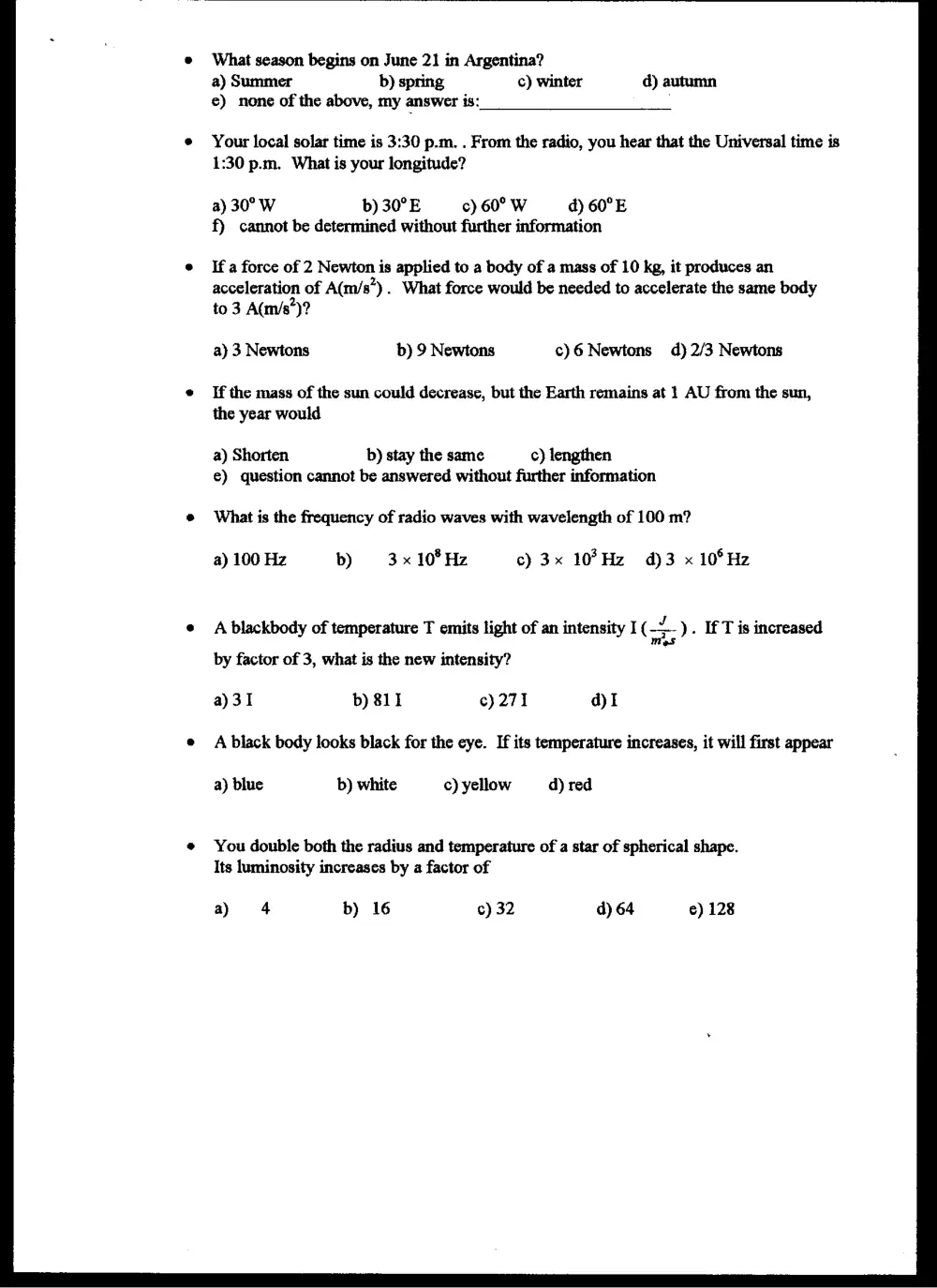
What season begins on June 21 in Argentina?
a) Summer b) spring c) winter d) autumn
e) none of the above, my answer is: ‘
Your local solar time is 3:30 p.m. . From the radio, you hear that the Universal time is
1:30 p.m. What is your longitude?
a) 30°W b) 30°E c) 60° W d) 60°E
f) cannot be determined without further information
If a force of 2 Newton is applied to a body of a mass of 10 kg, it produces an
acceleration of A(m/s”). What force would be needed to accelerate the same body
to 3 A(m/s”)?
a) 3 Newtons b) 9 Newtons ¢)6 Newtons d) 2/3 Newtons
If the mass of the sun could decrease, but the Earth remains at 1 AU from the sun,
the year would
a) Shorten b) stay the same ¢) lengthen
€) question cannot be answered without further information
What is the frequency of radio waves with wavelength of 100 m?
a) 100 Hz b) 3.x 10° Hz c) 3x 10°Hz d)3 x 10°Hz
A blackbody of temperature T emits light of an intensity I (3: ). If T is increased
ew
by factor of 3, what is the new intensity?
a) 31 b) 811 c) 271 di
A black body looks black for the eye. If its temperature increases, it will first appear
a) blue b) white c) yellow d) red
You double both the radius and temperature of a star of spherical shape.
Its luminosity increases by a factor of
a) 4 b) 16 ¢) 32 d) 64 e) 128
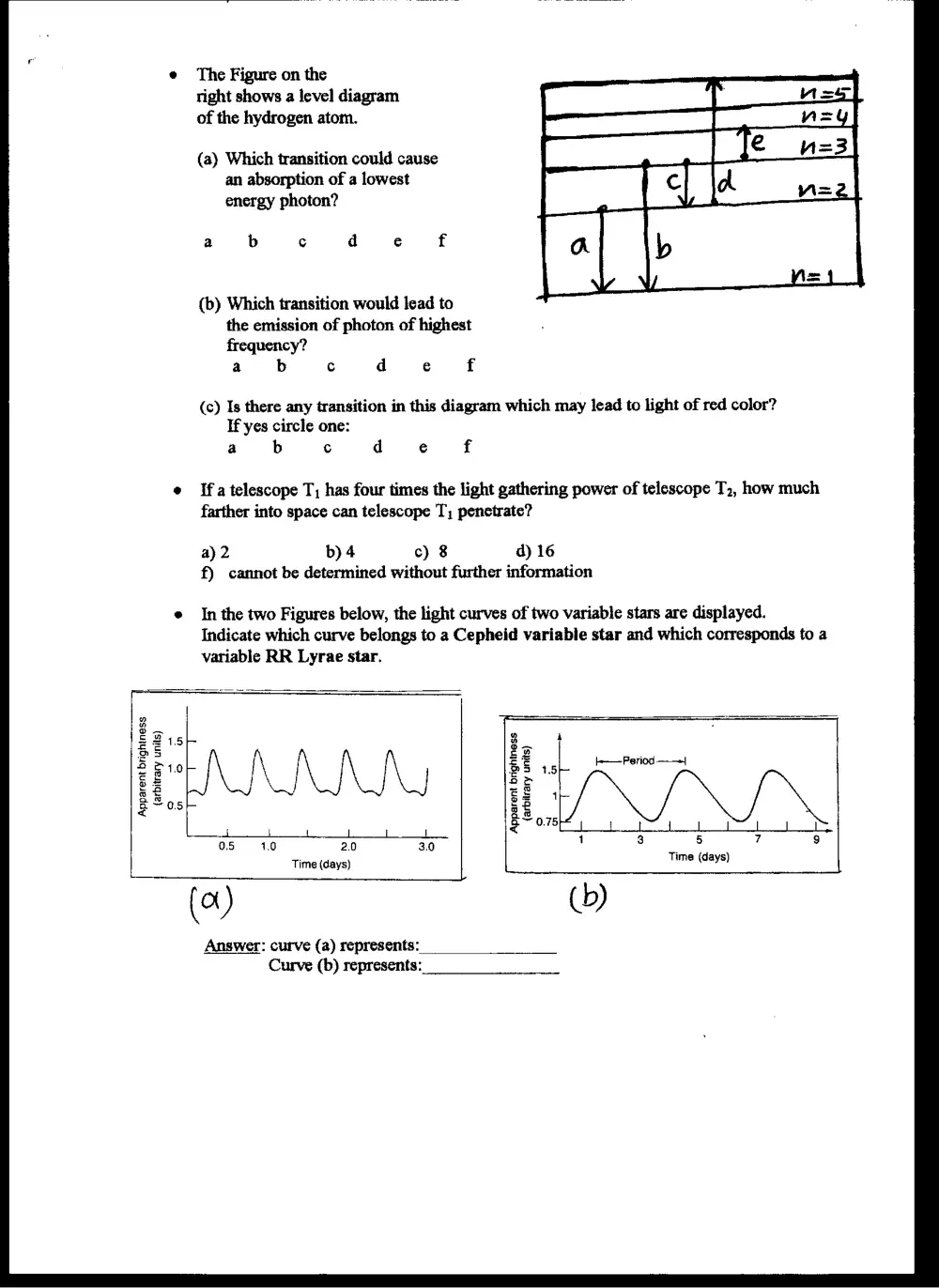
e The Figure on the
right shows a level diagram
of the hydrogen atom.
(a) Which transition could cause
an absorption of a lowest
energy photon?
a b c d e f
(b) Which transition would lead to
the emission of photon of highest
frequency?
a b c d e f
(c) Is there any transition in this diagram which may lead to light of red color?
If yes circle one:
a b c d e f
e Ifa telescope T, has four times the light gathering power of telescope T2, how much
farther into space can telescope T, penetrate?
a)2 b)4 c) 8 d) 16
f) cannot be determined without further information
© In the two Figures below, the light curves of two variable stars are displayed.
Indicate which curve belongs to a Cepheid variable star and which corresponds to a
variable RR Lyrae star.
~ - —
g
£215 FA
5 £2
SPB $5
= 8 1.0 Be 15
as 52 1
37 0.5 as
~ 0.75
nN \ n 1 | ! 2 4 ~
0.5 1.0 2.0 3.0 ' 3 ‘ 5 ? 8
Time (days) Time (days)
(a) (D)
Answer: curve (a) represents:
Curve (b) represents:
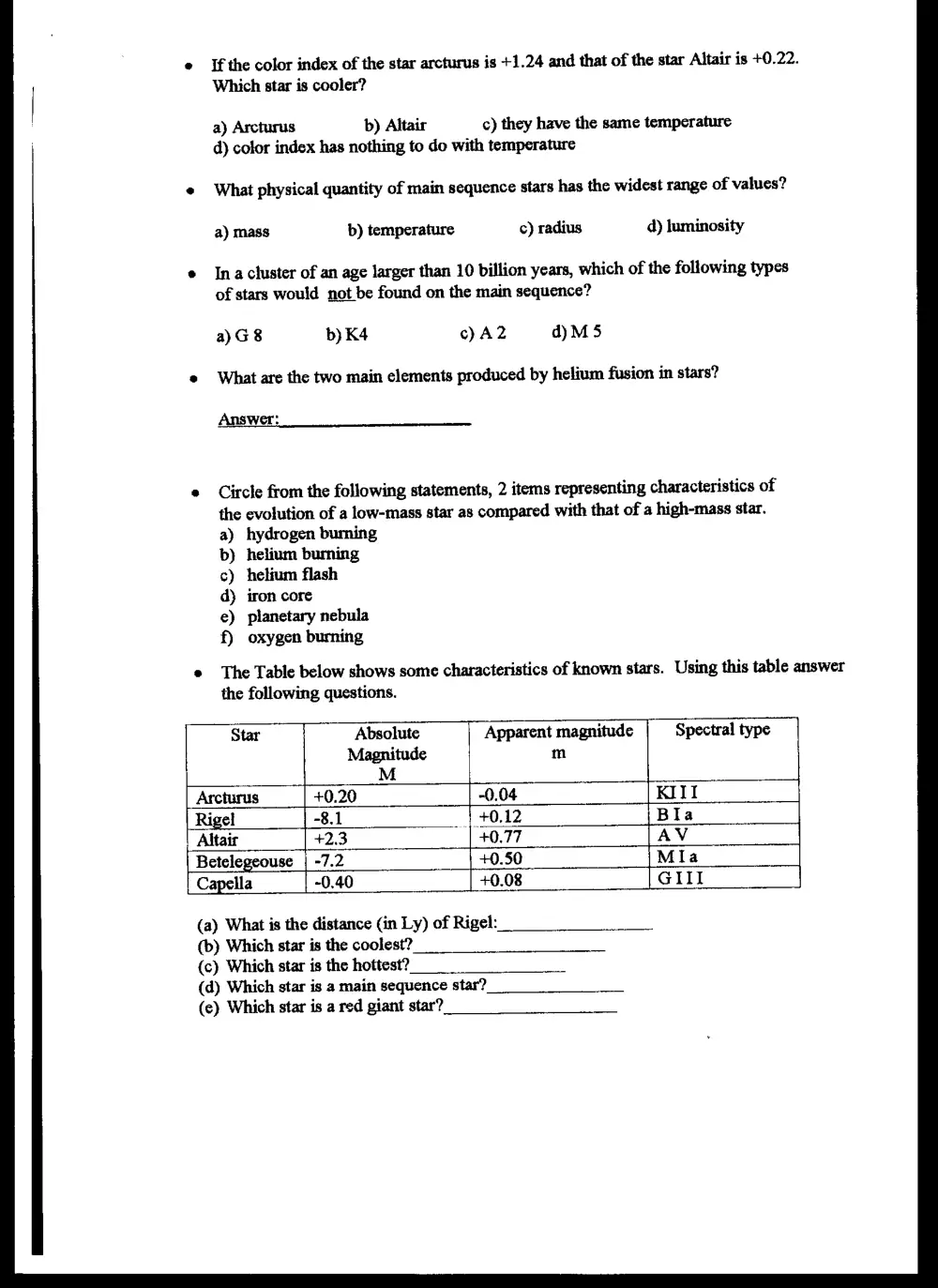
e If the color index of the star arcturus is +1.24 and that of the star Altair is +0.22.
Which star is cooler?
a) Arcturus b) Altair c) they have the same temperature
d) color index has nothing to do with temperature
© What physical quantity of main sequence stars has the widest range of values?
a) mass b) temperature c) radius d) luminosity
« Inactluster of an age larger than 10 billion years, which of the following types
of stars would not be found on the main sequence?
a)G8 b) K4 c)A2 d)M5
© What are the two main elements produced by helium fusion in stars?
Answer:
e Circle from the following statements, 2 items representing characteristics of
the evolution of a low-mass star as compared with that of a high-mass star.
a) hydrogen burning
b) helium buming
c) helium flash
d) iron core
e) planetary nebula
f) oxygen burning
e The Table below shows some characteristics of known siars. Using this table answer
the following questions.
Star Absolute Apparent magnitude Spectral type
Magnitude m
M
Arcturus +0.20 -0.04 KIII
Rigel -8.1 _ 1 +012 Bla
Altair +23 +0.77 AV |
Betelegeouse | -7.2 +0.50 Mia
Capella ~0.40 +0.08 GIl
(a) What is the distance (in Ly) of Rigel:
(b) Which star is the coolest?
(c) Which star is the hottest?
(d) Which star is a main sequence star?
(¢) Which star is a red giant star?
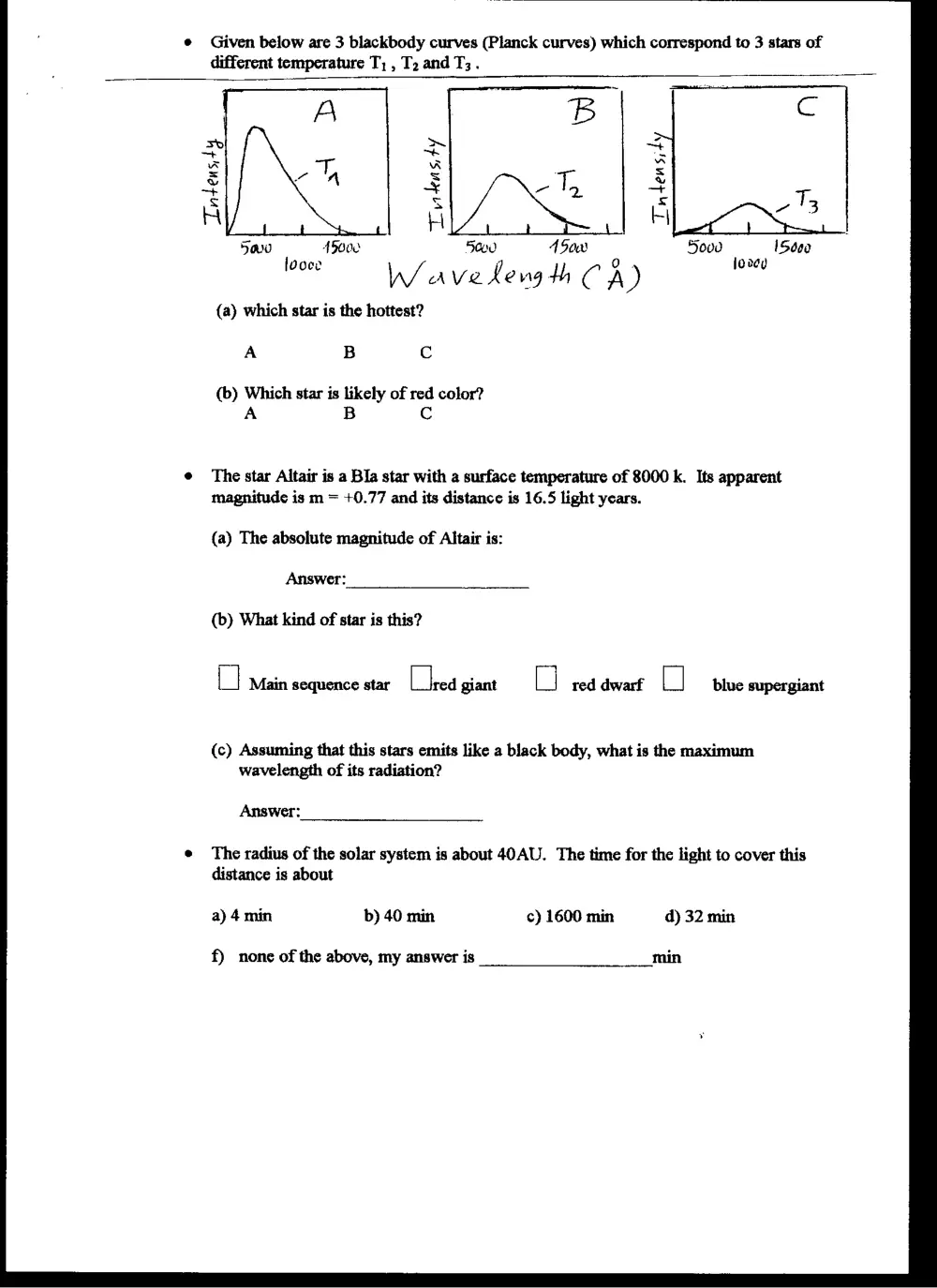
e Given below are 3 blackbody curves (Planck curves) which correspond to 3 stars of
different temperature T, , T. and T; .
a
= an
KY
Faw 45000 Sau 45008 ovo 15000
looce \/ cA Ve de Ay) +h C A) _
(a) which star is the hottest?
A B Cc
(b) Which star is likely of red color?
A B Cc
e The star Altair is a Bla star with a surface temperature of 8000 k. Its apparent
magnitude is m = +0.77 and its distance is 16.5 light years.
(a) The absolute magnitude of Altair is:
Answer:
(b) What kind of star is this?
Main sequence star red giant red dwarf blue supergiant
(c) Assuming that this stars emits like a black body, what is the maximum
wavelength of its radiation?
Answer:
e The radius of the solar system is about 40AU. The time for the light to cover this
distance is about
a) 4 min b) 40 min ¢) 1600 min d) 32 min
f) none of the above, my answer is min
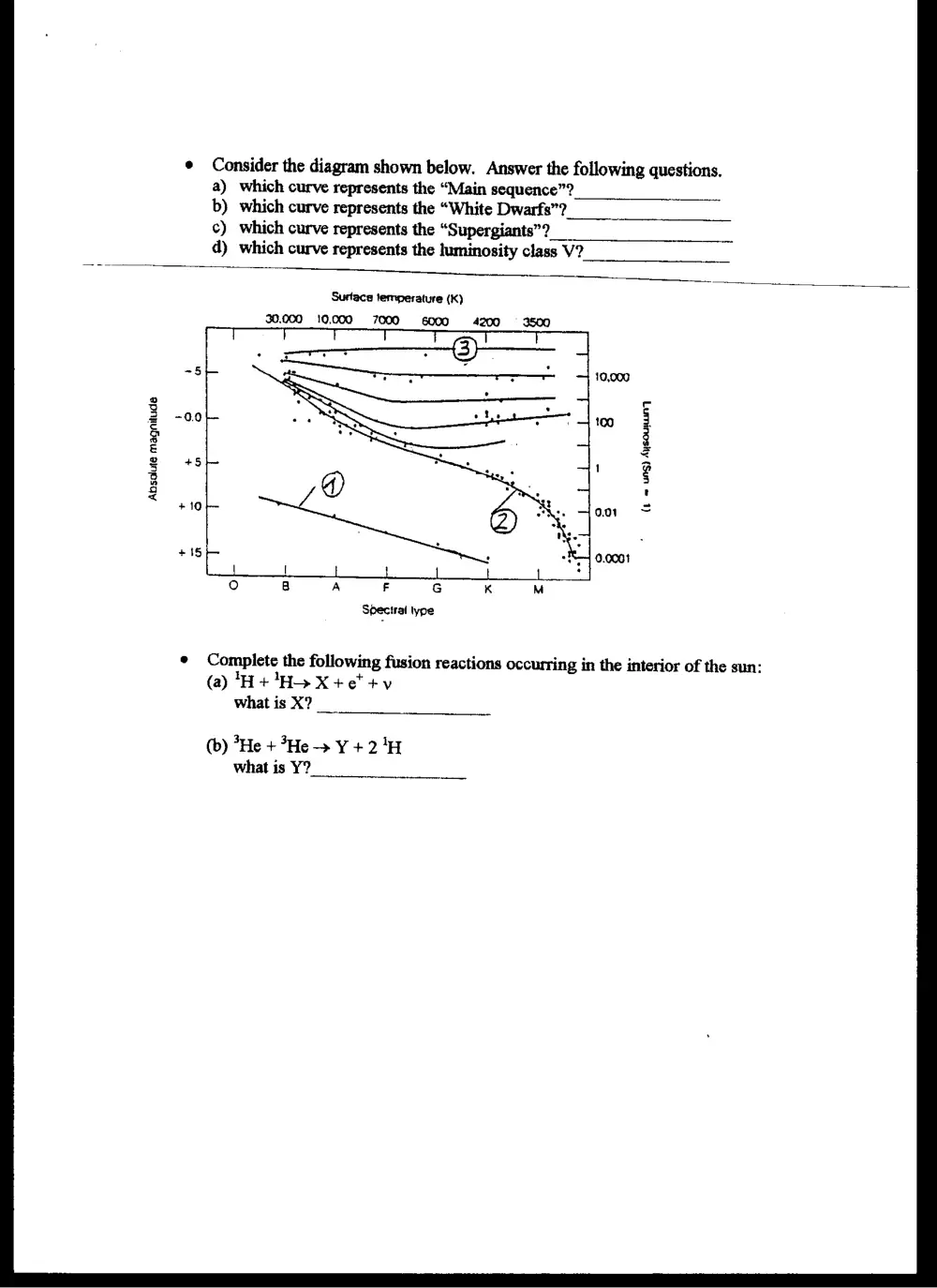
° Consider the diagram shown below. Answer the following questions.
a) which curve represents the “Main sequence”?
b) which curve represents the “White Dwarfs”?
¢) which curve represents the “Supergiants”?
d) which curve represents the luminosity class V?
Surface temperature (K)
30,000 10.000 7000 6000 4200 3600
T
-§5- 10,000
o c
ao] :
a -0.0-- oe . + 100 3
& > ° 3
& <
2 +5h 1 g
3 §
g '
< =
sok on
HIB KR 0.0001
Lt
ie)
Spectral lype
¢ Complete the following fusion reactions occurring in the interior of the sun:
(@) ‘H+ Ho X+eT+y
what is X?
(b) *He + *He -» Y+2°H
what is Y?
¢ Which type of supernovae have hydrogen emission lines in their spectra?
a) Type I (from binary stars)
b) Type II (from single stars)
c) Neither type has hydorgen lines
d) When a star explodes as a supernova, it cannot have hydrogen
e Pulsars are:
a) larger and more massive than neutron stars
b) smaller but more massive than neutron stars
¢) smaller and less massive than neutron stars
d) the same as neutron stars
© What temains after a supernova.
a) ared giant star
b) a white dwarf
c) aneutron stars
d) a black hole
e) either c) or d) depending on the mass of the star.
e The Schwarzschild radius of a star of 3 solar masses is about
a) 4.5 km b) 9.0 km c)zero — d) 0.09 km
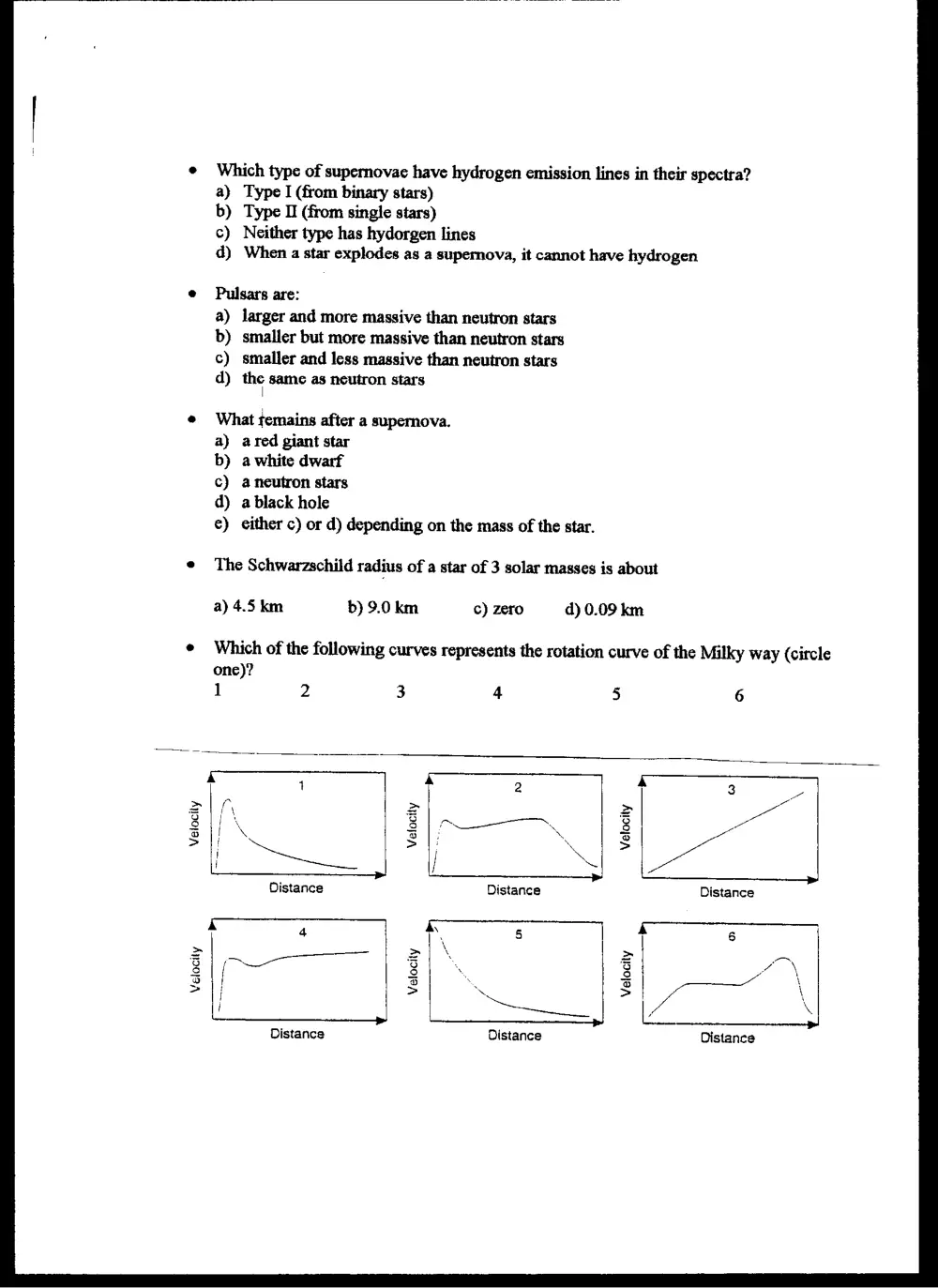
¢ Which of the following curves represents the rotation curve of the Milky way (circle
one)?
1 2 3 4 5 6
£ 7 & 2 ‘ 3 ~
awe > 2 “
B |) §| we 8 a
ay \ 3]: ‘ s
> Tt > |: nN >
. a
—> > >
Distance Distance Distance
x a | x 5 £ 6
> =| \ 2 _
BiB 3 -_
3 i $ N, s So \
j oe |. \
> — —p!
Distance Distance Distance
The bright granules on the sun’s surface are regions of
hot gas rising.
A type-A star looks reddish
A 5-meter diameter telescope will collect 10 times
more light than a 1 meter diameter telescope.
Relative to a solar day, a sidereal day is 4 minutes longer.
When the planets drift backward with respect to the stars,
the motion is called retrograde.
A full rainbow of colors given off by a hot star is called
emission spectrum.
The region of the sun where most of the radiation
escapes is called photosphere.
The temperature of the sun’s corona is smaller than that
of the photosphere.
Gravity is the force that lead to the fusion of
2 protons in the sun.