
PHYS 200 Final, Fall 1997
American University of Beirut · Understanding the Universe · 9 pages

More PHYS 200 files
Show the text of this final exam
Physics Department Physics 200 February 5, 1998
Final Exam Time: 1 4% hours
Name:
LD. No.
Information
¢ No make up of this exam without legal reason
¢ Incase of multiple choice questions, more than one answer will cancel the whole question.
e All questions are obligatory.
¢ Whenever you need the speed of light, it is : 3 x 10° mis.
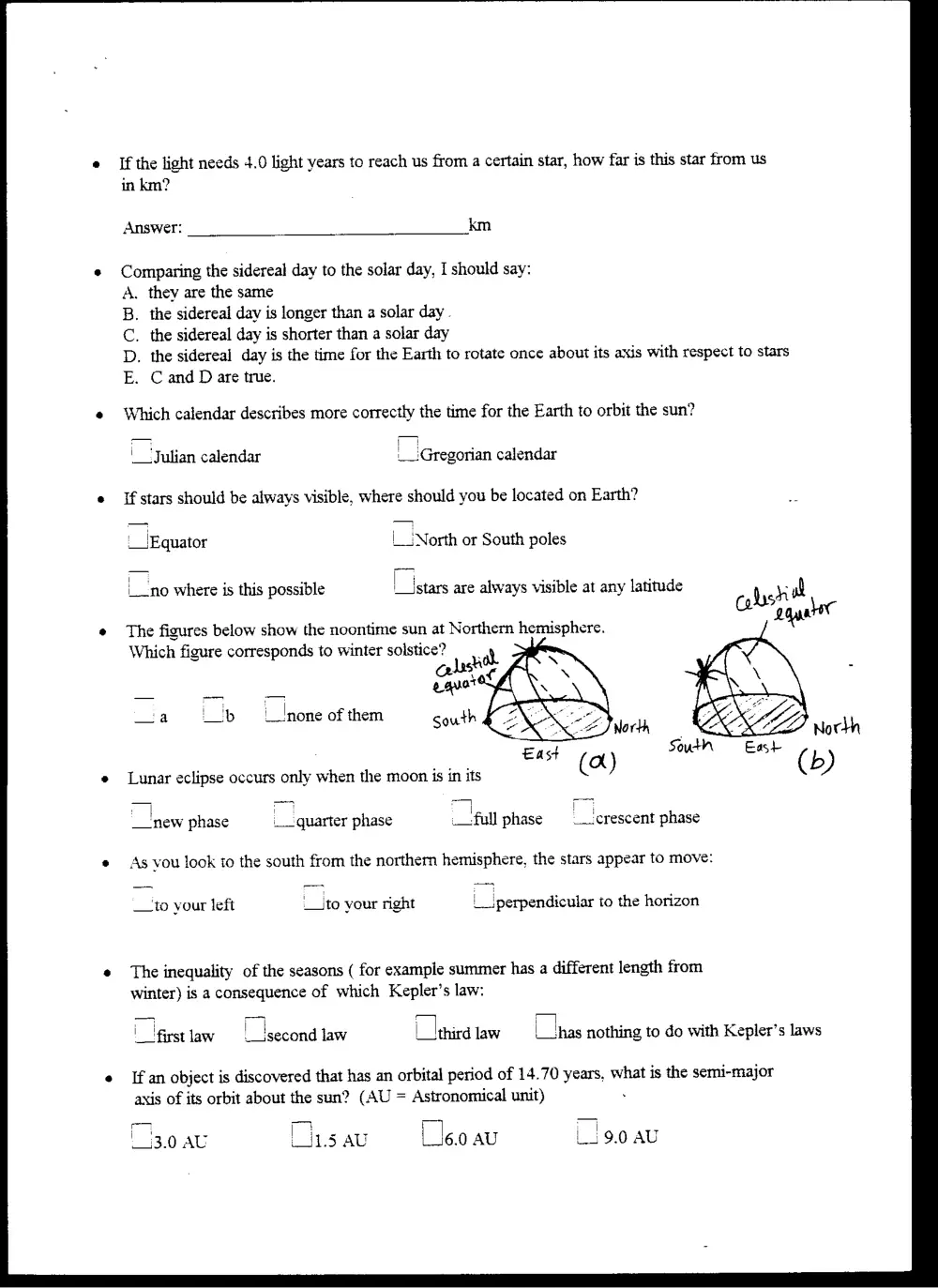
If the light needs 4.0 light years to reach us from a certain star, how far is this star from us
in km?
Answer: km
Comparing the sidereal day to the solar day, I should say:
A. they are the same
B. the sidereal day is longer than a solar day .
C. the sidereal day is shorter than a solar day
D. the sidereal day is the time for the Earth to rotate once about its axis with respect to stars
E. Cand D are true.
Which calendar describes more correctly the time for the Earth to orbit the sun?
‘Julian calendar |_Gregorian calendar
If stars should be always visible, where should you be located on Earth?
_lEquator |_North or South poles
i__no where is this possible | istars are always visible at any latitude
The figures below show the noontime sun at Northern hemisphere.
Which figure corresponds to winter solstice? AY .
calistie A
- emo \
; |) _|none of them th [BXED ZZ
South — East (
Lunar eclipse occurs only when the moon is in its
"new phase __ quarter phase full phase __lerescent phase
As vou look to the south from the northern hemisphere, the stars appear to move:
__'to your left __jto your right __iperpendicular to the horizon
The inequality of the seasons ( for example summer has a different length from
winter) is a consequence of which Kepler’s law:
"| |
\_ first law _Isecond law _ltnira law thas nothing to do with Kepler’s laws
If an object is discovered that has an orbital period of 14.70 years, what is the semi-major
axis of its orbit about the sun? (AU = Astronomical unit)
3.0 AU 1.5 AU Jeo au _|9.0 AU
¢ Ifyou could double the mass of the Earth, but keep its radius the same, you will be
attracted to the Earth’s center by force that is:
4 . i . ee
| the same __Jfour times larger (twice larger |_Jeignt times larger
e What is the wavelength of a 100 MHz ( MHz = Mega Hertz) radio signal?
Answer: meters
e An object A has a black body emission spectrum that peaks (has a maximum) at a wavelength
of 2x 1073cm. Another object B has a spectrum that peaks at 5.8 x 10⁷~Som.
rm
(a) which object is hotter? __JA LB
(b) the temperature of object A is :
LW 3800K | _/4000K 5000 K _—i_not possible to obtain from these information
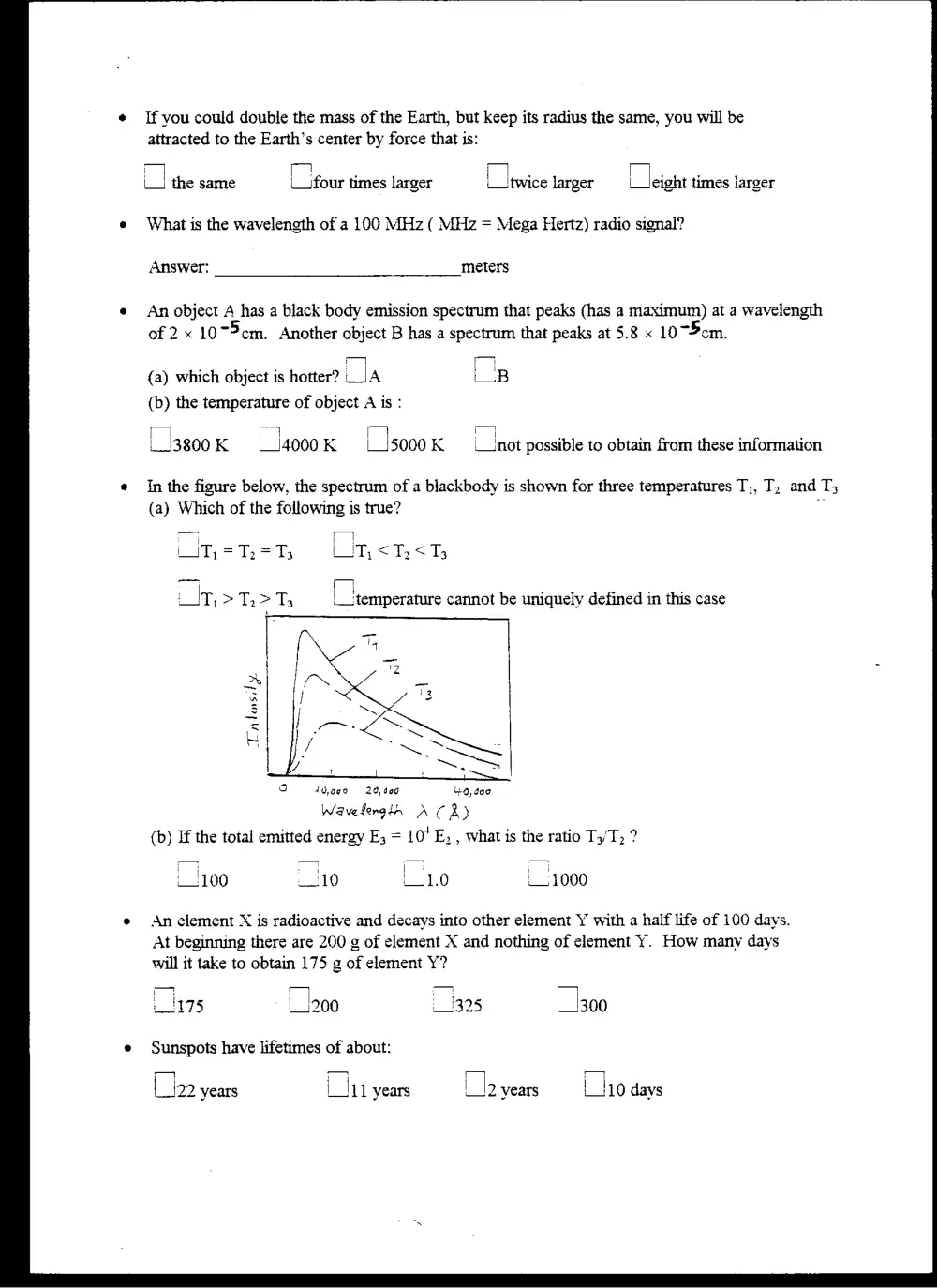
« In the figure below, the spectrum of a blackbody is shown for three temperatures T,, T, and T;
(a) Which of the following is true? ~
~~ 1
_IT, =T,=T; LIT, <T,< Ts;
a mq , a.
LIT, >T,>T; __ ‘temperature cannot be uniquely defined in this case
i] d4Qjag0 20, ¢00 40,400
Wavedengin CR)
(b) If the total emitted energy E; = 10° E; , what is the ratio TyT> ?
| 100 10 | 190 _ $1000
e An element X is radioactive and decays into other element Y with a half life of 100 days.
At beginning there are 200 g of element X and nothing of element Y. How many days
will it take to obtain 175 g of element Y?
— i —
1175 - | [200 _ 1325 |_|300
e Sunspots have lifetimes of about:
—
1_|22 years ili years Ll years | 10 days
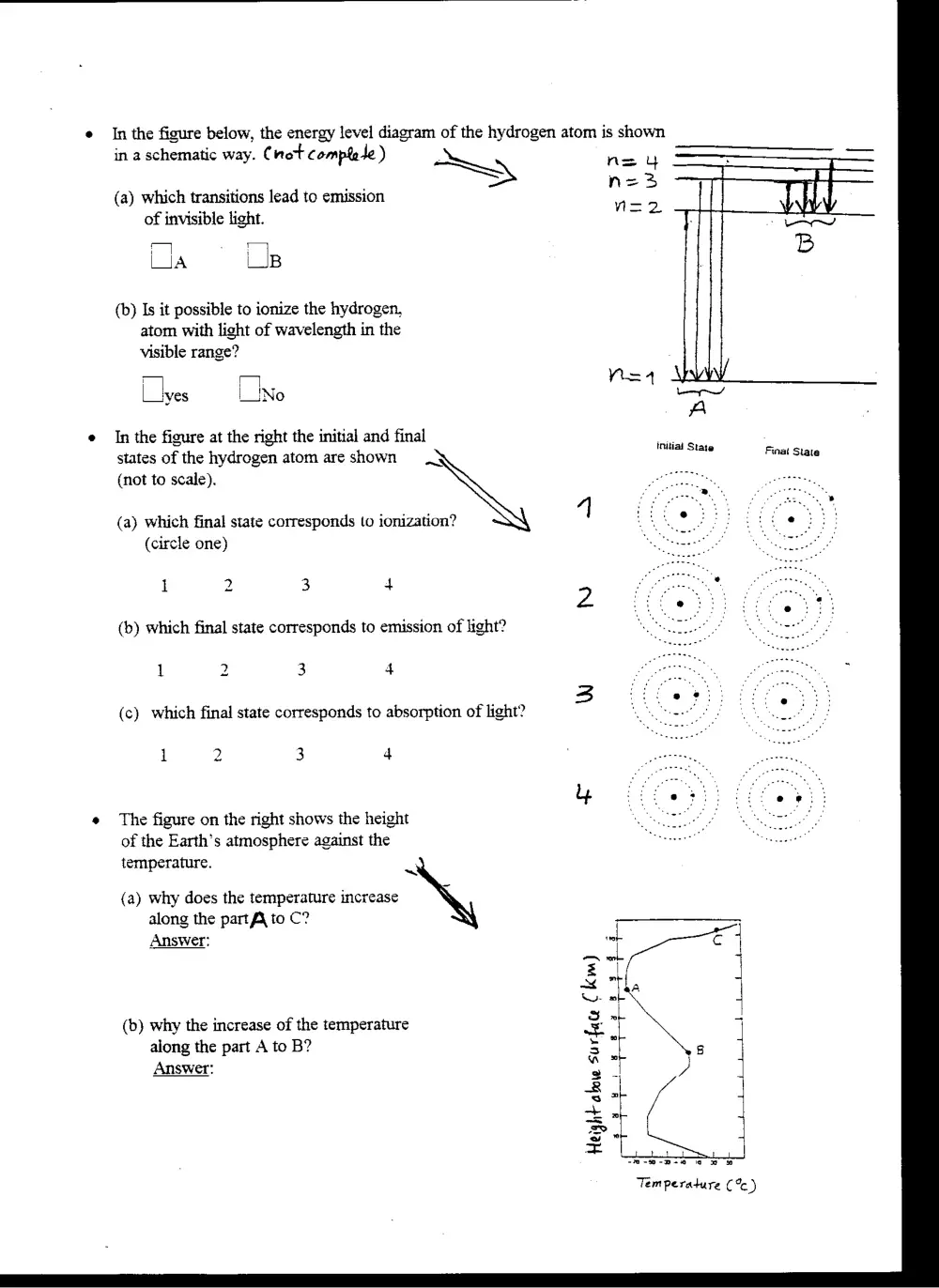
e Inthe figure below, the energy level diagram of the hydrogen atom is shown
in a schematic way. Cnet complete )
SS TS
(a) which transitions lead to emission n= >
of invisible light. ~ : :
LIA _JB . B
(b) Is it possible to ionize the hydrogen,
atom with light of wavelength in the
visible range?
ves | No La
a
S
iN
—
e In the figure at the right the initial and final initial Se
states of the hydrogen atom are shown ate Final State
(not to scale).
(a) which final state corresponds to ionization? 4
(circle one)
1 2 3 4
(b) which final state corresponds to emission of light?
1 2 3 4
(c) which final state corresponds to absorption of light?
1 2 3 4
¢ The figure on the right shows the height
of the Earth’s atmosphere against the
temperature.
~
(a) why does the temperature increase
along the part fA to C?
Answer: ai a4
?7 |
se
& Tk |
(b) why the increase of the temperature = “7 5
along the part A to B? $ a s |
Answer: |. 2? 7
8 om
3
ka
>
=
TR -D- 6 a
Temperature Cc)
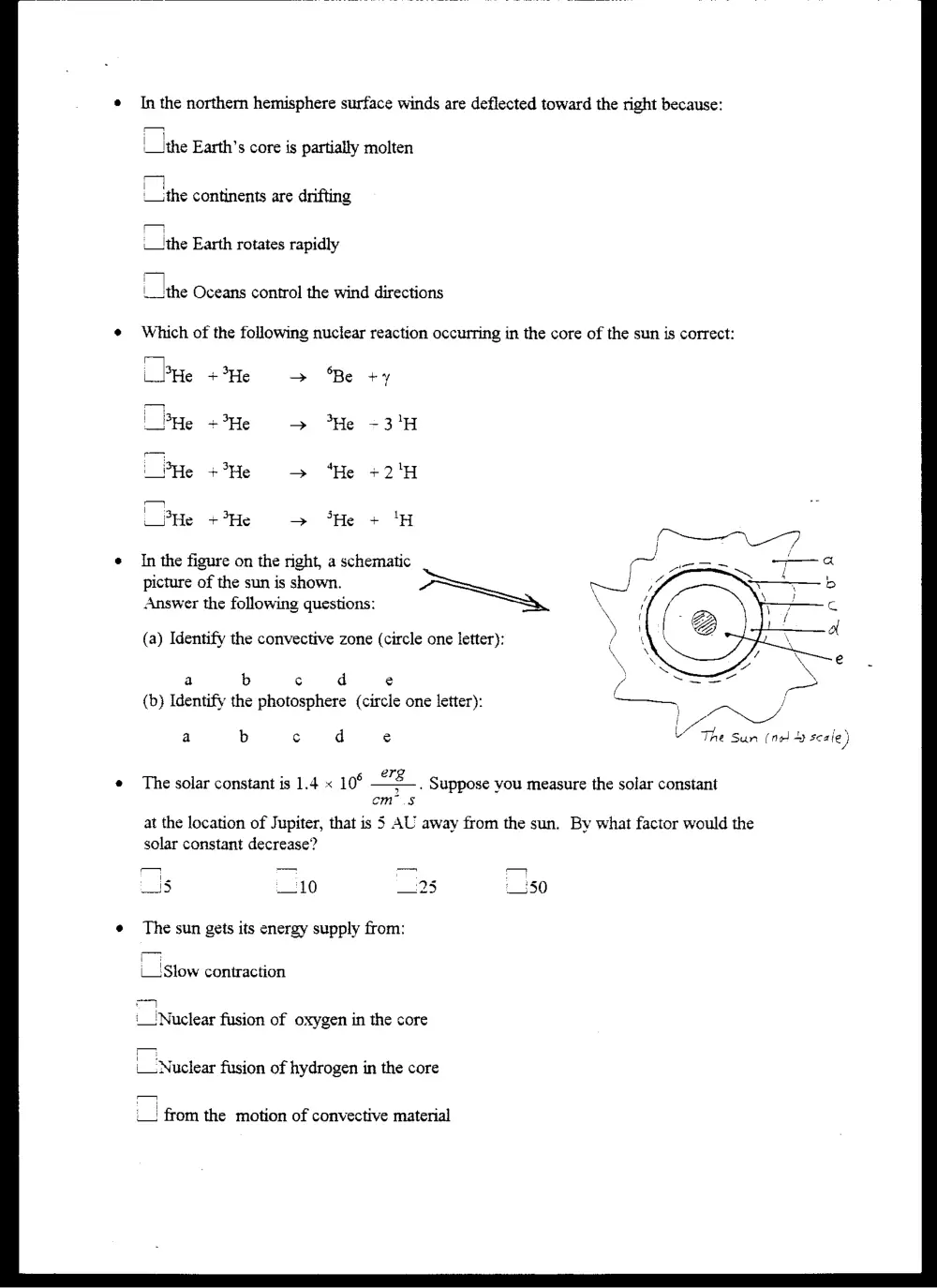
e In the northern hemisphere surface winds are deflected toward the right because:
\_Ithe Earth’s core is partially molten
—
\_ithe continents are drifting
co
__lIthe Earth rotates rapidly
f
__Ithe Oceans control the wind directions
¢ Which of the following nuclear reaction occurring in the core of the sun is correct:
—
iPHe +*He > Be +y¥
H 1
| PHe + He > “He -3'H
| PHe + *He > ‘He +2'H
—
1
_ He +°He > *He + 'H
e In the figure on the right, a schematic
picture of the sun is shown. 7
Answer the following questions:
(a) Identify the convective zone (circle one letter):
a b © d e
(b) Identify the photosphere (circle one letter): ee /
Lx a4
a b c d ¢ The Sun (nol + scale)
e The solar constant is 1.4 x 10° ore . Suppose vou measure the solar constant
em” ss
at the location of Jupiter, that is 5 AU away from the sun. By what factor would the
solar constant decrease?
— — —
IS _10 25 _ 350
e The sun gets its energy supply from:
-
\_'Stow contraction
oq
i_!Nuclear fusion of oxygen in the core
|_Nuclear fusion of hydrogen in the core
—
__| from the motion of convective material
What kind of particle leaves the sun without interaction?
— — — —
v4 ii toe Hy
__ photon __ electron i_cneuirino __ proton
The stellar spectral sequence from hottest to coolest is:
— ~ —
__|OFGKMGB |_| ABFGKMO \_\OBAF GKM __OBAFGMK
A first magnitude star is how may times brighter than an eleventh magnitude star?
H al l4 ma mo
10 i_Is5o L_Jj100 31,000 _ 110,000
A star has a distance of 10 parsecs. What is its parallax?
—~ — — —
__!10 minutes of are |_!10 seconds of arc 01 seconds of arc ‘10.01 seconds of arc
A star has a radial velocity of 30 km’s and a tangential velocity of 40 km/s. The space
velocity (proper motion) of this star is :
— — —
7 m7 mJ
i_/10 km/s __}20 km/s __ 125 km/s __!50 km/s
At what radial velocity would a spacecraft have to be moving for a radio station
transmitting at 100 MHz ( 10° Hertz) to be picked up by a radio tuned to 99.9 MHz?
— — — —
_'6 00 kms 3.00 kms _-300km/s __9 00 kms
A star A has a color index B-V = 0, another star B has a color index + 0.50,
Which star is hotter?
A an)
Mention three possible end stages of stellar evolution:
How far is the sun from the galactic center?
1
i
__ 10 kpc
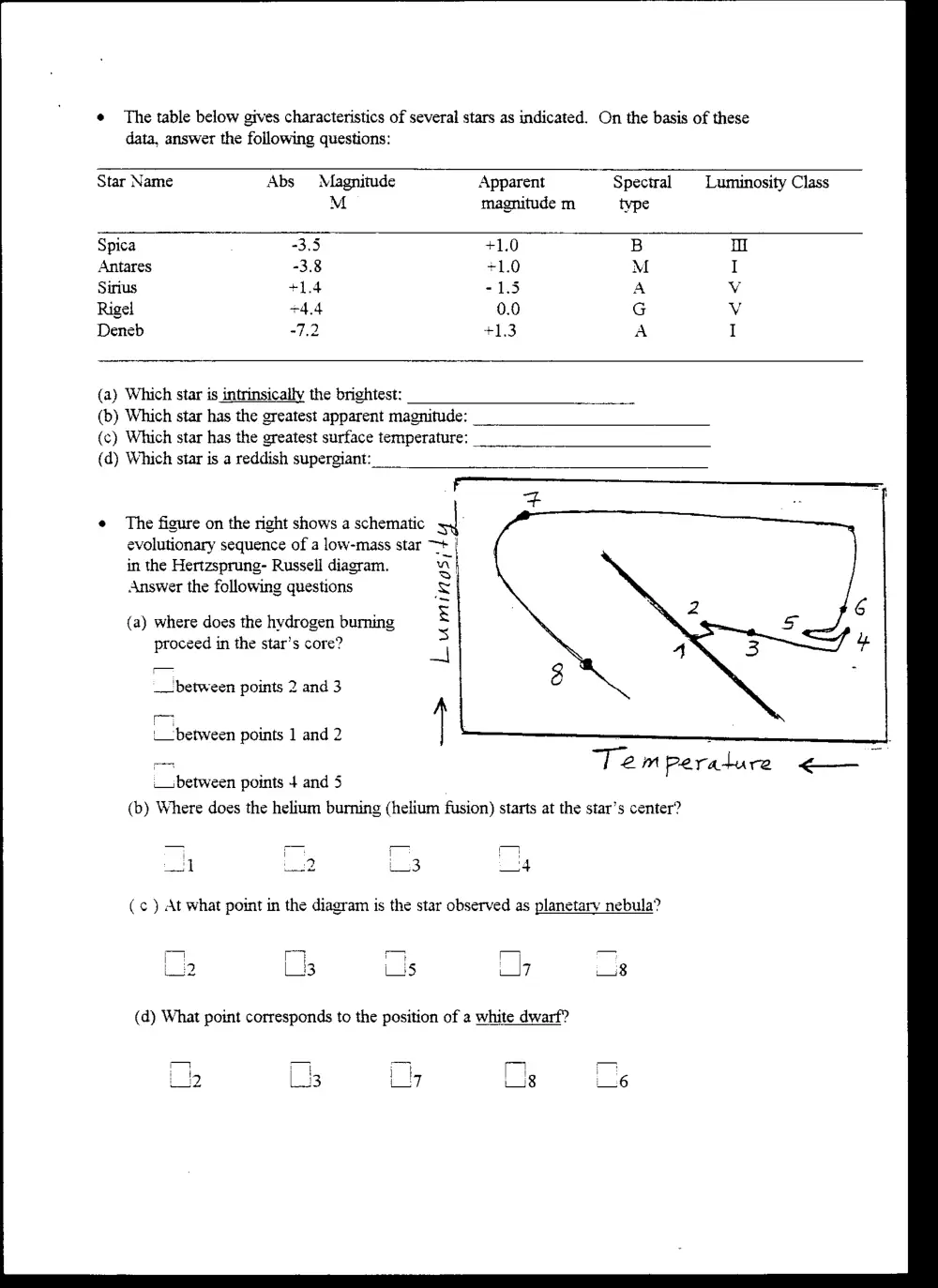
¢ The table below gives characteristics of several stars as indicated. On the basis of these
data, answer the following questions:
Star Name Abs Magnitude Apparent Spectral Luminosity Class
M magnitude m type
Spica -3.5 +1.0 B pal
Antares -3.8 +1.0 M I
Sirius +14 -1.5 A Vv
Rigel 4.4 0.0 G Vv
Deneb -7.2 +13 A I
(a) Which star is intrinsically the brightest:
(b) Which star has the greatest apparent magnitude:
(c) Which star has the greatest surface temperature:
(d) Which star is a reddish supergiant:
a P
Z
e The figure on the right shows a schematic wf
evolutionary sequence of a low-mass star al
in the Hertzsprung- Russell diagram.
Answer the following questions
(a) where does the hydrogen burning
proceed in the star’s core?
Lu minas
__ between points 2 and 3
__‘between points 1 and 2 ‘ - .
mo Temperature <—
__ibetween points 4 and 5
(b) Where does the helium burning (helium fusion) starts at the star’s center?
1 Lu? Lo3 —4
(¢ ) At what point in the diagram is the star observed as planetary nebula?
m 7
2 Ls Ls _|7 _8
(d) What point corresponds to the position of a white dwarf?
2 LB L'y [is _6
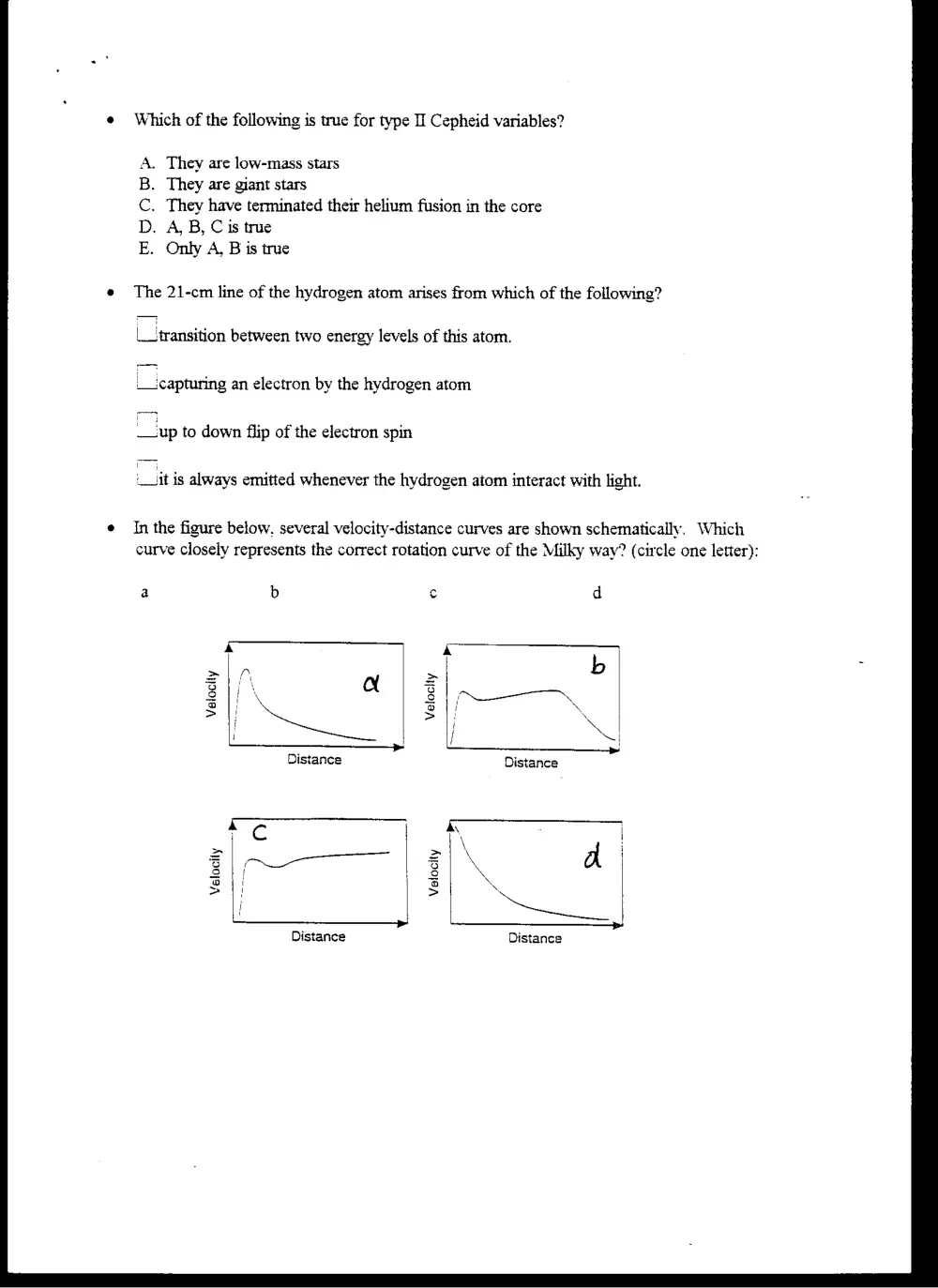
¢ Which of the following is true for type I Cepheid variables?
A. They are low-mass stars
B. They are giant stars
C. They have terminated their helium fusion in the core
D. A,B, Cis true
E. Only A, B is true
e The 21-cm line of the hydrogen atom arises from which of the following?
|_Jtransition between two energy levels of this atom.
__capturing an electron by the hydrogen atom
__!up to down flip of the electron spin
_it is always emitted whenever the hydrogen atom interact with light.
¢ Inthe figure below, several velocity-distance curves are shown schematically. Which
curve closely represents the correct rotation curve of the Milky way? (circle one letter):
a b ro d
& A
SFr = b
By A a 831A
S]i 3) ‘
2 ood NI
- >
Distance Distance
A Cc re - |
| '
=). —— | =)\ a
cae | s Ne
, .
Distance Distance
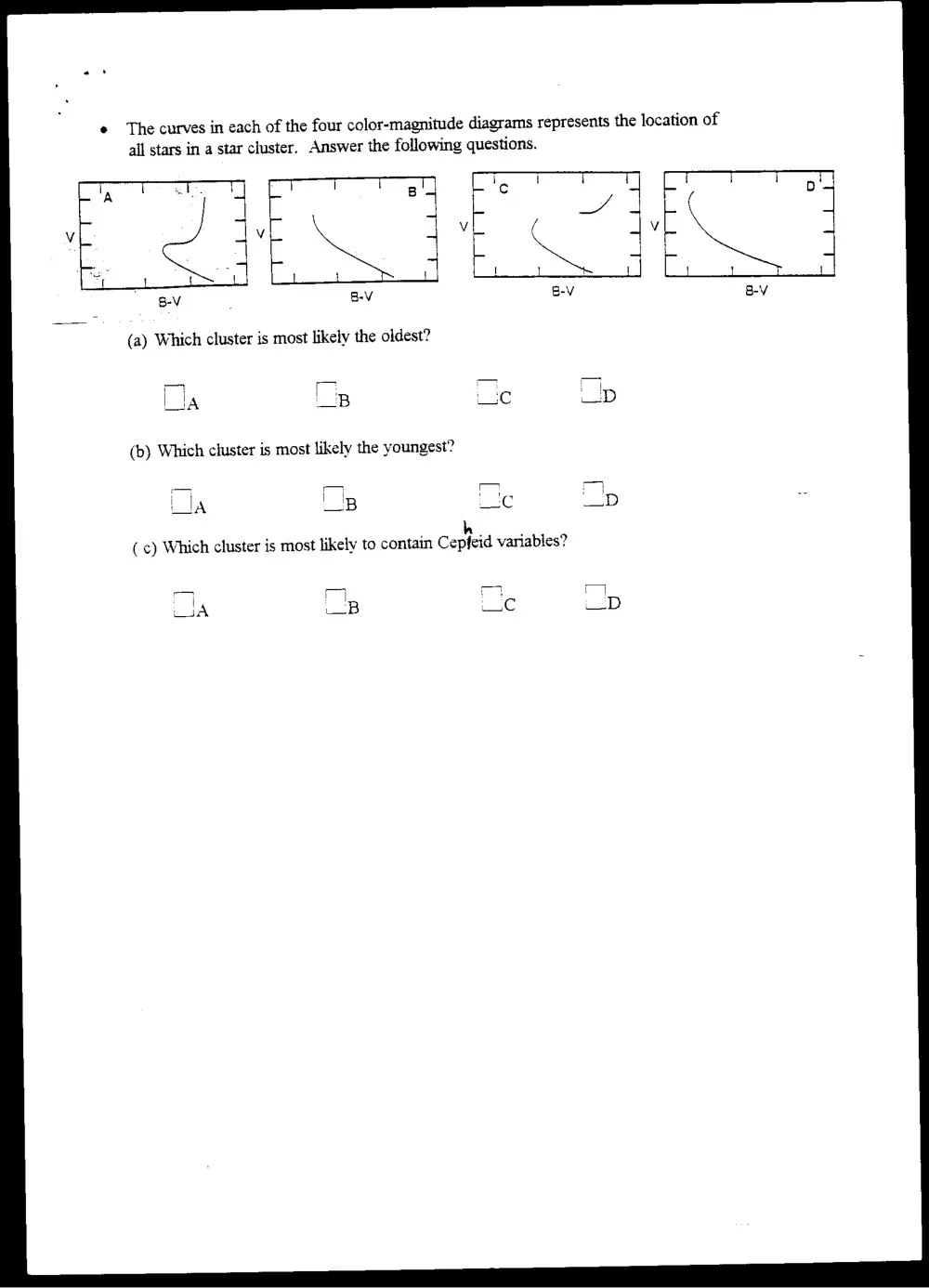
¢ The curves in each of the four color-magnitude diagrams represents the location of
all stars in a star cluster. Answer the following questions.
i
_B
(b) Which cluster is most likely the youngest?
— —
Lla _B ic
(c) Which cluster is most likely to contain Cepfeid variables?
LA Cc