
PHYS 200 Notes Midterm 1, Spring 2014
American University of Beirut · Understanding the Universe · 8 pages · Dr. Mounib El-Eid
More PHYS 200 files
Show the text of this notes
Physics 200 Notes
Chapter 1A
-
The word “Physics” is derived from the Greek word Phusis which means nature.
-
Science, unlike mathematics cannot prove the truth of its propositions, but it must
constantly test its hypothesis
-
Physics is:
o Acquisition of knowledge of our physical environment
o Creation of a worldview to understand the significance of this information.
-
We deal with knowledge and a worldview. Both arise together, or each creating the
condition for the other.
-
The universe is the totality of all space, time, matter and energy. 75% of the universe is of
unknown dark energy.
-
So to measure really long distances, people use a unit called a light year. Light travels at
186,000 miles per second (300,000 kilometers per second). Therefore, a light second is
186,000 miles (300,000 kilometers). Light years measure a distance, not time! A light year is
the distance that light can travel in a year, or:
186,000 miles/second * 60 seconds/minute * 60 minutes/hour * 24 hours/day * 365
days/year = 5,865,696,000,000 miles/year
A light year is 5,865,696,000,000 miles (9,460,800,000,000 kilometer= 9.46x10^12
-
Andromeda Galaxy: 2.0 million light years away.
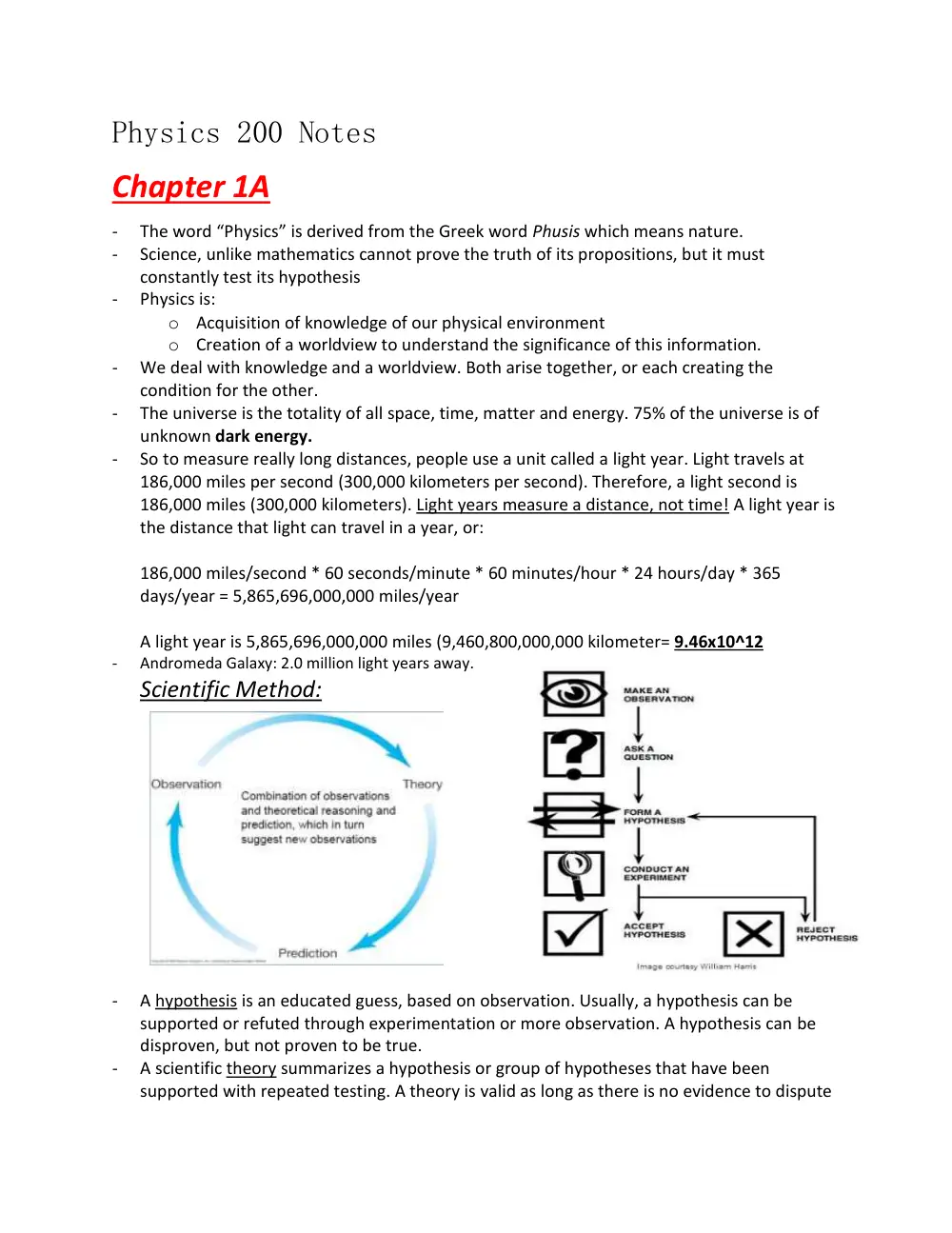
Scientific Method:
-
A hypothesis is an educated guess, based on observation. Usually, a hypothesis can be
supported or refuted through experimentation or more observation. A hypothesis can be
disproven, but not proven to be true.
-
A scientific theory summarizes a hypothesis or group of hypotheses that have been
supported with repeated testing. A theory is valid as long as there is no evidence to dispute
it. Therefore, theories can be disproven. Basically, if evidence accumulates to support a
hypothesis, then the hypothesis can become accepted as a good explanation of a
phenomenon. One definition of a theory is to say it's an accepted hypothesis.
-
A law generalizes a body of observations. At the time it is made, no exceptions have been
found to a law. Scientific laws explain things, but they do not describe them. One way to tell
a law and a theory apart is to ask if the description gives you a means to explain 'why'.
-
Scientific method: Based on observation, logic, and skepticism.
-
Hypothesis: A collection of well thought-out ideas to explain a phenomena
-
Model: Hypotheses that have withstood observational and experimental tests.
-
Theory: A well-founded body of related hypotheses and models that form a self-consistent
description of nature.
Constellations in the sky:
-
Constellations are patterns in the night sky often formed by the most prominent stars to the
naked eye. A configuration of stars in the same region of the sky. Technically a constellation
defines not just the group of stars that form their patterns but also the region of sky in
which it rests. There are 88 constellations across the sky between the northern and
southern hemispheres and, in both these parts of the celestial sphere, these patterns of
stars differ. The current list, which includes constellations such as Orion, Cassiopeia, Taurus
and the Plough, has been recognized by the International Astronomical Union (IAU) since
around 1922 and are based on the 48 which were previously identified by Greek
astronomer Claudius Ptolemy.
-
There are 88 constellations in total
-
Most powerful stars: Sirius - Betelgeouse - Rigel – Procyon
-
The Sun spends 3 weeks in the thirteen constellation. Ophiuchus not included in Astrology
since a year has 12 months
-
The constellations seem to move from east to west.
-
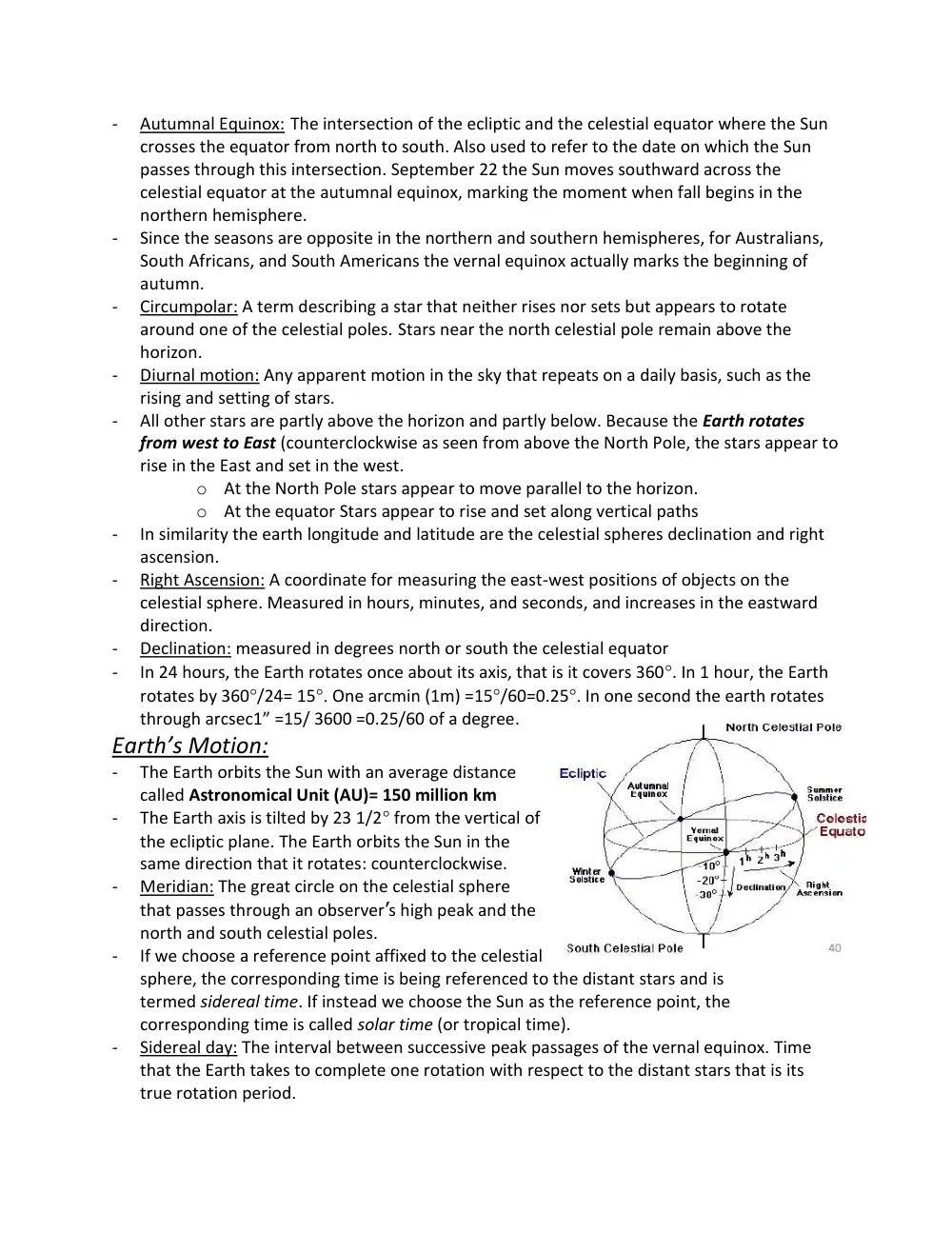
The celestial sphere: An imaginary sphere of very large radius centered on an observer; the
apparent sphere of the sky.
-
North Celestial Pole (NCP): The point directly above the Earth’s North Pole where the
Earth’s axis of rotation, if extended, would intersect the celestial sphere.
-
South Celestial Pole (SCP): The point directly above the Earth’s South Pole where the Earth’s
axis of rotation, if extended, would intersect the celestial sphere.
-
Celestial Equator: the projection of the Earth’s equator onto the celestial sphere. 90
from
the celestial poles.
-
Ecliptic: The apparent annual path of the Sun on the celestial sphere.
-
Equinox: One of the intersections of the ecliptic and the celestial equator. Also used to refer
to the date on which the Sun passes through such an intersection. Equinox= equal night
-
Vernal Equinox: The point on the ecliptic where the Sun crosses the celestial equator from
south to north. Also used to refer to the date on which the Sun passes through this
intersection. March 21 of each year, the Sun passes northward across the celestial equator
at the vernal equinox. This marks the beginning of spring in the northern hemisphere.
(“vernal” is from the Latin for “spring”)
-
Autumnal Equinox: The intersection of the ecliptic and the celestial equator where the Sun
crosses the equator from north to south. Also used to refer to the date on which the Sun
passes through this intersection. September 22 the Sun moves southward across the
celestial equator at the autumnal equinox, marking the moment when fall begins in the
northern hemisphere.
-
Since the seasons are opposite in the northern and southern hemispheres, for Australians,
South Africans, and South Americans the vernal equinox actually marks the beginning of
autumn.
-
Circumpolar: A term describing a star that neither rises nor sets but appears to rotate
around one of the celestial poles. Stars near the north celestial pole remain above the
horizon.
-
Diurnal motion: Any apparent motion in the sky that repeats on a daily basis, such as the
rising and setting of stars.
-
All other stars are partly above the horizon and partly below. Because the Earth rotates
from west to East (counterclockwise as seen from above the North Pole, the stars appear to
rise in the East and set in the west.
o At the North Pole stars appear to move parallel to the horizon.
o At the equator Stars appear to rise and set along vertical paths
-
In similarity the earth longitude and latitude are the celestial spheres declination and right
ascension.
-
Right Ascension: A coordinate for measuring the east-west positions of objects on the
celestial sphere. Measured in hours, minutes, and seconds, and increases in the eastward
direction.
-
Declination: measured in degrees north or south the celestial equator
-
In 24 hours, the Earth rotates once about its axis, that is it covers 360. In 1 hour, the Earth
rotates by 360/24= 15One arcmin (1m) =15/60=0.25 In one second the earth rotates
through arcsec1” =15/ 3600 =0.25/60 of a degree.
Earth’s Motion:
-
The Earth orbits the Sun with an average distance
called Astronomical Unit (AU)= 150 million km
-
The Earth axis is tilted by 23 1/2 from the vertical of
the ecliptic plane. The Earth orbits the Sun in the
same direction that it rotates: counterclockwise.
-
Meridian: The great circle on the celestial sphere
that passes through an observer’s high peak and the
north and south celestial poles.
-
If we choose a reference point affixed to the celestial
sphere, the corresponding time is being referenced to the distant stars and is
termed sidereal time. If instead we choose the Sun as the reference point, the
corresponding time is called solar time (or tropical time).
-
Sidereal day: The interval between successive peak passages of the vernal equinox. Time
that the Earth takes to complete one rotation with respect to the distant stars that is its
true rotation period.
-
Solar Day: 24 hours, the time between successive passages of the sun across the meridian
(noon to noon) The interval between successive meridian passages of the mean Sun;
the average length of a solar day.
-
solar day > sidereal day
-
Because the Earth is in motion on its orbit around the Sun in the course of a day, the Earth
must turn about 4 minutes longer each day (3 minutes and 56 seconds, to be exact) to bring
the Sun back to the celestial meridian than to bring the vernal equinox back to the celestial
meridian. Thus, the solar day is 3 minutes and 56 seconds longer than the sidereal day. It is
this almost 4 minute per day discrepancy that causes the difference in sidereal and solar
time, and is responsible for the fact that different constellations are overhead at a given
time of day during the summer than in the winter.
-
The Earth axis remains fixed in direction (conservation of angular momentum). As a
consequence, the Northern hemisphere is tripped toward the Sun in June and away from
the Sun in December. The reverse is true in the Southern Hemisphere.
-
In June, the sunlight strikes Northern Hemisphere at steeper angle (summer time), while the
angle is strikes the Southern Atmosphere.
Chapter 1B
-
Winter solstice about December 21, first day of winter. Sun farthest south of celestial
equator
-
Vernal (or spring) equinox about March 21, first day of spring. Sun passes northward across
the celestial equator.
-
Summer solstice about June 21, first day of summer. Sun stops “climbing” celestial sphere,
it cannot get more north. Solstice = to stand
-
Autumnal equinox about September 21, first day of fall. Sun moves southward across the
celestial equator.
-
most of Earth’s land is in the North lies above the equator. More oceans are in the Southern
Hemisphere. This makes the climate.
-
That axis slowly revolves about the vertical. Earth’s axis changes slowly its direction over the
course of time, but the axis
change is called precession. It is caused by twisting forces on Earth by the gravitational pull
of the Moon and the Sun. The earth’s axis is currently pointing toward the star Polaris. After
about 12,000 yrs it will point toward the star Vega.
-
Precession: A slow, conical motion of the Earth’s axis of rotation caused by the gravitational
pull of the Moon and Sun on the Earth’s equatorial bulge. A slow gyration of the earth's axis
around the pole of the ecliptic, caused mainly by the gravitational pull of the sun, moon,
and other planets on the earth's equatorial bulge.
-
Why does precession occur? It is caused by gravity’s effect on a tilted rotating object that is
not a perfect sphere.
-
Earth is not a perfect sphere. The Earth is slightly fatter across the equator than it is from
pole to pole. Equatorial diameter is 43 km larger than the diameter measured from pole to
pole. This the so called equatorial bulge.
Astronomical Timekeeping-Calendars:
-
Lunar year: 29.5 days x 12= 354 days. This is 11 days different from 365 days not really
practical
-
Sidereal year=365.2564 mean solar days. It is the time needed for the Sun to return to the
same position with respect to the stars. It is the orbital period of the Earth around the Sun,
but it is not the year on which we base our calendar. We want annual events like begin of
spring. But the spring begins when the Sun is at the vernal equinox.
-
Tropical year: The period of revolution of the Earth about the Sun with respect to the vernal
equinox. Tropical year= 365.2422 mean solar day.
-
Because of precession, the tropical year is 20 min and 24 s =1/26000 yrs) shorter than the
sidereal year.
-
In the Roman Julian Calendar, April used to be the first month of the year; but the Gregorian
calendar observed January as the first month.
Motion of the Moon and Eclipses:
-
The moon needs 29.5 days to complete one cycle of lunar phases.
-
Synchronous rotation: The rotation of a body with a period equal to its orbital period; also
called 1-to-1 spin-orbit coupling. (the moon)
-
Sidereal Period: It is the time the Moon takes to orbit the Earth once, and is equal to 27.3
days. Within this time, the Moon moves (eastward) each day by 13
-
Synodic Period: It is the Lunar Month, or it is the time it takes the Moon to complete one
cycle of phases, from new Moon to new Moon.
-
How long is the Synodic period? In 27.3 days, the Moon-Earth system moves by:
(27.3/365)360=26.93
In order for the Moon to line up again with the Earth and the Sun and to become new
moon, it needs additional time T: T x 13.19=26.9 -> T=2.024 days
-
So the synodic period =27.3+2.042=29.34 days=29.5
-
The Sun, Earth and Moon all happen to lie along a straight line. When this happens, the
shadow of the Earth can fall on the Moon or the shadow of the Moon can fall on the Earth.
-
Lunar eclipse: An eclipse of the Moon by the Earth; a passage of the Moon through the Earth’s
shadow. This occurs when the Moon passes through the Earth’s shadow, or the Earth
between the Sun and the Moon and a straight line. Occurs when the Moon is a full Moon.
-
The sunlight is deflected by the Earth’s atmosphere, blue light scattered away that is why the
moon looks copper colored.
-
Solar eclipse: An eclipse of the Sun by the Moon; a passage of the Earth through the Moon’s
shadow. This occurs only at new Moon.
-
Earth’s orbit and the Moon’s orbit are not exactly aligned. The angle is 5. Therefore, new or
full Moon occur when the Moon is either above or below the plane of the Earth’s orbit.
-
Nodes are the points where the Moon’s orbit
crosses the ecliptic plane.
-
Umbra: darkest part of the shadow in a solar
eclipse. Penumbra: the lighter part of the
shadow.
Measuring Distances:
- Next Star (not the Sun)): Proxima Centauri = 4.3 ly
Chapter 2
Geocentric Model of the Greeks:
-
Geocentric model: An Earth-centered theory of the universe.
-
The analogous situation is a celestial sphere moving westward. The stars co-rotate with it.
The Sun and Moon orbit a stationary Earth
-
Retrograde motion: The apparent westward motion of a planet with respect to background
stars.
-
Ptolemaic system: The definitive version of the geocentric cosmogony of ancient Greece.
-
Epicycle: A moving circle in the Ptolemaic system about which a planet revolves.
-
Planet moves on a circle called “epicycle”, whose center moves on a circle centered at
Earth, called “deferent”.
-
The problem of the Ptolemaic system was philosophical: it treated the planets independent
of each other. There was no principle law related their size and motion.
-
Elongation: The angular distance between a planet and the Sun as viewed from Earth.
Heliocentric Model of Copernicus:
-
Copernicus imagined a universe where the Sun was at the center instead of Earth.
-
He suggested that Earth’s motion around the Sun provided a more “natural” explanation for
retrograde loops as Earth passed the other planets.
-
He assumed:
o Sun at center (Not the Earth) and at rest.
o Only the Moon orbits the Earth.
o Retrograde motion of planets a consequence of the Earth’s motion relative to a planet.
o All planets revolve around the sun.
Modern Astronomy:
-
What did Galileo Discover? His approach was radical: testing his ideas by doing
experiments. Galileo built his own simple telescope in 1609. All his discoveries were in
conflict with the Greek’s theory but in support of Copernicus.
o The Moon shows mountains and craters, so it is not a perfect sphere as the Greeks
thought.
o Dark spots on the surface of the sun (sunspots).He looked directly at the sun with
the telescope, this has blinded him at the end of his life that. Again the sun was NOT
a jewel-like body as the Greeks thought. From the motion of the sunspots, Galileo
concluded that the sun was a rotating body!
o Galileo also observed Jupiter. He saw FOUR small moons orbiting Jupiter (invisible to
the naked eye). This was another conflict with the Greek’s model: The Earth is not
the only center of rotation. The Earth is NOT the center of everything.
o Galileo discovered that Venus shows a complete cycle of phases (similar to the
Moon’s phases)
Kepler’s Laws of Planetary Motion:
-
Motion Three laws were discovered by Kepler on empirical basis. Kepler was one of the first
modern theorist, as Galileo was one of the first modern observer.
-
Kepler's first law: The statement that each planet moves around the Sun in an elliptical orbit
with the Sun at one focus of the ellipse. The orbits of the planets are elliptical with the sun at
one focus.
-
d(aphelion)= a x (1-e) a=semi major points e= eccentricty
-
-
Kepler's second law: The statement that a planet sweeps out equal areas in equal times as it
orbits the Sun; also called the law of equal areas. A planet moves most rapidly when it is
nearest the Sun, at a point on its orbit called perihelion. Conversely, a planet moves most
slowly when it is farthest from the Sun, at a point called aphelion. This relationship is also
called the law of equal areas.
-
Kepler's third law: A relationship between the period of an orbiting object and the semi
major axis of its elliptical orbit. P^2=a^3. P is the sidereal period measured in years A is
measured in Astronomical units , 1AU=150x10^6 km
Isaac Newton:
-
Newton introduced the concept of universal gravitation. Every object in the universe
attracts every other object. This principle is based on the concepts of Force and Mass.
-