
PHYS 200 Final, Fall 1998
American University of Beirut · Understanding the Universe · 10 pages


More PHYS 200 files
Show the text of this final exam
Physics Department Physics 200 February 8, 1999
Final Exam Time:1 1/2 hours
Name:
LD No.:
cross the name of your instructor:
L lisber L | Eid
Information:
No make up for this exam without legal reason.
e Only one answer is valid in multiple choice questions.
Physical constants: the speed of light is e=3 x 10* m/s
Planck constant h = 6.626 x 10°" erg.s
Page Grade
(1)
(2)
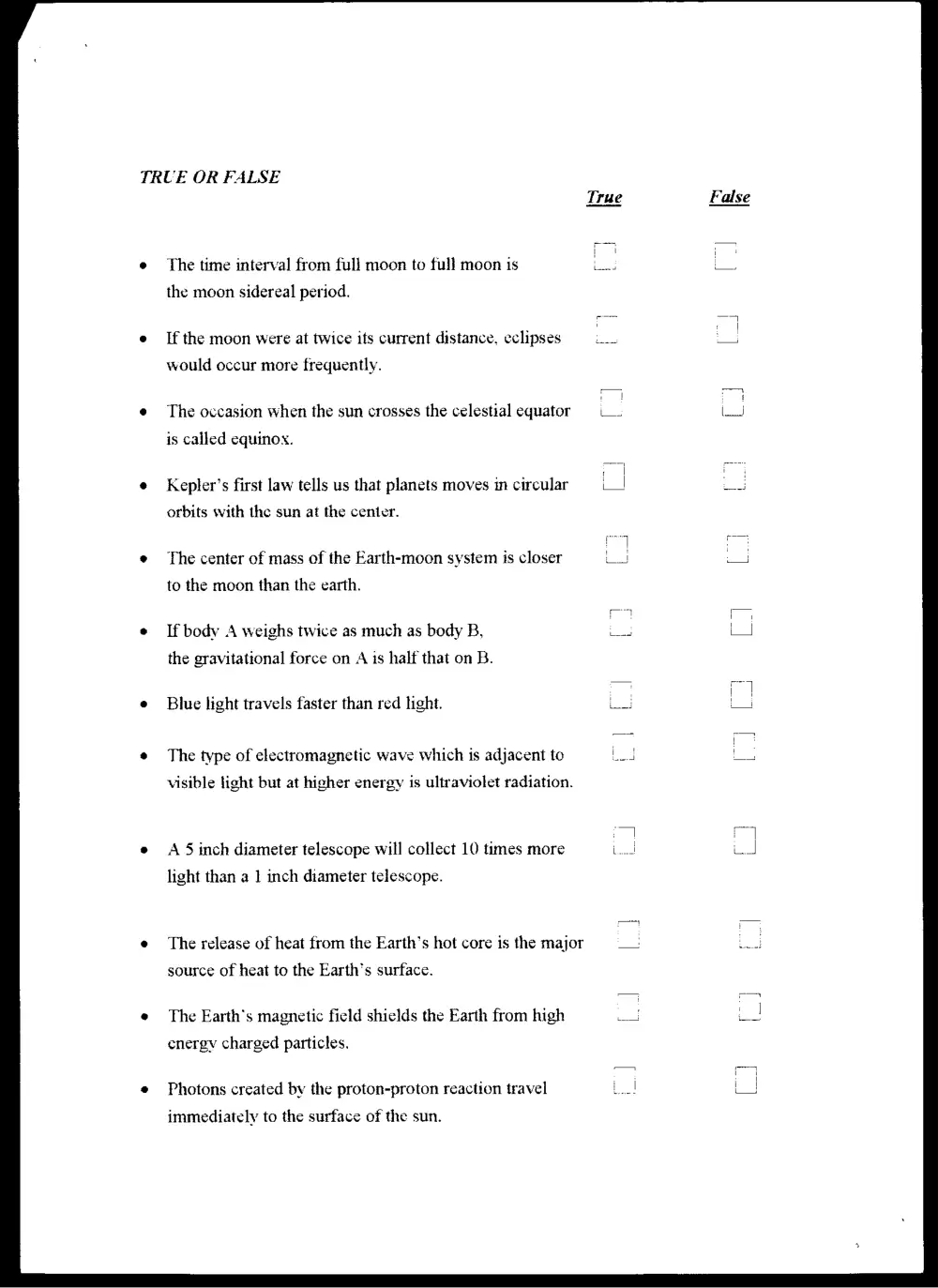
TRUE OR FALSE
The time interval from full moon to full moon is
the moon sidereal period.
If the moon were at twice its current distance, eclipses
would occur more frequently.
The occasion when the sun crosses the celestial equator
is called equinox.
Kepler’s first law tells us that planets moves in circular
orbits with the sun at the center.
The center of mass of the Earth-moon system is closer
to the moon than the earth.
If body A weighs twice as much as body B,
the gravitational force on A is half that on B.
Blue light travels faster than red light.
The type of electromagnetic wave which is adjacent to
visible light but at higher energy is ultraviolet radiation.
A 5 inch diameter telescope will collect 10 times more
light than a 1 inch diameter telescope.
The release of heat from the Earth’s hot core is the major
source of heat to the Earth's surface.
The Earth's magnetic field shields the Earth from high
energy charged particles.
Photons created by the proton-proton reaction travel
immediately to the surface of the sun.
e Energy transport in the sun is accomplished by radiation _ _
only.
. . sats 7 i |
e The sun is stable because of an equilibrium between the _ i
forces of gravity and the magnetic force.
e High temperature are required for fusion to occur because i_: ia
of electrostatic repulsion between the reacting nuclei.
e Different stars show different spectra only because of iJ Li
variations in their chemical composition.
e A sixth magnitude star is 100 times brighter than a first Lo Led
magnitude star.
e =A star with a parallax of 0.5 degrees of arc is two i _
Parsec away.
¢ Red supergiant stars are considerably cooler than red giant __. i
stars.
e An H-R diagram is a graph with mass plotted against a Le
luminosity.
e Asteroid A orbits the sun at a distance of 4 AU while asteroid, B, being one-half as
larger as A, orbits at 8 AU. Which asteroid will take longer to go around the sun
according to Kepler’s law?
(a) asteroid A.
(b) asteroid B.
(c) neither, both will take the same time.
e The ability to distinguish between details or to distinguish to adjacent objects as
separate is:
a) reflection
b) refraction
c) aperture
d) resolution
e) spectroscopy
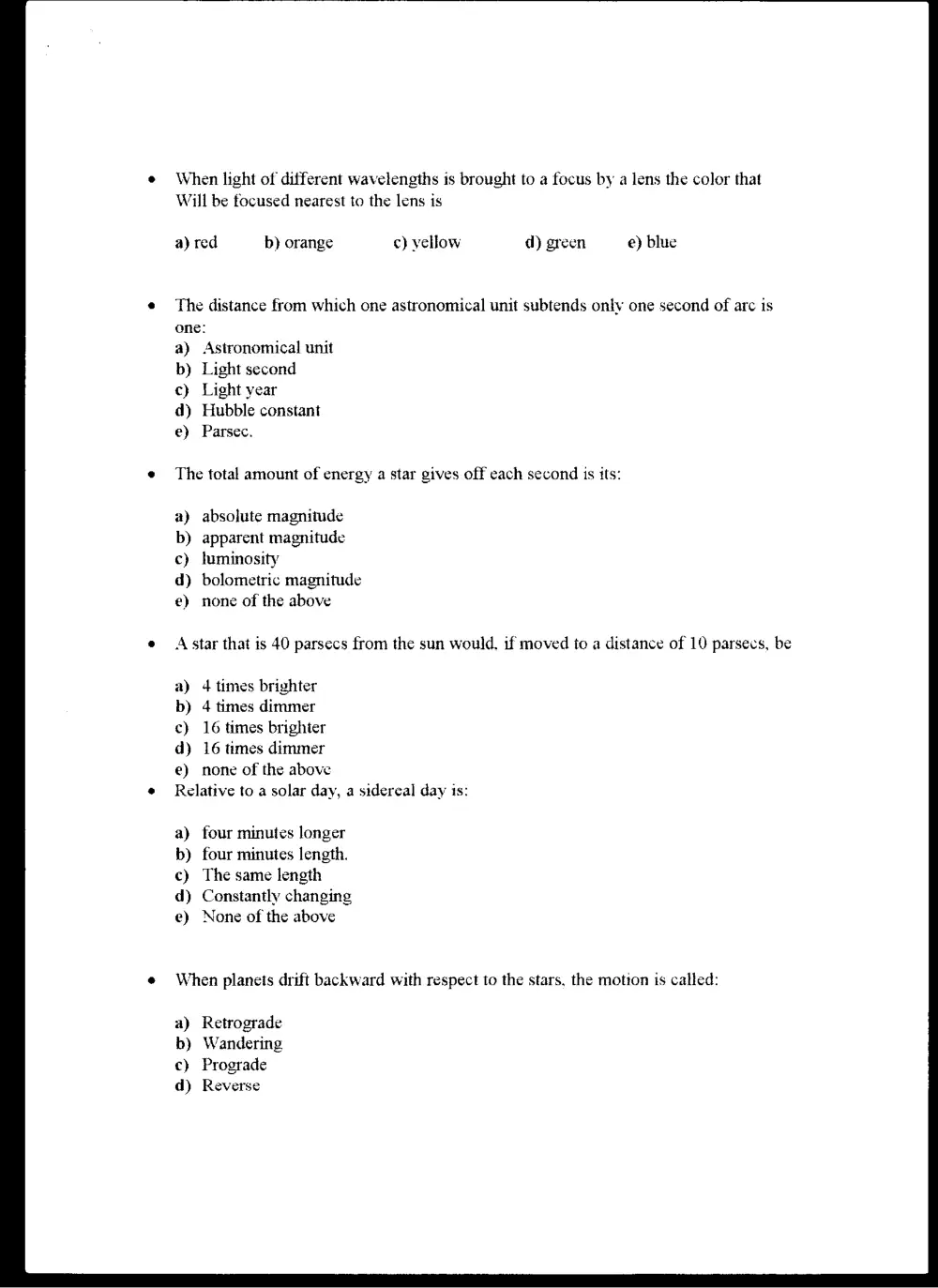
When light of different wavelengths is brought to a focus by a lens the color that
Will be focused nearest to the lens is
a) red b) orange ©) yellow d) green e) blue
The distance from which one astronomical unit subtends only one second of arc is
one:
a) Astronomical unit
b) Light second
c) Light year
d) Hubble constant
e) Parsec.
The total amount of energy a star gives off each second is its:
a) absolute magnitude
b) apparent magnitude
c) luminosity
d) bolometric magnitude
e) none of the above
A star that is 40 parsecs from the sun would, if moved to a distance of 10 parsecs, be
a) 4 times brighter
b) 4 times dimmer
c) 16 times brighter
d) 16 times dimmer
e) none of the above
Relative to a solar day, a sidereal day is:
a) four minutes longer
b) four minutes length.
c) The same length
d) Constantly changing
e) None of the above
When planets drift backward with respect to the stars, the motion is called:
a) Retrograde
b) Wandering
c} Prograde
d) Reverse
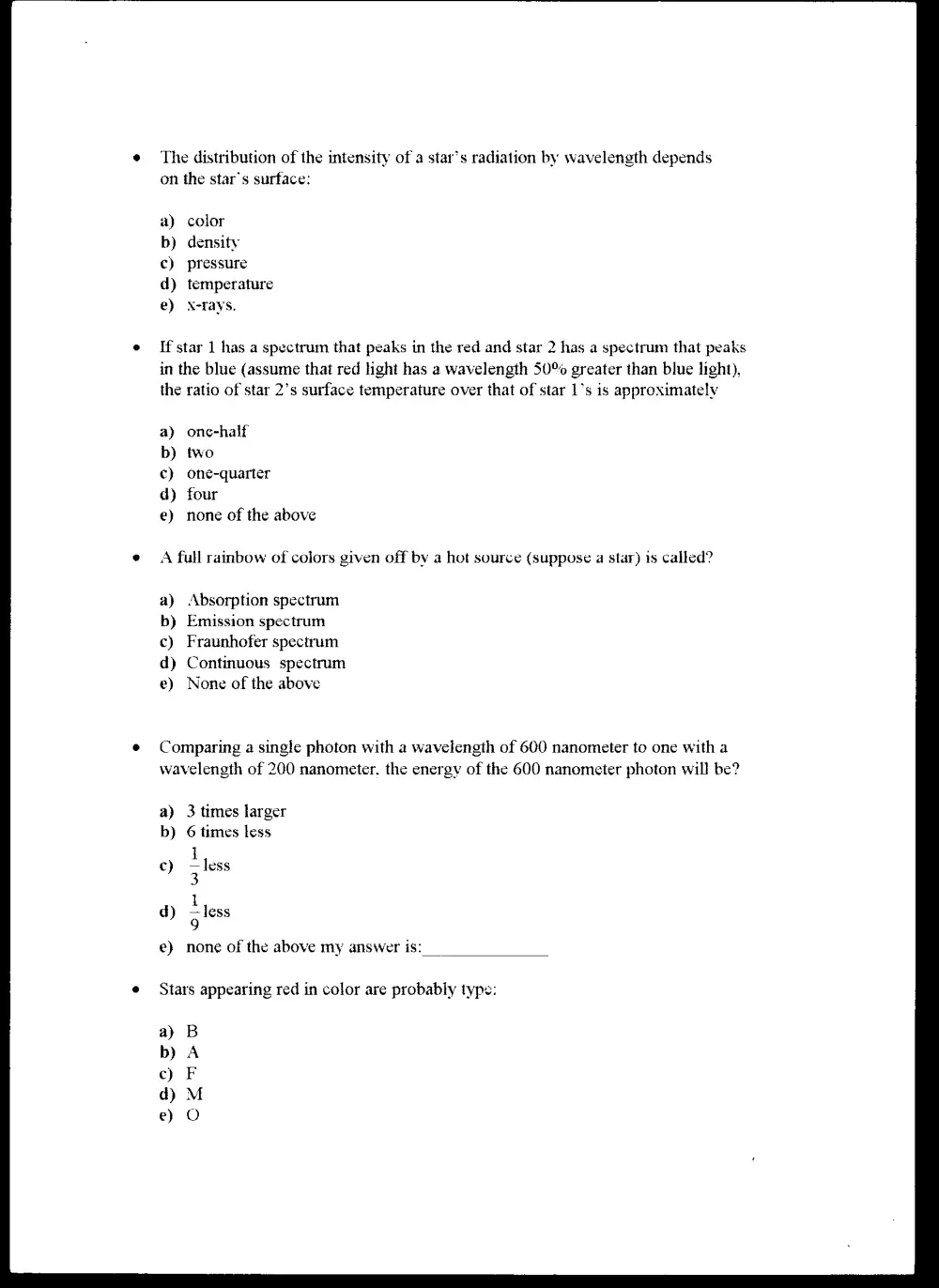
The distribution of the intensity of a star’s radiation by wavelength depends
on the star's surface:
a) color
b) density
c) pressure
d) temperature
e) x-rays,
If star 1 has a spectrum that peaks in the red and star 2 has a spectrum that peaks
in the blue (assume that red light has a wavelength 50° greater than blue light),
the ratio of star 2’s surface temperature over that of star 1°s is approximately
a) one-half
b) two
¢) one-quarter
d) four
e) none of the above
A full rainbow of colors given off by a hot source (suppose a star) is called?
a) Absorption spectrum
b) Emission spectrum
c) Fraunhofer spectrum
d) Continuous spectrum
e) None of the above
Comparing a single photon with a wavelength of 600 nanometer to one with a
wavelength of 200 nanometer, the energy of the 600 nanometer photon will be?
a) 3 times larger
b) 6 times less
c) i less
3
1
d) —le
) 9 SS
e) none of the above my answer is:
Stars appearing red in color are probably type:
a) B
b) A
c) F
d) M
e) O
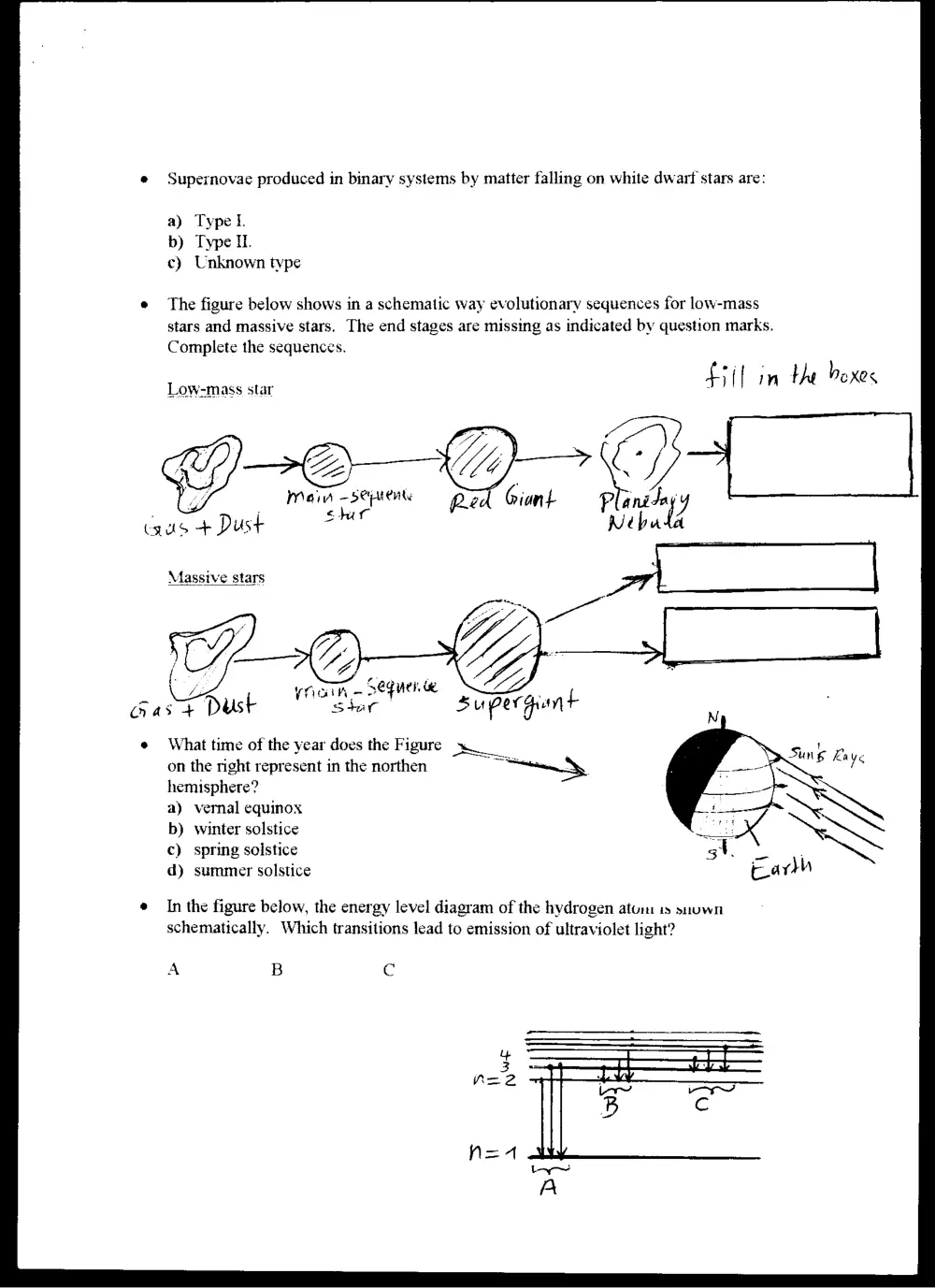
Supernovae produced in binary systems by matter falling on white dwart stars are:
a) Typel.
b) Type IL
c) Unknown type
The figure below shows in a schematic way evolutionary sequences for low-mass
stars and massive stars. The end stages are missing as indicated by question marks,
Complete the sequences.
Low-mass star
F
2
? Mara —Seuente
caus + Dust
shar
Massive stars
What time of the year does the Figure x
on the right represent in the northen aS
hemisphere?
a) vernal equinox
b) winter solstice
c) spring solstice
d) summer solstice
In the figure below, the energy level diagram of the hydrogen atum 19 suuwn
schematically. Which transitions lead to emission of ultraviolet light?
A B Cc
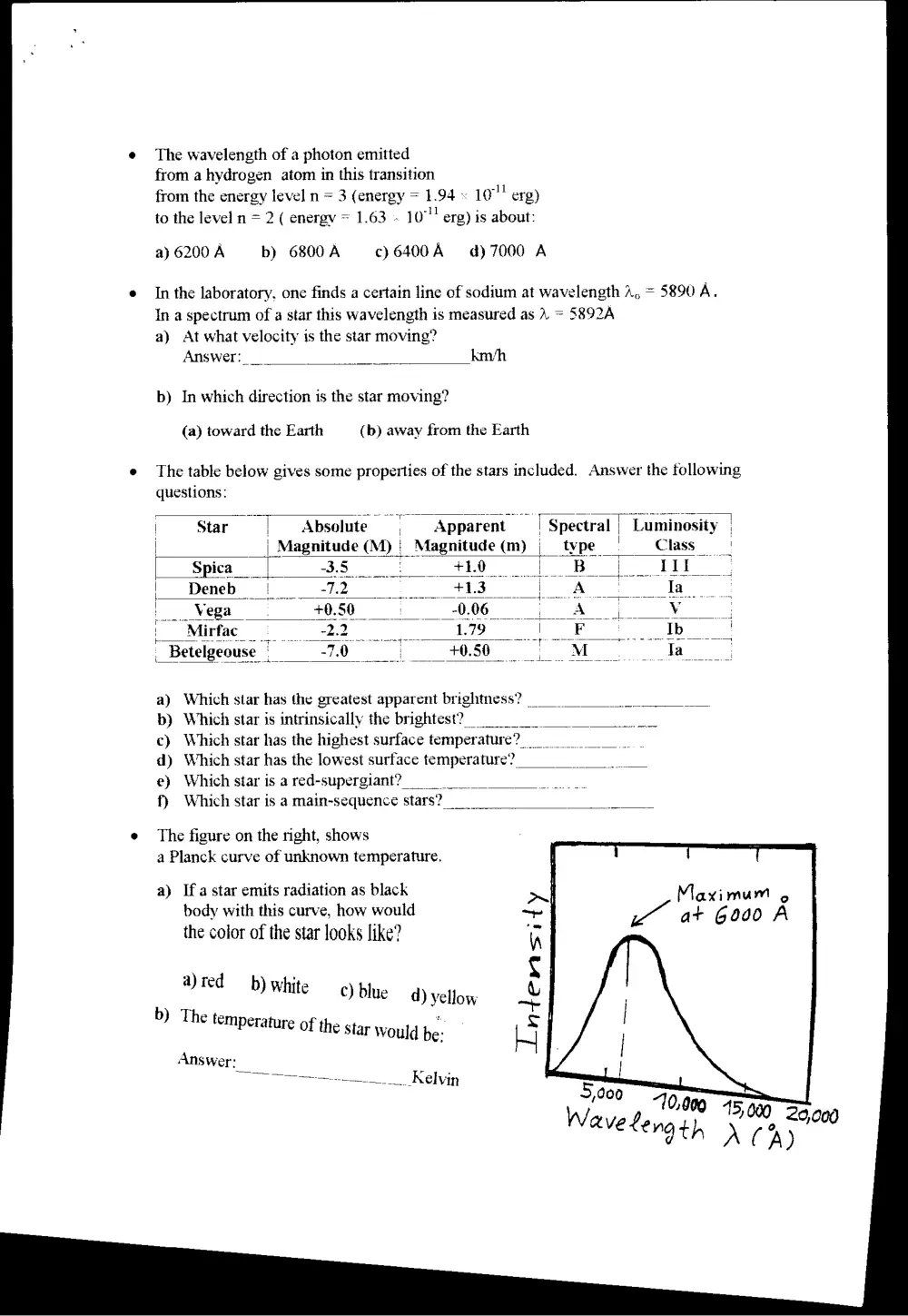
e¢ The wavelength of a photon emitted
from a hydrogen atom in this transition
from the energy level n = 3 (energy = 1.94 « 10 erg)
to the level n = 2 ( energy = 1.63 - 107 erg) is about:
a) 6200 A b) 6800A c)6400A =) 7000 A
e In the laboratory, one finds a certain line of sodium at wavelength 4, = 5890 A.
In a spectrum of a star this wavelength is measured as 2, = 5892A
a) At what velocity is the star moving?
Answer: _ knv/h
b) In which direction is the star moving?
(a) toward the Earth (b) away from the Earth
e The table below gives some properties of the stars included. Answer the following
questions:
| Star | Absolute os Apparent | Spectral | Luminosity |
Class!
Magnitude (M) | Magnitude (m) type
| .
2 BT
|
\ a
i
i
\
: Betelgeouse a
a) Which star has the greatest apparent brightness? |
b) Which star is intrinsically the brightest?
c) Which star has the highest surface temperature? |
d) Which star has the lowest surface temperature?
e) Which star is ared-supergiant?
f) Which star is a main-sequence stars? _
e The figure on the right, shows
a Planck curve of unknown temperature.
a) Ifa star emits radiation as black
body with this curve, how would
the color of the star looks like?
a)red — b) white c) blue
d) yellow
) The temperature of the star would be :
Answer:
wa «Kelvin
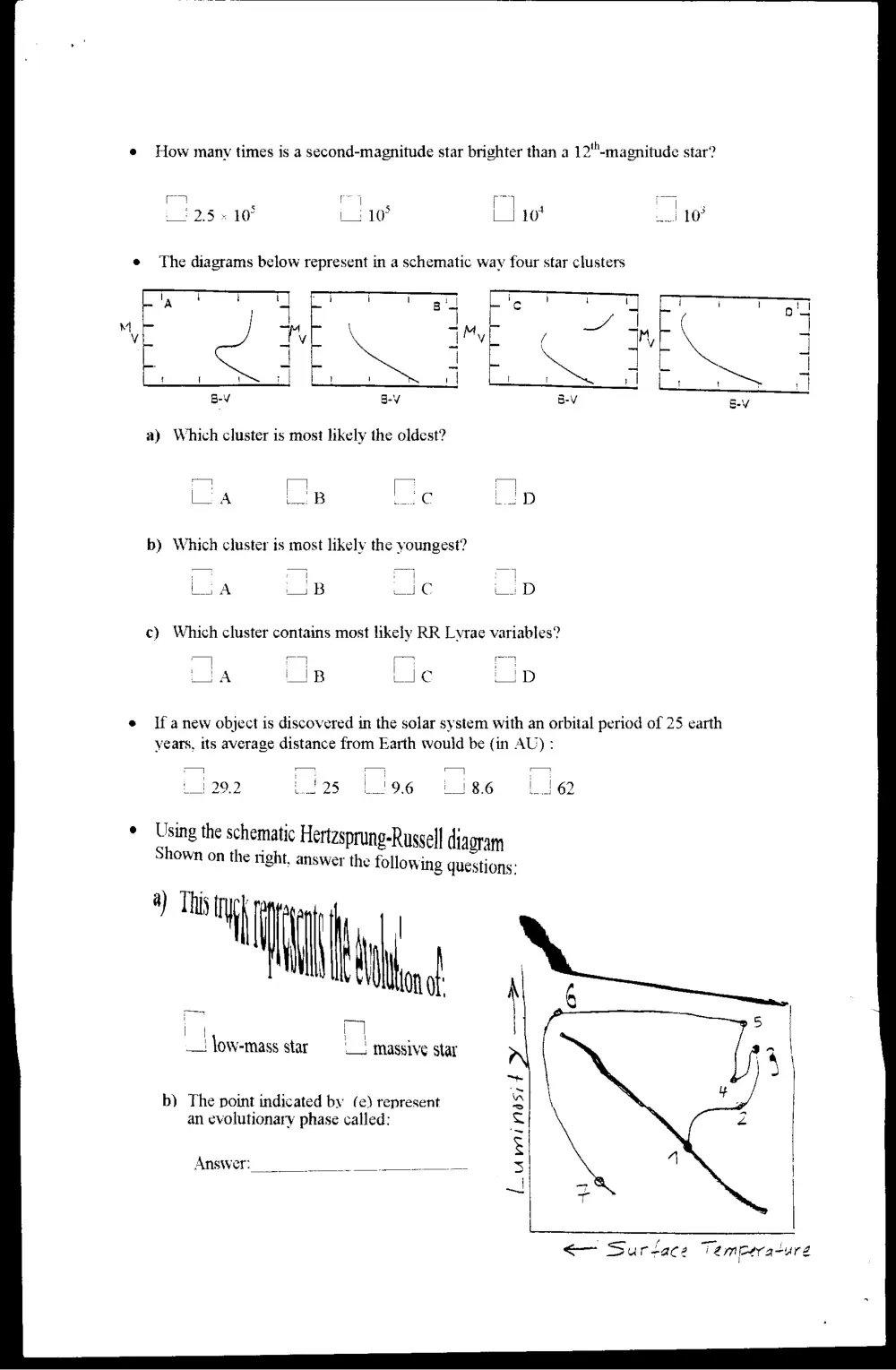
¢ How many times is a second-magnitude star brighter than a 12""-magnitude star?
m4 | m7 ma
5 5 | :
_225%10° i 310° L_| 10" i 10°
e The diagrams below represent in a schematic way four star clusters
a) Which cluster is most likely the oldest?
— 1 i
LUA i. B ¢ wD
b) Which cluster is most likelv the youngest?
1 i |
LA IB ic iD
c) Which cluster contains most likely RR Lyrae variables?
|
WIA
— oan
B mike LID
J]
* Ifanew object is discovered in the solar system with an orbital period of 25 earth
years, its average distance from Earth would be (in AU) :
~~ 7 H rt vd
'} 29.2 L425 196 Li86 Le
* Using the schematic Hertzsprung-Russell diagram
Shown on the right, answer the following questions:
» Hong hn
i | 7)
—_! low-mass star _! massive star
b) The point indicated by (ce) represent
an evolutionary phase called:
Answer:
lu minasit YY a
<— Surface Temperature
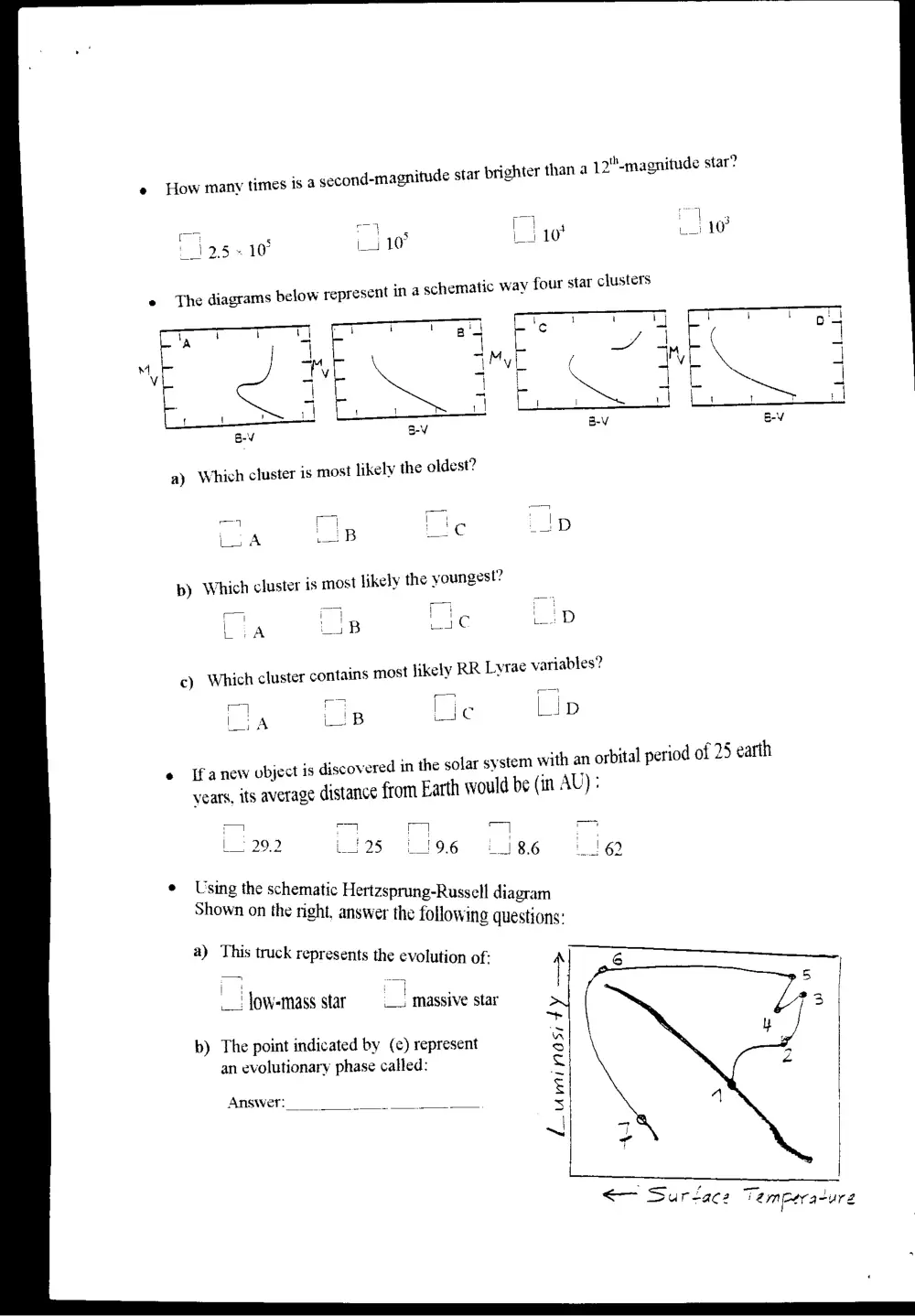
e How many times is a gecond-magnitude star brighter than a 12"-magnitude star?
-4 7
mo | i i
12.5% 10° 110° 110° Li
The diagrams below represent in a schematic way four star clusters
i
210
| o
mE LY 7 BEA -
4 BA |
i vl 1 _ ami
BV B-¥
a) Which cluster is most likely the oldest?
—4 4 — -
Li A 1B ae -2D
b) Which cluster is most likely the youngest?
; | i ra -_
LOA _oB KIc iD
c) Which cluster contains most likely RR Lyrae variables?
m7 mt cm
Loa LB Lic Lip
£25 earth
e [fa new object is discov ered in the solar system with an orbital period 0.
years, its average distance from Earth would be (in AU):
— — mm ~~)
1 od . oy j :
| 29.2 Li25 196 (j86 162
° 5 sing the schematic Hertzsprung-Russell diagram
non the night, answer the following questions:
a is
) This truck represents the evolution of:
—
— S ee
__! low-mass star _. massive star
b) The point indicated by (¢) represent
an evolutionary phase called:
Answer:
f_uminosity —>
7
a
t
<-S f _—
Sureac2 | emptra-ure
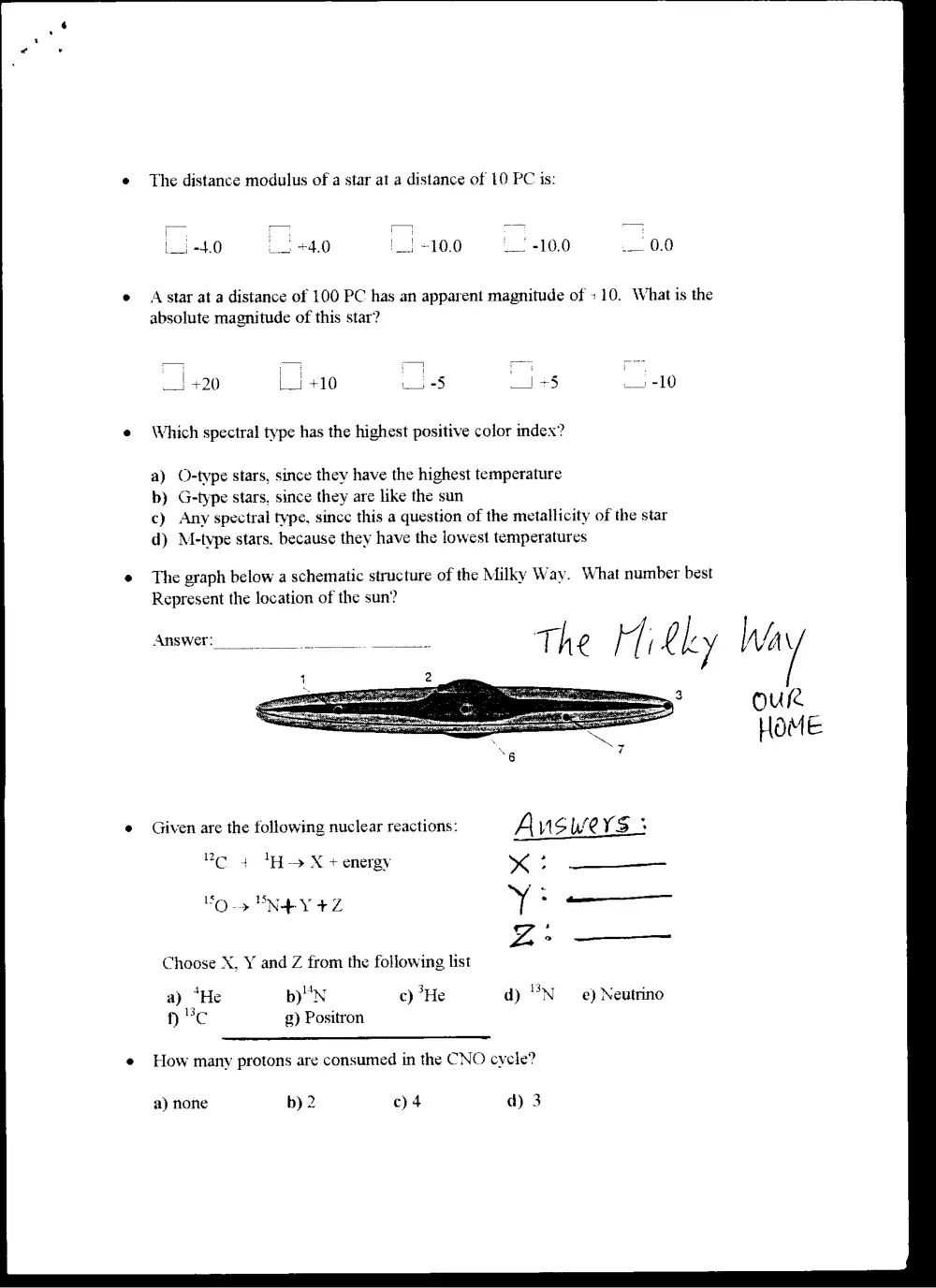
The distance modulus of a star at a distance of 10 PC is:
[34.0 i +4.0 ' +100 | -10.0 0.0
A star at a distance of 100 PC has an apparent magnitude of 1 10. What is the
absolute magnitude of this star?
LJ +10
Which spectral type has the highest positive color index?
a) O-tvpe stars, since they have the highest temperature
b) G-type stars, since they are like the sun
c) Any spectral type, since this a question of the metallicity of the star
d) M-type stars, because they have the lowest temperatures
The graph below a schematic structure of the Milky Way. What number best
The Hi eky Way
Represent the location of the sun?
° Our
Given are the following nuclear reactions:
Po 4 H+ X + energy
KO NAY +Z
Choose X, Y and Z from the following list
a) “He by'N c) *He d) °N__ e) Neutrino
fy Bc g) Positron
How many protons are consumed in the CNO cycle?
a) none b) 2 c)4 d) 3