
PHY 201 Exam 2, Fall 2016
Lebanese American University · Electricit and Magnetism · 7 pages
More PHY 201 files
Show the text of this exam
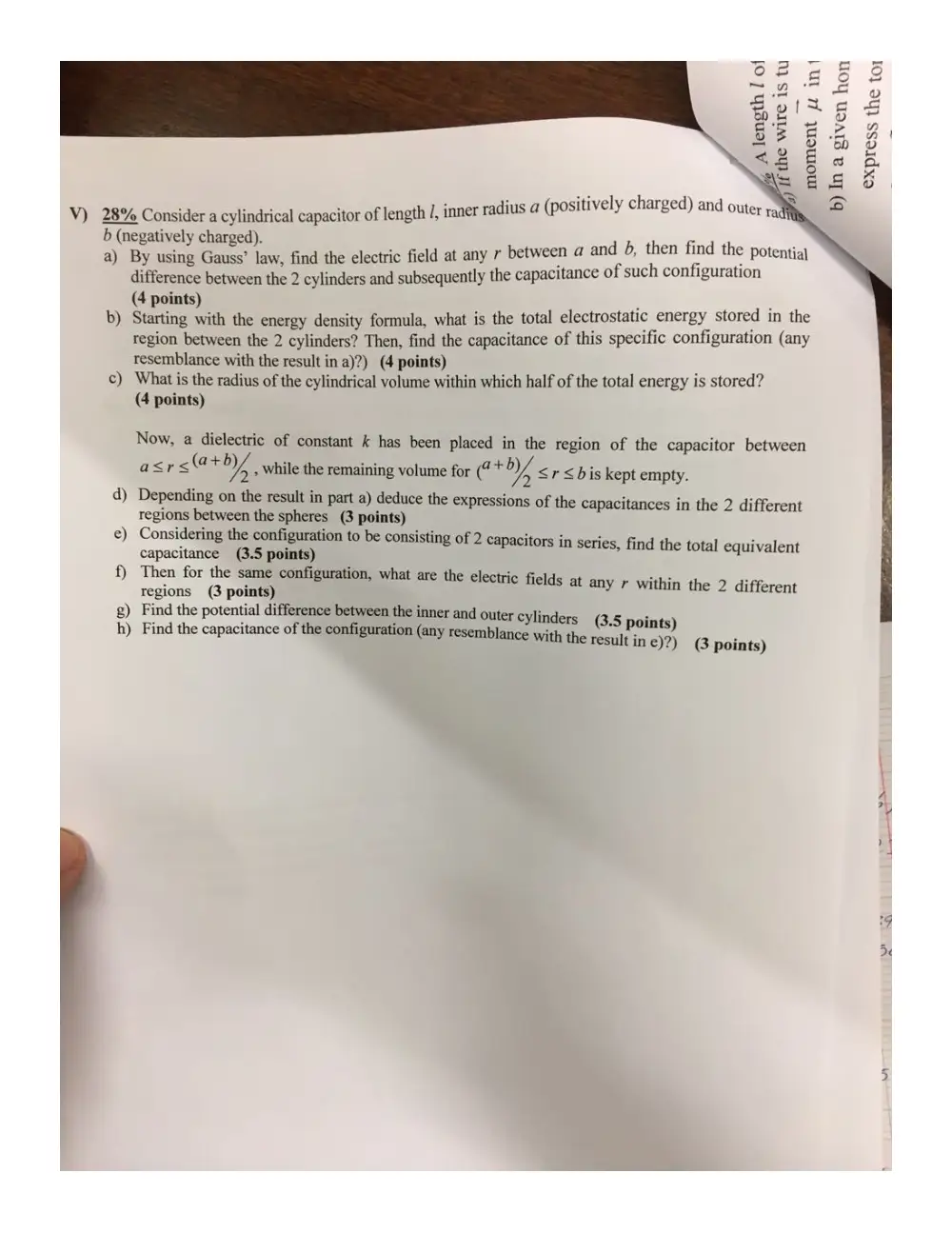
V) 28% Consider a cylindrical capacitor of length /, inner radiu:
b (negatively charged).
a) By using Gauss’ law, find the electric field at any 7
f, A length | o!
f the wire is tu
jy) |
s a (positively charged) and outer ra
difference between the 2 cylinders and subsequently the capacitance of such configuration
(4 points) . , :
b) Starting with the energy density formula, what is the total electrostatic energy stored in the
region between the 2 cylinders? Then, find the capacitance of this specific configuration (any
resemblance with the result in a)?) (4 points)
¢) What is the radius of the cylindrical volume within which half of the total energy is stored?
d)
e)
f)
8)
h)
(4 points)
moment yw in{
b) In a given hon
between a and 3, then find the potential
Now, a dielectric of constant k has been placed in the region of the capacitor between
ax<r<s(@t My , while the remaining volume for (4 Ba MA <r<bis kept empty.
Depending on the result in part a) deduce the expressions of the capacitances in the 2 different
regions between the spheres (3 points)
Considering the configuration to be consisting of 2 capacitors in series, find the total equivalent
capacitance (3.5 points)
Then for the same configuration, what are the electric fields at any r within the 2 different
regions (3 points)
Find the potential difference between the inner and outer
Find the capacitance of the configuration (any resemblan
cylinders (3.5 points)
ce with the result in e)?) 3 points)
€xpress the toy
oy]
“yy
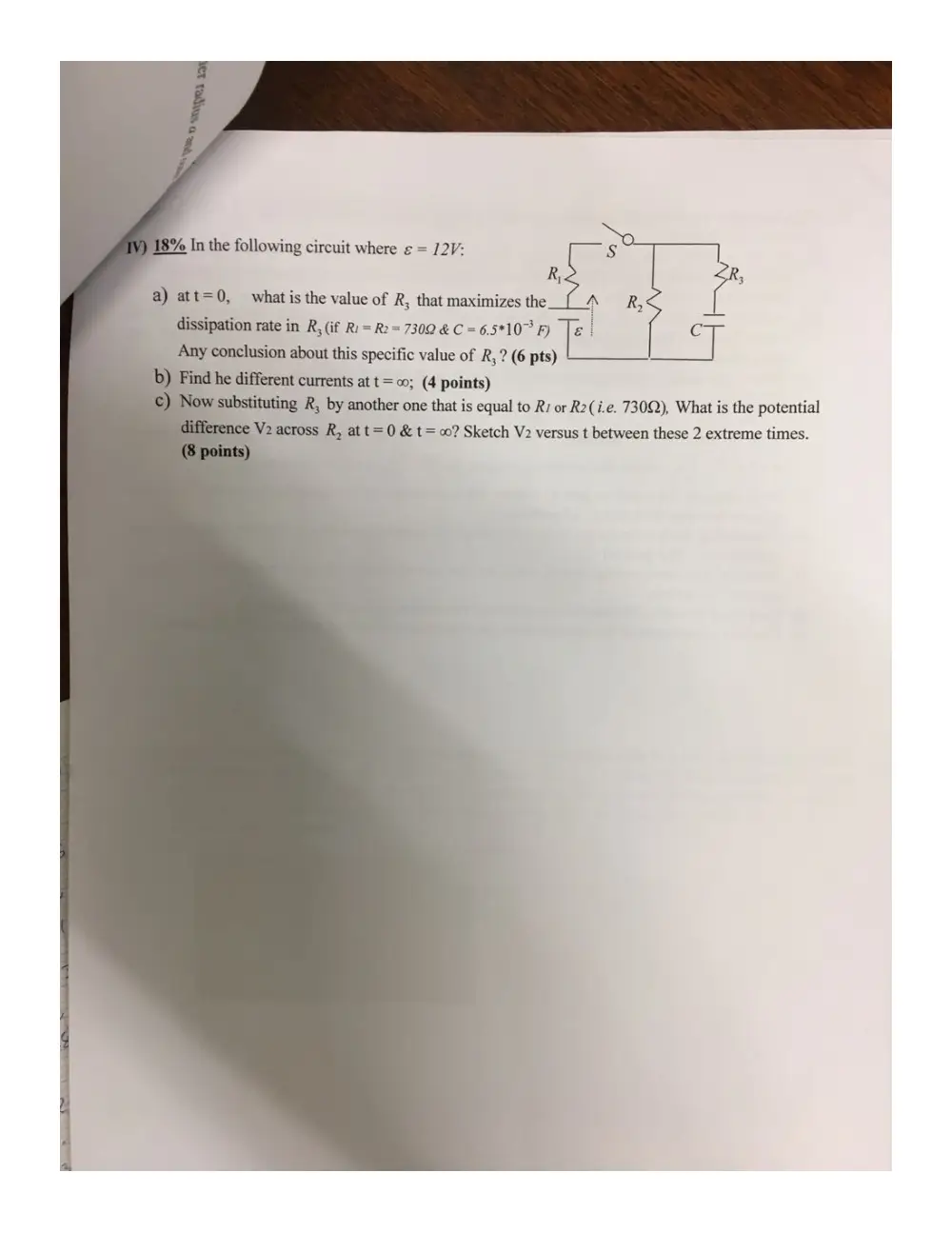
In the following circuit where ¢ = /2V: Ss
R, “4
a) att=0, what is the value of R, that maximizes the NR,
dissipation rate in R, (if Ri= R2= 7302 & C = 6.5*10° F) [f (@
conclusion about this specific value of R, ? (6 pts) |
ing R, by another one that is equal to Ry or R2(i.e. 730Q), What is the potential
across R, at t= 0 & t = 0? Sketch V2 versus t between these 2 extreme times.
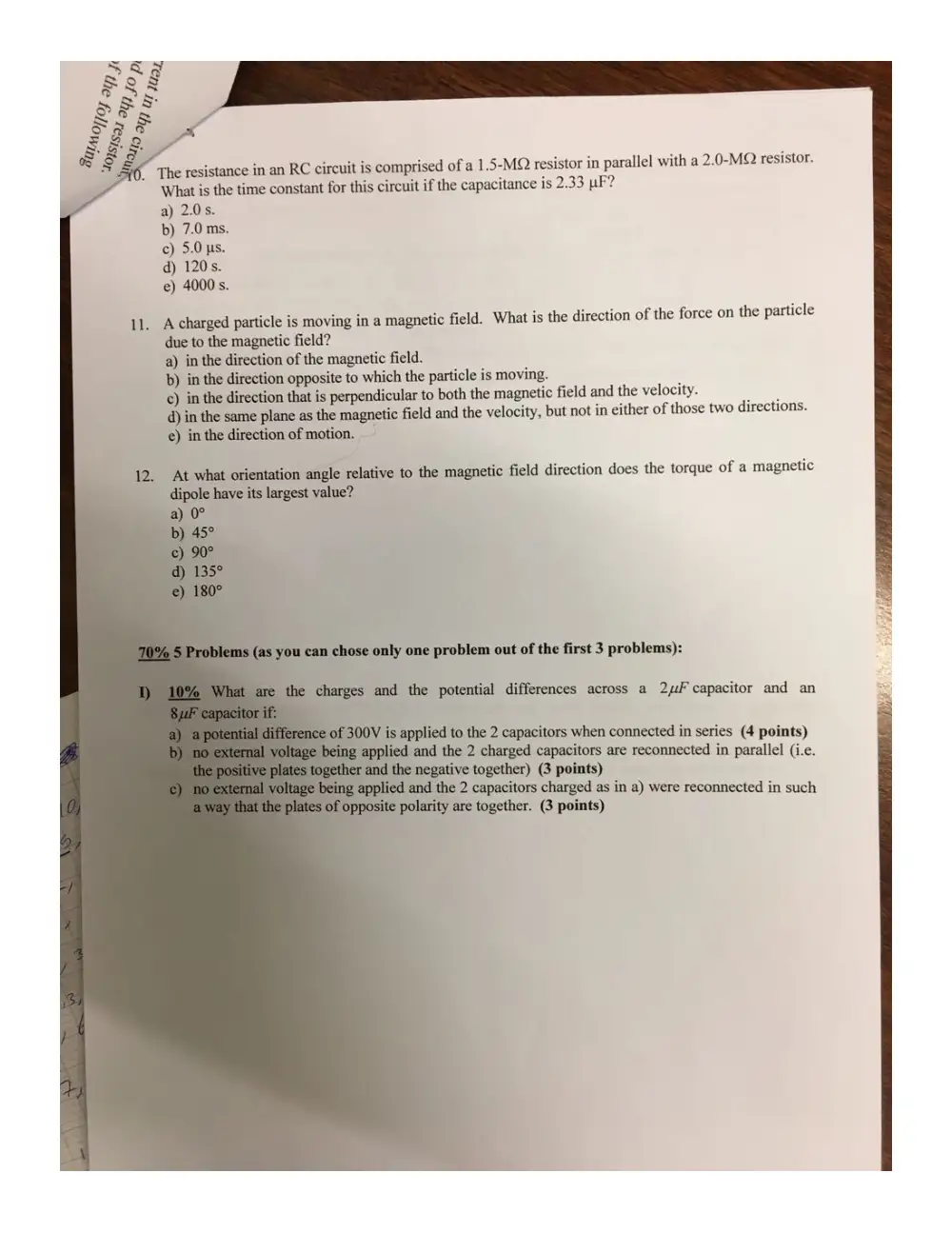
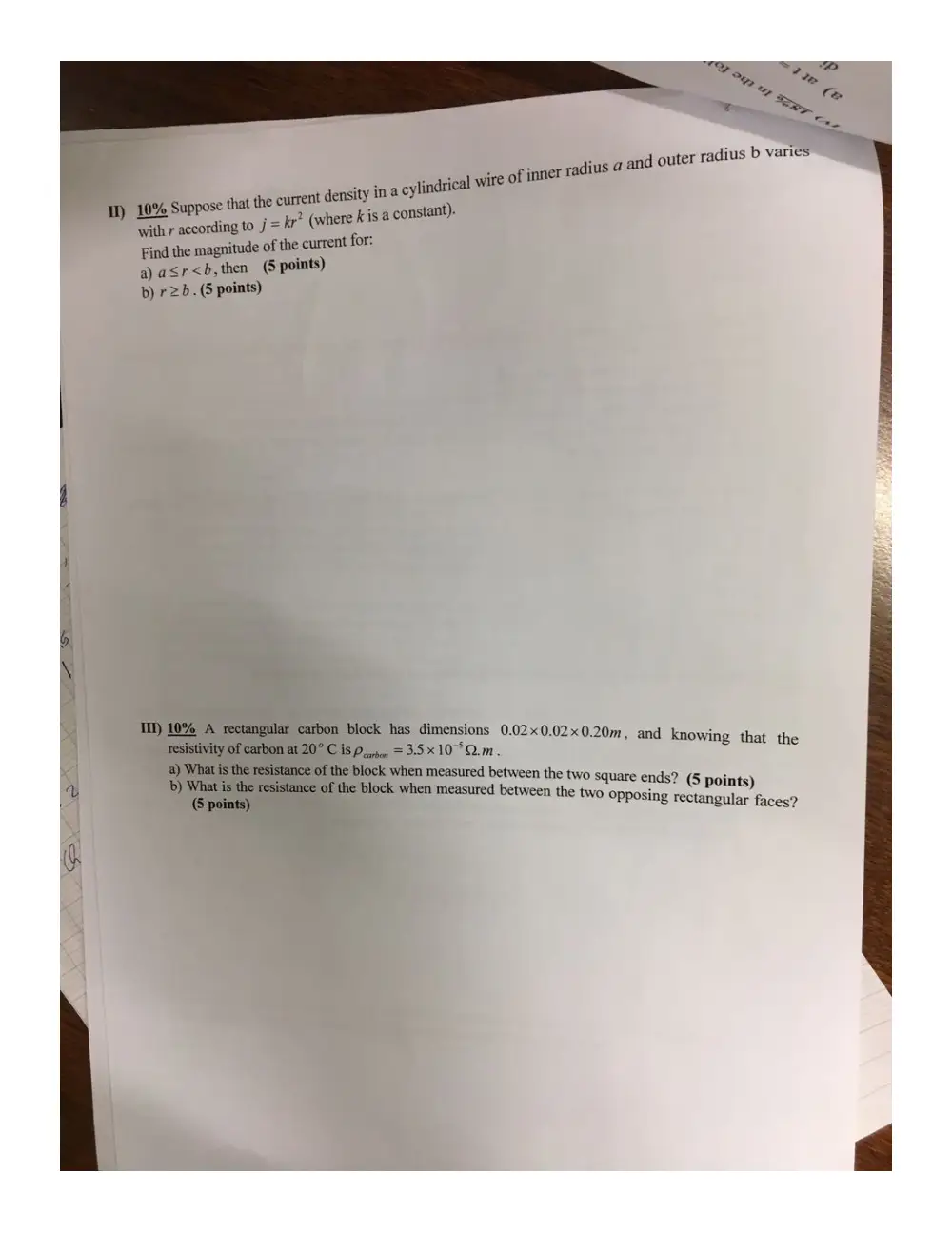
#0. The resistance in an RC circuit is comprised of a 1.5-MQ resistor in parallel with a 2.0-MQ resistor.
What is the time constant for this circuit if the capacitance is 2.33 pF?
a) 2.0s.
b) 7.0 ms.
c) 5.0 ps.
d) 120s.
e) 4000s.
11. Accharged particle is moving in a magnetic field. What is the direction of the force on the particle
due to the magnetic field?
a) in the direction of the magnetic field.
b) in the direction opposite to which the particle is moving.
¢) in the direction that is perpendicular to both the magnetic field and the velocity.
d) in the same plane as the magnetic field and the velocity, but not in either of those two directions.
e) in the direction of motion.
‘At what orientation angle relative to the magnetic field direction does the torque of a magnetic
dipole have its largest value?
a) 0°
an chose only one problem out of the first 3 problems):
and the potential differences across a 2s capacitor and an %2
is applied to the 2 capacitors when connected in series (4 points)
| and the 2 charged capacitors are reconnected in parallel (i.e.
ative together) (3 points)
and the 2 capacitors charged as in a) were reconnected in such
y are together. (3 points)
. So
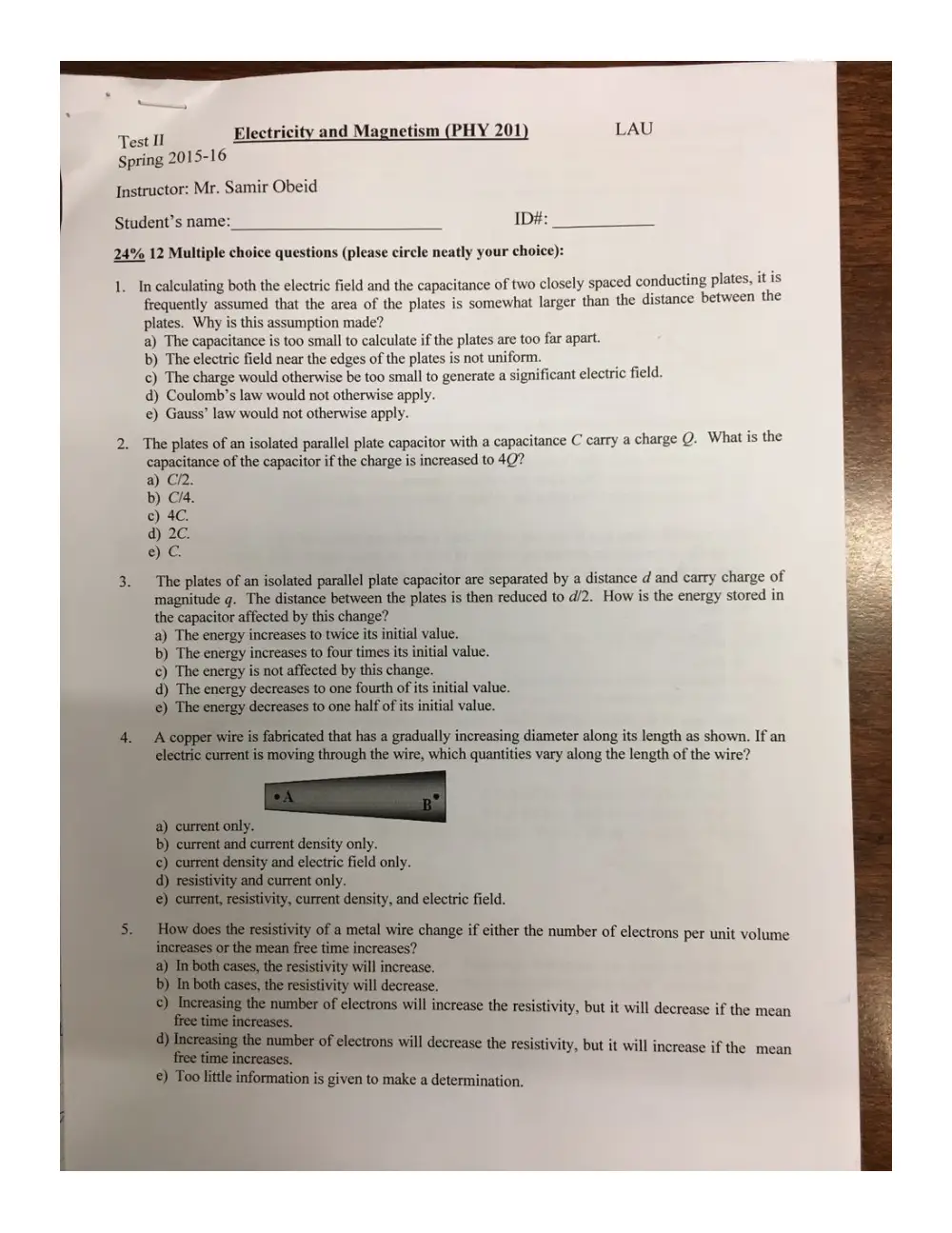
Test II Electricity and Magnetism (PHY 201) LAU
Spring 2015-16
Instructor: Mr. Samir Obeid
Student’s name: ID#:
24% 12 Multiple choice questions (please circle neatly your choice):
1. Incalculating both the electric field and the capacitance of two closely spaced conducting plates, it is
frequently assumed that the area of the plates is somewhat larger than the distance between the
plates. Why is this assumption made?
a) The capacitance is too small to calculate if the plates are too far apart.
b) The electric field near the edges of the plates is not uniform.
c) The charge would otherwise be too small to generate a significant electric field.
d) Coulomb’s law would not otherwise apply.
e) Gauss’ law would not otherwise apply.
2. The plates of an isolated parallel plate capacitor with a capacitance C carry a charge Q. What is the
capacitance of the capacitor if the charge is increased to 40?
a) C/2.
b) C/4.
capacitor are separated by a distance d and carry charge of
e plates is then reduced to d/2. How is the energy stored in
er the number of electrons per unit volume
ivity, but it will decrease if the mean
ivity, but it will increase if the mean
—— “og
oS
: 5A)
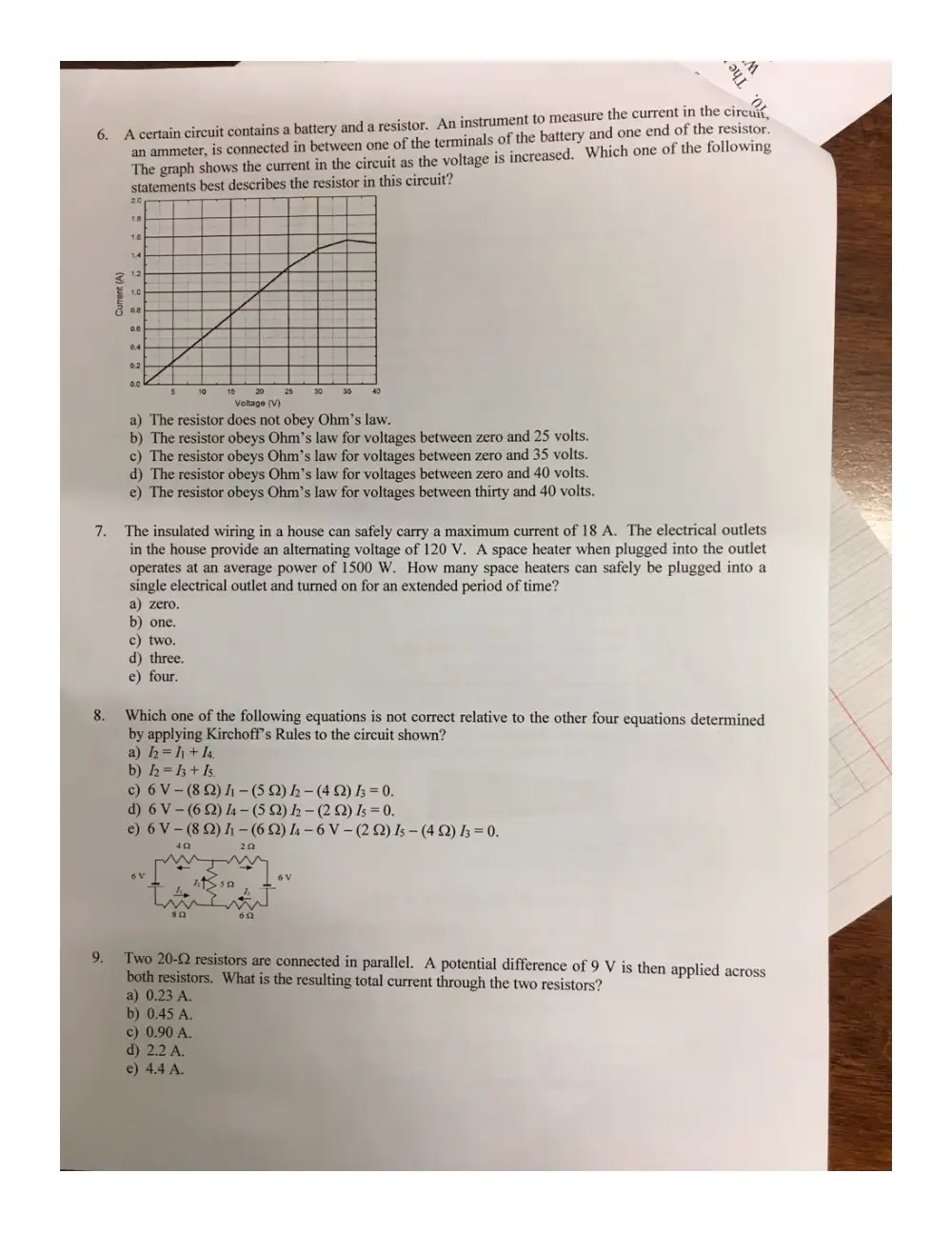
An instrument to measure the current in the circuif,
terminals and one end of the resistor.
ced. Which one of the following
circuit contains a battery and a resistor.
oF of the
as the voltage
circuit?
7. The insulated wiring in a house can safely carry a maximum current of 18 A. The electrical outlets
in the house provide an alternating voltage of 120 V. A space heater when plugged into the outlet
operates at an average power of 1500 W. How many space heaters can safely be plugged into a
single electrical outlet and turned on for an extended period of time?
a) zero.
b) one.
c) two.
d) three.
e) four.
equations is not correct relative to the other four equations determined
es to the circuit shown?
- (4.2) b= 0.
bh -(2.Q)1s=0.
-6V-(20)5-(49)5=0.
rallel. A potential difference of 9 V is then applied
current through the two resistors? os
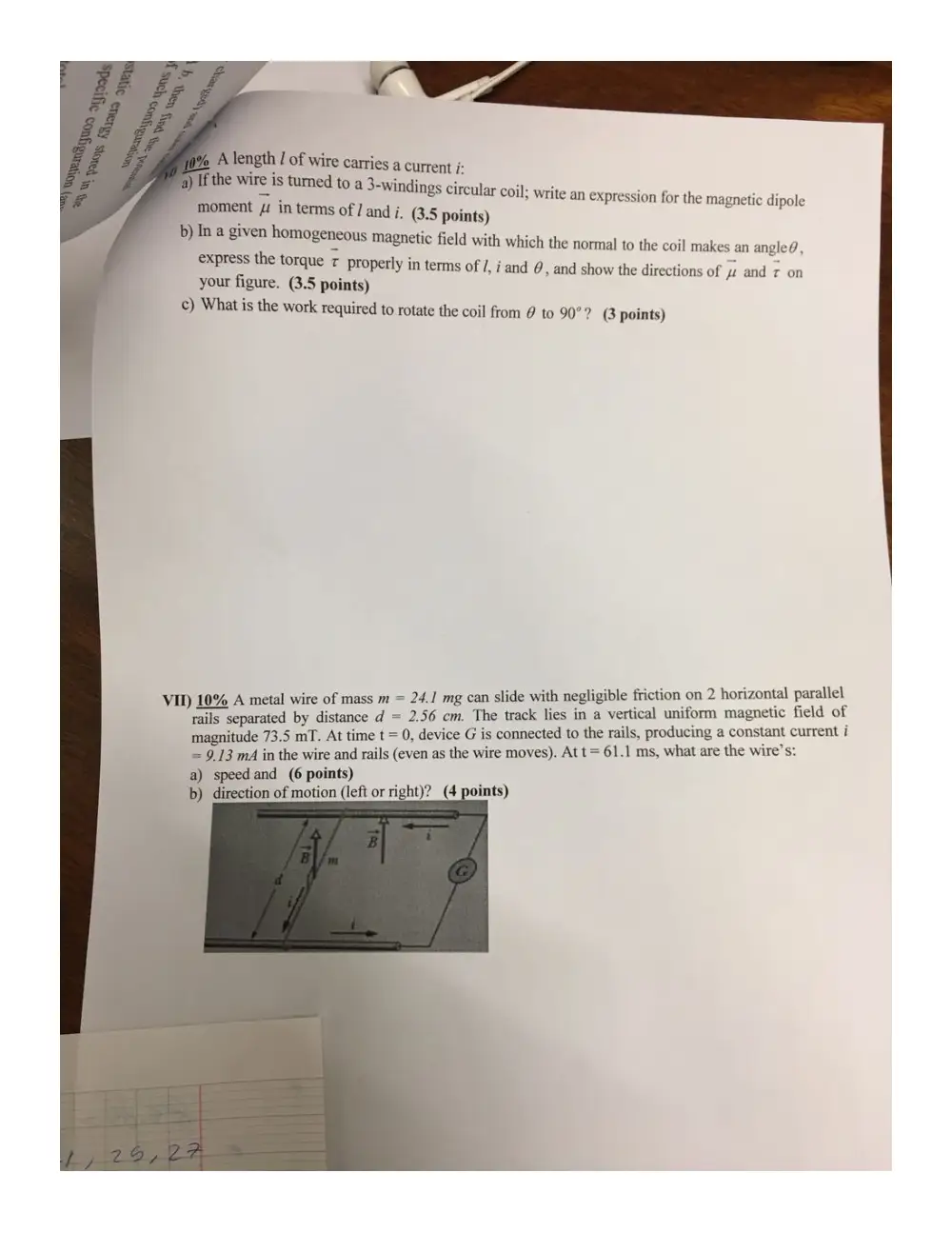
\ length 1 of wire carries a current i:
) wire is turned to a 3-windings circular coil; write an
. “moment # in terms of / and i. (3.5 points)
b) Ina given homogeneous magnetic field with whi
express the torque r properly in terms of /, i and
your figure. (3.5 points)
¢) What is the work required to rotate the coil from @ to 90°? (3 points)
expression for the magnetic dipole
ch the normal to the coil makes an angled,
0, and show the directions of j: and T on
VI) 10% A metal wire of mass m = 24.1 mg can slide with negligible friction on 2 horizontal parallel
rails separated by distance d = 2.56 cm. The track lies in a vertical uniform magnetic field of
magnitude 73.5 mT. At time t = 0, device G is connected to the rails, producing a constant current i
= 9.13 mA in the wire and rails (even as the wire moves). At t= 61.1 ms, what are the wire’s:
a) speed and (6 points)
direction of motion (left or right)? (4 points)