
PHY 201 Chapter 22, Fall 2017
Lebanese American University · Electricit and Magnetism · 27 pages · Dr. Jimmy Romanos




Showing the first 10 of 27 pages. Download the PDF to see all of it.
More PHY 201 files
Show the text of this chapter
CHAPTER 22
Electric Fields
The Electric Field
22-1
How does particle 1 “know” of the presence of particle 2?
That is, since the particles do not touch, how can particle 2 push on particle
1—how can there be such an action at a distance?
?
PHY 201
22-1 The Electric Field
ANSWER
Particle 2 sets up an electric field at all points in the surrounding
space, even if the space is a vacuum.
If we place particle 1 at any point in that space, particle 1 knows of
the presence of particle 2 because it is affected by the electric field
particle 2 has already set up at that point. Thus, particle 2 pushes
on particle 1 not by touching it as you would push on a coffee mug
by making contact. Instead, particle 2 pushes by means of the
electric field it has set up.
Electric Field
PHY 201
22-1 The Electric Field
The electric field E at any point is defined in terms of the electrostatic force F that
would be exerted on a positive test charge q0 placed there:
PHY 201
•
The electric field is a vector field
•
How to measure the electric field ?
+ q0
Positive test charge
F
The SI unit is (N/C)
22-1 The Electric Field
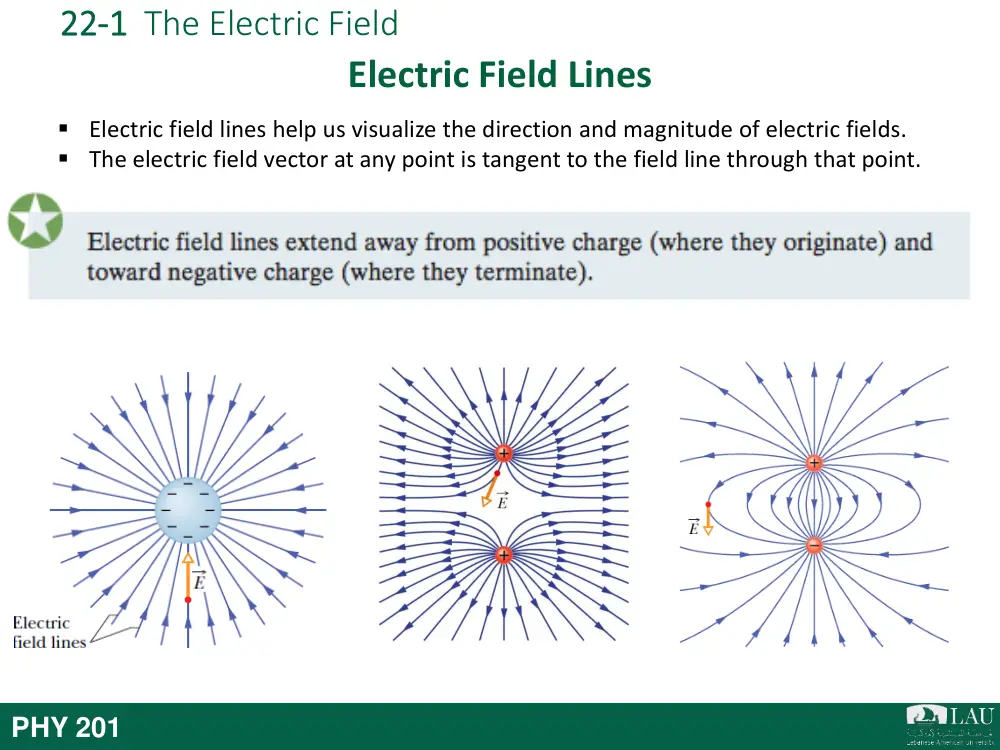
Electric Field Lines
Electric field lines help us visualize the direction and magnitude of electric fields.
The electric field vector at any point is tangent to the field line through that point.
PHY 201
22-1 The Electric Field
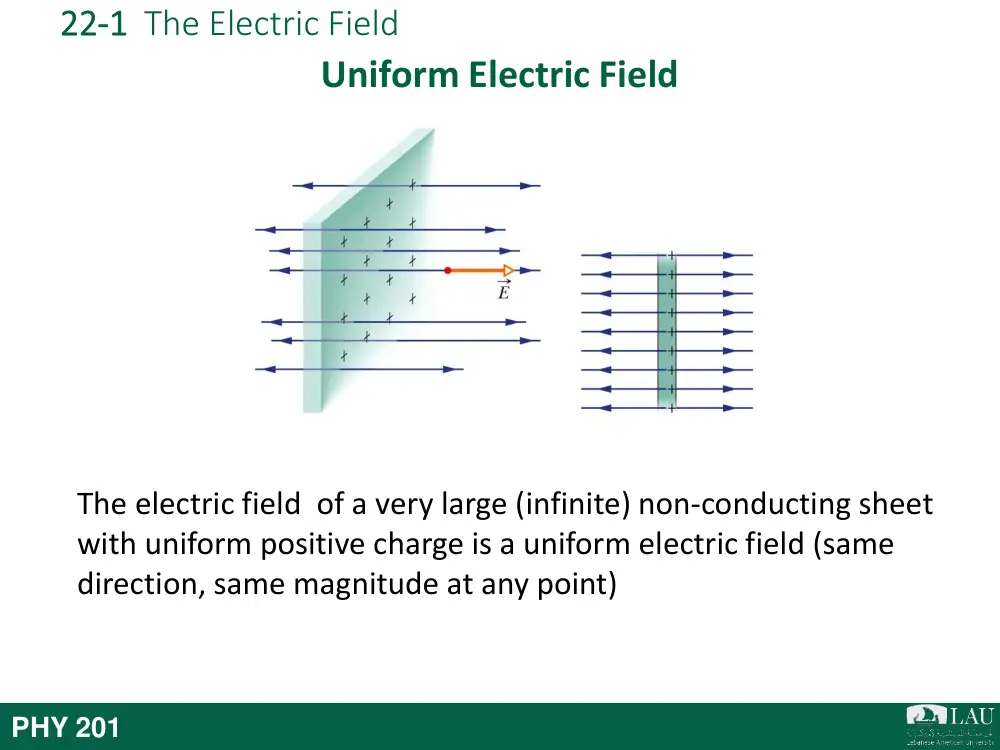
Uniform Electric Field
PHY 201
The electric field of a very large (infinite) non-conducting sheet
with uniform positive charge is a uniform electric field (same
direction, same magnitude at any point)
The Electric Field Due
to a Charged Particle
22-2
22-2 The Electric Field Due to a Charged Particle
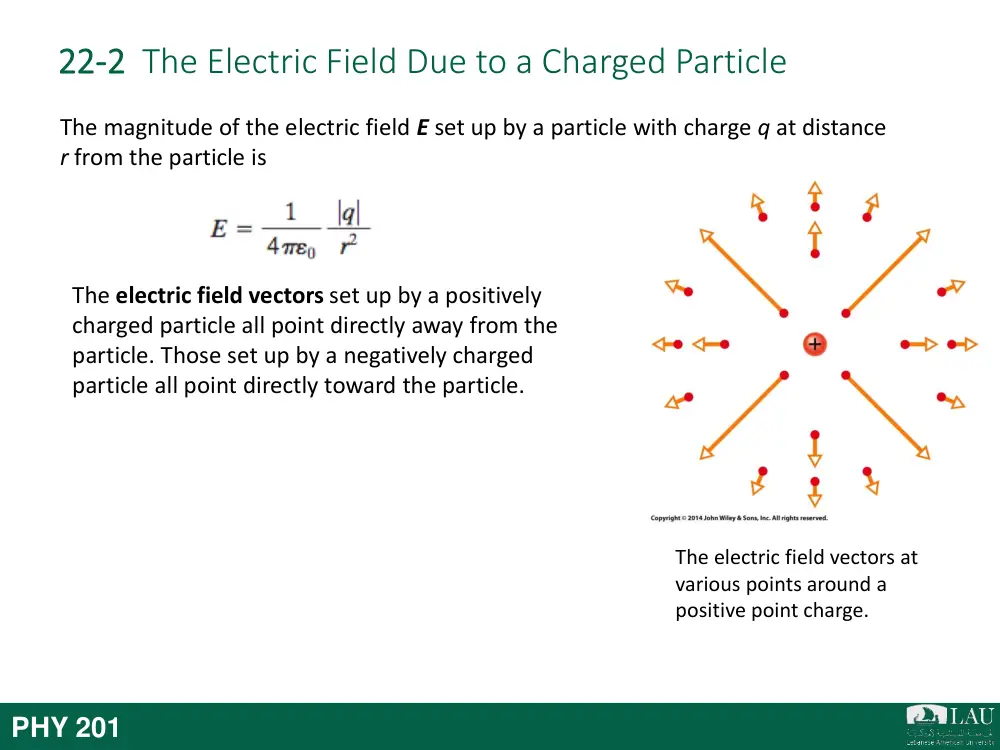
The magnitude of the electric field E set up by a particle with charge q at distance
r from the particle is
The electric field vectors set up by a positively
charged particle all point directly away from the
particle. Those set up by a negatively charged
particle all point directly toward the particle.
The electric field vectors at
various points around a
positive point charge.
PHY 201
22-2 The Electric Field Due to a Charged Particle
PHY 201
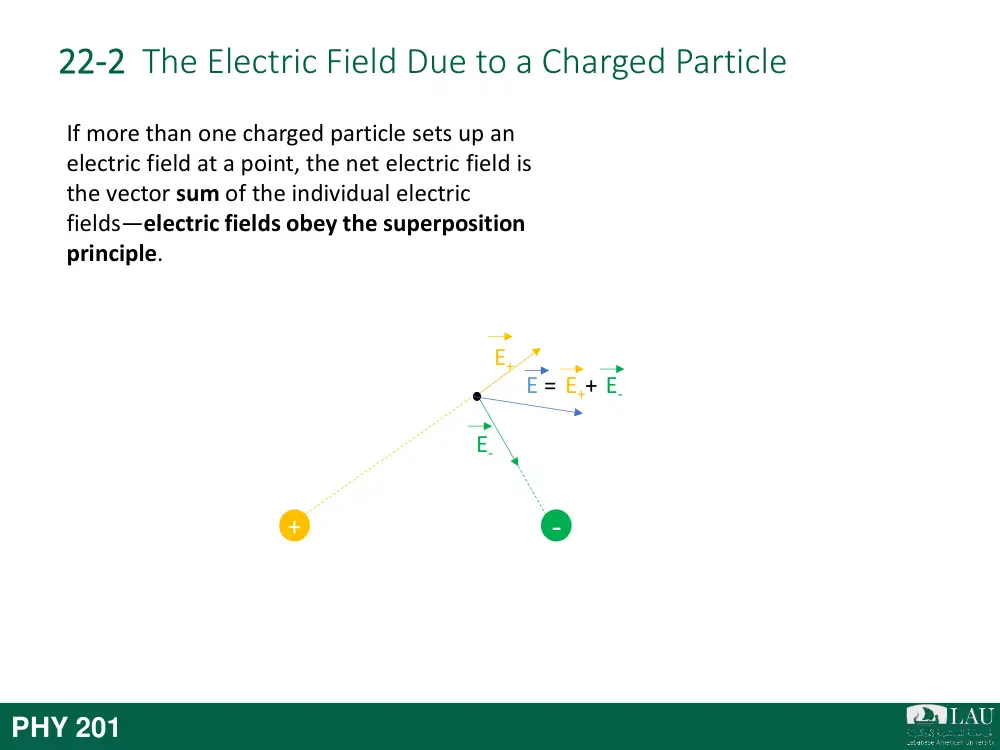
If more than one charged particle sets up an
electric field at a point, the net electric field is
the vector sum of the individual electric
fields—electric fields obey the superposition
principle.
+
-
E-
E+
E+ E-
E = +
The Electric Field Due
to a Dipole
22-3
22-3 The Electric Field Due to a Dipole
Electric Dipole
PHY 201
An electric dipole consists of two particles with
charges of equal magnitude q but opposite signs,
separated by a small distance d.
Electric dipole moment:
•
Magnitude: p = qd
•
Direction: From the negative to the positive end of
the dipole
d
q
-q
22-3 The Electric Field Due to a Dipole
Electric Dipole
The magnitude of the electric field set up by
an electric dipole at a distant point on the
dipole axis (which runs through both particles)
can be written in terms of either the product
qd or the magnitude p of the dipole moment:
where z is the distance between the point and the
center of the dipole.
PHY 201
The Electric Field Due
to a Line of Charge
22-4
22-4 The Electric Field Due to a Line of Charge
Key Concepts
• The equation for the electric field set up by a particle does not apply to an
extended object with charge (said to have a continuous charge distribution).
• To find the electric field of an extended object at a point:
1)
We first consider the electric field set up by a charge element dq in the object,
where the element is small enough for us to apply the equation for a particle.
2)
Then we sum, via integration, components of the electric fields dE from all the
charge elements.
• Because the individual electric fields dE have different magnitudes and point in
different directions, we first see if symmetry allows us to cancel out any of the
components of the fields, to simplify the integration.
PHY 201
22-4 The Electric Field Due to a Line of Charge
Key Concepts
PHY 201
𝜆 = 𝑑𝑞
𝑑𝑠
𝑑𝑠
𝜎 = 𝑑𝑞
𝑑𝐴
𝑑𝐴
𝜌 = 𝑑𝑞
𝑑𝑉
𝑑𝑉
22-4 The Electric Field Due to a Line of Charge
Charged Ring
A ring of uniform positive charge. A differential
element of charge occupies a length ds (greatly
exaggerated for clarity). This element sets up an
electric field dE at point P.
The components
perpendicular to the z
axis cancel; the
parallel components
add.
Canceling Components - Point P is on the axis: In the Figure (right),
consider the charge element on the opposite side of the ring. It too
contributes the field magnitude dE but the field vector leans at angle θ in
the opposite direction from the vector from our first charge element, as
indicated in the side view of Figure (bottom). Thus the two perpendicular
components cancel. All around the ring, this cancelation occurs for every
charge element and its symmetric partner on the opposite side of the
ring. So we can neglect all the perpendicular components.
PHY 201
22-4 The Electric Field Due to a Line of Charge
Charged Ring
A ring of uniform positive charge. A differential
element of charge occupies a length ds (greatly
exaggerated for clarity). This element sets up an
electric field dE at point P.
The components
perpendicular to the z
axis cancel; the
parallel components
add.
Adding Components. From the figure (bottom), we see that the parallel
components each have magnitude dE cosθ. We can replace cosθ by using
the right triangle in the Figure (right) to write
And, gives us the parallel
field component from each charge element
PHY 201
22-4 The Electric Field Due to a Line of Charge
Charged Ring
A ring of uniform positive charge. A differential
element of charge occupies a length ds (greatly
exaggerated for clarity). This element sets up an
electric field dE at point P.
The components
perpendicular to the z
axis cancel; the
parallel components
add.
Integrating. Because we must sum a huge number of these components,
each small, we set up an integral that moves along the ring, from element to
element, from a starting point (call it s=0) through the full circumference
(s=2πR). Only the quantity s varies as we go through the elements. We find
Finally,
PHY 201
The Electric Field Due
to a Charged Disk
22-5
22-5 The Electric Field Due to a Charged Disk
A disk of radius R and uniform positive
charge. The ring shown has radius r and
radial width dr. It sets up a differential
electric field dE at point P on its central
axis.
We superimpose a ring on the disk as shown in the Figure, at an
arbitrary radius r ≤ R. The ring is so thin that we can treat the charge
on it as a charge element dq. To find its small contribution dE to the
electric field at point P, on the axis, in terms of the ring’s charge dq
and radius r we can write
Then, we can sum all the dE contributions with
We find
PHY 201
A Point Charge in an
Electric Field
22-6
22-6 A Point Charge in an Electric Field
If a particle with charge q is placed in an external electric field E, an electrostatic force
F acts on the particle:
Ink-jet printer. Drops shot from generator G
receive a charge in charging unit C. An input
signal from a computer controls the charge
and thus the effect of field E on where the
drop lands on the paper.
PHY 201
A Dipole in an Electric
Field
22-7
22-7 A Dipole in an Electric Field General Knowledge
The torque on an electric dipole of dipole moment p when
placed in an external electric field E is given by a cross
product:
A potential energy U is associated with the
orientation of the dipole moment in the field,
as given by a dot product:
(a) An electric dipole in a uniform external electric field E. Two centers of equal but opposite charge
are separated by distance d. The line between them represents their rigid connection.
(b) Field E: causes a torque τ on the dipole. The direction of τ is into the page, as represented by the
symbol (x-in a circle) .
PHY 201
22 Summary
Definition of Electric Field
• The electric field at any point
Electric Field Lines
• provide a means for visualizing the
directions and the magnitudes of
electric fields
Field due to an Electric Dipole
• The magnitude of the electric field
set up by the dipole at a distant point
on the dipole axis is
Eq. 22-9
Field due to a Charged Disk
• The electric field magnitude at a
point on the central axis through a
uniformly charged disk is given by
Eq. 22-26
Field due to a Point Charge
• The magnitude of the electric field E set
up by a point charge q at a distance r
from the charge is
Eq. 22-1
Eq. 22-3
PHY 201
22 Summary
Force on a Point Charge in an
Electric Field
• When a point charge q is placed in an
external electric field E
Dipole in an Electric Field
• The electric field exerts a torque on a
dipole
• The dipole has a potential energy U
associated with its orientation in the
field
Eq. 22-34
Eq. 22-38
Eq. 22-28
PHY 201