
PHY 201 Chapter 21, Fall 2017
Lebanese American University · Electricit and Magnetism · 29 pages · Dr. Jimmy Romanos




Showing the first 10 of 29 pages. Download the PDF to see all of it.
More PHY 201 files
Show the text of this chapter
Electricity and Magnetism
PHY 201
Dr. J. Romanos
CHAPTER 21
Electric Charge
Introduction
PHY 201
Ancient Greek philosopher Thales of Miletus reported the
attractive properties of amber when rubbed
PHY 201
Brief History: Electric Charge
Thales of Miletus
600 BC
1675 AD, Robert Boyle: Electric attraction and repulsion in vacuum
17th
Century
1729 AD, Stephen Gray: Materials are classified as conductors and insulators
1733 AD, du Fay: Two distinct types of electricity
1750 AD, Benjamin Franklin: positive and negative label
1770 AD, Coulomb: Inverse Square Law
18th
Century
1839 AD, Michael Faraday: Electricity with different polarities
1890 AD J.J. Thompson: Quantization of electric charge
19th
Century
Coulomb
B. Franklin
Faraday
PHY 201
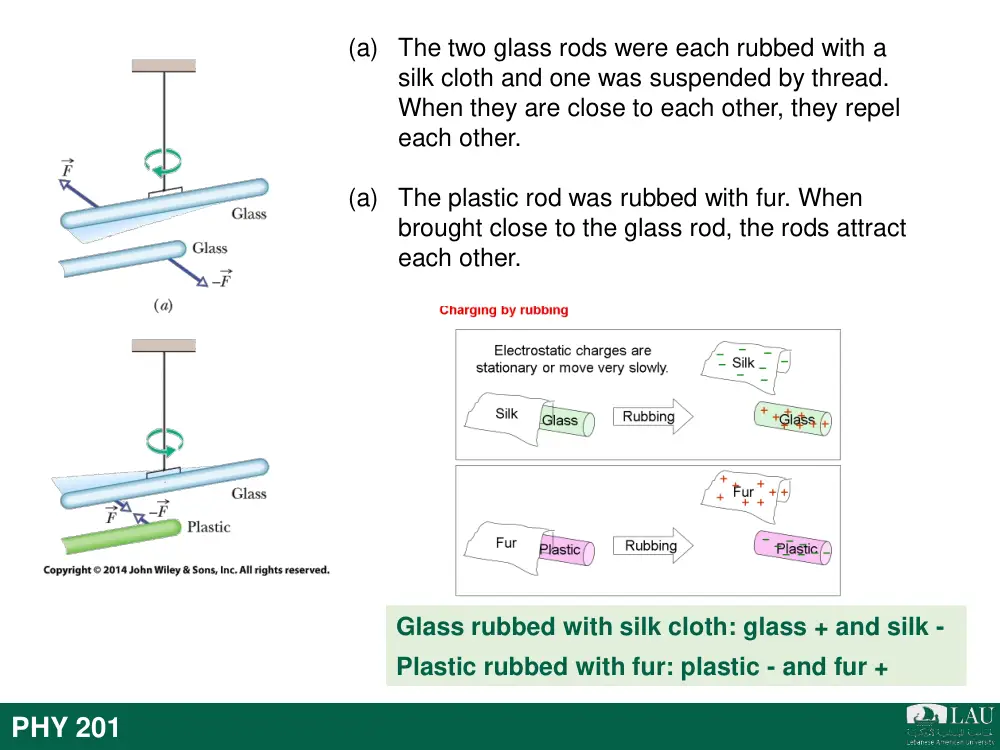
(a) The two glass rods were each rubbed with a
silk cloth and one was suspended by thread.
When they are close to each other, they repel
each other.
(a) The plastic rod was rubbed with fur. When
brought close to the glass rod, the rods attract
each other.
Glass rubbed with silk cloth: glass + and silk -
Plastic rubbed with fur: plastic - and fur +
PHY 201
Electric Charge
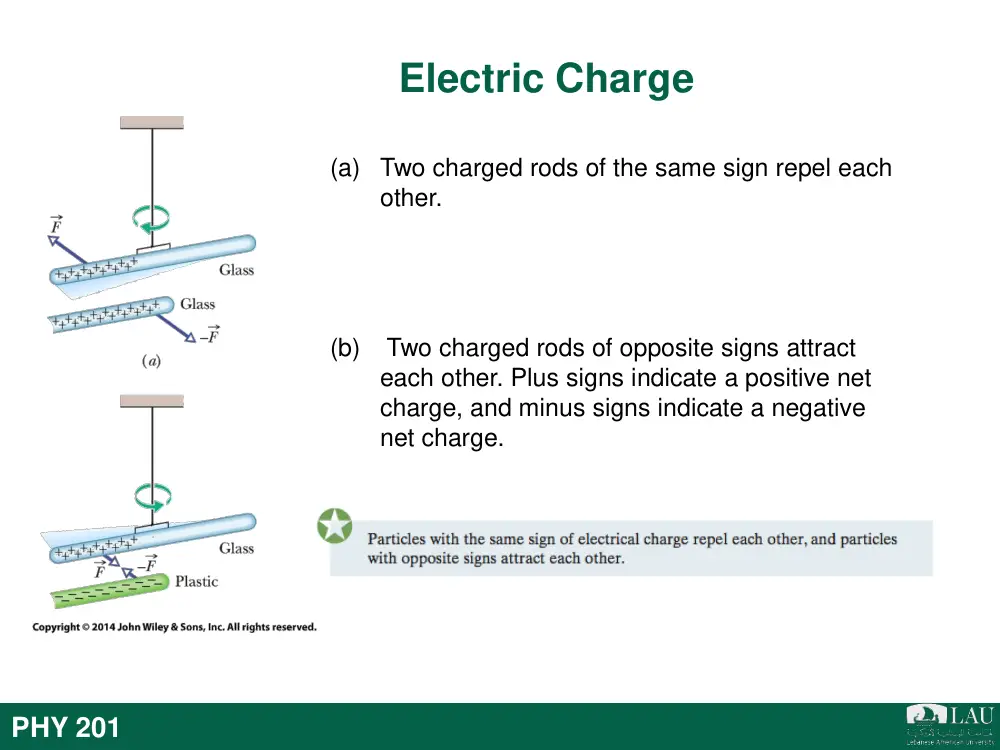
(a) Two charged rods of the same sign repel each
other.
(b)
Two charged rods of opposite signs attract
each other. Plus signs indicate a positive net
charge, and minus signs indicate a negative
net charge.
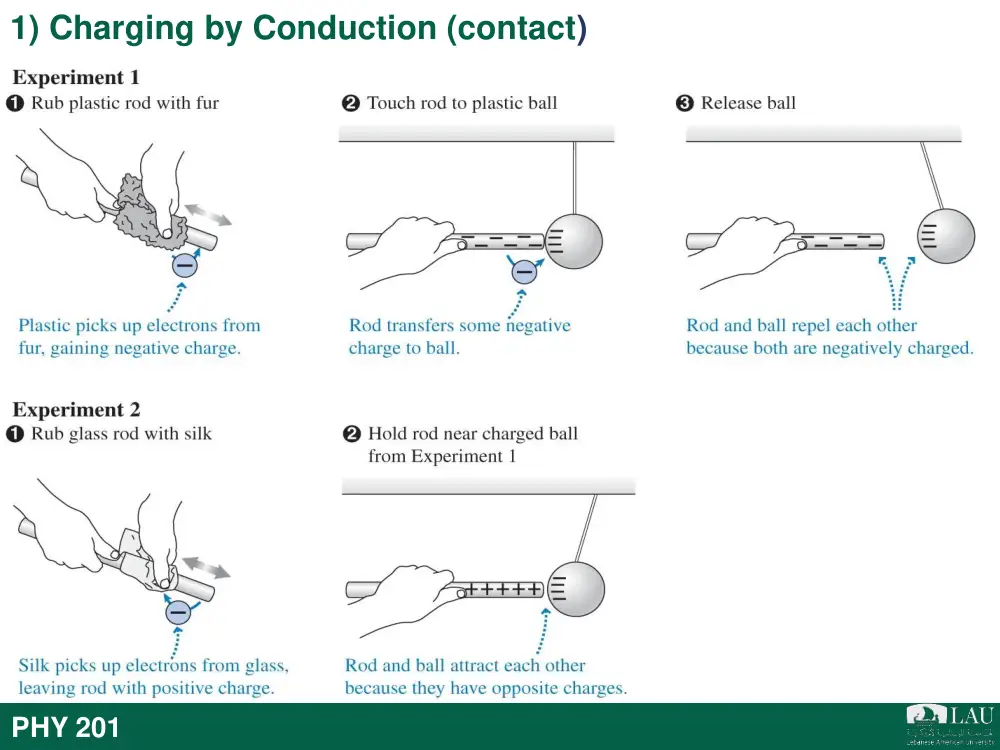
Charging by:
1) Conduction
2) Induction
1) Charging by Conduction (contact)
PHY 201
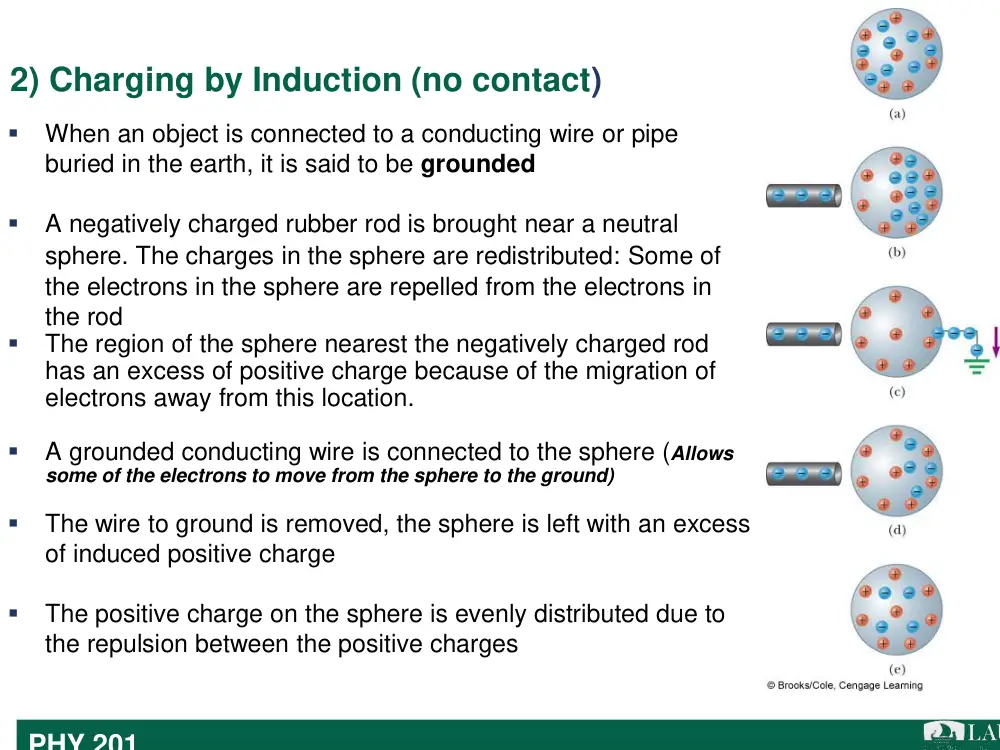
2) Charging by Induction (no contact)
PHY 305
When an object is connected to a conducting wire or pipe
buried in the earth, it is said to be grounded
A negatively charged rubber rod is brought near a neutral
sphere. The charges in the sphere are redistributed: Some of
the electrons in the sphere are repelled from the electrons in
the rod
The region of the sphere nearest the negatively charged rod
has an excess of positive charge because of the migration of
electrons away from this location.
A grounded conducting wire is connected to the sphere (Allows
some of the electrons to move from the sphere to the ground)
The wire to ground is removed, the sphere is left with an excess
of induced positive charge
The positive charge on the sphere is evenly distributed due to
the repulsion between the positive charges
PHY 201
Conductors
/Insulators
PHY 201
Materials classified based on their ability to
move charge
•
Conductors are materials in which a significant number of electrons are
free to move. Examples include metals.
•
The charged particles in nonconductors (insulators) are not free to move.
There are few (if any) free electrons in a nonconductor. Examples include
rubber, plastic, glass.
•
Semiconductors are materials that are intermediate between conductors
and insulators. Examples include silicon and germanium in computer chips.
•
Superconductors are materials that are perfect conductors, allowing
charge to move without any hindrance.
PHY 201
•
Charged Particles. The properties of conductors and insulators are due to the
structure and electrical nature of atoms. Atoms consist of positively charged protons,
negatively charged electrons, and electrically neutral neutrons. The protons and
neutrons are packed tightly together in a central nucleus and do not move.
𝐙
𝐀𝐗
Z: Atomic number (number of protons)
N: Number of neutrons
A: Mass number (A = Z + N)
For neutral atoms, Z is also the number of electrons
A neutral atom has equal numbers
of protons and electrons.
Proton
Neutron
PHY 201
.
Proton
Neutron
For conductors, outermost electrons are loosely held by nucleus
For insulators, outermost electrons are tightly held by nucleus
A neutral atom has equal numbers of
protons and electrons
An atom becomes a positive ion
when it loses electrons and a
negative ion when it gains electrons
PHY 201
•
When atoms of a conductor like copper come together to
form the solid, some of their outermost—and so most
loosely held—electrons become free to wander about within
the solid, leaving behind positively charged atoms ( positive
ions).
•
We call the mobile electrons conduction electrons.
•
Only conduction electrons can move
Conduction Electrons
PHY 201
Charged Insulator ?!
In insulator, such as glass, the atoms' electrons have very little freedom to
move around. External forces such as physical rubbing can force some of
these electrons to leave their respective atoms and transfer to the atoms of
another material, they do not move between atoms within that material very
easily.
PHY 201
Induced Charge. A neutral copper rod is electrically isolated from its surroundings by
being suspended on a non-conducting thread. Either end of the copper rod will be
attracted by a charged rod. Here, conduction electrons in the copper rod are repelled to
the far end of that rod by the negative charge on the plastic rod. Then that negative
charge attracts the remaining positive charge on the near end of the copper rod, rotating
the copper rod to bring that near end closer to the plastic rod.
Conductor: Induced charge
Insulator: Polarization
The charged object (on the left) induces charge on the surface of the
insulator
A charged comb attracts bits of paper due to polarization of the paper
PHY 201
PHY 201
+
+
Coulomb’s law
PHY 201
Coulomb’s law
• Charles Coulomb measured the magnitudes of electric
forces between two small charged spheres
• He found the force depended on the charges and the
distance between them
r
r
k q q
F
ˆ
2
1 2
PHY 201
The electrostatic force on particle 1 can
be described in terms of a unit vector r
along an axis through the two particles,
radially away from particle 2.
Coulomb’s law describes the electrostatic force (or
electric force) between two charged particles. If the
particles have charges q1 and q2, are separated by
distance r, and are at rest (or moving only slowly)
relative to each other, then the magnitude
of the force acting on each due to the other is
given by
where ε0 = 8.85 ×10⁻¹² C2/N.m2 is the permittivity constant. The ratio 1/4πε0 is often
replaced with the electrostatic constant (or Coulomb constant) k=8.99×10⁹ N.m2/C2.
Thus k = 1/4πε0 .
Coulomb’s law
PHY 201
•
The electrostatic force vector acting on a charged
particle due to a second charged particle is either
directly toward the second particle (opposite
signs of charge) or directly away from it (same
sign of charge).
•
If multiple electrostatic forces act on a particle,
the net force is the vector sum (not scalar sum)
of the individual forces.
Two charged particles repel each other if
they have the same sign of charge, either
(a) both positive or (b) both negative. (c)
They attract each other if they have
opposite signs of charge.
PHY 201
Multiple Forces: If multiple electrostatic forces act on a particle, the net force is the
vector sum (not scalar sum) of the individual forces.
Charge is quantized and
conserved
PHY 201
Charge is Quantized
•
Electric charge is measured in Coulomb
•
The smallest charge you can find is
•
Electric charge is quantized (restricted to certain values). All other charges are
multiple of this charge.
•
The charge of a particle can be written as ne, where n is a positive or negative
integer and e is the elementary charge. Any positive or negative charge q that
can be detected can be written as
in which e, the elementary charge, has the approximate value
PHY 201
Charge is Quantized
When a physical quantity such as charge can have only
discrete values rather than any value, we say that the quantity
is quantized.
It is possible, for example, to find a particle that has no charge
at all or a charge of +10e or -6e,
Charge of 3.57e is not possible
PHY 201
Charge is Conserved
The net electric charge of any isolated system is always
conserved.
If two charged particles undergo an annihilation process,
they have equal and opposite signs of charge.
If two charged particles appear as a result of a pair
production process, they have equal and opposite signs of
charge.
A photograph of trails of bubbles left in a bubble chamber by an electron and a positron.
The pair of particles was produced by a gamma ray that entered the chamber directly
from the bottom. Being electrically neutral, the gamma ray did not generate a telltale trail
of bubbles along its path, as the electron and positron did.
PHY 201
Electric Charge
• The strength of a particle’s electrical
interaction with objects around it
depends on its electric charge,
which can be either positive or
negative.
Conductors and Insulators
• Conductors are materials in which a
significant number of electrons are
free to move. The charged particles
in nonconductors (insulators) are
not free to move.
Coulomb’s Law
• The magnitude of the electrical
force between two charged
particles is proportional to the
product of their charges and
inversely proportional to the
square of their separation
distance.
• .
Eq. 21-4
Eq. 21-12
Conservation of Charge
• The net electric charge of any isolated
system is always conserved.
21 Summary
21 Summary