
ACO 201 Problems Chapter 6 Solutions, Spring 2013
Notre Dame University–Louaize · Principles of Accounting I · 54 pages · with solution
Showing the first 10 of 54 pages. Download the PDF to see all of it.
More ACO 201 files
- Chapter 1 · Spring 2013ChapterView
- Chapter 2 · Spring 2013ChapterView
- Chapter 3 · Spring 2013ChapterView
- Chapter 4 · Spring 2013ChapterView
- Chapter 5 · Spring 2013ChapterView
- Chapter 6 · Spring 2013ChapterView
- Chapter 7 · Spring 2013ChapterView
- Problems Chapter 2 Solution · Spring 2013Chapter · with solutionView
Show the text of this chapter
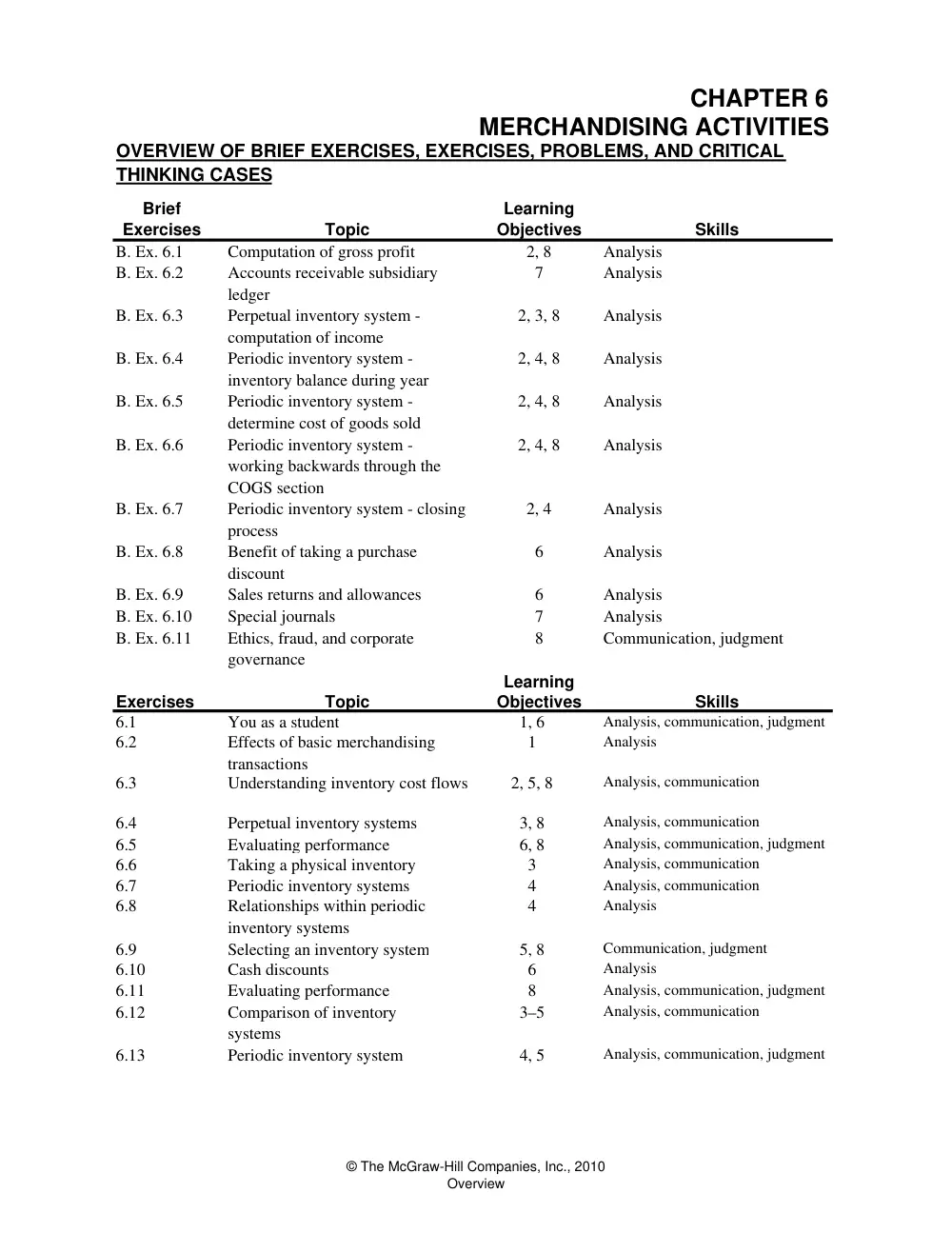
Brief
Exercises
B. Ex. 6.1
B. Ex. 6.2
B. Ex. 6.3
Analysis
B. Ex. 6.4
B. Ex. 6.5
Analysis
B. Ex. 6.6
B. Ex. 6.7
B. Ex. 6.8
B. Ex. 6.9
B. Ex. 6.10
B. Ex. 6.11
6.1
1, 6
6.2
1
6.3
2, 5, 8
6.4
3, 8
6.5
Evaluating performance
6, 8
6.6
3
6.7
4
6.8
4
6.9
5, 8
6.10
Cash discounts
6
6.11
Evaluating performance
8
6.12
3–5
6.13
Periodic inventory system
4, 5
Comparison of inventory
systems
Analysis, communication
Analysis, communication, judgment
Analysis
Communication, judgment
Analysis, communication, judgment
Analysis
Relationships within periodic
inventory systems
Selecting an inventory system
Analysis, communication, judgment
Analysis, communication
OVERVIEW OF BRIEF EXERCISES, EXERCISES, PROBLEMS, AND CRITICAL
THINKING CASES
Accounts receivable subsidiary
ledger
Perpetual inventory system -
computation of income
Periodic inventory system -
determine cost of goods sold
2, 3, 8
Periodic inventory system -
inventory balance during year
2, 4, 8
Analysis
2, 4, 8
Computation of gross profit
Special journals
7
Analysis
8
Communication, judgment
Ethics, fraud, and corporate
governance
6
Analysis
Sales returns and allowances
6
Analysis
Benefit of taking a purchase
discount
2, 4, 8
Analysis
Periodic inventory system - closing
process
2, 4
Analysis
Periodic inventory system -
working backwards through the
COGS section
2, 8
Analysis
7
Analysis
Learning
Topic
Objectives
Skills
Analysis, communication
Effects of basic merchandising
transactions
Analysis, communication, judgment
Exercises
Understanding inventory cost flows
Objectives
Perpetual inventory systems
Topic
Taking a physical inventory
Periodic inventory systems
CHAPTER 6
MERCHANDISING ACTIVITIES
Analysis, communication
Analysis, communication
Skills
You as a student
Analysis
Learning
© The McGraw-Hill Companies, Inc., 2010
Overview
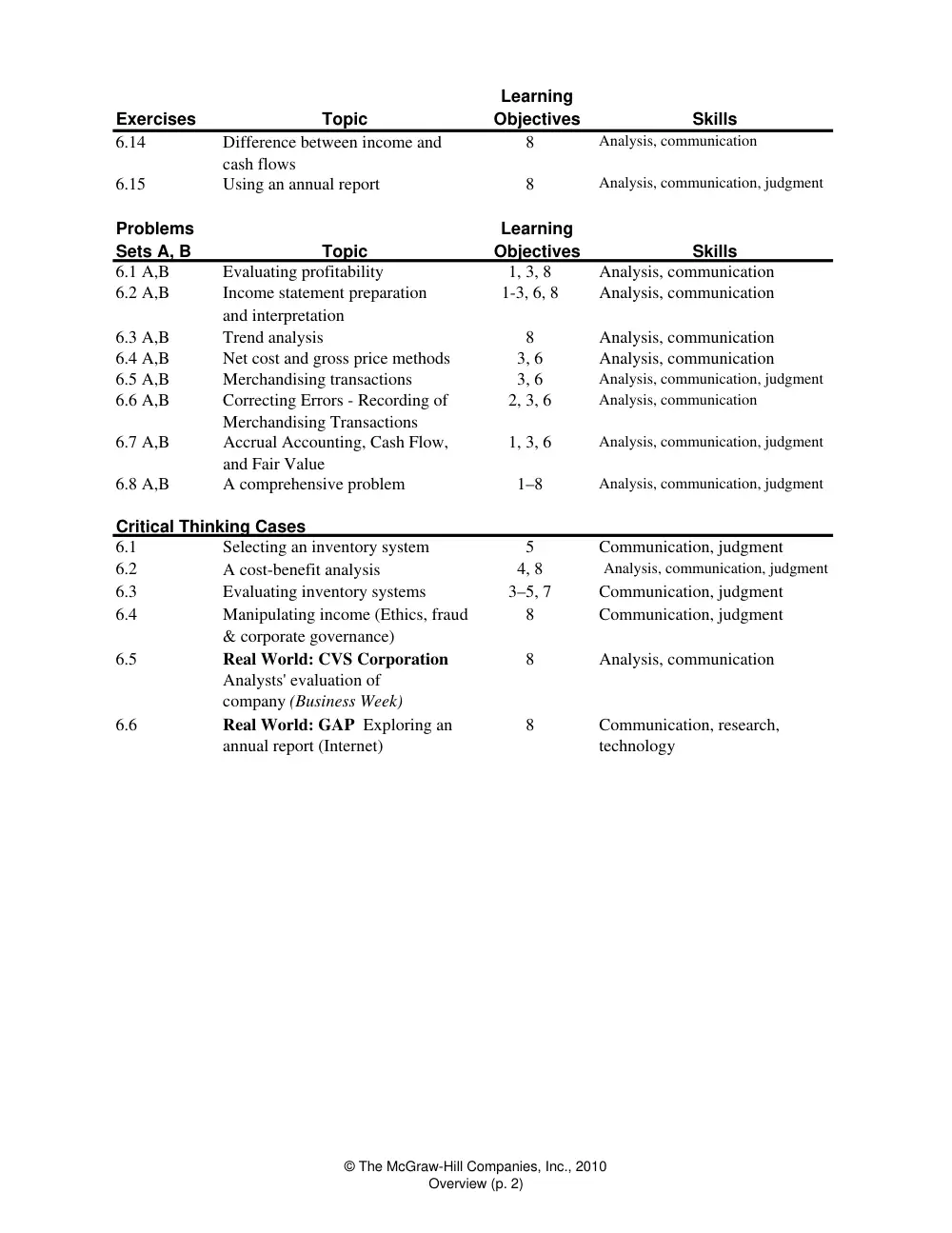
6.14
8
6.15
Using an annual report
8
Problems
Sets A, B
6.1 A,B
1, 3, 8
6.2 A,B
1-3, 6, 8
and interpretation
6.3 A,B
8
6.4 A,B
3, 6
6.5 A,B
3, 6
6.6 A,B
2, 3, 6
6.7 A,B
1, 3, 6
6.8 A,B
1–8
6.1
5
6.2
4, 8
6.3
3–5, 7
6.4
8
& corporate governance)
6.5
8
6.6
8
annual report (Internet)
technology
Learning
Objectives
Exercises
Topic
Objectives
Topic
Skills
Learning
Analysis, communication
Analysis, communication, judgment
Trend analysis
Analysis, communication
Income statement preparation
Net cost and gross price methods
Merchandising transactions
Analysts' evaluation of
company (Business Week)
Evaluating inventory systems
Manipulating income (Ethics, fraud
Real World: CVS Corporation
Analysis, communication
Communication, judgment
Critical Thinking Cases
Real World: GAP Exploring an
Communication, research,
Communication, judgment
Selecting an inventory system
Communication, judgment
A cost-benefit analysis
Analysis, communication, judgment
Analysis, communication, judgment
A comprehensive problem
Analysis, communication, judgment
Difference between income and
cash flows
Analysis, communication
Analysis, communication
Analysis, communication
Analysis, communication
Skills
Evaluating profitability
Analysis, communication, judgment
Correcting Errors - Recording of
Merchandising Transactions
Accrual Accounting, Cash Flow,
and Fair Value
© The McGraw-Hill Companies, Inc., 2010
Overview (p. 2)
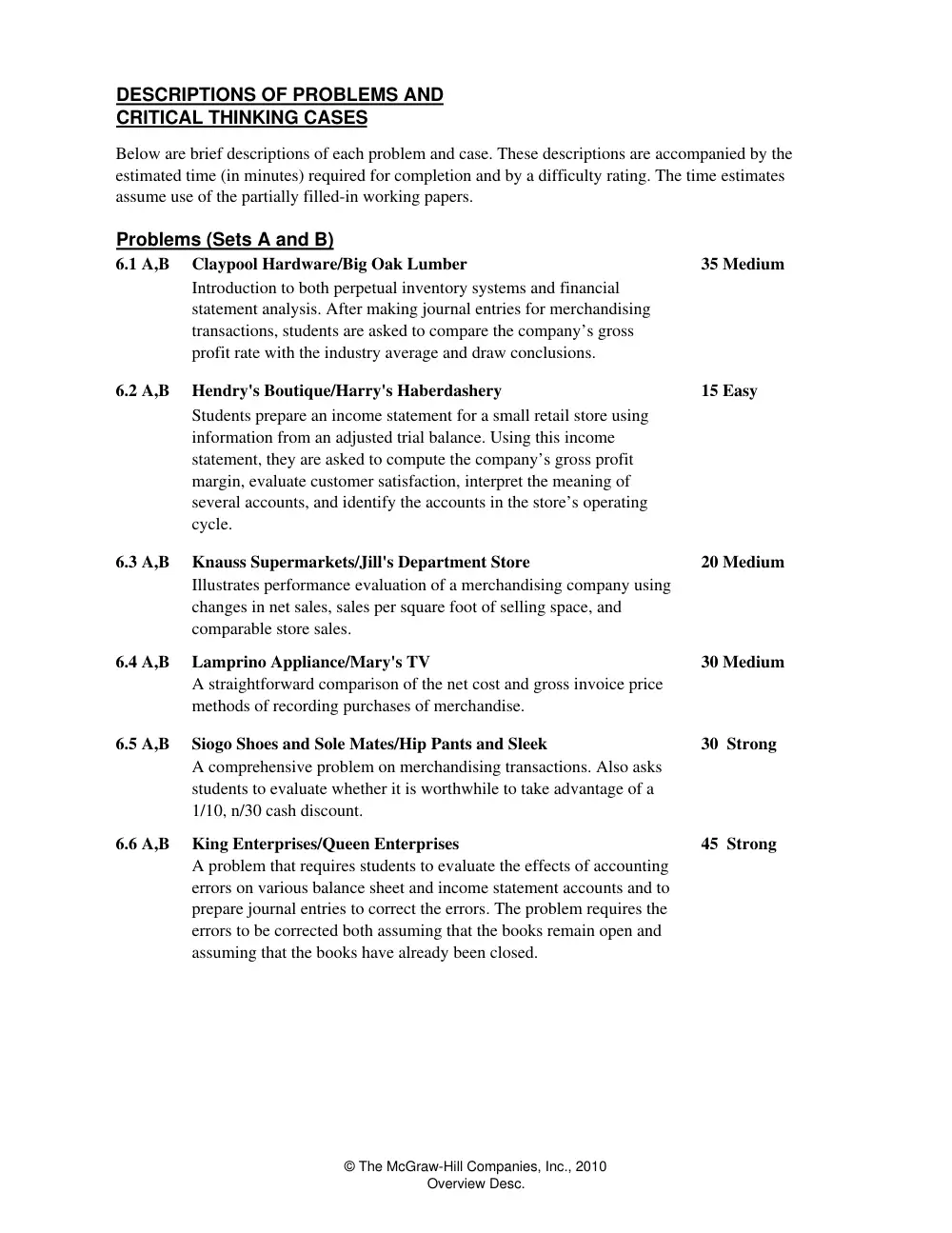
DESCRIPTIONS OF PROBLEMS AND
CRITICAL THINKING CASES
Problems (Sets A and B)
35 Medium
6.2 A,B
15 Easy
6.3 A,B
20 Medium
6.4 A,B
6.5 A,B
30 Strong
6.6 A,B
45 Strong
A problem that requires students to evaluate the effects of accounting
errors on various balance sheet and income statement accounts and to
prepare journal entries to correct the errors. The problem requires the
errors to be corrected both assuming that the books remain open and
assuming that the books have already been closed.
Below are brief descriptions of each problem and case. These descriptions are accompanied by the
estimated time (in minutes) required for completion and by a difficulty rating. The time estimates
assume use of the partially filled-in working papers.
6.1 A,B
Claypool Hardware/Big Oak Lumber
Hendry's Boutique/Harry's Haberdashery
Knauss Supermarkets/Jill's Department Store
Introduction to both perpetual inventory systems and financial
statement analysis. After making journal entries for merchandising
transactions, students are asked to compare the company’s gross
profit rate with the industry average and draw conclusions.
Siogo Shoes and Sole Mates/Hip Pants and Sleek
Lamprino Appliance/Mary's TV
Students prepare an income statement for a small retail store using
information from an adjusted trial balance. Using this income
statement, they are asked to compute the company’s gross profit
margin, evaluate customer satisfaction, interpret the meaning of
several accounts, and identify the accounts in the store’s operating
cycle.
Illustrates performance evaluation of a merchandising company using
changes in net sales, sales per square foot of selling space, and
comparable store sales.
King Enterprises/Queen Enterprises
30 Medium
A comprehensive problem on merchandising transactions. Also asks
students to evaluate whether it is worthwhile to take advantage of a
1/10, n/30 cash discount.
A straightforward comparison of the net cost and gross invoice price
methods of recording purchases of merchandise.
© The McGraw-Hill Companies, Inc., 2010
Overview Desc.
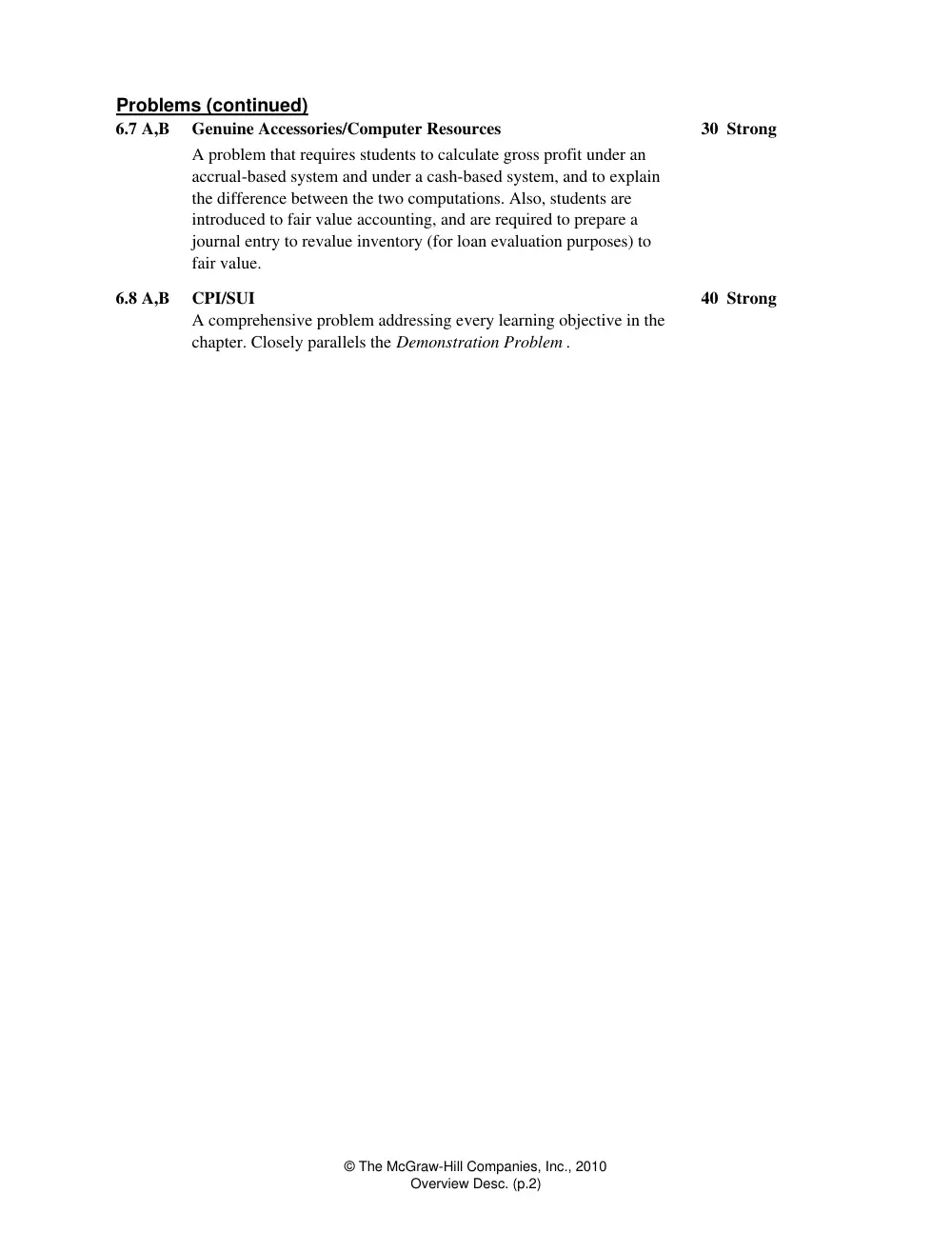
Problems (continued)
6.7 A,B
30 Strong
6.8 A,B
40 Strong
Genuine Accessories/Computer Resources
CPI/SUI
A comprehensive problem addressing every learning objective in the
chapter. Closely parallels the Demonstration Problem .
A problem that requires students to calculate gross profit under an
accrual-based system and under a cash-based system, and to explain
the difference between the two computations. Also, students are
introduced to fair value accounting, and are required to prepare a
journal entry to revalue inventory (for loan evaluation purposes) to
fair value.
© The McGraw-Hill Companies, Inc., 2010
Overview Desc. (p.2)
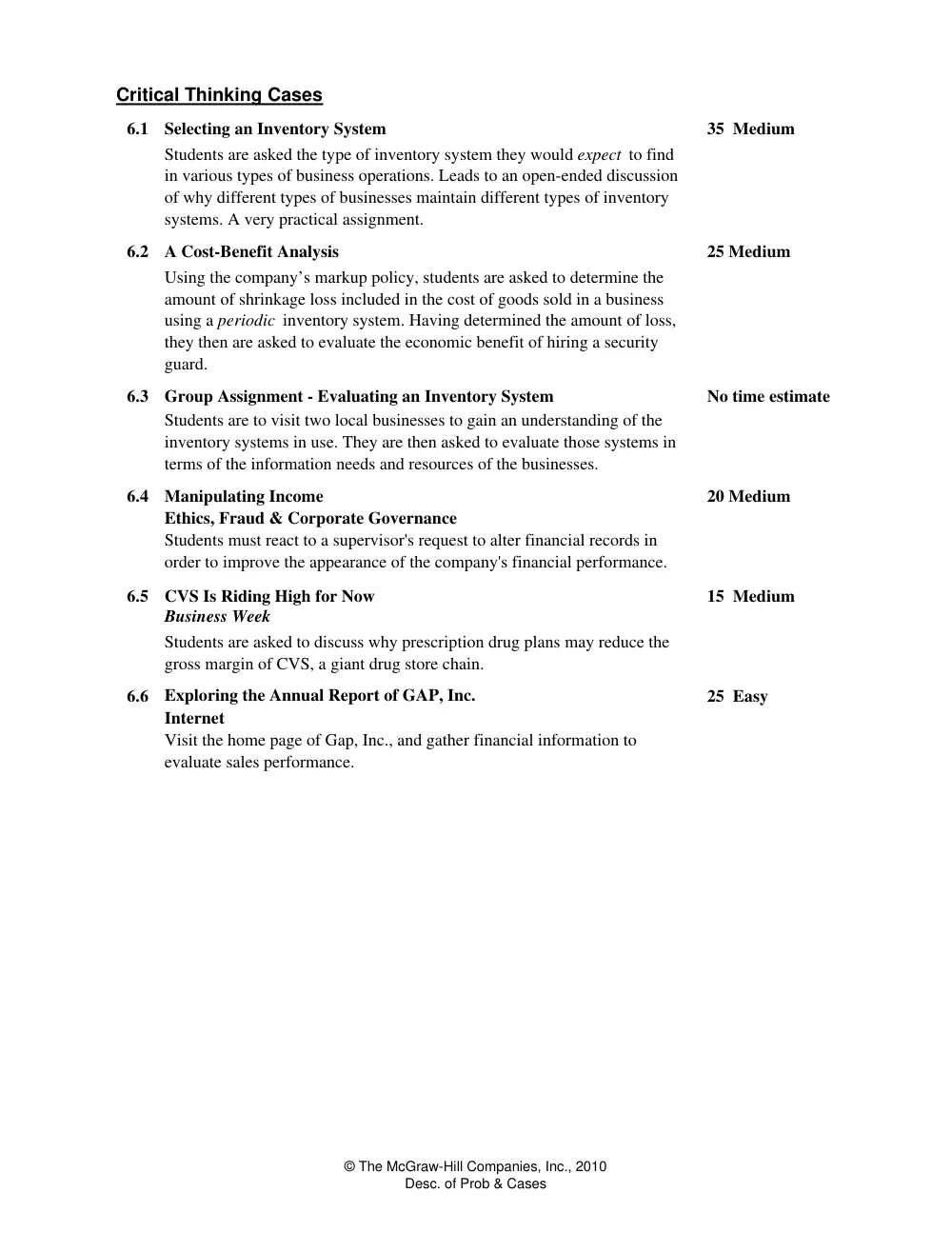
Critical Thinking Cases
Selecting an Inventory System
A Cost-Benefit Analysis
Group Assignment - Evaluating an Inventory System
6.4
Manipulating Income
20 Medium
Ethics, Fraud & Corporate Governance
CVS Is Riding High for Now
15 Medium
Business Week
Exploring the Annual Report of GAP, Inc.
Internet
Students must react to a supervisor's request to alter financial records in
order to improve the appearance of the company's financial performance.
6.6
25 Easy
6.5
Students are asked to discuss why prescription drug plans may reduce the
gross margin of CVS, a giant drug store chain.
Visit the home page of Gap, Inc., and gather financial information to
evaluate sales performance.
25 Medium
35 Medium
6.3
No time estimate
Students are to visit two local businesses to gain an understanding of the
inventory systems in use. They are then asked to evaluate those systems in
terms of the information needs and resources of the businesses.
6.2
6.1
Students are asked the type of inventory system they would expect to find
in various types of business operations. Leads to an open-ended discussion
of why different types of businesses maintain different types of inventory
systems. A very practical assignment.
Using the company’s markup policy, students are asked to determine the
amount of shrinkage loss included in the cost of goods sold in a business
using a periodic inventory system. Having determined the amount of loss,
they then are asked to evaluate the economic benefit of hiring a security
guard.
© The McGraw-Hill Companies, Inc., 2010
Desc. of Prob & Cases
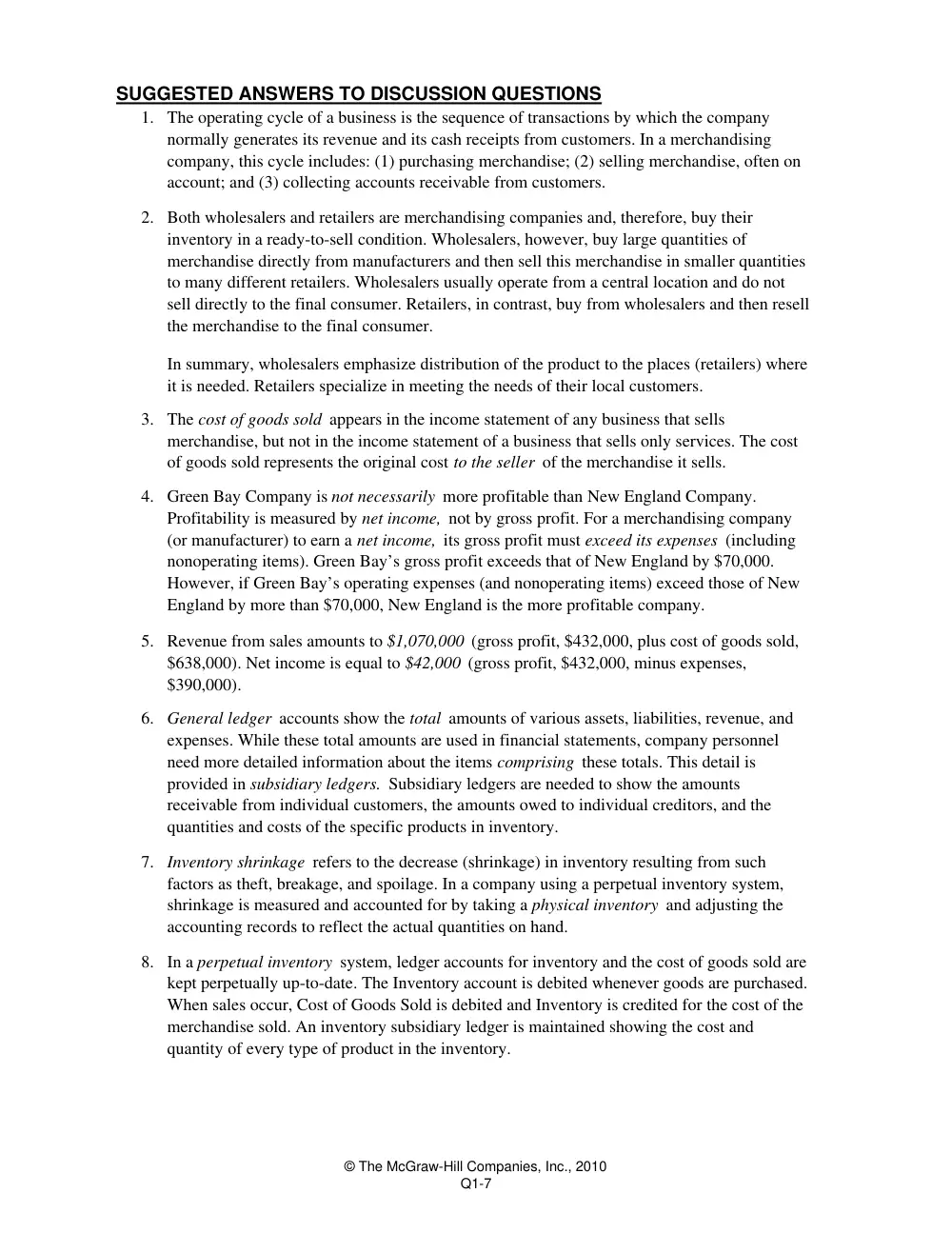
SUGGESTED ANSWERS TO DISCUSSION QUESTIONS
1.
2.
3.
4.
5.
6.
7.
8.
Inventory shrinkage refers to the decrease (shrinkage) in inventory resulting from such
factors as theft, breakage, and spoilage. In a company using a perpetual inventory system,
shrinkage is measured and accounted for by taking a physical inventory and adjusting the
accounting records to reflect the actual quantities on hand.
In a perpetual inventory system, ledger accounts for inventory and the cost of goods sold are
kept perpetually up-to-date. The Inventory account is debited whenever goods are purchased.
When sales occur, Cost of Goods Sold is debited and Inventory is credited for the cost of the
merchandise sold. An inventory subsidiary ledger is maintained showing the cost and
quantity of every type of product in the inventory.
The operating cycle of a business is the sequence of transactions by which the company
normally generates its revenue and its cash receipts from customers. In a merchandising
company, this cycle includes: (1) purchasing merchandise; (2) selling merchandise, often on
account; and (3) collecting accounts receivable from customers.
Both wholesalers and retailers are merchandising companies and, therefore, buy their
inventory in a ready-to-sell condition. Wholesalers, however, buy large quantities of
merchandise directly from manufacturers and then sell this merchandise in smaller quantities
to many different retailers. Wholesalers usually operate from a central location and do not
sell directly to the final consumer. Retailers, in contrast, buy from wholesalers and then resell
the merchandise to the final consumer.
General ledger accounts show the total amounts of various assets, liabilities, revenue, and
expenses. While these total amounts are used in financial statements, company personnel
need more detailed information about the items comprising these totals. This detail is
provided in subsidiary ledgers. Subsidiary ledgers are needed to show the amounts
receivable from individual customers, the amounts owed to individual creditors, and the
quantities and costs of the specific products in inventory.
In summary, wholesalers emphasize distribution of the product to the places (retailers) where
it is needed. Retailers specialize in meeting the needs of their local customers.
The cost of goods sold appears in the income statement of any business that sells
merchandise, but not in the income statement of a business that sells only services. The cost
of goods sold represents the original cost to the seller of the merchandise it sells.
Green Bay Company is not necessarily more profitable than New England Company.
Profitability is measured by net income, not by gross profit. For a merchandising company
(or manufacturer) to earn a net income, its gross profit must exceed its expenses (including
nonoperating items). Green Bay’s gross profit exceeds that of New England by $70,000.
However, if Green Bay’s operating expenses (and nonoperating items) exceed those of New
England by more than $70,000, New England is the more profitable company.
Revenue from sales amounts to $1,070,000 (gross profit, $432,000, plus cost of goods sold,
$638,000). Net income is equal to $42,000 (gross profit, $432,000, minus expenses,
$390,000).
© The McGraw-Hill Companies, Inc., 2010
Q1-7
9.
10.
11.
a.
b.
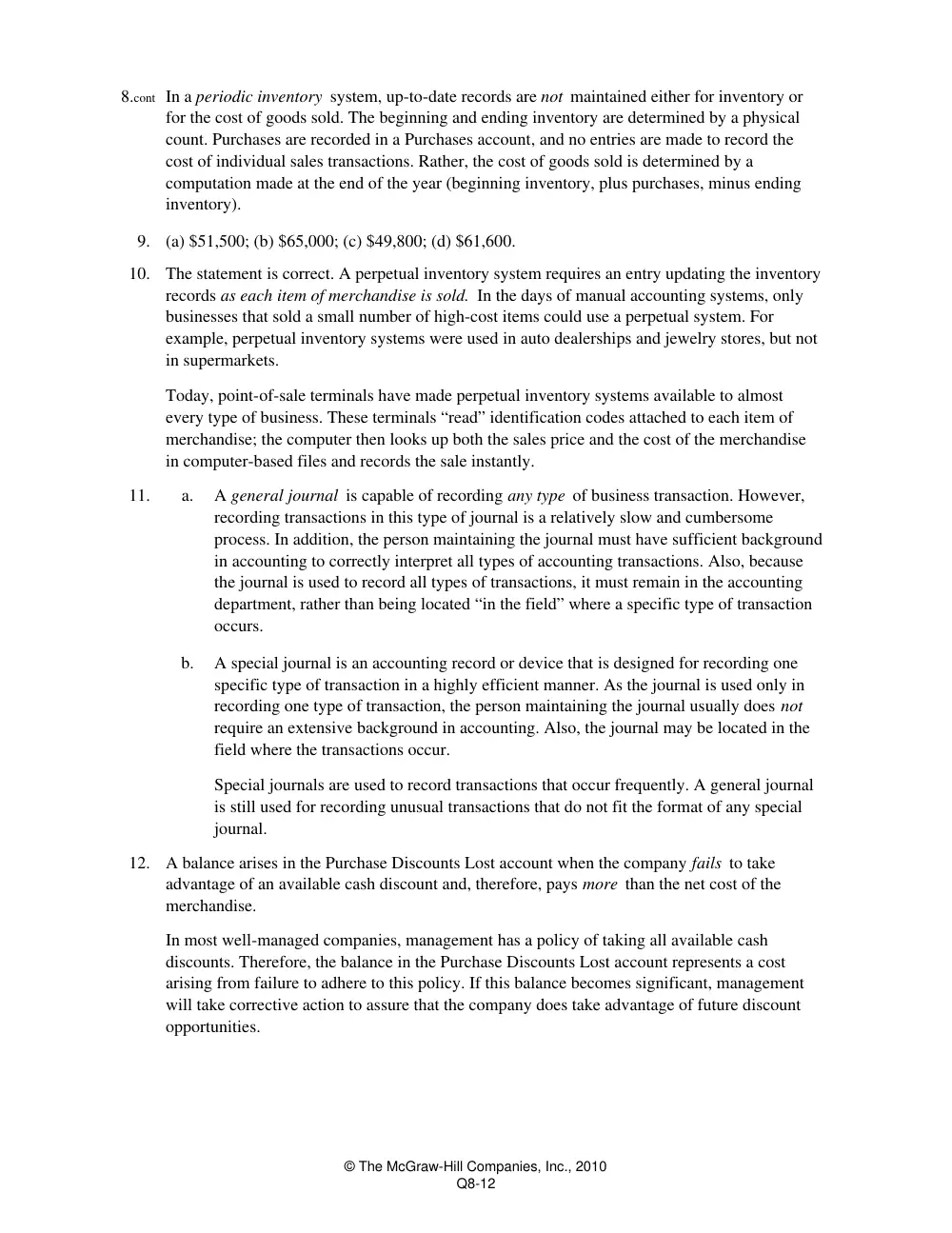
12.
A balance arises in the Purchase Discounts Lost account when the company fails to take
advantage of an available cash discount and, therefore, pays more than the net cost of the
merchandise.
In most well-managed companies, management has a policy of taking all available cash
discounts. Therefore, the balance in the Purchase Discounts Lost account represents a cost
arising from failure to adhere to this policy. If this balance becomes significant, management
will take corrective action to assure that the company does take advantage of future discount
opportunities.
8.cont In a periodic inventory system, up-to-date records are not maintained either for inventory or
for the cost of goods sold. The beginning and ending inventory are determined by a physical
count. Purchases are recorded in a Purchases account, and no entries are made to record the
cost of individual sales transactions. Rather, the cost of goods sold is determined by a
computation made at the end of the year (beginning inventory, plus purchases, minus ending
inventory).
(a) $51,500; (b) $65,000; (c) $49,800; (d) $61,600.
Special journals are used to record transactions that occur frequently. A general journal
is still used for recording unusual transactions that do not fit the format of any special
journal.
The statement is correct. A perpetual inventory system requires an entry updating the inventory
records as each item of merchandise is sold. In the days of manual accounting systems, only
businesses that sold a small number of high-cost items could use a perpetual system. For
example, perpetual inventory systems were used in auto dealerships and jewelry stores, but not
in supermarkets.
A general journal is capable of recording any type of business transaction. However,
recording transactions in this type of journal is a relatively slow and cumbersome
process. In addition, the person maintaining the journal must have sufficient background
in accounting to correctly interpret all types of accounting transactions. Also, because
the journal is used to record all types of transactions, it must remain in the accounting
department, rather than being located “in the field” where a specific type of transaction
occurs.
A special journal is an accounting record or device that is designed for recording one
specific type of transaction in a highly efficient manner. As the journal is used only in
recording one type of transaction, the person maintaining the journal usually does not
require an extensive background in accounting. Also, the journal may be located in the
field where the transactions occur.
Today, point-of-sale terminals have made perpetual inventory systems available to almost
every type of business. These terminals “read” identification codes attached to each item of
merchandise; the computer then looks up both the sales price and the cost of the merchandise
in computer-based files and records the sale instantly.
© The McGraw-Hill Companies, Inc., 2010
Q8-12
14.
15.
16.
17.
18.
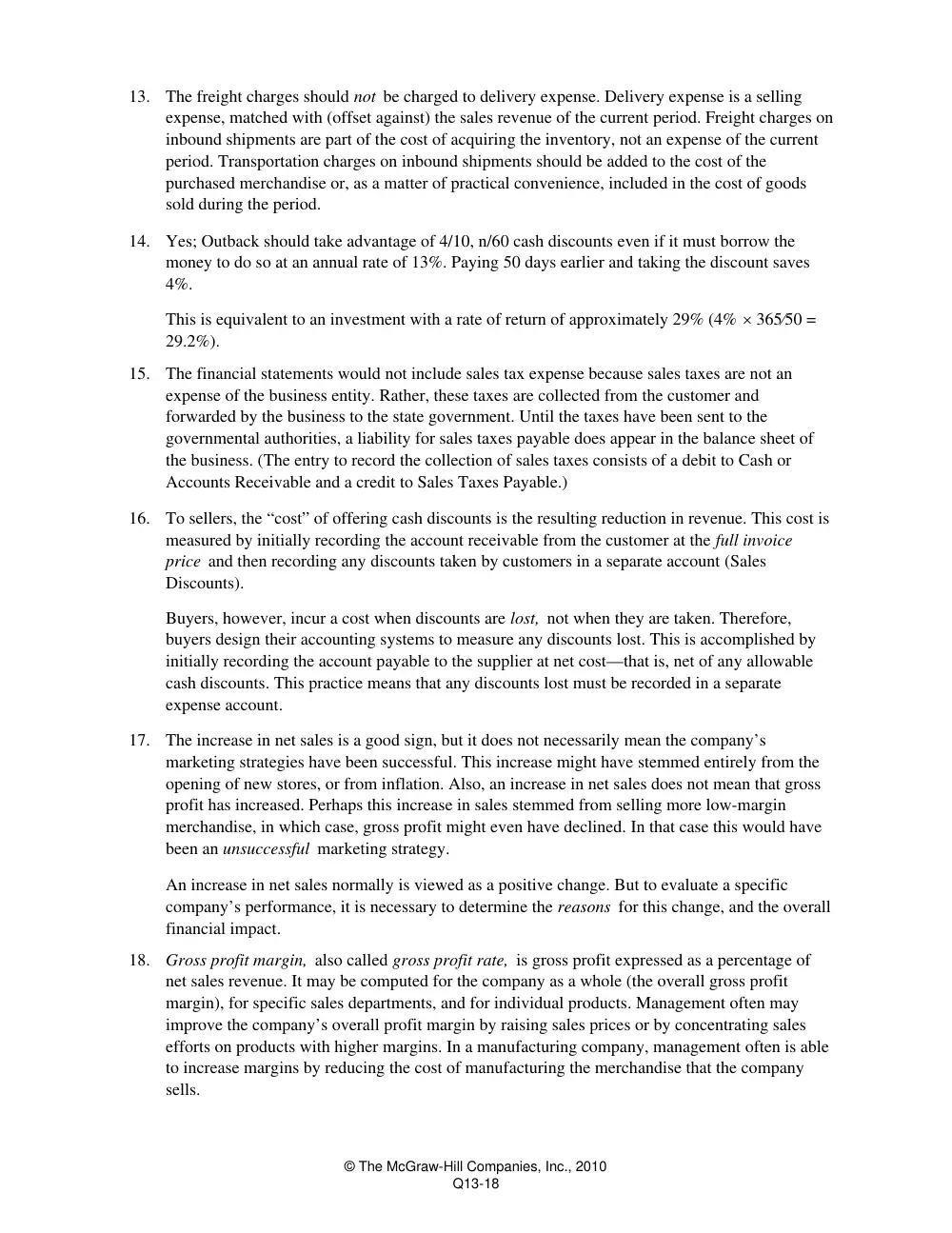
This is equivalent to an investment with a rate of return of approximately 29% (4% 36550 =
29.2%).
The financial statements would not include sales tax expense because sales taxes are not an
expense of the business entity. Rather, these taxes are collected from the customer and
forwarded by the business to the state government. Until the taxes have been sent to the
governmental authorities, a liability for sales taxes payable does appear in the balance sheet of
the business. (The entry to record the collection of sales taxes consists of a debit to Cash or
Accounts Receivable and a credit to Sales Taxes Payable.)
13.
The freight charges should not be charged to delivery expense. Delivery expense is a selling
expense, matched with (offset against) the sales revenue of the current period. Freight charges on
inbound shipments are part of the cost of acquiring the inventory, not an expense of the current
period. Transportation charges on inbound shipments should be added to the cost of the
purchased merchandise or, as a matter of practical convenience, included in the cost of goods
sold during the period.
Yes; Outback should take advantage of 4/10, n/60 cash discounts even if it must borrow the
money to do so at an annual rate of 13%. Paying 50 days earlier and taking the discount saves
4%.
An increase in net sales normally is viewed as a positive change. But to evaluate a specific
company’s performance, it is necessary to determine the reasons for this change, and the overall
financial impact.
Gross profit margin, also called gross profit rate, is gross profit expressed as a percentage of
net sales revenue. It may be computed for the company as a whole (the overall gross profit
margin), for specific sales departments, and for individual products. Management often may
improve the company’s overall profit margin by raising sales prices or by concentrating sales
efforts on products with higher margins. In a manufacturing company, management often is able
to increase margins by reducing the cost of manufacturing the merchandise that the company
sells.
To sellers, the “cost” of offering cash discounts is the resulting reduction in revenue. This cost is
measured by initially recording the account receivable from the customer at the full invoice
price and then recording any discounts taken by customers in a separate account (Sales
Discounts).
Buyers, however, incur a cost when discounts are lost, not when they are taken. Therefore,
buyers design their accounting systems to measure any discounts lost. This is accomplished by
initially recording the account payable to the supplier at net cost—that is, net of any allowable
cash discounts. This practice means that any discounts lost must be recorded in a separate
expense account.
The increase in net sales is a good sign, but it does not necessarily mean the company’s
marketing strategies have been successful. This increase might have stemmed entirely from the
opening of new stores, or from inflation. Also, an increase in net sales does not mean that gross
profit has increased. Perhaps this increase in sales stemmed from selling more low-margin
merchandise, in which case, gross profit might even have declined. In that case this would have
been an unsuccessful marketing strategy.
© The McGraw-Hill Companies, Inc., 2010
Q13-18
20.
An inventory subsidiary ledger is maintained under a perpetual inventory system but not under a
periodic inventory system. Under a perpetual inventory system, each purchase and sale of
individual inventory items is tracked. Under a periodic inventory system, the actual physical
quantity of inventory items on hand is only determined at the time that a physical inventory
count is taken, typically once a year.
19.
Even companies that use a perpetual inventory system will generally complete a physical count
of their merchandise inventory at least once a year to compare their actual physical inventory
with what the perpetual inventory records indicate should be on hand. There are typically
differences between the physical count of inventory and what the perpetual records indicate due
to breakage, spoilage, and employee and customer theft. This difference is referred to as
"shrink(age)" in the retail industry - one of the truly great euphemisms of all time -and is a
closely watched performance metric by management in the retail industry.
© The McGraw-Hill Companies, Inc., 2010
Q19-20
SOLUTIONS TO BRIEF EXERCISES
Office Today's gross profit is $160 million ($800 million - $640 million). Its gross
profit percentage is 20% ($160 million/$800 million). Office Today's gross profit
should provide the company with the ability to cover other expenses and to provide a
return to its shareholders.
The accounts receivable balance in the general ledger should be $850, the total of the
customer accounts with debit balances. The two customer accounts with credit
balances would be reclassified as accounts payable.
Alberto & Sons' gross profit for October is $1,500, the $30 gross profit on each item
($80 selling price - $50 cost) multiplied by the 50 units sold during October.
B. Ex 6.1
B. Ex. 6.2
B. Ex. 6.3
The balance in Neel & Neal's inventory account at February 1st would be $300,000,
the same balance as of the beginning of the year. Under a periodic inventory system,
the inventory account balance on the balance sheet is only updated when a physical
inventory count is taken, which generally only occurs on a yearly basis. Please note
that the inventory balance cannot be computed by adding the $250,000 of inventory
purchases to the beginning inventory balance, and then subtracting the $400,000 in
sales. The inventory account balance is generally stated at the cost of the inventory
items purchased, whereas the $400,000 of sales is recorded at the retail price at which
the goods are sold.
The cost of goods sold for Murphy Co. is $650,000. Add the purchases of $600,000 to
the beginning inventory of $300,000, and then subtract the $250,000 of ending
inventory.
B. Ex. 6.5
B. Ex 6.6
Yang & Min Inc. purchased $600,000 of goods during the year. Since Yang & Min
had an ending inventory of $200,000 and cost of goods sold of $500,000, we then know
that Yang & Min had goods available for sale of $700,000 (all goods available for sale
are either sold - cost of goods sold - or are still held at the end of the year - inventory).
Goods available for sale either existed at the beginning of the year - beginning
inventory - or were purchased during the year - purchases. Since Yang & Min's goods
available for sale are $700,000 and its beginning inventory is $100,000 Yang & Min
must have purchased $600,000 of goods during the year.
B. Ex. 6.4
© The McGraw-Hill Companies, Inc., 2010
BE6.1-6
330,000
Inventory (beginning balance)……………
80,000
Purchases………………………………….
250,000
30,000
Cost of Goods Sold………………………..
30,000
300,000
Cost of Goods Sold………………………..
300,000
2,000
Accounts Receivable (or Cash)…………..
2,000
To reduce the balance of the Cost of Goods Sold
account by the cost of merchandise still on hand at
year-end.
B. Ex 6.10
Allowance granted for defective merchandise.
Examples of special journals include: sales journal, cash receipts journal, cash
payments journal, purchases journal, and payroll journal.
Income Summary…………………………………..
B. Ex 6.11
To close the Cost of Goods Sold account to Income
Summary.
Pag Inc.'s equivalent annual rate of return by always paying its bills within the
discount period, and thereby receiving a 1% cash discount on the amount of its
purchases, is 18.25% (1% x 365/20).
B. Ex. 6.8
Sales Returns and Allowances
B. Ex. 6.9
The customer return was received before year end and as such needs to be recorded
in the period in which it occurred. Your cooperation with the controller's scheme to
overstate income will expose you to severe civil and criminal penalties,
notwithstanding the potential damage to your reputation and the unethical course of
action that the controller is asking you to pursue. You should try to convince the
controller of these facts. Failing this, you might avail yourself of the "hotline" that
all public companies are required to maintain to provide an anonymous mechanism
for employees to report concerns about improper accounting practices. If all else
fails, you are better off leaving the company than exposing yourself to the harsh
sanctions associated with securities fraud.
Cost of Goods Sold…………………………………
To close the accounts contributing to the cost of
goods sold for the year.
Inventory (ending balance)………………………..
B. Ex 6.7
© The McGraw-Hill Companies, Inc., 2010
BE6.7-11
Ex 6.1
a.
b.
c.
Option #4
Advantages : Control over cash receipts and inventory is maintained by the bookstore.
The bookstore is a high traffic area that caters to students, alumni, and visitors.
Disadvantages : The bookstore earns a 6% sales commission, meaning the band
receives only 94% of the total proceeds. The band must wait the entire year before the
bookstore settles its account. Thus, the band may experience difficulty in paying for
the inventory it purchases.
SOLUTIONS TO EXERCISES
Option #2 enables the band to have the least possible amount of cash invested in
inventory at any given time throughout the basketball season. Option #3 enables the
band to convert sales into cash immediately as shirts are sold. Thus, a combination of
options #2 and #3 will result in the shortest operating cycle.
Option #1 results in the band having an excessive amount invested in inventory early
in the season. Option #4 requires that the band wait until the end of the season to
collect its account receivable from the bookstore. Thus, a combination of options #1
and #4 will result in the longest operating cycle.
Option #1
Advantages : A 5% purchase discount applies to the purchase.
Disadvantages : A large amount of cash is invested in inventory early in the season.
The band must pay in advance for an entire season of inventory. Ordering inventory
for an entire season exposes the band to a high risk of purchasing too many or too few
T-shirts.
Option #2
Disadvantages : Maintaining control over cash receipts and inventory is potentially
more complex.
Advantages : T-shirts are ordered only when inventory levels become depleted.
Smaller amounts of cash are invested in inventory throughout the season. Ordering
shirts as needed reduces the risk of purchasing too many or too few.
Disadvantages : A 5% purchase discount does not apply.
Option #3
Advantages : Cash is collected immediately. Members of the band become an entire
“sales force” promoting interest in the product. The band receives 100% of all sales
proceeds.
© The McGraw-Hill Companies, Inc., 2010
E6.1
Trans-
Net
-
Cost of
-
All Other
=
Net
Assets
= Liabilities + Owners'
action Sales
Goods Sold
Expenses
Income
Equity
a.
NE
NE
NE
NE
I
I
NE
b.
I
NE
NE
I
I
NE
I
c.
NE
I
NE
D
D
NE
D
d.
NE
NE
NE
NE
NE
NE
NE
e.
NE
I
NE
D
D
NE
D
Ex 6.3
a.
Step 1
Net sales
Multiplied by the gross profit margin
Equals gross profit
Step 2
Net sales
Less: cost of goods sold
Equals gross profit (see Step 1)
Step 3
Cost of goods sold ($1.2 billion - $132 million)
b.
Step 1
Merchandise inventory (beginning of the year)
Add: Purchases
Less: Merchandise inventory (end of the year)
Equals cost of goods sold (see part a)
Step 2
Purchases ($1,068 billion + $57 million - $69 million)
c.
d.
1,068,000,000
$
69,000,000
$
PC Connection uses a perpetual inventory system for several reasons: (1) its inventory
has a relatively high unit cost, (2) its sales volume is extremely high, as evidenced by its
$1.2 billion in net sales, (3) immediate information about the availability of specific
products is required when customers contact the company to place orders, and (4) the
benefits derived from using a perpetual system outweigh the cost of implementing and
maintaining it.
57,000,000
1,068,000,000
$
?
1,056,000,000
$
Balance Sheet
Income Statement
Ex 6.2
The company’s low gross profit margin of 11% reflects the intense levels of price
competition in the personal computing industry. In order to stay competitive, computer
retailers like PC Connection have significantly reduced selling prices to their customers.
With gross profit being only eleven cents of every sales dollar, it is essential that these
retailers control other expenses (such advertising expense, wages expense, and insurance
expense) in order to remain profitable.
1,200,000,000
$
x 11%
132,000,000
$
1,200,000,000
$
?
132,000,000
$
© The McGraw-Hill Companies, Inc., 2010
E6.2,3
a.
Net sales
-
Cost of goods sold
=
Gross profit
$ 26,000,000
?
$ 15,000,000
b.
Beginning inventory +
Purchases
-
Cost of goods sold
= Ending Inventory
$ 6,450,000
$ 9,500,000
$ 4,950,000
c.
Ex. 6.5
a.
b. Wal-Mart reported a significant increase in its overall sales growth of 14%, but only a
3% increase in comparable store sales. The disparity between these two statistics may
suggest that Wal-Mart’s revenue growth was in large part attributed to new stores.
The stability of Wal-Mart’s gross profit rate implies that the company did not face
weakening demand or intensified price competition. Kmart’s performance was far
less impressive. The statistics reported in the text were released subsequent to the
company declaring bankruptcy. Kmart’s total sales grew by only 3%, and its
comparable store sales decreased by 0.1%. The 10% decline in the company’s gross
profit rate suggests that it faced weakening demand and increased price competition.
Percentage changes in comparable store sales represent the increase or
decrease in net sales of the same stores from one period to the next. By factoring
out the effects of opening new stores (and/or closing existing stores), this statistic
provides a better measure of marketing strategy effectiveness and revenue
growth.
Ex. 6.4
Cost of goods sold = $11,000,000
$11,000,000 (from part a)
The entry to record inventory shrinkage at the end of the year increased the Cost of
Goods Sold account and reduced its Merchandise Inventory account by $10,000. Thus,
immediately prior to recording inventory shrinkage, the Cost of Goods Sold account
had a debit balance of $10,990,000 ($11,000,000 computed in part a minus $10,000),
whereas the Merchandise Inventory account had a debit balance of $4,960,000
($4,950,000 computed in part b plus $10,000).
The change in net sales provides an overall measure of the effectiveness of the
company in generating revenue. A major limitation of this measure is that sales may
have changed largely because of the opening of new stores or the closing of
unprofitable ones. Thus, an increase in net sales is not always “good,” and a decrease
is not always “bad.”
Users of financial statements often compute changes in gross profit rates from one
period to the next. Increasing margins often mean that a company’s net sales growth
is outpacing its growth in the cost of goods sold. This often is the result of successful
marketing strategies. A declining gross profit rate, on the other hand, may indicate
weakening customer demand or intensified price competition.
© The McGraw-Hill Companies, Inc., 2010
E6.4,5
Ex. 6.6
a.
b.
4,000
c.
Ex. 6.7
a.
$ 2,800
30,200
33,000
3,000
$ 30,000
c.
Dec.
33,000
Inventory (Dec. 31, year 1) ……………
Purchases ………………………………
3,000
Cost of Goods Sold ………………………
$ 79,600
30,000
$ 49,600
e.
The reason why an actual physical count is likely to indicate a smaller inventory than
does the perpetual inventory records is inventory shrinkage —the normal loss of
inventory through theft, breakage, and spoilage.
To reduce inventory to the quantities reflected in the year-end physical count.
Both portions of the preceding entry should be posted to the general ledger. In
addition, the reduction in inventory should be posted to the inventory subsidiary
ledger accounts in which the shortages were determined to exist.
The amounts of beginning and ending inventory were determined by taking complete
physical inventories at (or near) the ends of year 1 and year 2. “Taking a complete
physical inventory” means physically counting the number of units of each product
on hand and then determining the cost of this inventory by reference to per-unit
purchase co