
ACO 201 Problems Chapter 8 Solutions, Spring 2013
Notre Dame University–Louaize · Principles of Accounting I · 49 pages · with solution
Showing the first 10 of 49 pages. Download the PDF to see all of it.
More ACO 201 files
- Chapter 1 · Spring 2013ChapterView
- Chapter 2 · Spring 2013ChapterView
- Chapter 3 · Spring 2013ChapterView
- Chapter 4 · Spring 2013ChapterView
- Chapter 5 · Spring 2013ChapterView
- Chapter 6 · Spring 2013ChapterView
- Chapter 7 · Spring 2013ChapterView
- Problems Chapter 2 Solution · Spring 2013Chapter · with solutionView
Show the text of this chapter
Brief
Learning
Exercises
Objectives
B. Ex. 8.1
FIFO inventory
1, 4
B. Ex. 8.2
LIFO inventory
1, 4
B. Ex. 8.3
Average inventory
4
B. Ex. 8.4
FIFO and LIFO inventory
4
Analysis
B. Ex. 8.5
FIFO and Average inventory
4
B. Ex. 8.6
Inventory shrinkage
3
Analysis
B. Ex. 8.7
Inventory error
5
Analysis
B. Ex. 8.8
Inventory error
5
B. Ex. 8.9
Inventory turnover
7
B. Ex. 8.10
Inventory turnover
7
8.1
Accounting terminology
1–7
8.2
Cost flow assumptions
1
8.3
Physical flows vs. cost flows
4
8.4
Effects of different cost flows
4
8.5
Transfer of title
2
8.6
Inventory write-downs
3
8.7
Periodic inventory systems
4
8.8
Inventory errors
5
8.9
Gross profit method
6
8.10
Retail method
6
8.11
1, 7
8.12
1, 7
8.13
7
8.14
7
8.15
7
Analysis
Analysis
Analysis
Analysis
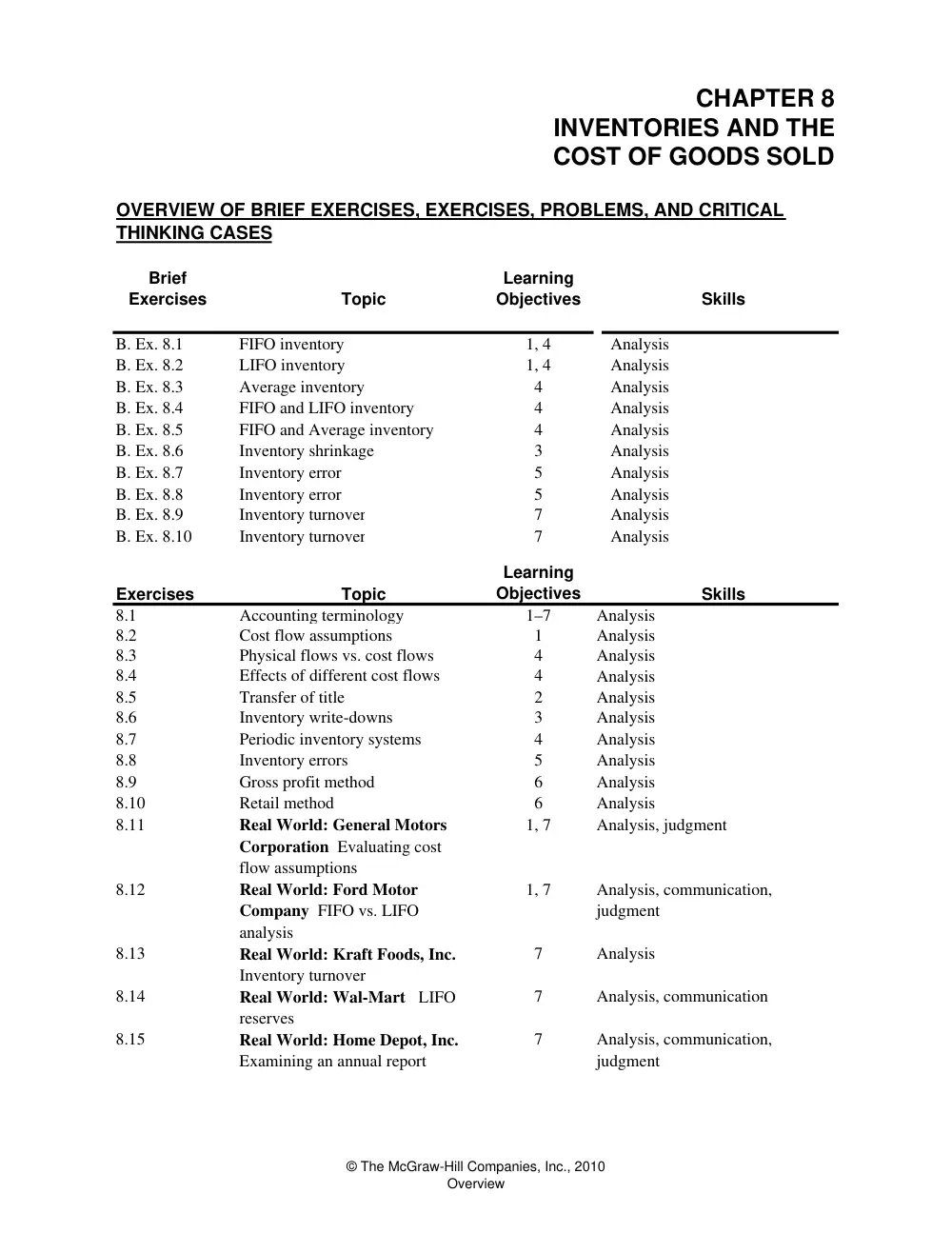
CHAPTER 8
INVENTORIES AND THE
Topic
Analysis
Analysis
Analysis
COST OF GOODS SOLD
OVERVIEW OF BRIEF EXERCISES, EXERCISES, PROBLEMS, AND CRITICAL
THINKING CASES
Topic
Skills
Analysis
Exercises
Real World: Home Depot, Inc.
Examining an annual report
Analysis
Analysis
Analysis
Analysis
Analysis, communication,
judgment
Analysis
Real World: General Motors
Corporation Evaluating cost
flow assumptions
Analysis, communication,
judgment
Skills
Learning
Objectives
Analysis
Analysis, judgment
Analysis
Analysis
Real World: Ford Motor
Company FIFO vs. LIFO
analysis
Real World: Kraft Foods, Inc.
Inventory turnover
Real World: Wal-Mart LIFO
reserves
Analysis
Analysis
Analysis, communication
© The McGraw-Hill Companies, Inc., 2010
Overview
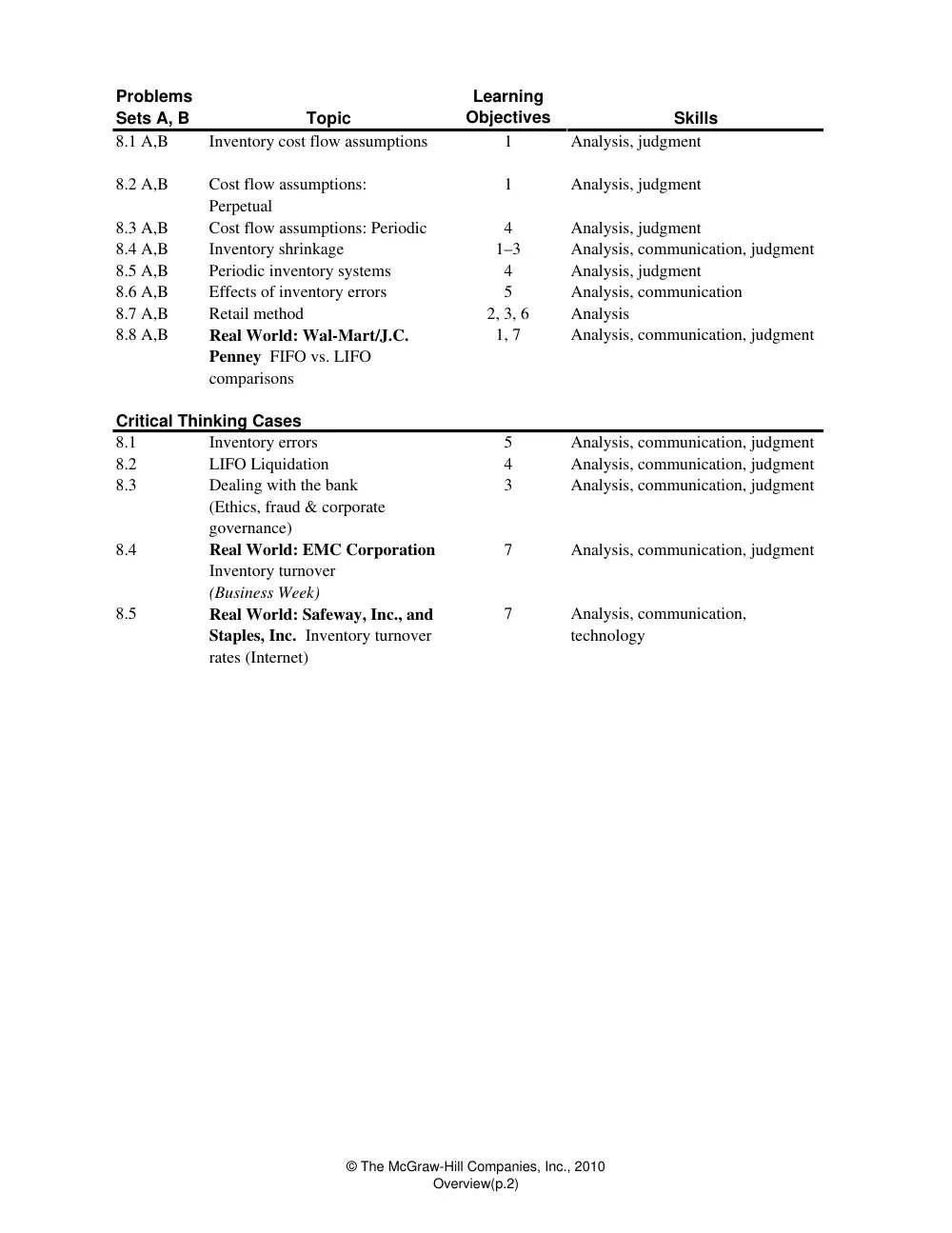
8.1 A,B
Inventory cost flow assumptions
1
8.2 A,B
Cost flow assumptions:
Perpetual
1
8.3 A,B
Cost flow assumptions: Periodic
4
8.4 A,B
Inventory shrinkage
1–3
8.5 A,B
Periodic inventory systems
4
8.6 A,B
Effects of inventory errors
5
8.7 A,B
Retail method
2, 3, 6
8.8 A,B
1, 7
8.1
Inventory errors
5
8.2
LIFO Liquidation
4
Dealing with the bank
8.4
7
Inventory turnover
8.5
7
Problems
Sets A, B
Analysis, judgment
Topic
Learning
Objectives
Skills
Analysis, judgment
Real World: Wal-Mart/J.C.
Penney FIFO vs. LIFO
comparisons
Analysis, judgment
Analysis, communication, judgment
Analysis, judgment
Analysis, communication
Analysis
Analysis, communication, judgment
(Business Week)
Analysis, communication, judgment
Real World: EMC Corporation
Analysis, communication,
technology
Real World: Safeway, Inc., and
Staples, Inc. Inventory turnover
rates (Internet)
Critical Thinking Cases
Analysis, communication, judgment
(Ethics, fraud & corporate
governance)
Analysis, communication, judgment
8.3
Analysis, communication, judgment
3
© The McGraw-Hill Companies, Inc., 2010
Overview(p.2)
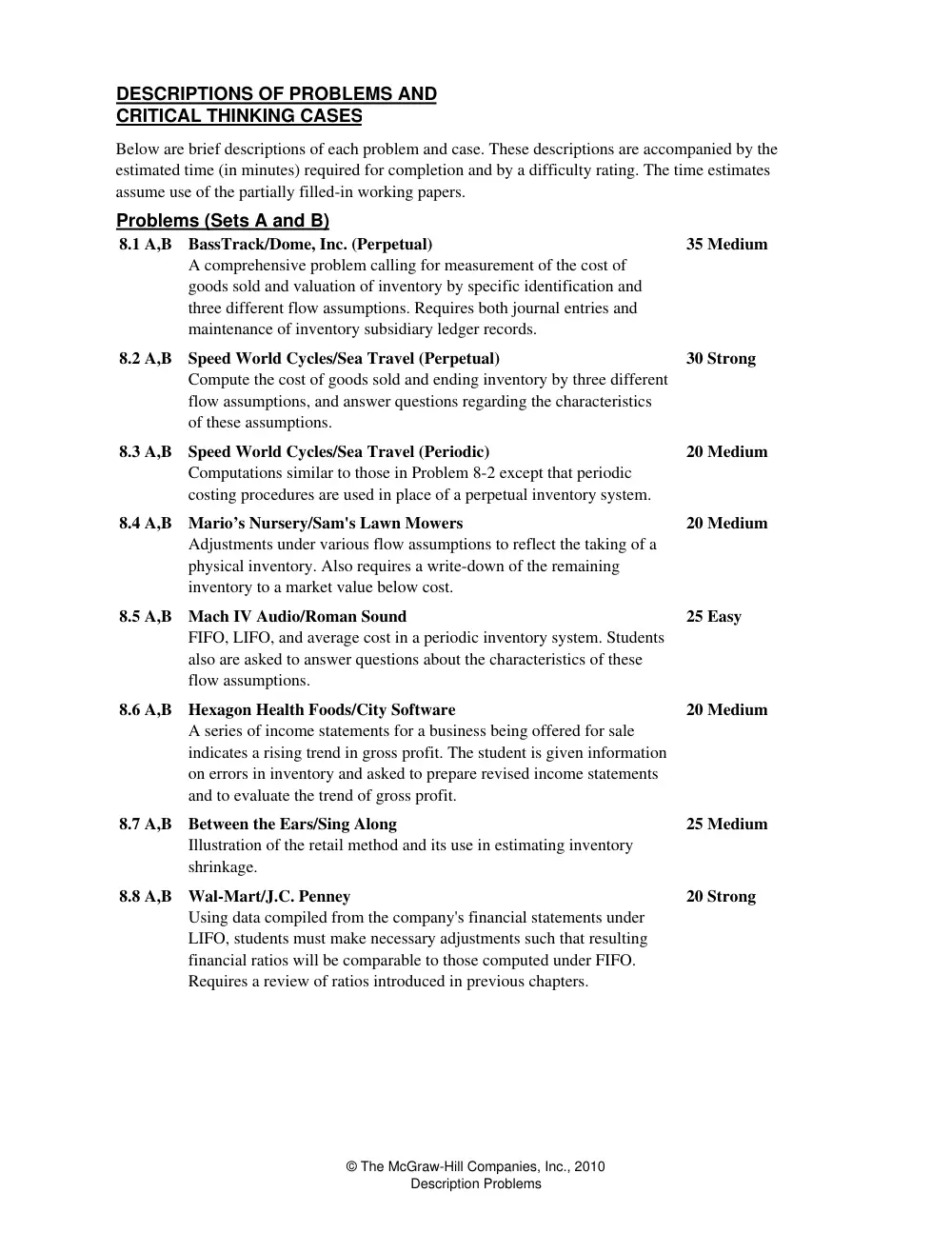
DESCRIPTIONS OF PROBLEMS AND
CRITICAL THINKING CASES
Problems (Sets A and B)
Below are brief descriptions of each problem and case. These descriptions are accompanied by the
estimated time (in minutes) required for completion and by a difficulty rating. The time estimates
assume use of the partially filled-in working papers.
8.2 A,B
BassTrack/Dome, Inc. (Perpetual)
A comprehensive problem calling for measurement of the cost of
goods sold and valuation of inventory by specific identification and
three different flow assumptions. Requires both journal entries and
maintenance of inventory subsidiary ledger records.
Speed World Cycles/Sea Travel (Perpetual)
8.1 A,B
8.3 A,B
8.4 A,B
Mario’s Nursery/Sam's Lawn Mowers
8.5 A,B
8.6 A,B
Mach IV Audio/Roman Sound
FIFO, LIFO, and average cost in a periodic inventory system. Students
also are asked to answer questions about the characteristics of these
flow assumptions.
Hexagon Health Foods/City Software
A series of income statements for a business being offered for sale
indicates a rising trend in gross profit. The student is given information
on errors in inventory and asked to prepare revised income statements
and to evaluate the trend of gross profit.
8.7 A,B
8.8 A,B
Between the Ears/Sing Along
Illustration of the retail method and its use in estimating inventory
shrinkage.
Wal-Mart/J.C. Penney
Using data compiled from the company's financial statements under
LIFO, students must make necessary adjustments such that resulting
financial ratios will be comparable to those computed under FIFO.
Requires a review of ratios introduced in previous chapters.
25 Medium
20 Strong
35 Medium
30 Strong
20 Medium
20 Medium
20 Medium
Compute the cost of goods sold and ending inventory by three different
flow assumptions, and answer questions regarding the characteristics
of these assumptions.
Speed World Cycles/Sea Travel (Periodic)
25 Easy
Adjustments under various flow assumptions to reflect the taking of a
physical inventory. Also requires a write-down of the remaining
inventory to a market value below cost.
Computations similar to those in Problem 8-2 except that periodic
costing procedures are used in place of a perpetual inventory system.
© The McGraw-Hill Companies, Inc., 2010
Description Problems
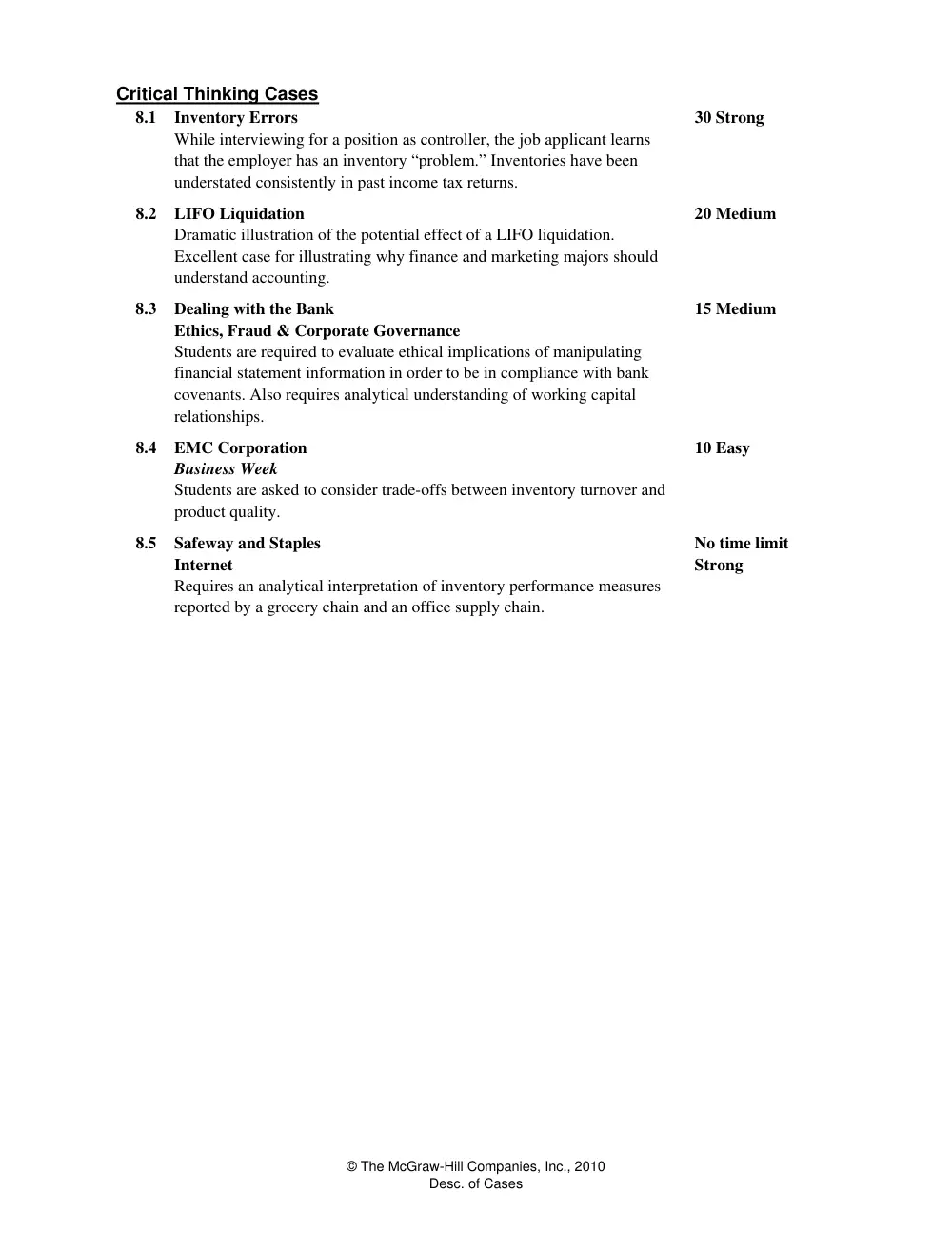
Critical Thinking Cases
Inventory Errors
LIFO Liquidation
Dealing with the Bank
Ethics, Fraud & Corporate Governance
EMC Corporation
Business Week
Safeway and Staples
No time limit
Internet
Strong
20 Medium
Dramatic illustration of the potential effect of a LIFO liquidation.
Excellent case for illustrating why finance and marketing majors should
understand accounting.
Students are required to evaluate ethical implications of manipulating
financial statement information in order to be in compliance with bank
covenants. Also requires analytical understanding of working capital
relationships.
10 Easy
8.3
8.1
15 Medium
30 Strong
While interviewing for a position as controller, the job applicant learns
that the employer has an inventory “problem.” Inventories have been
understated consistently in past income tax returns.
8.2
8.5
Students are asked to consider trade-offs between inventory turnover and
product quality.
Requires an analytical interpretation of inventory performance measures
reported by a grocery chain and an office supply chain.
8.4
© The McGraw-Hill Companies, Inc., 2010
Desc. of Cases
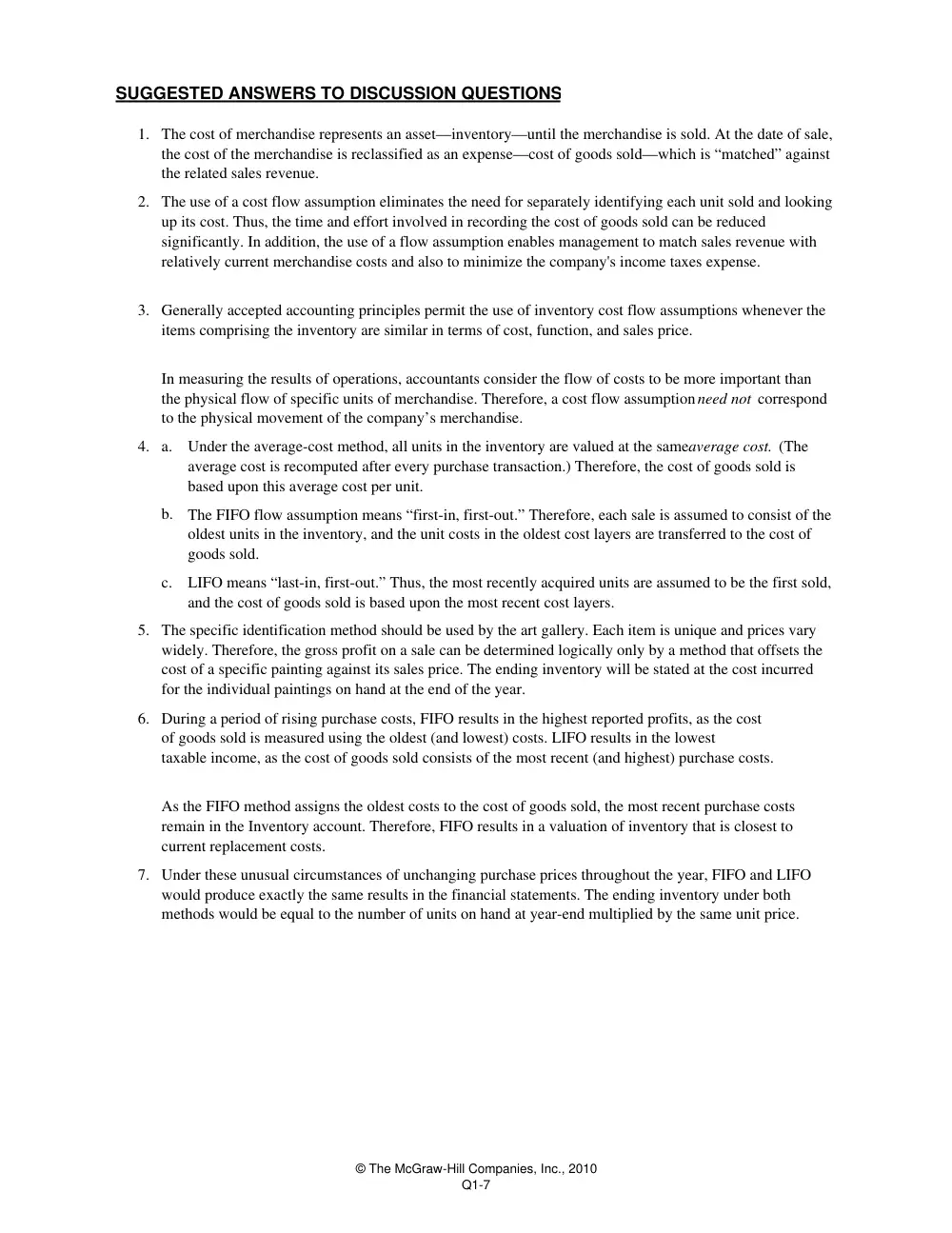
SUGGESTED ANSWERS TO DISCUSSION QUESTIONS
1.
3.
4. a.
b.
c.
5.
6.
7.
The specific identification method should be used by the art gallery. Each item is unique and prices vary
widely. Therefore, the gross profit on a sale can be determined logically only by a method that offsets the
cost of a specific painting against its sales price. The ending inventory will be stated at the cost incurred
for the individual paintings on hand at the end of the year.
In measuring the results of operations, accountants consider the flow of costs to be more important than
the physical flow of specific units of merchandise. Therefore, a cost flow assumption need not correspond
to the physical movement of the company’s merchandise.
During a period of rising purchase costs, FIFO results in the highest reported profits, as the cost
of goods sold is measured using the oldest (and lowest) costs. LIFO results in the lowest
taxable income, as the cost of goods sold consists of the most recent (and highest) purchase costs.
As the FIFO method assigns the oldest costs to the cost of goods sold, the most recent purchase costs
remain in the Inventory account. Therefore, FIFO results in a valuation of inventory that is closest to
current replacement costs.
Under these unusual circumstances of unchanging purchase prices throughout the year, FIFO and LIFO
would produce exactly the same results in the financial statements. The ending inventory under both
methods would be equal to the number of units on hand at year-end multiplied by the same unit price.
2.
LIFO means “last-in, first-out.” Thus, the most recently acquired units are assumed to be the first sold,
and the cost of goods sold is based upon the most recent cost layers.
The cost of merchandise represents an asset—inventory—until the merchandise is sold. At the date of sale,
the cost of the merchandise is reclassified as an expense—cost of goods sold—which is “matched” against
the related sales revenue.
The use of a cost flow assumption eliminates the need for separately identifying each unit sold and looking
up its cost. Thus, the time and effort involved in recording the cost of goods sold can be reduced
significantly. In addition, the use of a flow assumption enables management to match sales revenue with
relatively current merchandise costs and also to minimize the company's income taxes expense.
Under the average-cost method, all units in the inventory are valued at the same average cost. (The
average cost is recomputed after every purchase transaction.) Therefore, the cost of goods sold is
based upon this average cost per unit.
The FIFO flow assumption means “first-in, first-out.” Therefore, each sale is assumed to consist of the
oldest units in the inventory, and the unit costs in the oldest cost layers are transferred to the cost of
goods sold.
Generally accepted accounting principles permit the use of inventory cost flow assumptions whenever the
items comprising the inventory are similar in terms of cost, function, and sales price.
© The McGraw-Hill Companies, Inc., 2010
Q1-7
8.
9.
10.
11.
12.
13.
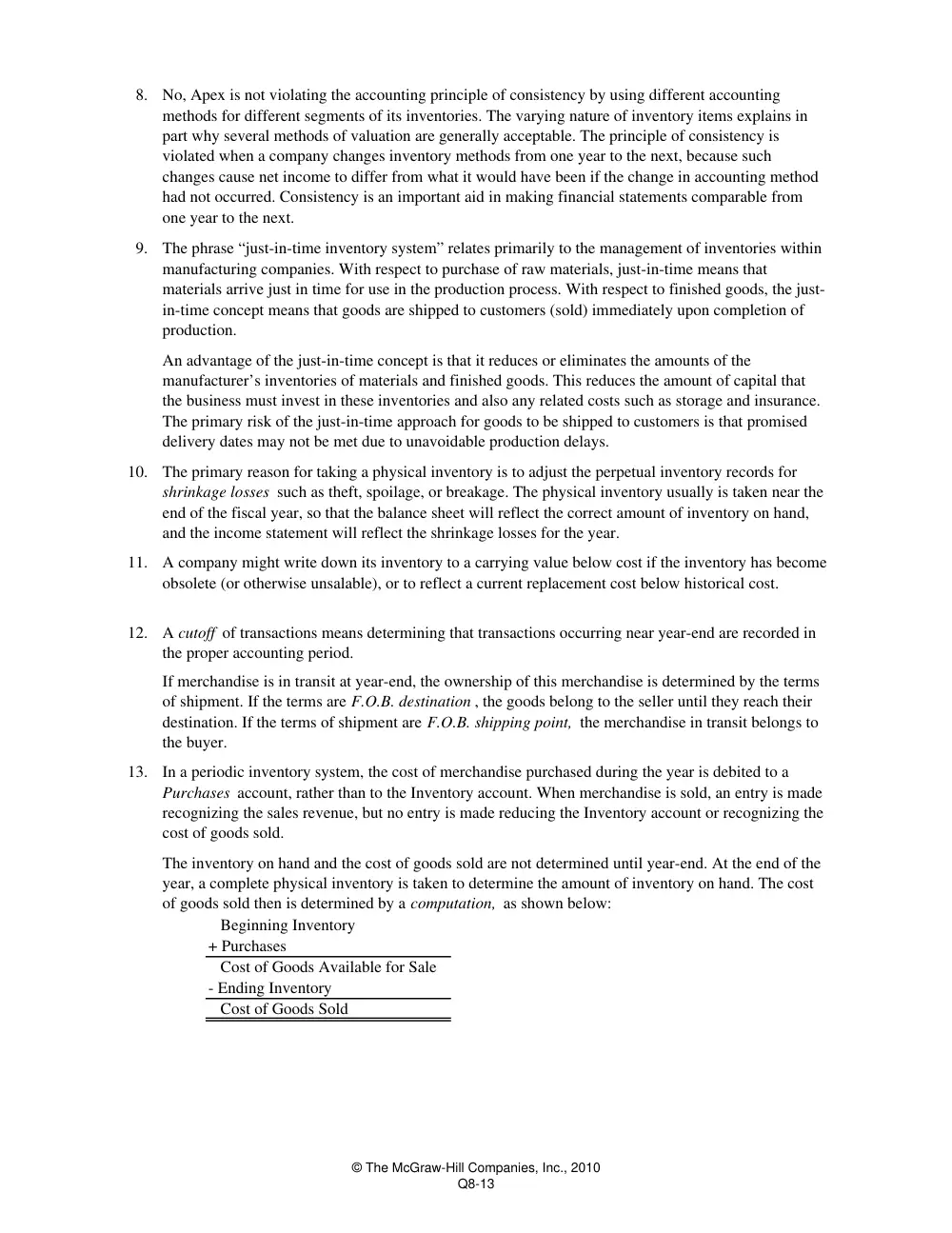
The inventory on hand and the cost of goods sold are not determined until year-end. At the end of the
year, a complete physical inventory is taken to determine the amount of inventory on hand. The cost
of goods sold then is determined by a computation, as shown below:
+ Purchases
Cost of Goods Available for Sale
- Ending Inventory
Cost of Goods Sold
No, Apex is not violating the accounting principle of consistency by using different accounting
methods for different segments of its inventories. The varying nature of inventory items explains in
part why several methods of valuation are generally acceptable. The principle of consistency is
violated when a company changes inventory methods from one year to the next, because such
changes cause net income to differ from what it would have been if the change in accounting method
had not occurred. Consistency is an important aid in making financial statements comparable from
one year to the next.
The phrase “just-in-time inventory system” relates primarily to the management of inventories within
manufacturing companies. With respect to purchase of raw materials, just-in-time means that
materials arrive just in time for use in the production process. With respect to finished goods, the just-
in-time concept means that goods are shipped to customers (sold) immediately upon completion of
production.
An advantage of the just-in-time concept is that it reduces or eliminates the amounts of the
manufacturer’s inventories of materials and finished goods. This reduces the amount of capital that
the business must invest in these inventories and also any related costs such as storage and insurance.
The primary risk of the just-in-time approach for goods to be shipped to customers is that promised
delivery dates may not be met due to unavoidable production delays.
The primary reason for taking a physical inventory is to adjust the perpetual inventory records for
shrinkage losses such as theft, spoilage, or breakage. The physical inventory usually is taken near the
end of the fiscal year, so that the balance sheet will reflect the correct amount of inventory on hand,
and the income statement will reflect the shrinkage losses for the year.
A company might write down its inventory to a carrying value below cost if the inventory has become
obsolete (or otherwise unsalable), or to reflect a current replacement cost below historical cost.
A cutoff of transactions means determining that transactions occurring near year-end are recorded in
the proper accounting period.
If merchandise is in transit at year-end, the ownership of this merchandise is determined by the terms
of shipment. If the terms are F.O.B. destination , the goods belong to the seller until they reach their
destination. If the terms of shipment are F.O.B. shipping point, the merchandise in transit belongs to
the buyer.
Beginning Inventory
In a periodic inventory system, the cost of merchandise purchased during the year is debited to a
Purchases account, rather than to the Inventory account. When merchandise is sold, an entry is made
recognizing the sales revenue, but no entry is made reducing the Inventory account or recognizing the
cost of goods sold.
© The McGraw-Hill Companies, Inc., 2010
Q8-13
14.
a.
b.
c.
15.
16.
17.
18.
19.
20.
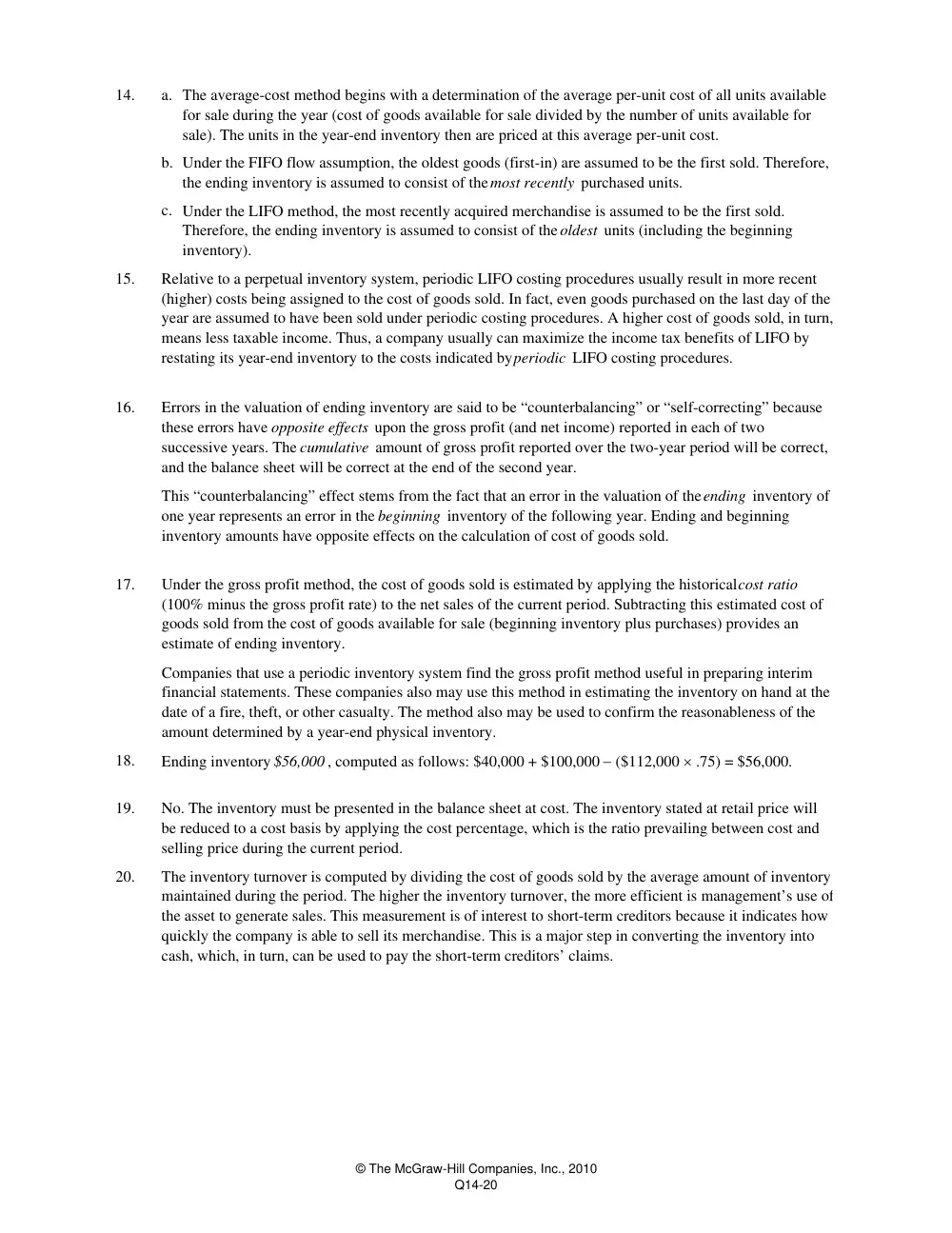
Errors in the valuation of ending inventory are said to be “counterbalancing” or “self-correcting” because
these errors have opposite effects upon the gross profit (and net income) reported in each of two
successive years. The cumulative amount of gross profit reported over the two-year period will be correct,
and the balance sheet will be correct at the end of the second year.
The inventory turnover is computed by dividing the cost of goods sold by the average amount of inventory
maintained during the period. The higher the inventory turnover, the more efficient is management’s use of
the asset to generate sales. This measurement is of interest to short-term creditors because it indicates how
quickly the company is able to sell its merchandise. This is a major step in converting the inventory into
cash, which, in turn, can be used to pay the short-term creditors’ claims.
The average-cost method begins with a determination of the average per-unit cost of all units available
for sale during the year (cost of goods available for sale divided by the number of units available for
sale). The units in the year-end inventory then are priced at this average per-unit cost.
Under the FIFO flow assumption, the oldest goods (first-in) are assumed to be the first sold. Therefore,
the ending inventory is assumed to consist of the most recently purchased units.
Ending inventory $56,000 , computed as follows: $40,000 + $100,000 ($112,000 .75) = $56,000.
No. The inventory must be presented in the balance sheet at cost. The inventory stated at retail price will
be reduced to a cost basis by applying the cost percentage, which is the ratio prevailing between cost and
selling price during the current period.
This “counterbalancing” effect stems from the fact that an error in the valuation of the ending inventory of
one year represents an error in the beginning inventory of the following year. Ending and beginning
inventory amounts have opposite effects on the calculation of cost of goods sold.
Under the gross profit method, the cost of goods sold is estimated by applying the historical cost ratio
(100% minus the gross profit rate) to the net sales of the current period. Subtracting this estimated cost of
goods sold from the cost of goods available for sale (beginning inventory plus purchases) provides an
estimate of ending inventory.
Companies that use a periodic inventory system find the gross profit method useful in preparing interim
financial statements. These companies also may use this method in estimating the inventory on hand at the
date of a fire, theft, or other casualty. The method also may be used to confirm the reasonableness of the
amount determined by a year-end physical inventory.
Under the LIFO method, the most recently acquired merchandise is assumed to be the first sold.
Therefore, the ending inventory is assumed to consist of the oldest units (including the beginning
inventory).
Relative to a perpetual inventory system, periodic LIFO costing procedures usually result in more recent
(higher) costs being assigned to the cost of goods sold. In fact, even goods purchased on the last day of the
year are assumed to have been sold under periodic costing procedures. A higher cost of goods sold, in turn,
means less taxable income. Thus, a company usually can maximize the income tax benefits of LIFO by
restating its year-end inventory to the costs indicated by periodic LIFO costing procedures.
© The McGraw-Hill Companies, Inc., 2010
Q14-20
21.
a.
b.
c.
22.
a.
b.
23.
a.
b.
c.
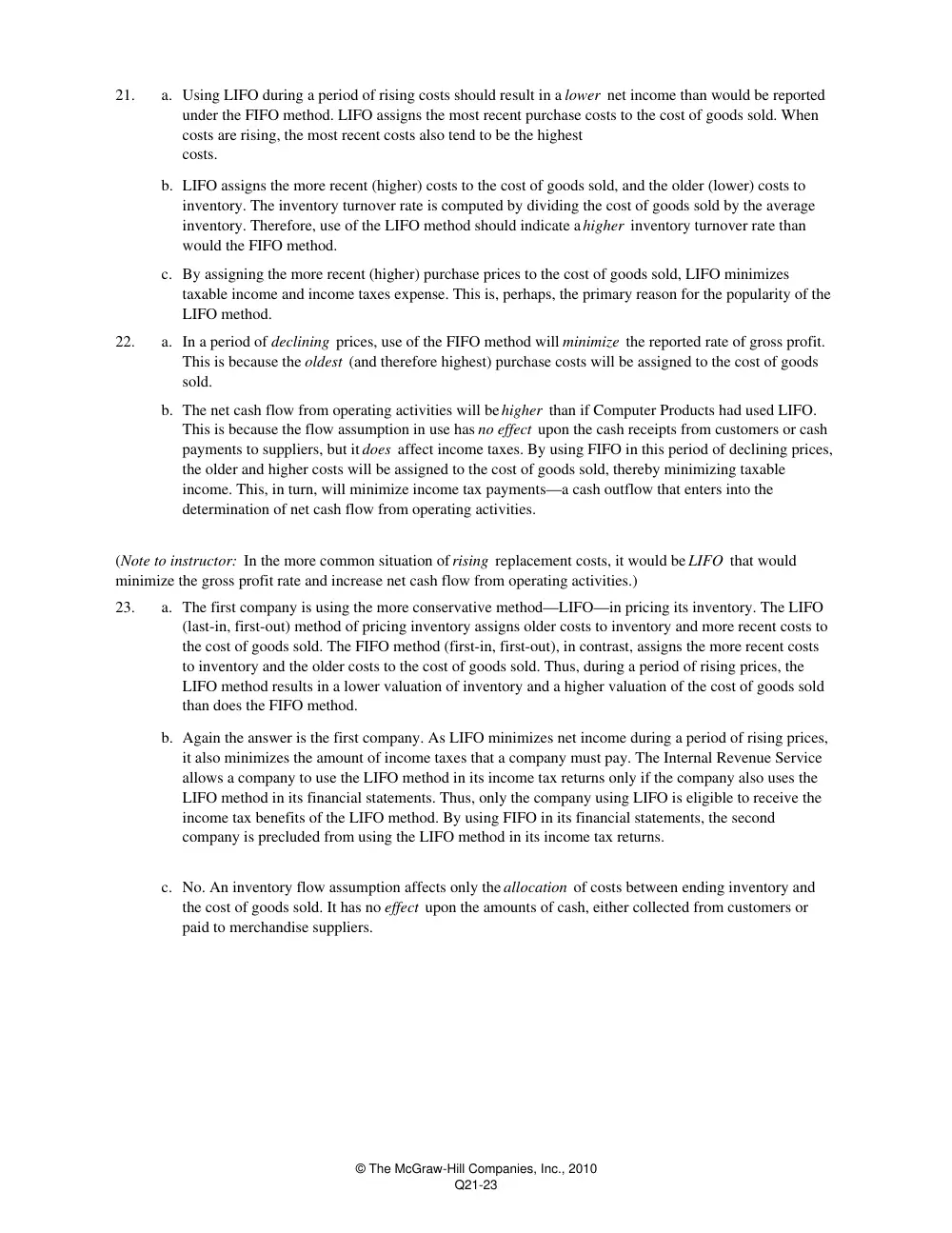
Using LIFO during a period of rising costs should result in a lower net income than would be reported
under the FIFO method. LIFO assigns the most recent purchase costs to the cost of goods sold. When
costs are rising, the most recent costs also tend to be the highest
costs.
LIFO assigns the more recent (higher) costs to the cost of goods sold, and the older (lower) costs to
inventory. The inventory turnover rate is computed by dividing the cost of goods sold by the average
inventory. Therefore, use of the LIFO method should indicate a higher inventory turnover rate than
would the FIFO method.
By assigning the more recent (higher) purchase prices to the cost of goods sold, LIFO minimizes
taxable income and income taxes expense. This is, perhaps, the primary reason for the popularity of the
LIFO method.
In a period of declining prices, use of the FIFO method will minimize the reported rate of gross profit.
This is because the oldest (and therefore highest) purchase costs will be assigned to the cost of goods
sold.
Again the answer is the first company. As LIFO minimizes net income during a period of rising prices,
it also minimizes the amount of income taxes that a company must pay. The Internal Revenue Service
allows a company to use the LIFO method in its income tax returns only if the company also uses the
LIFO method in its financial statements. Thus, only the company using LIFO is eligible to receive the
income tax benefits of the LIFO method. By using FIFO in its financial statements, the second
company is precluded from using the LIFO method in its income tax returns.
The first company is using the more conservative method—LIFO—in pricing its inventory. The LIFO
(last-in, first-out) method of pricing inventory assigns older costs to inventory and more recent costs to
the cost of goods sold. The FIFO method (first-in, first-out), in contrast, assigns the more recent costs
to inventory and the older costs to the cost of goods sold. Thus, during a period of rising prices, the
LIFO method results in a lower valuation of inventory and a higher valuation of the cost of goods sold
than does the FIFO method.
The net cash flow from operating activities will be higher than if Computer Products had used LIFO.
This is because the flow assumption in use has no effect upon the cash receipts from customers or cash
payments to suppliers, but it does affect income taxes. By using FIFO in this period of declining prices,
the older and higher costs will be assigned to the cost of goods sold, thereby minimizing taxable
income. This, in turn, will minimize income tax payments—a cash outflow that enters into the
determination of net cash flow from operating activities.
(Note to instructor: In the more common situation of rising replacement costs, it would be LIFO that would
minimize the gross profit rate and increase net cash flow from operating activities.)
No. An inventory flow assumption affects only the allocation of costs between ending inventory and
the cost of goods sold. It has no effect upon the amounts of cash, either collected from customers or
paid to merchandise suppliers.
© The McGraw-Hill Companies, Inc., 2010
Q21-23
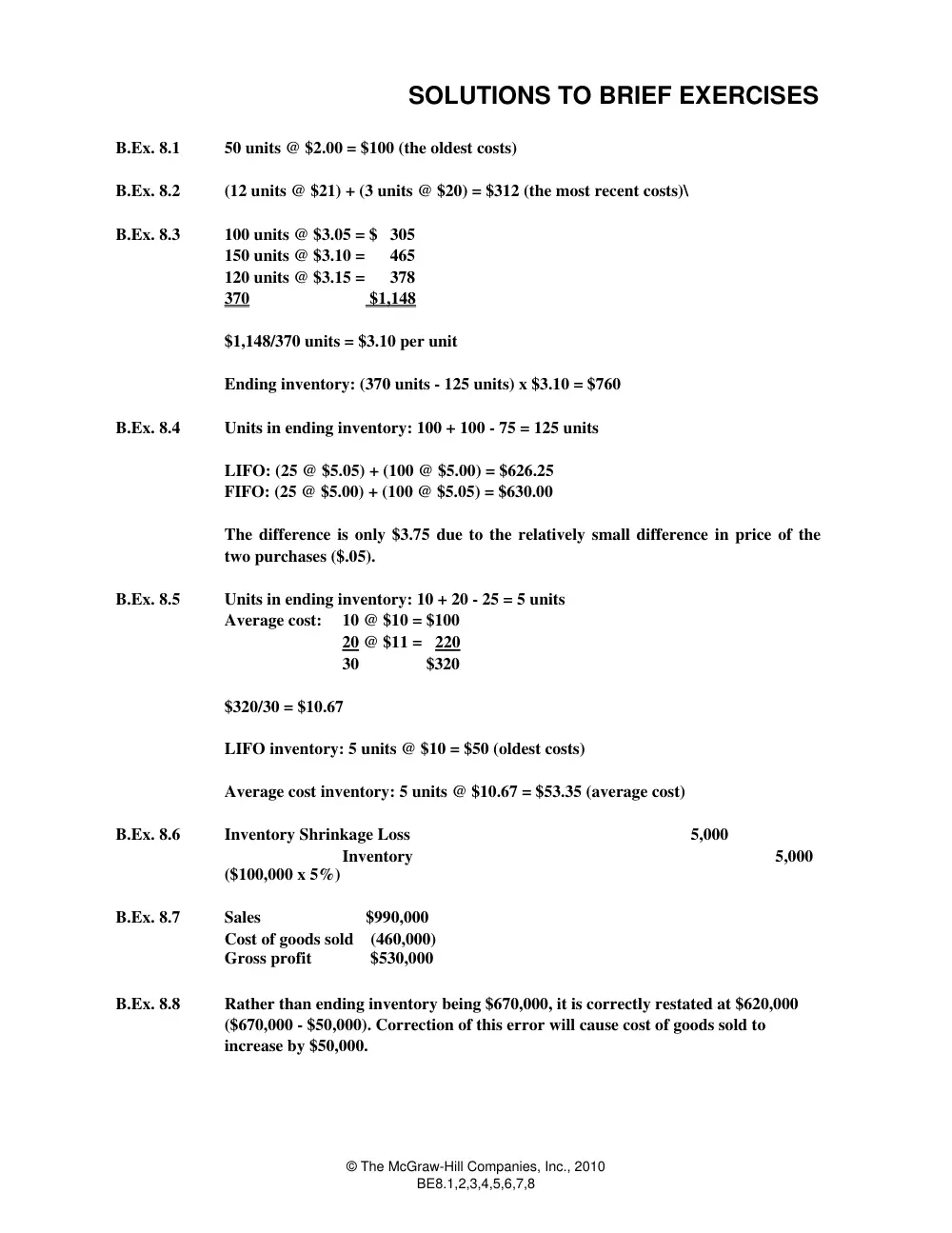
B.Ex. 8.1
B.Ex. 8.2
B.Ex. 8.3
B.Ex. 8.4
B.Ex. 8.5
Average cost:
10 @ $10 = $100
20 @ $11 = 220
30 $320
B.Ex. 8.6
5,000
5,000
B.Ex. 8.7
B.Ex. 8.8
Cost of goods sold (460,000)
Gross profit $530,000
Rather than ending inventory being $670,000, it is correctly restated at $620,000
($670,000 - $50,000). Correction of this error will cause cost of goods sold to
increase by $50,000.
Average cost inventory: 5 units @ $10.67 = $53.35 (average cost)
Inventory Shrinkage Loss
($100,000 x 5%)
Sales $990,000
Inventory
FIFO: (25 @ $5.00) + (100 @ $5.05) = $630.00
The difference is only $3.75 due to the relatively small difference in price of the
two purchases ($.05).
$1,148/370 units = $3.10 per unit
Ending inventory: (370 units - 125 units) x $3.10 = $760
LIFO: (25 @ $5.05) + (100 @ $5.00) = $626.25
SOLUTIONS TO BRIEF EXERCISES
50 units @ $2.00 = $100 (the oldest costs)
Units in ending inventory: 100 + 100 - 75 = 125 units
(12 units @ $21) + (3 units @ $20) = $312 (the most recent costs)\
100 units @ $3.05 = $ 305
150 units @ $3.10 = 465
370 $1,148
120 units @ $3.15 = 378
LIFO inventory: 5 units @ $10 = $50 (oldest costs)
$320/30 = $10.67
Units in ending inventory: 10 + 20 - 25 = 5 units
© The McGraw-Hill Companies, Inc., 2010
BE8.1,2,3,4,5,6,7,8
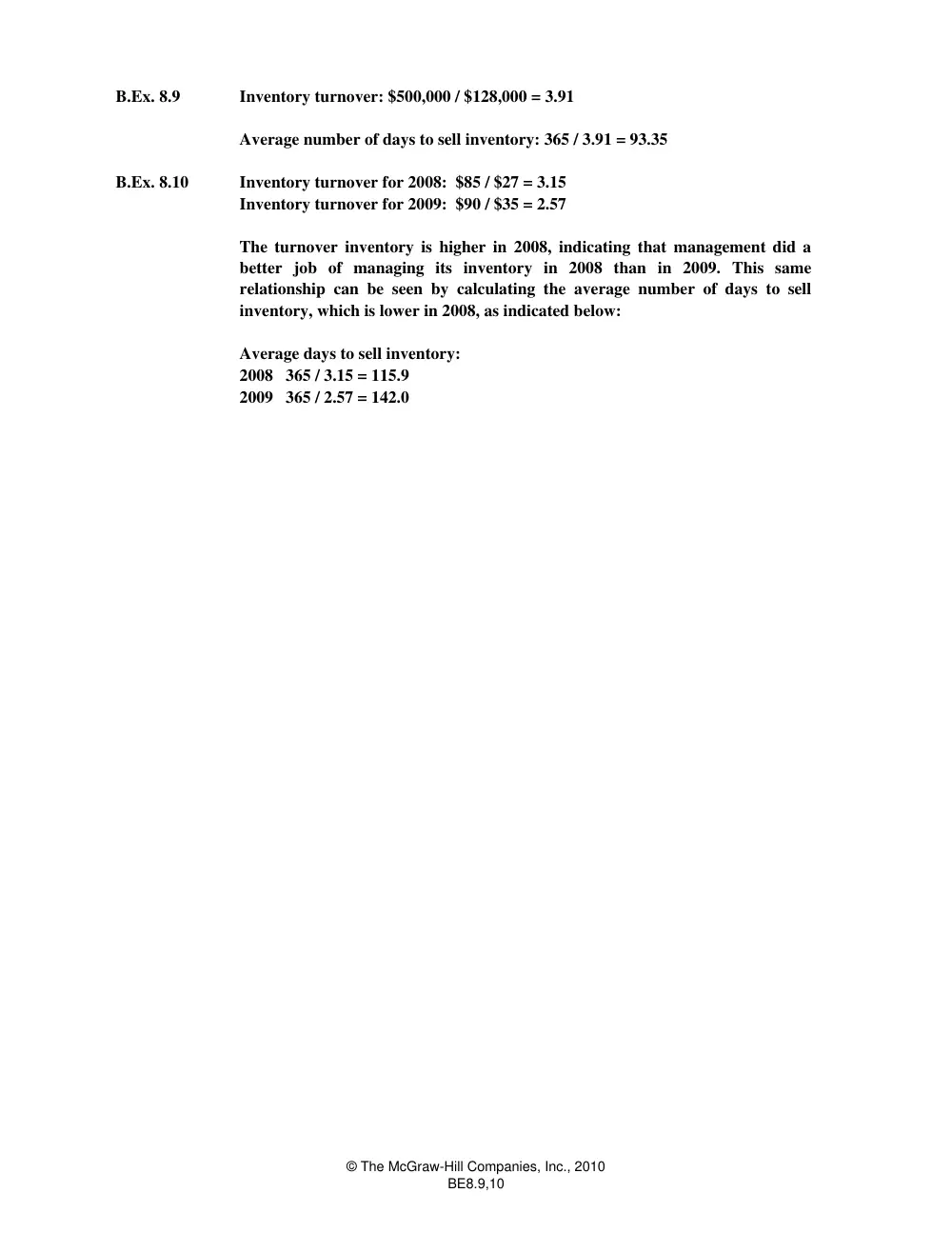
B.Ex. 8.9
B.Ex. 8.10
Inventory turnover: $500,000 / $128,000 = 3.91
Inventory turnover for 2009: $90 / $35 = 2.57
The turnover inventory is higher in 2008, indicating that management did a
better job of managing its inventory in 2008 than in 2009. This same
relationship can be seen by calculating the average number of days to sell
inventory, which is lower in 2008, as indicated below:
2008 365 / 3.15 = 115.9
Average number of days to sell inventory: 365 / 3.91 = 93.35
2009 365 / 2.57 = 142.0
Average days to sell inventory:
Inventory turnover for 2008: $85 / $27 = 3.15
© The McGraw-Hill Companies, Inc., 2010
BE8.9,10
Ex. 8.1
a.
b.
c.
d.
LIFO method
e.
FIFO method
f.
Ex. 8.2
a.
137,800
137,800
$93,000
44,800
Cost of goods sold ……………
$137,800
b.
137,700
137,700
c.
137,000
137,000
70 @ $1,500 …………………… $105,000
20 @ $1,600 ……………………
32,000
Cost of goods sold ……………
$137,000
d.
138,000
Inventory ……………………………………
138,000
30 @ $1,600 ……………………
$48,000
90,000
$138,000
To record the cost of 90 Millenium computers sold to
Apex Publishers. Cost determined by the LIFO flow
assumption:
60 @ $1,500 …………………
Cost of goods sold ……………
SOLUTIONS TO EXERCISES
Inventory ……………………………………
Inventory ……………………………………
Average-cost method
Inventory ……………………………………
Cost of Goods Sold …………………………………………
Flow assumption
Cost of Goods Sold …………………………………………
62 @ $1,500 ……………………
28 @ $1,600 ……………………
Specific identification
To record the cost of 90 Millenium computers sold to
Apex Publishers. Cost determined by the FIFO flow
assumption:
Retail method
To record the cost of 90 Millenium computers sold to
Apex Publishers. Cost determined by the specific
identification method:
To record the cost of 90 Millenium computers sold to
Apex Publishers. Cost determined by the average-cost
method:
Cost of Goods Sold …………………………………………
Cost of Goods Sold …………………………………………
90 @ $1,530 ($153,000 100 units)
© The McGraw-Hill Companies, Inc., 2010
E8.1,2
e.
Ex. 8.3
a.
1.
2.
3.
b.
c.
Under FIFO, the cost of goods sold is based on the oldest costs. Thus, relative
to using LIFO, the FIFO method will result in higher net income during
periods of rising prices, which will increase a company’s income tax liability.
In the balance sheet, the FIFO method reports inventory at
the most current costs. The LIFO method, on the other hand, reports the
same inventory at older, more conservative, and perhaps out-of-date
costs.
In order for a company to account for its entire inventory as a single,
combined, “pool,” all items should be relatively homogeneous. Obviously, the
physical properties of heating oil, coal, and kerosene differ significantly.
Keeping separate inventory records for each fuel type makes the reported
figures more meaningful and gives management more control over the
operations of the business. If management determined, for example, that one
of its product lines is unprofitable, it might decide to discontinue selling that
product and focus attention on the profitable products.
As heating oil is purchased and put into storage tanks, it mixes
completely with the heating oil remaining in these tanks from prior
purchases. As oil is pumped into the company’s delivery trucks, it
actually represents a blend of multiple purchase costs. Thus, the average-
cost method appears to best describe the physical flow of the heating oil
inventory.
The company’s large coal storage bins are loaded and emptied from the
top by giant machines, making the most recent coal acquired the most
recent coal sold. Thus, the LIFO method best describes the physical flow
of the coal inventory.
The kerosene inventory is stored on shelves in 5-gallon containers.
Management probably “rotates” this stock on a regular basis. Thus, the
FIFO method best describes the physical flow of the kerosene
inventory.
The LIFO method would probably result in the lowest income tax liability for
the company (assuming that fuel prices are rising). The LIFO method
allocates the most recent purchase prices to the cost of goods sold for the
period. Thus, in periods of rising prices, LIFO usually results in a higher cost
of goods sold and, consequently, a lower taxable income than other allocation
methods.
© The McGraw-Hill Companies, Inc., 2010
E8.3
Ex. 8.4
a.
b.
1.
$125,000
15,000
$110,000
2.
taxes x 40%)……………………………………………………
$44,000
3.
$110,000
44,000
Net income (assuming LIFO) …………………………………
$66,000
4.
$123,250
8,500
$131,750
Ex. 8.5
The inventory at December 31 amounts to $725,000, computed by adding the $125,000
inbound shipment of merchandise to $600,000 of merchandise on hand. Terms of the
$125,000 shipment were F.O.B. shipping point; therefore, title passed at the point of
shipment on December 28 and the goods were the property of the buyer (Jensen) while
in transit.
The $95,000 outbound shipment was correctly handled. Title to these goods passed to
the customer on December 30 when the goods were shipped, so they are not part of the
Jensen inventory at December 31. This shipment was billed on December 30, so the
account receivable is properly included in the balance sheet.
In addition to the $125,000 increase in inventory, accounts payable should be increased
by $125,000. Jensen owns the merchandise at December 31 and has a liability to pay
for it.
Income before income taxes (as reported under FIFO) ………
Less: Additional cost of goods sold had LIFO been in use
use ($1,865,000 - $1,850,000)……………………………………
Income before income taxes (assuming LIFO) ………………
Income taxes expense under LIFO ($110,000 income before
Income before income taxes (LIFO basis, part 1 ) ……………
Less: Income taxes expense under LIFO (part 2 ) ……………
paid, minus $44,000 from part 2)…………………………….
Net cash provided by operating activities (assuming LIFO) …
LIFO results in a higher cost of goods sold than does FIFO when the replacement
costs of merchandise are rising. Under LIFO, the most recent (higher) costs are
assigned to the cost of goods sold, and the oldest (lower) costs to inventory. This
situation reverses under FIFO.
Because LIFO assigns the oldest (lowest) costs to inventory, it is reasonable to
expect that the LIFO inventory would be lower than that resulting from FIFO
valuation, not higher.
Dollar amounts stated in thousands:
Net cash provided by operating activities (as reported)
under FIFO)……………………………………………………
Add: Income tax savings had LIFO been in use ($52,500
© The McGraw-Hill Companies, Inc., 2010
E8.4,5
Ex. 8.6
a. 1.
2,400
2,400
$9,400
Replacement cost (28 units @ $250) ……
7,000
$2,400
2.
5,250
5,250
3,750
3,750
b. 1.
1,200
1,200
2.
930
930
3.
Loss from Write-down of Inventory ……………………
Cost …………………………………….
Cost of Goods Sold ……………………………………….
Inventory ………………………………………
Inventory ………………………………………
To write down the inventory of 28 units of
WordCrafter to the lower-of-cost-or-market:
To recognize the sales revenue from the sale of 15
WordCrafter programs @ $350, cash.
Cost of Goods Sold …………………………………………
Sales ……………………………………………
To record shrinkage loss of 3 units of WordCrafter
software using the FIFO flow assumption (3 units @
$400).
To record shrinkage loss of 3 units of WordCrafter
software using the LIFO flow assumption (3 units @
$310).
Using the FIFO method would result in a $270 lower net income figure than
using the LIFO method ($1,200 $930 = $270). This is due to the reduction in
price paid for the second purchase. Although the company would report a lower
net income figure using FIFO, it would not really be any less efficient in
conducting operations. An inventory valuation method affects only the allocation
of costs between ending inventory and cost of goods sold. It has no effect upon
the total costs actually incurred in purchasing or manufacturing inventory.
Cost of Goods Sold …………………………………………
Inventory ………………………………………
Reduction in carrying value ……………
To record cost of 15 WordCrafter programs sold on
January 9 using the FIFO flow assumption. (All units
are carried in inventory at $250 following the year-end
reduction to the lower-of-cost-or-market.)
Inventory ………………………………………
Cash …………………………………………………………
© The McGraw-Hill Companies, Inc., 2010
E8.6
Ex. 8.7
a.
b.
c.
d.
Ex. 8.8
a.
2009
2008
350,000
$
250,000
$
Correction of understatement of inventory at end of 2008 ……
(40,000)
40,000
310,000
$
290,000
$
For 2008:
$640,000
42.67%
For 2009:
$710,000
35.50%
c.
b.
Correction of owner's equity:
Average cost $79.60 (20 units @ $3.98). (Average cost = $438/110 units =
$3.98)
FIFO, $99.00 (19 units @ $5.00 + 1 unit @ $4.00).
LIFO, $65.50 (9 units @ $3.00 + 11 units @ $3.50).
Only the FIFO method results in the same ending inventory valuation in both
periodic and perpetual costing environments. Under the average cost and LIFO
methods, periodic and perpetual systems usually result in different valuations due
to the timing of inventory purchases and sales. Under FIFO, the value assigned to
ending inventory is the same using periodic or perpetual procedures, regardless of
when purchases or sales occur during the period.
Compute corrected net income figures:
Net income as reported ………………………………………
Net income as corrected ………………………………………
Gross profit percentage ($710,000 $2,000,000) ……………
Owner’s equity at the end of 2008 should be increased by $40,000 to $540,000. At
the end of 2009 the owner’s equity of $580,000 requires no correction because the
inventory error counterbalanced, as evidenced by the fact that the combined net
income for the two years was $600,000, both before and after the correction of net
income for the individual years.
Gross profit percentage ($640,000 $1,500,000) ……………
Adjusted gross profit ($750,000 $40,000) …………………
Compute gross profit amounts and gross profit percentages
for each year based on corrected data