
CSC 316 Chapter 2a, Spring 2004
Notre Dame University–Louaize · Computers Security and Their Data · 45 pages · Dr. Victor Sawma

Showing the first 10 of 45 pages. Download the PDF to see all of it.
More CSC 316 files
Show the text of this chapter
Basic Cryptography
Chapter 2
V. Sawma, Computer Security
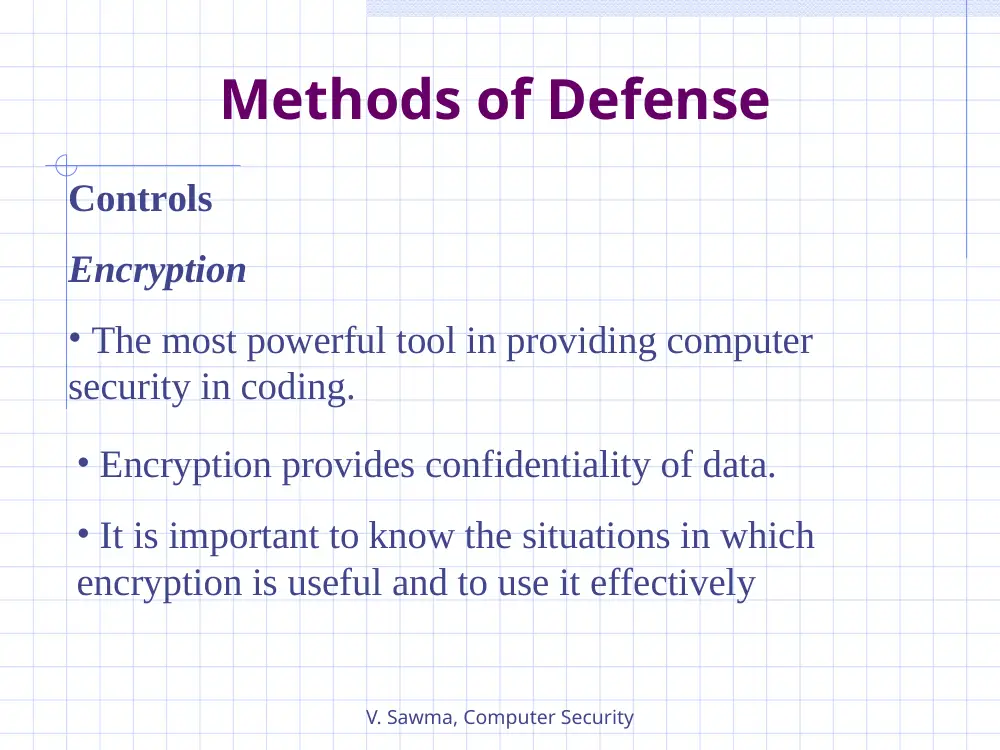
Controls
Encryption
• The most powerful tool in providing computer
security in coding.
Methods of Defense
• Encryption provides confidentiality of data.
• It is important to know the situations in which
encryption is useful and to use it effectively
V. Sawma, Computer Security
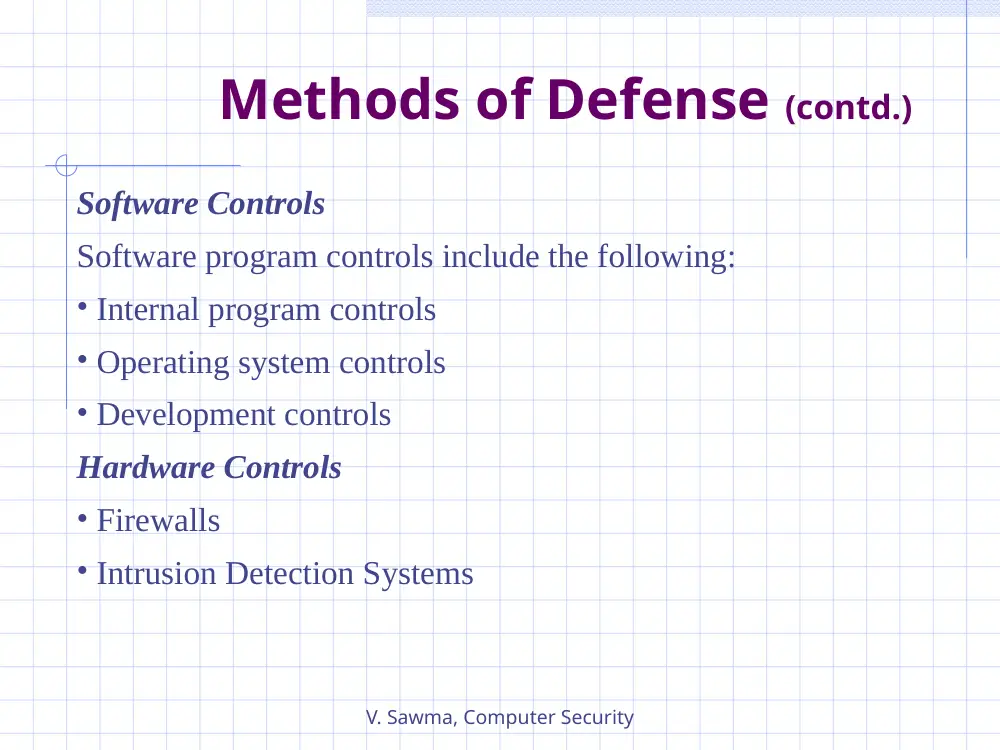
Software Controls
Software program controls include the following:
• Internal program controls
• Operating system controls
• Development controls
Hardware Controls
• Firewalls
• Intrusion Detection Systems
Methods of Defense (contd.)
V. Sawma, Computer Security
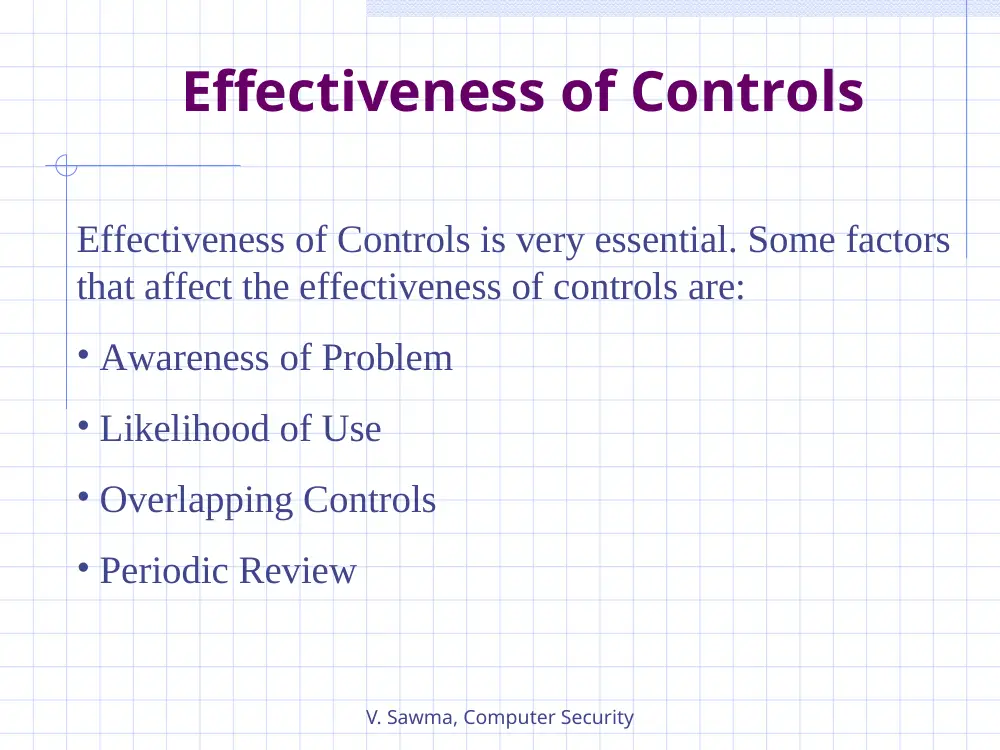
Effectiveness of Controls is very essential. Some factors
that affect the effectiveness of controls are:
• Awareness of Problem
• Likelihood of Use
• Overlapping Controls
• Periodic Review
Effectiveness of Controls
V. Sawma, Computer Security
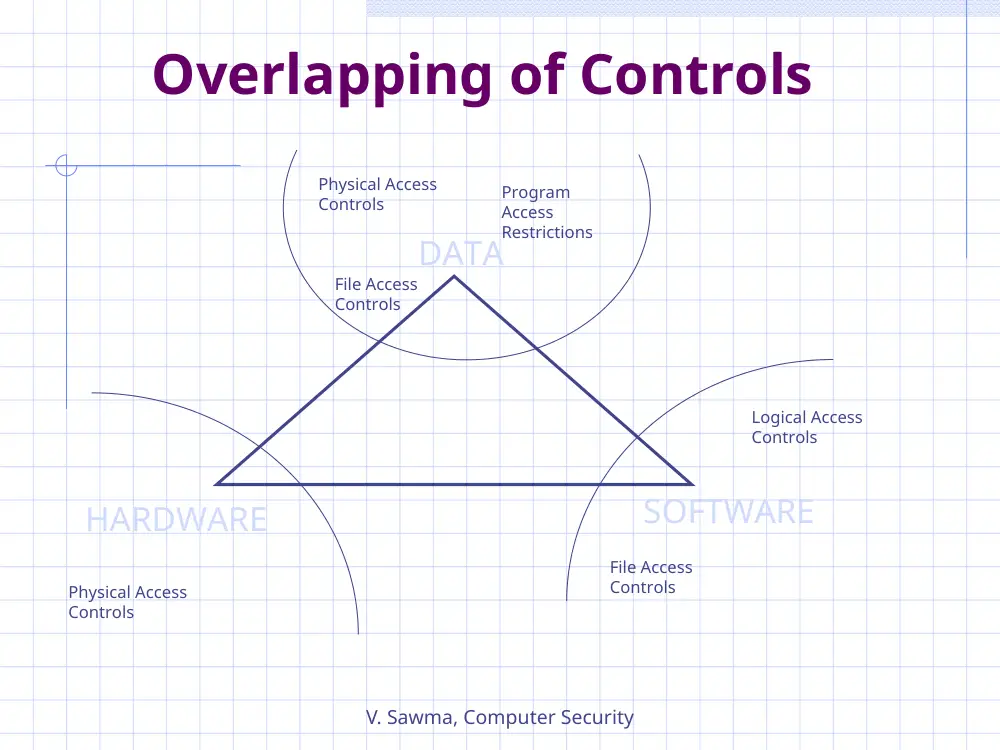
Overlapping of Controls
DATA
Program
Access
Restrictions
File Access
Controls
Physical Access
Controls
HARDWARE
Physical Access
Controls
SOFTWARE
File Access
Controls
Logical Access
Controls
V. Sawma, Computer Security
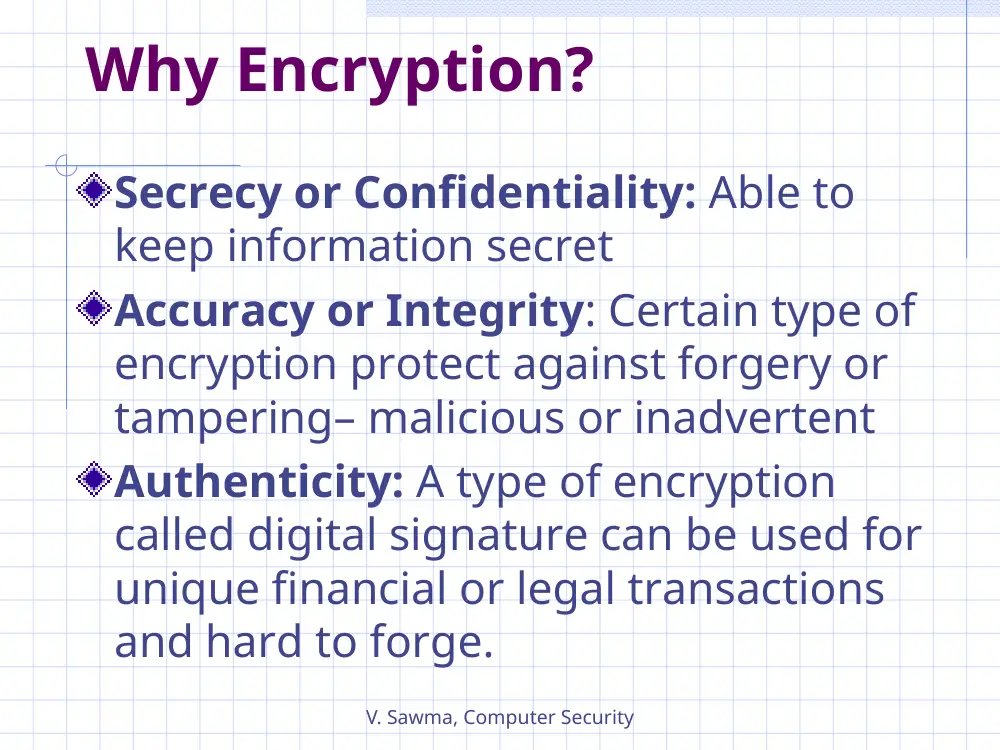
Why Encryption?
Secrecy or Confidentiality: Able to
keep information secret
Accuracy or Integrity: Certain type of
encryption protect against forgery or
tampering– malicious or inadvertent
Authenticity: A type of encryption
called digital signature can be used for
unique financial or legal transactions
and hard to forge.
V. Sawma, Computer Security
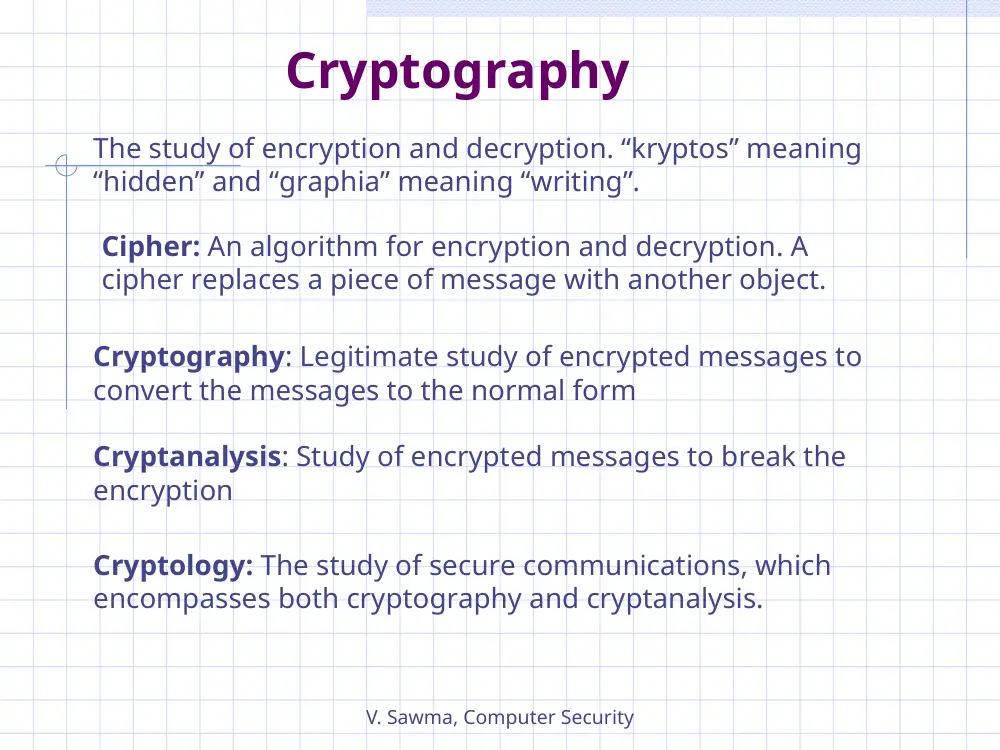
The study of encryption and decryption. “kryptos” meaning
“hidden” and “graphia” meaning “writing”.
Cryptography
Cryptology: The study of secure communications, which
encompasses both cryptography and cryptanalysis.
Cipher: An algorithm for encryption and decryption. A
cipher replaces a piece of message with another object.
Cryptography: Legitimate study of encrypted messages to
convert the messages to the normal form
Cryptanalysis: Study of encrypted messages to break the
encryption
V. Sawma, Computer Security
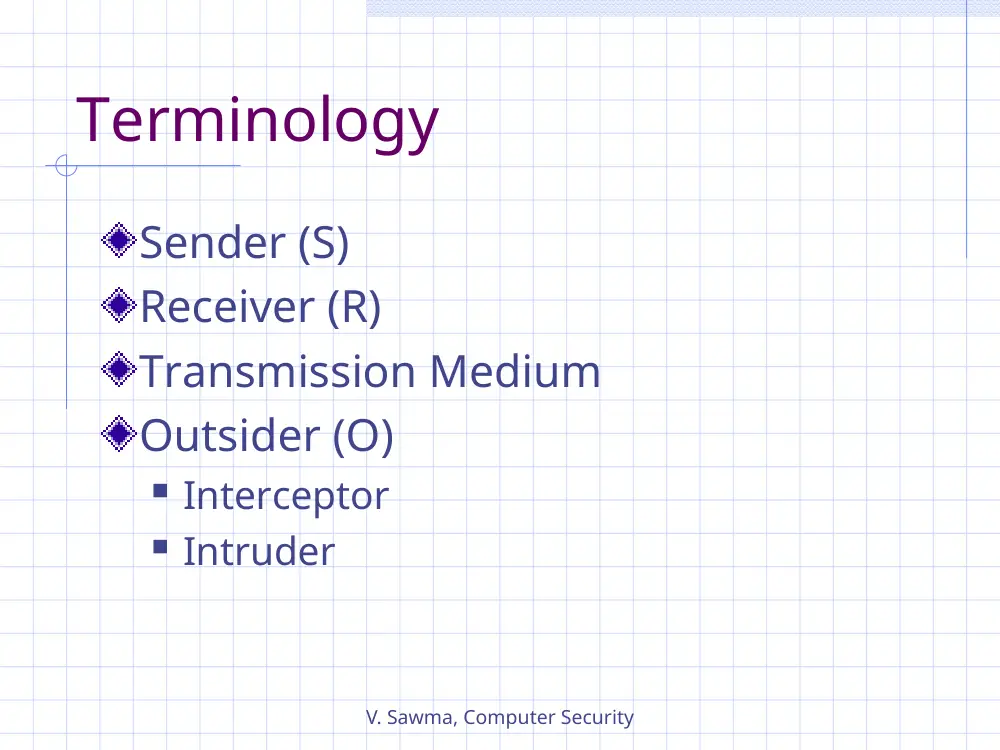
Terminology
Sender (S)
Receiver (R)
Transmission Medium
Outsider (O)
Interceptor
Intruder
V. Sawma, Computer Security
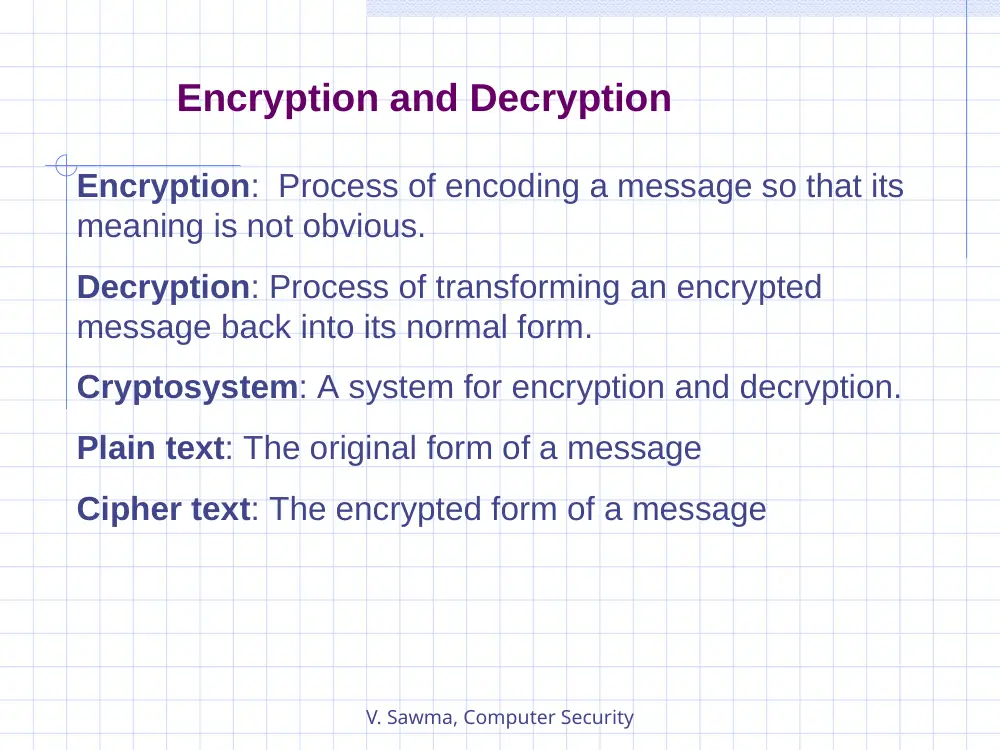
Encryption: Process of encoding a message so that its
meaning is not obvious.
Decryption: Process of transforming an encrypted
message back into its normal form.
Cryptosystem: A system for encryption and decryption.
Plain text: The original form of a message
Cipher text: The encrypted form of a message
Encryption and Decryption
V. Sawma, Computer Security
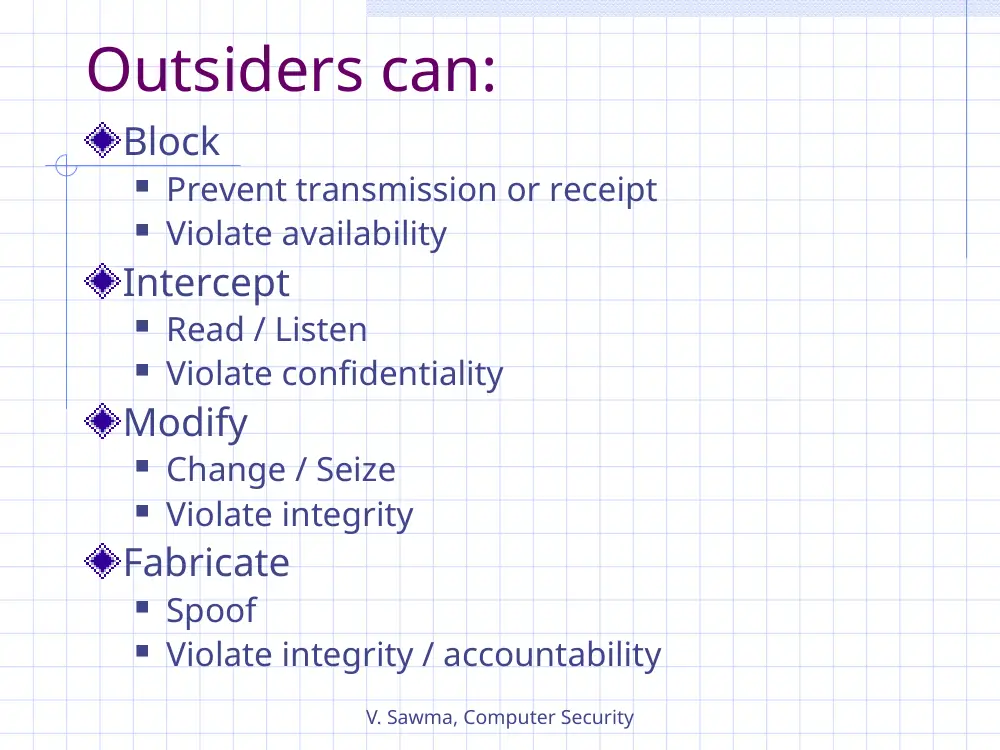
Outsiders can:
Block
Prevent transmission or receipt
Violate availability
Intercept
Read / Listen
Violate confidentiality
Modify
Change / Seize
Violate integrity
Fabricate
Spoof
Violate integrity / accountability
V. Sawma, Computer Security
Cryptography
Plain text vs Cipher text
Plain text: P
Cipher text: C
Encryption
Encode / Encrypt
Denoted: C = E(P)
Decryption
Decode / Decrypt
Denoted: P = (D(C))
V. Sawma, Computer Security
Encryption Algorithms
The basic idea is to use a key K
Encryption: Cipher text can be obtained from plain text
using a key
C = E(K,P)
Decryption: When the encryption and decryption keys are
the same, then plain text can be obtained as
P = D(K, E(K,P))
This type of encryption is called Symmetric encryption
V. Sawma, Computer Security
Encryption Algorithms (contd.)
When the encryption and decryption keys are not similar
then plain text can be obtained as:
P = D(KD, e(KE,P))
where
KE = Encryption key and KD = Decryption key
This type of encryption is called Asymmetric
encryption
Encryption
Decryption
Plaintext
Cipher-
text
Original
Plaintext
Basic Encryption
V. Sawma, Computer Security
Encryption Algorithms (contd.)
Encryption
Decryption
Plaintext
Cipher-
text
Original
Plaintext
KEY
Encryption
Decryption
Plaintext
Cipher-
text
Original
Plaintext
Encryption key KE
Decryption key KD
Symmetric Cryptosystem
Asymmetric Cryptosystem
V. Sawma, Computer Security
Secret key (Symmetric system ) and
Public Key (Asymmetric system)
Secret Key:
A particular key is shared between two users
Key distribution is a major problem
Public Key:
Works with two keys, public key and the private key
Public key is publicly available for encryption
The private key only decrypts the encrypted message
n (n-1)/2 keys are needed for n users to communicate
V. Sawma, Computer Security
Cryptanalysis
Break an algorithm via:
Breaking a single message
Recognizing patterns
Learn algorithm (ex. Repeated patterns)
Finding weaknesses in encryption algorithm
Works with any of the following:
Intercepted messages (cipher and/or plain)
Known encryption algorithms
Mathematics, statistics, language properties,
etc.
Ingenuity and Luck!!!
V. Sawma, Computer Security
Modular Arithmetic
Represent letters with numbers
A(0) B(1) C(2) D(3) E(4) F(5)
Can perform calculations
A + 3 = D
Circular
E + 3 = B
Also known as mod n
V. Sawma, Computer Security
Monoalphabetic Ciphers
Also known as substitutions
Uses a correspondence table
Each ONE cipher “corresponds” to ONE plain
We will take TWO ciphers:
The Caesar Cipher
Named after Julius Caesar
Permutations
V. Sawma, Computer Security
Monoalphabetic Substitution Ciphers
Substituting each character by another character or
symbol is called monoalphabetic cipher or a simple
substitution.
The Caesar Cipher
• Each letter is translated to the letter a fixed number of
letters after it in the alphabet.
• Uses a shift of 3
• Plain text pi can be used to obtain cipher text ci as
follows:
ci = E(pi ) = pi + 3
Encrypt TREATY IMPOSSIBLE
V. Sawma, Computer Security
The Caesar Cipher
b
a
z
y
w x
v
u
t
s
r
q
p
o
m n
l
k
j
i
h
g
f
e
d
K L M N O P Q R S T U V W X Y
J
B C D E F G H I
A
c
Z
Example:
Example:
Plain:
TREATY IMPOSSIBLE
Cipher:
wuhdwb lpsrvvleoh
V. Sawma, Computer Security
The Caesar Cipher
Advantages
Easy to perform
Was protected b/c only FEW people could read
Pattern (pi + 3) is easy to remember
Disadvantages
Pattern is easy to guess
Pattern repetition in Cipher
Try breaking the following cipher:
wklv phvvdjh lv qrw wrr kdug wr euhdn
V. Sawma, Computer Security
Disadvantages of the Caesar Cipher
•
It is easily observable that blanks are not
encrypted and are replaced by blanks itself.
•
As English has got few small words, the two letter
words can be easily replaced with few guesses
•
Next the three letter words which have two
continuous same letters can be determined as
such patterned words are very few
•
The ciphertext letters uncovered are just three
positions away from their plaintext counterparts. A
cryptanalyst might try that same pattern on all the
unmatched ciphertext.
V. Sawma, Computer Security
Permutations
Alphabet is scrambled
Each plaintext letter maps to a
unique ciphertext letter
Example:
Plain:
1,2,3,4,5,6,7,8,9,10
Perm1:
1,3,5,7,9,10,8,6,4,2
Perm2:
10,9,8,7,6,5,4,3,2,1,0
V. Sawma, Computer Security
Permutations (cont’d)
Some permutations use keys
Example:
Plain:
ABCDEFGHIJKLMNOPQRSTUVWXYZ
Perm1: KEYABCDFGHIJLMNOPQRSTUVWXZ
Perm2: SPECTAULRBDFGHIJKMNOQVWXYZ
V. Sawma, Computer Security
Polyalphabetic Substitution Ciphers
Monoalphabetic ciphers reflect PLAIN TEXT
frequency distribution
Polyalphabetic ciphers aim to provide a
more flat distribution!!!
One way to do so is to COMBINE
monoalphabetic ciphers
Odd plain text letters use a Permutation
Even plain text letters use another Permutation
V. Sawma, Computer Security
Vigenère Tableaux
V. Sawma, Computer Security
Vigenère Tableaux (cont’d)
Encrypt the following:
Plain: BUT SOFT WHAT LIGHT
Key: Juliet
a
r
e
x
i
s
q
c
y
s
a
e
o
k
u
j
t
e
i
l
u
j
t
e
i
l
u
j
G
I
L
T
W H A
T
F
O
S
B U T
V. Sawma, Computer Security
Cryptanalysis of Poly. Subs.
# of alphabets used
Break cipher into pieces that were
ciphered with the same alphabet
Solve each piece as a monoalphabet
substitution
Two tools can help:
Kasiski method
Index of coincidence
V. Sawma, Computer Security
Kasiski Method
Relies on regularity of English
Not only letters but also groupings
Ending: th, ing, ed, ion, tion, ation, etc.
Beginning: im, in, un, re, etc.
Patterns: eek, oot, our, etc.
V. Sawma, Computer Security
Kasiski Method (cont’d)
Identify all repeated patterns in the
ciphertext
For each pattern:
1.
Write down the starting position
2.
Compute the distance between successive
starting positions
3.
Distance must be a multiple of key length
4.
Determine all factors of difference (eg. 21
means the key is either 3 or 7 characters long)
5.
Divide the cipher into blocks (based on key
length)
6.
Columns in each block must have been
encrypted using the SAME key character
7.
Use frequency distribution to determine the
letter
V. Sawma, Computer Security
Kasiski Method Example
Cipher text example:
afexddyzlskfjkwlkdfxskejfkkfexdjfieuyty
2 28
28 - 2 = 26
Key must be of length: 1, 2, 13, or 26
V. Sawma, Computer Security
Index of Coincidence
Def: Is a measure of the variation
between frequencies in a distribution
English has HIGH and LOW frequencies
The more substitutions we use, the lower
the HIGHs and the higher the LOWs
This index allows us to predict the
number of substitutions used
V. Sawma, Computer Security
Index of Coincidence (cont’d)
- n denotes the number of letters used
in cipher message, not 26!
z
a
n
n
freq
freq
IC
)1
(
)1
( )
( ) (
V. Sawma, Computer Security
The “Perfect” Substitution Cipher
Use many alphabets (infinite
nonrepeating sequence if possible)
Kasiski method fails because:
no repetition occurs
If a repetition occurs, it does not mean
the end of the key confusion
V. Sawma, Computer Security
One-time Pads
Use key once and destroy
Identical pads at both sides
Problem:
Need for absolute synchronization
Need for unlimited number of keys
V. Sawma, Computer Security
One-Time Pads
Long Random Number Sequences
Random numbers are NOT random!
They form a sequence with a VERY LONG
period
Vernam Cipher
Random numbers are generated from a tape
Safe as long as tape is not reused
Binary Vernam Cipher
Rely on binary operations
Encrypts binary data using binary data
Produces binary data
Can be easily performed on computers (XOR)
V. Sawma, Computer Security
The Vernam Cipher
It is a type of One-Time pad
Immune to cryptanalytic attacks
V. Sawma, Computer Security
Book Cipher
Select numbers from a book
Telephone book, choose a number, apply
mod 26 and then use Vigenere Tableau
Phrase from a book, use it as a key and
the use the Vigenere Tableau
V. Sawma, Computer Security
Cryptanalysis of Book Cipher
The message and the key text are not evenly
distributed
The distributions cluster around high-frequency
letters
V. Sawma, Computer Security
Random Number Generation (cont’d)
Long sequences from books
Problem: Neither the message nor the
key text is evenly distributed
Dual Message Entrapment
Encrypt two messages at once
One message is real, the other is dummy
Even if decrypted, cryptanalyst cannot
distinguish message from key!!!
V. Sawma, Computer Security
Summary:
Substitutions & Transpositions
Substitutions
Monoalphabetic Ciphers
Polyalphabetic Ciphers
These are called Stream Ciphers
Transpositions
Permutation
These are Block Ciphers
V. Sawma, Computer Security
Summary: Mono-alphabetic Ciphers
Caesar Cipher
Formula:
Treaty Impossible --> wuhdwb lpsrvvleoh
Advantages & Disadvantages
Easy to perform
Simple, so easy to predict the pattern
Repeat characters give clue to break
Permutation Cipher
Use a key
ABCDE ………
k e ya b……….
Since key is short, most plaintext letters are only one
or two positions off
Time complexity of these algorithms -- linear in
n where n is the no. of characters in plaintext
3
)
(
i
i
i
p
E p
c
V. Sawma, Computer Security
Summary: Polyalphabetic Substitution Ciphers
Main problem with monoalphabetic ciphers is
the non-flat frequency distribution
A flat distribution gives no information to
cryptanalyst
Flattening by combining distributions
Two or more separate encryption alphabets for
the same character of the plaintext
Eg., one encryption for characters in odd
positions and another for at even positions
Reduces the repeat symbols in the ciphertext
Makes it hard to break
V. Sawma, Computer Security
Summary: Vigenere Tableaux
Need to smooth out peaks and valleys of
frequency distribution
Can be done by extending no. of
permutations
Extreme case -- extend to 26
permutations
A 26 X 26 table is used
Key word of length 3 is sufficient to
smooth out the distribution
Cryptanalysis of Polyalphabetic
V. Sawma, Computer Security
Summary: Perfect Substitution Cipher
Requires an infinite non-repeating
sequence of alphabets
This will confound the cryptanalyst
One-Time pads
Vernam Cipher
Uses an arbitrarily long sequence of
numbers
Random Numbers
Middle digits of phone numbers in a
residential directory