
CSC 316 Chapter 6a, Spring 2004
Notre Dame University–Louaize · Computers Security and Their Data · 19 pages · Dr. Victor Sawma

Showing the first 10 of 19 pages. Download the PDF to see all of it.
More CSC 316 files
Show the text of this chapter
Chapter 6
Data Base Security
Sawma V., Computer Security and Their Data
2
Outline
Integrity in data bases (6.1-6.3)
Security in data bases (6.4, 6.5)
Multilevel data bases (6.6, 6.7)
Sawma V., Computer Security and Their Data
3
Data base Introduction
Data base
Data base administrator
Data base management system (DBMS)
Informally known as “Front end”
Data base server
Sawma V., Computer Security and Their Data
4
Data base Introduction
Schema (or logical structure)
Subschema (part of the database schema)
Records (rows)
Attributes (columns)
Fields (or elements, cells)
Queries: retrieval, change (insert, delete,
update), aggregate functions
Sawma V., Computer Security and Their Data
5
Data Base Security Requirements
Physical data base integrity
Immune to physical problems: power failure
Logical data base integrity
Structure of database is preserved: modifying one
element does not modify another (or vice versa)
Element integrity
Data in element is accurate
Auditability
Keep track of access information
Keep track of who made what, when, where, and how
Sawma V., Computer Security and Their Data
6
Data Base Security Requirements
Access control
Control authorized access
Block unauthorized access
User authentication
Ensure positive user identification
Availability
Access all data if authorized
Access no data if NOT authorized
Database Integrity
Applies to individual elements of the database
Sawma V., Computer Security and Their Data
7
Data Base Security Requirements
Confidentiality
Related to data (mainly deals with inference
problem)
Availability
Important due to shared access motivation
that underlies the usage of databases.
Other requirements? (for mission critical
systems)
Fault tolerance
highly available
Sawma V., Computer Security and Their Data
8
Data Base Reliability
Three dimensions of data base reliability/integrity:
1.
Data base integrity
–
Protection of database as a whole
–
OS responsibility
–
integrity control and recovery procedures
–
ex. Backup
2.
Element integrity
–
Data written or changed only by authorized users
–
DBMS responsibility: Access control
3.
Element accuracy
–
Only correct values are written into elements
–
DBMS responsibility: field check and constraint
conditions
Sawma V., Computer Security and Their Data
9
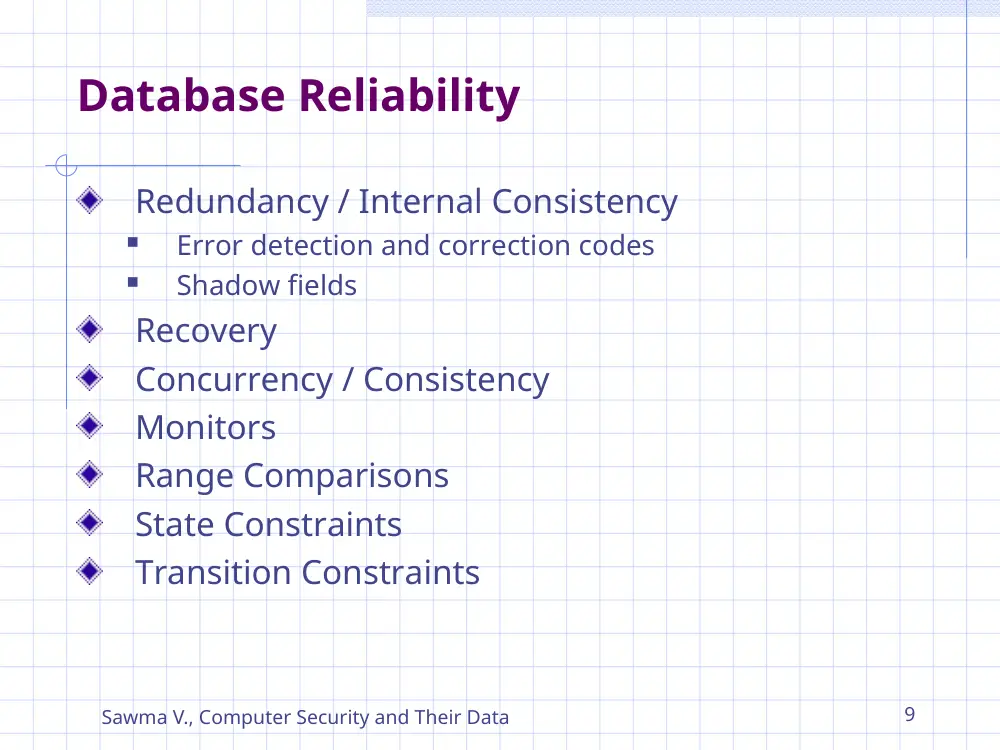
Database Reliability
Redundancy / Internal Consistency
Error detection and correction codes
Shadow fields
Recovery
Concurrency / Consistency
Monitors
Range Comparisons
State Constraints
Transition Constraints
Sawma V., Computer Security and Their Data
10
The 2-Phase Update Protocol
Goal: To prevent inconsistent data base states
Two steps:
1.
The intent phase
–
Check to make sure that each step can be done
–
Save final results in a temporary place
–
This phase can be repeated many times with no harm
2.
The update phase
–
Set COMMIT flag
–
All checks have been made successfully in previous phase
–
Move temporary values to real places
–
Unset COMMIT flag
–
This phase can be repeated many times with no harm
Sensitive Data
Sawma V., Computer Security and Their Data
12
Sensitive Data
Introduction (1)
Sensitive data is data that should not be public.
Three kinds of databases:
One that contains nothing sensitive
One that contains everything sensitive
One that contains some but not all sensitive
Sensitive data may be in varying degrees of
sensitivity.
Sawma V., Computer Security and Their Data
13
Sensitive Data
Introduction (2)
The access control problem is to limit
users’ access so that they can obtain only
the data to which they have legitimate
access.
Several factors that make data sensitive:
inherently sensitive (value itself is sensitive)
from a sensitive source
declared sensitive
of a sensitive attribute or a sensitive record
sensitive in relation to previously disclosed
information (composite data)
Sawma V., Computer Security and Their Data
14
Sensitive Data
Access Decisions (1)
Access decisions are made by database
administrator and based on an access policy.
The DBMS implements the access decisions.
There are several factors when deciding whether to
permit an access. They are:
Availability of the data: some required data
may not be accessible.
Example: locking of tuples when updating
Serious problem may result: Denial of Service
Sawma V., Computer Security and Their Data
15
Sensitive Data
Access Decisions (2)
Acceptability of access: some data may be
sensitive and not accessible by some user.
This control is not as simple as it sounds,
because:
the sensitive fields may not be directly
requested but only be referenced
some user may want a nonsensitive statistic
from the sensitive data
Sawma V., Computer Security and Their Data
16
Sensitive Data
Access Decisions (3)
Assurance of Authenticity: certain
characteristics of the user that is external to the
database may also be considered.
access the database only during the working
time
previous request made by the user may be
considered (because sensitive data can
sometimes be revealed by combining less
sensitive data)
Sawma V., Computer Security and Their Data
17
Sensitive Data
Types of Disclosures (1)
Data can be sensitive, but even information about
data is also a form of disclosure. So a successful
security strategy must protect from both direct
and indirect disclosure.
Exact data: sensitive data itself
Bounds: sometimes by knowing the bounds on a
sensitive data and using a narrowing technique
the user may determine the sensitive data in any
desired precision.
Sawma V., Computer Security and Their Data
18
Sensitive Data
Types of Disclosures (2)
Negative Result: some query may be made to
determine a negative result from which sensitive
data may be disclosed.
Existence: the existence of data is itself a sensitive
data, regardless of the actual value.
Probable value: it may be possible to determine
the probability that a certain element has a certain
value.
Sawma V., Computer Security and Their Data
19
Sensitive Data
Security vs. Precision
Sharing of nonsensitive data:
Security: To disclose only nonsensitive data,
and reject any query that mentions a sensitive
field.
Precision: To protect all sensitive data while
disclose as much nonsensitive data as possible.
The ideal combination is to maintain perfect
security with maximum precision. In fact, we
often must sacrifice precision in order to maintain
security.