
CSC 316 Chapter 2b, Spring 2004
Notre Dame University–Louaize · Computers Security and Their Data · 23 pages · Dr. Victor Sawma


Showing the first 10 of 23 pages. Download the PDF to see all of it.
More CSC 316 files
Show the text of this chapter
Chapter 2
Basic Encryption and Decryption (part B)
V. Sawma, Computer Security
2
2.4 Transpositions
(Permutations)
Transposition: an encryption in which
the letters of the message are
rearranged
Also known as permutations
Compare the goals:
Substitution confusion
Transposition diffusion
V. Sawma, Computer Security
3
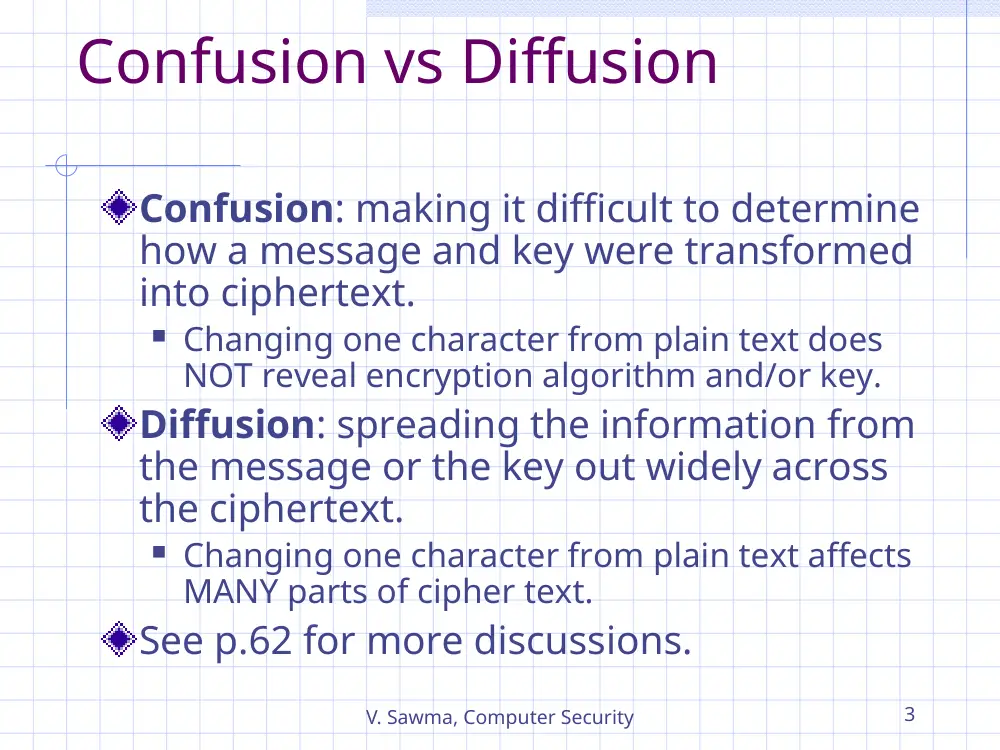
Confusion vs Diffusion
Confusion: making it difficult to determine
how a message and key were transformed
into ciphertext.
Changing one character from plain text does
NOT reveal encryption algorithm and/or key.
Diffusion: spreading the information from
the message or the key out widely across
the ciphertext.
Changing one character from plain text affects
MANY parts of cipher text.
See p.62 for more discussions.
V. Sawma, Computer Security
4
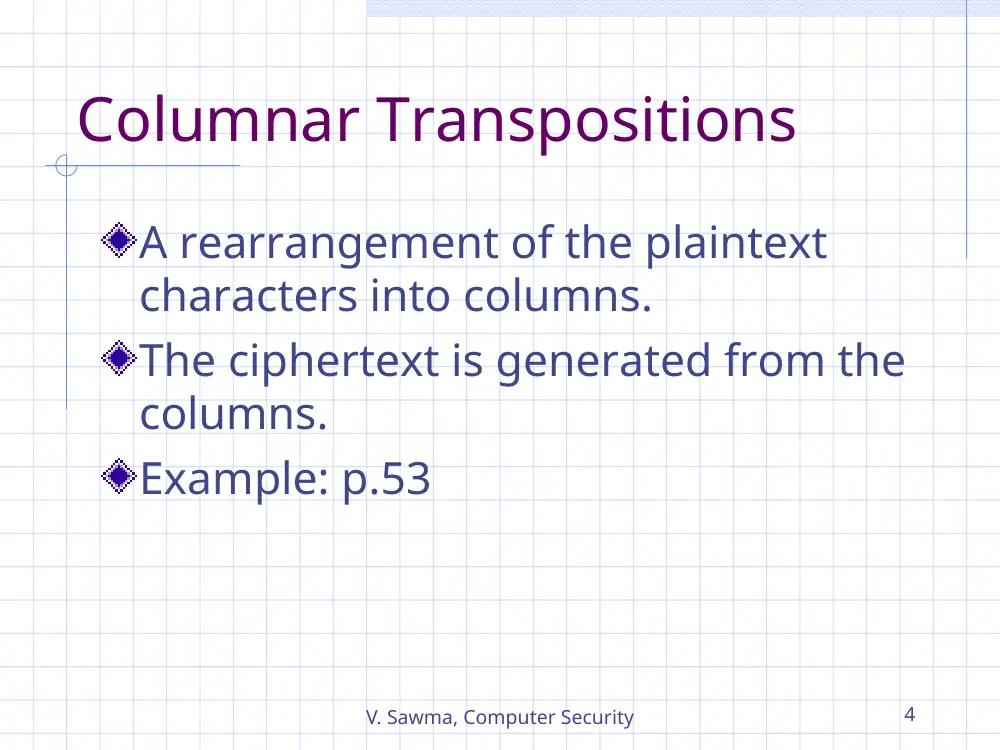
Columnar Transpositions
A rearrangement of the plaintext
characters into columns.
The ciphertext is generated from the
columns.
Example: p.53
V. Sawma, Computer Security
5
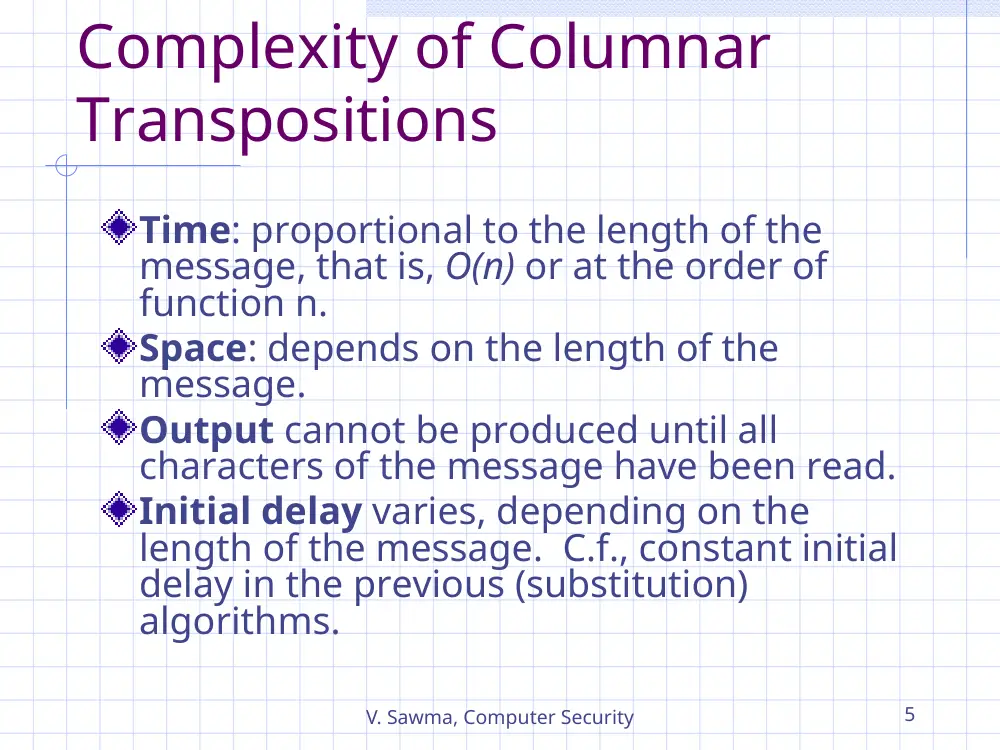
Complexity of Columnar
Transpositions
Time: proportional to the length of the
message, that is, O(n) or at the order of
function n.
Space: depends on the length of the
message.
Output cannot be produced until all
characters of the message have been read.
Initial delay varies, depending on the
length of the message. C.f., constant initial
delay in the previous (substitution)
algorithms.
V. Sawma, Computer Security
6
Digrams, Trigrams, & Other
Patterns
Digrams: groups of two letters
Trigrams: groups of three letters
Table 2-2 (p.54): Most common
English Digrams and Trigrams.
V. Sawma, Computer Security
7
Digrams, Trigrams, and Other Patterns
Pair of adjacent letters-digrams
Group of three letters-trigrams
V. Sawma, Computer Security
8
Cryptanalysis by Digram Analysis
1. To compute the letter frequencies
o
Clue: The fact that all letters appear
with their normal frequencies implies
that a transposition has been
performed.
2. To find where in the ciphertext a
pair of adjacent columns lies (that is,
to determine the width of a row in
the original table used for
encryption)
o
The ‘moving window’ method (next)
V. Sawma, Computer Security
9
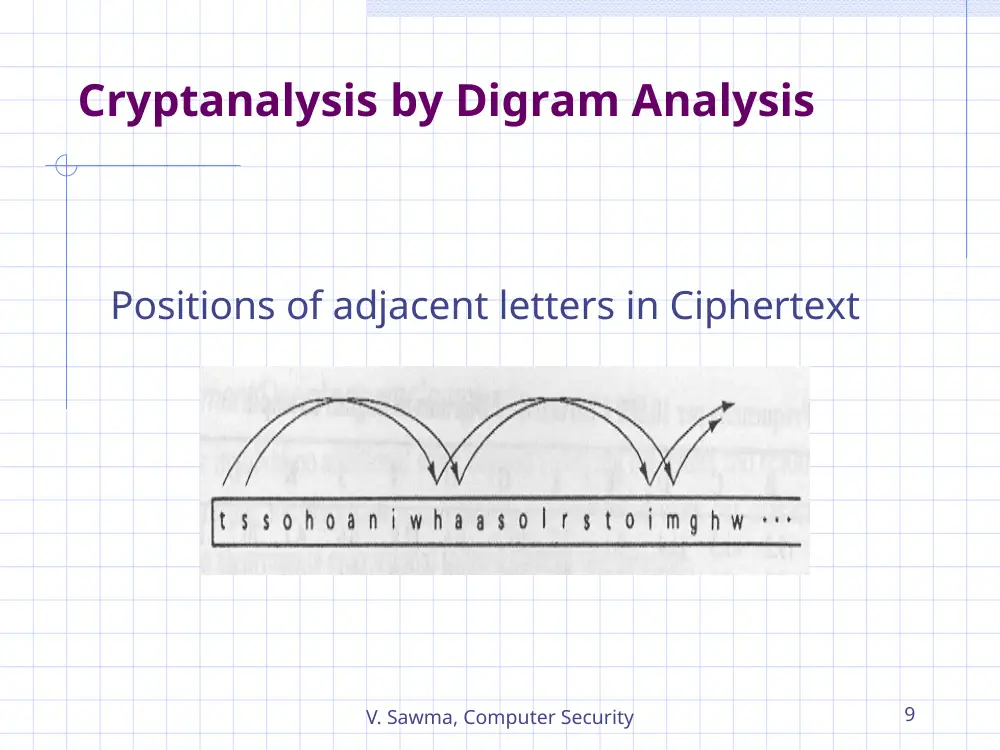
Positions of adjacent letters in Ciphertext
Cryptanalysis by Digram Analysis
V. Sawma, Computer Security
10
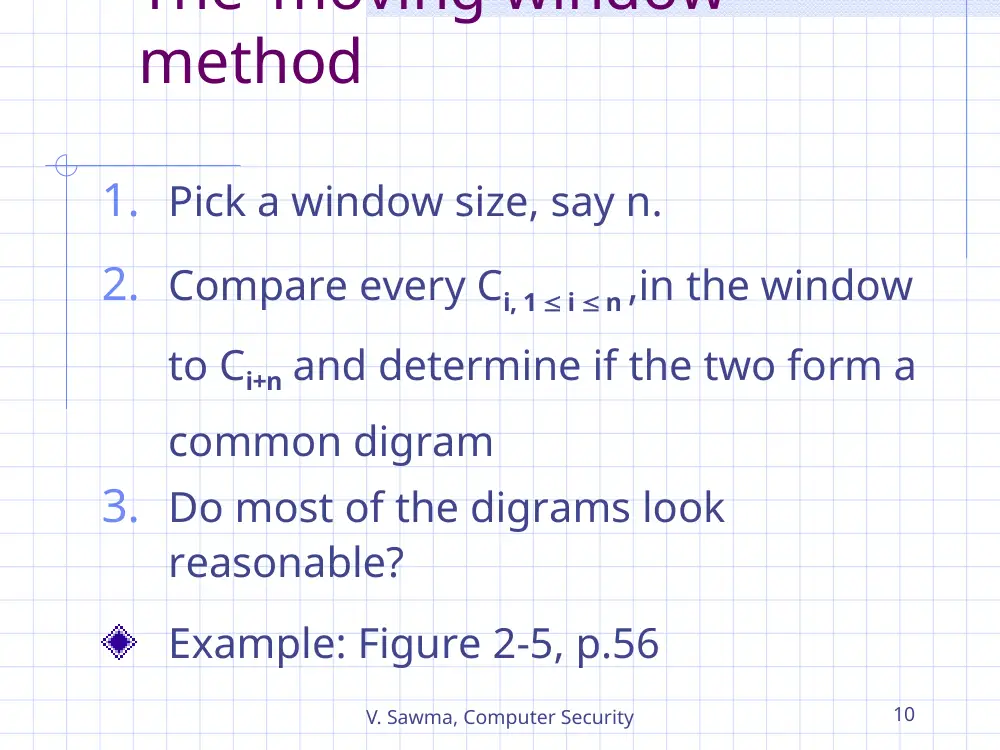
The moving window
method
1. Pick a window size, say n.
2. Compare every Ci, 1 i n ,in the window
to Ci+n and determine if the two form a
common digram
3. Do most of the digrams look
reasonable?
Example: Figure 2-5, p.56
V. Sawma, Computer Security
11
Moving Window Example
T
S
S
O
H
O
A
N
I
W
H
A
A
S
O
L
R
S
T
O
V. Sawma, Computer Security
12
Good Encryption Algorithms
The level of secrecy needed depends on the
effort
The keys and encryption algorithm should be
free from complexity
The algorithm and the key implementation
should be easy
Errors occurred during encryption should not
effect the rest of the message
Size of the cipher text message should not be
larger than the original message
V. Sawma, Computer Security
13
Trustworthy Encryption
Systems
It should be based on sound mathematics
It should have been analyzed by
competent experts and found to be sound
It has stood the “test of time”
V. Sawma, Computer Security
14
Stream versus Block Ciphers
Stream ciphers: The plaintext characters are
encoded by the sender letter-by-letter as sent to
the receiver.
Example: substitution ciphers
Block ciphers: Blocks of plaintext are encoded
into ciphertext before being sent.
Example: columnar transposition
V. Sawma, Computer Security
15
Stream Ciphers
One symbol of plaintext is converted
immediately into a symbol of ciphertext
Substitutions are examples of stream ciphers
Y
Encryption
ISSOPMI
Plaintext
wdhuw….
Ciphertext
Keystream
V. Sawma, Computer Security
16
Stream Ciphers
Fast
Little storage space
Low error propagation, meaning that
encoding errors affect just one character in
the ciphertext
low diffusion, meaning that individual
characters in the ciphertext can be analyzed
using frequency distribution, digram
analysis, IC and the Kasiski method
Susceptibility to malicious insertions and
modifications
V. Sawma, Computer Security
17
Block Ciphers
Encrypts a group of plaintext symbols at a time
Transpositions are examples of block ciphers
IH
Encryption
Plaintext
Ciphertext
Keystream
KN
OI
TP
YR
CN
ES
ba
qc
kd
em
mc
po
V. Sawma, Computer Security
18
Block Ciphers
Slow
Require more storage space
Error propagation
High diffusion
High immunity to insertions
V. Sawma, Computer Security
19
4 cryptanalysis cases &
5 approaches
1. Ciphertext only
Ciphertext-only attack
2. Full or partial plaintext
Known plaintext attack
Probable plaintext analysis
3. Ciphertext of any plaintext
Chosen plaintext attack
4. Algorithm + Ciphertext
Chosen ciphertext attack
V. Sawma, Computer Security
20
Summary: Transpositions
It is a method where letters of the
message are rearranged
Goal here is diffusion rather than
confusion
Information is spread widely across the
ciphertext
Columnar transposition is an easy one
Characters are rearranged into columns
V. Sawma, Computer Security
21
Summary: Transpositions (Cont’d)
Encipherment/Decipherment
Complexity
Algorithm is constant in the amount of
work per character
Time is proportional to length of message
Space required is directly proportional to
message length
Output characters cannot be produced until
all characters are read in
Delay depends on the length of the message
Not appropriate for long messages
V. Sawma, Computer Security
22
Summary
Two basic methods of encryption:
substitutions and transposition
Common cryptanalytic tools:
Frequency distribution, Digram/trigram
study, IC, Repeated patterns, Probable
letters
Four cryptanalysis cases & 5
approaches
V. Sawma, Computer Security
23
Summary: A crypto-analytic’s job
Compute Index of coincidence
If >0.068 then (monoalphabetic)
Compute frequency of distribution
If highest freq is for letter ‘e’ then Transposition
Else substitution (either Caesar or Scrambled
Permutation)
Else Polyalphabetic
Use Kasiski’s method to determine key length
Group Cipher text in columns (based on chosen
Key Length)
Solve for each column as Monoalphabetic