
CSC 316 Chapter 2c, Spring 2004
Notre Dame University–Louaize · Computers Security and Their Data · 24 pages · Dr. Victor Sawma

Showing the first 10 of 24 pages. Download the PDF to see all of it.
More CSC 316 files
Show the text of this chapter
Chapter 2
Basic Encryption (Part C)
V. Sawma, Computer Security
2
Outline
NP-completeness & Encryption
Symmetric (secret key) vs Asymmetric (public key)
Encryptions
Popular Encryption Algorithms
DES
AES
RSA Encryption
El Gamal Algorithms
Hashing Algorithms
V. Sawma, Computer Security
3
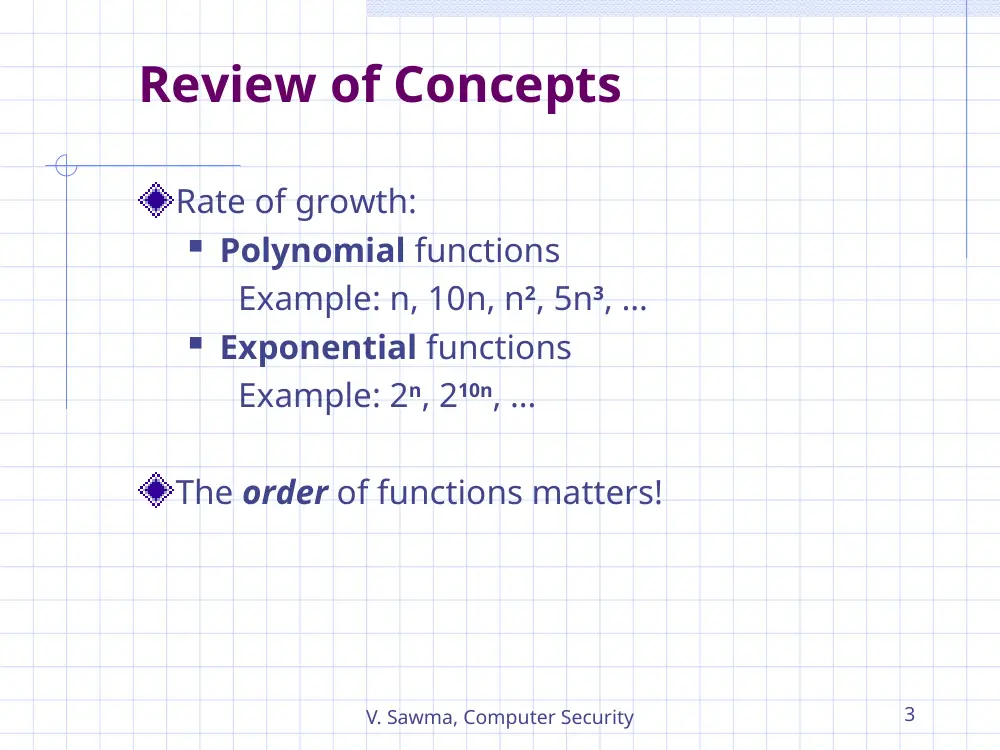
Review of Concepts
Rate of growth:
Polynomial functions
Example: n, 10n, n2, 5n3, …
Exponential functions
Example: 2n, 210n, …
The order of functions matters!
V. Sawma, Computer Security
4
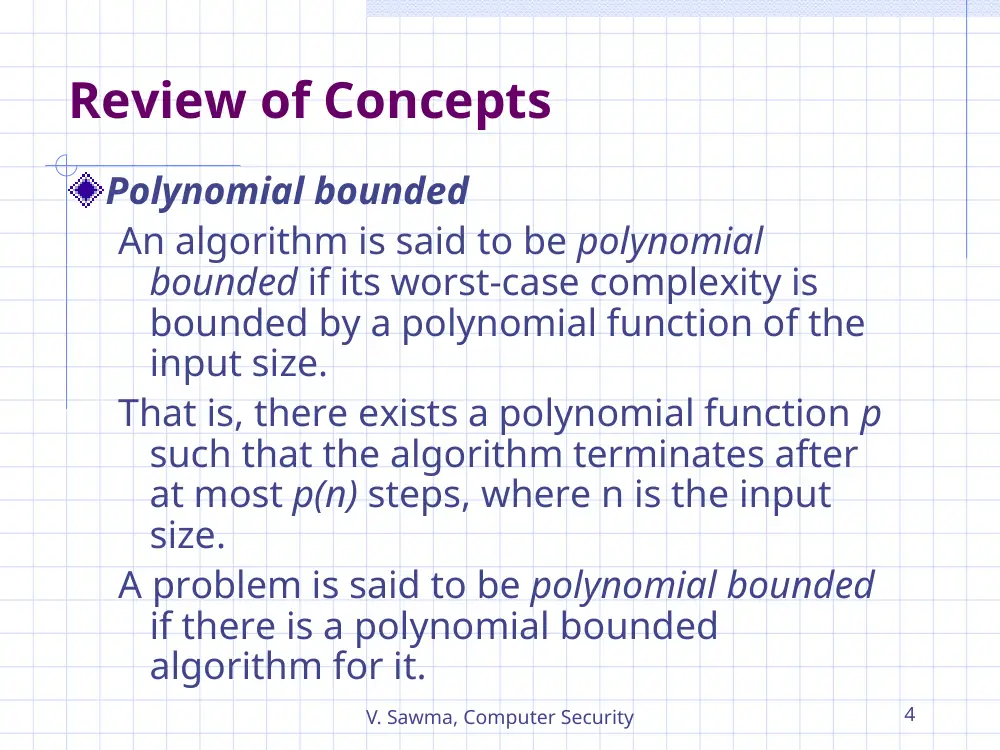
Review of Concepts
Polynomial bounded
An algorithm is said to be polynomial
bounded if its worst-case complexity is
bounded by a polynomial function of the
input size.
That is, there exists a polynomial function p
such that the algorithm terminates after
at most p(n) steps, where n is the input
size.
A problem is said to be polynomial bounded
if there is a polynomial bounded
algorithm for it.
V. Sawma, Computer Security
5
Nondeterminism
A nondeterministic algorithm has two phases:
1.
The nondeterministic phase (the guessing
phase)
A guess at a solution for the problem is
proposed.
2.
The deterministic phase (the checking phase)
A deterministic algorithm is executed,
with or without the proposed solution
from phase 1.
V. Sawma, Computer Security
6
Complexity Classes
Complexity Classes:
Class P
P is the class of problems that are polynomial-
bounded.
Class NP
NP is the class of problems for which there is a
nondeterministic polynomial-bounded
algorithm.
A theorem: P NP
Implication: A deterministic algorithm is a special
case of a nondeterministic algorithm (with phase 1
ignored).
V. Sawma, Computer Security
7
Characteristics of Hard Problems
P.632
Each problem is solvable, and a relatively simple
approach solves it (although the approach may be
time-consuming).
There are 2n cases to consider if we use the
approach of enumerating all possibilities, where n
is the input size.
The problems exist in various areas (logic, number
theory, graph theory, …).
If it were possible to guess perfectly, each problem
could be solved in relatively little time. That is, the
verification process is polynomial bounded.
V. Sawma, Computer Security
8
A broad Knapsack problem
From Baase, Computer Algorithms (2nd ed.)
Given:
a knapsack of capacity C (a positive
integer
N objects with sizes s1, …, sn and “profits”
p1, …, pn, where s1, …, sn and p1, …, pn are
positive integers.
Problem: Find the largest total profit of any
subset of the objects that fits in the
knapsack (and find a subset that achieves
the maximum profit).
V. Sawma, Computer Security
9
The Graph Coloring Problem
A coloring of a graph G = (V, E) is a mapping C: VS,
where S is a finite set of “coloring”, such that if vw
E then C(v) C(w); that is, adjacent vertices are not
assigned the same color.
A decision problem: Given G and a positive integer k,
is there a coloring of G using at most k colors? (Is G
k-colorable?)
An application: Scheduling the final exams at a
university without conflicts.
Let V be the set of courses.
Let E be the pairs of courses whose exams must not be at
the same time.
Suppose there are 15 time slots (3 exams per day X 5 days).
Then the exams can be scheduled in the 15 time slots
without conflicts if and only if the graph G = (V, E) is 15-
colorable.
V. Sawma, Computer Security
10
NP-completeness
P.632
A problem is called NP-complete if it can
represent the entire class NP.
Implication: If a NP-complete problem can be
solved by a deterministic, polynomial time
algorithm, then all NP problems can be
solved by such algorithms.
The converse implication: “If for even one of
the NP-complete problems it could be shown
that there was no deterministic algorithm
that ran in polynomial time, then no
deterministic algorithm could exist for any of
them.”
V. Sawma, Computer Security
11
Does P = NP or P NP?
NP-complete problems have been studied for a
long time by many different groups of people and
so far no polynomial, deterministic solution has
been found for any one of the problems.
Implication: It is very likely that no polynomial,
deterministic solution exists for NP-complete
problems. That is, NP P.
Note: The question ‘Does P = NP?’ is still an open
question.
V. Sawma, Computer Security
12
NP-completeness & Cryptography
Hard-to-solve problems are fundamental to
cryptography, because the interceptor would
need to work hard to break the encryption.
But, be aware of the fallacies:
1.
An NP-complete problem does not guarantee
that there is no solution easier than exponential.
2.
Every NP-complete problem has a deterministic
exponential time solution. That is, O(2n).
3.
Continuing advances in hardware make
problems of larger size tractable.
4.
The interceptor does not always have to solve
the hard problem in order to crack the
encryption.
V. Sawma, Computer Security
13
Properties of Arithmetic
Identity & Inverse
A number i is called an identity for • if x • i = x
and i • x = x for every number x.
The number b is called the inverse of a under •
if a • b = i , where i be an identity for •.
Prime Number
A prime number is any positive number that is
divisible (with remainder 0) only by itself and 1.
Greatest Common Divisor (gcd) of two numbers, a
and b, is the largest integer that divides both a and b.
V. Sawma, Computer Security
14
The greatest common divisor of two positive integers a
and b, sometimes written (a, b), is the largest divisor
common to a and b.
Example: gcd(15,10)=5 because 5 divides both 10 and
15, and nothing larger than 5 does.
If p is a prime, for any number q < p, gcd(p,q)=1.
Greatest Common Divisor
V. Sawma, Computer Security
15
Euclidean Algorithm
• The Euclidean Algorithm is a procedure for computing
the gcd of two numbers.
• It exploits the fact that if x divides a and b, x also
divides a-(k*b) for every k.
• Suppose x divides both a and b; then a=x*a1 and
b=x*b1. But
a-(k*b) = x * a1 – (x*k*b1)
= x * (a1- k*b1)
= x * d
So that x divides a-(k*b)
V. Sawma, Computer Security
16
Euclidean Algorithm (contd.)
Example: To calculate gcd(3615807, 2763323)
3,615,807 = (1) * 2,763,323 + 852, 484
2,763,323 = (3) * 852,484 + 205,871
852,484 = (4) * 205,871 + 29,000
205,871 = (7) * 29,000 + 2,871
29,000 = (10) * 2,871 + 290
2,871 = (9) * 290 + 261
290 = (1) * 261 + 29
261 = (9) * 29 +0
V. Sawma, Computer Security
17
Fermat’s Theorem
In number theory, Fermat’s theorem states that for any
prime p and any element a<p,
ap mod p = a or ap-1 mod p =1
This result leads to the inverse. For a prime p and an
element a<p, the inverse of a is the element x such that
ax mod p = 1
Combining the last two equations:
ax mod p = 1 = ap-1 mod p
so that
x = ap-2 mod p
V. Sawma, Computer Security
18
Fermat’s Theorem
Example:
To find inverse of 3 mod 5:
3-1 mod 5 = 35-2 mod 5
= 33 mod 5
= 27 mod 5
= 2
V. Sawma, Computer Security
19
Modular Arithmetic
Example
+
0
1
2
3
4
0
0
1
2
3
4
1
1
2
3
4
0
2
2
3
4
0
1
3
3
4
0
1
2
4
4
0
1
2
3
*
0
1
2
3
4
0
0
0
0
0
0
1
0
1
2
3
4
2
0
2
4
1
3
3
0
3
1
4
2
4
0
4
3
2
1
V. Sawma, Computer Security
20
Principles of Modular Arithmetic
Examples:
X
3 * x
3 * x
mod 5
1
3
3
2
6
1
3
9
4
4
12
2
5
15
0
6
18
3
7
21
1
X
3 * x
3 * x
mod 6
1
3
3
2
6
0
3
9
3
4
12
0
5
15
3
6
18
0
7
21
3
3 * x mod 5
3 * x mod 6
V. Sawma, Computer Security
21
Secret versus Public Key Encryptions
Secret Key Encryption Algorithms
Also called single key, symmetric, private
key, or conventional algorithms.
Both the encryptor and the decryptor use the
same key.
Example: DES, AES
Public Key Encryption Algorithms
The sender uses the receiver’s public key to
encrypt the message.
The receiver uses his own private key to
decrypt the encrypted message.
Examples: RSA Encryption, El Gamal
Algorithms
V. Sawma, Computer Security
22
Secret Key Encryptions
Advantages
The symmetry of the key provides a two-way
channel. Both ends can both encrypt and
decrypt information.
Authentication of incoming messages: An
incoming ciphertext is authenticated because
only legitimate sender can produce the
ciphertext.
V. Sawma, Computer Security
23
Secret Key Encryptions
Disadvantages
1.
A single-point failure: A compromised key allows
the interceptor not only to decrypt all the ciphertext
encrypted by the key, but also to fabricate “bogus”
ciphertext to be sent to legitimate receivers.
2.
Distribution of keys can be a problem. (Key
distribution in pieces)
3.
The number of keys increases rapidly, roughly half
of the square of the number of people.
–
Adding a new user into an existing network of N
users requires the addition of N new keys.
4.
The symmetric key encryptions can be relatively
weak, unless based on hard problems.
V. Sawma, Computer Security
24
Public Key Encryptions
Proposed by Diffie and Hellman in 1976.
Each user has two keys: a public key and a private
key, which operate as inverses.
P = C (KPRIV, E (KPUB, P ) )
Advantage:
No need for a shared key between every two users.
See table 2-5 p. 75 for a comparison between
secret key and public key encryption.