
CSC 316 Chapter 2e, Spring 2004
Notre Dame University–Louaize · Computers Security and Their Data · 18 pages · Dr. Victor Sawma


Showing the first 10 of 18 pages. Download the PDF to see all of it.
More CSC 316 files
Show the text of this chapter
Chapter 2
Encryption Algorithms (Part E)
V. Sawma, Computer Security
2
Outline
NP-completeness & Encryption
Symmetric (secret key) vs Asymmetric (public key)
Encryptions
Popular Encryption Algorithms
DES
AES
RSA Encryption
El Gamal Algorithms
Hashing Algorithms
V. Sawma, Computer Security
3
ADVANCED ENCRYPTION
STANDARD
V. Sawma, Computer Security
4
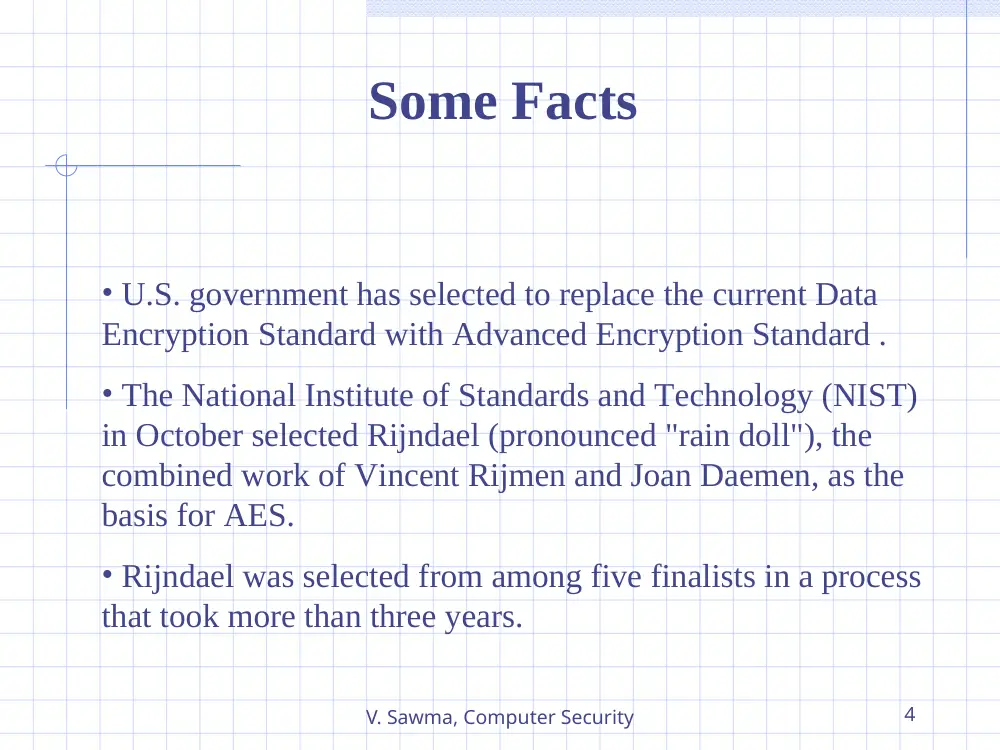
• U.S. government has selected to replace the current Data
Encryption Standard with Advanced Encryption Standard .
• The National Institute of Standards and Technology (NIST)
in October selected Rijndael (pronounced "rain doll"), the
combined work of Vincent Rijmen and Joan Daemen, as the
basis for AES.
• Rijndael was selected from among five finalists in a process
that took more than three years.
Some Facts
V. Sawma, Computer Security
5
Although a fundamentally sound algorithm, the older DES,
which dates back to the 1970s, has been proven to be
breakable through brute-force attacks because it uses a
relatively small key size (56 bits).
Some Facts(contd.)
V. Sawma, Computer Security
6
AES vs. Triple-DES
AES
Triple-DES
Type of algorithm
Symmetric, block cipher
Symmetric, feistel
cipher
Key size (in bits)
128, 192, 256
112 or 168
Speed
High
Low
Time to crack (assume a machine could try
255 keys per second — NIST)
149 trillion years
4.6 billion years
Resource consumption
Low
Medium
NIST standard number
FIPS PUB 197
FIPS 46-3
AES vs. Triple DES
The big differentiators between AES and Triple-DES are
not strength of security, but superior performance and
better use of resources.
V. Sawma, Computer Security
7
Rijndael - The Proposed
Algorithm
•
Block cipher with a variable block length and a
variable key length.
•
The block length and the key length can be
independently chosen as 128, 192 or 256 bits.
•
The block to which the operations are applied is
called a state.
•
A state is organized as an array of bytes (8 bits) with
four rows. The number of columns is equal to the
block length divided by 32.
V. Sawma, Computer Security
8
Rijndael - The Proposed
Algorithm(contd.)
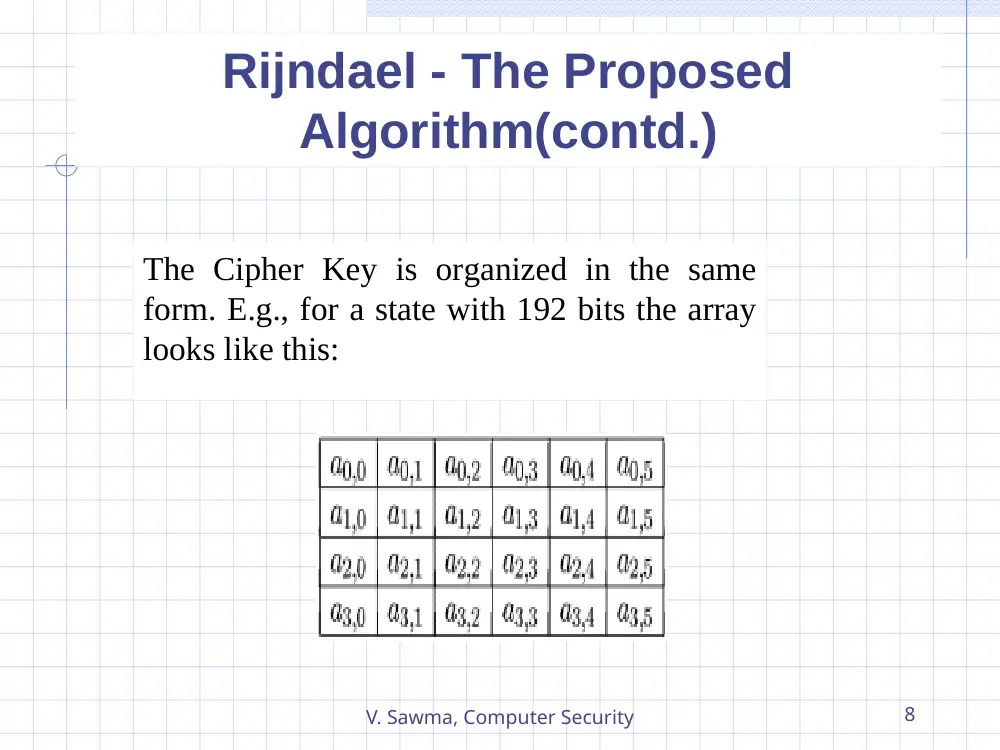
The Cipher Key is organized in the same
form. E.g., for a state with 192 bits the array
looks like this:
V. Sawma, Computer Security
9
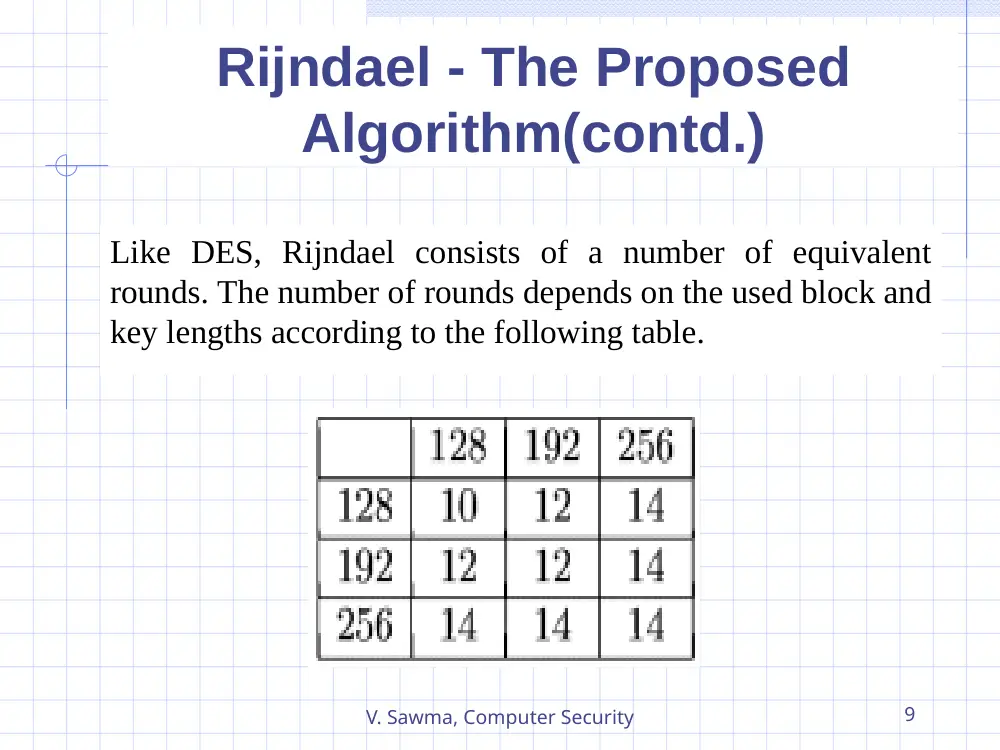
Like DES, Rijndael consists of a number of equivalent
rounds. The number of rounds depends on the used block and
key lengths according to the following table.
Rijndael - The Proposed
Algorithm(contd.)
V. Sawma, Computer Security
10
The Process Stages
Initial round: Add round key
Intermediate rounds: Byte Sub, Row Shift, Mix
Column, Add round key
Final round: Byte Sub, Row Shift, Add round key
V. Sawma, Computer Security
11
The Round Transformation
The transformation in each round is composed of four
different transformations in the following order:
Byte substitution
Row shifting (ShiftRow)
Column mixing (MixColumn)
Round key addition (AddRoundKey)
V. Sawma, Computer Security
12
This is a non-linear byte substitution realized by an 8-
to-8 S-Box. It is executed on each byte (cell) in a state.
Byte substitution
V. Sawma, Computer Security
13
S – Box
V. Sawma, Computer Security
14
The four rows of the state are cyclically shifted
over different offsets.
Row shifting (ShiftRow)
V. Sawma, Computer Security
15
In this step every column of a state is transformed
using a matrix multiplication.
Column mixing (MixColumn)
V. Sawma, Computer Security
16
A round key is applied to the state by a
bitwise XOR.
Round key addition (AddRoundKey)
V. Sawma, Computer Security
17
The complete Rijndael Encryption consists of
•An initial round key addition,
• Several rounds of ByteSub, ShiftRow, MixColumn,
AddRoundKey,
• And a final round of ByteSub, ShiftRow and
AddRoundKey.
The Encryption Algorithm
V. Sawma, Computer Security
18
• The inverse of a round is given by AddRoundKey,
InvMixColumn, InvShiftRow and InvByteSub.
• The inverse of a final round is given by
AddRoundKey, InvShiftRow and InvByteSub.
• A final AddRoundKey has to be done.
The Decryption Algorithm