
CSC 316 Chapter 6b, Spring 2004
Notre Dame University–Louaize · Computers Security and Their Data · 23 pages · Dr. Victor Sawma

Showing the first 10 of 23 pages. Download the PDF to see all of it.
More CSC 316 files
Show the text of this chapter
Chapter 6
Data Base Security
Sawma V., Computer Security
2
Inference Problem
Inference problem is to derive sensitive data from nonsensitive
data. It’s a subtle vulnerability in database security.
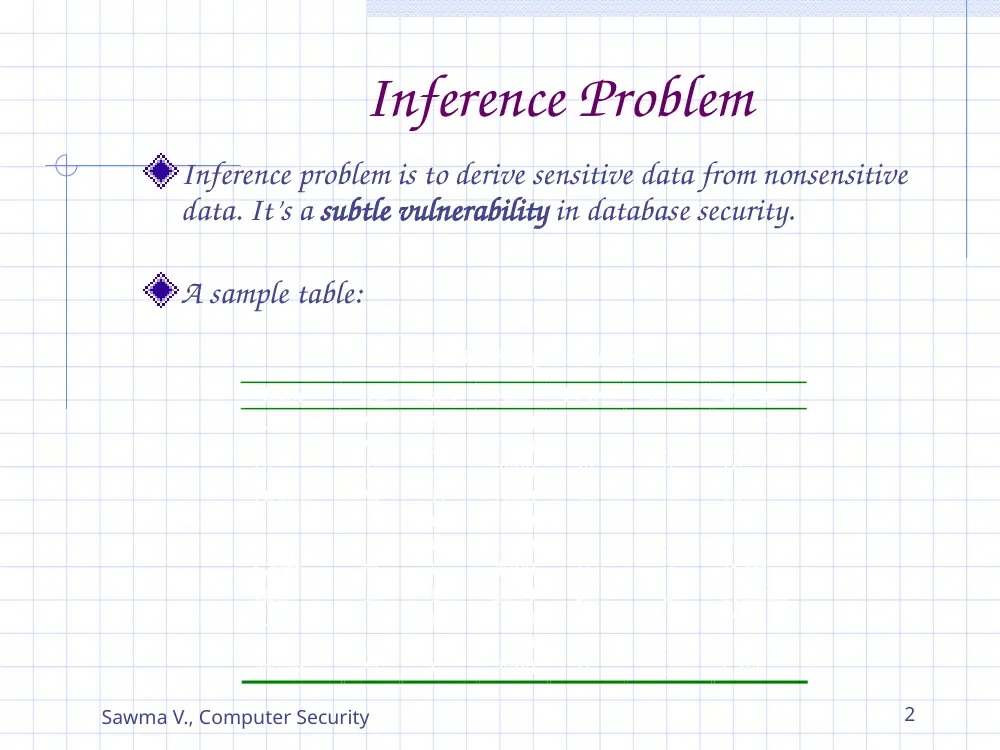
A sample table:
Table 8-2 Sample Database
Name
Sex
Race
Aid
Fines
Drugs
Dorm
Adams
M
C
5000
45.
1
Holmes
Bailey
M
B
0
0.
0
Grey
Chin
F
A
3000
20.
0
West
Dewitt
M
B
1000
35.
3
Grey
Earhart
F
C
2000
95.
1
Holmes
Fein
F
C
1000
15.
0
West
Groff
M
C
4000
0.
3
West
Hill
F
B
5000
10.
2
Holmes
Koch
F
C
0
0.
1
West
Liu
F
A
0
10.
2
Grey
Majors
M
C
2000
0.
2
Grey
Sawma V., Computer Security
3
Inference Problem
Direct Attack (1)
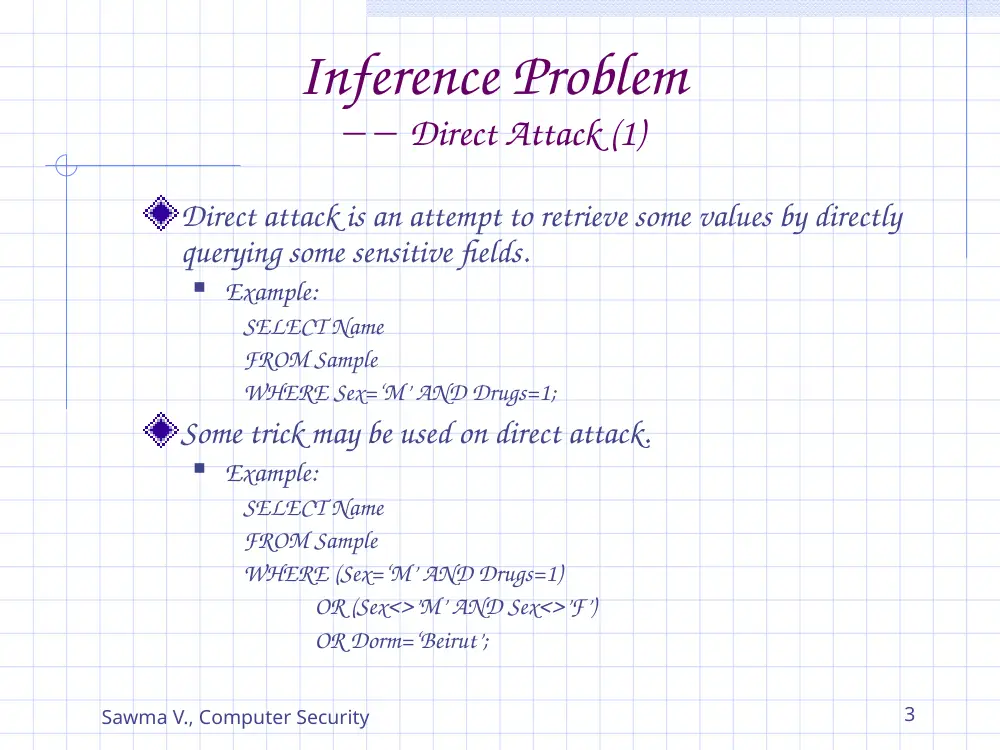
Direct attack is an attempt to retrieve some values by directly
querying some sensitive fields.
Example:
SELECT Name
FROM Sample
WHERE Sex=‘M’ AND Drugs=1;
Some trick may be used on direct attack.
Example:
SELECT Name
FROM Sample
WHERE (Sex=‘M’ AND Drugs=1)
OR (Sex<>’M’ AND Sex<>’F’)
OR Dorm=‘Beirut’;
Sawma V., Computer Security
4
Inference Problem
Direct Attack (2)
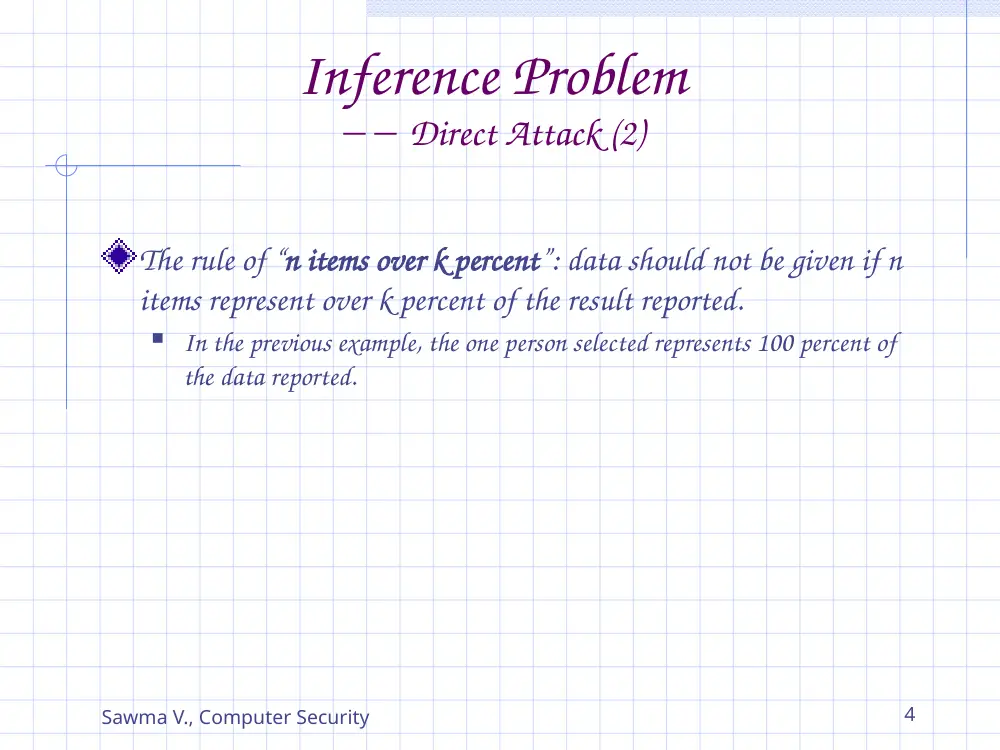
The rule of “n items over k percent”: data should not be given if n
items represent over k percent of the result reported.
In the previous example, the one person selected represents 100 percent of
the data reported.
Sawma V., Computer Security
5
Inference Problem
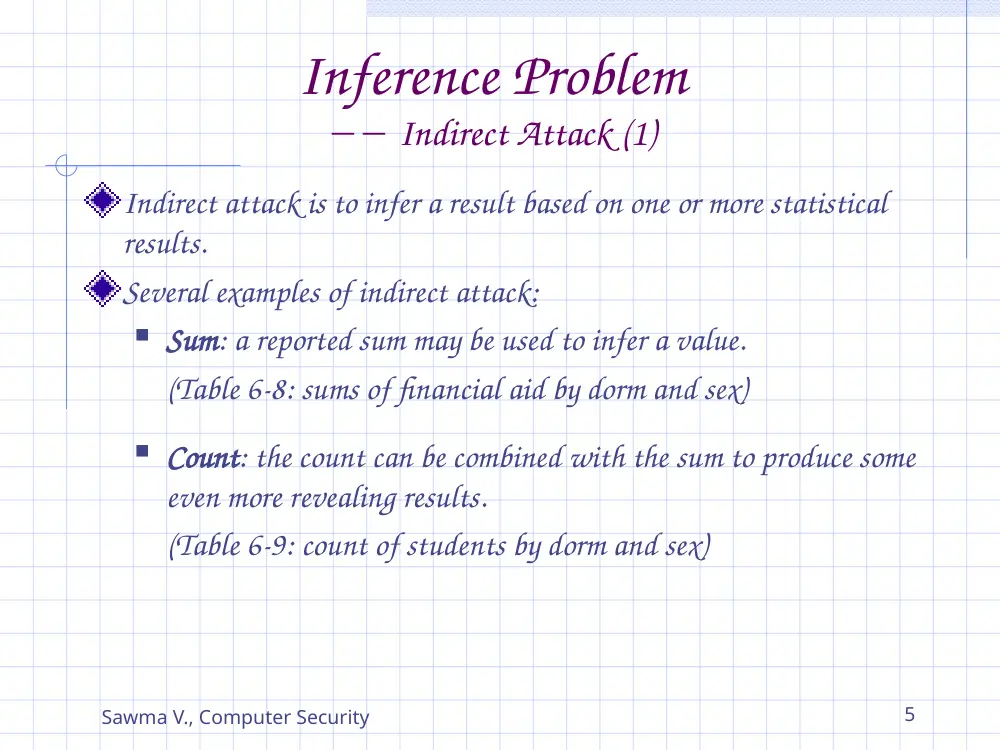
Indirect Attack (1)
Indirect attack is to infer a result based on one or more statistical
results.
Several examples of indirect attack:
Sum: a reported sum may be used to infer a value.
(Table 6-8: sums of financial aid by dorm and sex)
Count: the count can be combined with the sum to produce some
even more revealing results.
(Table 6-9: count of students by dorm and sex)
Sawma V., Computer Security
6
Inference Problem
Indirect Attack (3)
Linear system vulnerability: with a little algebra and a little
more luck in the distribution of the database contents, it’s
possible to determine a series of queries that returns results
relating to several different sets.
q1 = c1 + c2 + c3 + c4 + c5
q2 = c1 + c2 + c4
q3 = c3 + c4
q4 = c4 + c5
q5 = c2 + c5
Sawma V., Computer Security
7
Inference Problem
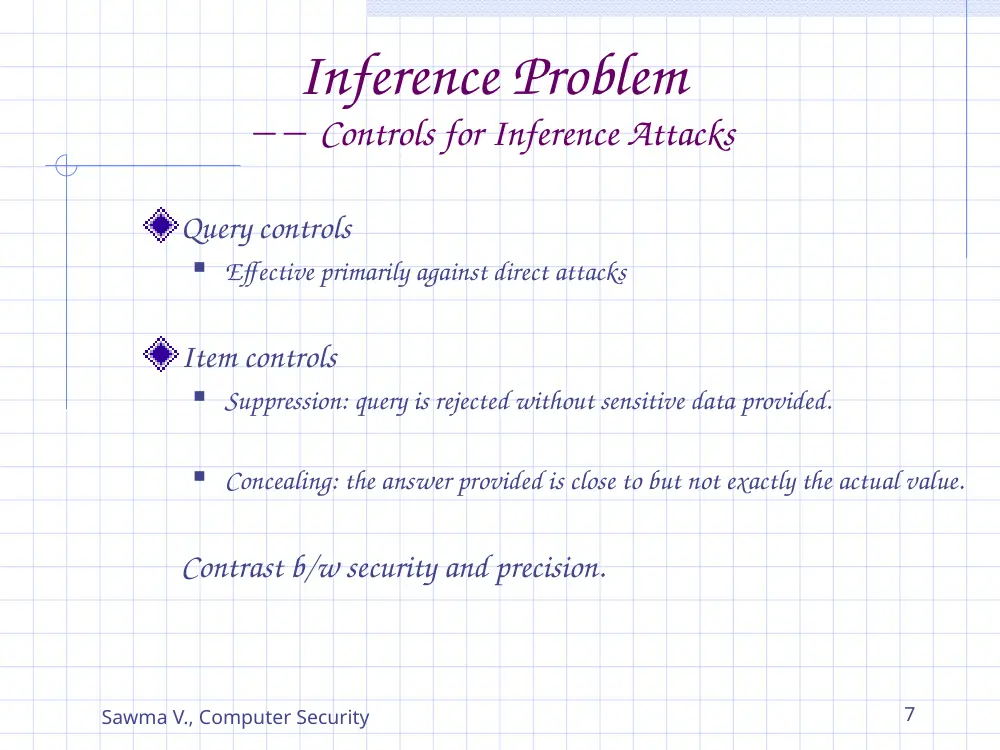
Controls for Inference Attacks
Query controls
Effective primarily against direct attacks
Item controls
Suppression: query is rejected without sensitive data provided.
Concealing: the answer provided is close to but not exactly the actual value.
Contrast b/w security and precision.
Sawma V., Computer Security
8
Inference Problem
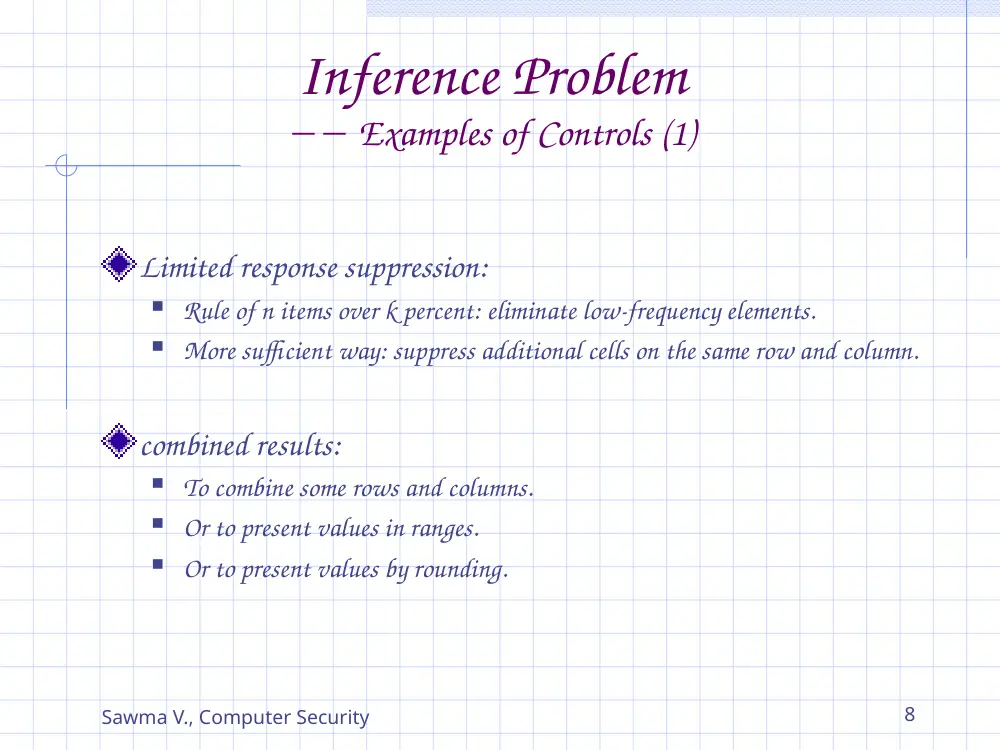
Examples of Controls (1)
Limited response suppression:
Rule of n items over k percent: eliminate low-frequency elements.
More sufficient way: suppress additional cells on the same row and column.
combined results:
To combine some rows and columns.
Or to present values in ranges.
Or to present values by rounding.
Sawma V., Computer Security
9
Inference Problem
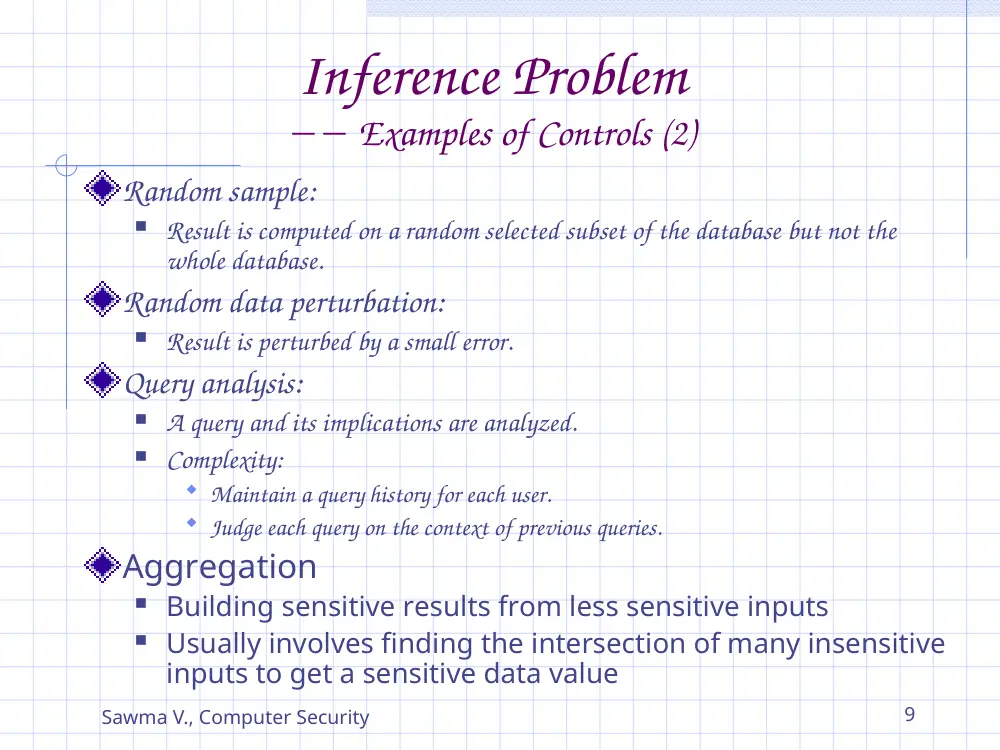
Examples of Controls (2)
Random sample:
Result is computed on a random selected subset of the database but not the
whole database.
Random data perturbation:
Result is perturbed by a small error.
Query analysis:
A query and its implications are analyzed.
Complexity:
Maintain a query history for each user.
Judge each query on the context of previous queries.
Aggregation
Building sensitive results from less sensitive inputs
Usually involves finding the intersection of many insensitive
inputs to get a sensitive data value
Sawma V., Computer Security
10
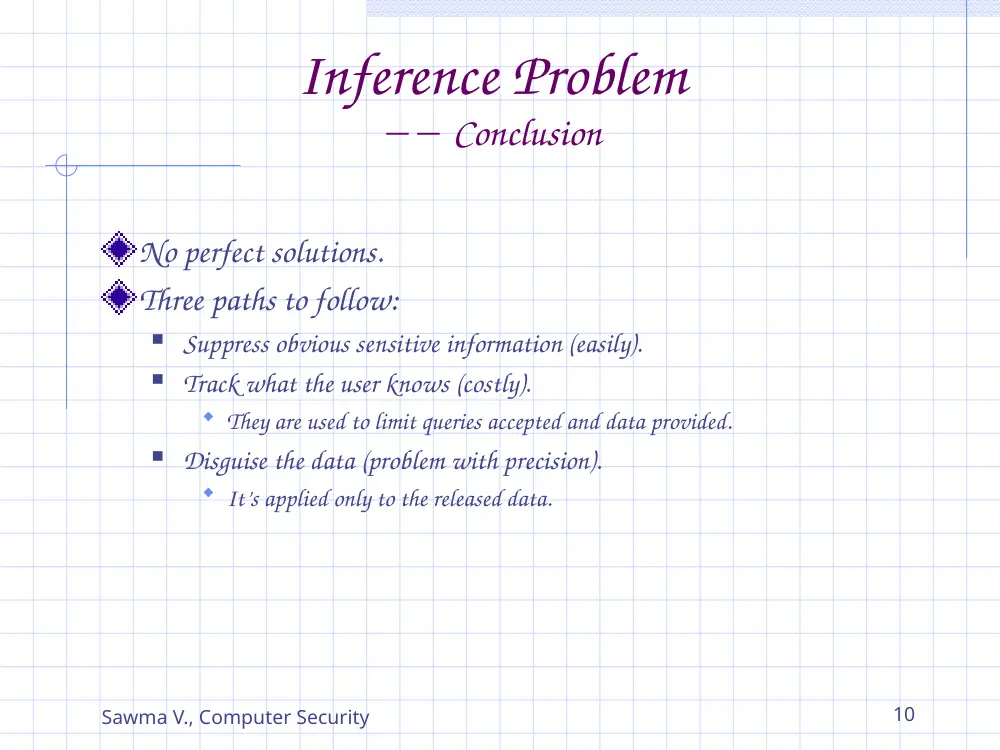
Inference Problem
Conclusion
No perfect solutions.
Three paths to follow:
Suppress obvious sensitive information (easily).
Track what the user knows (costly).
They are used to limit queries accepted and data provided.
Disguise the data (problem with precision).
It’s applied only to the released data.
Sawma V., Computer Security
11
Multilevel Databases
Differentiated Security
An illusion: Sensitivity was determined just by attribute.
sensitive vs nonsensitive attributes
The fact: differentiated data security
Three characteristics of database security:
The security of a single element may be different from the others in the same
row or column.
Several grades of security are needed.
The security of an aggregate (a sum, a count, or a group of values) may be
different from the security of the individual elements.
Sawma V., Computer Security
12
Multilevel Databases
Granularity
An analogy: Defining the sensitivity of each value in a data base is
similar to applying a sensitivity level to each individual word of a
document.
Both element and combination of elements may have a distinct
sensitivity.
In order to keep each value of a database being in its own
sensitivity level:
An access control policy must define which users can have
access to what data.
confidentiality (or secrecy)
Each value must be guaranteed NOT to be changed by any
unauthorized person.
integrity
Sawma V., Computer Security
13
Multilevel Databases
Security Issues (1)
Integrity
In multilevel databases a high-level user should not be able to
write a lower-level data element.
Problem: Sometimes read and write must happen to the same
process, like DBMS.
Solution: Either the process cleared at a high level cannot write
to a lower level, or the process must be a “trusted process”.
Sawma V., Computer Security
14
Multilevel Databases
Security Issues (2)
Confidentiality
In multilevel databases two different users from different levels
of security may get two different answers to the same query.
Unknowing redundancy, known as polyinstantiation, may be
introduced; that is, one record can appear many times, with
different level of secrecy each time.
Sawma V., Computer Security
15
Proposals for multilevel security
Partitioning
Model: The database is divided into separate databases, each at its
own security level.
Weakness:
Destroy basic advantage of a database: elimination of redundancy.
Sawma V., Computer Security
16
Proposals
Encryption
Model: Each level of sensitive data is stored in a table
encrypted under a key unique to the level of sensitivity.
Weakness:
Chosen plaintext attack may increase.
High overhead of processing a query: decrypting
required fields.
Encryption is not often used to implement separation in
data bases.
Sawma V., Computer Security
17
Proposals
Integrity and Sensitivity Locks (1)
Integrity lock (spray paint): The protection is made with elements,
not with tables.
Each data item includes:
Data itself: stored in plaintext for efficiency of access.
Sensitivity label: defines the sensitivity of the data.
Sensitivity labels are unforgeable, unique, and concealed.
Checksum: computed across both data and sensitivity label. (Cryptographic
checksum)
Sawma V., Computer Security
18
Proposals
Integrity and Sensitivity Locks (2)
Sensitivity lock: is a combination of a unique identifier and the
sensitivity level.
Sensitivity lock = E(Key, Sensitivity label, unique identifier)
Intention:
Use any (untrusted) database manager with a trusted procedure that handles
access control.
Sawma V., Computer Security
19
Proposals
Integrity and Sensitivity Locks (3)
It’s only a short-term solution for multilevel security.
Weakness:
–
Efficiency of integrity locks is a serious drawback.
The space required is expanded.
–
The processing time of decoding sensitivity label is a problem.
–
Trojan horse attack: database manager sees all data.
Sawma V., Computer Security
20
Proposals
Trusted Front-End
Model (Figure 6-11):
A trusted front-end (known as a guard) is added.
Interaction b/w user, front-end, and DBMS (page368)
c.f., Commutative filters:
Reformat user’s request if necessary and return only data of appropriate
sensitivity to the user.
Advantage:
Database manager can do as much as possible, like selection, optimization,
subquery …
Overall efficiency of the system.
Sawma V., Computer Security
21
Proposals
Distributed/federated Database
Operation of a trusted front-end:
Control access to two database managers with different sensitivity.
Take user’s query and formulate single-level queries to the databases as
appropriate.
Return results to user, combining results appropriately if they are obtained
from different databases.
Weakness:
–
The front-end is potentially including most of the functionality of a full
database manager.
–
Data must be kept in separate databases according to their different
sensitivity degrees.
Sawma V., Computer Security
22
Proposals
Window/View
Window
–
A window is a subset of a database, containing exactly the information that
a user is entitled to access.
View
–
A view can represent a single user’s subset database, so that all of a user’s
queries access only that subset database and sensitive data to the user may
be filtered.
–
Layered system (TCB, trusted computing base):
• First layer: access control & user authentication.
• Second layer: index & computation of database.
• Third layer: translate views into the base relations.
Sawma V., Computer Security
23
Concluding Remarks
Partitioning and Distributed databases are not popular, mainly
because there is a difficulty in combined usage of different
databases.
Integrity lock is just a short-term solution for the security of
multilevel databases. Trusted front-end and Commutative filter
look like more practical, but more complicated.
Encryption is used, but big problem is overhead of processing.
Window and View are concepts more related to the functionality of
database itself.