
ACCT 215 Problems Solutions, Fall 2011
American University of Beirut · Management Accounting · 12 pages · with solution


Showing the first 10 of 12 pages. Download the PDF to see all of it.
More ACCT 215 files
- Problems Solutions · Fall 2011Problems · with solutionView
- Problems Solutions · Fall 2011Problems · with solutionView
- Problems Solutions · Fall 2011Problems · with solutionView
- Problems Solutions · Fall 2011Problems · with solutionView
- Problems Solutions · Fall 2011Problems · with solutionView
- Problems Solutions · Fall 2011Problems · with solutionView
- Problems Solutions · Fall 2011Problems · with solutionView
- Problems Solutions · Fall 2011Problems · with solutionView
Show the text of this problems
Chapter 10A Predetermined Overhead Rates and Overhead Analysis in a Standard Costing System
Appendix 10A
Predetermined Overhead Rates and
Overhead Analysis in a Standard Costing
System
Exercise 10A-1 (15 minutes)
1. The total overhead cost at the denominator level of activity must be
determined before the predetermined overhead rate can be
computed.
Total fixed overhead cost per year..................................
$600,000
Total variable overhead cost
($3.50 per DLH × 80,000 DLHs)......................................
280,000
Total overhead cost at the denominator level of
activity...............................................................................
$880,000
2. Standard direct labor-hours allowed
for the actual output (a).......................
82,000 DLHs
Predetermined overhead rate (b)..........
$11.00 per DLH
Overhead applied (a) × (b)......................
$902,000
10A-1
Chapter 10A Predetermined Overhead Rates and Overhead Analysis in a Standard Costing System
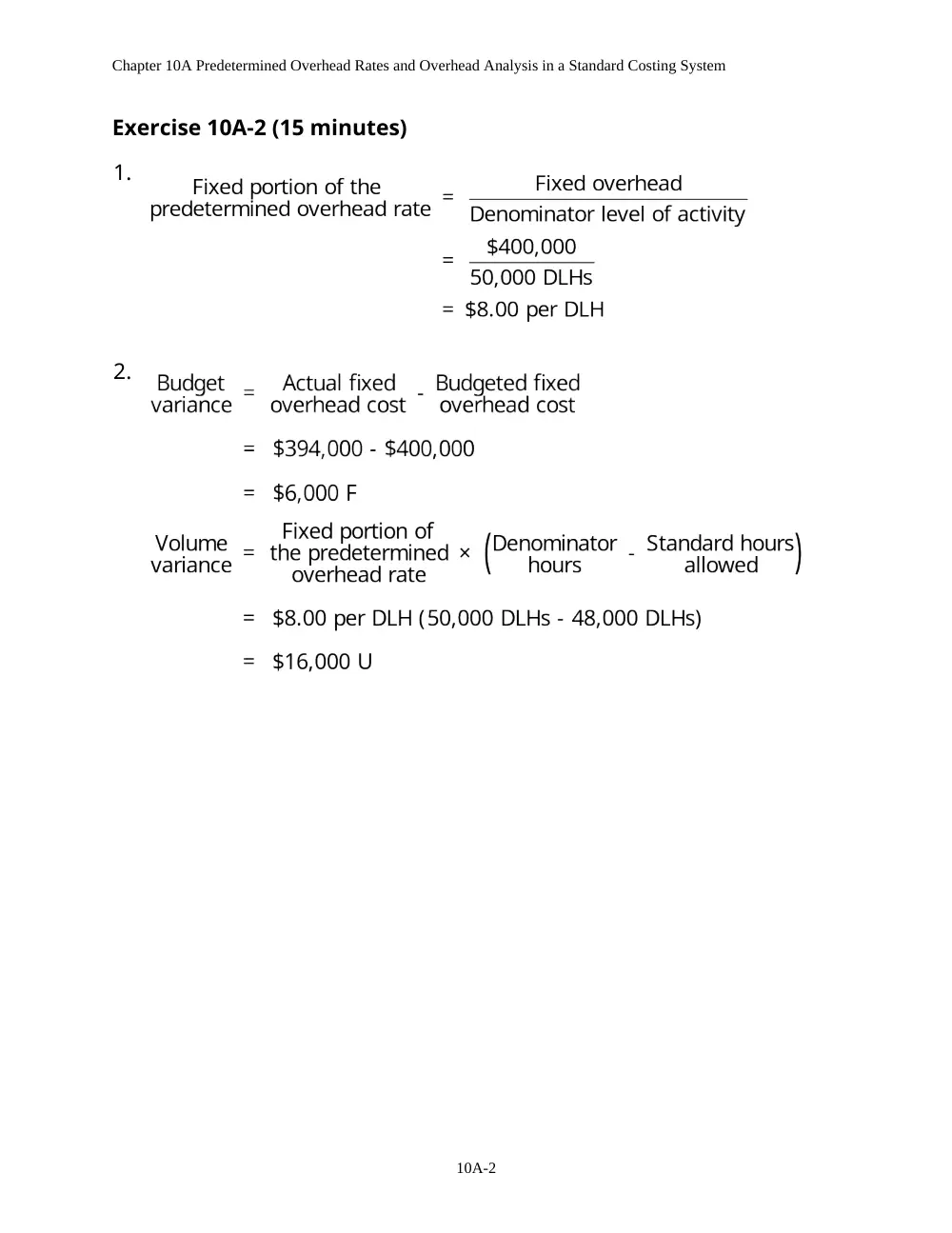
Exercise 10A-2 (15 minutes)
1.
2.
10A-2
Chapter 10A Predetermined Overhead Rates and Overhead Analysis in a Standard Costing System
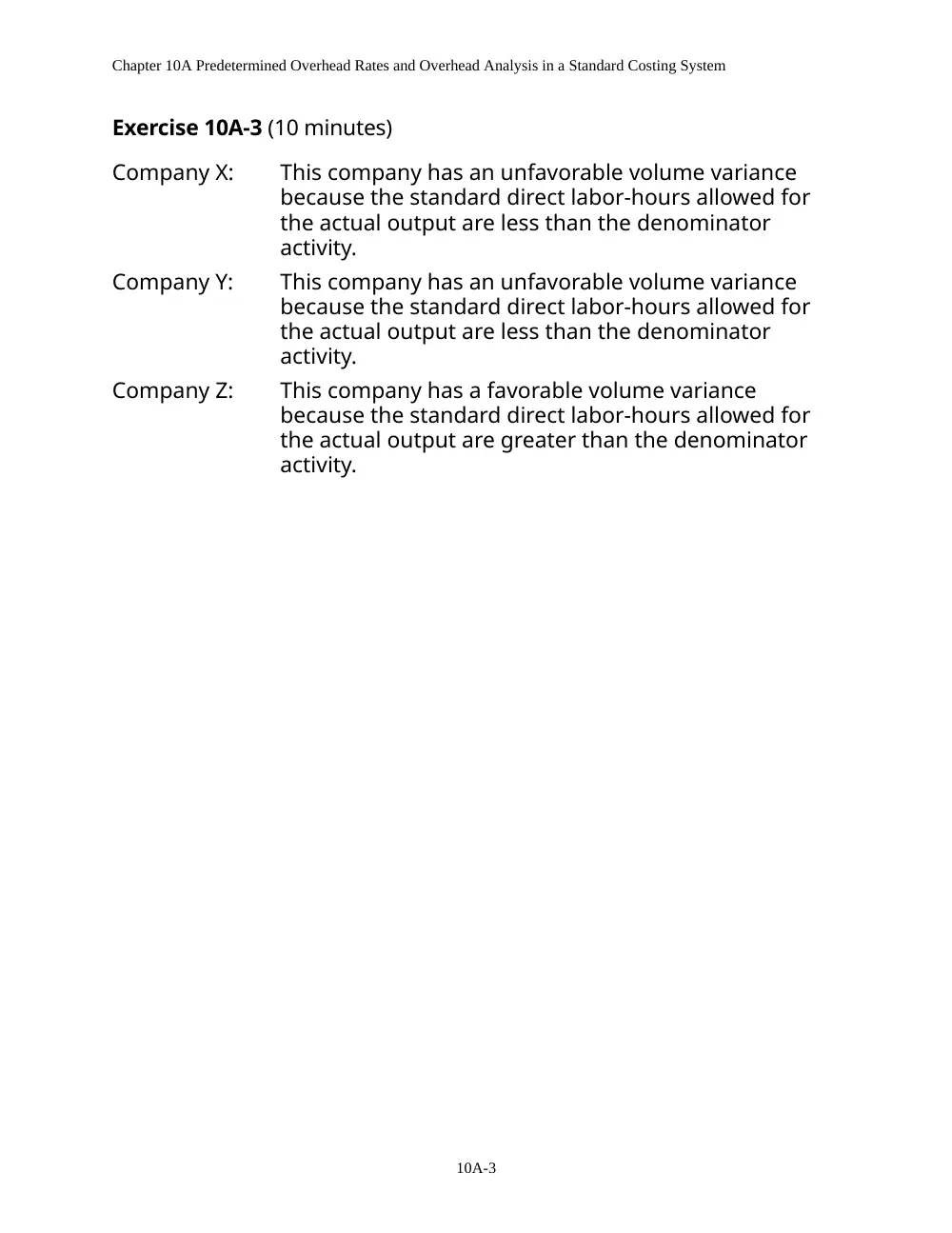
Exercise 10A-3 (10 minutes)
Company X:
This company has an unfavorable volume variance
because the standard direct labor-hours allowed for
the actual output are less than the denominator
activity.
Company Y:
This company has an unfavorable volume variance
because the standard direct labor-hours allowed for
the actual output are less than the denominator
activity.
Company Z:
This company has a favorable volume variance
because the standard direct labor-hours allowed for
the actual output are greater than the denominator
activity.
10A-3
Chapter 10A Predetermined Overhead Rates and Overhead Analysis in a Standard Costing System
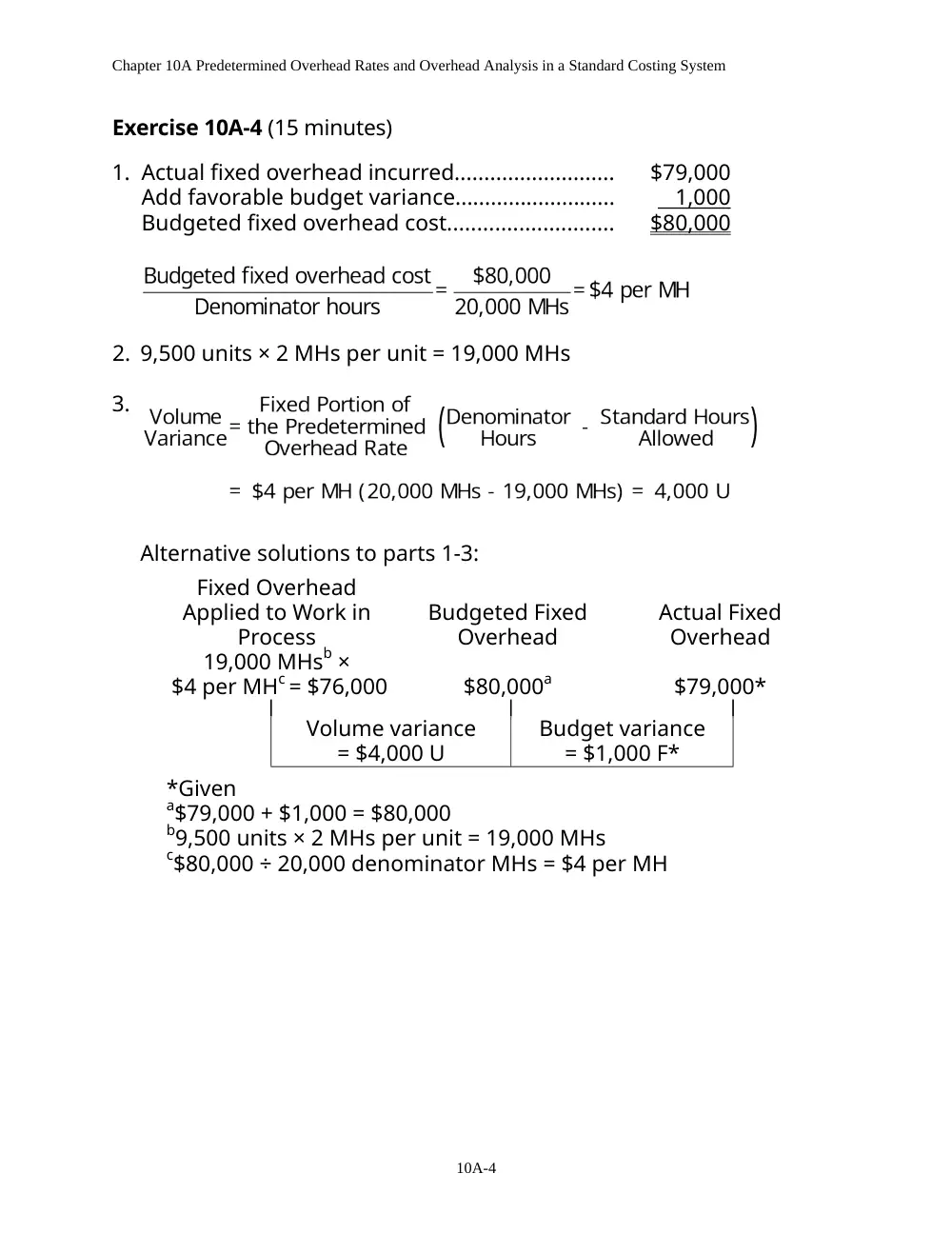
Exercise 10A-4 (15 minutes)
1. Actual fixed overhead incurred...........................
$79,000
Add favorable budget variance...........................
1,000
Budgeted fixed overhead cost............................
$80,000
2. 9,500 units × 2 MHs per unit = 19,000 MHs
3.
Alternative solutions to parts 1-3:
Fixed Overhead
Applied to Work in
Process
Budgeted Fixed
Overhead
Actual Fixed
Overhead
19,000 MHsb ×
$4 per MHc = $76,000
$80,000a
$79,000*
Volume variance
= $4,000 U
Budget variance
= $1,000 F*
*Given
a$79,000 + $1,000 = $80,000
b9,500 units × 2 MHs per unit = 19,000 MHs
c$80,000 ÷ 20,000 denominator MHs = $4 per MH
10A-4
Chapter 10A Predetermined Overhead Rates and Overhead Analysis in a Standard Costing System
Exercise 10A-5 (15 minutes)
1.
Variable element: ($1.60 per DLH × 24,000 DLH) ÷ 24,000 DLHs =
$38,400 ÷ 24,000 DLHs = $1.60 per DLH
Fixed element: $84,000 ÷ 24,000 DLHs = $3.50 per DLH
2. Direct materials, 2 pounds × $4.20 per pound....................
$ 8.40
Direct labor, 3 DLHs* × $12.60 per DLH...............................
37.80
Variable manufacturing overhead, 3 DLHs × $1.60 per
DLH........................................................................................
4.80
Fixed manufacturing overhead, 3 DLHs × $3.50 per DLH..
10.50
Total standard cost per unit...................................................
$61.50
*24,000 DLHs ÷ 8,000 units = 3 DLHs per unit
10A-5
Chapter 10A Predetermined Overhead Rates and Overhead Analysis in a Standard Costing System
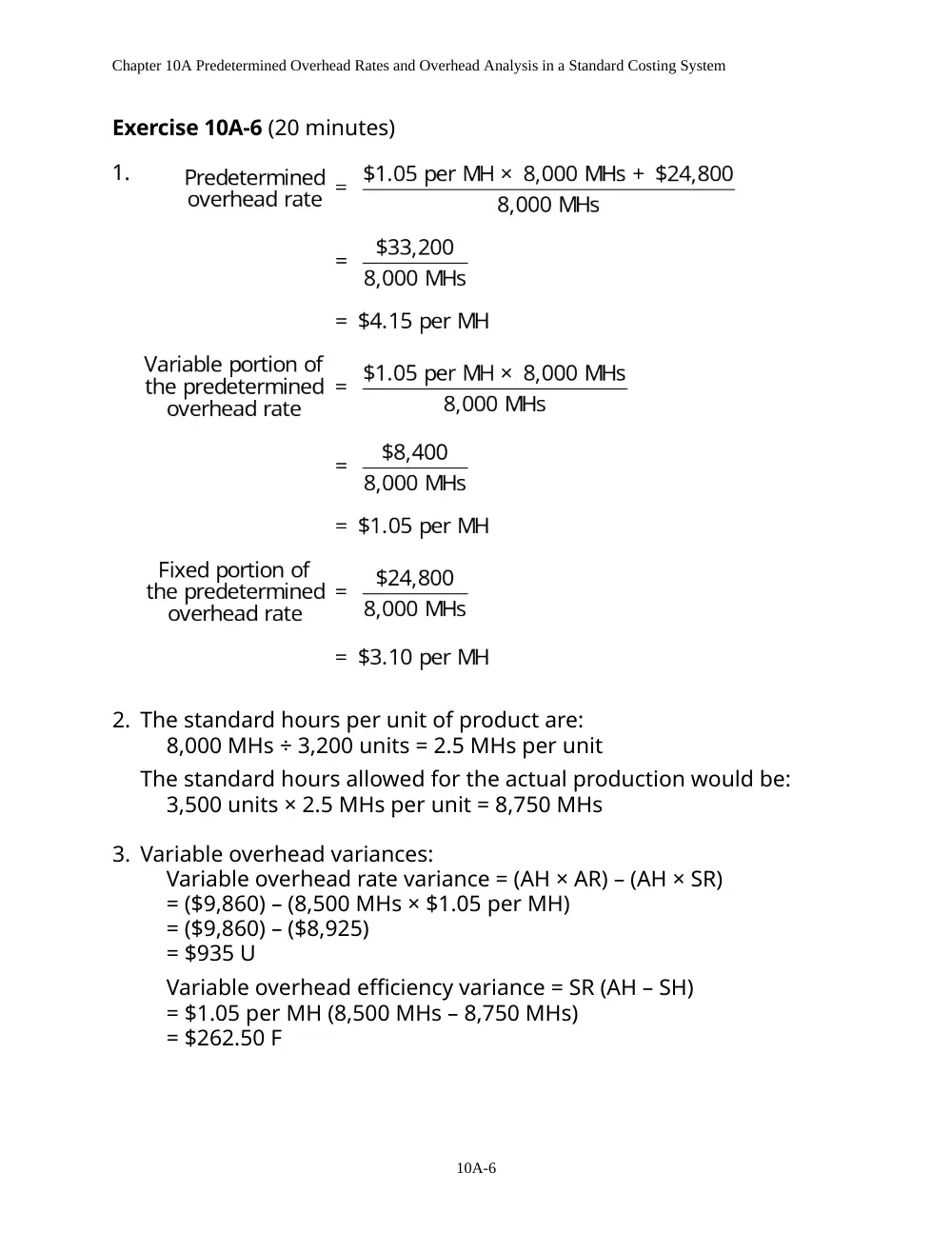
Exercise 10A-6 (20 minutes)
1.
2. The standard hours per unit of product are:
8,000 MHs ÷ 3,200 units = 2.5 MHs per unit
The standard hours allowed for the actual production would be:
3,500 units × 2.5 MHs per unit = 8,750 MHs
3. Variable overhead variances:
Variable overhead rate variance = (AH × AR) – (AH × SR)
= ($9,860) – (8,500 MHs × $1.05 per MH)
= ($9,860) – ($8,925)
= $935 U
Variable overhead efficiency variance = SR (AH – SH)
= $1.05 per MH (8,500 MHs – 8,750 MHs)
= $262.50 F
10A-6
Chapter 10A Predetermined Overhead Rates and Overhead Analysis in a Standard Costing System
Exercise 10A-6 (continued)
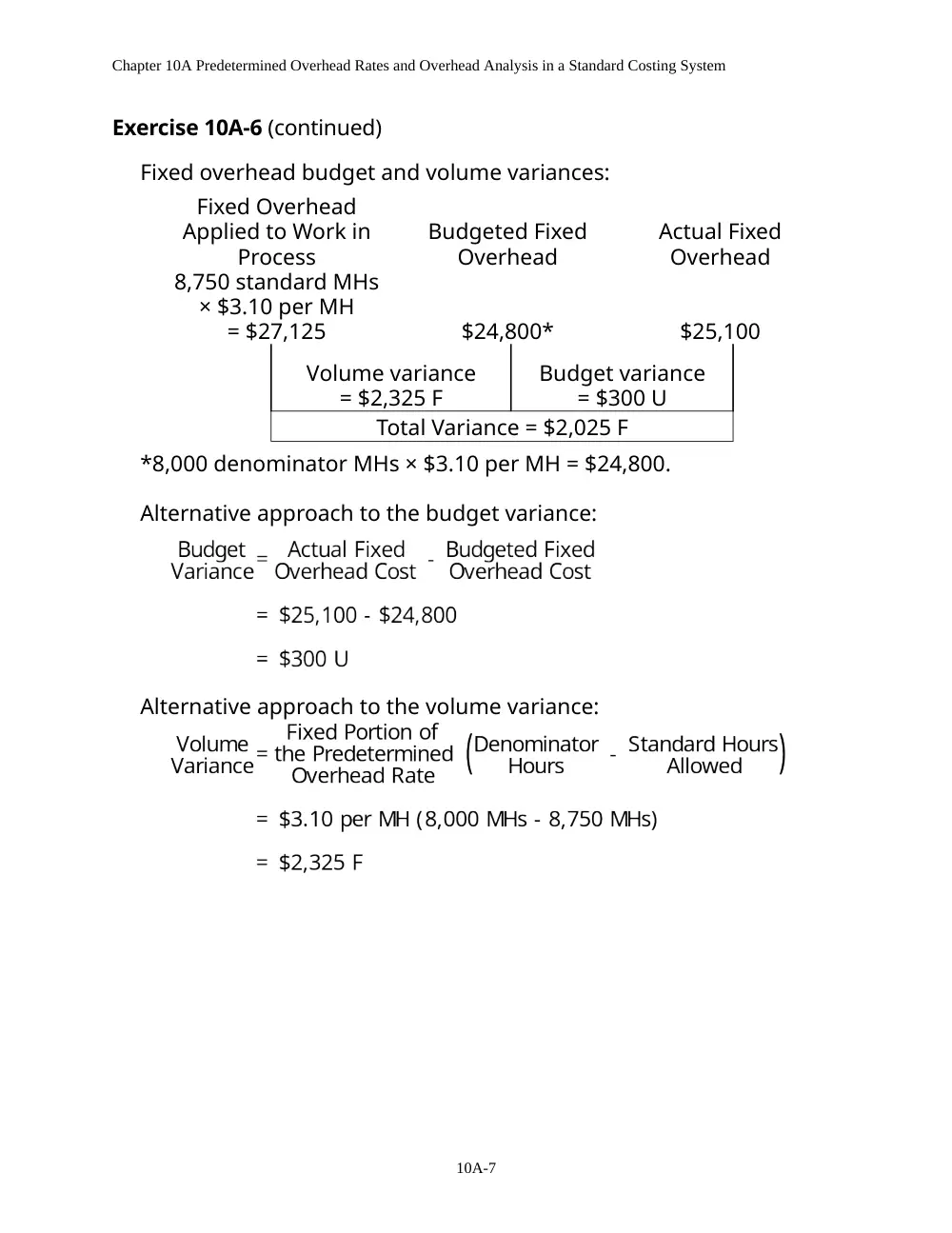
Fixed overhead budget and volume variances:
Fixed Overhead
Applied to Work in
Process
Budgeted Fixed
Overhead
Actual Fixed
Overhead
8,750 standard MHs
× $3.10 per MH
= $27,125
$24,800*
$25,100
Volume variance
= $2,325 F
Budget variance
= $300 U
Total Variance = $2,025 F
*8,000 denominator MHs × $3.10 per MH = $24,800.
Alternative approach to the budget variance:
Alternative approach to the volume variance:
10A-7
Chapter 10A Predetermined Overhead Rates and Overhead Analysis in a Standard Costing System
Exercise 10A-7 (15 minutes)
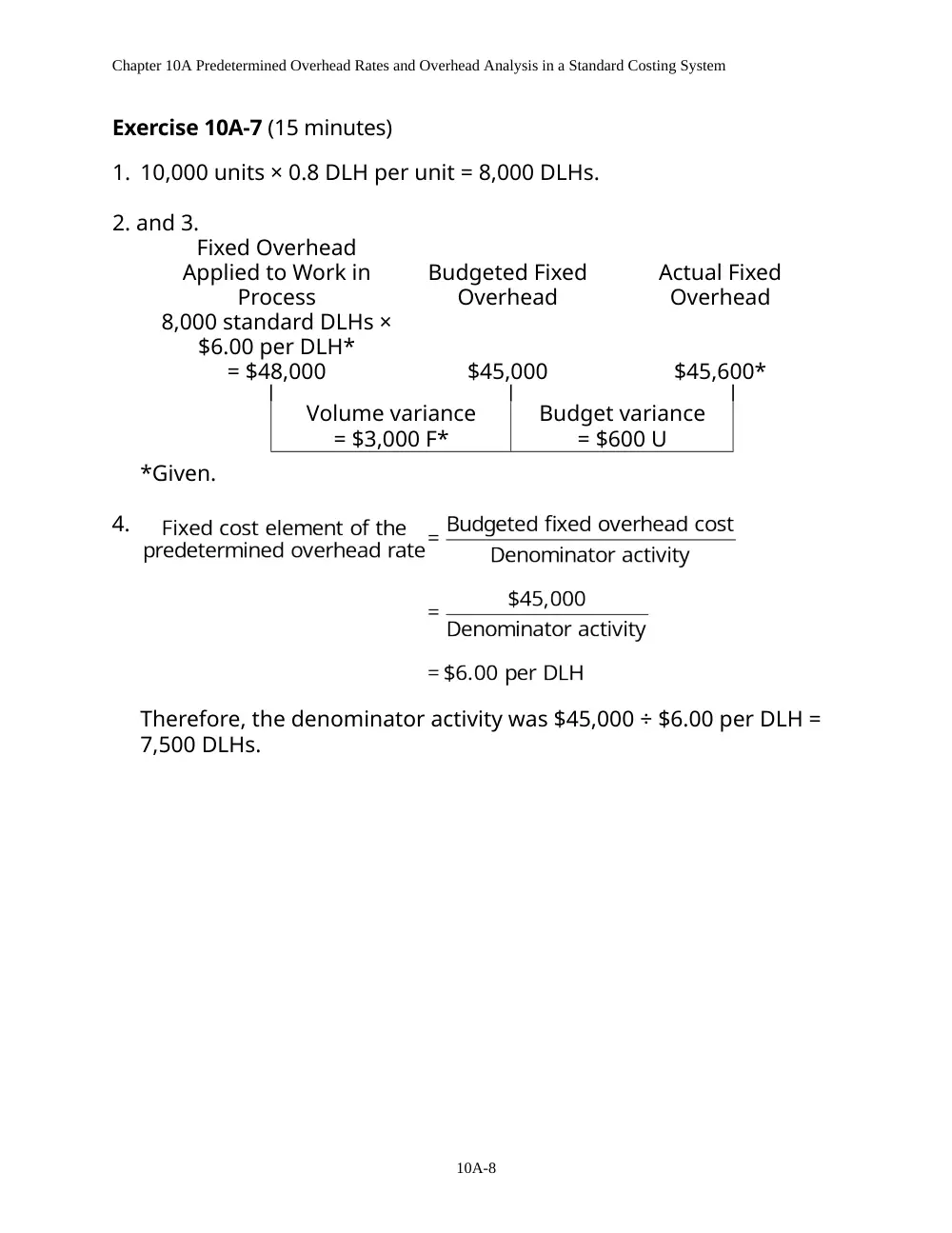
1. 10,000 units × 0.8 DLH per unit = 8,000 DLHs.
2. and 3.
Fixed Overhead
Applied to Work in
Process
Budgeted Fixed
Overhead
Actual Fixed
Overhead
8,000 standard DLHs ×
$6.00 per DLH*
= $48,000
$45,000
$45,600*
Volume variance
= $3,000 F*
Budget variance
= $600 U
*Given.
4.
Therefore, the denominator activity was $45,000 ÷ $6.00 per DLH =
7,500 DLHs.
10A-8
Chapter 10A Predetermined Overhead Rates and Overhead Analysis in a Standard Costing System
Problem 10A-10 (45 minutes)
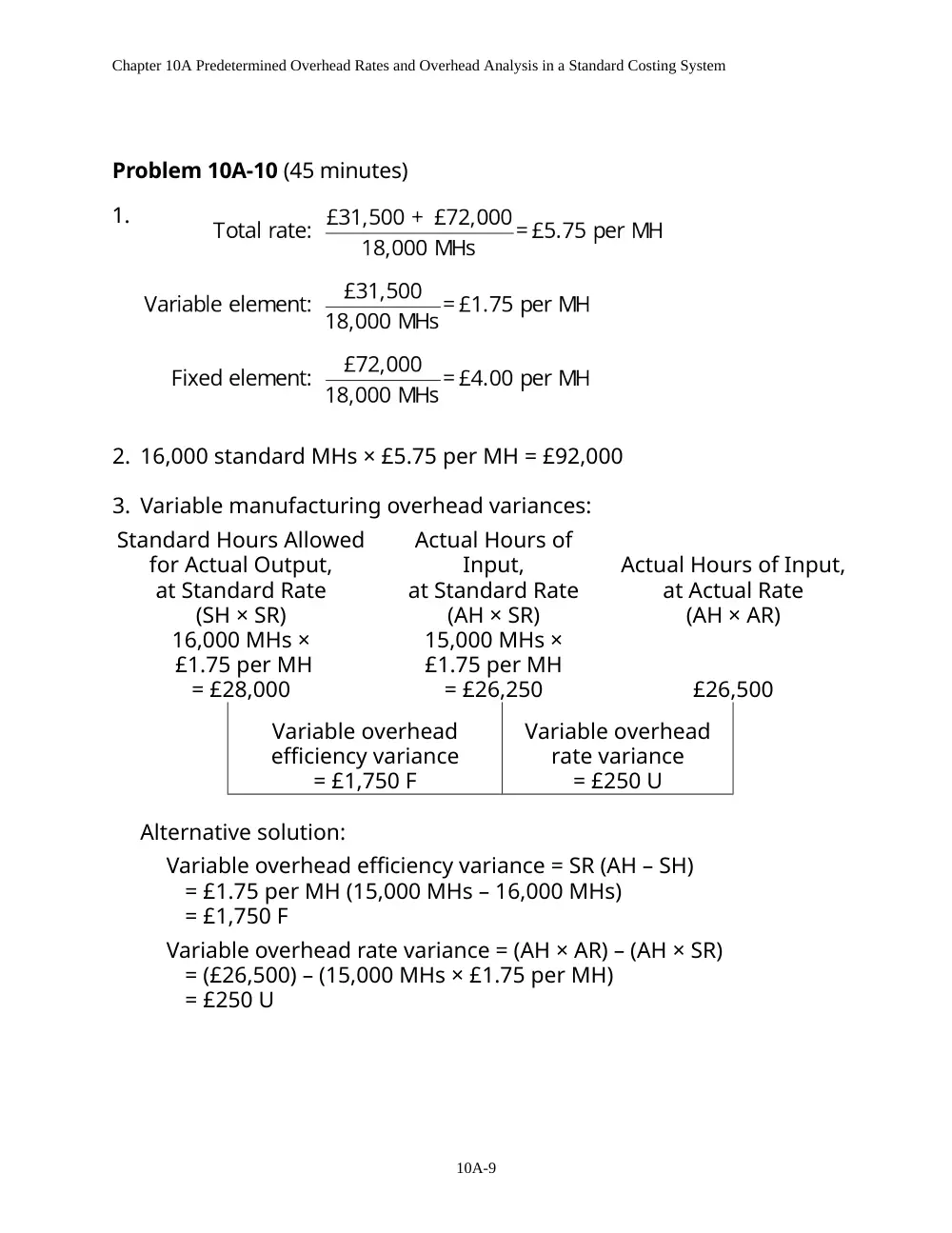
1.
2. 16,000 standard MHs × £5.75 per MH = £92,000
3. Variable manufacturing overhead variances:
Standard Hours Allowed
for Actual Output,
at Standard Rate
(SH × SR)
Actual Hours of
Input,
at Standard Rate
(AH × SR)
Actual Hours of Input,
at Actual Rate
(AH × AR)
16,000 MHs ×
£1.75 per MH
= £28,000
15,000 MHs ×
£1.75 per MH
= £26,250
£26,500
Variable overhead
efficiency variance
= £1,750 F
Variable overhead
rate variance
= £250 U
Alternative solution:
Variable overhead efficiency variance = SR (AH – SH)
= £1.75 per MH (15,000 MHs – 16,000 MHs)
= £1,750 F
Variable overhead rate variance = (AH × AR) – (AH × SR)
= (£26,500) – (15,000 MHs × £1.75 per MH)
= £250 U
10A-9
Chapter 10A Predetermined Overhead Rates and Overhead Analysis in a Standard Costing System
Problem 10A-10 (continued)
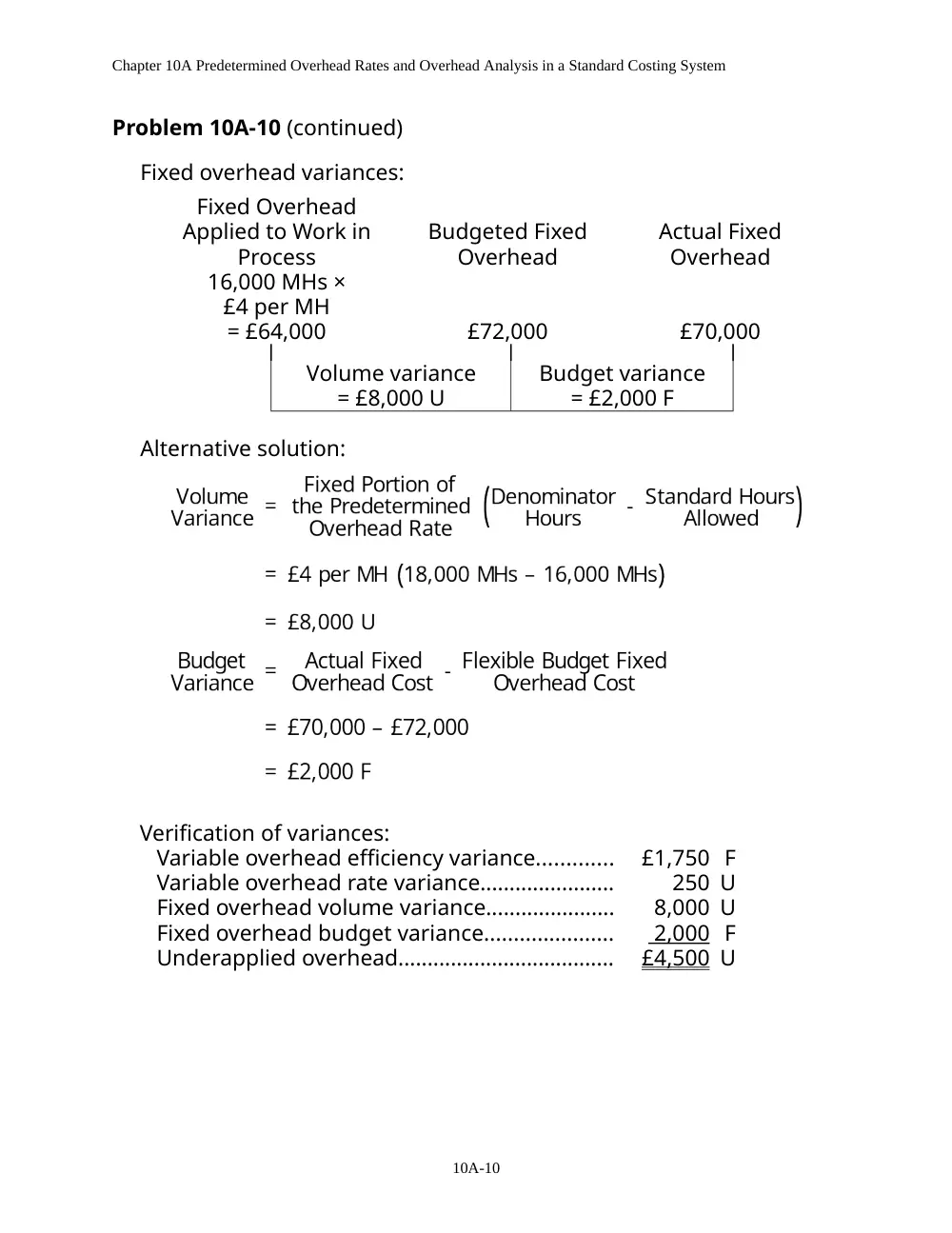
Fixed overhead variances:
Fixed Overhead
Applied to Work in
Process
Budgeted Fixed
Overhead
Actual Fixed
Overhead
16,000 MHs ×
£4 per MH
= £64,000
£72,000
£70,000
Volume variance
= £8,000 U
Budget variance
= £2,000 F
Alternative solution:
Verification of variances:
Variable overhead efficiency variance.............
£1,750 F
Variable overhead rate variance.......................
250 U
Fixed overhead volume variance......................
8,000 U
Fixed overhead budget variance......................
2,000
F
Underapplied overhead.....................................
£4,500 U
10A-10
Chapter 10A Predetermined Overhead Rates and Overhead Analysis in a Standard Costing System
Problem 10A-10 (continued)
4. Variable overhead
Variable overhead rate variance: This variance includes both price and
quantity elements. The overhead spending variance reflects
differences between actual and standard prices for variable
overhead items. It also reflects differences between the amounts of
variable overhead inputs that were actually used and the amounts
that should have been used for the actual output of the period.
Because the variable overhead spending variance is unfavorable,
either too much was paid for variable overhead items or too many
of them were used.
Variable overhead efficiency variance: The term “variable overhead
efficiency variance” is a misnomer, because the variance does not
measure efficiency in the use of overhead items. It measures the
indirect effect on variable overhead of the efficiency or inefficiency
with which the activity base is utilized. In this company, machine-
hours is the activity base. If variable overhead is really proportional
to machine-hours, then more effective use of machine-hours has
the indirect effect of reducing variable overhead. Because 1,000
fewer machine-hours were required than indicated by the
standards, the indirect effect was presumably to reduce variable
overhead spending by about £1,750 (£1.75 per machine-hour ×
1,000 machine-hours).
Fixed overhead
Fixed overhead budget variance: This variance is simply the difference
between the budgeted fixed cost and the actual fixed cost. In this
case, the variance is favorable, which indicates that actual fixed
costs were lower than anticipated in the budget.
Fixed overhead volume variance: This variance occurs as a result of
actual activity being different from the denominator activity that
was used in the predetermined overhead rate. In this case, the
variance is unfavorable, so actual activity was less than the
denominator activity. It is difficult to place much of a meaningful
economic interpretation on this variance. It tends to be large, so it
often swamps the other, more meaningful variances if they are
simply netted against each other.
10A-11
Chapter 10A Predetermined Overhead Rates and Overhead Analysis in a Standard Costing System
10A-12