
ACCT 215 Problems Solutions, Fall 2011
American University of Beirut · Management Accounting · 20 pages · with solution





Showing the first 10 of 20 pages. Download the PDF to see all of it.
More ACCT 215 files
- Problems Solutions · Fall 2011Problems · with solutionView
- Problems Solutions · Fall 2011Problems · with solutionView
- Problems Solutions · Fall 2011Problems · with solutionView
- Problems Solutions · Fall 2011Problems · with solutionView
- Problems Solutions · Fall 2011Problems · with solutionView
- Problems Solutions · Fall 2011Problems · with solutionView
- Problems Solutions · Fall 2011Problems · with solutionView
- Problems Solutions · Fall 2011Problems · with solutionView
Show the text of this problems
Chapter 10 Standard Costs and Variances
Chapter 10
Standard Costs and Variances
Exercise 10-1 (20 minutes)
1. Number of chopping blocks...................................
4,000
Number of board feet per chopping block..........
× 2.5
Standard board feet allowed..................................
10,000
Standard cost per board foot.................................
× $1.80
Total standard cost..................................................
$18,000
Actual cost incurred................................................
$18,700
Standard cost above................................................
18,000
Spending variance—unfavorable..........................
$ 700
2.
Standard Quantity
Allowed
for Actual Output,
at Standard Price
(SQ × SP)
Actual Quantity of
Input,
at Standard Price
(AQ × SP)
Actual Quantity of
Input,
at Actual Price
(AQ × AP)
10,000 board feet ×
$1.80 per board foot
= $18,000
11,000 board feet ×
$1.80 per board foot
= $19,800
$18,700
Materials quantity
variance = $1,800 U
Materials price
variance = $1,100 F
Spending variance = $700 U
Alternatively, the variances can be computed using the formulas:
Materials quantity variance = SP (AQ – SQ)
= $1.80 per board foot (11,000 board feet – 10,000 board feet)
= $1,800 U
Materials price variance = AQ (AP – SP)
= 11,000 board feet ($1.70 per board foot* – $1.80 per board
foot)
= $1,100 F
10-1
Chapter 10 Standard Costs and Variances
*$18,700 ÷ 11,000 board feet = $1.70 per board foot.
10-2
Chapter 10 Standard Costs and Variances
Exercise 10-2 (20 minutes)
1.
Number of meals prepared.....................
6,000
Standard direct labor-hours per meal....
× 0.20
Total direct labor-hours allowed.............
1,200
Standard direct labor cost per hour.......
× $9.50
Total standard direct labor cost.............. $11,400
Actual cost incurred.................................. $11,500
Total standard direct labor cost
(above).....................................................
11,400
Spending variance....................................
$ 100
Unfavorable
2.
Standard Hours Allowed
for Actual Output,
at Standard Rate
(SH × SR)
Actual Hours of
Input,
at Standard Rate
(AH × SR)
Actual Hours of Input,
at Actual Rate
(AH × AR)
1,200 hours ×
$9.50 per hour
= $11,400
1,150 hours ×
$9.50 per hour
= $10,925
1,150 hours ×
$10.00 per hour
= $11,500
Labor efficiency variance
= $475 F
Labor rate variance
= $575 U
Spending variance = $100 U
Alternatively, the variances can be computed using the formulas:
Labor efficiency variance = SR(AH – SH)
= $9.50 per hour (1,150 hours – 1,200 hours)
= $475 F
Labor rate variance = AH(AR – SR)
= 1,150 hours ($10.00 per hour – $9.50 per hour)
= $575 U
10-3
Chapter 10 Standard Costs and Variances
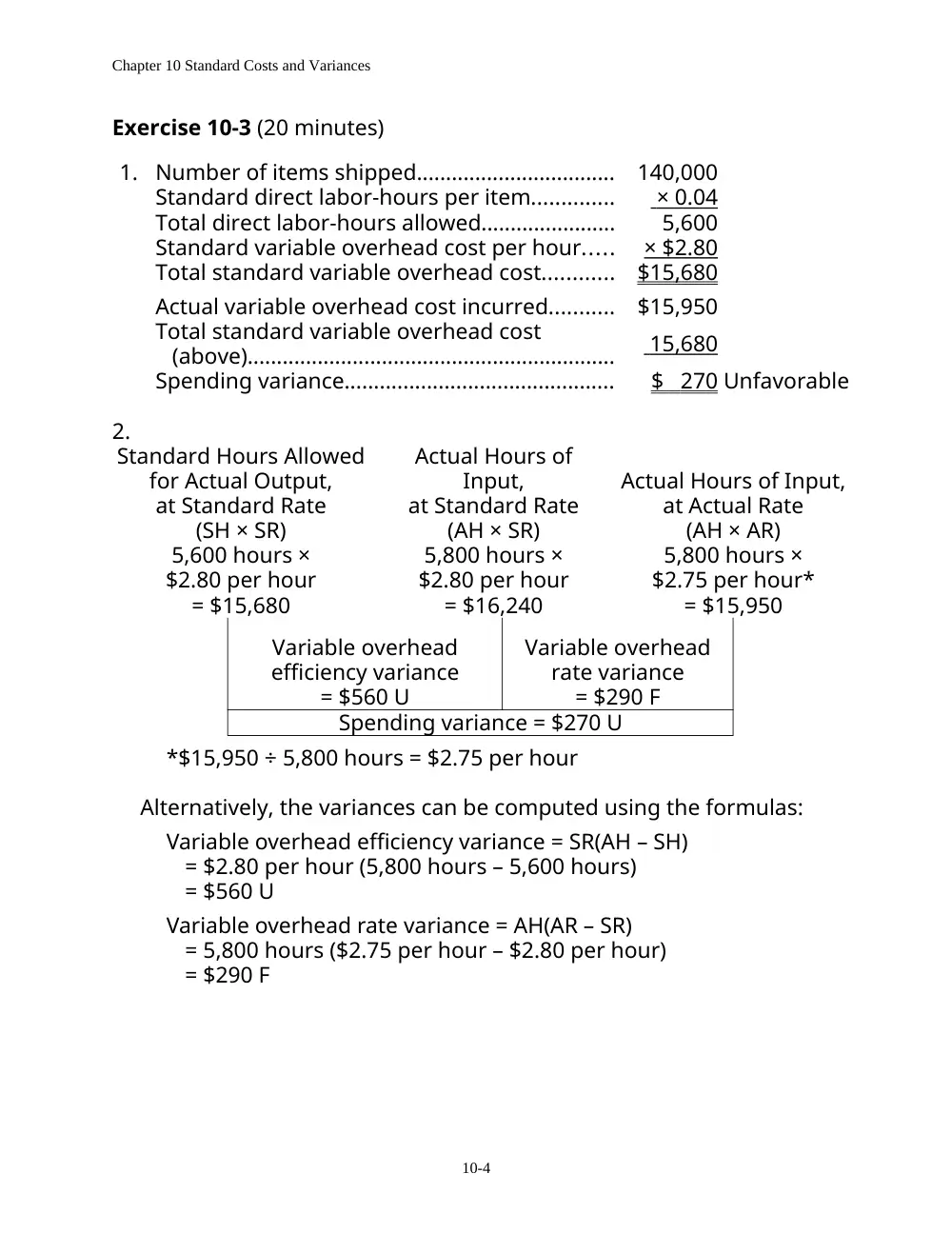
Exercise 10-3 (20 minutes)
1.
Number of items shipped..................................
140,000
Standard direct labor-hours per item..............
× 0.04
Total direct labor-hours allowed.......................
5,600
Standard variable overhead cost per hour.....
× $2.80
Total standard variable overhead cost............
$15,680
Actual variable overhead cost incurred...........
$15,950
Total standard variable overhead cost
(above)...............................................................
15,680
Spending variance..............................................
$ 270
Unfavorable
2.
Standard Hours Allowed
for Actual Output,
at Standard Rate
(SH × SR)
Actual Hours of
Input,
at Standard Rate
(AH × SR)
Actual Hours of Input,
at Actual Rate
(AH × AR)
5,600 hours ×
$2.80 per hour
= $15,680
5,800 hours ×
$2.80 per hour
= $16,240
5,800 hours ×
$2.75 per hour*
= $15,950
Variable overhead
efficiency variance
= $560 U
Variable overhead
rate variance
= $290 F
Spending variance = $270 U
*$15,950 ÷ 5,800 hours = $2.75 per hour
Alternatively, the variances can be computed using the formulas:
Variable overhead efficiency variance = SR(AH – SH)
= $2.80 per hour (5,800 hours – 5,600 hours)
= $560 U
Variable overhead rate variance = AH(AR – SR)
= 5,800 hours ($2.75 per hour – $2.80 per hour)
= $290 F
10-4
Chapter 10 Standard Costs and Variances
Exercise 10-5 (20 minutes)
1. If the total labor spending variance is $330 unfavorable, and if the
labor rate variance is $150 favorable, then the labor efficiency
variance must be $480 unfavorable, because the labor rate and
labor efficiency variances taken together equal the total labor
spending variance.
Knowing that the labor efficiency variance is $480 unfavorable, one
approach to the solution would be:
Labor efficiency variance = SR (AH – SH)
$12 per hour (AH – 210 hours*) = $480 U
$12 per hour × AH – $2,520 = $480**
$12 per hour × AH = $3,000
AH = 250 hours
* 168 batches × 1.25 hours per batch = 210 hours
** When used with the formula, unfavorable variances are
positive and favorable variances are negative.
2. Knowing that 250 hours of labor time were used during the week,
the actual rate of pay per hour can be computed as follows:
Labor rate variance = AH (AR – SR)
250 hours (AR – $12 per hour) = $150 F
250 hours × AR – $3,000 = -$150*
250 hours × AR = $2,850
AR = $11.40 per hour
* When used with the formula, unfavorable variances are
positive and favorable variances are negative.
10-5
Chapter 10 Standard Costs and Variances
Exercise 10-5 (continued)
An alternative approach would be to work from known to unknown
data in the columnar model for variance analysis:
Standard Hours Allowed
for Actual Output,
at Standard Rate
(SH × SR)
Actual Hours of
Input,
at Standard Rate
(AH × SR)
Actual Hours of Input,
at Actual Rate
(AH × AR)
210 hours§ ×
$12.00 per hour*
= $2,520
250 hours ×
$12.00 per hour*
= $3,000
250 hours ×
$11.40 per hour
= $2,850
Labor efficiency variance
= $480 U
Labor rate variance
= $150 F*
Spending variance = $330 U*
§168 batches × 1.25 hours per batch = 210 hours
*Given
10-6
Chapter 10 Standard Costs and Variances
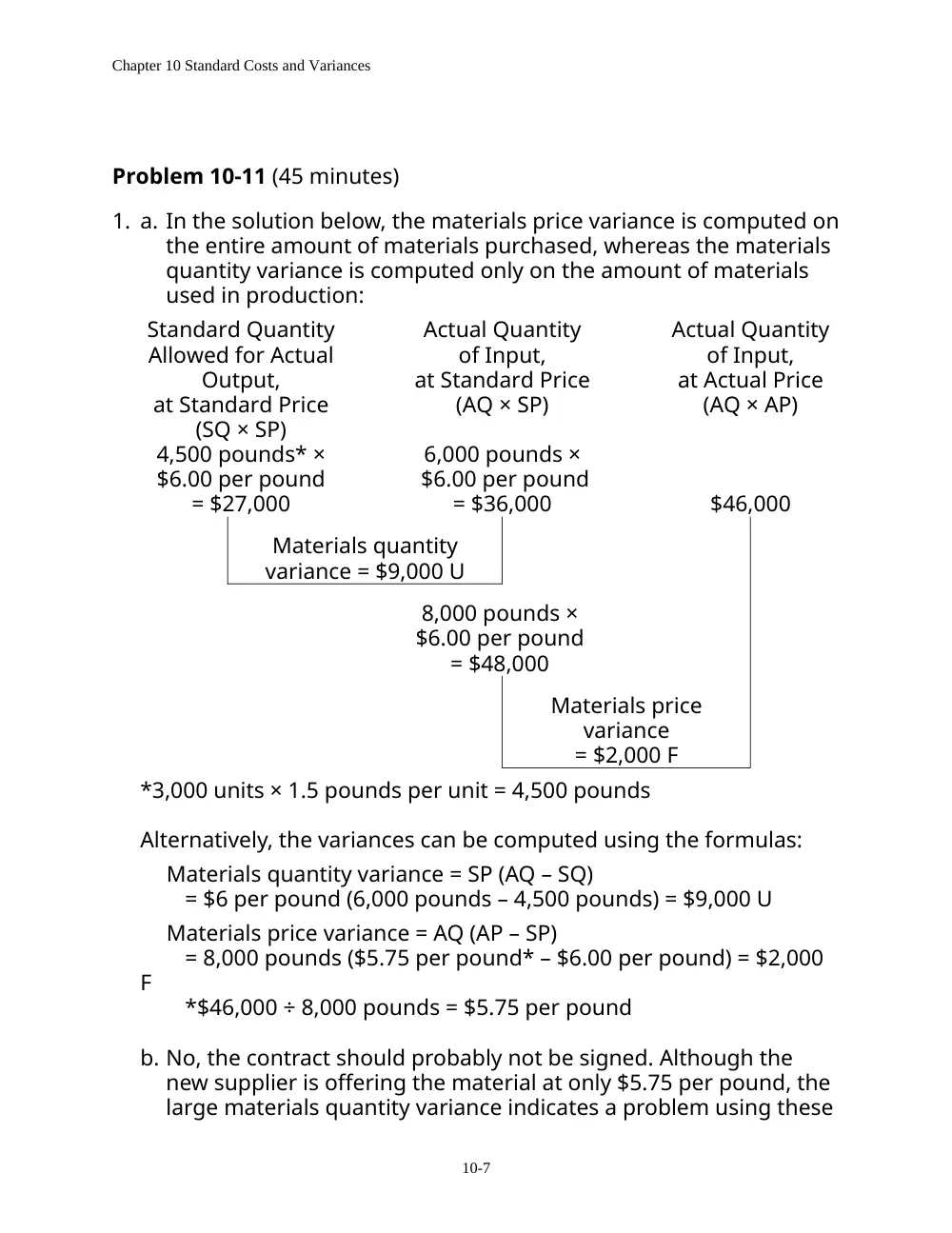
Problem 10-11 (45 minutes)
1. a. In the solution below, the materials price variance is computed on
the entire amount of materials purchased, whereas the materials
quantity variance is computed only on the amount of materials
used in production:
Standard Quantity
Allowed for Actual
Output,
at Standard Price
(SQ × SP)
Actual Quantity
of Input,
at Standard Price
(AQ × SP)
Actual Quantity
of Input,
at Actual Price
(AQ × AP)
4,500 pounds* ×
$6.00 per pound
= $27,000
6,000 pounds ×
$6.00 per pound
= $36,000
$46,000
Materials quantity
variance = $9,000 U
8,000 pounds ×
$6.00 per pound
= $48,000
Materials price
variance
= $2,000 F
*3,000 units × 1.5 pounds per unit = 4,500 pounds
Alternatively, the variances can be computed using the formulas:
Materials quantity variance = SP (AQ – SQ)
= $6 per pound (6,000 pounds – 4,500 pounds) = $9,000 U
Materials price variance = AQ (AP – SP)
= 8,000 pounds ($5.75 per pound* – $6.00 per pound) = $2,000
F
*$46,000 ÷ 8,000 pounds = $5.75 per pound
b. No, the contract should probably not be signed. Although the
new supplier is offering the material at only $5.75 per pound, the
large materials quantity variance indicates a problem using these
10-7
Chapter 10 Standard Costs and Variances
materials is production. The company still has 2,000 pounds of
unused material in the warehouse; if these materials do as poorly
in production as the 6,000 pounds already used, the total quantity
variance on the 8,000 pounds of materials purchased will be very
large.
10-8
Chapter 10 Standard Costs and Variances
Problem 10-11 (continued)
2. a.
Standard Hours Allowed
for Actual Output,
at Standard Rate
(SH × SR)
Actual Hours of
Input,
at Standard Rate
(AH × SR)
Actual Hours of Input,
at Actual Rate
(AH × AR)
1,800 hours* ×
$12.00 per hour
= $21,600
1,600 hours** ×
$12.00 per hour
= $19,200
1,600 hours** ×
$12.50 per hour
= $20,000
Labor efficiency variance
= $2,400 F
Labor rate variance
= $800 U
Spending variance = $1,600 F
* 3,000 units × 0.6 hours per unit
= 1,800 hours
** 10 workers × 160 hours per
worker
= 1,600 hours
Alternatively, the variances can be computed using the formulas:
Labor efficiency variance = SR (AH – SH)
= $12.00 per hour (1,600 hours – 1,800 hours)
= $2,400 F
Labor rate variance = AH (AR – SR)
= 1,600 hours ($12.50 per hour – $12.00 per hour)
= $800 U
b. Yes, the new labor mix should probably be continued. Although it
increases the average hourly labor cost from $12.00 to $12.50,
resulting in an $800 unfavorable labor rate variance, this is more
than offset by greater efficiency of labor time. Notice that the
labor efficiency variance is $2,400 favorable. Thus, the new labor
mix reduces overall labor costs.
10-9
Chapter 10 Standard Costs and Variances
Problem 10-11 (continued)
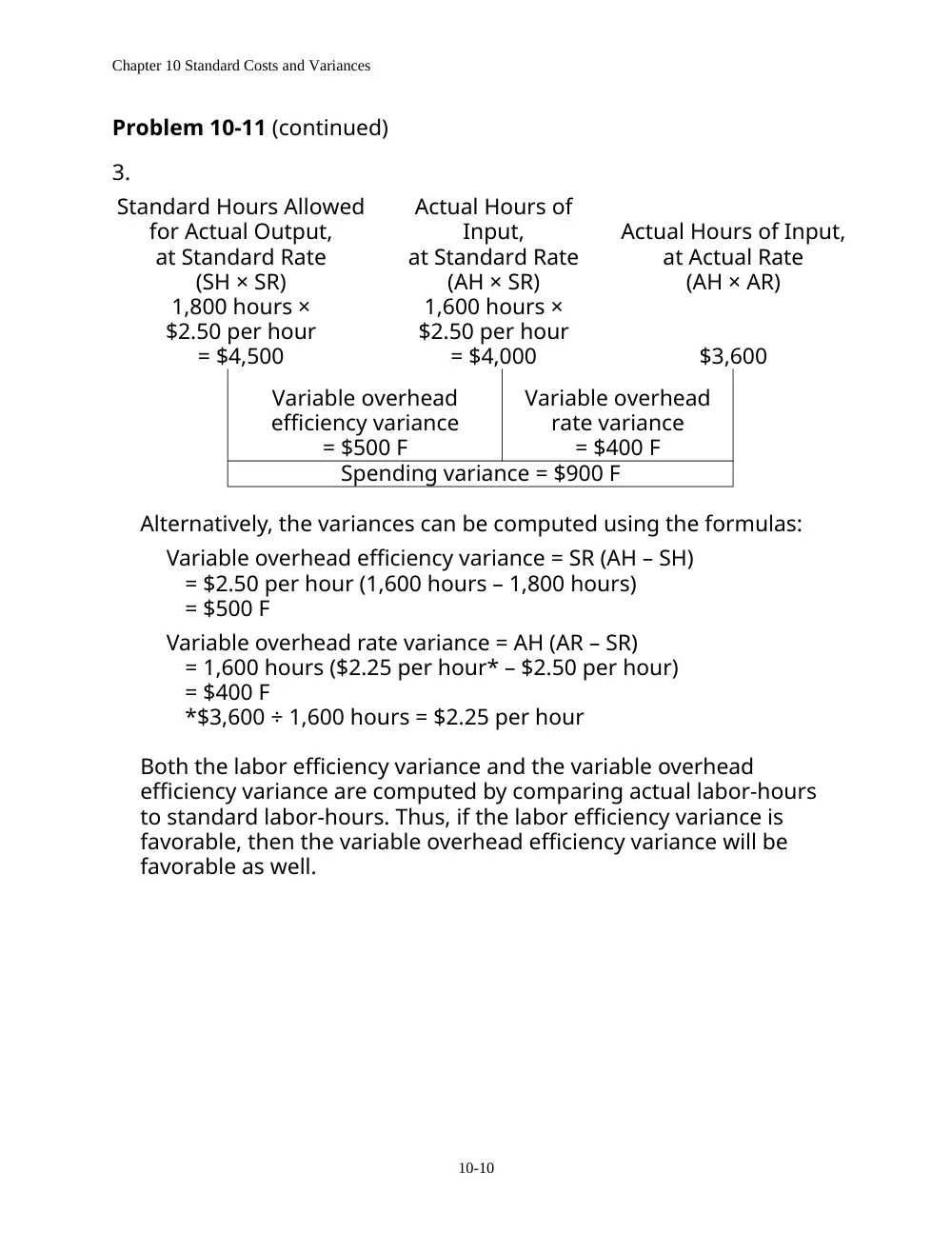
3.
Standard Hours Allowed
for Actual Output,
at Standard Rate
(SH × SR)
Actual Hours of
Input,
at Standard Rate
(AH × SR)
Actual Hours of Input,
at Actual Rate
(AH × AR)
1,800 hours ×
$2.50 per hour
= $4,500
1,600 hours ×
$2.50 per hour
= $4,000
$3,600
Variable overhead
efficiency variance
= $500 F
Variable overhead
rate variance
= $400 F
Spending variance = $900 F
Alternatively, the variances can be computed using the formulas:
Variable overhead efficiency variance = SR (AH – SH)
= $2.50 per hour (1,600 hours – 1,800 hours)
= $500 F
Variable overhead rate variance = AH (AR – SR)
= 1,600 hours ($2.25 per hour* – $2.50 per hour)
= $400 F
*$3,600 ÷ 1,600 hours = $2.25 per hour
Both the labor efficiency variance and the variable overhead
efficiency variance are computed by comparing actual labor-hours
to standard labor-hours. Thus, if the labor efficiency variance is
favorable, then the variable overhead efficiency variance will be
favorable as well.
10-10
Chapter 10 Standard Costs and Variances
Problem 10-12 (45 minutes)
1. a.
Standard Quantity
Allowed
for Actual Output,
at Standard Price
(SQ × SP)
Actual Quantity of
Input,
at Standard Price
(AQ × SP)
Actual Quantity of
Input,
at Actual Price
(AQ × AP)
21,600 feet* ×
$3.00 per foot
= $64,800
21,000 feet** ×
$3.00 per foot
= $63,000
21,000 feet** ×
$3.20 per foot
= $67,200
Materials quantity
variance = $1,800 F
Materials price
variance = $4,200 U
Spending variance = $2,400 U
* 12,000 units × 1.80 feet per unit = 21,600 feet
** 12,000 units × 1.75 feet per unit = 21,000 feet
Alternatively, the variances can be computed using the formulas:
Materials quantity variance = SP (AQ – SQ)
= $3.00 per foot (21,000 feet – 21,600 feet)
= $1,800 F
Materials price variance = AQ (AP – SP)
= 21,000 feet ($3.20 per foot – $3.00 per foot)
= $4,200 U
10-11
Chapter 10 Standard Costs and Variances
Problem 10-12 (continued)
1. b.
Standard Hours Allowed
for Actual Output,
at Standard Rate
(SH × SR)
Actual Hours of
Input,
at Standard Rate
(AH × SR)
Actual Hours of Input,
at Actual Rate
(AH × AR)
10,800 hours* ×
$18.00 per hour
= $194,400
11,400 hours** ×
$18.00 per hour
= $205,200
11,400 hours** ×
$17.40 per hour
= $198,360
Labor efficiency variance
= $10,800 U
Labor rate variance
= $6,840 F
Spending variance = $3,960 U
* 12,000 units × 0.90 hours per unit = 10,800 hours
** 12,000 units × 0.95 hours per unit = 11,400 hours
Alternatively, the variances can be computed using the formulas:
Labor efficiency variance = SR (AH – SH)
= $18.00 per hour (11,400 hours – 10,800 hours)
= $10,800 U
Labor rate variance = AH (AR – SR)
= 11,400 hours ($17.40 per hour – $18.00 per hour)
= $6,840 F
10-12
Chapter 10 Standard Costs and Variances
Problem 10-12 (continued)
1. c.
Standard Hours Allowed
for Actual Output,
at Standard Rate
(SH × SR)
Actual Hours of
Input,
at Standard Rate
(AH × SR)
Actual Hours of Input,
at Actual Rate
(AH × AR)
10,800 hours* ×
$5.00 per hour
= $54,000
11,400 hours** ×
$5.00 per hour
= $57,000
11,400 hours** ×
$4.60 per hour
= $52,440
Variable overhead
efficiency variance
= $3,000 U
Variable overhead
rate variance
= $4,560 F
Spending variance = $1,560 F
* 12,000 units × 0.90 hours per unit = 10,800 hours
** 12,000 units × 0.95 hours per unit = 11,400 hours
Alternatively, the variances can be computed using the formulas:
Variable overhead efficiency variance = SR (AH – SH)
= $5.00 per hour (11,400 hours – 10,800 hours)
= $3,000 U
Variable overhead rate variance = AH (AR – SR)
= 11,400 hours ($4.60 per hour – $5.00 per hour)
= $4,560 F
2.
Materials:
Quantity variance ($1,800 ÷ 12,000 units).....
$0.15
F
Price variance ($4,200 ÷ 12,000 units)............
0 .35 U
$0.20
U
Labor:
Efficiency variance ($10,800 ÷ 12,000 units)..
0.90 U
Rate variance ($6,840 ÷ 12,000 units)............
0 .57 F
0.33 U
Variable overhead:
Efficiency variance ($3,000 ÷ 12,000 units)....
0.25 U
Rate variance ($4,560 ÷ 12,000 units)............
0 .38 F
0.13 F
10-13
Chapter 10 Standard Costs and Variances
Excess of actual over standard cost per unit.....
$0.40
U
10-14
Chapter 10 Standard Costs and Variances
Problem 10-12 (continued)
3. Both the labor efficiency and variable overhead efficiency variances
are affected by inefficient use of labor time.
Excess of actual over standard cost per unit.....
$0.40
U
Less portion attributable to labor inefficiency:
Labor efficiency variance.....................................
0.90 U
Variable overhead efficiency variance................
0.25 U
1.15 U
Portion due to other variances............................
$0.75 F
In sum, had it not been for the apparent inefficient use of labor
time, the total variance in unit cost for the month would have been
favorable by $0.75 rather than unfavorable by $0.40.
4. Although the excess of actual cost over standard cost is only $0.40
per unit, the total amount of $4,800 (= $0.40 per unit × 12,000 units)
is substantial. Moreover, the details of the variances are significant.
The materials price variance is $4,200 U, the labor efficiency
variance is $10,800 U, the labor rate variance is $6,840 F, the
variable overhead efficiency variance is $3,000 U, and the variable
rate variance is $4,560 F. Taken together, the two variances that
reflect apparent inefficient use of the labor time total $13,800 U.
Each of these variances may warrant further investigation.
10-15
Chapter 10 Standard Costs and Variances
Problem 10-13 (45 minutes)
1. a. Materials price variance = AQ (AP – SP)
6,000 pounds ($2.75 per pound* – SP) = $1,500 F**
$16,500 – 6,000 pounds × SP = $1,500***
6,000 pounds × SP = $18,000
SP = $3.00 per pound
*$16,500 ÷ 6,000 pounds = $2.75 per pound
**$1,200 U + ? = $300 F; $1,200 U – $1,500 F = $300 F
***When used with the formula, unfavorable variances are
positive and favorable variances are negative.
b. Materials quantity variance = SP (AQ – SQ)
$3.00 per pound (6,000 pounds – SQ) = $1,200 U
$18,000 – $3.00 per pound × SQ = $1,200*
$3.00 per pound × SQ = $16,800
SQ = 5,600 pounds
*When used with the formula, unfavorable variances are
positive and favorable variances are negative.
Alternative approach to parts (a) and (b):
Standard Quantity
Allowed
for Actual Output,
at Standard Price
(SQ × SP)
Actual Quantity of
Input,
at Standard Price
(AQ × SP)
Actual Quantity of
Input,
at Actual Price
(AQ × AP)
5,600 pounds ×
$3.00 per pound
= $16,800
6,000 pounds* ×
$3.00 per pound
= $18,000
$16,500*
Materials quantity
variance = $1,200 U*
Materials price
variance = $1,500 F
Spending variance = $300 F*
*Given.
c. 5,600 pounds ÷ 1,400 units = 4 pounds per unit.
10-16
Chapter 10 Standard Costs and Variances
Problem 10-13 (continued)
2. a. Labor efficiency variance = SR (AH – SH)
$9.00 per hour (AH – 3,500 hours*) = $4,500 F
$9.00 per hour × AH – $31,500 = –$4,500**
$9.00 per hour × AH = $27,000
AH = 3,000 hours
*1,400 units × 2.5 hours per unit = 3,500 hours
**When used with the formula, unfavorable variances are
positive and favorable variances are negative.
b. Labor rate variance = AH (AR – SR)
3,000 hours ($9.50 per hour* – $9.00 per hour) = $1,500 U
Alternative approach to parts (a) and (b):
Standard Hours Allowed
for Actual Output,
at Standard Rate
(SH × SR)
Actual Hours of
Input,
at Standard Rate
(AH × SR)
Actual Hours of Input,
at Actual Rate
(AH × AR)
3,500 hours*** ×
$9.00 per hour**
= $31,500
3,000 hours ×
$9.00 per hour**
= $27,000
3,000 hours ×
$9.50 per hour*
= $28,500*
Labor efficiency variance
= $4,500 F*
Labor rate variance
= $1,500 U
Spending variance = $3,000 F
* $28,500 total labor cost ÷ 3,000 hours = $9.50 per hour
** Given
*** 1,400 units × 2.5 hours per unit = 3,500 hours
10-17
Chapter 10 Standard Costs and Variances
Problem 10-16 (45 minutes)
1.
Standard
Quantity
or Hours
Standard Price
or Rate
Standard
Cost
Alpha8:
Direct materials—X342.....
1.8 kilos
$3.50 per kilo
$ 6.30
Direct materials—Y561.....
2.0 liters
$1.40 per liter
2.80
Direct labor—Sintering....
0.20
hours
$20.00 per
hour
4.00
Direct labor—Finishing.....
0.80
hours
$19.00 per
hour
15.20
Total....................................
$28.30
Zeta9:
Direct materials—X342.....
3.0 kilos
$3.50 per kilo
$10.50
Direct materials—Y561.....
4.5 liters
$1.40 per liter
6.30
Direct labor—Sintering....
0.35
hours
$20.00 per
hour
7.00
Direct labor—Finishing.....
0.90
hours
$19.00 per
hour
17.10
Total....................................
$40.90
10-18
Chapter 10 Standard Costs and Variances
Problem 10-16 (continued)
2. The computations to follow will require the standard quantities
allowed for the actual output for each material.
Standard Quantity Allowed
Material X342:
Production of Alpha8 (1.8 kilos per unit × 1,500 units)....
2,700 kilos
Production of Zeta9 (3.0 kilos per unit × 2,000 units)......
6,000 kilos
Total........................................................................................
8,700 kilos
Material Y561:
Production of Alpha8 (2.0 liters per unit × 1,500 units)...
3,000 liters
Production of Zeta9 (4.5 liters per unit × 2,000 units).....
9,000 liters
Total........................................................................................
12,000 liters
Direct Materials Variances—Material X342:
Materials quantity variance = SP (AQ – SQ)
= $3.50 per kilo (8,500 kilos – 8,700 kilos)
= $700 F
Materials price variance = AQ (AP – SP)
= 14,000 kilos ($3.70 per kilo* – $3.50 per kilo)
= $2,800 U
*$51,800 ÷ 14,000 kilos = $3.70 per kilo
Direct Materials Variances—Material Y561:
Materials quantity variance = SP (AQ – SQ)
= $1.40 per liter (13,000 liters – 12,000 liters)
= $1,400 U
Materials price variance = AQ (AP – SP)
= 15,000 liters ($1.30 per liter* – $1.40 per liter)
= $1,500 F
*$19,500 ÷ 15,000 liters = $1.30 per liter
10-19
Chapter 10 Standard Costs and Variances
Problem 10-16 (continued)
3. The computations to follow will require the standard quantities
allowed for the actual output for direct labor in each department.
Standard Hours Allowed
Sintering:
Production of Alpha8 (0.20 hours per unit × 1,500 units)
300 hours
Production of Zeta9 (0.35 hours per unit × 2,000 units)..
700 hours
Total........................................................................................
1,000 hours
Finishing:
Production of Alpha8 (0.80 hours per unit × 1,500 units)
1,200 hours
Production of Zeta9 (0.90 hours per unit × 2,000 units)..
1,800 hours
Total........................................................................................
3,000 hours
Direct Labor Variances—Sintering:
Labor efficiency variance = SR (AH – SH)
= $20.00 per hour (1,200 hours – 1,000 hours)
= $4,000 U
Labor rate variance = AH (AR – SR)
= 1,200 hours ($22.50 per hour* – $20.00 per hour)
= $3,000 U
*$27,000 ÷ 1,200 hours = $22.50 per hour
Direct Labor Variances—Finishing:
Labor efficiency variance = SR (AH – SH)
= $19.00 per hour (2,850 hours – 3,000 hours)
= $2,850 F
Labor rate variance = AH (AR – SR)
= 2,850 hours ($21.00 per hour* – $19.00 per hour)
= $5,700 U
*$59,850 ÷ 2,850 hours = $21.00 per hour
10-20