
ACCT 215 Problems Solutions, Fall 2011
American University of Beirut · Management Accounting · 5 pages · with solution

More ACCT 215 files
- Problems Solutions · Fall 2011Problems · with solutionView
- Problems Solutions · Fall 2011Problems · with solutionView
- Problems Solutions · Fall 2011Problems · with solutionView
- Problems Solutions · Fall 2011Problems · with solutionView
- Problems Solutions · Fall 2011Problems · with solutionView
- Problems Solutions · Fall 2011Problems · with solutionView
- Problems Solutions · Fall 2011Problems · with solutionView
- Problems Solutions · Fall 2011Problems · with solutionView
Show the text of this problems
Chapter 03A The Predetermined Overhead Rate and Capacity
Appendix 3A
The Predetermined Overhead Rate and
Capacity
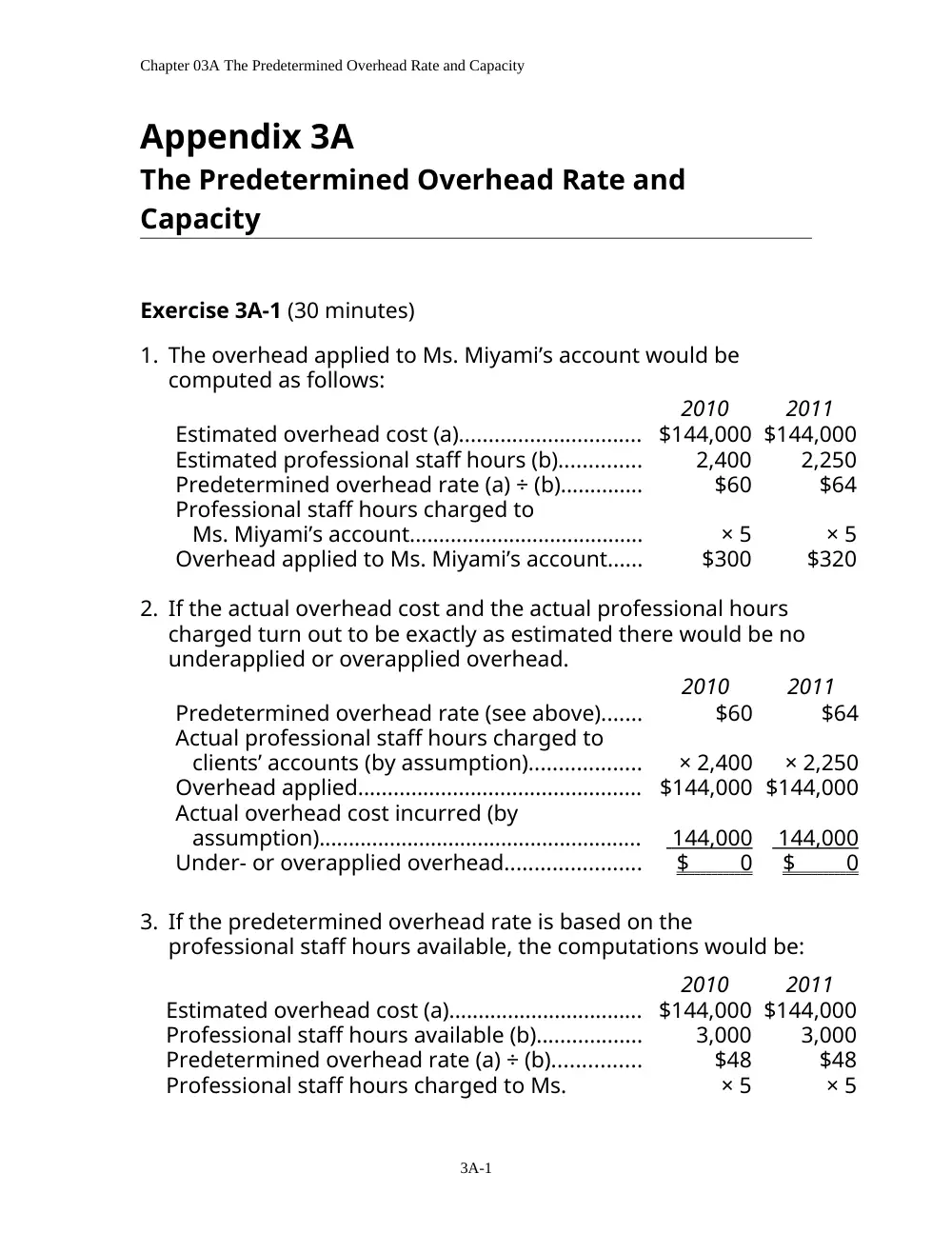
Exercise 3A-1 (30 minutes)
1. The overhead applied to Ms. Miyami’s account would be
computed as follows:
2010
2011
Estimated overhead cost (a)............................... $144,000 $144,000
Estimated professional staff hours (b)..............
2,400
2,250
Predetermined overhead rate (a) ÷ (b)..............
$60
$64
Professional staff hours charged to
Ms. Miyami’s account........................................
× 5
× 5
Overhead applied to Ms. Miyami’s account......
$300
$320
2. If the actual overhead cost and the actual professional hours
charged turn out to be exactly as estimated there would be no
underapplied or overapplied overhead.
2010
2011
Predetermined overhead rate (see above).......
$60
$64
Actual professional staff hours charged to
clients’ accounts (by assumption)...................
× 2,400
× 2,250
Overhead applied................................................
$144,000 $144,000
Actual overhead cost incurred (by
assumption).......................................................
144,000
144,000
Under- or overapplied overhead.......................
$ 0
$ 0
3. If the predetermined overhead rate is based on the
professional staff hours available, the computations would be:
2010
2011
Estimated overhead cost (a)................................. $144,000 $144,000
Professional staff hours available (b)..................
3,000
3,000
Predetermined overhead rate (a) ÷ (b)...............
$48
$48
Professional staff hours charged to Ms.
× 5
× 5
3A-1
Chapter 03A The Predetermined Overhead Rate and Capacity
Miyami’s account................................................
3A-2
Chapter 03A The Predetermined Overhead Rate and Capacity
Overhead applied to Ms. Miyami’s account.......
$240
$240
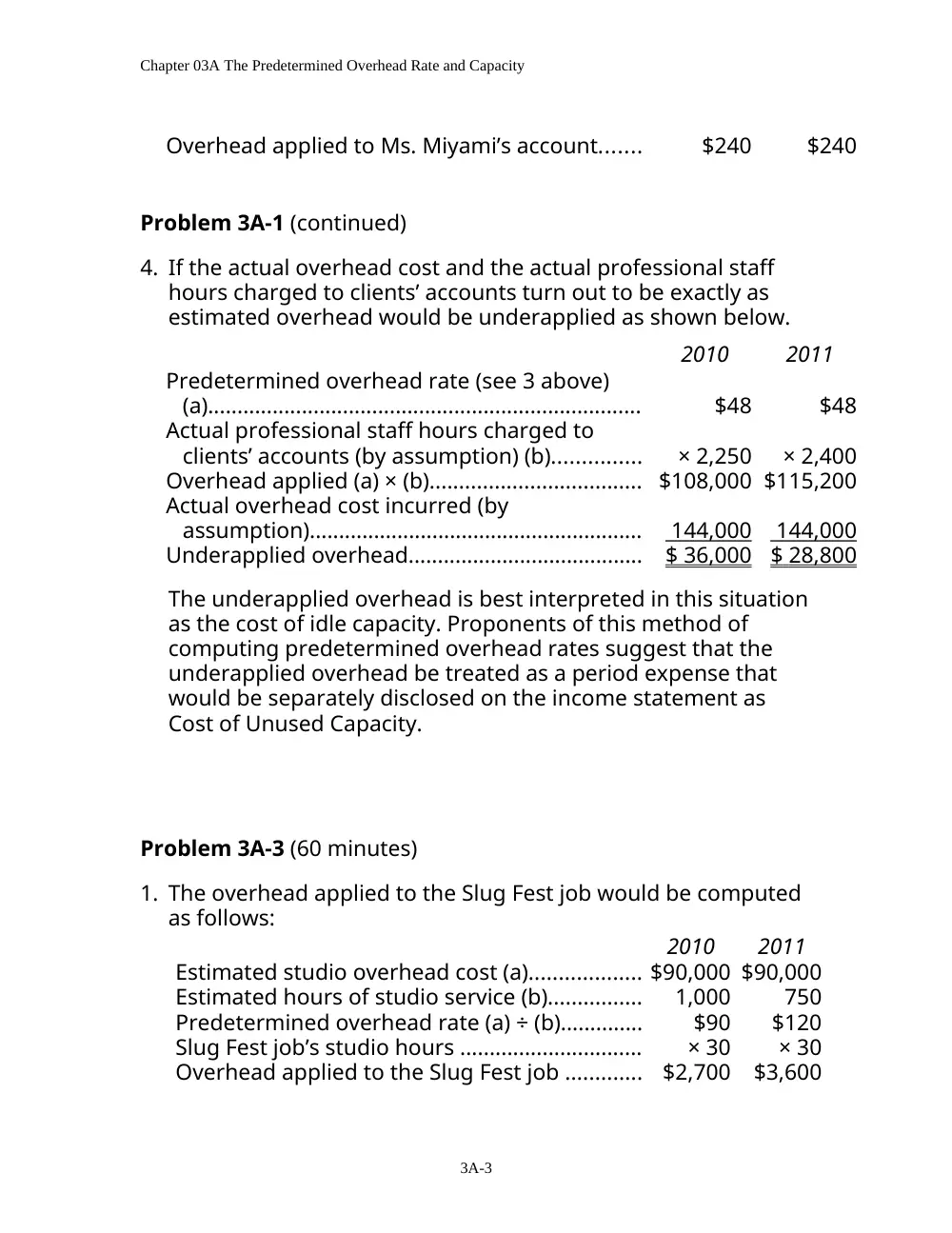
Problem 3A-1 (continued)
4. If the actual overhead cost and the actual professional staff
hours charged to clients’ accounts turn out to be exactly as
estimated overhead would be underapplied as shown below.
2010
2011
Predetermined overhead rate (see 3 above)
(a)..........................................................................
$48
$48
Actual professional staff hours charged to
clients’ accounts (by assumption) (b)...............
× 2,250
× 2,400
Overhead applied (a) × (b).................................... $108,000 $115,200
Actual overhead cost incurred (by
assumption).........................................................
144,000
144,000
Underapplied overhead........................................
$ 36,000
$ 28,800
The underapplied overhead is best interpreted in this situation
as the cost of idle capacity. Proponents of this method of
computing predetermined overhead rates suggest that the
underapplied overhead be treated as a period expense that
would be separately disclosed on the income statement as
Cost of Unused Capacity.
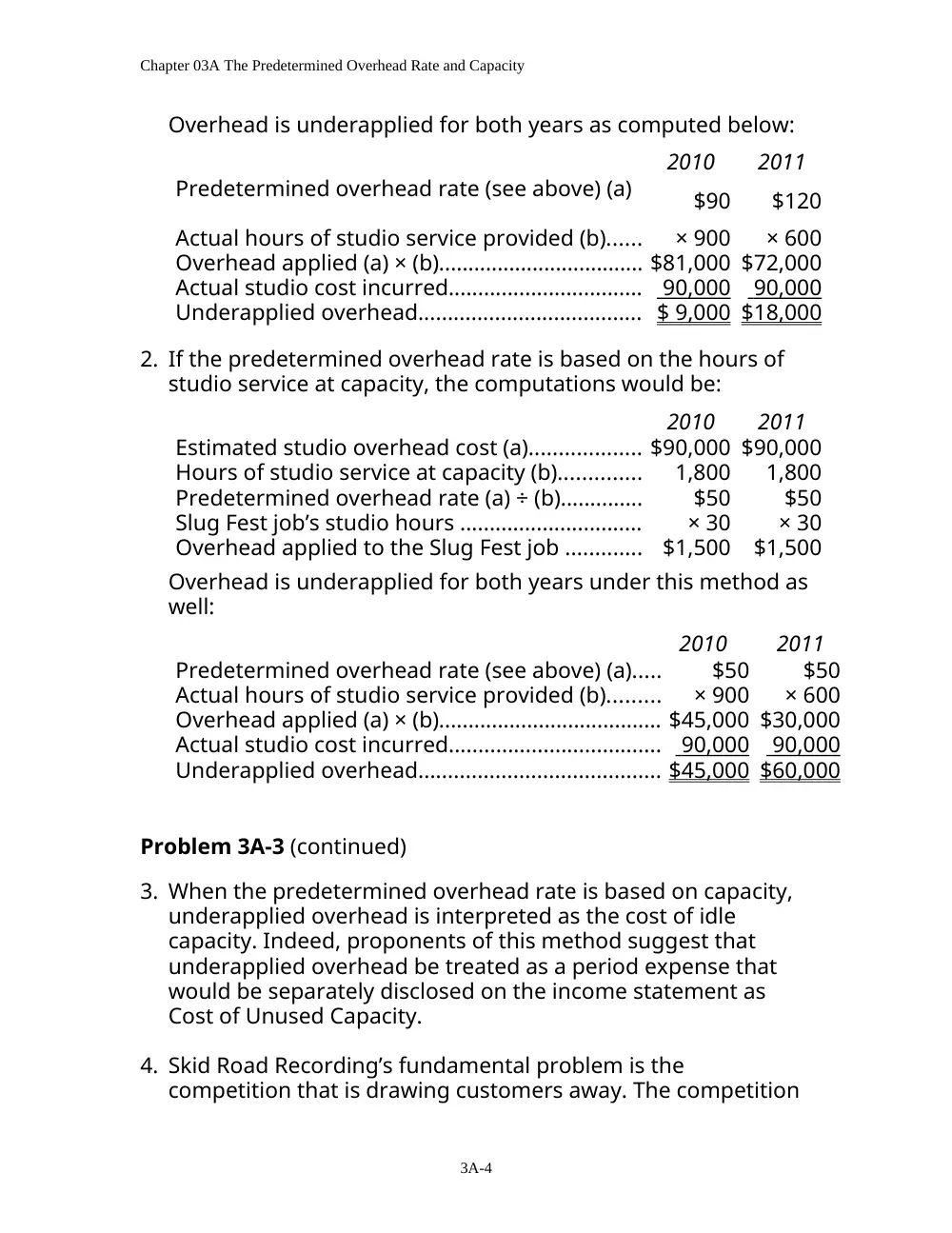
Problem 3A-3 (60 minutes)
1. The overhead applied to the Slug Fest job would be computed
as follows:
2010
2011
Estimated studio overhead cost (a)................... $90,000 $90,000
Estimated hours of studio service (b)................
1,000
750
Predetermined overhead rate (a) ÷ (b)..............
$90
$120
Slug Fest job’s studio hours ...............................
× 30
× 30
Overhead applied to the Slug Fest job .............
$2,700
$3,600
3A-3
Chapter 03A The Predetermined Overhead Rate and Capacity
Overhead is underapplied for both years as computed below:
2010
2011
Predetermined overhead rate (see above) (a)
$90
$120
Actual hours of studio service provided (b)......
× 900
× 600
Overhead applied (a) × (b)................................... $81,000 $72,000
Actual studio cost incurred................................. 90,000
90,000
Underapplied overhead...................................... $ 9,000
$18,000
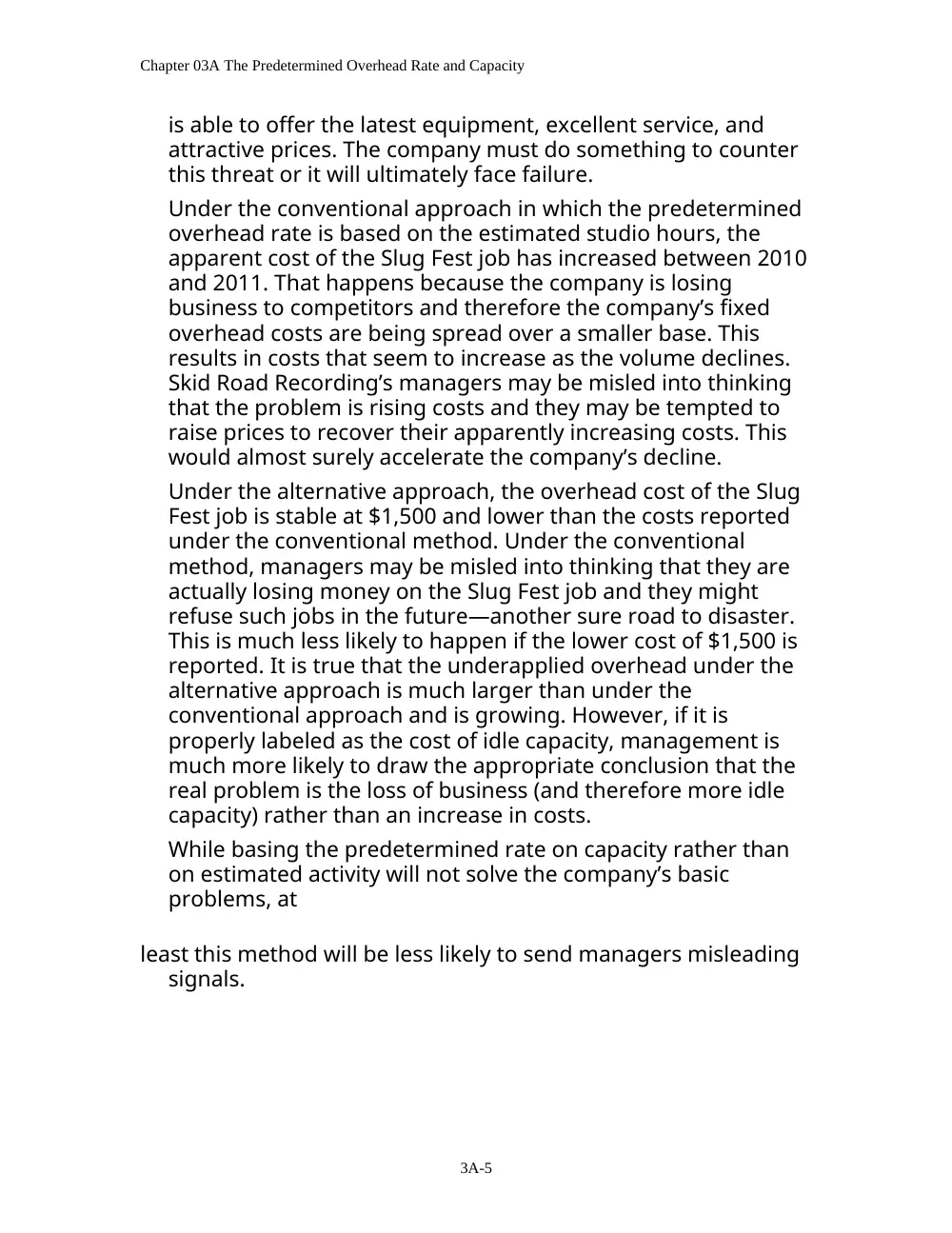
2. If the predetermined overhead rate is based on the hours of
studio service at capacity, the computations would be:
2010
2011
Estimated studio overhead cost (a)................... $90,000 $90,000
Hours of studio service at capacity (b)..............
1,800
1,800
Predetermined overhead rate (a) ÷ (b)..............
$50
$50
Slug Fest job’s studio hours ...............................
× 30
× 30
Overhead applied to the Slug Fest job .............
$1,500
$1,500
Overhead is underapplied for both years under this method as
well:
2010
2011
Predetermined overhead rate (see above) (a).....
$50
$50
Actual hours of studio service provided (b).........
× 900
× 600
Overhead applied (a) × (b)...................................... $45,000 $30,000
Actual studio cost incurred.................................... 90,000
90,000
Underapplied overhead......................................... $45,000 $60,000
Problem 3A-3 (continued)
3. When the predetermined overhead rate is based on capacity,
underapplied overhead is interpreted as the cost of idle
capacity. Indeed, proponents of this method suggest that
underapplied overhead be treated as a period expense that
would be separately disclosed on the income statement as
Cost of Unused Capacity.
4. Skid Road Recording’s fundamental problem is the
competition that is drawing customers away. The competition
3A-4
Chapter 03A The Predetermined Overhead Rate and Capacity
is able to offer the latest equipment, excellent service, and
attractive prices. The company must do something to counter
this threat or it will ultimately face failure.
Under the conventional approach in which the predetermined
overhead rate is based on the estimated studio hours, the
apparent cost of the Slug Fest job has increased between 2010
and 2011. That happens because the company is losing
business to competitors and therefore the company’s fixed
overhead costs are being spread over a smaller base. This
results in costs that seem to increase as the volume declines.
Skid Road Recording’s managers may be misled into thinking
that the problem is rising costs and they may be tempted to
raise prices to recover their apparently increasing costs. This
would almost surely accelerate the company’s decline.
Under the alternative approach, the overhead cost of the Slug
Fest job is stable at $1,500 and lower than the costs reported
under the conventional method. Under the conventional
method, managers may be misled into thinking that they are
actually losing money on the Slug Fest job and they might
refuse such jobs in the future—another sure road to disaster.
This is much less likely to happen if the lower cost of $1,500 is
reported. It is true that the underapplied overhead under the
alternative approach is much larger than under the
conventional approach and is growing. However, if it is
properly labeled as the cost of idle capacity, management is
much more likely to draw the appropriate conclusion that the
real problem is the loss of business (and therefore more idle
capacity) rather than an increase in costs.
While basing the predetermined rate on capacity rather than
on estimated activity will not solve the company’s basic
problems, at
least this method will be less likely to send managers misleading
signals.
3A-5