
ACCT 215 Problems Solutions, Fall 2011
American University of Beirut · Management Accounting · 27 pages · with solution





Showing the first 10 of 27 pages. Download the PDF to see all of it.
More ACCT 215 files
- Problems Solutions · Fall 2011Problems · with solutionView
- Problems Solutions · Fall 2011Problems · with solutionView
- Problems Solutions · Fall 2011Problems · with solutionView
- Problems Solutions · Fall 2011Problems · with solutionView
- Problems Solutions · Fall 2011Problems · with solutionView
- Problems Solutions · Fall 2011Problems · with solutionView
- Problems Solutions · Fall 2011Problems · with solutionView
- Problems Solutions · Fall 2011Problems · with solutionView
Show the text of this problems
Chapter 3 Job-Order Costing
Chapter 3
Job-Order Costing
Exercise 3-10 (10 minutes)
Direct material..............................
$12,000
Direct labor...................................
8,000
Manufacturing overhead
applied:
$8,000 × 120%............................
9,600
Total manufacturing cost............
$29,600
Unit product cost:
$29,600 ÷ 200 units...................
$148
Exercise 3-11 (30 minutes)
1. a. Raw Materials Inventory..........................
210,000
Accounts Payable...................................
210,000
b. Work in Process.........................................
152,000
Manufacturing Overhead.........................
38,000
Raw Materials Inventory........................
190,000
c. Work in Process.........................................
49,000
Manufacturing Overhead.........................
21,000
Salaries and Wages Payable.................
70,000
d. Manufacturing Overhead.........................
105,000
Accumulated Depreciation....................
105,000
e. Manufacturing Overhead.........................
130,000
Accounts Payable...................................
130,000
3-1
Chapter 3 Job-Order Costing
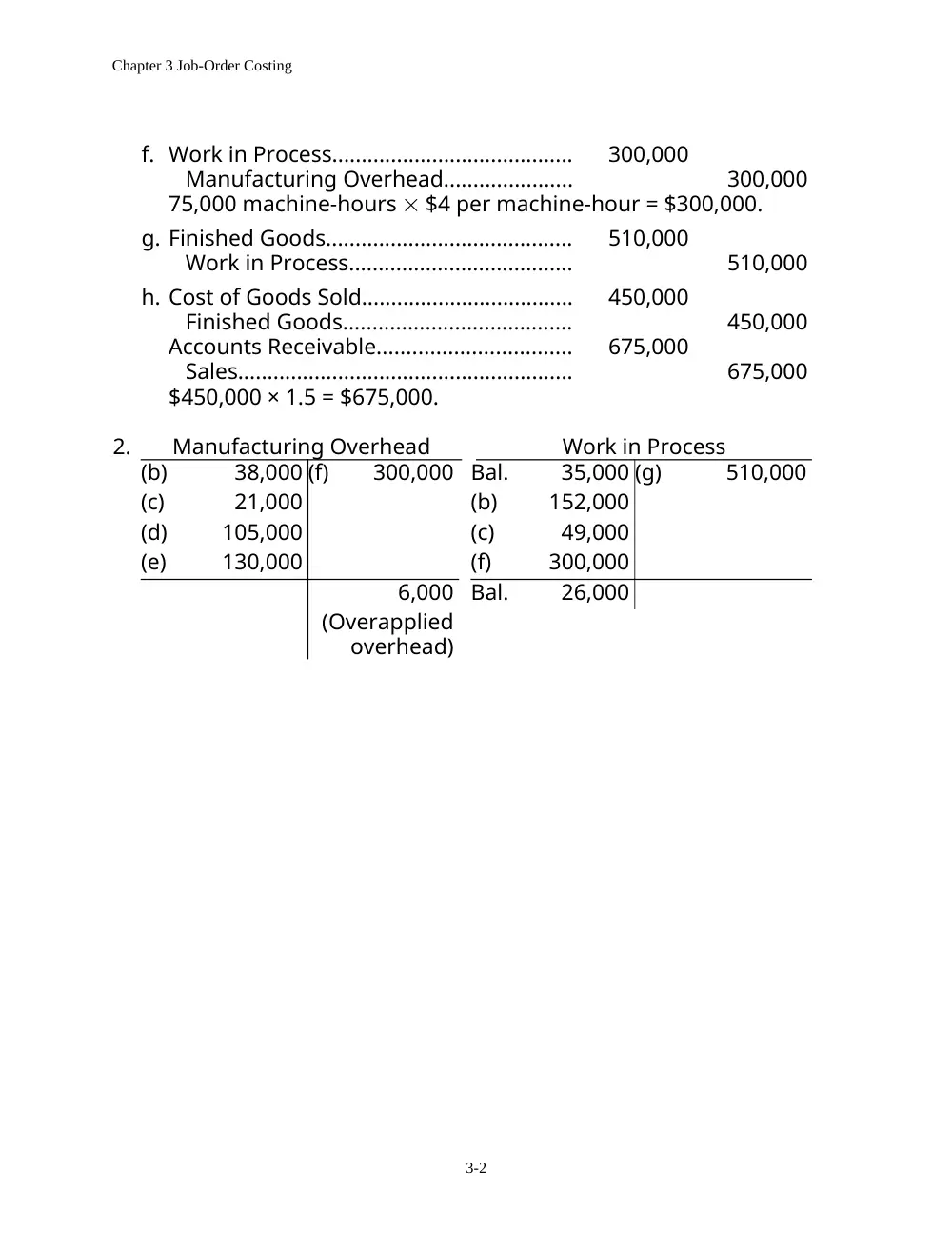
f. Work in Process.........................................
300,000
Manufacturing Overhead......................
300,000
75,000 machine-hours $4 per machine-hour = $300,000.
g. Finished Goods..........................................
510,000
Work in Process......................................
510,000
h. Cost of Goods Sold....................................
450,000
Finished Goods.......................................
450,000
Accounts Receivable.................................
675,000
Sales.........................................................
675,000
$450,000 × 1.5 = $675,000.
2.
Manufacturing Overhead
Work in Process
(b)
38,000 (f)
300,000 Bal.
35,000 (g)
510,000
(c)
21,000
(b)
152,000
(d)
105,000
(c)
49,000
(e)
130,000
(f)
300,000
6,000 Bal.
26,000
(Overapplied
overhead)
3-2
Chapter 3 Job-Order Costing
Exercise 3-12 (20 minutes)
1. The estimated total manufacturing overhead cost is computed as
follows:
Y = $750,000 + $4.00 per MH × 150,000 MHs
Estimated fixed manufacturing overhead..............
$ 750,000
Estimated variable manufacturing overhead
$4.00 per MH × 150,000 MHs................................
600,000
Estimated total manufacturing overhead cost......
$1,350,000
The predetermined overhead rate is computed as follows:
Estimated total manufacturing overhead....
$1,350,00
0
÷ Estimated total machine-hours (MHs).......
150,000 MHs
= Predetermined overhead rate....................
$9.00 per
MH
2. Total manufacturing cost assigned to Job 500:
Direct materials..................................
$350
Direct labor.........................................
230
Manufacturing overhead applied
$9.00 per MH × 30 MHs..................
270
Total manufacturing cost..................
$850
3. Computing underapplied/overapplied overhead:
Actual manufacturing overhead (a).....
$1,325,000
Actual machine-hours............................
147,000
× Predetermined overhead rate...........
$9.00
= Manufacturing overhead applied
(b)...........................................................
$1,323,000
Underapplied overhead (a) – (b)...........
$ 2,000
Manufacturing overhead
underapplied........................................
$2,000
The closing entry would increase cost of goods sold by $2,000 and
decrease net operating income by $2,000.
3-3
Chapter 3 Job-Order Costing
Exercise 3-14 (30 minutes)
Note to the instructor: This exercise is a good vehicle for introducing
the concept of predetermined overhead rates. This exercise can also
be used as a launching pad for a discussion of the appendix to the
chapter.
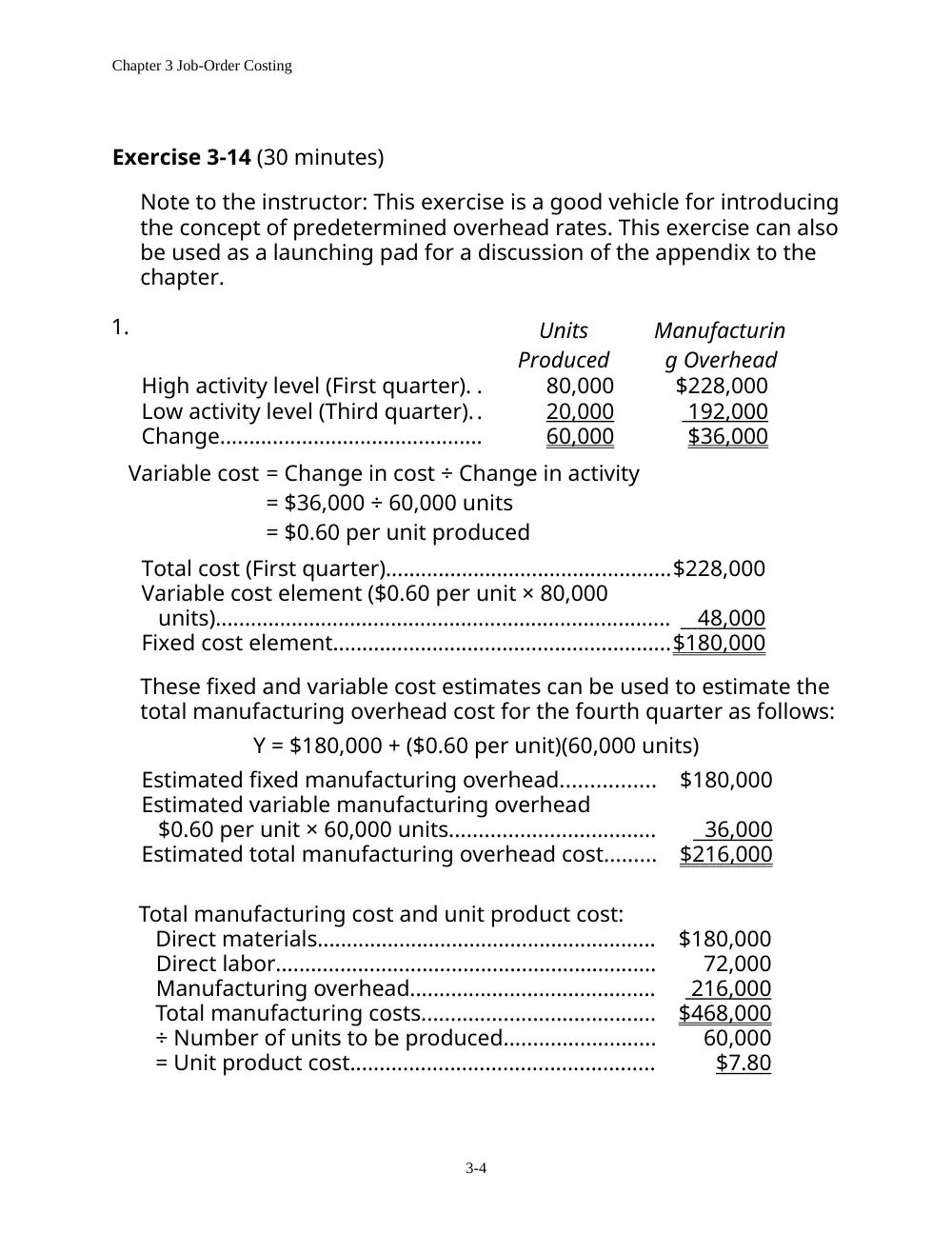
1.
Units
Produced
Manufacturin
g Overhead
High activity level (First quarter). .
80,000
$228,000
Low activity level (Third quarter)..
20,000
192,000
Change.............................................
60,000
$36,000
Variable cost = Change in cost ÷ Change in activity
= $36,000 ÷ 60,000 units
= $0.60 per unit produced
Total cost (First quarter).................................................$228,000
Variable cost element ($0.60 per unit × 80,000
units).............................................................................. 48,000
Fixed cost element..........................................................$180,000
These fixed and variable cost estimates can be used to estimate the
total manufacturing overhead cost for the fourth quarter as follows:
Y = $180,000 + ($0.60 per unit)(60,000 units)
Estimated fixed manufacturing overhead................
$180,000
Estimated variable manufacturing overhead
$0.60 per unit × 60,000 units...................................
36,000
Estimated total manufacturing overhead cost.........
$216,000
Total manufacturing cost and unit product cost:
Direct materials..........................................................
$180,000
Direct labor.................................................................
72,000
Manufacturing overhead..........................................
216,000
Total manufacturing costs........................................
$468,000
÷ Number of units to be produced..........................
60,000
= Unit product cost....................................................
$7.80
3-4
Chapter 3 Job-Order Costing
Exercise 3-14 (continued)
2. The fixed portion of the manufacturing overhead cost is causing the
unit product costs to fluctuate. The unit product cost increases as
the level of production decreases because fixed overhead is being
spread over fewer units.
3. The unit product cost can be stabilized by using a predetermined
overhead rate that is based on expected activity for the entire year.
The cost formula created in requirement 1 can be adapted to
compute the annual predetermined overhead rate. The annual fixed
manufacturing overhead is $720,000 ($180,000 per quarter × 4
quarters). The variable manufacturing overhead per unit is $0.60.
The cost formula is as follows:
Y = $720,000 + $0.60 per unit × 200,000 units
Estimated fixed manufacturing overhead................
$720,000
Estimated variable manufacturing overhead
$0.60 per unit × 200,000 units.................................
120,000
Estimated total manufacturing overhead cost.........
$840,000
The annual predetermined overhead rate is computed as follows:
Estimated total manufacturing
overhead.......................................................
$840,000
÷ Estimated total units produced..............
200,000
= Predetermined overhead rate................
$4.20 per unit
The predetermined overhead rate of $4.20 would be used
throughout the entire year, thereby eliminating the impact of
seasonal variations in demand on unit product costs.
3-5
Chapter 3 Job-Order Costing
Exercise 3-15 (15 minutes)
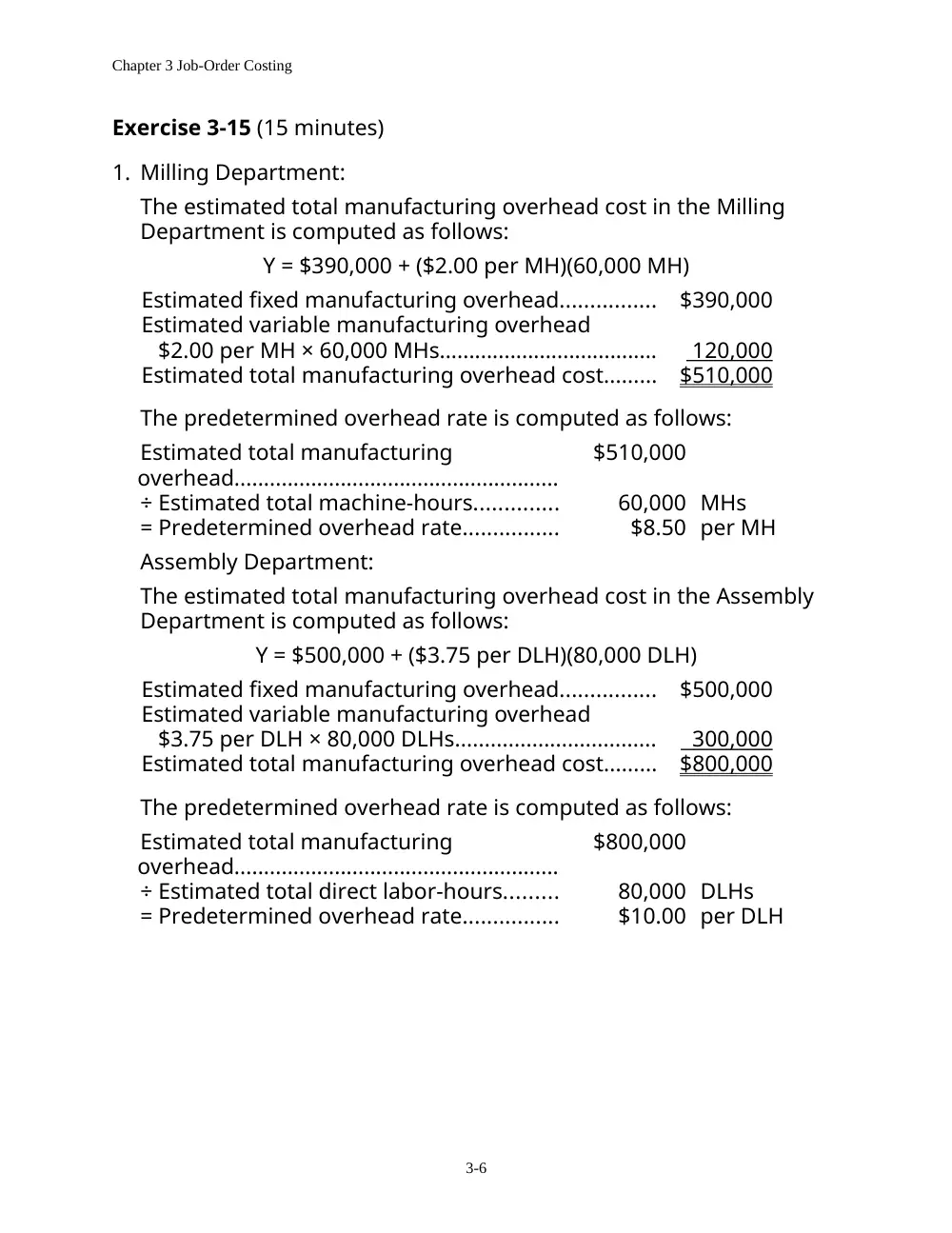
1. Milling Department:
The estimated total manufacturing overhead cost in the Milling
Department is computed as follows:
Y = $390,000 + ($2.00 per MH)(60,000 MH)
Estimated fixed manufacturing overhead................
$390,000
Estimated variable manufacturing overhead
$2.00 per MH × 60,000 MHs.....................................
120,000
Estimated total manufacturing overhead cost.........
$510,000
The predetermined overhead rate is computed as follows:
Estimated total manufacturing
overhead.......................................................
$510,000
÷ Estimated total machine-hours..............
60,000 MHs
= Predetermined overhead rate................
$8.50 per MH
Assembly Department:
The estimated total manufacturing overhead cost in the Assembly
Department is computed as follows:
Y = $500,000 + ($3.75 per DLH)(80,000 DLH)
Estimated fixed manufacturing overhead................
$500,000
Estimated variable manufacturing overhead
$3.75 per DLH × 80,000 DLHs..................................
300,000
Estimated total manufacturing overhead cost.........
$800,000
The predetermined overhead rate is computed as follows:
Estimated total manufacturing
overhead.......................................................
$800,000
÷ Estimated total direct labor-hours.........
80,000 DLHs
= Predetermined overhead rate................
$10.00 per DLH
3-6
Chapter 3 Job-Order Costing
Exercise 3-15 (continued)
2. Total manufacturing cost assigned to Job
407:
Direct materials ($800 + $370)...........................
$1,170
Direct labor ($45 + $160)....................................
205
Milling Department (90 MHs × $8.50 per MH).
$765
Assembly Department (20 DLH × $10 per
DLH)....................................................................
200
965
Total manufacturing cost...................................
$2,340
3. Yes; if some jobs require a large amount of machine time and a
small amount of labor time, they would be charged substantially
less overhead cost if a plantwide rate based on direct labor hours
were used. It appears, for example, that this would be true of Job
407 which required considerable machine time to complete, but
required a relatively small amount of labor hours.
3-7
Chapter 3 Job-Order Costing
Exercise 3-16 (15 minutes)
1. Item (a): Actual manufacturing overhead costs for the year.
Item (b):
Overhead cost applied to work in process for the
year.
Item (c): Cost of goods manufactured for the year.
Item (d): Cost of goods sold for the year.
2. Manufacturing Overhead.............................
30,000
Cost of Goods Sold...................................
30,000
3. The overapplied overhead will be allocated to the other accounts on
the basis of the amount of overhead applied during the year in the
ending balance of each account:
Work in process...................................
$ 32,800
8 %
Finished goods....................................
41,000
10
Cost of goods sold..............................
336,200
82
Total cost..............................................
$410,000
100 %
Using these percentages, the journal entry would be as follows:
Manufacturing Overhead............................
30,000
Work in Process (8% × $30,000)............
2,400
Finished Goods (10% × $30,000)...........
3,000
Cost of Goods Sold (82% × $30,000)....
24,600
3-8
Chapter 3 Job-Order Costing
Exercise 3-17 (30 minutes)
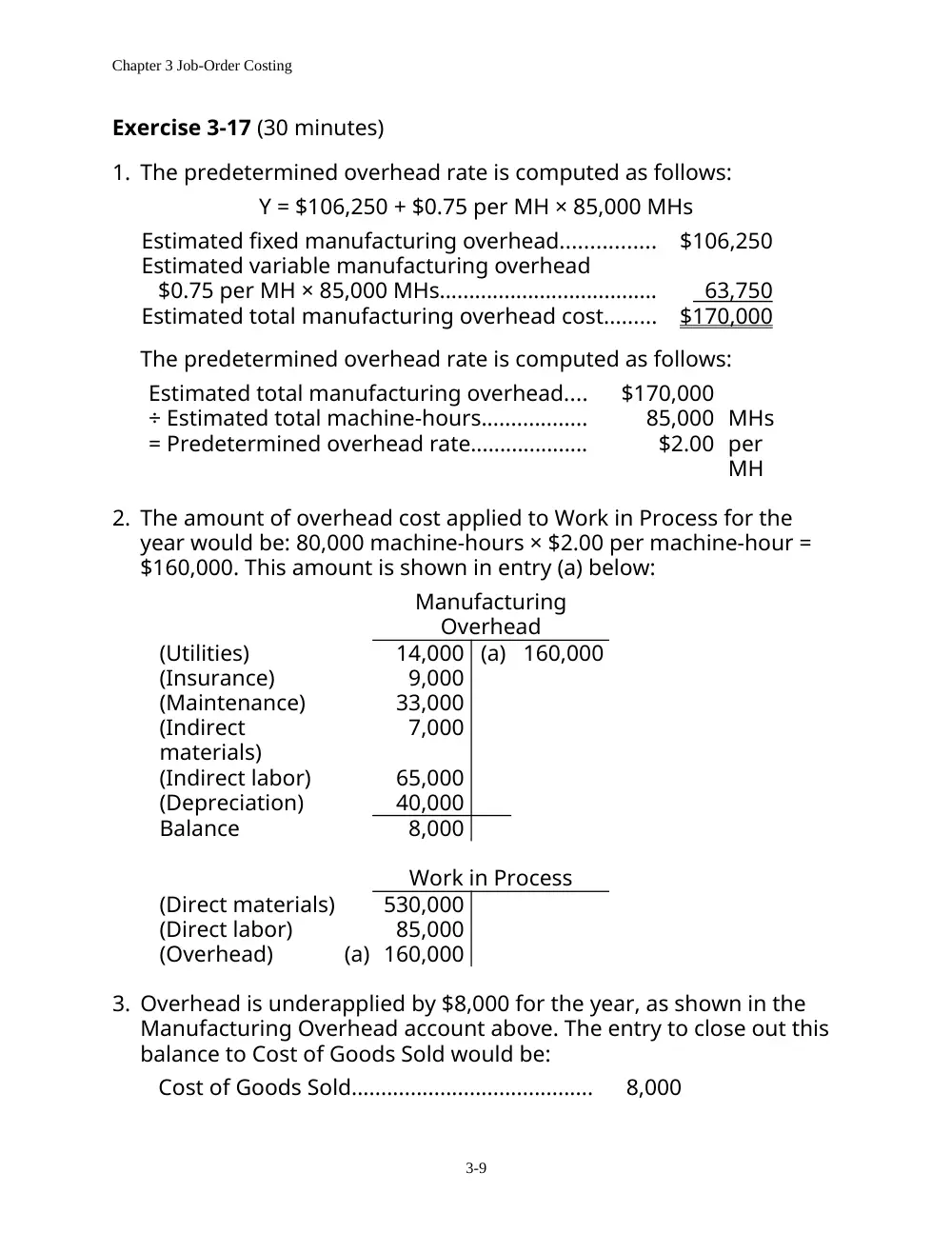
1. The predetermined overhead rate is computed as follows:
Y = $106,250 + $0.75 per MH × 85,000 MHs
Estimated fixed manufacturing overhead................
$106,250
Estimated variable manufacturing overhead
$0.75 per MH × 85,000 MHs.....................................
63,750
Estimated total manufacturing overhead cost.........
$170,000
The predetermined overhead rate is computed as follows:
Estimated total manufacturing overhead....
$170,000
÷ Estimated total machine-hours..................
85,000 MHs
= Predetermined overhead rate....................
$2.00 per
MH
2. The amount of overhead cost applied to Work in Process for the
year would be: 80,000 machine-hours × $2.00 per machine-hour =
$160,000. This amount is shown in entry (a) below:
Manufacturing
Overhead
(Utilities)
14,000 (a) 160,000
(Insurance)
9,000
(Maintenance)
33,000
(Indirect
materials)
7,000
(Indirect labor)
65,000
(Depreciation)
40,000
Balance
8,000
Work in Process
(Direct materials)
530,000
(Direct labor)
85,000
(Overhead)
(a) 160,000
3. Overhead is underapplied by $8,000 for the year, as shown in the
Manufacturing Overhead account above. The entry to close out this
balance to Cost of Goods Sold would be:
Cost of Goods Sold.........................................
8,000
3-9
Chapter 3 Job-Order Costing
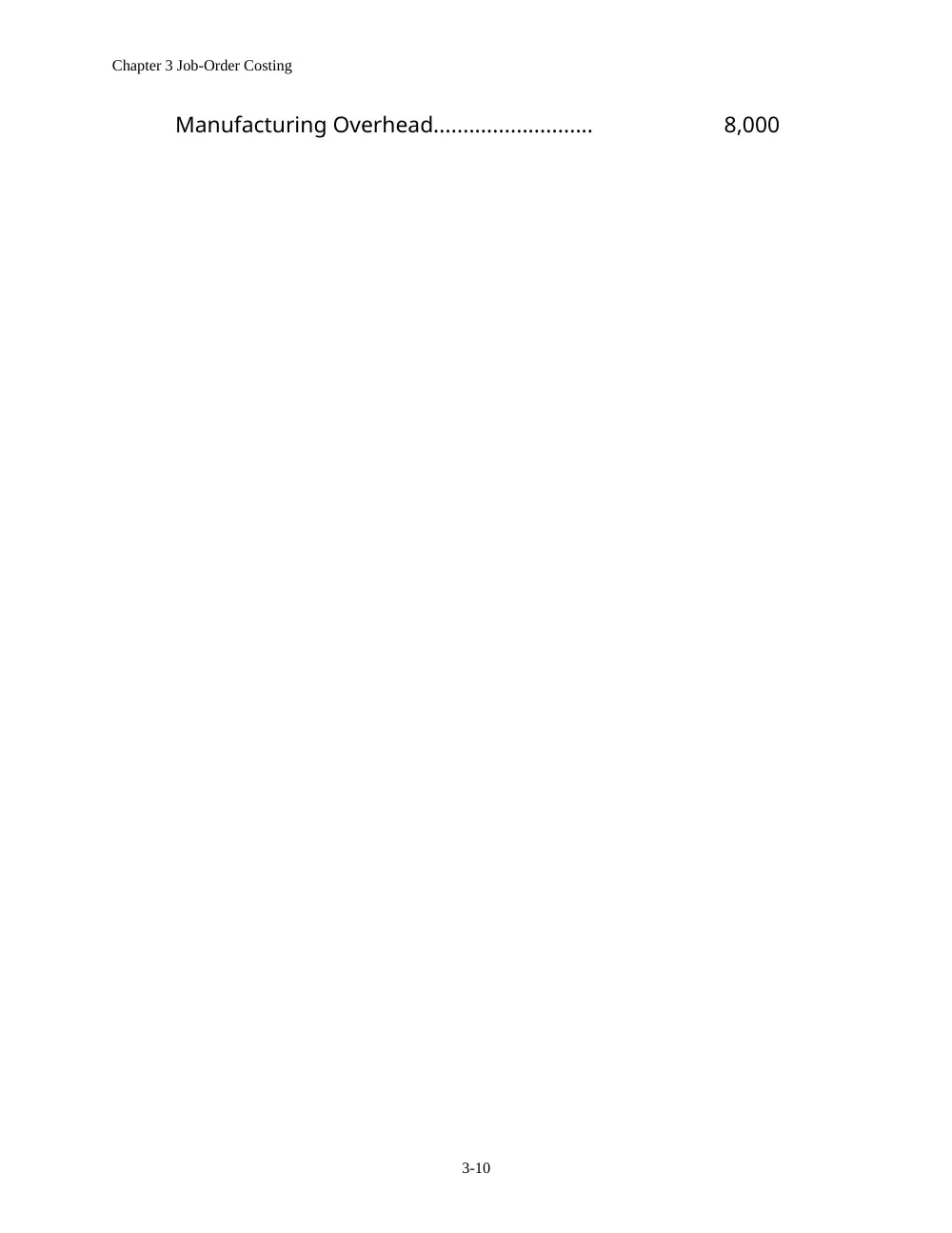
Manufacturing Overhead...........................
8,000
3-10
Chapter 3 Job-Order Costing
Exercise 3-17 (continued)
4. When overhead is applied using a predetermined rate based on
machine-hours, it is assumed that overhead cost is proportional to
machine-hours. When the actual level of activity turns out to be
80,000 machine-hours, the costing system assumes that the
overhead will be 80,000 machine-hours × $2.00 per machine-hour,
or $160,000. This is a drop of $10,000 from the initial estimated total
manufacturing overhead cost of $170,000. However, the actual total
manufacturing overhead did not drop by this much. The actual total
manufacturing overhead was $168,000—a drop of only $2,000 from
the estimate. The manufacturing overhead did not decline by the
full $10,000 because of the existence of fixed costs and/or because
overhead spending was not under control. These issues will be
covered in more detail in later chapters.
3-11
Chapter 3 Job-Order Costing
Exercise 3-18 (45 minutes)
1 a. The estimated total manufacturing overhead cost is computed as
follows:
Y = $1,100,000 + $5.00 per MH × 50,000 MHs
Estimated fixed manufacturing overhead................
$1,100,000
Estimated variable manufacturing overhead
$5.00 per MH × 50,000 MHs.....................................
250,000
Estimated total manufacturing overhead cost.........
$1,350,000
The predetermined overhead rate is computed as follows:
Estimated total manufacturing overhead....
$1,350,00
0
÷ Estimated total machine-hours (MHs).......
50,000
MHs
= Predetermined overhead rate....................
$27.00
per MH
1 b and 1 c. Total manufacturing cost assigned to Jobs D-75 and C-100:
D-75
C-100
Direct materials...................................
$ 700,000 $ 550,000
Direct labor..........................................
360,000
400,000
Manufacturing overhead applied
($27.00 per MH × 20,000 MHs;
$27.00 per MH × 30,000 MHs)........
540,000
810,000
Total manufacturing cost................... $1,600,000 $1,760,000
Bid prices for Jobs D-75 and C-100:
D-75
C-100
Total manufacturing cost................... $1,600,000 $1,760,000
× Markup percentage.........................
150%
150%
= Bid price............................................. $2,400,000 $2,640,000
1 d. Because the company has no beginning or ending inventories
and only Jobs D-75 and C-100 were started, completed, and sold
during the year, the cost of goods sold is equal to the sum of the
manufacturing costs assigned to both jobs of $3,360,000
(= $1,600,000 + $1,760,000).
3-12
Chapter 3 Job-Order Costing
Exercise 3-18 (continued)
2 a. Molding Department:
The estimated total manufacturing overhead cost in the Molding
Department is computed as follows:
Y = $800,000 + $5.00 per MH × 20,000 MH
Estimated fixed manufacturing overhead................
$800,000
Estimated variable manufacturing overhead
$5.00 per MH × 20,000 MHs.....................................
100,000
Estimated total manufacturing overhead cost.........
$900,000
The predetermined overhead rate is computed as follows:
Estimated total manufacturing overhead...
$900,000
÷ Estimated total machine-hours.................
20,000 MHs
= Predetermined overhead rate...................
$45.00 per
MH
Fabrication Department:
The estimated total manufacturing overhead cost in the
Fabrication Department is computed as follows:
Y = $300,000 + $5.00 per MH × 30,000 MH
Estimated fixed manufacturing overhead................
$300,000
Estimated variable manufacturing overhead
$5.00 per MH × 30,000 MHs.....................................
150,000
Estimated total manufacturing overhead cost.........
$450,000
The predetermined overhead rate is computed as follows:
Estimated total manufacturing overhead...
$450,000
÷ Estimated total direct labor-hours............
30,000 MHs
= Predetermined overhead rate...................
$15.00 per
MH
3-13
Chapter 3 Job-Order Costing
Exercise 3-18 (continued)
2b and 2c. Total manufacturing costs assigned to Jobs D-75 and C-100:
D-75
C-100
Direct materials............................
$700,000
$550,000
Direct labor...................................
360,000
400,000
Molding Department
(15,000 MHs × $45 per MH;
5,000 MHs × $45 per MH)........
675,000
225,000
Fabrication Department
(5,000 MH × $15 per MH;
25,000 MH × $15 per MH)........
75,000
375,000
Total manufacturing cost............ $1,810,000 $1,550,000
Bid prices for Jobs D-75 and C-100:
D-75
C-100
Total manufacturing cost............
$1,810,000 $1,550,000
× Markup percentage..................
150%
150%
= Bid price.....................................
$2,715,000 $2,325,000
2 d. Because the company has no beginning or ending inventories
and only Jobs D-75 and C-100 were started, completed, and sold
during the year, the cost of goods sold is equal to the sum of the
manufacturing costs assigned to both jobs $3,360,000 (=
$1,810,000 + $1,550,000).
3. The plantwide and departmental approaches produce identical cost
of goods sold figures. However, these two approaches lead to
different bid prices for Jobs D-75 and C-100. The bid price for Job D-
75 using the departmental approach is $315,000 higher than the bid
price using the plantwide approach. This is because the
departmental cost pools reflect the fact that Job D-75 is an intensive
user of Molding machine-hours. The overhead rate in Molding ($45)
is three times higher than the overhead rate in Fabrication ($15).
Conversely, Job C-100 is an intensive user of the less-expensive
Fabrication machine-hours, so its departmental bid price is $315,000
lower than the plantwide bid price.
3-14
Chapter 3 Job-Order Costing
Exercise 3-18 (continued)
Whether a job-order costing system has only one plantwide
overhead cost pool or numerous departmental overhead cost pools
does not usually have an important impact on the accuracy of the
cost of goods sold reported for the company as a whole. However, it
can have a huge impact on internal decisions with respect to
individual jobs, such as establishing bid prices for those jobs. Job-
order costing systems that rely on one plantwide overhead cost
pool are commonly used to value ending inventories and cost of
goods sold for external reporting purposes, but they can create
costing inaccuracies for individual jobs that adversely influence
internal decision making.
Exercise 3-19 (30 minutes)
1. a. Raw Materials................................
315,000
Accounts Payable....................
315,000
b. Work in Process.............................
216,000
Manufacturing Overhead............
54,000
Raw Materials..........................
270,000
c. Work in Process.............................
80,000
Manufacturing Overhead............
110,000
Wages and Salaries Payable. .
190,000
d. Manufacturing Overhead............
63,000
Accumulated Depreciation.....
63,000
e. Manufacturing Overhead............
85,000
Accounts Payable....................
85,000
f. Work in Process.............................
300,000
Manufacturing Overhead.......
300,000
3-15
Chapter 3 Job-Order Costing
40,000 MHs × $7.50 per MH = $300,000.
2.
Manufacturing Overhead
Work in Process
3-16
Chapter 3 Job-Order Costing
(b)
54,000 (f)
300,000
(b)
216,000
(c)
110,000
(c)
80,000
(d)
63,000
(f)
300,000
(e)
85,000
3. The cost of the completed job would be $596,000 as shown in the
Work in Process T-account above. The entry for item (g) would be:
Finished Goods..................................
596,000
Work in Process...........................
596,000
4. The unit product cost on the job cost sheet would be:
$596,000 ÷ 8,000 units = $74.50 per unit.
Exercise 3-20 (30 minutes)
1. Since $320,000 of studio overhead cost was applied to Work in
Process on the basis of $200,000 of direct staff costs, the apparent
predetermined overhead rate was 160%:
2. The Krimmer Corporation Headquarters project is the only job
remaining in Work in Process at the end of the month; therefore,
the entire $40,000 balance in the Work in Process account at that
point must apply to it. Recognizing that the predetermined
overhead rate is 160% of direct staff costs, the following
computation can be made:
Total cost added to the Krimmer
Corporation Headquarters project..
$40,000
Less:
Direct staff costs...................................
$13,500
Studio overhead cost
3-17
Chapter 3 Job-Order Costing
($13,500 × 160%)................................
21,600
35,100
Costs of subcontracted work...............
$ 4,900
With this information, we can now complete the job cost sheet for
the Krimmer Corporation Headquarters project:
Costs of subcontracted work.......... $ 4,900
Direct staff costs...............................
13,500
Studio overhead...............................
21,600
Total cost to January 31................... $40,000
Problem 3-25 (120 minutes)
1. a. Raw Materials......................................... 142,000
Accounts Payable..............................
142,000
b. Work in Process...................................... 150,000
Raw Materials....................................
150,000
c. Manufacturing Overhead......................
21,000
Accounts Payable..............................
21,000
d. Work in Process...................................... 216,000
Manufacturing Overhead......................
90,000
Salaries Expense..................................... 145,000
Salaries and Wages Payable............
451,000
e. Manufacturing Overhead......................
15,000
Accounts Payable..............................
15,000
f. Advertising Expense.............................. 130,000
Accounts Payable..............................
130,000
g. Manufacturing Overhead......................
45,000
Depreciation Expense............................
5,000
Accumulated Depreciation..............
50,000
h. Manufacturing Overhead......................
72,000
Rent Expense..........................................
18,000
Accounts Payable..............................
90,000
i.
Miscellaneous Expense..........................
17,000
Accounts Payable..............................
17,000
3-18
Chapter 3 Job-Order Costing
j.
Work in Process...................................... 240,000
Manufacturing Overhead................
240,000
$150,000 direct materials cost × 160% = $240,000 applied.
k. Finished Goods.......................................
590,000
Work in Process................................
590,000
l. Accounts Receivable.............................. 1,000,000
Sales...................................................
1,000,000
Cost of Goods Sold.................................
600,000
Finished Goods.................................
600,000
2.
Accounts Receivable
Raw Materials
(l)
1,000,000
Bal.
18,000 (b)
150,000
(a)
142,000
Bal.
10,000
Work in Process
Finished Goods
Bal.
24,000 (k)
590,000
Bal.
35,000 (l)
600,000
(b)
150,000
(k)
590,000
(d)
216,000
(j)
240,000
Bal.
40,000
Bal.
25,000
Manufacturing Overhead
Accounts Payable
(c)
21,000 (j)
240,000
(a)
142,000
(d)
90,000
(c)
21,000
(e)
15,000
(e)
15,000
(g)
45,000
(f)
130,000
(h)
72,000
(h)
90,000
Bal.
3,000
(i)
17,000
3-19
Chapter 3 Job-Order Costing
Accumulated Depreciation
Depreciation Expense
(g)
50,000
(g)
5,000
Salaries & Wages Payable
Salaries Expense
(d)
451,000
(d)
145,000
Miscellaneous Expense
Advertising Expense
(i)
17,000
(f)
130,000
Rent Expense
Cost of Goods Sold
(h)
18,000
(l)
600,000
Sales
(l)
1,000,000
3.
Southworth Company
Schedule of Cost of Goods Manufactured
Direct materials:
Raw materials inventory, beginning.................. $ 18,000
Add: Purchases of raw materials........................ 142,000
Materials available for use..................................
160,000
Deduct: Raw materials inventory, ending.........
10,000
Materials used in production..............................
$150,000
Direct labor...............................................................
216,000
Manufacturing overhead applied to work in
process...................................................................
240,000
Total manufacturing cost.......................................
606,000
Add: Work in process, beginning...........................
24,000
630,000
Deduct: Work in process, ending..........................
40,000
Cost of goods manufactured.................................
$590,000
4.
Cost of Goods Sold.............................................
3,000
Manufacturing Overhead............................
3,000
3-20
Chapter 3 Job-Order Costing
Schedule of cost of goods sold:
Finished goods inventory, beginning............ $ 35,000
Add: Cost of goods manufactured.................
590,000
Cost of goods available for sale.....................
625,000
Deduct: Finished goods inventory, ending...
25,000
Unadjusted cost of goods sold......................
600,000
Add: Underapplied overhead.........................
3,000
Adjusted cost of goods sold........................... $603,000
5.
Southworth Company
Income Statement
Sales.................................................................
$1,000,000
Cost of goods sold..........................................
603,000
Gross margin...................................................
397,000
Selling and administrative expenses:
Salaries expense..........................................
$145,000
Advertising expense....................................
130,000
Depreciation expense.................................
5,000
Rent expense................................................
18,000
Miscellaneous expense...............................
17,000
315,000
Net operating income....................................
$ 82,000
6.
Direct materials..................................................................
$ 3,600
Direct labor (400 hours × $11 per hour)..........................
4,400
Manufacturing overhead cost applied (160% ×
$3,600)..............................................................................
5,760
Total manufacturing cost..................................................
13,760
Add markup (75% × $13,760)............................................
10,320
Total billed price of Job 218...............................................
$24,080
$24,080 ÷ 500 units = $48.16 per unit.
3-21
Chapter 3 Job-Order Costing
Problem 3-26 (30 minutes)
1. Preparation Department:
The estimated total manufacturing overhead cost in the Preparation
Department is computed as follows:
Y = $256,000 + $2.00 per MH × 80,000 MH
Estimated fixed manufacturing overhead................
$256,000
Estimated variable manufacturing overhead:
$2.00 per MH × 80,000 MHs.....................................
160,000
Estimated total manufacturing overhead cost.........
$416,000
The predetermined overhead rate is computed as follows:
Estimated total manufacturing overhead. .
$416,000
÷ Estimated total machine-hours.................
80,000 MHs
= Predetermined overhead rate..................
$5.20 per
MH
Fabrication Department:
The estimated total manufacturing overhead cost in the Fabrication
Department is computed as follows:
Y = $520,000 + $4.00 per DLH × 50,000 DLH
Estimated fixed manufacturing overhead................
$520,000
Estimated variable manufacturing overhead:
$4.00 per DLH × 50,000 DLHs..................................
200,000
Estimated total manufacturing overhead cost.........
$720,000
The predetermined overhead rate is computed as follows:
Estimated total manufacturing overhead. .
$720,000
÷ Estimated total machine-hours.................
50,000 DLHs
= Predetermined overhead rate..................
$14.40 per
DLH
3-22
Chapter 3 Job-Order Costing
Problem 3-26 (continued)
2. Preparation Department overhead applied:
350 machine-hours × $5.20 per machine-hour... $1,820
Fabrication Department overhead applied:
130 direct labor-hours × $14.40 per labor-
hour....................................................................... 1,872
Total overhead cost................................................... $3,692
3. Total cost of Job 127:
Preparatio
n
Fabrication
Total
Direct materials................
$ 940
$1,200
$2,140
Direct labor.......................
710
980
1,690
Manufacturing
overhead........................
1,820
1,872
3,692
Total cost...........................
$3,470
$4,052
$7,522
Unit product cost for Job 127:
Total manufacturing cost............................
$7,522
÷ Number of units in the job......................
25 units
= Unit product cost......................................
$300.88 per unit
4.
Preparatio
n
Fabrication
Manufacturing overhead cost
incurred...................................................
$390,000
$740,000
Manufacturing overhead cost applied:
73,000 machine-hours × $5.20 per
machine-hour......................................
379,600
54,000 direct labor-hours × $14.40
per direct labor-hour..........................
777,600
Underapplied (or overapplied)
overhead.................................................
$ 10,400
$(37,600)
3-23
Chapter 3 Job-Order Costing
Problem 3-27 (45 minutes)
1. a. Raw Materials............................................
160,000
Accounts Payable................................
160,000
b. Work in Process.........................................
120,000
Manufacturing Overhead........................
20,000
Raw Materials......................................
140,000
c. Work in Process.........................................
90,000
Manufacturing Overhead........................
60,000
Sales Commissions Expense....................
20,000
Salaries Expense.......................................
50,000
Salaries and Wages Payable..............
220,000
d. Manufacturing Overhead........................
13,000
Insurance Expense...................................
5,000
Prepaid Insurance...............................
18,000
e. Manufacturing Overhead........................
10,000
Accounts Payable................................
10,000
f. Advertising Expense.................................
15,000
Accounts Payable................................
15,000
g. Manufacturing Overhead........................
20,000
Depreciation Expense..............................
5,000
Accumulated Depreciation................
25,000
h. Work in Process.........................................
110,000
Manufacturing Overhead...................
110,000
50,000 actual MHs × £2.20 per MH = £110,000 overhead applied.
3-24
Chapter 3 Job-Order Costing
Problem 3-27 (continued)
i. Finished Goods.....................................
310,000
Work in Process..............................
310,000
j. Accounts Receivable.............................
498,000
Sales.................................................
498,000
Cost of Goods S