
ACCT 215 Problems Solutions, Fall 2011
American University of Beirut · Management Accounting · 26 pages · with solution



Showing the first 10 of 26 pages. Download the PDF to see all of it.
More ACCT 215 files
- Problems Solutions · Fall 2011Problems · with solutionView
- Problems Solutions · Fall 2011Problems · with solutionView
- Problems Solutions · Fall 2011Problems · with solutionView
- Problems Solutions · Fall 2011Problems · with solutionView
- Problems Solutions · Fall 2011Problems · with solutionView
- Problems Solutions · Fall 2011Problems · with solutionView
- Problems Solutions · Fall 2011Problems · with solutionView
- Problems Solutions · Fall 2011Problems · with solutionView
Show the text of this problems
Chapter 07
Activity-Based Costing: A Tool to Aid
Decision Making
Exercise 7-1 (10 minutes)
a.
Various individuals manage the parts inventories.
Product-level
b
A clerk in the factory issues purchase orders for a
job.
Batch-level
c.
The personnel department trains new production
workers.
Organization
-sustaining
d
The factory’s general manager meets with other
department heads, such as marketing, to
coordinate plans.
Organization
-sustaining
e.
Direct labor workers assemble products.
Unit-level
f.
Engineers design new products.
Product-level
g
The materials storekeeper issues raw materials
to be used in jobs.
Batch-level
h
The maintenance department performs periodic
preventative maintenance on general-use
equipment.
Organization
-sustaining
Some of these classifications are debatable and may depend on the
specific circumstances found in particular companies.
7-1
Exercise 7-5 (15 minutes)
Sales ($1,650 per standard model glider × 10
standard model gliders + $2,300 per custom
designed glider × 2 custom designed gliders).....
$21,10
0
Costs:
Direct materials ($462 per standard model glider
× 10 standard model gliders + $576 per custom
designed glider × 2 custom designed gliders). .
$5,77
2
Direct labor ($19 per direct labor-hour × 28.5
direct labor-hours per standard model glider ×
10 standard model gliders + $19 per direct
labor-hour × 32 direct labor-hours per custom
designed glider × 2 custom designed gliders). .
6,631
Supporting direct labor ($18 per direct labor-
hour × 28.5 direct labor-hours per standard
model glider × 10 standard model gliders + $18
per direct labor-hour × 32 direct labor-hours
per custom designed glider × 2 custom
designed gliders)...................................................
6,282
Order processing ($192 per order × 3 orders).....
576
Custom designing ($261 per custom design × 2
custom designs)....................................................
522
Customer service ($426 per customer ×
1 customer)............................................................
426
20,209
Customer margin........................................................
$ 891
7-2
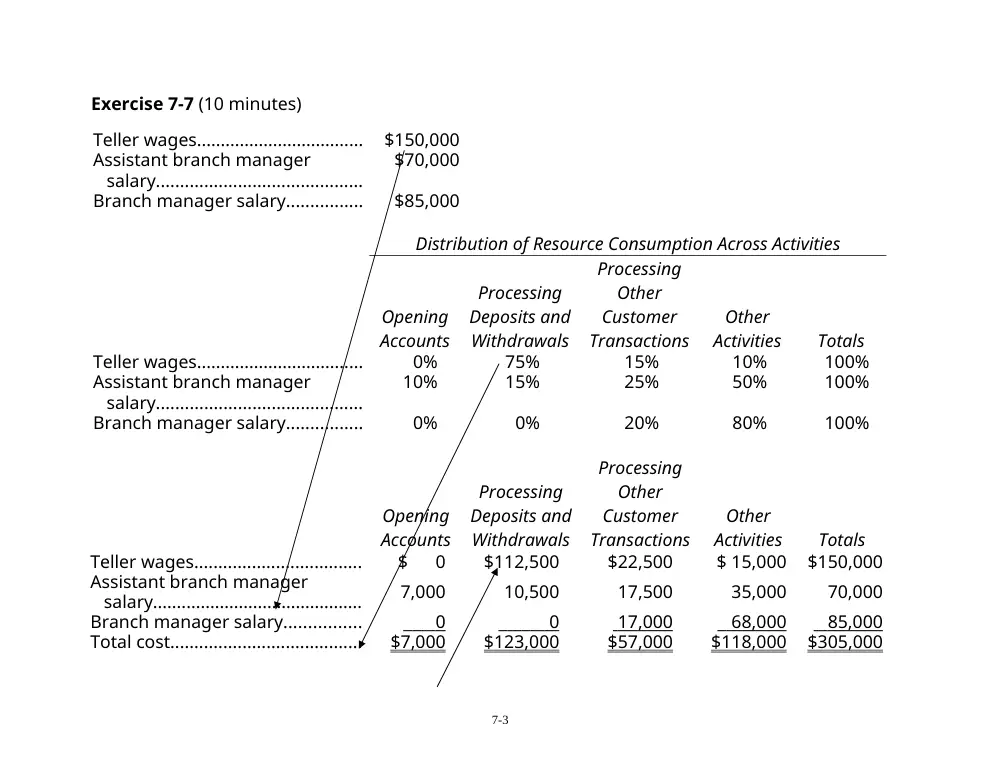
Exercise 7-7 (10 minutes)
Teller wages...................................
$150,000
Assistant branch manager
salary...........................................
$70,000
Branch manager salary................
$85,000
Distribution of Resource Consumption Across Activities
Opening
Accounts
Processing
Deposits and
Withdrawals
Processing
Other
Customer
Transactions
Other
Activities
Totals
Teller wages...................................
0%
75%
15%
10%
100%
Assistant branch manager
salary...........................................
10%
15%
25%
50%
100%
Branch manager salary................
0%
0%
20%
80%
100%
Opening
Accounts
Processing
Deposits and
Withdrawals
Processing
Other
Customer
Transactions
Other
Activities
Totals
Teller wages...................................
$ 0
$112,500
$22,500
$ 15,000
$150,000
Assistant branch manager
salary............................................
7,000
10,500
17,500
35,000
70,000
Branch manager salary................
0
0
17,000
68,000
85,000
Total cost........................................
$7,000
$123,000
$57,000
$118,000
$305,000
7-3
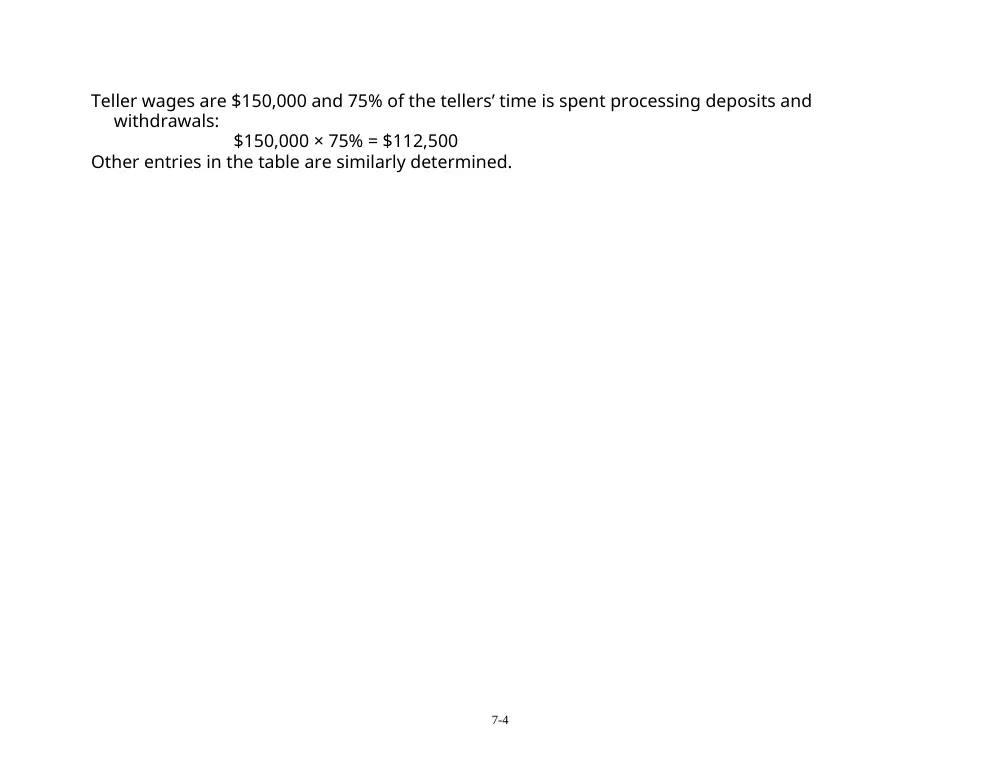
Teller wages are $150,000 and 75% of the tellers’ time is spent processing deposits and
withdrawals:
$150,000 × 75% = $112,500
Other entries in the table are similarly determined.
7-4
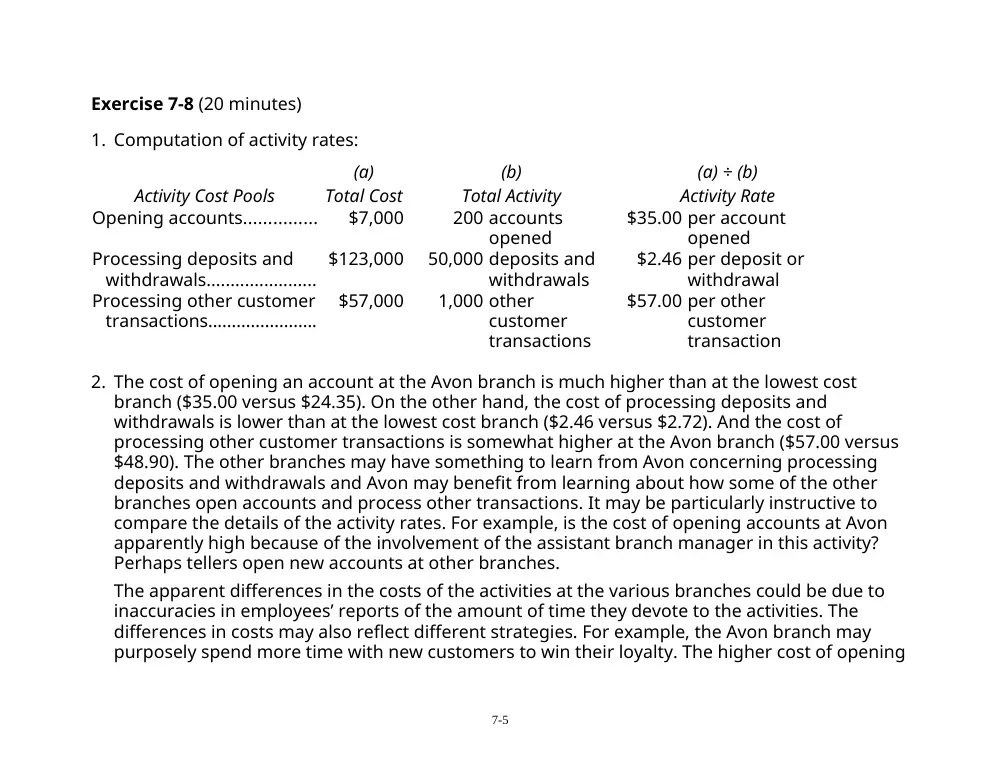
Exercise 7-8 (20 minutes)
1. Computation of activity rates:
Activity Cost Pools
(a)
Total Cost
(b)
Total Activity
(a) ÷ (b)
Activity Rate
Opening accounts...............
$7,000
200 accounts
opened
$35.00 per account
opened
Processing deposits and
withdrawals.......................
$123,000
50,000 deposits and
withdrawals
$2.46 per deposit or
withdrawal
Processing other customer
transactions.......................
$57,000
1,000 other
customer
transactions
$57.00 per other
customer
transaction
2. The cost of opening an account at the Avon branch is much higher than at the lowest cost
branch ($35.00 versus $24.35). On the other hand, the cost of processing deposits and
withdrawals is lower than at the lowest cost branch ($2.46 versus $2.72). And the cost of
processing other customer transactions is somewhat higher at the Avon branch ($57.00 versus
$48.90). The other branches may have something to learn from Avon concerning processing
deposits and withdrawals and Avon may benefit from learning about how some of the other
branches open accounts and process other transactions. It may be particularly instructive to
compare the details of the activity rates. For example, is the cost of opening accounts at Avon
apparently high because of the involvement of the assistant branch manager in this activity?
Perhaps tellers open new accounts at other branches.
The apparent differences in the costs of the activities at the various branches could be due to
inaccuracies in employees’ reports of the amount of time they devote to the activities. The
differences in costs may also reflect different strategies. For example, the Avon branch may
purposely spend more time with new customers to win their loyalty. The higher cost of opening
7-5
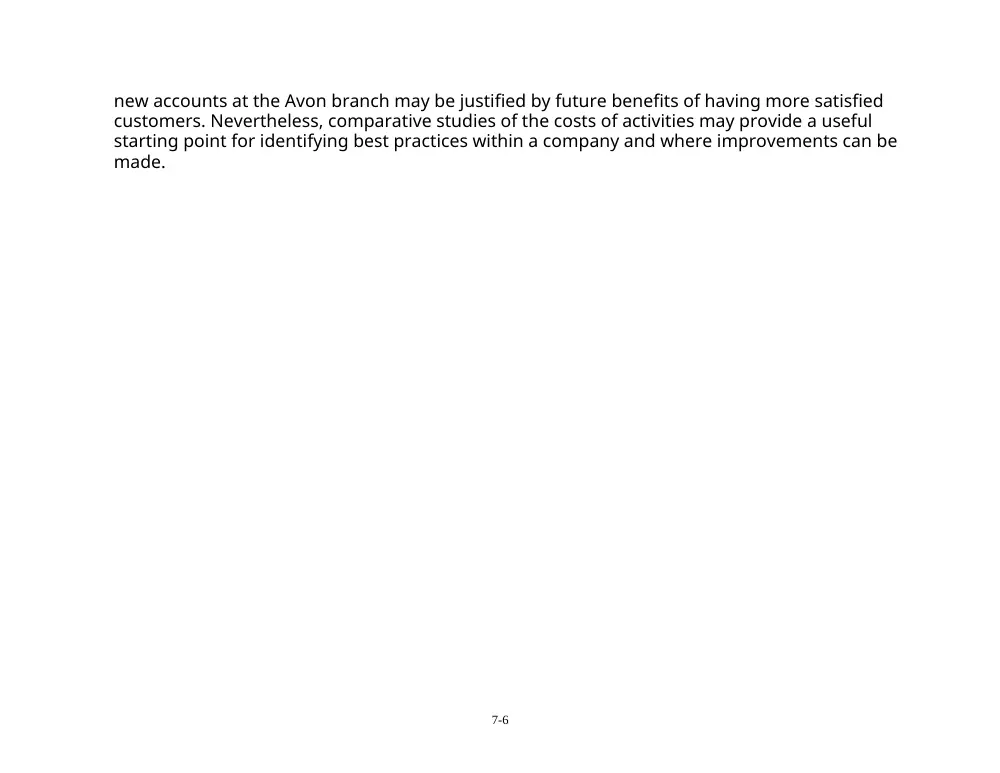
new accounts at the Avon branch may be justified by future benefits of having more satisfied
customers. Nevertheless, comparative studies of the costs of activities may provide a useful
starting point for identifying best practices within a company and where improvements can be
made.
7-6
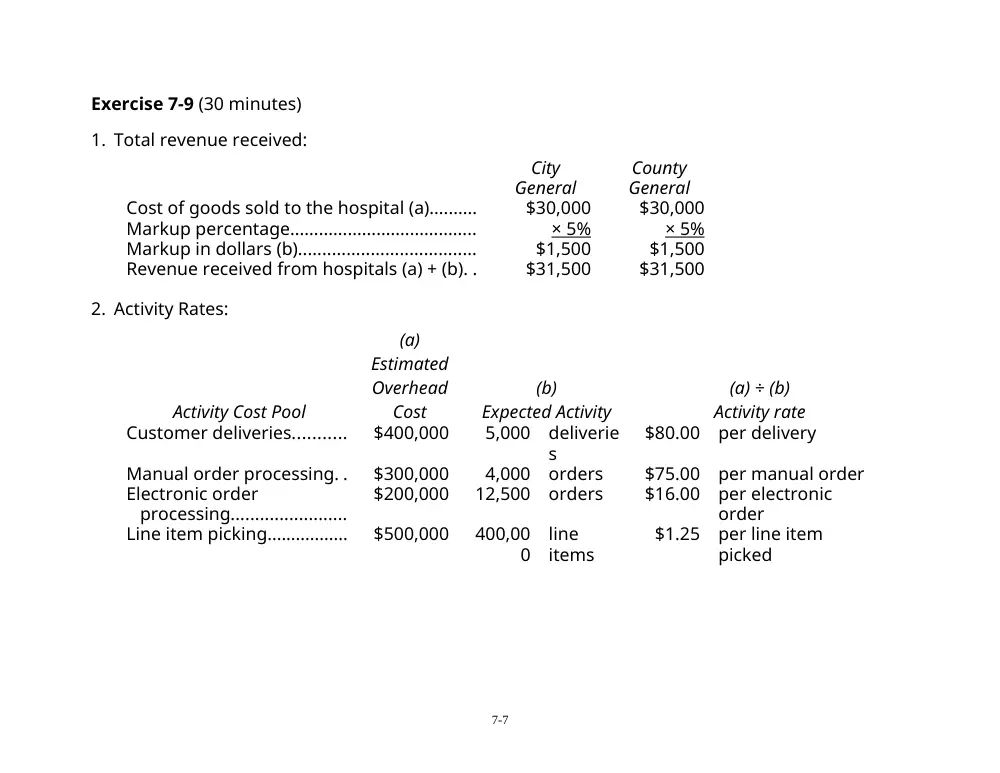
Exercise 7-9 (30 minutes)
1. Total revenue received:
City
General
County
General
Cost of goods sold to the hospital (a)..........
$30,000
$30,000
Markup percentage.......................................
×
5%
×
5%
Markup in dollars (b).....................................
$1,500
$1,500
Revenue received from hospitals (a) + (b). .
$31,500
$31,500
2. Activity Rates:
Activity Cost Pool
(a)
Estimated
Overhead
Cost
(b)
Expected Activity
(a) ÷ (b)
Activity rate
Customer deliveries...........
$400,000
5,000
deliverie
s
$80.00
per delivery
Manual order processing. .
$300,000
4,000
orders
$75.00
per manual order
Electronic order
processing........................
$200,000
12,500
orders
$16.00
per electronic
order
Line item picking.................
$500,000
400,00
0
line
items
$1.25
per line item
picked
7-7
Exercise 7-9 (continued)
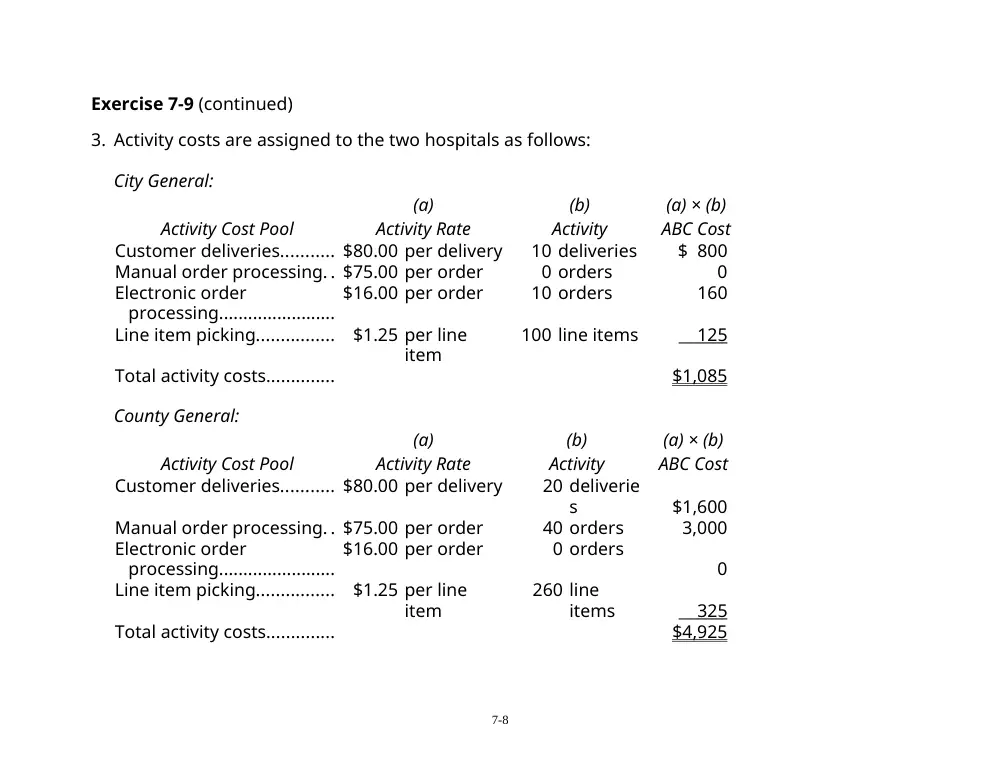
3. Activity costs are assigned to the two hospitals as follows:
City General:
Activity Cost Pool
(a)
Activity Rate
(b)
Activity
(a) × (b)
ABC Cost
Customer deliveries........... $80.00 per delivery
10 deliveries
$ 800
Manual order processing. . $75.00 per order
0 orders
0
Electronic order
processing........................
$16.00 per order
10 orders
160
Line item picking................
$1.25 per line
item
100 line items
125
Total activity costs..............
$1,085
County General:
Activity Cost Pool
(a)
Activity Rate
(b)
Activity
(a) × (b)
ABC Cost
Customer deliveries........... $80.00 per delivery
20 deliverie
s
$1,600
Manual order processing. . $75.00 per order
40 orders
3,000
Electronic order
processing........................
$16.00 per order
0 orders
0
Line item picking................
$1.25 per line
item
260 line
items
325
Total activity costs..............
$4,925
7-8
Exercise 7-9 (continued)
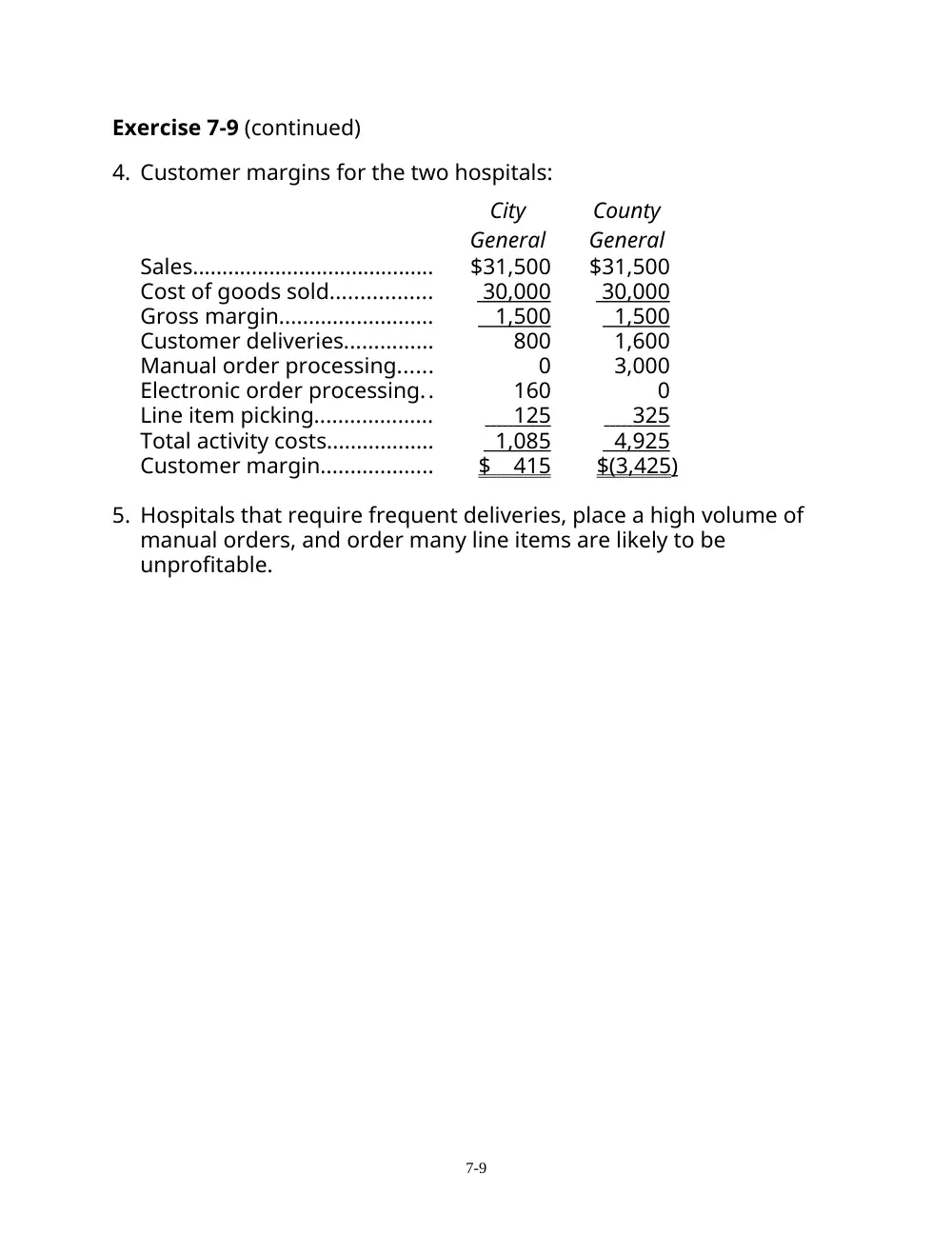
4. Customer margins for the two hospitals:
City
General
County
General
Sales.........................................
$31,500
$31,500
Cost of goods sold.................
30,000
30,000
Gross margin..........................
1,500
1,500
Customer deliveries...............
800
1,600
Manual order processing......
0
3,000
Electronic order processing..
160
0
Line item picking....................
125
325
Total activity costs..................
1,085
4,925
Customer margin...................
$ 415
$(3,425)
5. Hospitals that require frequent deliveries, place a high volume of
manual orders, and order many line items are likely to be
unprofitable.
7-9
Exercise 7-11 (30 minutes)
1. First-stage allocations of overhead costs to the activity cost pools:
Distribution of Resource Consumption
Across Activity Cost Pools
Direct Labor
Support
Order
Processing
Customer
Support
Other
Totals
Wages and salaries.........
30%
35%
25%
10%
100%
Other overhead costs.....
25%
15%
20%
40%
100%
Direct Labor
Support
Order
Processing
Customer
Support
Other
Totals
Wages and salaries.........
$105,000
$122,500
$ 87,500
$ 35,000
$350,000
Other overhead costs.....
50,000
30,000
40,000
80,000
200,000
Total cost..........................
$155,000
$152,500
$127,500
$115,000
$550,000
Example: 30% of $350,000 is $105,000.
2. Computation of activity rates:
Activity Cost Pools
(a)
Total Cost
(b)
Total Activity
(a) ÷ (b)
Activity Rate
Direct labor support.......
$155,000 10,000 DLHs
$15.50 per DLH
Order processing............
$152,500
500 orders
$305 per order
Customer support..........
$127,500
100 customers $1,275 per customer
7-10
Exercise 7-11 (continued)
3. Computation of the overhead costs for the Indus Telecom order:
Activity Cost Pool
(a)
Activity Rate
(b)
Activity
(a) × (b)
ABC Cost
Direct labor
support.............. $15.50 per DLH
50 DLHs*
$ 775
Order processing
$305 per order
1 orders
305
Customer
support..............
$1,275 per
customer
1
custome
r
1,275
Total......................
$2,355
*0.5 DLH per unit × 100 units = 50 DLHs
4. The customer margin for Indus Telecom is computed as follows:
Customer Margin—ABC Analysis
Sales (100 units × $295 per unit)..................
$29,500
Costs:
Direct materials ($264 per unit × 100
units).............................................................
$26,400
Direct labor ($25 per DLH × 0.5 DLH per
unit × 100 units)...........................................
1,250
Direct labor support overhead (see part 3
above)...........................................................
775
Order processing overhead (see part 3
above)...........................................................
305
Customer support overhead (see part 3
above)...........................................................
1,275
30,005
Customer margin.............................................
$(
505
)
7-11
Exercise 7-12 (30 minutes)
1. Activity rates are computed as follows:
Activity Cost Pool
(a)
Estimated
Overhead Cost
(b)
Expected
Activity
(a) ÷ (b)
Activity
Rate
Machine setups......
$21,600
180
setup
s
$120 per setup
Special processing..
$180,000
4,000 MHs
$45 per MH
General factory.......
$288,000
24,000 DLHs
$12 per DLH
2. Overhead is assigned to the two products as follows:
Rims:
Activity Cost Pool
(a)
Activity Rate
(b)
Activity
(a) × (b)
ABC Cost
Machine setups......................
$120 per setup
100 setups
$ 12,000
Special processing.................
$45 per MH
4,000 MHs
180,000
General factory.......................
$12 per DLH
8,000 DLHs
96,000
Total.........................................
$288,000
Posts:
Activity Cost Pool
(a)
Activity Rate
(b)
Activity
(a) × (b)
ABC Cost
Machine setups......................
$120 per setup
80 setups
$ 9,600
Special processing.................
$45 per MH
0 MHs
0
General factory.......................
$12 per DLH
16,000 DLHs
192,000
Total.........................................
$201,600
7-12
Exercise 7-12 (continued)
Rims
Posts
Direct materials.....................................
$17.00
$10.00
Direct labor:
$16 per DLH × 0.40 DLHs per unit....
6.40
$16 per DLH × 0.20 DLHs per unit....
3.20
Overhead:
$288,000 ÷ 20,000 units.....................
14.40
$201,600 ÷ 80,000 units.....................
2.52
Unit cost..................................................
$37.80
$15.72
7-13
Exercise 7-13 (15 minutes)
Customer Margin—ABC Analysis
Sales (2,400 seats × $137.95 per seat)..............
$331,080
Costs:
Direct materials ($112 per seat × 2,400 seats)
$268,800
Direct labor ($14.40 per seat × 2,400 seats)....
34,560
Supporting direct labor ($12 per DLH × 0.8
DLH per seat × 2,400 seats)............................
23,040
Batch processing ($96 per batch × 4 batches)
384
Order processing ($284 per order × 1 order)..
284
Customer service overhead ($2,620 per
customer × 1 customer)..................................
2,620
329,688
Customer margin..................................................
$ 1,392
7-14
Problem 7-16 (20 minutes)
1. The cost of serving the local commercial market according to the ABC model can be determined
as follows:
Activity Cost Pool
(a)
Activity Rate
(b)
Activity
(a) × (b)
ABC Cost
Animation concept.......
$6,000 per proposal
20 proposals
$120,000
Animation production..
$7,700 per minute of
animation
12 minutes
92,400
Contract
administration...........
$6,600 per contract
8 contracts
52,800
$265,200
2. The margin earned serving the local commercial market is negative, as shown below:
Profitability Analysis
Sales..........................................................
$240,000
Costs:
Animation concept............................... $120,000
Animation production..........................
92,400
Contract administration.......................
52,800
265,200
Margin......................................................
$(25,200)
3. It appears that the local commercial market is losing money and the company would be better
off dropping this market segment. However, not all of the costs included above may be
avoidable. If more than $25,200 of the total costs of $265,200 is not avoidable, then the
company really isn’t losing money on the local commercial market and the segment should not
be dropped. These issues will be discussed in more depth in later chapters.
7-15
7-16
Problem 7-17 (45 minutes)
1. Under the traditional direct labor-dollar based costing system,
manufacturing overhead is applied to products using the
predetermined overhead rate computed as follows:
The product margins using the traditional approach would be
computed as follows:
EX300
TX500
Total
Sales.......................................
$1,200,00
0
$500,000
$1,700,000
Direct materials.....................
366,325
162,550
528,875
Direct labor............................
120,000
42,500
162,500
Manufacturing overhead
applied @ $3.13 per
direct labor-dollar..............
375,600
133,025
508,625
Total manufacturing cost....
861,925
338,075
1,200,000
Product margin.....................
$ 338,075
$161,925
$ 500,000
Note that all of the manufacturing overhead cost is applied to the
products under the company’s traditional costing system.
7-17
Problem 7-17 (continued)
2. The first step is to determine the activity rates:
Activity Cost Pools
(a)
Total
Cost
(b)
Total Activity
(a) ÷ (b)
Activity Rate
Machining.............
$198,25
0
152,500 MHRs
$1.30 per MHR
Setups....................
$150,00
0
375 setup hrs.
$400 per setup
hr.
Product sustaining $100,00
0
2 products
$50,000 per product
*The Other activity cost pool is not shown above because it includes
organization-sustaining and idle capacity costs that should not be
assigned to products.
Under the activity-based costing system, the product margins would
be computed as follows:
EX300
TX500
Total
Sales.............................
$1,200,00
0
$500,000
$1,700,00
0
Direct materials..........
366,325
162,550
528,875
Direct labor.................
120,000
42,500
162,500
Advertising expense. .
50,000
100,000
150,000
Machining...................
117,000
81,250
198,250
Setups..........................
30,000
120,000
150,000
Product sustaining.....
50,000
50,000
100,000
Total cost.....................
733,325
556,300
1,289,625
Product margin..........
$ 466,675
$(56,300)
$ 410,375
7-18
Problem 7-17 (continued)
3. The quantitative comparison is as follows:
EX300
TX500
Total
Traditional Cost System
(a)
Amount
(a) ÷ (c)
%
(b)
Amount
(b) ÷ (c)
%
(c)
Amount
Direct materials...................................
$366,32
5
69.3%
$162,55
0
30.7%
$ 528,875
Direct labor...........................................
120,000
73.8%
42,500
26.2%
162,500
Manufacturing overhead....................
375,600
73.8%
133,025
26.2%
508,625
Total cost assigned to products........
$861,92
5
$338,07
5
1,200,000
Selling and administrative..................
550,000
Total cost..............................................
$1,750,00
0
Activity-Based Costing System
Direct costs:
Direct materials................................
$366,32
5
69.3%
$162,55
0
30.7%
$ 528,875
Direct labor........................................
120,000
73.8%
42,500
26.2%
162,500
Advertising expense.........................
50,000
33.3%
100,000
66.7%
150,000
Indirect costs:
Machining..........................................
117,000
59.0%
81,250
41.0%
198,250
Setups................................................
30,000
20.0%
120,000
80.0%
150,000
Product sustaining...........................
50,000
50.0%
50,000
50.0%
100,000
Total cost assigned to products........
$733,32
5
$556,30
0
1,289,625
7-19
Costs not assigned to products:
Selling and administrative...............
400,000
Other..................................................
60,375
Total cost..............................................
$1,750,00
0
7-20
Problem 7-17 (continued)
The traditional and activity-based cost assignments differ for three
reasons. First, the traditional system assigns all $508,625 of
manufacturing overhead to products. The ABC system assigns only
$448,250 of manufacturing overhead to products. The ABC system
does not assign the $60,375 of Other activity costs to products
because they represent organization-sustaining costs. Second, the
traditional system uses one unit-level activity measure, direct labor
dollars, to assign 73.9% of all overhead to the EX300 product line
and 26.1% of all overhead to the TX500 product line. The ABC
system assigns 59.0% of Machining costs to the EX300 product line
and 41.0% to the TX500 product line. The ABC system assigns 20.0%
of Setup costs (a batch-level activity) to the EX300 product line and
80.0% to the TX500 product line. The ABC system assigns 50% of
Product sustaining costs (a product-level activity) to each product
line. Third, the traditional system does not trace any advertising
expenses to the two products. The ABC system traces $50,000 of
advertising to the EX300 and $100,000 of advertising to the TX500
product line.
7-21
Problem 7-18 (45 minutes)
1. Under the traditional direct labor-hour based costing system,
manufacturing overhead is applied to products using the
predetermined overhead rate computed as follows:
*25,000 units of Xactive @ 1.4 DLH per unit + 75,000 units of the
Pathbreaker @ 1.0 DLH per unit = 35,000 DLHs + 75,000 DLHs =
110,000 DLHs
Consequently, the product margins using the traditional approach
would be computed as follows:
Xactive
Pathbreaker
Total
Sales.......................................
$3,175,00
0
$6,675,000
$9,850,000
Direct materials.....................
1,620,000
3,825,000
5,445,000
Direct labor............................
455,000
975,000
1,430,000
Manufacturing overhead
applied @ $20.00 per
direct labor-hour................
700,000
1,500,000
2,200,000
Total manufacturing cost....
2,775,000
6,300,000
9,075,000
Product margin.....................
$ 400,000
$ 375,000
$ 775,000
Note that all of the manufacturing overhead cost is applied to the
products under the company’s traditional costing system.
7-22
Problem 7-18 (continued)
2. The first step is to determine the activity rates:
Activity Cost Pools
(a)
Total
Cost
(b)
Total Activity
(a) ÷ (b)
Activity Rate
Supporting direct
labor....................
$797,50
0 110,000 DLHs
$7.25 per DLH
Batch setups.........
$680,00
0
400 setups
$1,700 per setup
Product
sustaining...........
$650,00
0
2 products
$325,00
0
per
product
*The Other activity cost pool is not shown above because it includes
organization-sustaining and idle capacity costs that should not be
assigned to products.
Under the activity-based costing system, the product margins would
be computed as follows:
Xactive
Pathbreaker
Total
Sales....................................
$3,175,000
$6,675,000
$9,850,000
Direct materials.................
1,620,000
3,825,000
5,445,000
Direct labor........................
455,000
975,000
1,430,000
Supporting direct labor....
253,750
543,750
797,500
Batch setups......................
425,000
255,000
680,000
Product sustaining............
325,000
325,000
650,000
Total cost............................
3,078,750
5,923,750
9,002,500
Product margin.................
$ 96,250
$ 751,250
$ 847,500
7-23
Problem 7-18 (continued)
3. The quantitative comparison is as follows:
Xactive
Pathbreaker
Total
Traditional Cost System
(a)
Amount
(a) ÷ (c)
%
(b)
Amount
(b) ÷ (c)
%
(c)
Amount
Direct materials...........................
$1,620,00
0
29.8%
$3,825,00
0
70.2%
$5,445,00
0
Direct labor..................................
455,000
31.8%
975,000
68.2%
1,430,000
Manufacturing overhead...........
700,000
31.8%
1,500,000
68.2%
2,200,000
Total cost assigned to
products....................................
$2,775,00
0
$6,300,00
0
$9,075,00
0
Activity-Based Costing System
Direct costs:
Direct materials........................
$1,620,00
0
29.8%
$3,825,00
0
70.2%
$5,445,00
0
Direct labor...............................
455,000
31.8%
975,000
68.2%
1,430,000
Indirect costs:
Supporting direct labor...........
253,750
31.8%
543,750
68.2%
797,500
Batch setups.............................
425,000
62.5%
255,000
37.5%
680,000
Product sustaining...................
325,000
50.0%
325,000
50.0%
650,000
Total cost assigned to
products....................................
$3,078,75
0
$5,923,75
0
9,002,500
Costs not assigned to
products:
Other..........................................
72,500
Total cost......................................
$9,075,00
7-24
0
7-25
Problem 7-18 (continued)
The traditional and activity-based cost assignments differ for two
reasons. First, the traditional system assigns all $2,200,000 of
manufacturing overhead to products. The ABC system assigns only
$2,127,500 of manufacturing overhead to products. The ABC system
does not assign the $72,500 of Other activity costs to products
because they represent organization-sustaining and idle capacity
costs. Second, the traditional system uses one unit-level activity
measure, direct labor hours, to assign 31.8% of all overhead to the
Xactive product line and 68.2% of all overhead to the Pathbreaker
product line. The ABC system assigns 62.5% of Batch setup costs (a
batch-level activity) to the Xactive product line and 37.5% to the
Pathbreaker product line. The ABC system assigns 50% of Product
sustaining costs (a product-level activity) to each product line.
7-26