
CMPS 251 Final, Fall 2000
American University of Beirut · Numerical Computing · 2 pages
More CMPS 251 files
Show the text of this final exam
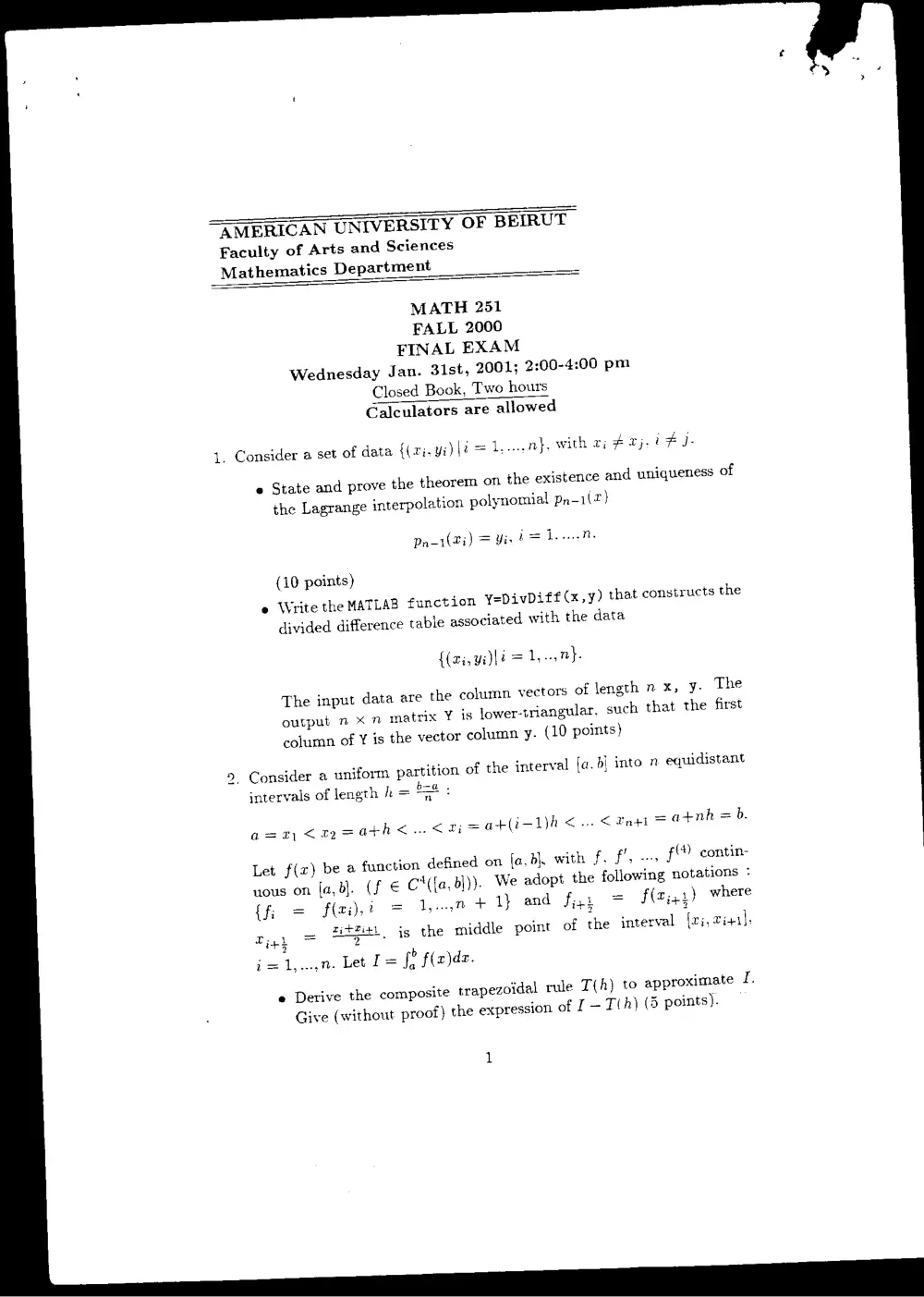
AMERICAN UNIVERSITY OF BEIRUT
Faculty of Arts and Sciences
Mathematics Department
MATH 251
FALL 2000
FINAL EXAM
Wednesday Jan. 31st, 2001; 2:00-4:00 pm
Closed Book, Two hours
Calculators are allowed
1. Consider a set of data {rey = 1... np. with o) # Tj. i#xj-
e State and prove the theorem on the existence and uniqueness of
the Lagrange interpolation polynomial Pn-1(2)
Pn-U@i) = Yas P= Levee
(10 points)
e Write the MATLAB function Y=DivDiff (x,y) that constructs the
divided difference table associated with the data
{(2iys)li = 11}.
The input data are the column vectors of length n x, J. The
output nx 7 matrix Y is lower-triangular, such that the first
column of ¥ is the vector column y. (10 points)
2. Consider a uniform partition of the interval [a.}] into n equidistant
intervals of length h = boa :
as7r< 22 =ath<..<ri= at(i-l)h <.. <2nti = atnh = b.
Let f(z) be a function defined on [a,b], with f. fly wes f contin-
uous on [a,d}. (f € C*([a,d])). We adopt the following notations :
{fi = fled.t = Lean + 1 and fig = f(z.4) where
= wttit1 is the middle point of the interval (ri. vival
z; 2
L
2
jalan. Let D= ff f(x)de.
e Derive the composite trapezoidal rule T(h) to approximate f.
Give (without proof} the expression of I — Th) (5 points).
1
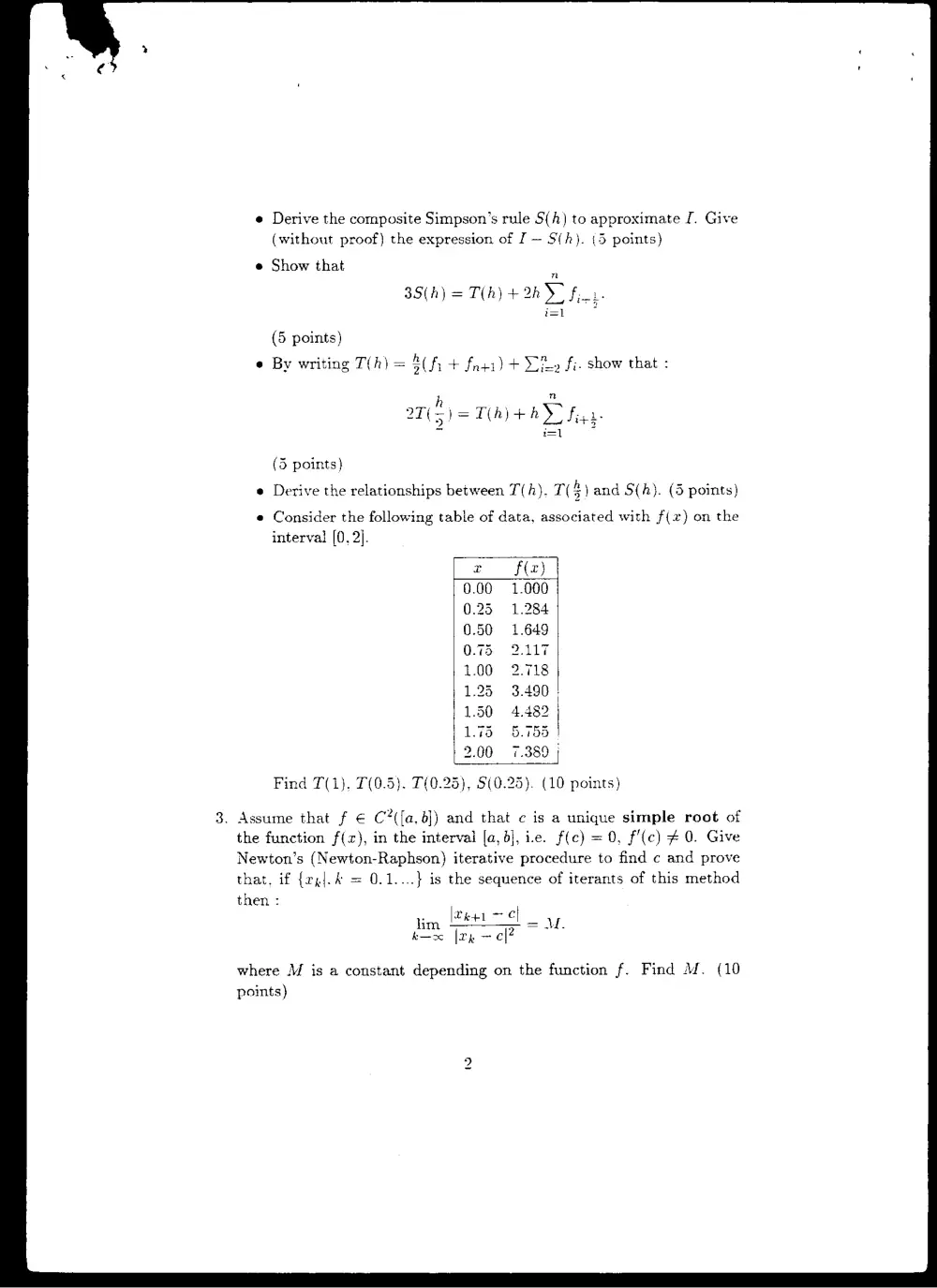
Derive the composite Simpson’s rule S(h) to approximate I. Give
(without proof} the expression of I — S(h). (5 points)
Show that
35(h) = T(h) + 2k fio.
t=] .
(5 points)
By writing T(h) = 8(f1 + fati) + De fi. show that :
} nm
2T(5) = Ta) +h figs
- i=l
(5 points)
Derive the relationships between T(h). T( 4) and S(h). (5 points)
Consider the following table of data, associated with f(x) on the
interval [0,2].
2 fl)
0.00 1.000
0.25 1.284
0.50 1.649
0.75 2.117
1.00 2.718
1.25 3.490 »
1.50 4.482
1.75 5.755
2.00 7.389 |
Find T(1). T(0.5). T(0.25), $(0.25). (10 points)
3. Assume that f € C?({a,d]) and that c is a unique simple root of
the function f(z), in the interval [a, d], i.e. f(c) = 0, f'(c) #0. Give
Newton’s (Newton-Raphson) iterative procedure to find c and prove
that, if {rg].4 = 0.1....} is the sequence of iterants of this method
then :
tim Matic yy,
kx |rR _ e|?
where M is a constant depending on the function f. Find M. (10
points)