
CMPS 251 Final, Fall 2013
American University of Beirut · Numerical Computing · 10 pages · Dr. Wadi' Jureidini


More CMPS 251 files
Show the text of this final exam
Page | 1
Faculty of Arts & Sciences
Department of Computer Science
CMPS 251—Numerical Computing
Fall 2013–14
Friday, Dec 20th, 2013
Instructions
Write your name, Id number, and your major in the space provided above.
THE EXAM IS CLOSED BOOK, CLOSED NOTES, & “CLOSED NEIGHBOR”!!
Your answers must be presented on the question sheet itself. Your handwriting should be readable so it can be
graded. Use the provided space for your answers. If the space is not enough, then most probably you are writing
more than what is expected. In case you need more space, put an “explicit pointer” to where your answer is
written or continued (e.g. draw an arrow, or say back of page or both !!!…)
There are 8 problems altogether and 10 pages (including this front page). You may use the back of the sheets
for scratch work.
DO NOT CUT OFF ANY PAGE !!
Family Name
First Name
Id. Num
Major
FINAL EXAM Duration: 90 Minutes
Problem
Grade
Your Grade
1
20
2
10
3
25
4
10
5
15
6
15
7
25
8
10
Total
130
Page | 2
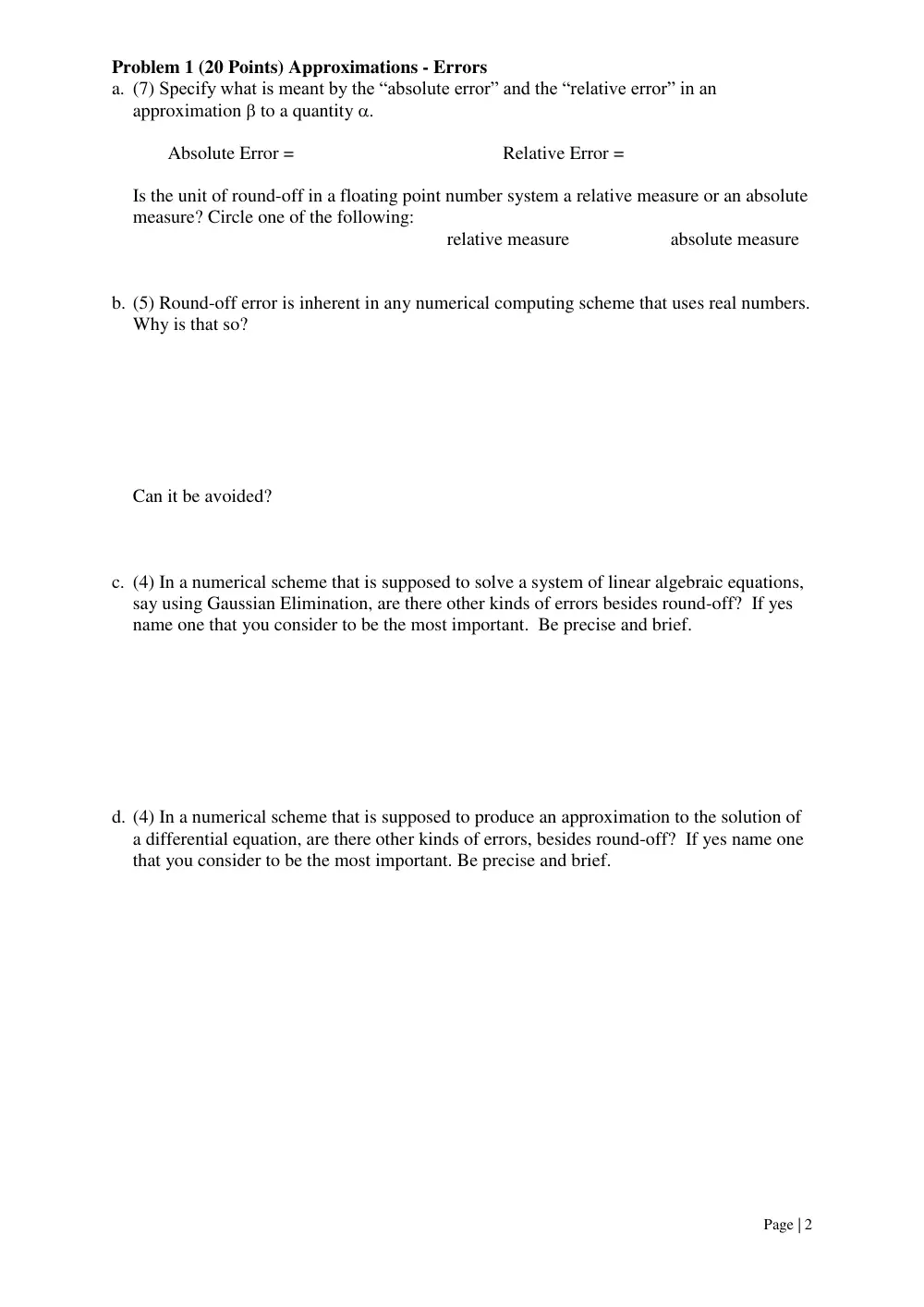
Problem 1 (20 Points) Approximations - Errors
a. (7) Specify what is meant by the “absolute error” and the “relative error” in an
approximation to a quantity .
Absolute Error =
Relative Error =
Is the unit of round-off in a floating point number system a relative measure or an absolute
measure? Circle one of the following:
relative measure
absolute measure
b. (5) Round-off error is inherent in any numerical computing scheme that uses real numbers.
Why is that so?
Can it be avoided?
c. (4) In a numerical scheme that is supposed to solve a system of linear algebraic equations,
say using Gaussian Elimination, are there other kinds of errors besides round-off? If yes
name one that you consider to be the most important. Be precise and brief.
d. (4) In a numerical scheme that is supposed to produce an approximation to the solution of
a differential equation, are there other kinds of errors, besides round-off? If yes name one
that you consider to be the most important. Be precise and brief.
Page | 3
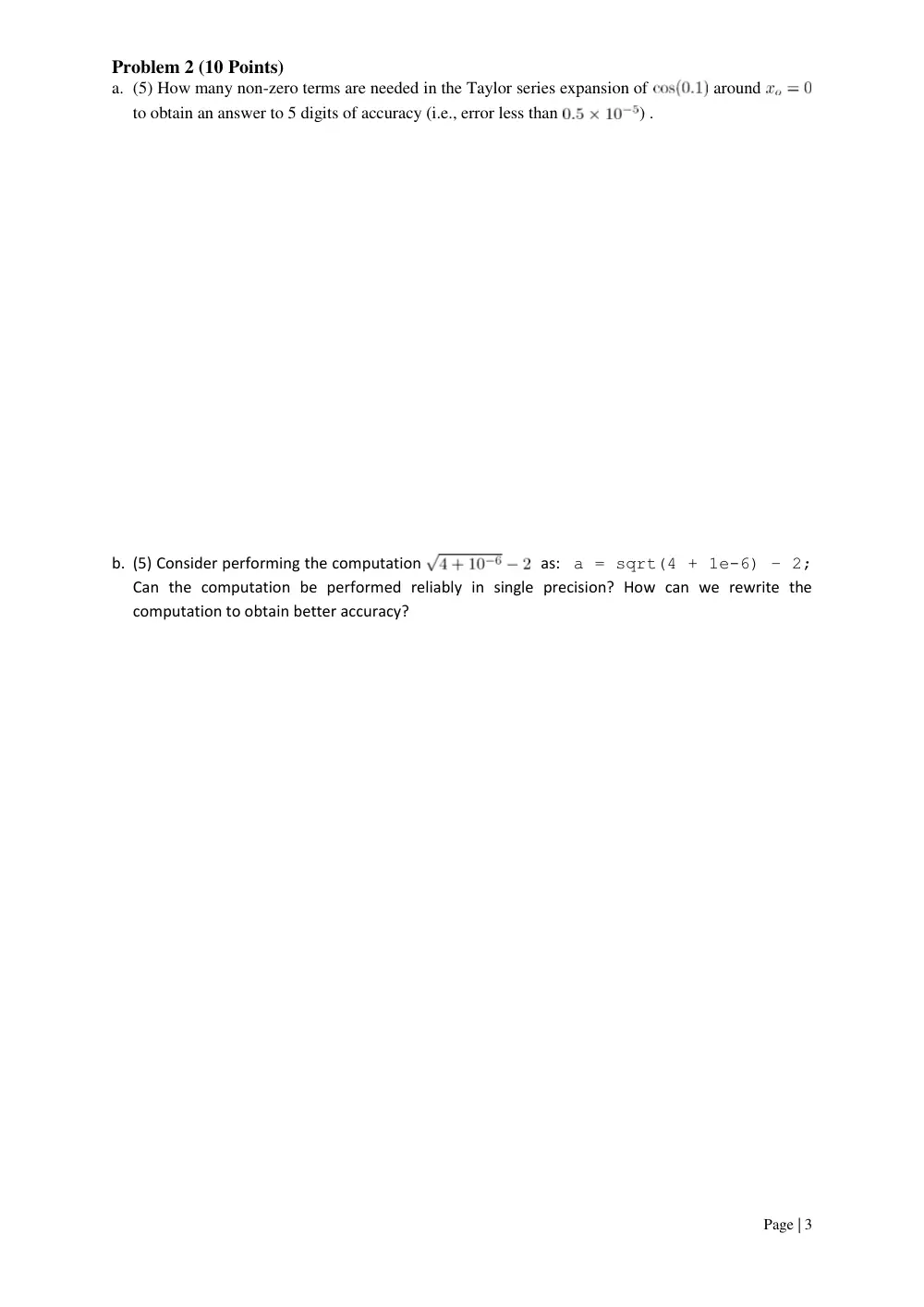
Problem 2 (10 Points)
a. (5) How many non-zero terms are needed in the Taylor series expansion of
around
to obtain an answer to 5 digits of accuracy (i.e., error less than
) .
b. (5) Consider performing the computation
as: a = sqrt(4 + 1e-6) – 2;
Can the computation be performed reliably in single precision? How can we rewrite the
computation to obtain better accuracy?
Page | 4
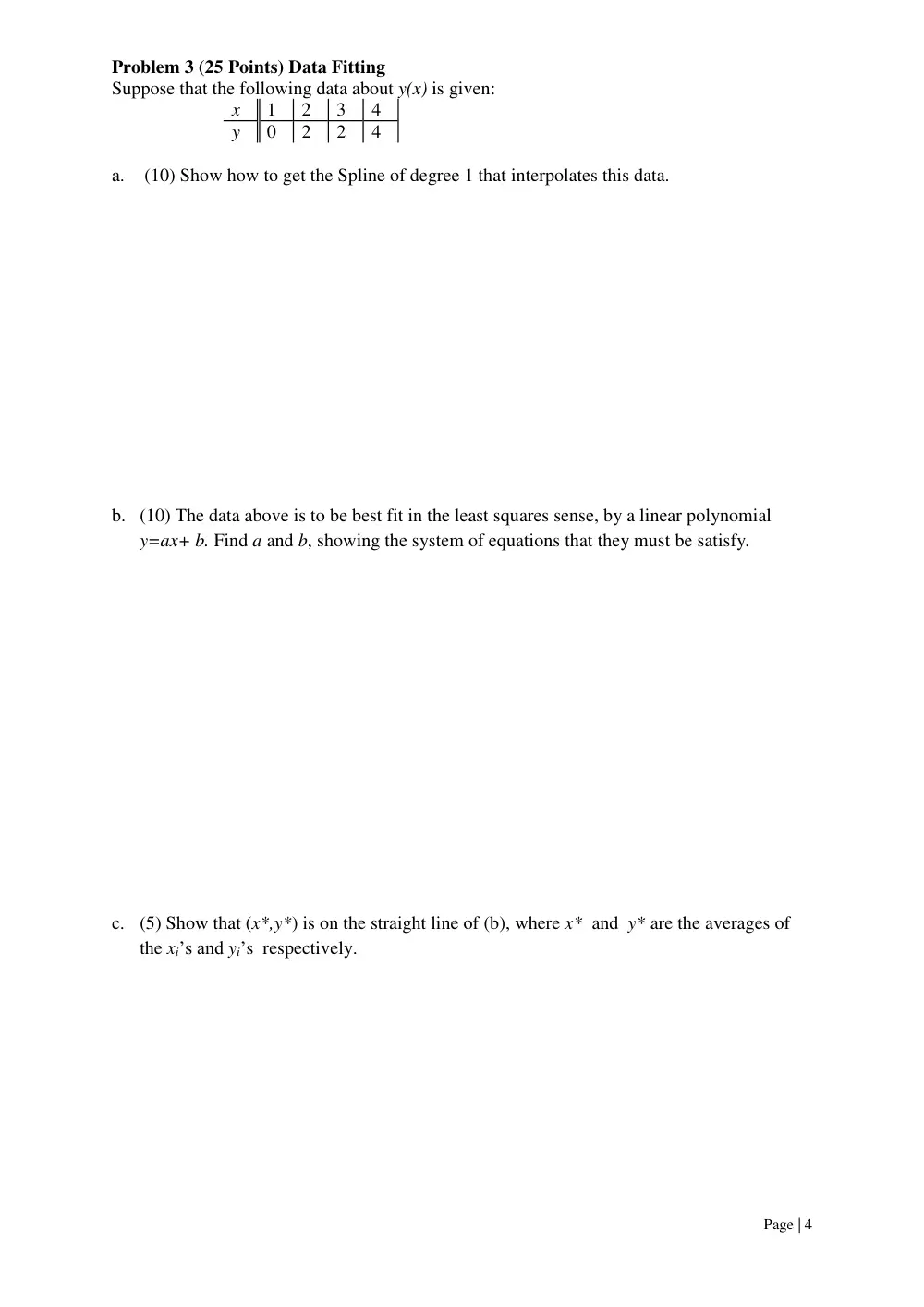
Problem 3 (25 Points) Data Fitting
Suppose that the following data about y(x) is given:
x
1
2
3
4
y
0
2
2
4
a. (10) Show how to get the Spline of degree 1 that interpolates this data.
b. (10) The data above is to be best fit in the least squares sense, by a linear polynomial
y=ax+ b. Find a and b, showing the system of equations that they must be satisfy.
c. (5) Show that (x*,y*) is on the straight line of (b), where x* and y* are the averages of
the xi’s and yi’s respectively.
Page | 5
Problem 4 (10 Points) Cubic Spline
Do there exist a, b, c, and d such that the function
-x
(-10 x -1)
S(x) =
a x3 + bx2 + cx + d
(-1 x 1)
x
(1 x 10)
is a natural cubic spline? Justify your answer.
Page | 6
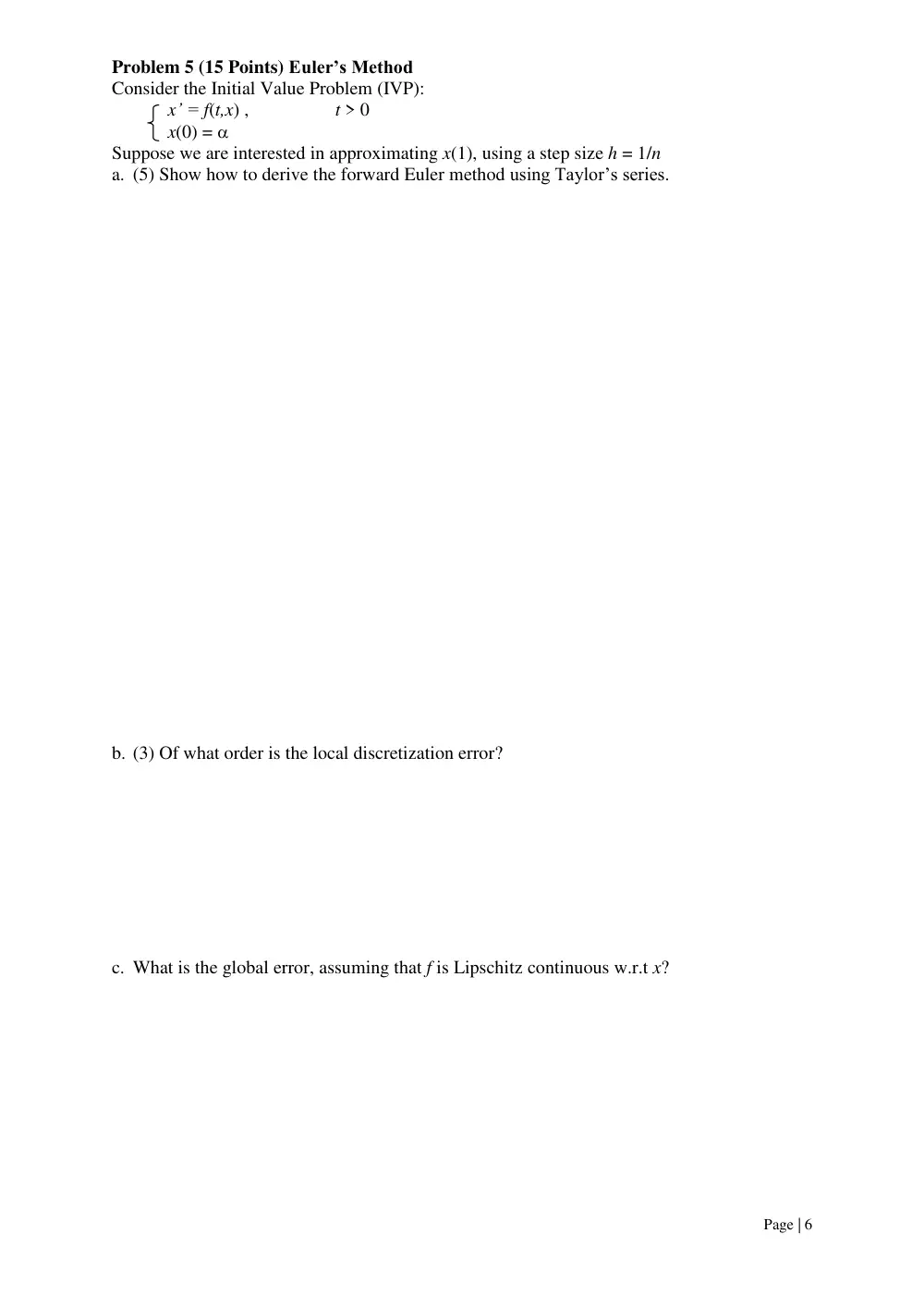
Problem 5 (15 Points) Euler’s Method
Consider the Initial Value Problem (IVP):
x’ = f(t,x) ,
t > 0
x(0) =
Suppose we are interested in approximating x(1), using a step size h = 1/n
a. (5) Show how to derive the forward Euler method using Taylor’s series.
b. (3) Of what order is the local discretization error?
c. What is the global error, assuming that f is Lipschitz continuous w.r.t x?
Page | 7
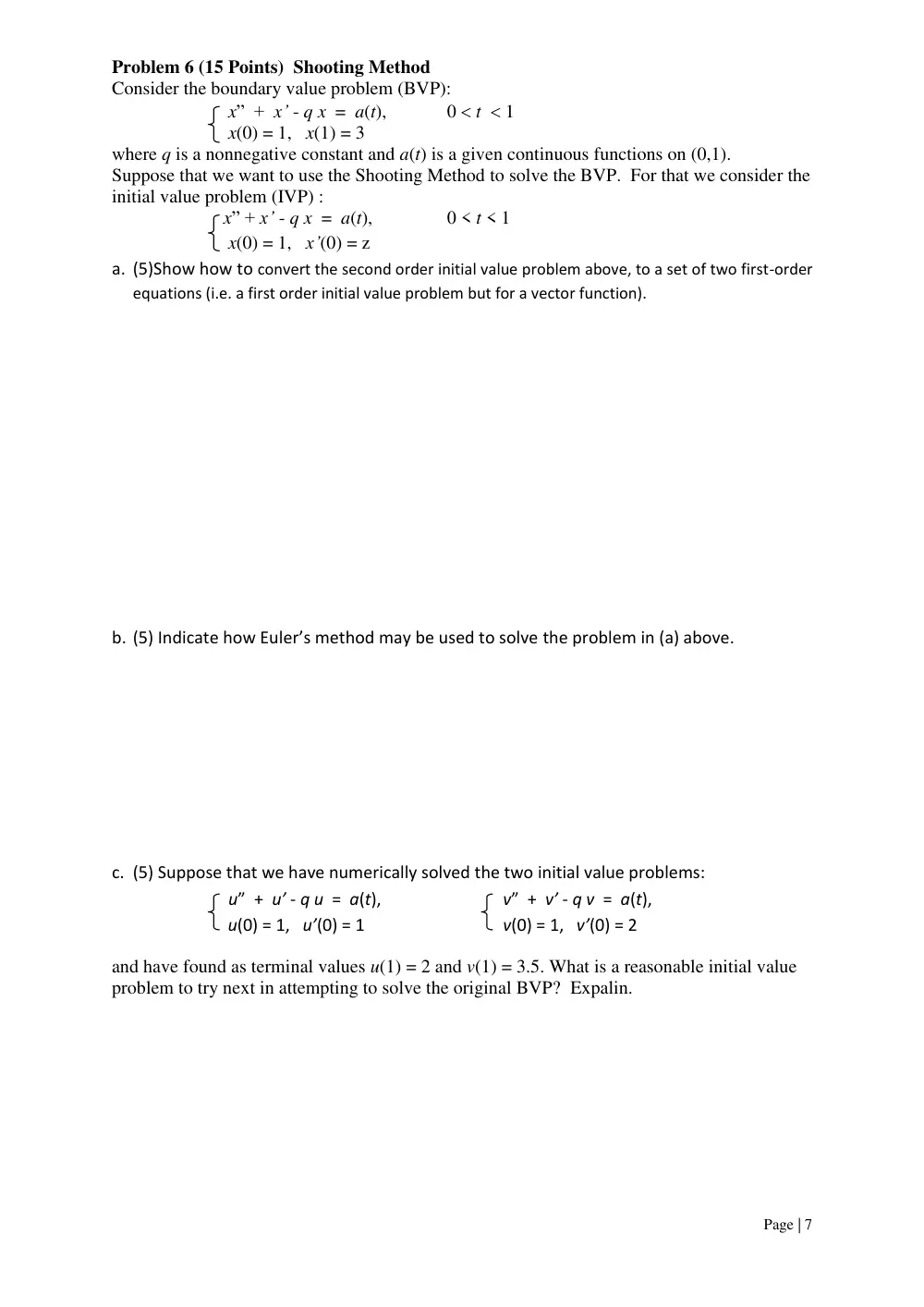
Problem 6 (15 Points) Shooting Method
Consider the boundary value problem (BVP):
x” + x’ - q x = a(t),
0 t 1
x(0) = 1, x(1) = 3
where q is a nonnegative constant and a(t) is a given continuous functions on (0,1).
Suppose that we want to use the Shooting Method to solve the BVP. For that we consider the
initial value problem (IVP) :
x” + x’ - q x = a(t),
0 < t < 1
x(0) = 1, x’(0) = z
a. (5)Show how to convert the second order initial value problem above, to a set of two first-order
equations (i.e. a first order initial value problem but for a vector function).
b. (5) Indicate how Euler’s method may be used to solve the problem in (a) above.
c. (5) Suppose that we have numerically solved the two initial value problems:
u” + u’ - q u = a(t),
v” + v’ - q v = a(t),
u(0) = 1, u’(0) = 1
v(0) = 1, v’(0) = 2
and have found as terminal values u(1) = 2 and v(1) = 3.5. What is a reasonable initial value
problem to try next in attempting to solve the original BVP? Expalin.
Page | 8
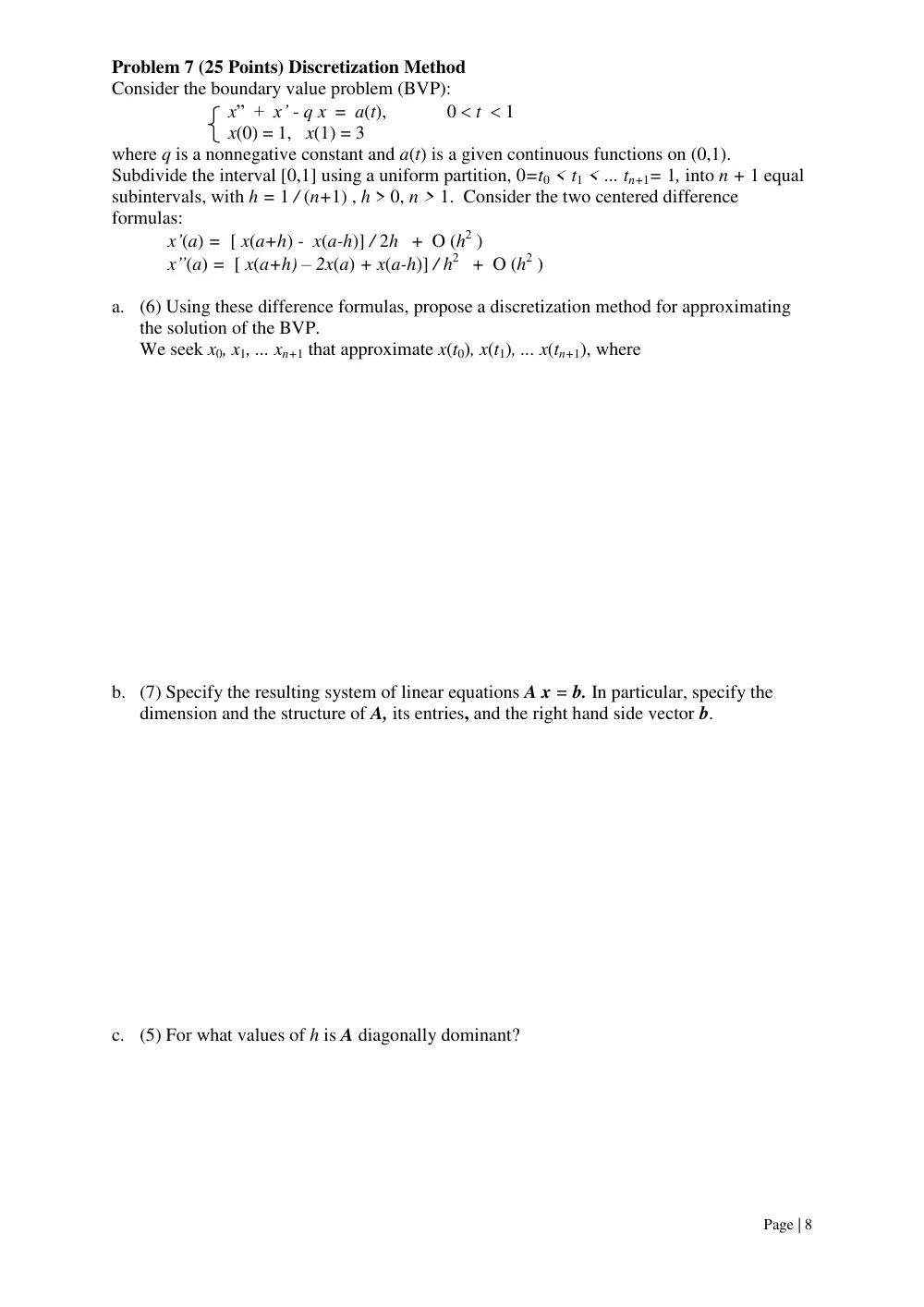
Problem 7 (25 Points) Discretization Method
Consider the boundary value problem (BVP):
x” + x’ - q x = a(t),
0 t 1
x(0) = 1, x(1) = 3
where q is a nonnegative constant and a(t) is a given continuous functions on (0,1).
Subdivide the interval [0,1] using a uniform partition, 0=t0 < t1 < ... tn+1= 1, into n + 1 equal
subintervals, with h = 1 / (n+1) , h > 0, n > 1. Consider the two centered difference
formulas:
x’(a) = [ x(a+h) - x(a-h)] / 2h + O (h )
x”(a) = [ x(a+h) – 2x(a) + x(a-h)] / h2 + O (h )
a. (6) Using these difference formulas, propose a discretization method for approximating
the solution of the BVP.
We seek x0, x1, ... xn+1 that approximate x(t0), x(t1), ... x(tn+1), where
b. (7) Specify the resulting system of linear equations A x = b. In particular, specify the
dimension and the structure of A, its entries, and the right hand side vector b.
c. (5) For what values of h is A diagonally dominant?
Page | 9
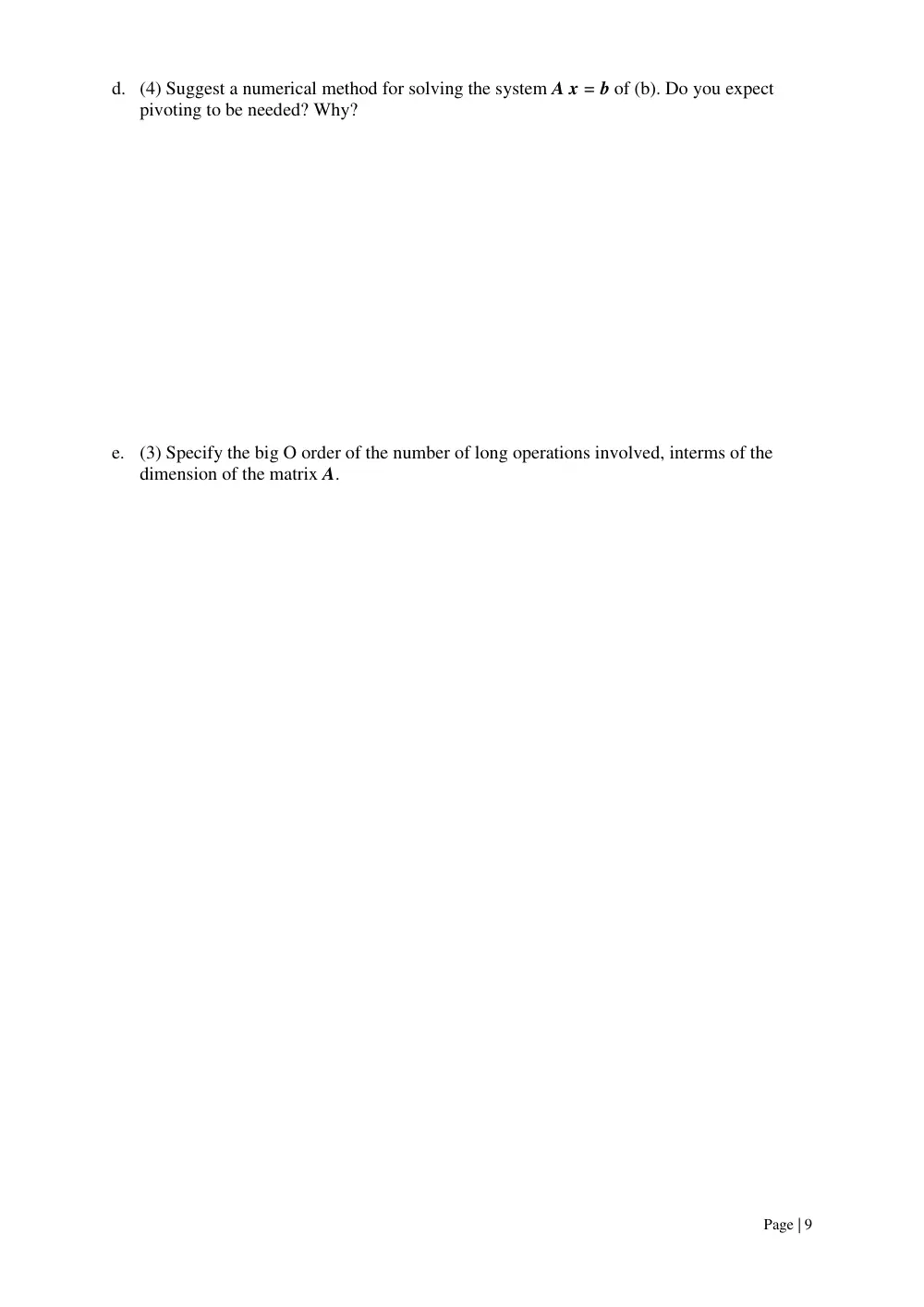
d. (4) Suggest a numerical method for solving the system A x = b of (b). Do you expect
pivoting to be needed? Why?
e. (3) Specify the big O order of the number of long operations involved, interms of the
dimension of the matrix A.
Page | 10
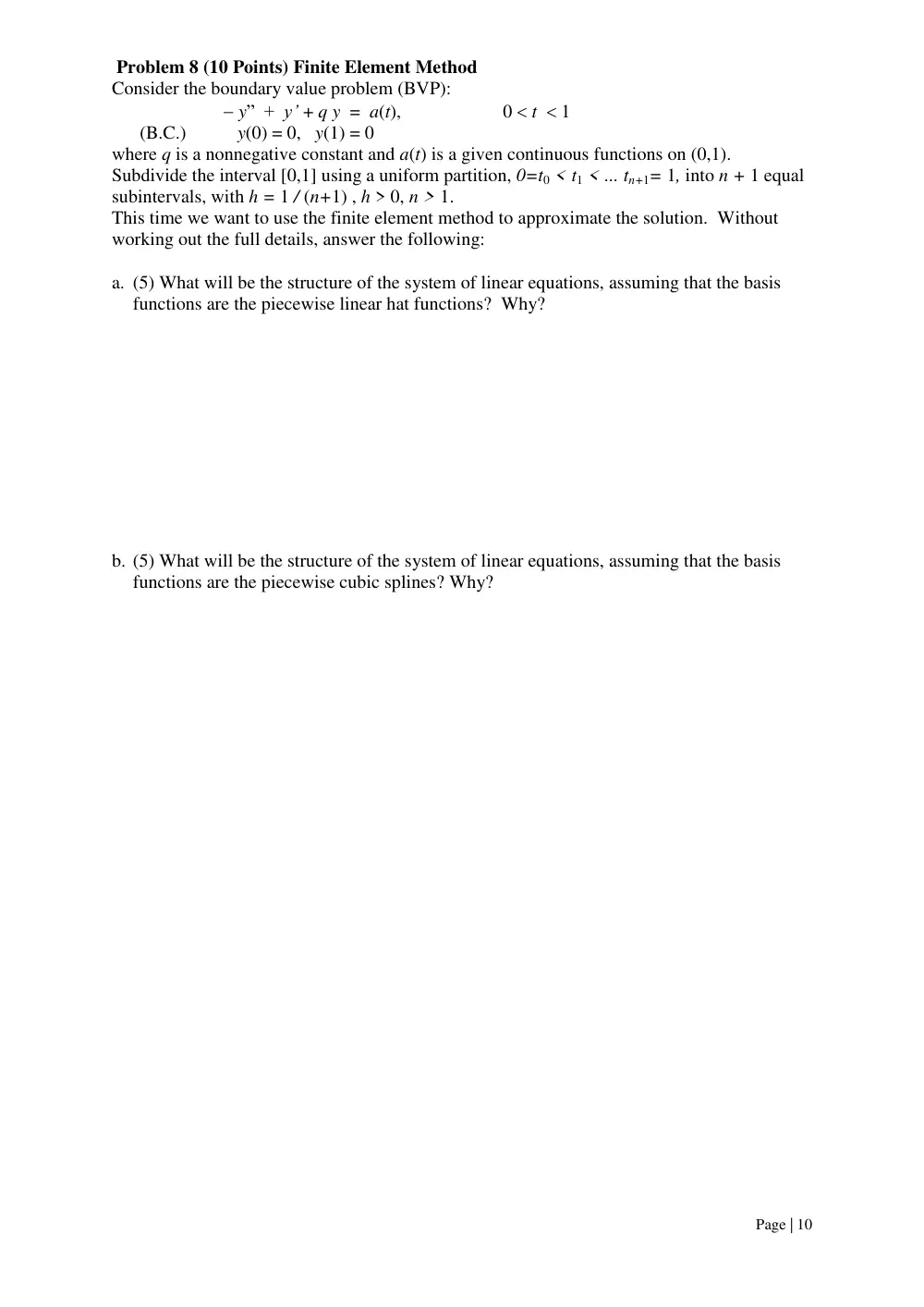
Problem 8 (10 Points) Finite Element Method
Consider the boundary value problem (BVP):
y” + y’ + q y = a(t),
0 t 1
(B.C.)
y(0) = 0, y(1) = 0
where q is a nonnegative constant and a(t) is a given continuous functions on (0,1).
Subdivide the interval [0,1] using a uniform partition, 0=t0 < t1 < ... tn+1= 1, into n + 1 equal
subintervals, with h = 1 / (n+1) , h > 0, n > 1.
This time we want to use the finite element method to approximate the solution. Without
working out the full details, answer the following:
a. (5) What will be the structure of the system of linear equations, assuming that the basis
functions are the piecewise linear hat functions? Why?
b. (5) What will be the structure of the system of linear equations, assuming that the basis
functions are the piecewise cubic splines? Why?