
CMPS 251 Final, Fall 2001
American University of Beirut · Numerical Computing · 4 pages
More CMPS 251 files
Show the text of this final exam
FRICAN CNIVERSIT®
LIBRARY
OF RTEKEY
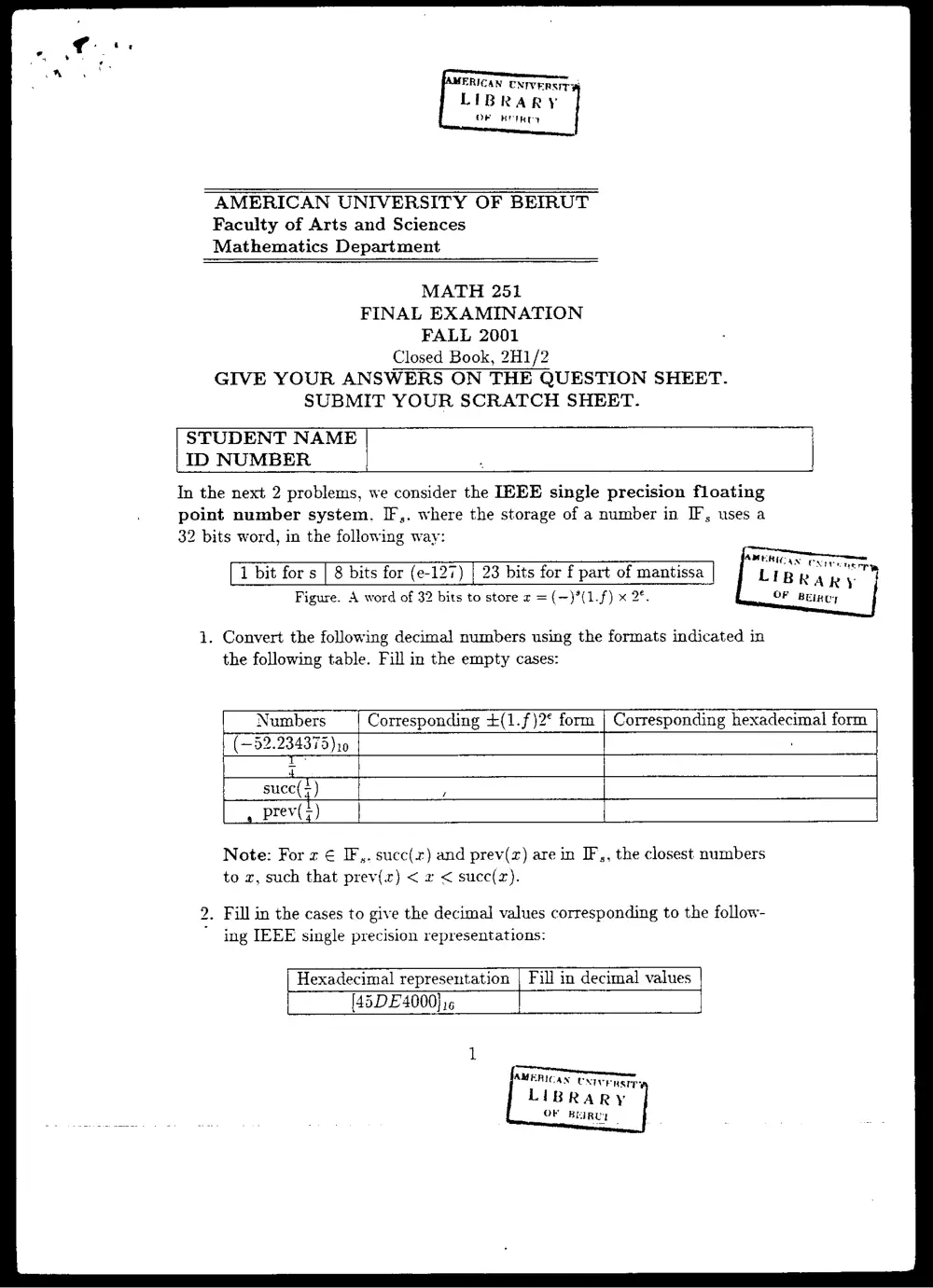
AMERICAN UNIVERSITY OF BEIRUT
Faculty of Arts and Sciences
Mathematics Department
MATH 251
FINAL EXAMINATION
FALL 2001
Closed Book, 2H1/2
GIVE YOUR ANSWERS ON THE QUESTION SHEET.
SUBMIT YOUR SCRATCH SHEET.
STUDENT NAME
ID NUMBER
In the next 2 problems, we consider the IEEE single precision floating
point number system. IF,. where the storage of a number in IF, uses a
32 bits word, in the following way:
1 bit for s | 8 bits for (e-127) | 23 bits for f part of mantissa
Figure. A word of 32 bits to store = (~)*(1.f) « 2°.
1. Convert the following decimal numbers using the formats indicated in
the following table. Fill in the empty cases:
Numbers Corresponding +(1.f)2° form | Corresponding hexadecimal form
(—52.934375)10
a
4
succ(=)
‘ prev(-)
Note: For z € IF,. succ(x) and prev(z) are in IF ,, the closest numbers
to z, such that prev(x) < 2 < suce(z).
. Fill in the cases to give the decimal values corresponding to the follow-
ing IEEE single precision representations:
Hexadecimal representation | Fill in decimal values
[45DE4000)16
OF BuRUY
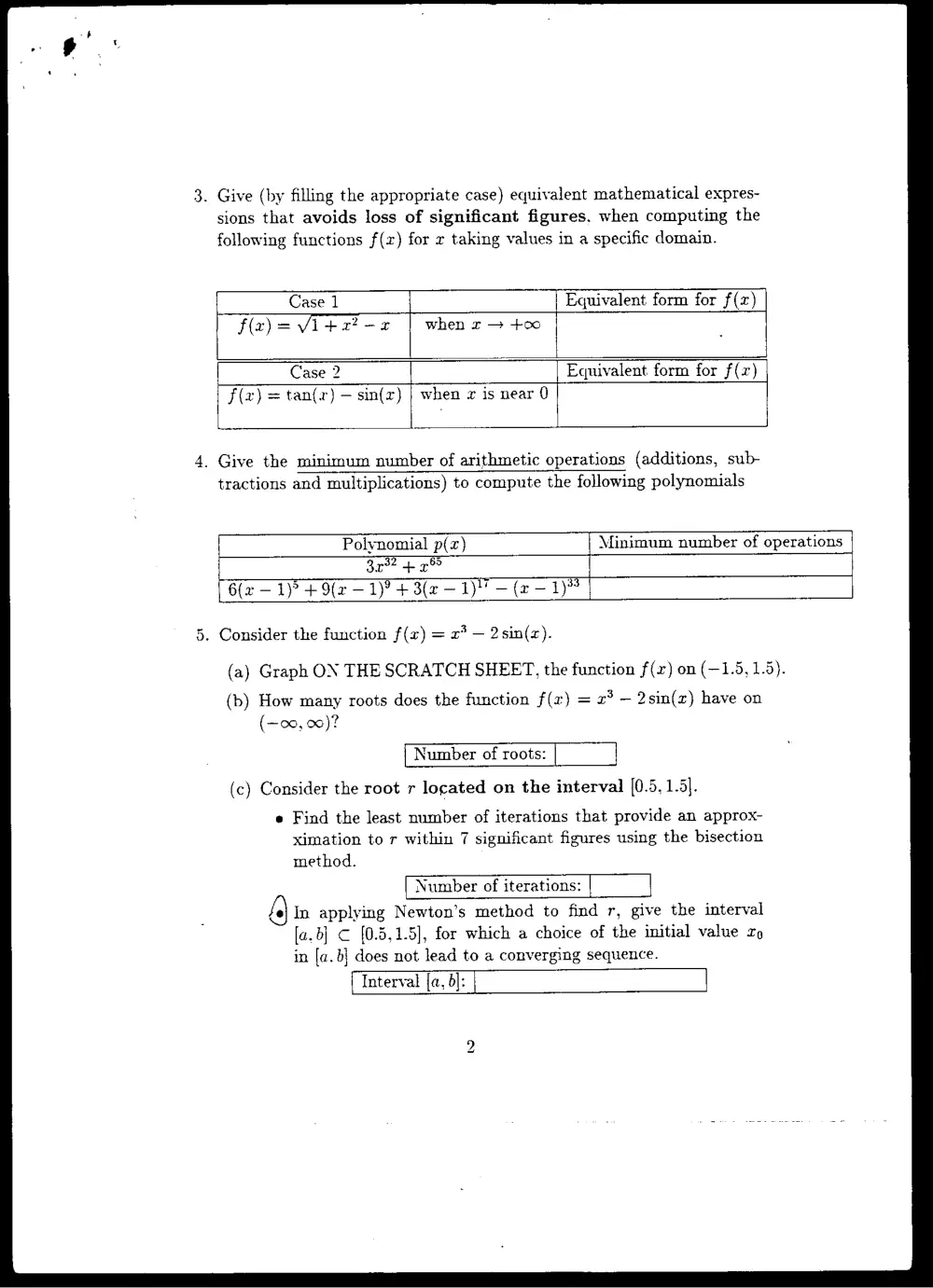
3. Give (by filling the appropriate case) equivalent mathematical expres-
sions that avoids loss of significant figures. when computing the
following functions f(z) for z taking values in a specific domain.
Case 1
Equivalent form for f(z)
f(z) =V1l+2?-2 | when r— +00
Case ?
Equivalent form for f(z)
f(z) = tan(x) — sin(x) | when z is near 0
4. Give the minimum number of arithmetic operations (additions, sub-
tractions and multiplications) to compute the following polynomials
Polynomial p(z)
Minimum number of operations
30%? +
6(@ — 1) + 92 — 1)? + 3(a — 1)" — (x - 1)”
5. Consider the function f(x) = z* — 2sin(z).
(a) Graph ON THE SCRATCH SHEET, the function f(x) on (—1.5, 1.5).
(b) How many roots does the function f(z) = 2° — 2sin(z) have on
(~00, 90)?
Number of roots:
(c) Consider the root r located on the interval [0.5, 1.5].
e Find the least number of iterations that provide an approx-
ximation to r within 7 significant
method.
figures using the bisection
Number of iterations:
& In applying Newton’s method to find r, give the interval
[a,b] C [0.5,1.5], for which a choice of the initial value xo
in [a. 6] does not lead to a converging sequence.
Interval [a, 8]: |
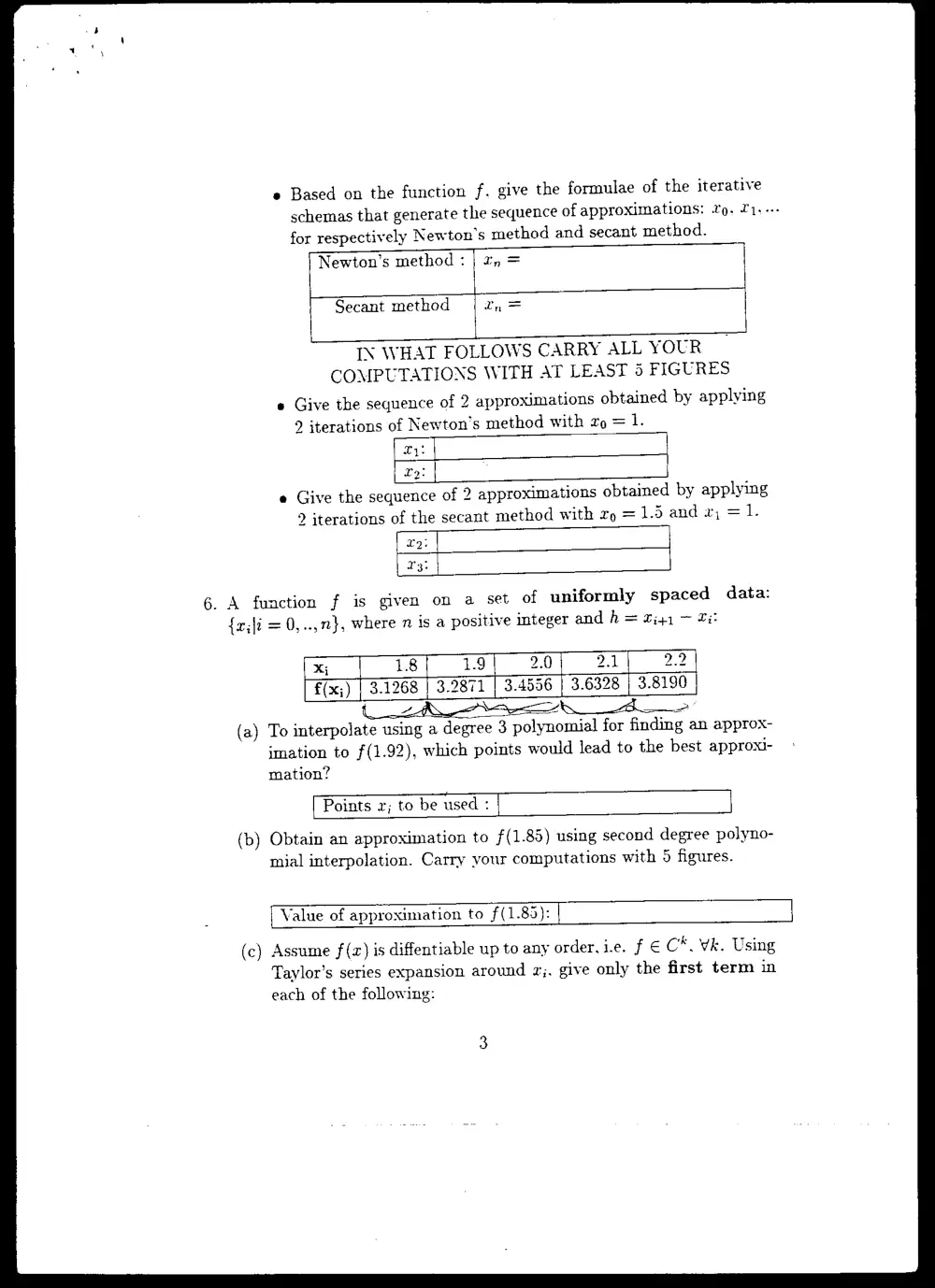
e Based on the function f. give the formulae of the iterative
schemas that generate the sequence of approximations: v9. I1.-..
for respectively Newton's method and secant method.
Newton’s method : | tp =
Secant method rn =
IX WHAT FOLLOWS CARRY ALL YOUR
COMPUTATIONS WITH AT LEAST 5 FIGURES
Give the sequence of 2 approximations obtained by applying
2 iterations of Newton's method with zp = 1.
Zh:
Le:
Give the sequence of 2 approximations obtained by applying
9 iterations of the secant method with rp = 1.5 and2, =1.
2:
3:
6. A function f is given on a set of uniformly spaced data:
{x;}i =0,..,.n}, where n is a positive integer and A = 2i41 — Fit
Xj 18 : 2.0 2.1 2.2
F(x;) | 3.1268 | 3.2871 | 3.4556 3.6328 | 3.8190
ee Sa SS
(a) To interpolate using a degree 3 polynomial for finding an approx-
imation to (1.92), which points would lead to the best approxi-
mation?
Points x; to be used :
(b) Obtain an approximation to f( 1.85) using second degree polyno-
mial interpolation. Carry your computations with 5 figures.
f Value of approximation to f(1.85):
(c) Assume f(z) is diffentiable up to any order, i.e. f € C*. Vk. Using
Taylor’s series expansion around 2;. give only the first term in
each of the following:
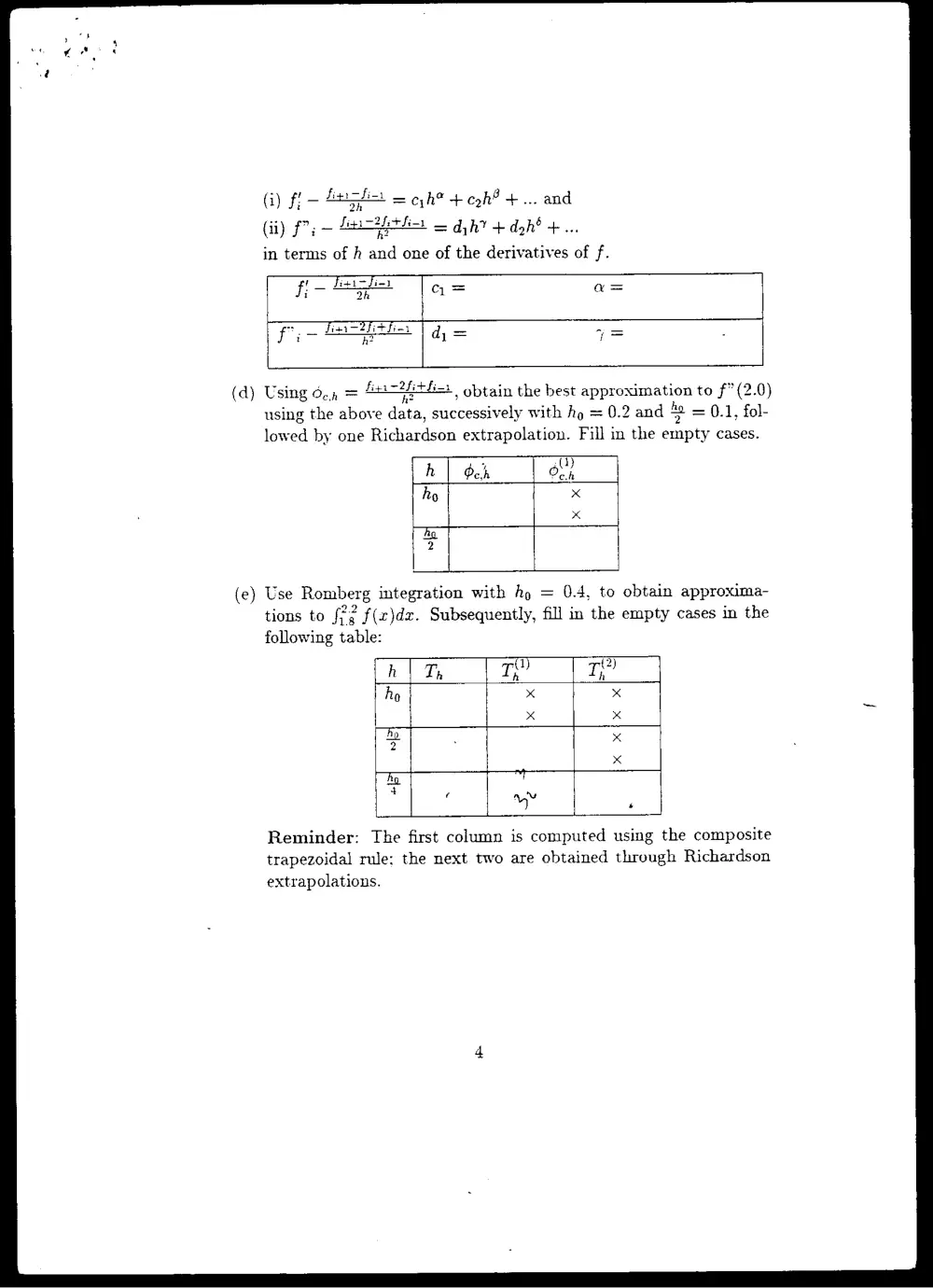
(i) fi _ fhe: = cyh® + coh? +... and
(ii) #7, — eA = dh + hh’ +...
in terms of h and one of the derivatives of f.
? dist fins = =
fi = oh Cy “=
| fi- Fiaa2hE Fo d, =
(d) Using 6., = fan tithion obtain the best approximation to f” (2.0)
using the above data, successively with ho = 0.2 and ho = 0.1, fol-
lowed by one Richardson extrapolation. Fill in the empty cases.
* i
eh oh
x
x
(e) Use Romberg integration with hy = 0.4, to obtain approxima-
tions to R 3 f(x)dz. Subsequently, fill in the empty cases in the
following table:
{1 2
Tr Ww Th”
x *
x
x
x
x
~~
‘ “uy
Reminder: The first column is computed using the composite
trapezoidal rule; the next two are obtained through Richardson
extrapolations.