
CMPS 251 Final, Spring 2002
American University of Beirut · Numerical Computing · 7 pages


More CMPS 251 files
Show the text of this final exam
cee TD
Enh CSIVERS!
LIBRARY
OF BEIRUT
_AMERICAN UNIVERSITY OF BEIRUT
Faculty of Arts and Sciences
Mathematics Department
MATH 251
FINAL EXAM
SPRING 2002/03
Closed Book, Two hours
GIVE YOUR ANSWERS ON THE QUESTION SHEET
SUBMIT WITH BOOKLET
STUDENT NAME
ID NUMBER
Section
ERICAN UNTWERS!
LIBRARY
OF BEIRUT
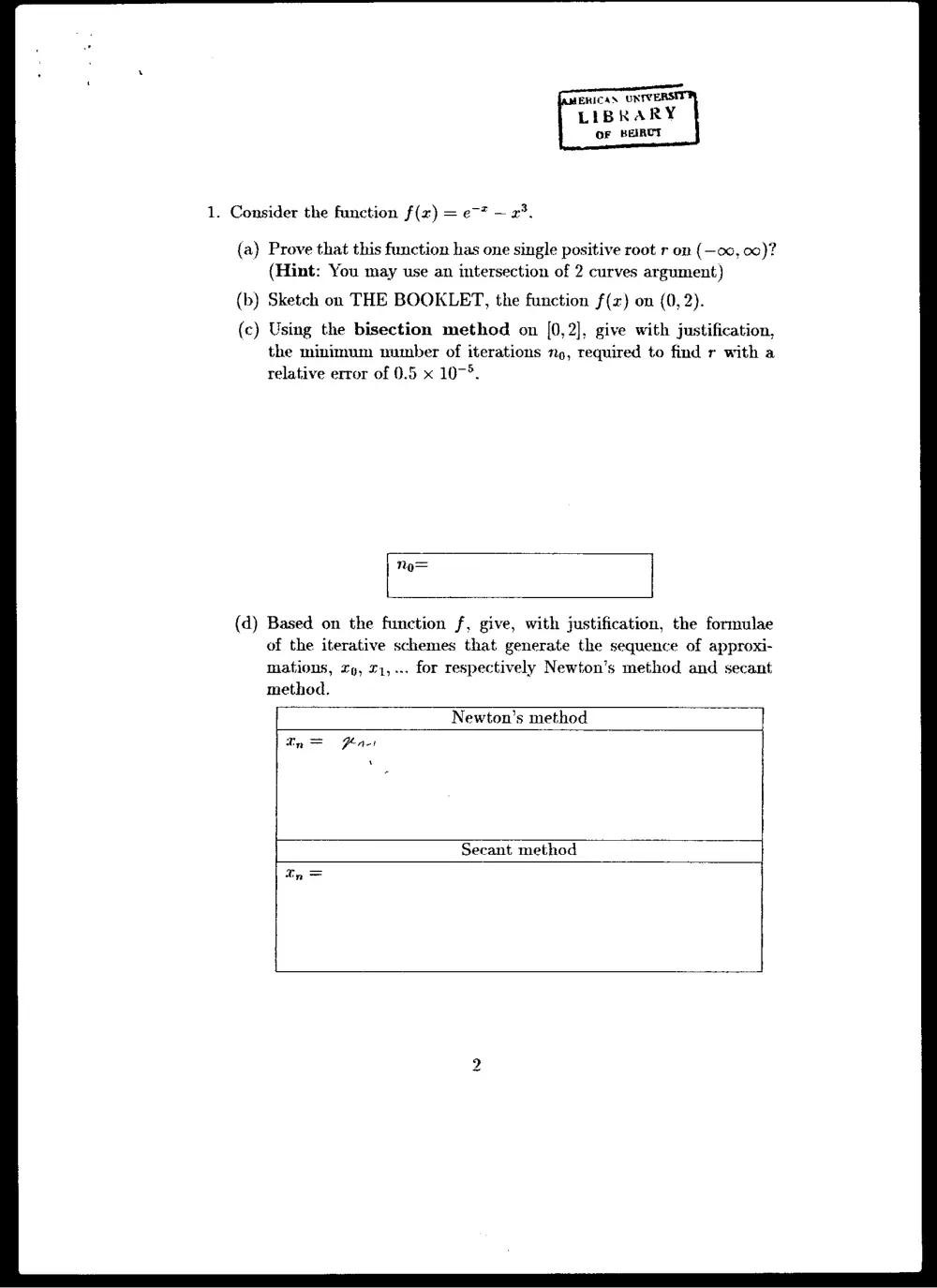
1. Consider the function f(z) = e7* — 23.
(a) Prove that this function has one single positive root r on (—oo, 00)?
(Hint: You may use an intersection of 2 curves argument)
(b) Sketch on THE BOOKLET, the function f(x) on (0,2).
(c) Using the bisection method on [0,2], give with justification,
the minimum number of iterations no, required to find r with a
relative error of 0.5 x 1075.
No=
Based on the function f, give, with justification, the formulae
of the iterative schemes that generate the sequence of approxi-
mations, x9, %1,... for respectively Newton’s method and secant
method.
Newton’s method
Secant method
IN WHAT FOLLOWS CARRY ALL YOUR. COMPUTATIONS
WITH AT LEAST 7 FIGURES
(e) Give the sequence of 3 approximations obtained by applying 3
iterations of Newton’s method with ry = 0.5.
(f} Give the sequence of 2 approximations obtained by applying 2
iterations of the secant method with 29 = 0 and 21 = 1.
Ht
£3:
ERICAN CNIVERS!
LIBRARY
OF BEIRUT
2. To perform Gauss elimination for the following quadridiagonal, di-
agonnaly dominant matrix
dj uy vy OO .. - 0 0
I, dg uw vw 06 - - 0
0 ly dz UZ U3 0 . 0
0 0 & dy wy U4 . 0
0 - 0 1; d;
In-3 d,-2 Un-2 Un-2
0 . 2. ~ |ya daey Un-1
On. 2. OL 0 tir dn
One uses the following algorithm:
for i from 1 to n-1
L=18/d;
dig) = digas — Ui * uy;
if i<n-i
Ui4n = Ui — 1+;
end
end
Give the exact number of floating point operations needed to per-
form this algorithm.
k 5
3. Prove that for k = 1,2,..., 2% = (2°-’)?, then give with justifi-
cation the minimum number of arithmetic operations (additions, sub-
tractions and multiplications) to compute, using nested multiplication,
the following polynomials
Polynomial p(x) Minimum number of arithmetic operations
2F
a > k=1,2,...
3(z — 1)? +(x — 1)
6x3 + 927 4 3x3 — 271
ERICAN UNIVER!
LIBRARY
OF REIROT
4. A function f ic given on a oct of uniformly spaced data:
{x;|i = 0,...n}, where n is a positive integer and h = 241 — 23
Xj 1.8 1.9 2.0 2.1 2.2
f(x;) | 3.1268 | 3.2871 | 3.4556 | 3.6328 | 3.8190
Compute, the approximations of the definite integral J?) f(x)dz, using
the mid-point rectangular, trapezoidal and Simpson rules followed by
Romberg integration, for hy = 0.4, 0.2, 0.1.
Mid-point | Trapezoidal | Simpson rule | First Romberg
M(h) T(h) S(h) Rith)
No fill
5. Let 2, y € IF, be two positive numbers in IF,, the IEEE simple pre-_
cision number system, with
z=m, x 2° and y=m, x 2°,
m, = 14,27! +a,2—24+...+a,2°% and my = 1+b,2714+b.2—2-4...4+6,277,
and
a;,b; € {0,1}, Vi =1,-.-p,
€z,ty ES = {n:-l <n<b},
where S is a set of imtegers.
{a) Specify the set S and the integer p.
p=
h=
=
(b) Given x, specify for what values of y, one has (“absorption” of y
by rt), le r@y=a.