
CMPS 251 Final, Fall 2003
American University of Beirut · Numerical Computing · 8 pages

More CMPS 251 files
Show the text of this final exam
AMERICAN UNIVERSITY OF BEIRUT
Faculty of Arts and Sciences
Computer Science Department
CMPS 251
FINAL EXAM
FALL 2003-2004
Closed Book, Two hours
GIVE YOUR ANSWERS ON THE QUESTION SHEET
SUBMIT WITH BOOKLET
STUDENT NAME
ID NUMBER
fur PNT
EI iak
OF BERLE:
1. In this problem, we consider the following table for the function f(z).
All computations shall be carried out with 8 significant figures.
zi vi
0.000 | 4.000000000000000
0.125 | 3.938461538461539
0.250 | 3.764705882352941
0.375 | 3.506849315068493
0.500 | 3.200000000000000
0.625 | 2.876404494382022
0.750 | 2.560000000000000
0.875 | 2.265486725663717
1.000 | 2.000000000000000
(a) Write the polynomial of degree 3 p(z) that would best approxi-
mate f(0.3). Find p(0.3).
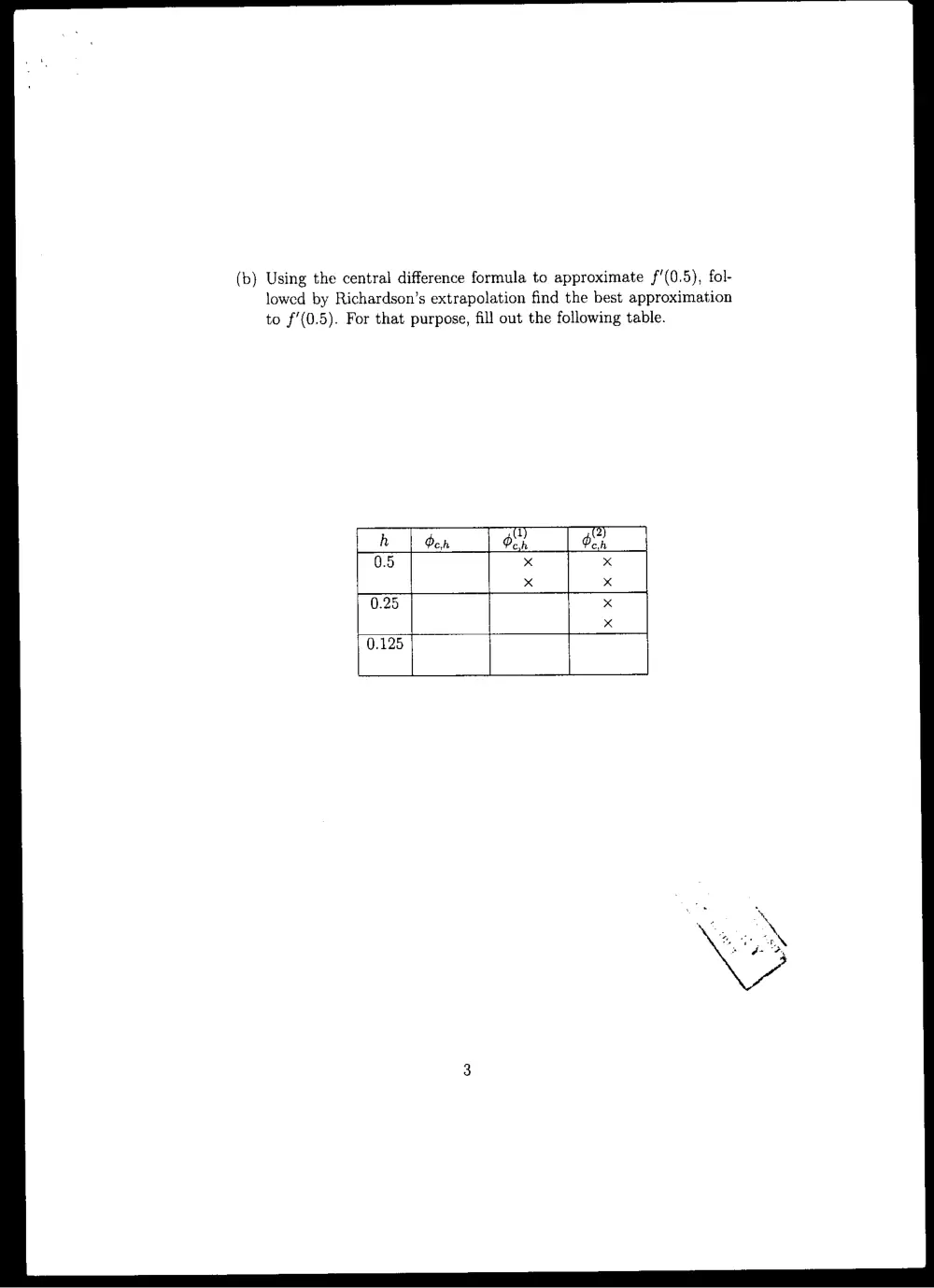
(b) Using the central difference formula to approximate f’(0.5), fol-
lowed by Richardson’s extrapolation find the best approximation
to f’(0.5). For that purpose, fill out the following table.
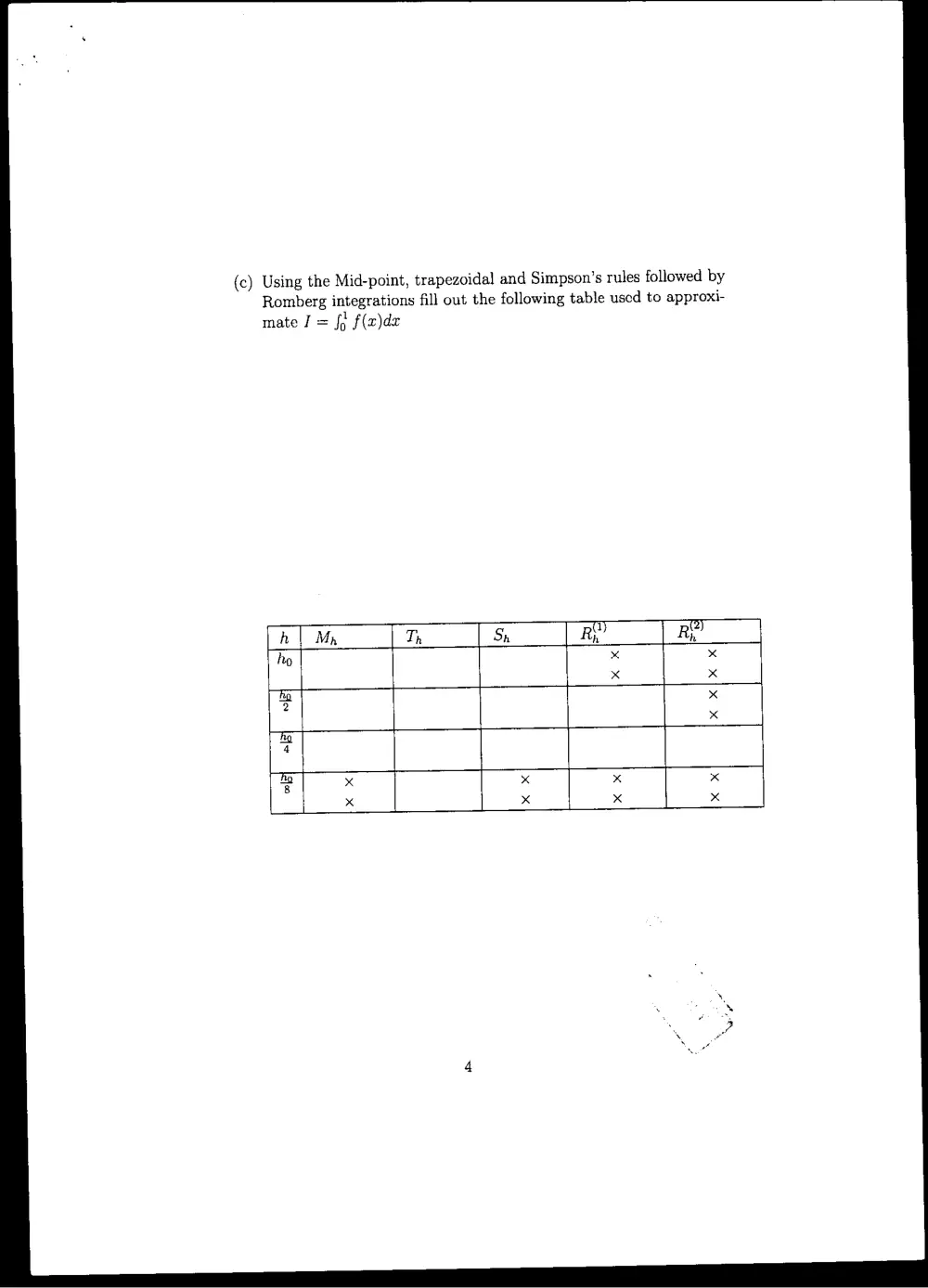
(c) Using the Mid-point, trapezoidal and Simpson’s rules followed by
Romberg integrations fill out the following table used to approxi-
mate I = fj f(x)dz
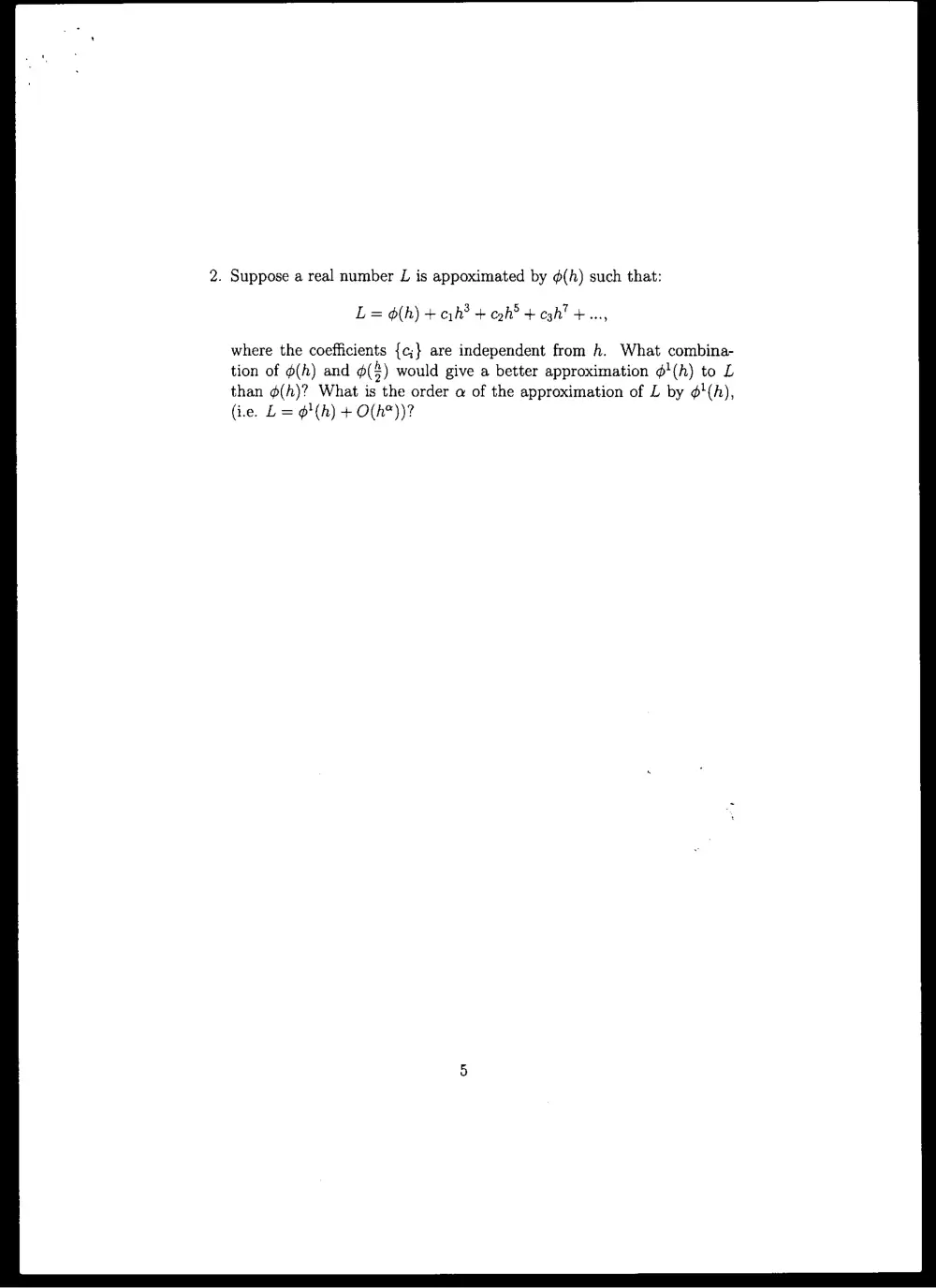
2. Suppose a real number L is appoximated by ¢(h) such that:
L= o(h) + qh? + cgh® + cgh™ +...,
where the coefficients {c;} are independent from h. What combina-
tion of d(h) and ¢(8) would give a better approximation ¢'(h) to L
than $(h)? What is the order a of the approximation of L by ¢'{h),
(ie. L = '(h) + O(h?))?
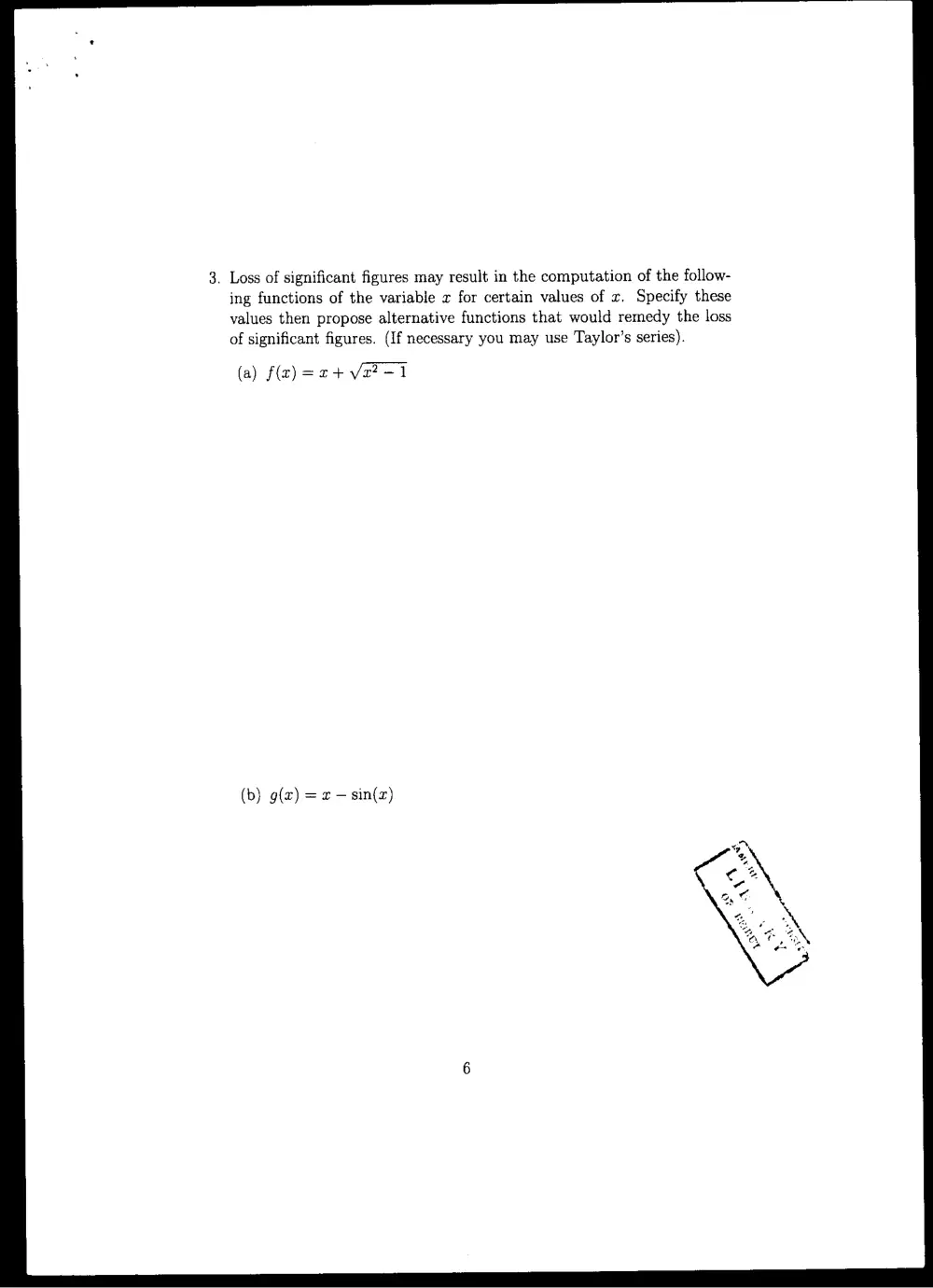
3. Loss of significant figures may result in the computation of the follow-
ing functions of the variable x for certain values of x. Specify these
values then propose alternative functions that would remedy the loss
of significant figures. (If necessary you may use Taylor’s series).
(a) f(t) =ac2+Va2?-1
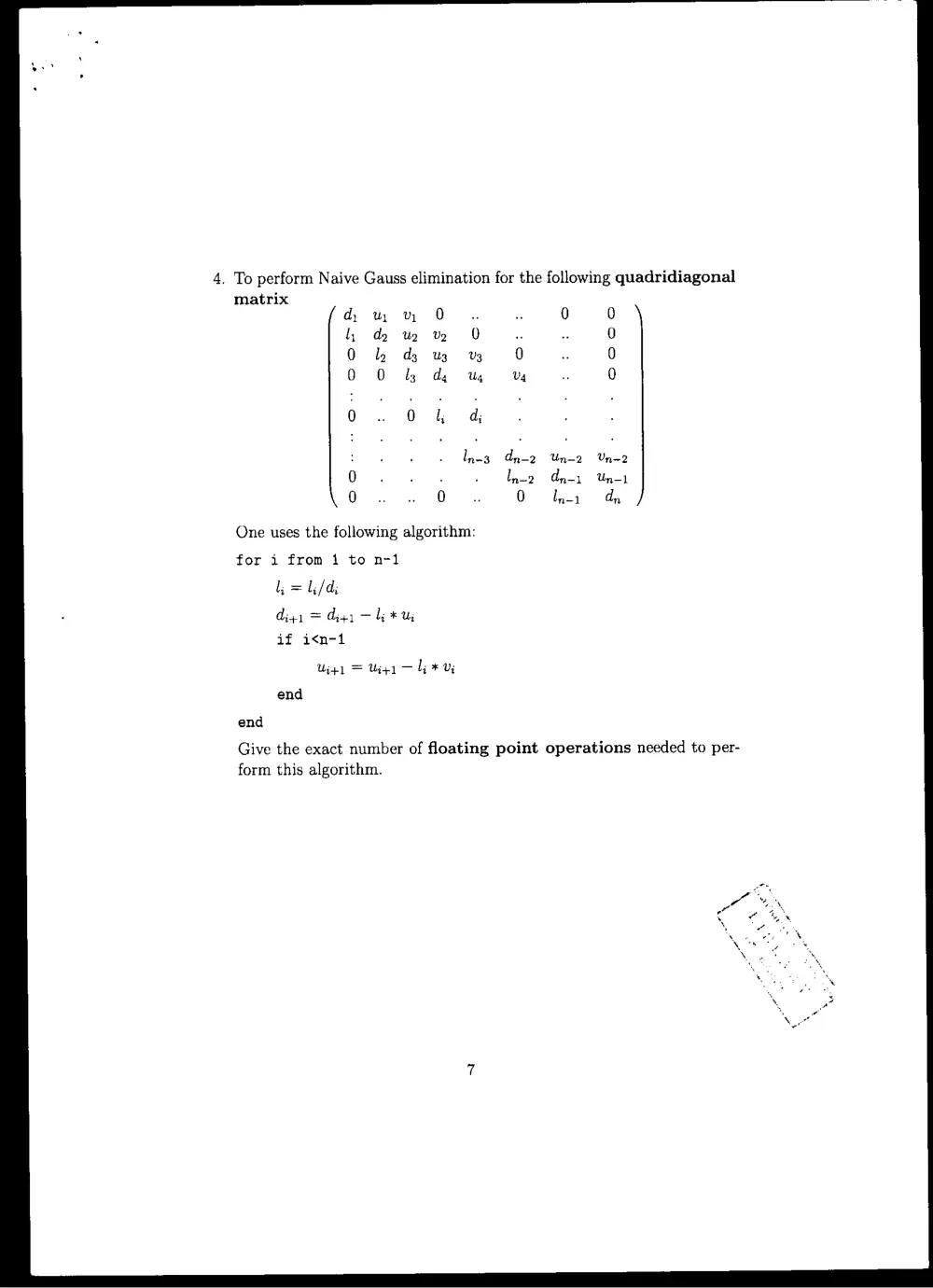
4. To perform Naive Gauss elimination for the following quadridiagonal
matrix
d, Uy Vi . ” 0
ly dy U2
0 bk ad
0 0 k
0
One uses the following algorithm:
for i from 1 to n-1
l, = b/d;
dig. = dig, — li * Ui
if i<n-1
Wiad = Ug — UY * vy
end
end
Give the exact number of floating point operations needed to per-
form this algorithm.
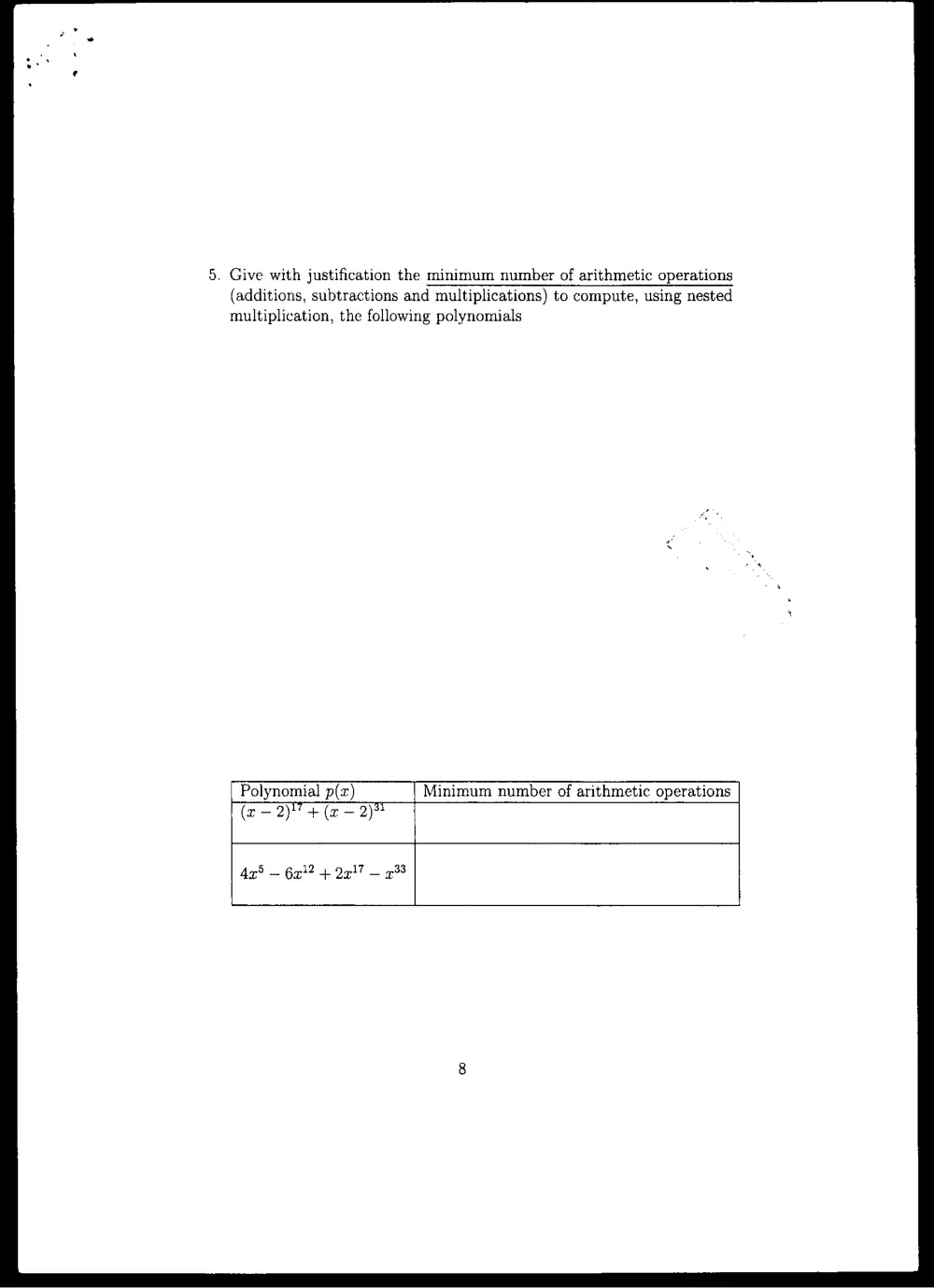
5. Give with justification the minimum number of arithmetic operations
(additions, subtractions and multiplications) to compute, using nested
multiplication, the following polynomials
Polynomial p(x) Minimum number of arithmetic operations
(@— 2) + @— 9
4x5 — 6x}? + Qz)7 — 798