
CMPS 251 Final, Spring 2000
American University of Beirut · Numerical Computing · 2 pages

More CMPS 251 files
Show the text of this final exam
AMERICAN UNIVERSITY OF BEIRUT
Mathematics 251, Final Examination
‘Time = 1 hon and 50 minutes
INSTRUCTIONS: Please, print your name aud 1D number on both the
booklet. aud the quostiou/anuswer sheet.
Yor are allowed to use a calculator aud oue formula sheet.
For the multiple choice part, you CANNOT check more thau one answer. If
you mistakenly checked more than oue auswer, Please, coorect it by writing
“My answer is ——” or you lose all points for that question. GOOD LUCK!
1. Determine an approximation for e/2 using the third degree Taylor
polynomial for ¢” expanded about x = 0. (Round off your answer to 3
places after the clecimal.)
(A) 1.625 (B) 1.646 (C) 1.648 (D) 1.649 (E) 1.666
2. You are to use the bisection alyorithm to determine an approximation
37 ae
to 6. Let r, be the approximation of the root after the n'steps. The
algoritm is applied until the following condition is met:
(1)
Using starting values @ = 1 aud b = 2, determine the muumber of itera- —
tious required
(A) 2 (B) 4 (c) 6 (D) 8 (E) 10
Whiat is the coeflicient of «*?
(A) 0 (B) 2 (C) 4 (D) 6 (E) 8
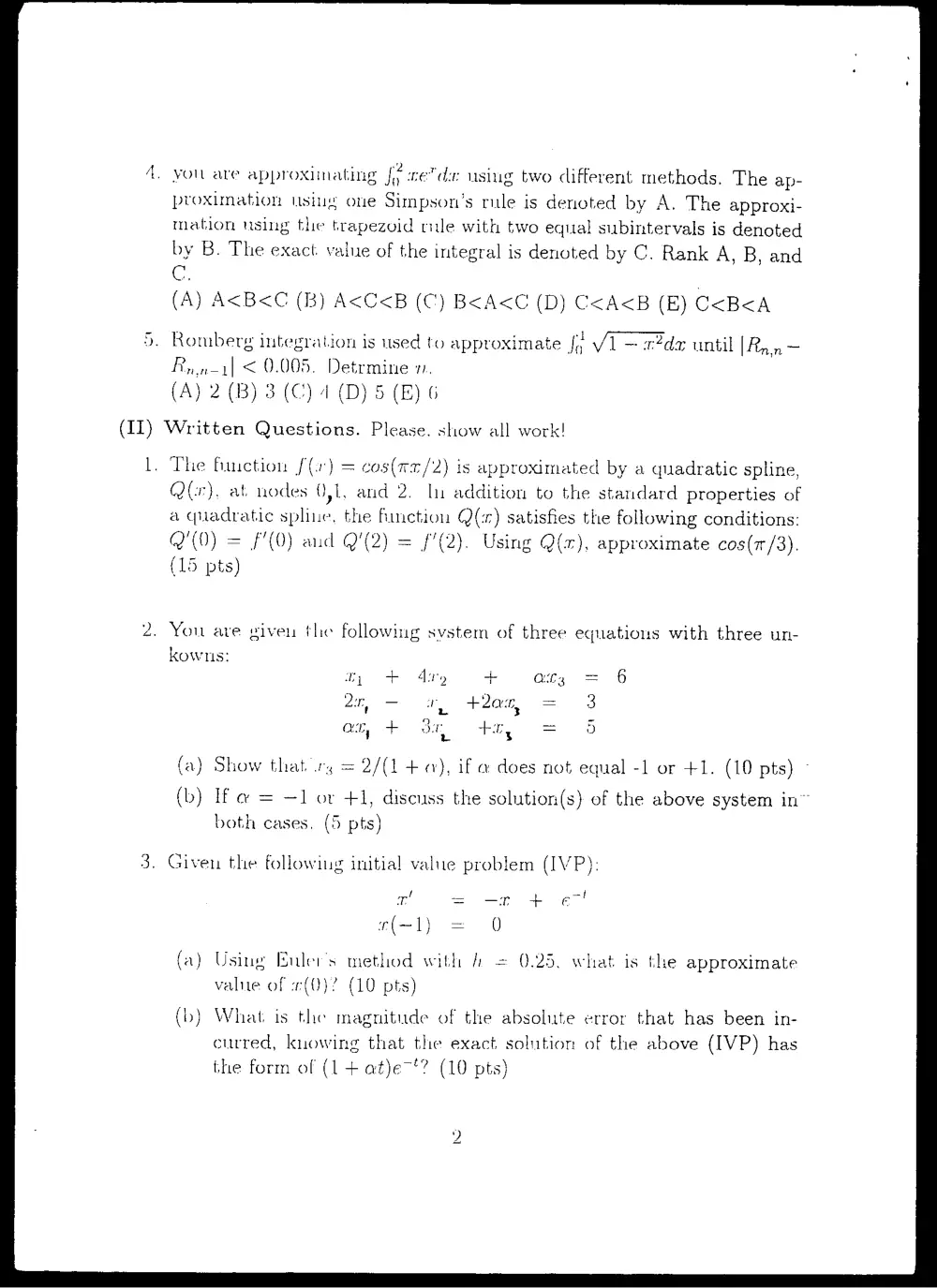
4. youl ave approximating f? rede using two cliffevent methods. The ap-
proximation using oue Simpson's rule is denoted by A. The approxi-
mation using the trapezoid mie with two equal subintervals is denoted
by B. The exact. value of the integral is denoted by C. Rank A, B, and
C.
(A) A<B<C (B) A<C<B (C) B<A<C (D) C<A<B (E) C<B<A
5. Romberg integration is used to approximate fi} /1 — 22d2 until [Ran ~
PRrn-1| < 0.005. Detrmine 1.
(A) 2 (B) 3 (C) 4 (D) 5 (E) 6
(II) Written Questions. Please. show all work!
Ll. The function f(r) = cos(rx/2) is approximated by a quadratic spline,
Qtr), at nodes Q,1, and 2. lu addition to the standard properties of
a quadratic spline. the function Q(s) satishes the following conditions:
Q'(0) = f(O) and Q'(2) = f'(2). Using Q(r), approximate cos(z/3).
{15 pts)
2. You ave given the following systern of three equatious with three un-
kowus:
wy + Ary + ars = 6
Qn ty +2ac, = 3
oO
Oly + on +e, =
a) Show that ry = 2/(1 +), if a does not equal -1 or +1. (10 pts) »
(b) If @ = -1 or +1, discuss the solution(s) of the above system in™
both cases. (5 pts)
3. Given the following initial value problem (IVP):
rw! = -r +e
r(-l) = 0
-1
(a) Using Euler's method with # = 0.25, what is the approximate
value of (0)? (10 pts)
(b) What is the magnitude of the absolute error that has been in-
curred, kuowing that the exact solution of the above (IVP) has
the form of (1+ atje~*? (10 pts)