
CMPS 251 Final, Spring 2001
American University of Beirut · Numerical Computing · 2 pages

More CMPS 251 files
Show the text of this final exam
AMERICAN UNIVERSITY OF BEIRUT
VIATH 251. Final Exam
June 15. 2001
‘Time = 1 Honr and 50 Minnites
Part I: Multiple choice (each question catrics a weieht of 10 points)
(VIP: Checking more than oue auswer 18 considered as a wrong answer!)
1. Given a frmetion (7) which las derivative of infinite order. What does
the following expression,
al —h) a .
Se 2h),
estiinate?
(a) fr) (b) f"Gr) (e) fila) + £" Cr) (ad) Ce) = f(r) (e) none of the
above
2. The integral [! 2"dr is to be approximated by using Romberg method.
What is the value of nsnch that [R(n, 2) — RU.n — 1)| < 0.005.
(a) 1 (b) 2 (c) 3 (d) 4 (e) none of the above
3. Yon are to obtain an approximate solution to the equation: c?—4e+1 =
0. One iteration by the Newton's method is performed, using the initial
approximation vy = 0. resulting in a first approximation, ©. One
iteration of the Secaut method is then performed. using 2o and 7,
as the initial approximations. proditcing au approximate solution, y.
Determine :r2
(aj 3/8 (b) 31/60 (c) -1/2 (a) 1 (e) none of the above
. Given the followings table of data:
|
4
7
[3
a {| 1 |: 3
fo) J2yrfi
4
[2
Using Lagrange interpolating polynomial for the above data, what is
the value of Iq(-2)°
(a) 1 (b) 5 (ce) 1% (a) 35 (e) none of the above
1
+
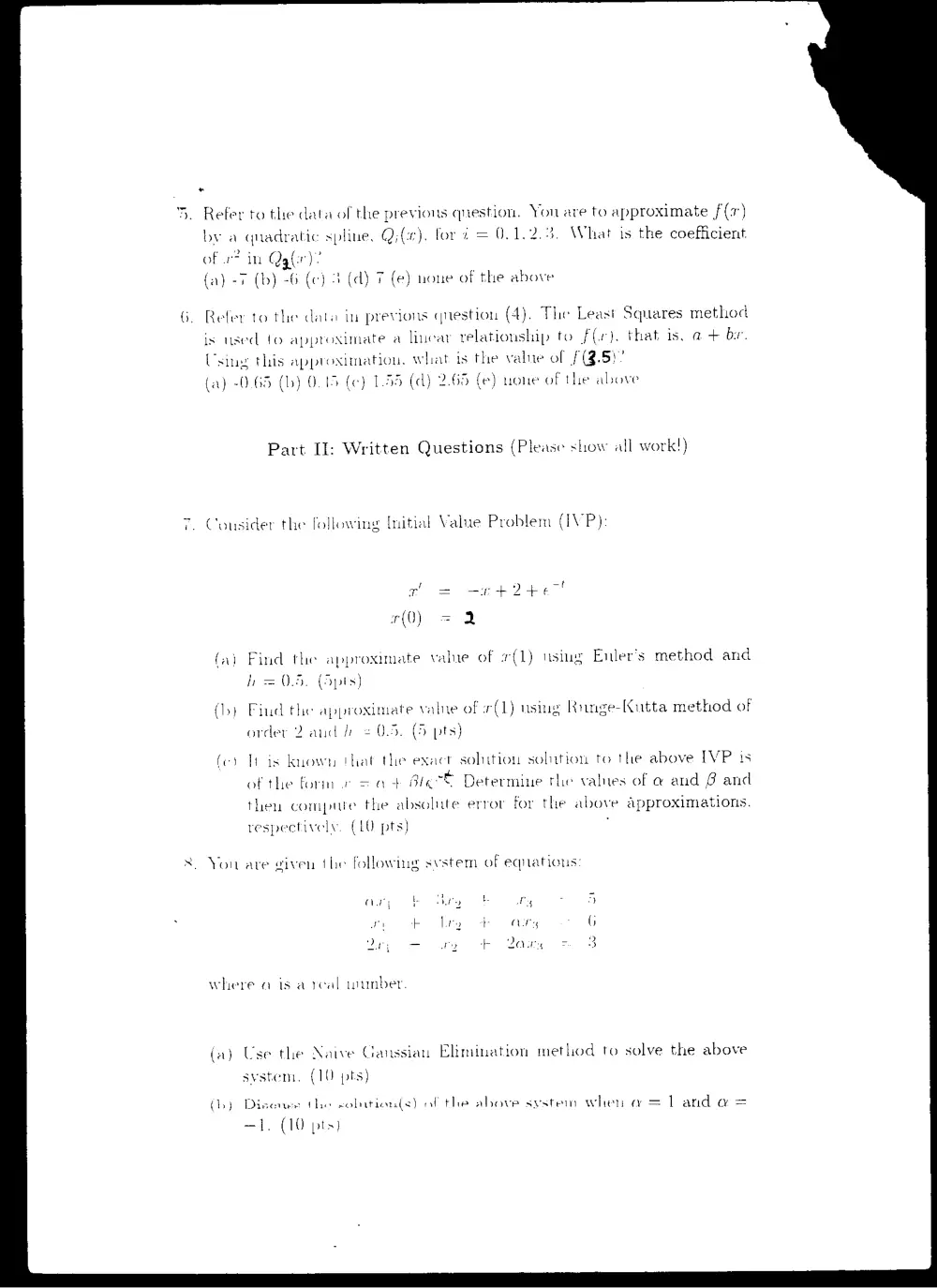
Refer to the data of the previous qnestion. You are to approximate f(s)
2
by a quadratic spline, Q;(r). for 4 = 0.1.2.3. What is the coefficient
of we? in gr)?
(a) -7 (b) -6 (¢) 5 (d) T (e) none of the above
Refer to the data in previons question (4). The Least Squares method
ix used fo approximate a liuear relationship to f(r). that is, a + be.
Using this approximation. what is the value of ((@.5)"
(a) -0.65 (bb) 0.15 (c) 1.54 (d) 2.65 (e) none of the above
Part Il: Written Questions (Please show all work!)
Cousider the following [nitial Value Problem (1\P):
(0)
(ai Find the approximate value of vr(1) usiug Enler’s method and
hes 0.4. (pts)
(hb) Pind the approximate valne of (1) using Runge-Kutta method of
order 2 aud fy = 0.5. (5 pts)
(oy Tis known that the exact soliitiou solution to the above [VP ts
OD
of the form rsa + dle Jetermine the values of a and § and
then compure the absolute errov for the above approximations.
respectively. (LO pts)
X. You are given the following svstem of eqnatious
where @ is a real munber.
(a) Use the Naive Ganssiau Elimination method to solve the above
system. (10 pts)
(bo) Disesue the sobttion(s) af the above system when @ = 1 and a =